"All the World's a Stage We Pass Through" – R. Ayana

Tuesday, 9 June 2015

Really Working: Why You Should Never Get a Job

Really Working
10 Reasons You Should Never Get a Job


1942


by Steve Pavlina


It’s funny that when people reach a certain age, such as after graduating college, they assume it’s time to go out and get a job. But like many things the masses do, just because everyone does it doesn’t mean it’s a good idea. In fact, if you’re reasonably intelligent, getting a job is one of the worst things you can do to support yourself. There are far better ways to make a living than selling yourself into indentured servitude.

Here are some reasons you should do everything in your power to avoid getting a job:


1.  Income for dummies.

Getting a job and trading your time for money may seem like a good idea. There’s only one problem with it. It’s stupid! It’s the stupidest way you can possibly generate income! This is truly income for dummies.

Why is getting a job so dumb? Because you only get paid when you’re working. Don’t you see a problem with that, or have you been so thoroughly brainwashed into thinking it’s reasonable and intelligent to only earn income when you’re working? Have you never considered that it might be better to be paid even when you’re not working? Who taught you that you could only earn income while working? Some other brainwashed employee perhaps?

Don’t you think your life would be much easier if you got paid while you were eating, sleeping, and playing with the kids too? Why not get paid 24/7? Get paid whether you work or not. Don’t your plants grow even when you aren’t tending to them? Why not your bank account?

Who cares how many hours you work? Only a handful of people on this entire planet care how much time you spend at the office. Most of us won’t even notice whether you work 6 hours a week or 60. But if you have something of value to provide that matters to us, a number of us will be happy to pull out our wallets and pay you for it. We don’t care about your time — we only care enough to pay for the value we receive. Do you really care how long it took me to write this article? Would you pay me twice as much if it took me 6 hours vs. only 3?

Non-dummies often start out on the traditional income for dummies path. So don’t feel bad if you’re just now realizing you’ve been suckered. Non-dummies eventually realize that trading time for money is indeed extremely dumb and that there must be a better way. And of course there is a better way. The key is to de-couple your value from your time.

Smart people build systems that generate income 24/7, especially passive income. This can include starting a business, building a web site, becoming an investor, or generating royalty income from creative work. The system delivers the ongoing value to people and generates income from it, and once it’s in motion, it runs continuously whether you tend to it or not. From that moment on, the bulk of your time can be invested in increasing your income (by refining your system or spawning new ones) instead of merely maintaining your income.

This web site [http://www.stevepavlina.com] is an example of such a system. At the time of this writing, it generates about $9000 a month in income for me (update: $40,000 a month as of 10/31/06), and it isn’t my only income stream either. I write each article just once (fixed time investment), and people can extract value from them year after year. The web server delivers the value, and other systems (most of which I didn’t even build and don’t even understand) collect income and deposit it automatically into my bank account. It’s not perfectly passive, but I love writing and would do it for free anyway. But of course it cost me a lot of money to launch this business, right? Um, yeah, $9 is an awful lot these days (to register the domain name). Everything after that was profit.

Sure it takes some upfront time and effort to design and implement your own income-generating systems. But you don’t have to reinvent the wheel — feel free to use existing systems like ad networks and affiliate programs. Once you get going, you won’t have to work so many hours to support yourself. Wouldn’t it be nice to be out having dinner with your spouse, knowing that while you’re eating, you’re earning money? If you want to keep working long hours because you enjoy it, go right ahead. If you want to sit around doing nothing, feel free. As long as your system continues delivering value to others, you’ll keep getting paid whether you’re working or not.

Your local bookstore is filled with books containing workable systems others have already designed, tested, and debugged. Nobody is born knowing how to start a business or generate investment income, but you can easily learn it. How long it takes you to figure it out is irrelevant because the time is going to pass anyway. You might as well emerge at some future point as the owner of income-generating systems as opposed to a lifelong wage slave. This isn’t all or nothing. If your system only generates a few hundred dollars a month, that’s a significant step in the right direction.


2. Limited experience.

You might think it’s important to get a job to gain experience. But that’s like saying you should play golf to get experience playing golf. You gain experience from living, regardless of whether you have a job or not. A job only gives you experience at that job, but you gain ”experience” doing just about anything, so that’s no real benefit at all. Sit around doing nothing for a couple years, and you can call yourself an experienced meditator, philosopher, or politician.

The problem with getting experience from a job is that you usually just repeat the same limited experience over and over. You learn a lot in the beginning and then stagnate. This forces you to miss other experiences that would be much more valuable. And if your limited skill set ever becomes obsolete, then your experience won’t be worth squat. In fact, ask yourself what the experience you’re gaining right now will be worth in 20-30 years. Will your job even exist then?

Consider this. Which experience would you rather gain? The knowledge of how to do a specific job really well — one that you can only monetize by trading your time for money – or the knowledge of how to enjoy financial abundance for the rest of your life without ever needing a job again? Now I don’t know about you, but I’d rather have the latter experience. That seems a lot more useful in the real world, wouldn’t you say?


3. Lifelong domestication.

Getting a job is like enrolling in a human domestication program. You learn how to be a good pet.

Look around you. Really look. What do you see? Are these the surroundings of a free human being? Or are you living in a cage for unconscious animals? Have you fallen in love with the color beige?

How’s your obedience training coming along? Does your master reward your good behavior? Do you get disciplined if you fail to obey your master’s commands?

Is there any spark of free will left inside you? Or has your conditioning made you a pet for life?

Humans are not meant to be raised in cages. You poor thing…


4. Too many mouths to feed.

Employee income is the most heavily taxed there is. In the USA you can expect that about half your salary will go to taxes. The tax system is designed to disguise how much you’re really giving up because some of those taxes are paid by your employer, and some are deducted from your paycheck. But you can bet that from your employer’s perspective, all of those taxes are considered part of your pay, as well as any other compensation you receive such as benefits. Even the rent for the office space you consume is considered, so you must generate that much more value to cover it. You might feel supported by your corporate environment, but keep in mind that you’re the one paying for it.

Another chunk of your income goes to owners and investors. That’s a lot of mouths to feed.

It isn’t hard to understand why employees pay the most in taxes relative to their income. After all, who has more control over the tax system? Business owners and investors or employees?

You only get paid a fraction of the real value you generate. Your real salary may be more than triple what you’re paid, but most of that money you’ll never see. It goes straight into other people’s pockets.

What a generous person you are!


5. Way too risky.

Many employees believe getting a job is the safest and most secure way to support themselves.

Morons.

Social conditioning is amazing. It’s so good it can even make people believe the exact opposite of the truth.

Does putting yourself in a position where someone else can turn off all your income just by saying two words (“You’re fired”) sound like a safe and secure situation to you? Does having only one income stream honestly sound more secure than having 10?

The idea that a job is the most secure way to generate income is just silly. You can’t have security if you don’t have control, and employees have the least control of anyone. If you’re an employee, then your real job title should be professional gambler.


6. Having an evil bovine master.

When you run into an idiot in the entrepreneurial world, you can turn around and head the other way. When you run into an idiot in the corporate world, you have to turn around and say, “Sorry, boss.”

Did you know that the word boss comes from the Dutch word baas, which historically means master? Another meaning of the word boss is “a cow or bovine.” And in many video games, the boss is the evil dude that you have to kill at the end of a level.

So if your boss is really your evil bovine master, then what does that make you? Nothing but a turd in the herd.

Who’s your daddy?


7. Begging for money.

When you want to increase your income, do you have to sit up and beg your master for more money? Does it feel good to be thrown some extra Scooby Snacks now and then?

Or are you free to decide how much you get paid without needing anyone’s permission but your own?

If you have a business and one customer says “no” to you, you simply say “next.”


8. An inbred social life.

Many people treat their jobs as their primary social outlet. They hang out with the same people working in the same field. Such incestuous relations are social dead ends. An exciting day includes deep conversations about the company’s switch from Sparkletts to Arrowhead, the delay of Microsoft’s latest operating system, and the unexpected delivery of more Bic pens. Consider what it would be like to go outside and talk to strangers. Ooooh… scary! Better stay inside where it’s safe.

If one of your co-slaves gets sold to another master, do you lose a friend? If you work in a male-dominated field, does that mean you never get to talk to women above the rank of receptionist? Why not decide for yourself whom to socialize with instead of letting your master decide for you? Believe it or not, there are locations on this planet where free people congregate. Just be wary of those jobless folk — they’re a crazy bunch!


9. Loss of freedom.

It takes a lot of effort to tame a human being into an employee. The first thing you have to do is break the human’s independent will. A good way to do this is to give them a weighty policy manual filled with nonsensical rules and regulations. This leads the new employee to become more obedient, fearing that s/he could be disciplined at any minute for something incomprehensible. Thus, the employee will likely conclude it’s safest to simply obey the master’s commands without question. Stir in some office politics for good measure, and we’ve got a freshly minted mind slave.

As part of their obedience training, employees must be taught how to dress, talk, move, and so on. We can’t very well have employees thinking for themselves, now can we? That would ruin everything.

God forbid you should put a plant on your desk when it’s against the company policy. Oh no, it’s the end of the world! Cindy has a plant on her desk! Summon the enforcers! Send Cindy back for another round of sterility training!

Free human beings think such rules and regulations are silly of course. The only policy they need is: “Be smart. Be nice. Do what you love. Have fun.”


10. Becoming a coward.

Have you noticed that employed people have an almost endless capacity to whine about problems at their companies? But they don’t really want solutions – they just want to vent and make excuses why it’s all someone else’s fault. It’s as if getting a job somehow drains all the free will out of people and turns them into spineless cowards. If you can’t call your boss a jerk now and then without fear of getting fired, you’re no longer free. You’ve become your master’s property.

When you work around cowards all day long, don’t you think it’s going to rub off on you? Of course it will. It’s only a matter of time before you sacrifice the noblest parts of your humanity on the altar of fear: first courage… then honesty… then honor and integrity… and finally your independent will. You sold your humanity for nothing but an illusion. And now your greatest fear is discovering the truth of what you’ve become.

I don’t care how badly you’ve been beaten down. It is never too late to regain your courage. Never!


Still want a job?

If you’re currently a well-conditioned, well-behaved employee, your most likely reaction to the above will be defensiveness. It’s all part of the conditioning. But consider that if the above didn’t have a grain of truth to it, you wouldn’t have an emotional reaction at all. This is only a reminder of what you already know. You can deny your cage all you want, but the cage is still there. Perhaps this all happened so gradually that you never noticed it until now… like a lobster enjoying a nice warm bath.

If any of this makes you mad, that’s a step in the right direction. Anger is a higher level of consciousness than apathy, so it’s a lot better than being numb all the time. Any emotion — even confusion — is better than apathy. If you work through your feelings instead of repressing them, you’ll soon emerge on the doorstep of courage. And when that happens, you’ll have the will to actually do something about your situation and start living like the powerful human being you were meant to be instead of the domesticated pet you’ve been trained to be.


Happily jobless

What’s the alternative to getting a job? The alternative is to remain happily jobless for life and to generate income through other means. Realize that you earn income by providing value — not time – so find a way to provide your best value to others, and charge a fair price for it. One of the simplest and most accessible ways is to start your own business. Whatever work you’d otherwise do via employment, find a way to provide that same value directly to those who will benefit most from it. It takes a bit more time to get going, but your freedom is easily worth the initial investment of time and energy. Then you can buy your own Scooby Snacks for a change.

And of course everything you learn along the way, you can share with others to generate even more value. So even your mistakes can be monetized.

One of the greatest fears you’ll confront is that you may not have any real value to offer others. Maybe being an employee and getting paid by the hour is the best you can do. Maybe you just aren’t worth that much. That line of thinking is all just part of your conditioning. It’s absolute nonsense. As you begin to dump such brainwashing, you’ll soon recognize that you have the ability to provide enormous value to others and that people will gladly pay you for it. There’s only one thing that prevents you from seeing this truth — fear.

All you really need is the courage to be yourself. Your real value is rooted in who you are, not what you do. The only thing you need actually do is express your real self to the world. You’ve been told all sort of lies as to why you can’t do that. But you’ll never know true happiness and fulfillment until you summon the courage to do it anyway.

The next time someone says to you, “Get a job,” I suggest you reply as Curly did: ”No, please… not that! Anything but that!” Then poke him right in the eyes.

You already know deep down that getting a job isn’t what you want. So don’t let anyone try to tell you otherwise. Learn to trust your inner wisdom, even if the whole world says you’re wrong and foolish for doing so. Years from now you’ll look back and realize it was one of the best decisions you ever made.


Why We Work: Are We Just Working for Work’s Sake?


We don't live to work; we work to live.


It’s easy to forget that we weren’t put on this planet to punch a clock. Do you remember why you work a job in the first place?


It can be hard to remember that we don’t live to work. Cultural pressure is high to have a good job, and to work hard in that job to get a better job. To make more money so we can buy more stuff. To work the hardest and sacrifice the most.

We stigmatize leisure as the mark of someone who won’t get far in life. We furrow our brows disapprovingly at the high school graduate who wants to take a year or two off before deciding what to study in college (or whether they should go at all). We look down on the smart kid who works a part-time job because he’s “not living up to his potential.”

But what does all that really mean? Do leisure time, taking a break to find yourself, and working just hard enough to get by really signify a problem? Or are we uncomfortable with the idea of valuing something else over work?

It can feel a lot like the latter in most cases.

But here’s the thing:

We don’t live to work.

We work to live.


What are you working for?


We Work to Have Freedom

When I was eleven, I wanted a Nintendo 64 in the worst way. But at $200, my chances were slim. I got a weekly allowance of $10, so by my estimation it would be a thousand years before I’d saved up enough to buy one.

I had to beg my parents and promise that they’d never have to buy me anything ever again1 in order to get one.

When I was 14 I got my first job washing dishes at a local restaurant. My first paycheck blew me away: I’d made over $160 in just two weeks!2

When the next gaming console rolled out, I didn’t have to beg anyone for it — I could buy it with my own money.

The freedom that I felt when I made my first big purchase with money I’d earned at my job was intoxicating. I knew I never wanted to be stuck begging for the things I wanted again.


Work Shouldn’t Rob Us of Freedom


We work to remove the limitations that exist when we can’t afford to do the things we want and need. Income gives us the ability to choose what’s best for ourselves, rather than being beholden to someone in a position of power over us.

If we let work become the dominant force in our lives, we start to give away that same freedom we’ve worked to gain. Only this time it’s not a shortage of income that shackles us, but a shortage of time.

If we’re trading our freedom for higher wages, or for career advancement, or for anything at all, really, we’re actively undermining one of the core principles of work: we work so we have the freedom to choose.


We Work to Have Purpose

I recently visited the Elephant Nature Park, run by Lek Chailert, a tiny woman with a deep reverence for elephants who grew up in a rural part of Thailand.

As an adult, she works hard to rescue abused, disabled, and unwanted domesticated elephants and raise awareness about the rapidly disappearing elephant population and mistreatment of elephants as livestock.

She’s found purpose in her work — or maybe it’s better to say she found work in her purpose. It’s clear that she finds her work incredibly important and fulfilling.

Even if our work isn’t our main purpose, it provides a means to pursue that purpose. To quote the words of modern-day philosopher Jay-Z:

I can’t help the poor if I’m one of them
So I got rich and gave back, to me that’s the win/win
-      Jay-Z, Moment of Clarity


Work Shouldn’t Rob Us of Purpose


By working, we create the opportunity for ourselves to apply time, money, and effort on the things that we think are most important in life.

When we let work spill over into our personal lives, the means to pursue our passions begins to diminish. We don’t have the energy to go after the things that we used to consider most important — we’re too exhausted from working, too preoccupied with meaningless metrics, or too worried about moving up the corporate ladder.

When we let our work displace our purpose, we start to lose steam, and the results can be disastrous: midlife crises, depression, a sense of purposelessness.


Work Is a Tool, Not a Burden

We work because we want to live better lives, and to do that we need to have a way to make an income. For most of us, that means a job.

Work is a tool that gives us access to meet our needs and fulfill our various wants. And when it’s treated like a tool, we’re able to control our efforts in a way that creates a better life for ourselves and our loved ones.

But if we lose sight of what’s important to us, work can become the sole focus in our lives — it’s no longer a tool, it’s a burden that prevents us from doing what we want to do.

We have to remember that we weren’t put on this planet to punch a clock and die on a pile of money; we were put here to live.

So repeat after me:

We don’t live to work.

We work to live.


What’s Next?

If you’re like me, the idea of traveling permanently while making a living probably seems like a dream. . .but you don’t think you can pull it off.

I felt that way right up until I actually boarded a flight to leave the United States. And now I can’t believe I didn’t start living this life sooner.

I want to help you avoid my mistake: you can start living the life of your dreams right now. And I’ve put together a free step-by-step guide to show you how.

Click here to get the free guide.


From Jason Lengstorf @ http://lengstorf.com/work-to-live/


The Old Models of Work Are Broken


charles hugh smithby Charles Hugh Smith


The only sustainable way to avoid being commoditized is to learn to create value in ways that cannot be commoditized.


Though we are still in the early stages of web-enabled automation, it's already evident that the old models of work are broken--though few are willing to admit it.The primary model of work is being an employee in a hierarchy--Corporate America or the state (government) or a government-funded industry (defense, higher education, R&D, Medicare, etc.)


The foundation of employee financial security is the paycheck, which is earned for 1) showing up and 2) following orders.


In the employee model, ownership is generally limited to those with stock options. Those working for start-ups that successfully go public can cash in their options for extraordinary profits; those working for start-ups that fizzle can use their expired options as bathroom wallpaper.


The conventional employee gets no ownership of their work, and this disconnect between the employee and the value created by the employee's labor is the source of Marx's definition of alienation: the worker is alienated from the output of his/her labor, which is owned by others.


In the new model of work, the worker has ownership of his/her work and human capital. Security in the new model flows not from dependence on an employer but on ownership of the entire process of value creation which includes the social and human capital of skills, collaboration, accountability and creativity.


As Gordon Long and I discuss in this program on the changing nature of work, in the new model:


  Each participant creates the work and owns the value proposition


  Innovation and collaboration are paramount


Innovation, blah, blah, blah, right? Yes, the word is terribly over-used, but the point is to avoid commodification. Whatever tasks can be reduced to input, processes and output can be automated or done anywhere, i.e. the task is a commodity that can be performed by interchangeable workers.


If the work can be performed by interchangeable workers, why pay a premium for labor in the U.S. Japan and Europe?


The only sustainable way to avoid being commoditized is to learn to create value in ways that cannot be commoditized. That's the point of collaboration, accountability and innovation: software and robots are superb at repeating specified processes. Figuring out human emotions and markets and combining insights from different fields--not so much. Those still require human learning, communication, collaboration and ingenuity.


Try programming a robot to navigate a flower bed on uneven ground, remove the rotten boards in a staircase and replace them with the appropriate type of lumber.Perhaps a robot will be able to do this cheaper than a human some day, but that day is not yet here. Being able to apply a variety of skills to ambiguous real-world problems is another set of skills that cannot be commoditized.


It's tempting to pine for the days when just showing up and doing routine work was enough to earn a middle-class paycheck, but that's no different than sighing wistfully for the days when making buggy whips and shoveling horse manure off the streets were common jobs: those days are gone.


Any employer who pays humans to do work that can be automated or performed elsewhere for a fraction of the cost will soon go broke as competitors eat his/her lunch. Employers that want to survive recessions and competition can only pay for the value their employees create in the marketplace. Consumers don't pay for blue sky, and so neither can employers.


The government is currently immune to such pressures, but since the state is itself dependent on taxes skimmed from profits and wages, the erosion of the old model means the state's revenues are doomed to shrink right along with profits and wages.


No sector will be immune to the changing nature of work and value creation.


There is much more on the topic in the video program (31:55):


For more information about freedom see http://nexusilluminati.blogspot.com/search/label/freedom
For more information about wage slavery see http://nexusilluminati.blogspot.com/search/label/wage%20slaves
- Scroll down through ‘Older Posts’ at the end of each section


Hope you like this not for profit site -
It takes hours of work every day by a genuinely incapacitated invalid to maintain, write, edit, research, illustrate and publish this website from a tiny cabin in a remote forest
Like what we do? Please give anything you can -  
Contribute any amount and receive at least one New Illuminati eBook!
(You can use a card securely if you don’t use Paypal)
Please click below -


Spare Bitcoin change?


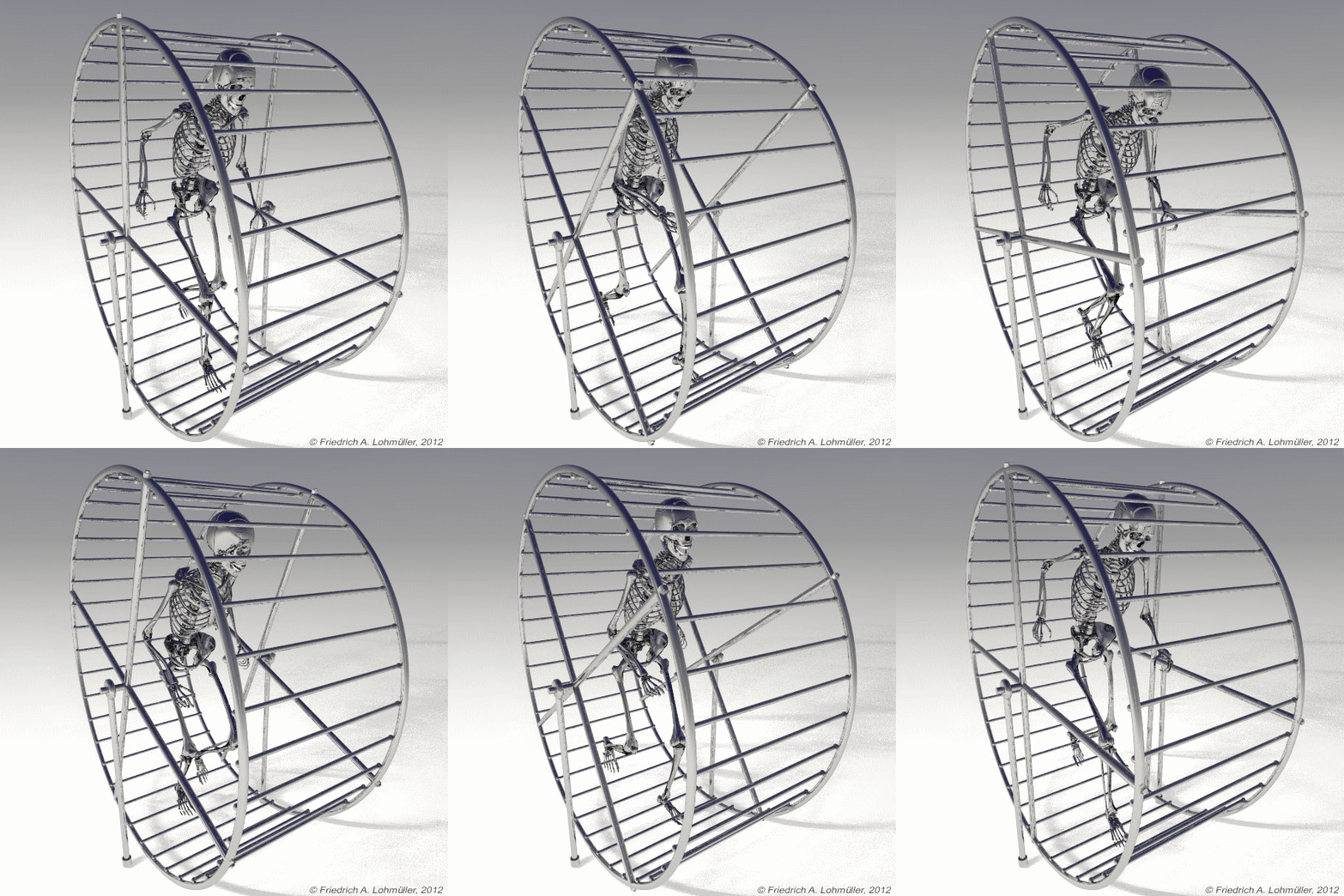
Xtra Image – http://www.f-lohmueller.de/pov_anim/human/Sk_2012_m10_Wheel_006d_256.gif


For further enlightening information enter a word or phrase into the random synchronistic search box @ the top left of http://nexusilluminati.blogspot.com


And see


 New Illuminati on Facebook - https://www.facebook.com/the.new.illuminati

New Illuminati Youtube Channel - http://www.youtube.com/user/newilluminati


New Illuminati on Twitter @ www.twitter.com/new_illuminati


New Illuminations –Art(icles) by R. Ayana @ http://newilluminations.blogspot.com

The Her(m)etic Hermit - http://hermetic.blog.com


DISGRUNTLED SITE ADMINS PLEASE NOTE –
We provide a live link to your original material on your site (and links via social networking services) - which raises your ranking on search engines and helps spread your info further!

This site is published under Creative Commons (Attribution) CopyRIGHT (unless an individual article or other item is declared otherwise by the copyright holder). Reproduction for non-profit use is permitted & encouraged - if you give attribution to the work & author and include all links in the original (along with this or a similar notice).

Feel free to make non-commercial hard (printed) or software copies or mirror sites - you never know how long something will stay glued to the web – but remember attribution!

If you like what you see, please send a donation (no amount is too small or too large) or leave a comment – and thanks for reading this far…

Live long and prosper! Together we can create the best of all possible worlds…


From the New Illuminati – http://nexusilluminati.blogspot.com

Monday, 8 June 2015

The Establishment Has Already Acknowledged a Lost Race of Giants


The Establishment Has Already Acknowledged a Lost Race of Giants  

3d Digital Sculpture of Giant with hair, copper breastplate, and gorget. Image courtesy of Marcia K. Moore, Ciamar Studio.
3d Digital Sculpture of Giant with hair, copper breastplate, and gorget. Image courtesy of Marcia K. Moore, Ciamar Studio. For more reconstructions of giants, visit Marcia K. Moore’s website.


One of the most controversial subjects regarding the ancient prehistoric cultures of North America concerns what we refer to as the Unique Physical Types (UPT). For the purposes of what follows, these UPT are often gigantic humanoid skeletons with hyper elongated or high-vaulted crania, occasional extra or pathological detentions (including several reports of double or triple rows of teeth), and are usually discovered in the burial mounds and associated graveyards of the Adena-Hopewell, Archaic Cultures, and Southeastern Ceremonial Complex.

It is common today for alternative history researchers to tell the story of how these beings were discovered en masse throughout the 19th and early 20th centuries. Historians, antiquarians, and archaeologists recorded the discovery of the Unique Physical Types all over the United States, with a large concentration found in the mounds and earthworks of the Ohio River Valley and along the Mississippi River.  These accounts can be found in any number of county, township, and state histories, as well as anthropological literature from both inside and outside of the Smithsonian Institution. Here are several examples:

Kentucky: “From a mound on the farm of Edin Burrowes, near Franklin, were exhumed, in May, 1841, at a depth of over 12 feet, several human skeletons. One, of extraordinary dimensions, was found between what appeared to have been two logs, covered with a wooden slab. Many of the bones were entire. The under jaw-bone was large enough to fit over the jaw, flesh and all, of any common man of the present day. The thigh-bones were full six inches longer than those of any man in Simpson County. Teeth, arms, ribs, and all, gave evidence of a giant of a former race”. (History of Kentucky, Lewis Collins)

Jo Daviess County, Illinois: “The mounds on the bluff have nearly all been opened within the last two or three years…In all that have been opened the excavators have found in the center a pit that was evidently dug about two and a half feet below the original surface of the ground…The bones in this pit indicate a race of gigantic stature, buried in a sitting posture around the sides of the pit, with legs extending toward the center”. (The History of Joe Daviess County)

“Near the original surface, 10 or 12 feet from the center (of the mound), on the lower side, lying at full length upon its back, was one of the largest skeletons discovered by the Bureau agents, the length as proved by actual measurement being between 7 and 8 feet. It was all clearly traceable…” (12th Annual Report of the Bureau of Ethnology)

Kanawha Valley, West Virginia: “No 11 is now 35 by 40 feet at the base and 4 feet high. In the center, 3 feet below the surface, was a vault 8 feet long and 3 feet wide. In the bottom of this, among the decayed fragments of bark wrappings, lay a skeleton fully 7 feet long, extended at full length on the back, head west…. Nineteen feet from the top…in the remains of a bark coffin, a skeleton, measuring 7.5 feet in length and 19 inches across the shoulders, was discovered”.  (12th Annual Report of the Bureau of Ethnology)

“Within the village of Brownstown, ten miles above Charleston and just below the mouth of Lens creek, is another such ancient burying ground…At Brownstown, not long since, two skeletons were found together, one a huge frame about seven feet in length and the other about four feet, a dwarf and deformed”. (History of the Great Kanawha Valley)

Mounds in Dunbar and South Charleston recorded by the Bureau of American Ethnology in 1884


Florida: “Pursuing my investigations, and excavating further toward the south east face of the mound, I came upon the largest stone ax I have ever seen or that had ever been found in this section of the country. Close to it was the largest and most perfect cranium of the mound…Near by the side of this skull were the right femoris, the tibia, the humerus, and part of the radius, with a portion of the pelvis directly under the skull…Anticipating a perfect specimen in this skull, I was doomed to disappointment, for, after taking it out of the earth and setting it up, so that I could view the fleshless face of this gigantic savage, in the space of two hours it crumbled to pieces, except small portions. According to measurement of the bones of this skeleton, its height must have been quite 7 feet”. (Annual Report of the Boards of Regents of the Smithsonian)

Digital sketch, ancient Florida giant.
Digital sketch, ancient Florida giant. Image courtesy of Marcia K. Moore, Ciamar Studio.


Louisiana: “In the same line of abnormality was the finding of one skull in which the detention reached the unusual number of forty teeth, the increase consisting of eight additional incisors…The formation of the skull found in the Larto mound, as compared with those of other localities, is highly anomalous…The anomaly in these cases cannot be ascribed to artificial disfiguration, for, were it such, the otherwise symmetrical development of the other parts would be impossible…their remarkable conformation could not possibly have been the result of bandages or other external appliances, but was undoubtedly congenital”. (Publication of the Louisiana Historical Society)

Etowah Mound Group: “Grave A, a stone sepulcher, 2.5 feet wide, 8 feet long, and 2 feet deep, was formed by placing steatite slabs on edge at the sides and ends, and others across the top. The bottom consisted simply of earth hardened by fire. It contained the remains of a single skeleton, lying on its back, with the head east. The frame was heavy and 7 feet long”. (12th Annual Report of the Bureau of Ethnology)


These examples represent the various anomalous features of the Unique Physical Types, which were encountered in the 19th and early 20th centuries. Spatially and culturally, they illustrate the extensive temporal and geographical range of these types. The Kanawha Valley Mound Builders left their remains in an area where some of the oldest Fayette Thick Adena Pottery and diverse types of mound construction have been found. It has recently been suggested that sites in West Virginia may push the “acceptable” beginning of the Early Woodland Period back to 1400-1300 BC.

The samples from Illinois come from a region where Archaic era mounds have been found, often with Hopewell Mounds built over and into them hundreds or thousands of years later, as in the case of Elizabeth Mound 1 and Peter Klunk Mound 7. The Etowah Mound (Mound C) is ascribed to the Mississippian Cult, dated to 950-1450 AD.

Ancient mounds and monuments of the Mississippi Valley. Originally published in William Cullen Bryant and Sydney Howard Gay
Ancient mounds and monuments of the Mississippi Valley. Originally published in William Cullen Bryant and Sydney Howard Gay, A Popular History of the United States, Vol I (1888), p. 24. (Wikimedia Commons)


After the Government and Philanthropies took over American Archaeology in the 1900s, the establishment undertook the policy of flatly denying the existence of anomalous remains. The actual beginning point for the revisionist tendency in the National Museum was very early. By 1851, E G Squier was working to debunk theories of pre-Columbian contact, and several decades later, Gerald Fowke would attempt to discredit and jettison the work of virtually every researcher in the field up to his day, including the skeletal measurements of his fellow agents in the Bureau of Ethnology. However, the denial of the Unique Types truly got underway during the reign of Ales Hrdlicka as the Curator of Anthropology at the Smithsonian (circa 1903).

"Ales hrdlicka" by Unknown - Archive Museum of Aleš Hrdlička in Humpolec.
"Ales hrdlicka" by Unknown - Archive Museum of Aleš Hrdlička in Humpolec. Licensed under CC BY-SA 3.0 via Wikimedia Commons

Hrdlicka seems to have made a hobby of constantly disparaging the notion that anomalous skeletons were ever found. This was done in scholarly works as well as public venues:

"And the ‘giant’ and ‘eight-foot’ skeleton is to this day the almost stereotyped feature of many an amateur report of a find of skeletal remains in Florida as well as other parts of the country. All these reports…it may be said once and for all, are exaggerations."

Dr Hrdlicka blames the ‘will to believe’ of amateur anthropologists for many reports of ‘discoveries’ which find their way to his office with monotonous frequency…the purported ‘finds’ describe a race of ancient giants between 7 and 8 feet tall with bones and jaws considerably larger than those living today…Next to human ‘giants’ Dr. Hrdlicka reports, fancy finds its sway with human ‘dwarfs’.

Interestingly, Hrdlicka’s name appears in several reports of discoveries of gigantic skeletons during his tenure at the American Museum:

"The skeletons of these Hitherto Unknown American Aborigines Showed They All Ranged in Height from Six and One-Half to Seven Feet…Excavating in the sand dunes of the sun-sprayed Golden Isles, Georgia, archaeologists have gouged out the strange record of an amazing prehistoric race of giants…What manner of men were these, the members of whose tribe all averaged six and one-half and seven feet tall?...Some of the first skulls to be disinterred by Preston Holder have already been examined at the Smithsonian Institute by Dr Ales Hrdlicka, foremost authority on North American Types."

Currently there are a slew of books, DVDs and even at least one TV show documenting the exploits of modern hunters who are “on the trail” of the anomalous dead, who insist that if at least one of these skeletons could be found and presented to the “experts” it would somehow alter the professed paradigm of the establishment itself. However, as we will demonstrate in part 2, the “experts” have already rediscovered, photographed, and measured these types of remains.


Illustration from "Mundus subterraneus" - suggesting that fossil bones were from giants
Illustration from "Mundus subterraneus" - suggesting that fossil bones were from giants (Wikimedia Commons).


Following our overview of discoveries of gigantic humanoid skeletons in the burial mounds and associated graveyards of the Adena-Hopewell, Archaic Cultures, and Southeastern Ceremonial Complex, we will now document the discovery of the Unique Physical Types (UPT) even after the institution of the mainstream policy of denial, or “post cover-up”.

The two pre-eminent Adena scholars of the twentieth century were William S Webb (assisted by Charles Snow of the University of Kentucky) and Don Dragoo, of the Carnegie Museum. When Webb excavated the Dover Mound in Mason Co, Kentucky, he encountered a group burial of 4 skeletons, one of which represented the Unique Physical Type:

“The remains of burial 40 is one of the largest known to Adena; the skull-foot field measurement is 84 inches (7 feet).” (The Dover Mound, William S Webb and Charles Snow 1959)

The Burial Census Table mentions that this skeleton had a “very thick” skull and represented the “tallest Adena male” from the mound.  For other burials in the Dover Mound the Table includes such details as “prominent bilateral chin”, “rugged head and face, wide bilateral chin” and “High Vaulted, large-faced”. (Webb and Snow, 1959)

The Dover Mound also yielded skeletons with dental abnormalities. Burial 54 included “a supernumerary tooth with twin cusps, lying diagonally in the left maxilla”, as well as “shovel shaped later incisors.” (Webb and Snow, 1959)

Recently recorded instances of Adena supernumerary teeth occur at McMurrey Mound 1 and Sidner Mound 1 in Ohio. (Mortuary Variability in the Middle Big Darby Drainage of Central Ohio Between 300 BC and 300 AD Volume 1, Bruce Aument). One particularly monstrous deformation analyzed and photographed in the Ohio Archaeologist may be an extreme case of the type of dental anomalies found in the Dover Mound. (Ohio Archaeologist, 10(4), Oct 1960.)

Webb and Snow also noted the large crania of the Adena, which they partly attributed to head-boarding:

“Not only do the Dover people show the results of head shaping (deformation), but they exceed the total Kentucky series in the great width and height of the skull vault!...it is to be noted that the head shaping…has been extreme in these skulls…These people as a group…have the highest skull vaults reported anywhere in the world.” (Webb and Snow, 1959)

Artist’s reconstruction of the high skull vaults reported in descriptions of North American giants.
Artist’s reconstruction of the high skull vaults reported in descriptions of North American giants. Image courtesy of Marcia K. Moore, Ciamar Studio.


Another feature of the UPTs documented by Webb and Snow is the massive lower jaw:

“One of the outstanding and un-Indian traits present among the Adena people is their prominent and often bilateral chins…One of the skulls from the Dover Mound, Burial 25…represents a bilateral chin with a width of 52 mm.” (Webb and Snow, 1959)

“One of the particular features present in at least one-half of the observed examples is the great width of the bony chin, formed by bilateral eminences rarely found among the skulls of the much earlier Shell Heap People or among the later Hopewell People.” (The Adena People, No 2, by Webb and Baby).

Besides the large skeletal type, Snow noted the discovery of the “Dwarf” type mentioned in early literature in his observations of the famous Adena pipe from Ross County, Ohio:

“Further evidence of abnormal Adena individuals is portrayed in a remarkable piece of sculpture in the round-the Adena Pipe figurine…The figure depicted is typical of this form of dwarfism.” (The Adena People, No 2, by Webb and Baby.)

The Adena Pipe. His head and torso are large in comparison to his legs, suggesting to some that he represents a dwarf.
The Adena Pipe. His head and torso are large in comparison to his legs, suggesting to some that he represents a dwarf. (Photo courtesy of the Ohio Historical Society)


The text references the excavation of one of these individuals at Waverly, Ohio. The following description of this burial is from Gerald Fowke:

“…a skeleton of peculiar form. It was not over five feet long, but the bones were very thick and the processes for attachment of muscles were extraordinary in their development. The skull was nearly half an inch thick and of unusual size, mostly back of the ears, though the forehead was full and high. The teeth were large, hard, and but little worn”. (The Archaeological History of Ohio, by Gerald Fowke, page 372.)

In 1958, Don Dragoo encountered the large Adena type while excavating the Cresap Mound in West Virginia on behalf of the Carnegie Museum.  In a subfloor tomb he unearthed Burial 54:

“This individual was of large proportions. When measured in the tomb his length was approximately 7.04 feet. All the long bones were heavy and possessed marked eminences for the attachment of muscles.” (Mounds for the Dead, by Don Dragoo, 1963).

A burial mound of the Adena Culture. Grave Creek Mound in Moundsville, West Virginia
A burial mound of the Adena Culture. Grave Creek Mound in Moundsville, West Virginia (Wikimedia Commons)


This discovery, as well as a review of Webb’s earlier work at the Dover Mound, influenced Dragoo’s remarkable observations on Adena anthropology:

“Two outstanding traits have been noted repeatedly for this group. One is the protruding and massive chin often with prominent bilateral protrusions. The second trait is the large size of many of the males and some of the females. A male of six feet was common and some individuals approaching seven feet in height have been found, for example, Burial 40 in the Dover Mound and Burial 54 in the Cresap Mound. Some of the females in the Dover Mound also were more than six feet in height. Not only were these Adena people tall but also the massiveness of the bones indicates powerfully built individuals. The head was generally big with a large cranial capacity”. (Mounds for the Dead, by Don Dragoo, 1963).

To Webb, Snow, and Dragoo, the evidence clearly pointed towards the existence of a group of genetically related elites within the Adena sphere who shared the UPT traits. The true number of these individuals had been obfuscated by the common practice of cremation:

“If, as the evidence seems to indicate, the burials in the tombs were those of a selected group such factors would have undoubtedly been of importance not only in the development of the prominent chin but also in the large stature. If only certain inbreeding individuals of the total population were members of the ‘selected group’, genetic factors would also have played an important part in the establishment of the unique Adena physical type…How wide-spread throughout the entire Adena population were the unique traits of the tomb burials is unknown but Snow’s study of the cremated remains from the Dover Mound indicated that at least some of the individuals among these cremated remains also possessed the unique traits of the flesh burials in the tombs. Because of the common practice of cremating most of the dead, we will probably never be able to determine the full extent of these special traits in the general population.” (Mounds for the Dead, by Don Dragoo, 1963).

The emerging picture is of an elite race within Late Archaic/Early Woodland societies who were often buried in the mounds, and who represented a type of “royalty”. Among these interrelated groups were UPTs. This elitism is further evidenced by the presence of extensive child and infant burials in the tombs, often accompanied by the same exotic goods as the adults including shell beads and copper rings.  Also, dental and bone anomalies have been used to establish a genetic connection between individuals at mound sites.

Gigantic discoveries are often challenged with the generic statement that average Adena were between 5’6’’ and 5’11’’ feet tall, but this argument is a conjecture of half-truth disguised as science. We are not concerned with the “average” stature of the Adena populace, but rather the irregular characteristics (and often abnormally tall stature) of their elite.

Skeletons of a male giant and a female dwarf, displayed at the Royal College of Surgeons.
Skeletons of a male giant and a female dwarf, displayed at the Royal College of Surgeons. (Wikimedia Commons)


Besides the professional literature, so-called “amateur” archaeologists have also chronicled conclusive evidence of Unique Physical Types with a great consistency to the discoveries of Dragoo and Webb. In 1908, Louis Welles Murray recorded that at Tioga Point in Pennsylvania, remains of “a skeleton of a man six or more feet in height” beneath a cist-like grave were found. The grave itself was encased and moved to the local museum where the bones were studied by hundreds of people. Other skeletons from this same area “were of unusual size; one, judged from the length of thigh bone, to be seven feet.” (A History of Old Tioga Point and Early Athens, Pennsylvania, by Louis Welles Murray.)

In addition to these, Murray documents the examination of a large skeleton by a Professor Holbrooke:

“Judging by the thigh bone he must have been seven feet tall. The skull was much larger than usual, very thick, the forehead unusually receding, the top flattened. The jaws were extremely strong, full of large, perfect teeth.” (A History of Old Tioga Point and Early Athens, Pennsylvania, by Louis Welles Murray.)

Following the discovery of burials in her own flower garden, Murray embarked on an archaeological odyssey of her own. In 1921, she published an article for the American Anthropologist, noting that the femur, jaw, and teeth of one of the seven-foot skeletons was then still in the Tioga Point Museum. Also included are references to many skeletons between 6 and 7 feet tall, with photographs of artifacts, pottery, and the in situ burial of one of the “above 6ft” burials. The article also features a photograph of the “Paul Scott Collection”, described as “a multiplicity of small artifacts, suggesting a race of pygmies” which included a “miniature amulet and sinker stones.” (Aboriginal Sites In And Near “Teaoga”, in American Anthropologist 23(2) 1921).

Regardless of the disparagement of amateurs, historians, and antiquarians, the credentials of Webb, Snow, and Dragoo have never been brought into question. With so many researchers scrambling today to discover irrefutable evidence of gigantic or otherwise anomalous beings to prove their existence, the authors question why they do not simply present the works of William S Webb and Don Dragoo to anthropologists, and more importantly, their audiences.

While the concept of a mysterious and undiscovered race may create an air of sensationalism healthy for selling books and DVDs, we feel that it is of far more relevance to demonstrate that the Unique Physical Types were discovered by professionals all the way up through the 20th century, even after the institutionalized policy of denial, and yet the establishment continues to deny their own documented evidence and the truth.


References:

History of Kentucky, Volume 2. Lewis Collins, 1878. Giants appear in the text on pages 107, 653, 654, 666, 683, and 722 https://archive.org/stream/collinshistoricav02coll#page/n7/mode/2up
The History of Joe Daviess County, Illinois, 1878. Reference is page 843 https://archive.org/stream/historyofjodavie00kett#page/844/mode/2up/search/Ancient+Mounds
12th Annual Report of the Bureau of Ethnology, 1891. https://archive.org/stream/annualreportofbu1218901891smit#page/n7/mode/2up
History of the Great Kanawha Valley, by John P Hale, 1891. Reference on page 47.
https://archive.org/stream/historyofgreatka01madi#page/n7/mode/2up

Annual Report of the Boards of Regents of the Smithsonian, 1874. See Antiwuities of Florida, page 392.
Publications of the Louisiana Historical Society 1896. Mounds of Louisiana, Part 1. Reference begins on page 20.
https://archive.org/stream/publicationslou02socigoog#page/n143/mode/2up

Building Woodland Archaeological Units in The Kanawha River Basin, West Virginia, by Patrick D Trader, in Woodland Period Systematics in The Middle Ohio Valley, edited by Darlene Applegate and Robert Mainford, 2005.
For Elizabeth Mound number 1, see The Archaic and Woodland Cemeteries of the Elizabeth Site in the Lower Illinois Valley edited by Leigh and Buikstra, 1988.
For Peter Klunk Mound 7, see Hopewell and Woodland Site Archaeology in Illinois, Bulletin 6 Illinois Archaeological Survey
https://uofi.app.box.com/s/gw2ah1c1wyi602w27umt

Essay attached to Memoir on the European Colonization of America, page 20.
https://archive.org/stream/cihm_42357#page/n23/mode/2up

Archaeological History of Ohio, Gerald Fowke.
https://archive.org/stream/cu31924005690155#page/n5/mode/2up

Anthropology of Florida, Ales Hrdlicka 1922.
https://archive.org/stream/anthropologyoffl00hrdli#page/n5/mode/2up

Newspaper article discovered in a clipping file by Ross Hamilton, author of A Tradition of Giants: The Elite Social Hierarchy of American Prehistory.
The Salt Lake Tribune, 8/21/1936, courtesy of the excellent Greater Ancestors website:
http://greaterancestors.com/the-golden-isles-giants/


The Dover Mound, William S Webb and Charles Snow 1959. The measurement of the giant is on page 22, the burial census is on pages 29-32, and the dental anomalies are photographed on page 43.
Mortuary Variability in the Middle Big Darby Drainage of Central Ohio Between 300 BC and 300 AD Volume 1, Bruce Aument.
Ohio Archaeologist, 10 (4), Oct 1960. Article and photograph on pages 140-141.
https://kb.osu.edu/dspace/bitstream/handle/1811/55999/OHIO_ARCHAEOLOGIST_10_4_OCTOBER_1960.pdf?sequence=1
The Adena People, No 2, by Webb and Baby.
The Archaeological History of Ohio, by Gerald Fowke, page 372.
Mounds for the Dead, by Don Dragoo (1963). Burial 54 is measured and described on page 67, and an actual photograph of the skeleton in situ appears on page 50.
A History of Old Tioga Point and Early Athens, Pennsylvania, by Louis Welles Murray. Large Skeletons appear in the text around page 200. Page 203 features a photo of a large type in situ.
https://archive.org/stream/ahistoryoldtiog00murrgoog#page/n8/mode/2up
Aboriginal Sites In And Near “Teaoga”, Now Athens, Pennsylvania, in American Anthropologist 23(2) 1921 page 183. The article features a photo of the “pygmy artifacts”.


For more information about giants see http://nexusilluminati.blogspot.com/search/label/giants
- Scroll down through ‘Older Posts’ at the end of each section


Hope you like this not for profit site -
It takes hours of work every day by a genuinely incapacitated invalid to maintain, write, edit, research, illustrate and publish this website from a tiny cabin in a remote forest
Like what we do? Please give anything you can -  
Contribute any amount and receive at least one New Illuminati eBook!
(You can use a card securely if you don’t use Paypal)
Please click below -


Spare Bitcoin change?


For further enlightening information enter a word or phrase into the random synchronistic search box @ the top left of http://nexusilluminati.blogspot.com


And see


 New Illuminati on Facebook - https://www.facebook.com/the.new.illuminati

New Illuminati Youtube Channel - http://www.youtube.com/user/newilluminati


New Illuminati on Twitter @ www.twitter.com/new_illuminati


New Illuminations –Art(icles) by R. Ayana @ http://newilluminations.blogspot.com

The Her(m)etic Hermit - http://hermetic.blog.com


DISGRUNTLED SITE ADMINS PLEASE NOTE –
We provide a live link to your original material on your site (and links via social networking services) - which raises your ranking on search engines and helps spread your info further!

This site is published under Creative Commons (Attribution) CopyRIGHT (unless an individual article or other item is declared otherwise by the copyright holder). Reproduction for non-profit use is permitted & encouraged - if you give attribution to the work & author and include all links in the original (along with this or a similar notice).

Feel free to make non-commercial hard (printed) or software copies or mirror sites - you never know how long something will stay glued to the web – but remember attribution!

If you like what you see, please send a donation (no amount is too small or too large) or leave a comment – and thanks for reading this far…

Live long and prosper! Together we can create the best of all possible worlds…


From the New Illuminati – http://nexusilluminati.blogspot.com