Were Venus and Mars Once Habitable Planets?
And Did a Mega Collision Alter Venus?

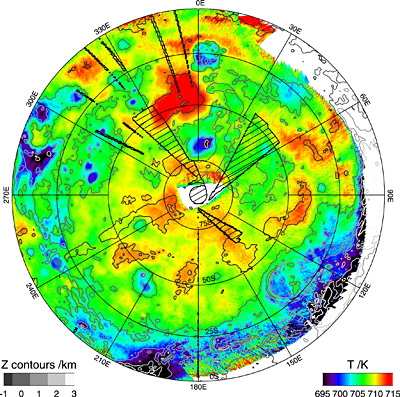
The European Space Agency's Venus Express is helping planetary scientists investigate whether Venus once had oceans. If it did, it may even have begun its existence as a habitable planet similar to Earth.
These days, Earth and Venus seem completely different. Earth is a lush, clement world teeming with life, whilst Venus is hellish, its surface roasting at temperatures higher than those of a kitchen oven.
But underneath it all the two planets share a number of striking similarities. They are nearly identical in size and now, thanks to ESA's Venus Express orbiter, planetary scientists are seeing other similarities too.
"The basic composition of Venus and Earth is very similar," says Håkan Svedhem, ESA Venus Express Project Scientist. Just how similar planetary scientists from around the world will be discussing in Aussois, France, where they are gathering this week for a conference.
One difference stands out: Venus has very little water. Were the contents of Earth's oceans to be spread evenly across the world, they would create a layer 3 km deep. If you were to condense the amount of water vapour in Venus' atmosphere onto its surface, it would create a global puddle just 3 cm deep.
Yet there is another similarity here. Billions of years ago, Venus probably had much more water. Venus Express has certainly confirmed that the planet has lost a large quantity of water into space.
It happens because ultraviolet radiation from the Sun streams into Venus' atmosphere and breaks up the water molecules into atoms: two hydrogens and one oxygen. These then escape to space.
Venus Express has measured the rate of this escape and confirmed that roughly twice as much hydrogen is escaping as oxygen. It is therefore believed that water is the source of these escaping ions. It has also shown that a heavy form of hydrogen, called deuterium, is progressively enriched in the upper echelons of Venus's atmosphere, because the heavier hydrogen will find it less easy to escape the planet's grip.
"Everything points to there being large amounts of water on Venus in the past," says Colin Wilson, Oxford University, UK. But that does not necessarily mean there were oceans on the planet's surface.
Eric Chassefière, Université Paris-Sud, France, has developed a computer model that suggests the water was largely atmospheric and existed only during the very earliest times, when the surface of the planet was completely molten. As the water molecules were broken into atoms by sunlight and escaped into space, the subsequent drop in temperature probably triggered the solidification of the surface. In other words: no oceans.
Although it is difficult to test this hypothesis it is a key question. If Venus ever did possess surface water, the planet may possibly have had an early habitable phase.
Even if true, Chassefière's model does not preclude the chance that colliding comets brought additional water to Venus after the surface crystallised, and these created bodies of standing water in which life may have been able to form.
There are many open questions. "Much more extensive modelling of the magma ocean-atmosphere system and of its evolution is required to better understand the evolution of the young Venus," says Chassefière.
When creating those computer models, the data provided by Venus Express will prove crucial. #
Did A Mega-Collision Alter Venus?

Venus is a sister planet to Earth. It is nearly the same size and density yet it has a surface temperature of 720 K, an atmosphere dominated by carbon dioxide and no evidence of oceans or ridges. It has been described as “Earth’s evil twin”.
Dr Huw Davies, of the School of Earth and Ocean Sciences argues that a mega-collision could explain these differences. In particular the collision could explain why the interior of Venus is dry, the odd rotation of the planet and the carbon dioxide atmosphere.
Dr Davies of the School of Earth and Ocean Sciences said: “A collision theory has been explored by scientists previously but was abandoned as the planet Venus has no moon usually expected from such an impact. However, a mega-impact could have created Venus, since the head-on collision I propose does not produce a moon.”
The hot ball of gas and liquid that would result immediately following the collision would allow iron to react away the water, leaving Venus a dry planet. Significant suggested consequences of a dry planet include the lack of plate tectonics, continents and life.
Dr Davies’ research is published in the journal Earth and Planetary Science Letters. *
Mars Was Wet, Globally

The picture of an ancient Mars that looked a lot more like Earth came into sharper focus with a new study showing that the planet’s northern regions apparently shared a proclivity for water.
Kudos to a team of French and American scientists who found the north’s first telltale clay mineral deposits, which form in water’s presence. Thousands of similar deposits have been found in the planet’s southern highlands... The detections by Europe’s Mars Express and NASA’s Mars Reconnaissance orbiters are the first time the minerals have been found in the north, which has younger surface rocks due to more recent volcanic activity.
Writing in this week’s Science, the researchers explain that the minerals were found in some large craters that had cut through the younger, overlying rocks. In nine of 91 craters scanned, clay-like minerals called phyllosilicates, which on Earth form in wet environments, were found. The discovery raises the prospect that early Mars had water on a global scale.%
NASA report: Hydrated Minerals Exposed at Stokes, Northern Mars

Stokes Crater, pictured here, is one of at least nine craters in the northern lowlands of Mars with exposures of hydrated minerals detected from orbit, according to a June 25, 2010, report.
These minerals, including phyllosilicates, have previously been found in thousands of small outcrops in the southern highlands of Mars, but had not previously been identified in the northern lowlands, which cover nearly half of the planet. The numerous outcrops in the south have been interpreted as evidence that early Mars -- about 4 billion years ago -- had wet conditions necessary for producing phyllosilicates and possibly conducive to life.
The exposures in some northern craters indicate these minerals are in an older layer underneath the younger surface of northern Mars and are made visible where crater-forming impacts have exposed the underlying material. The new report in the journal Science by John Carter of the University of Paris and his co-authors says that the northern finds suggest the ancient, wet conditions extended globally. Their report draws upon observations by the Compact Reconnaissance Imaging Spectrometer for Mars (CRISM) aboard NASA's Mars Reconnaissance Orbiter and the OMEGA spectrometer orbiting aboard the European Space Agency's Mars Express.
Stokes spans 66 kilometers (41 miles) in diameter, centered at 55.6 degrees north latitude, 171.2 degrees east longitude.
The image on the right shows an area near the center of the crater, with color coding for where CRISM observations have shown exposures of three types of hydrated minerals and nearby exposures of two volcanic minerals unaltered by water: pyroxene and olivine. The scale bar is 2 kilometers (1.2 miles).
The context map on the left indicates the location of that CRISM footprint within Stokes Crater. It is a mosaic of images taken by the Context Camera on Mars Reconnaissance Orbiter and the High Resolution Stereo Camera on Mars Express. The scale bar is 25 kilometers (15.5 miles).
NASA's Jet Propulsion Laboratory, a division of the California Institute of Technology, Pasadena, manages the Mars Reconnaissance Orbiter for the NASA Science Mission Directorate, Washington. Lockheed Martin Space Systems, Denver, built the spacecraft. The Johns Hopkins University Applied Physics Laboratory led the effort to build the CRISM instrument and operates CRISM in coordination with an international team of researchers from universities, government and the private sector. Malin Space Science Systems, San Diego, provided and operates the Context Camera.
The European Space Operations Centre in Darmstadt, Germany, operates the European Space Agency's Mars Express mission. The High Resolution Stereo Camera was developed by a group with leadership at the Freie Universitat Berlin.
- NASA report @ http://www.nasa.gov/mission_pages/MRO/multimedia/gallery/mro20100624-b.html
# Via ScienceDaily (June 24, 2010) — http://www.sciencedaily.com/releases/2010/06/100624091753.htm
* Via ScienceDaily (Feb. 27, 2008) -http://www.sciencedaily.com/releases/2008/02/080226160017.htm
% Analysis by Irene Klotz from http://news.discovery.com/space/mars-was-wet-globally.html
For more material on past habitability of nearby planetary companions see http://newilluminati.blog-city.com/index.cfm?search=velikovsky
For further enlightenment see –
The Her(m)etic Hermit - http://hermetic.blog.com
New Illuminati – http://nexusilluminati.blogspot.com
New Illuminati on Facebook - http://www.facebook.com/pages/New-Illuminati/320674219559
This material is published under Creative Commons Copyright (unless an individual item is declared otherwise by copyright holder) – reproduction for non-profit use is permitted & encouraged, if you give attribution to the work & author - and please include a (preferably active) link to the original along with this notice. Feel free to make non-commercial hard (printed) or software copies or mirror sites - you never know how long something will stay glued to the web – but remember attribution! If you like what you see, please send a tiny donation or leave a comment – and thanks for reading this far…
From the New Illuminati – http://nexusilluminati.blogspot.com