"All the World's a Stage We Pass Through" R. Ayana

Showing posts with label telepathy evidence. Show all posts

Friday, 30 November 2012

Mysteries, Miracles & Parapsychology


Mysteries, Miracles & Parapsychology

By Robert Schoch

 

Parapsychology is full of anecdotal accounts of strange occurrences, which cause many people to simply shake their heads in disbelief.1 The phenomena of parapsychology grade into the mysteries and miracles that are the boon and bane of much religion. After all, to use a Christian example (and in no way am I making a statement about Christianity per se), not only can Jesus and the saints perform miracles, but so can Satan and his cohorts!

When it comes to the question of whether or not parapsychological phenomena are real, for many people the stakes are high, as the answer has the potential to confirm or deny their worldview. Some are incredulous when it comes to telepathy, even though it has been statistically demonstrated time and again in laboratory settings, whereas the credulity of others stretches much, much further.

In popular culture often the reality, or not, of the paranormal (viewed popularly as “miracles”) is seen as confirming, or refuting, one of the fundamental tenets of many religions, namely life after death. As the late parapsychologist and University of Virginia (Charlottesville) psychiatrist Dr. Ian Stevenson (1918 – 2007) wrote,

Some persons can segregate beliefs about different aspects of non-material existences and events. This would be particularly likely to be true of persons who have made a special study of psychical phenomena…. However, I think that members of the general public do not usually make such a distinction. For most of them, a belief in life after death almost entails a belief in miracles, such as the phenomena described in the Bible, and also a belief in what we call paranormal cognition. Conversely, members of the general public who do not believe in life after death are also likely to be skeptical about all kinds of paranormal phenomena, the recognition of which would imply for them a soul that would survive bodily death.2


The Incredulity Meter

http://www.simion7d.com/images/mangalaxy.jpgI am absolutely convinced that telepathy is real, even if a somewhat fickle and uncontrollable phenomenon. Given the choice between a telephone and telepathic rapport to communicate an important and specific message, I will use the phone. In my opinion there is nothing miraculous about telepathy, although how it occurs remains a mystery (there is still no generally agreed upon theory as to the mechanism for telepathic transmission).3 I should note, however, that I always attempt to maintain a healthy skepticism about any particular claim of telepathy (it is human nature to be disingenuous, or to fool one’s self), but there are plenty of well-documented cases of telepathy in the literature, and I have had my share personally.

My incredulity meter really begins to perk up when it comes to physical parapsychological phenomena, such as psychokinesis and levitations, materialisations of solid substances out of “thin air,” or the ability to withstand physical trauma, such as walking on hot coals or applying extreme heat or fire directly to the skin without damage. Lacking good, indeed virtually impeccable, documentation for certain extreme feats of this nature, I instinctively dismiss them as nonsense, or at the least remain agnostic.

http://www.estatevaults.com/bol/%20levitation%20White%20House.jpgOf all the cases that register high on my incredulity meter, however, some are classics and though they may boggle the imagination, it is difficult to dismiss them. Here I will focus on particular aspects of two such celebrated examples from the history of parapsychology, one from the seventeenth century and the other from the nineteenth century. They are, in the opinions of some, intimately tied to religious beliefs and the concept of miracles.


The Flying Saint


Saint Joseph of Cupertino (San Giuseppe da Copertino, 1603-1663; born Giuseppe Maria Desa in Cupertino, southeastern Italy) was considered rather dull witted (in modern terms, he may have suffered from learning disabilities), and said to possess a violent temper (a point we will return to). Joseph was extremely pious, however, and became a Franciscan friar. Joseph exhibited various mental psychic phenomena; for instance, it is said he was aware of the thoughts of penitents and knew if they were not fully honest and forthright during confession. Due to his mental deficiencies, he could learn only a small amount of material at a time. When preparing for exams he simply studied one specific topic, and then prayed that that would be the very subject, of all possible subjects, that would be asked of him – and so it was. Was this an example of precognition, or was Joseph telepathically influencing or accessing (perhaps unconsciously) the examiners in terms of the questions they would put to him?

Joseph was also said to have the power to heal the sick. But it was his bodily levitations, his literal flights in the air, that he is most famous for, and which by many are considered to be absolutely mysterious and miraculous, either justifiably earning Joseph the appellation of Saint (he was canonised in 1767), or in the skeptic’s opinion dismissal as either a fraud, or at the least someone who incited hallucinations among those witnessing the supposed levitations. At first glance, St. Joseph’s flights rank high on my incredulity meter.4

Although we are separated from St. Joseph by three and a half centuries, and his time still contained a strong element of superstition and anti-scientific sentiment (after all, the Inquisition was in full swing during Joseph’s lifetime, persecuting Galileo in 1633), it is still difficult to dismiss all of the varied eyewitness accounts of Joseph’s flights. Reportedly the first levitation was in his hometown of Cupertino during an outdoor procession on the feast day of St. Francis of Assisi. Joseph took off, flying over the crowd. After it was over, in embarrassment, he fled to hide in his mother’s house. From then until the end of his life, Joseph experienced uncontrolled fits of bodily levitation. Various minor incidents could potentially initiate a levitation: a casual remark about the wonders of God, or viewing an image of the Virgin Mary, could send Joseph into ecstasy, and then with a loud sob or cry he would fly into the air.

His reported flights were not trivial. On one occasion he flew from the middle of the church to the high altar, a distance of forty feet, and remained there for about fifteen minutes before descending. He once flew over the heads of bystanders to reach a statue of the Immaculate Conception, and then flew back again over their heads once more. Another time he reportedly flew eighty yards, over a pulpit, to a crucifix.5 During another levitation he ended up in a tree, and once he came out of his trance he was unable to get down until a ladder was fetched. On several occasions he carried another person up with him, holding them by the hand or hair.

Although it is “only” eyewitness testimony (but what else can we have from the seventeenth century?), it is incredibly varied and consistent, and Joseph’s levitations were not always viewed positively. Indeed, his superiors often found Joseph to be an embarrassment. His unannounced flights during solemn ceremonies could cause a disruption. Once floating before the altar holding the Holy Sacrament, his sandals fell off. Joseph was at times banned from choir practices, public masses, and even from meals with his fellow friars. Joseph and his “miracles” attracted a huge following, and especially later in his life, the church authorities periodically attempted to place him in seclusion. In my mind, these facts only reinforce that the levitations may well have been genuine. Prominent witnesses to Joseph’s levitations were the High Admiral of Castile, Spanish Ambassador to the Papal Court (his wife fainted at the sight); John Frederick, Duke of Brunswick (who converted from Lutheranism to Catholicism as a result of witnessing Joseph levitate); and Pope Urban VIII (during a papal audience Joseph fell into ecstasy and levitated).


The Inquisition and Poltergeists


What do we make of Joseph’s levitations? Could they have been genuine? They are difficult to explain away as hallucinations on the part of the witnesses. Furthermore, they hardly fit the mold that would be expected of stories tailored to aid in the canonisation of a beloved friar. Due to the publicity he attracted, in 1638 Joseph was investigated by the Inquisition in Naples, but cleared of any wrongdoing. Joseph’s levitations were undisciplined, uncouth (he apparently cried out at the start of each incident), and disrupting to those around him. What is really pertinent in my mind is that Joseph is not the sole example of such levitations, for similar phenomena are reported widely in medieval church accounts, popular folklore, and in ethnographic accounts of “primitive” peoples and their myths.6

Joseph’s levitations strike me as perhaps a form of self-directed “poltergeist” affliction. Derived from the German, meaning a boisterous or noisy ghost, typical poltergeist incidents include strange noises (scratching, raps, knocks, banging) and the movement of objects. In a typical poltergeist case objects inexplicably fall off of shelves or get thrown through the air even when nobody is close enough to reach them, and no physical means are apparent that could have caused the objects to move.

As the physicist and early psychical researcher Sir William Barrett wrote in 1911, “Of the genuineness and inexplicable nature of the phenomena there can be no manner of doubt, in spite of occasional attempts at their fraudulent imitation.”7

It appears that in most cases the affected objects are not being moved by spirits or ghosts, as traditionally believed, but unconsciously via paranormal means by a living person, someone who is typically emotionally or psychologically disturbed, with unresolved repressed feelings of deep guilt or fear, and intense “hysterical” tendencies. The poltergeist instances swirling around such a person are a sort of unconscious acting out and externalisation of the emotions.

Interestingly, very similar types of poltergeist phenomena have been described for thousands of years in different cultures on different continents;8 such facts lend credence to the idea that poltergeist instances are genuine (and I will admit that I have witnessed a mild poltergeist instance first-hand). Modern researchers, such as Dr. William G. Roll,9 have intensively studied various modern poltergeist cases and it is clear that the paranormal movement of material objects against the forces of gravity and inertia is real (that is, objects are levitated) and such movements follow general patterns (as would be expected of a genuine set of phenomena).

I believe that Joseph was a psychologically disturbed, highly conflicted, individual prone to extremes in temperament. This is evidenced by his reported fits of rapture and ecstasy, as well as his occasional violent temper (even the saints can have bad days, I suppose). His own frustration with his apparent learning disabilities and mental limitations probably added to his troubles. Joseph also suffered from cataleptic or epileptic fits, convulsions, and severe attacks of depression (melancholia, as it was called10). Joseph, I suggest, did genuinely levitate. I hypothesise that Joseph was essentially the centre of what we might now refer to as poltergeist activity (or to use the more modern terminology, recurrent spontaneous psychokinesis, RSPK), but in his case the activity (the levitation of objects, or an object) was directed unconsciously toward his own physical body. Joseph basically inflicted the levitations upon himself.


The Levitations of Home
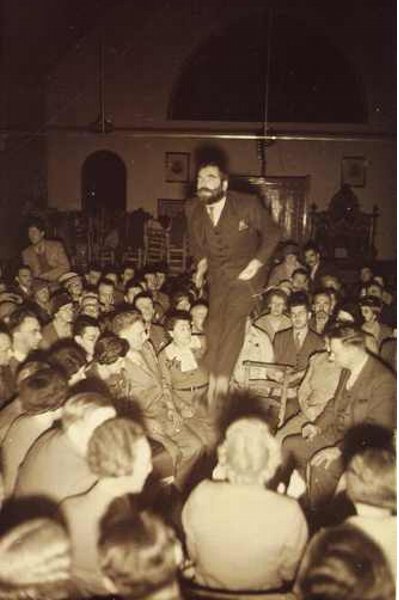
 

https://blogger.googleusercontent.com/img/b/R29vZ2xl/AVvXsEhudo1mPns3HgqTvcpLUEiaNbUnasE52R2IHhsbh650JjeMYtsf6KluoEhtX6AxyvUV2RdEUMwZHkYV_I49ptG6hmV8q5kKpWol1Jn4Z7VxDBU5DeRJrnO_OngVWulwHMBWlmLa_LEPiEkT/s320/Colin_Evans_1938.jpgIn the nineteenth century the famous Scottish (though raised in America during his childhood) spiritualistic medium Daniel Dunglas Home (1833 – 1886) was known for his bodily levitations, as well as levitations of other objects, in séance settings.11 In one famous instance, Home reportedly went into a trance and was levitated out a window about seventy feet from the ground, observed to be floating in the air outside an adjacent window (seven and a half feet from the first window), and then glided in through the second window feet first.

The well-known English physicist and chemist, Sir William Crookes (1832 – 1919; he was knighted in 1897), a careful laboratory experimentalist (among other things, he was a co-discoverer of the element thallium, invented the Crookes radiometer, and developed Crookes tubes), carried out investigations of D.D. Home and other so-called mediums. Crookes witnessed Home levitate numerous times, as he describes in his own words:

The best cases of Home’s levitation I witnessed were in my own house. On one occasion he went to a clear part of the room, and, after standing quietly for a minute, told us he was rising. I saw him slowly rise up with a continuous gliding movement, and remain about six inches off the ground for several seconds, when he slowly descended. On this occasion no one moved from their places. On another occasion I was invited to come to him, when he rose eighteen inches off the ground, and I passed my hands under his feet, round him, and over his head when he was in the air. On several occasions, Home and the chair on which he was sitting at the table rose off the ground. This was generally done very deliberately, and Home sometimes then tucked up his feet on the seat of the chair and held up his hands in full view of all of us. On such occasions I have gone down and seen and felt all four legs were off the ground at the same time, Home’s feet being on the chair. Less frequently the levitating power extended to those next to him. Once my wife was thus raised off the ground in her chair.12 


All Hallucinations?


The reported incidents of levitation by Home, both of his own body and objects around him, are numerous, reported by many witnesses, and they fall into a larger pattern including not just St. Joseph. As the early psychical researcher and Scottish folklorist Andrew Lang (1844 – 1912) wrote,

…when we find savage ‘birraarks’ in Australia, fakirs in India, saints in mediaeval Europe, a gentleman’s butler in Ireland, boys in Somerset and Midlothian, a young warrior in Zululand, Miss Nancy Wesley at Epworth in 1716, and Mr. Daniel Home in London in 1856-70, all triumphing over the law of gravitation, all floating in the air, how are we to explain the uniformity of stories palpably ridiculous?13

Other than mechanical tricks, such as concealed strings, wires, and rods (which, in my opinion, really strain credulity as an explanation for the best cases of levitation in the likes of Joseph or Home – I hardly think Crookes would have overlooked a mechanical apparatus and they seem out of the question for Joseph), a classic “explanation” for levitations is that of “excited expectation” and “mass hallucination” on the part of the duped observers.

Addressing this theory, Lang received the following information from Mr. Hamilton Aïdé (a member of the nineteenth century London literary scene):

The argument of excited expectation and consequent hallucination does not apply to Mr. Hamilton Aïdé and M. Alphonse Karr… Both were extremely prejudiced against Home, and at Nice went to see, and, if possible, to expose him. Home was a guest at a large villa in Nice, M. Karr and Mr. Aïdé were two of a party in a spacious brilliantly lighted salon, where Home received them. A large heavy table, remote from the group, moved towards them. M. Karr then got under a table which rose in [the] air, and carefully examined the space beneath, while Mr. Aïdé observed it from above. Neither of them could discover any explanation of the phenomenon, and they walked away together, disgusted, disappointed, and reviling Home.14

So, might at least some (if not all) of Home’s levitations have been genuine? Possibly. And possibly they were due to self-inflicted poltergeist-type manifestations. My sense, reading about his life and career, is that Home, like Joseph, suffered from various emotional and psychological issues, and it is documented that he was the focus of classic poltergeist manifestations during his youth. It is often stated that Home was never caught in any fraudulent behaviour. This is true to a point. In fact there were allegations of fraud made against Home, but these were investigated explicitly, and thoroughly, shortly after Home’s death by the meticulous psychical researches W.F. Barrett and F.W.H. Myers, who concluded “…we have found no allegations of fraud [italics in the original] on which we should be justified in laying much stress.”15

photo


Fire Ordeals


Besides his levitations, Home was also well known for his ability to handle hot coals with immunity, and even to be able to transfer this ability to observers around him.16 Home could perform such feats as holding a handkerchief in his hand, and place a hot piece of charcoal on it, taken directly from a burning fire, and yet the handkerchief would not burn. Crookes studied these fire phenomena intensely, even subjecting such a handkerchief to laboratory analyses afterwards to test for fire retardants, but found nothing unusual. Likewise, hot coals applied to St. Joseph’s body had no effect when he was in an ecstatic trance.17 Indeed, incidents of handling hot charcoal, coal, and other hot objects, walking on fire, and other “ordeals by fire” are widely reported in the ethnological literature18 and in that sense are nothing unusual, but are they genuine or simple conjurers tricks?

In 1959 the psychiatrist Berthold Eric Schwarz, M.D., investigated first-hand fire ordeals among members of a fundamentalist Christian sect, known as The Free Pentecostal Holiness Church, found in the rural mountain regions of Kentucky, Tennessee, Virginia, and North Carolina. On numerous occasions Schwarz observed church members place their hands and feet in kerosene flames with immunity.19

In one instance, shortly after washing his hands (thus presumably precluding the possibility that they were coated with a fire retardant or non-conducting substance), an individual smeared fuel oil on his hands and feet, and held them in a flame for over ten seconds, but they did not burn. He poured a pool of oil into his cupped hand and attempted to light it with a torch, but it only flickered and would not burn. As a control, Schwarz reports that both an iron poker and a wooden dowel sprinkled with the fuel oil burst into flames when the torch was brought to them, and Schwarz himself could not keep his own hand closer than three centimetres to the torch flame for more than one or two seconds without pain or being burnt. Other examples of fire handling reported by Schwarz include:

On three occasions, three different women held the blaze [from kerosene or fuel oil torches] to their chests, so that the flames were in intimate contact with their cotton dresses, exposed necks, faces and hair. This lasted for longer than a few seconds. [This is very similar to the immunity to fire that Home was said to be able to impart to handkerchiefs, clothing, and people. – Note by Schoch.] Twice, at separate times, one of the ‘most faithful of the saints’ slowly moved the palmar and lateral aspects of one hand and the fifth finger in the midpoint of an acetylene flame… He did this for more than four seconds, and then repeated the procedure, using the other hand…. Once this saint, when in a relatively calm mood, turned to a coal fire of an hour’s duration, picked up a flaming ‘stone coal’ the size of a hen’s egg and held it in the palms of his hands for 65 seconds while he walked among the congregation. As a control, the author could not touch a piece of burning charcoal for less than one second without developing a painful blister.20

Although he did not observe it directly, Schwarz was told that during winter services the young girls would hug red-hot stovepipes and pass around hot glass lamp chimneys with immunity. The key to these miracles, at least according to his informants, was that one must be in a trance and truly believe that no harm will occur. When not entranced, even members of the sect suffer burns. Schwarz recounts a couple of examples. A male congregant was applying a kerosene torch to his hand with no ill effects, until he noticed that a piece of the wick was breaking off. This caused him to come out of his religious trance and he suffered a burn only in the one spot where the flame had touched his skin post-trance (the areas where the flame was applied to his skin during the trance were not affected). In a similar manner, a female congregant who had often handled hot glass lamp chimneys with immunity developed blistering burns when, one night when the electric power at the church failed, she reflexively grabbed a burning kerosene lantern hanging on a wall. She was not in a trance state at the time and so suffered.21


Something Strange


Are levitations and fire ordeals real? Is there something more to them than simple conjuring and fraud? If so, how do we explain what is happening? Mysteries and miracles? Do such phenomena support certain religious beliefs, or the value of faith? Do we need to extend our common sense concepts of what is possible? I will refrain from making pronouncements but, to quote the title of Professor Archie Roy’s book on the paranormal, I have “A Sense of Something Strange.”22


Footnotes


1. Parapsychology is the study of paranormal psychical phenomena such as direct mind-to-mind interactions (telepathy), precognition, and the possibility of mind-over-matter phenomena (also known as psychokinesis). For an introduction to parapsychology, see Robert M. Schoch and Logan Yonavjak, compilers and commentators, The Parapsychology Revolution: A Concise Anthology of Paranormal and Psychical Research, New York: Jeremy P. Tarcher/Penguin, 2008.
2. Ian Stevenson, “Thoughts on the Decline of Major Paranormal Phenomena”, Proceedings of the Society for Psychical Research, vol. 57, part 215, pp. 149-162 (April 1990); quotation from p.155.
3. See discussion of, and evidence for, telepathy in Schoch and Yonavjak, 2008.
4. For information on Joseph’s life and paranormal feats, see Brian Inglis, Natural and Supernatural: A History of the Paranormal from Earliest Times to 1914 (Revised Edition), Dorset: Prism Press, 1992; Andrew Lang, Cock Lane and Common-Sense, London: Longmans, Green, and Co., 1894; Montague Summers, The History of Witchcraft, New York: The Citadel Press, 1970 (originally published 1956).
5. Lang, 1894, p.104.
6. Lang, 1894; see also, Andrew Lang, The Making of Religion, London: Longmans, Green, and Co., 1898.
7. William F. Barrett, “Poltergeists: Old and New”, Journal of the Society for Psychical Research, vol.15, pp.36-40 (1911); quotation from page 37 and reprinted on page 103 of Schoch and Yonavjak, 2008.
8. Lang, 1894, 1898; Caesar de Vesme, A History of Experimental Spiritualism, Vol. 1, Primitive Man (translated from the French by Stanley de Brath), London: Rider and Co., 1931; Caesar de Vesme, A History of Experimental Spiritualism, Vol. 2, Peoples of Antiquity (translated from the French by Fred Rothwell), London: Rider and Co., 1931.
9. William G. Roll, “Poltergeists, Electromagnetism and Consciousness”, Journal of Scientific Exploration, vol. 17, no. 1, pp.75-86 (2003); reprinted in Schoch and Yonavjak, 2008, pp.105-122.
10. Lang, 1894, p.102.
11. For general information on the life and mediumship of D.D. Home, see W.F. Barrett and F.W.H. Myers, “Review of D. D. Home, His Life and Mission, by Madame Dunglas Home”, Journal of the Society for Psychical Research, vol.4, pp.101-136 (July 1889); Stephen E. Braude, “The Fear of Psi: It’s the Thought that Counts”, Darklore vol. 2, pp.98-111, 266-267 (Brisbane, Australia: Daily Grail Publishing, 2008); Hereward Carrington, The Physical Phenomena of Spiritualism, Fraudulent and Genuine, Boston: Small, Maynard & Co., 1908; William Crookes, Researches in the Phenomena of Spiritualism, London: J. Burns, 1874; David Fontana, Is There An Afterlife? A Comprehensive Overview of the Evidence, Blue Ridge Summit, Pennsylvania: O Books, 2005 [2007 reprint]; D.D. Home, Incidents in My Life, London: Longman, Green, Longman, Roberts & Green, 1863.
12. Quoted in Carrington, 1908, p.380.
13. Lang, 1894, pp.99-100.
14. Lang, 1898, pp.362-363.
15. Barrett and Myers, 1889, p.102.
16. Carrington, 1908, pp.399-409.
17. Lang, 1894, p.103.
18. See discussion and references in Carrington, 1908; Berthold Eric Schwarz, Psychic-Nexus: Psychic Phenomena in Psychiatry and Everyday Life, New York: Van Nostrand Reinhold, 1980.
19. See Schwarz, 1980, chapter 1, “Ordeal by Serpents, Fire and Strychnine: A Study of Some Provocative Psychosomatic Phenomena,” pp.3-24 (originally published in Psychiatric Quarterly, vol.34, pp.405-429 (July 1960).
20. Schwarz, 1980, p.14.
21. Schwarz, 1980, p.15.
22. Archie E. Roy, A Sense of Something Strange: Investigations into the Paranormal, Glasgow: Dog and Bone Press, 1990. Archie Roy, Emeritus Professor of Astronomy at Glasgow University and a past president of the Society for Psychical Research, has carried out extensive research on paranormal phenomena; he agrees that there is “something to it” and psychical research deserves to be taken seriously.

ROBERT M. SCHOCH, Ph.D., is renowned for his work on re-dating the Great Sphinx. Based on his geological studies, he determined that the Sphinx’s origins date prior to dynastic times. He has also focused his attention on the Great Pyramid and various other temples and tombs in Egypt, as well as studying similar structures around the world. Dr. Schoch is an author and coauthor of both technical and popular books, including the trilogy with R. A. McNally: Voices of the Rocks: A Scientist looks at Catastrophes and Ancient Civilizations (1999), Voyages of the Pyramid Builders: The True Origins of the Pyramids from Lost Egypt to Ancient America (2003), and Pyramid Quest: Secrets of the Great Pyramid and the Dawn of Civilization (2005). Dr. Schoch’s most recent book is The Parapsychology Revolution: A Concise Anthology of Paranormal and Psychical Research (2008, compilation and commentary by Robert M. Schoch and Logan Yonavjak). Website: www.robertschoch.com.
The above article appeared in New Dawn Special Issue 9.

From New Dawn @ http://www.newdawnmagazine.com/articles/mysteries-miracles-parapsychology

For more information about levitation see http://nexusilluminati.blogspot.com/search/label/levitation
For more information about psi powers see http://nexusilluminati.blogspot.com/search/label/psychic%20abilities

- Click ‘See Older Posts’ at the end of each article


Please Help This Unique Independent Site Stay Online
Donate any amount and receive at least one New Illuminati eBook!
Just press the button -


Xtra Images – http://www.simion7d.com/images/mangalaxy.jpg
http://www.estatevaults.com/bol/%20levitation%20White%20House.jpg
https://blogger.googleusercontent.com/img/b/R29vZ2xl/AVvXsEhudo1mPns3HgqTvcpLUEiaNbUnasE52R2IHhsbh650JjeMYtsf6KluoEhtX6AxyvUV2RdEUMwZHkYV_I49ptG6hmV8q5kKpWol1Jn4Z7VxDBU5DeRJrnO_OngVWulwHMBWlmLa_LEPiEkT/s320/Colin_Evans_1938.jpg
http://farm4.staticflickr.com/3158/2889481410_246f1645ab_b.jpg


For further enlightening information enter a word or phrase into the search box @  New Illuminati or click on any label/tag at the bottom of the page @  http://nexusilluminati.blogspot.com


And see


 New Illuminati on Facebook - https://www.facebook.com/the.new.illuminati

New Illuminati Youtube Channel - http://www.youtube.com/user/newilluminati/feed


The Her(m)etic Hermit - http://hermetic.blog.com


The Prince of Centraxis - http://centraxis.blogspot.com (Be Aware! This link leads to implicate & xplicit concepts & images!)


This site is published under Creative Commons Fair Use Copyright (unless an individual item is declared otherwise by copyright holder) – reproduction for non-profit use is permitted & encouraged, if you give attribution to the work & author - and please include a (preferably active) link to the original along with this notice. Feel free to make non-commercial hard (printed) or software copies or mirror sites - you never know how long something will stay glued to the web – but remember attribution! If you like what you see, please send a small but heartfelt donation or leave a comment – and thanks for reading this far…

Live long and prosper!


From the New Illuminati – http://nexusilluminati.blogspot.com

Monday, 15 August 2011

“God Helmet” Inventor Discovers Telepathy Link in Lab Experiments

“God Helmet” Inventor Discovers Telepathy Link in Lab Experiments

Neuroscience Researcher and Laurentian University professor Dr. Michael Persinger demonstrates telepathy under laboratory conditions.

https://blogger.googleusercontent.com/img/b/R29vZ2xl/AVvXsEjgUWjIyX-JSQuvq0qj4pkOYOAmc03Qt76lnAGfs1ubRwmw_3tQRGuXrb_rBSQWY0xBlaSvoThJn2UVP6IDq6Sx5NIg7AmceVxJQdJ7ONGZqcaKwlzYrV597xoqF9TciiY3pG48m3tnCgDq/s400/2362241755_c304b38f8b_b%5B1%5D.jpg

Claims of telepathy, ESP and other psi phenomena are a mainstay of popular culture but taboo in neuroscience research circles.  Fortunately, Dr. Michael Persinger of Canada’s Laurentian University has never been afraid to venture where other researchers fear to go. In the 1980s Persinger made headlines with his “God Helmet”, a device that stimulates temporal lobes with a weak magnetic field in order to produce religious states.

Now, Persinger has discovered the same type of brain stimulation can create metal states conducive to human telepathy.  “What we have found is that if you place two different people at a distance and put a circular magnetic field around both, and you make sure they are connected to the same computer so they get the same stimulation, then if you flash a light in one person’s eye the person in the other room receiving just the magnetic field will show changes in their brain as if they saw the flash of light. We think that’s tremendous because it may be the first macro demonstration of a quantum connection, or so-called quantum entanglement. If true, then there’s another way of potential communication that may have physical applications, for example, in space travel.”

While Persinger’s experiments could prove groundbreaking, he remains doubtful about his controversial findings reaching his colleagues, “I think the critical thing about science is to be open-minded. It’s really important to realize that the true subject matter of science is the pursuit of the unknown. Sadly scientists have become extraordinarily group-oriented. Our most typical critics are not are mystic believer types.  They are scientists who have a narrow vision of what the world is like.”

Play it:


Alex Tsakiris: Welcome to Skeptiko where we explore controversial science with leading researchers, thinkers, and their critics. I’m your host, Alex Tsakiris, and before we get started with today’s interview, and a very fascinating interview it is with Dr. Michael Persinger, I’m going to take a minute and invite you to connect – connect with this show, Skeptiko, and with me personally.

In the last few months as I had a chance to talk to more and more researchers and dig into all the science surrounding human consciousness and spirituality and where science is leading us, I felt a stronger and stronger need to connect with you and to create a community, if you will, of like-minded people. So in the last week or so I’ve tried to take some steps in that direction.

I’ve finally gotten on Facebook and Twitter and I’m going to try and post there more regularly. But I’m going to invite you to join me. To follow me and to allow me to follow you and see if we can create a community, if you will, of like-minded people who are interested in following the data wherever it leads, as I say. So you’ll find all the links on the Skeptiko Web site for following me and please connect up and I’ll do the same.

But for right now, let’s move into this interview that I have with Dr. Michael Persinger.  And quite a fascinating interview it is. I really, really admire the courage that the maverick scientist has, and that’s where Dr. Michael Persinger is. You know, he gets it from both sides. He really is a materialist and very much a mind equals brain guy.

That’s not where I see the data leading but it’s certainly where he sees the data leading, and he really approaches it from a “let’s get down and prove it, here’s the research.” He doesn’t shy away from that. He doesn’t throw extraordinary claims, extraordinary proof kind of bullcrap. He just says, “Hey, here’s what I’m finding, here’s what I think, here’s the way I think things are showing themselves.” I find that very refreshing.

But he also gets it on the other side because while he is very much of a materialist and a neuroscience guy, he also has some surprising data when it comes to telepathy, that you’ll hear about, where he says he’s basically proven it in his lab and can replicate this quantum entanglement communication thing that you’ve heard about maybe on this show and certainly a lot of other places. So very, very interesting. In my mind it’s what makes Skeptiko so exciting for me and makes it hopefully interesting for you to be able to hear from these researchers who we really, really don’t hear enough from. So stay with me for Michael Persinger.

I’m joined today by Dr. Michael Persinger, an internationally renowned cognizant neuroscience researcher and professor at Laurentian University in Canada. He’s probably most famous, and many of you I’m sure have seen him on TV or especially in a YouTube video with his God Helmet, a device that he has used experimentally to demonstrate that electromagnetic disturbances in the brain maybe the source of mystical and spiritual experiences. So, Dr. Persinger, thank you very much for joining me today on Skeptkio.

Dr. Michael Persinger: You’re quite welcome.

Alex Tsakiris: And let me start by as I kind of stuttered through that introduction, is there anything that I may be didn’t quite get right there in describing, I guess, the research that most people associate with you, and that is with the God Helmet and the electromagnetic stimulation of the brain to create mystical experiences.

Dr. Michael Persinger: No, that was very succinctly stated. I mean, effectively what we’ve been doing all these years is to try to understand the brain basis to all experiences. The basic assumption is that all experiences are generated by brain activity, determined in large part by the structure of the brain.

Alex Tsakiris: That point that you just made, is you started with the idea, the materialistic notion that all conscious experience originates with the brain. I think what’s fascinating, if we’re going to dive right into this and make the most effective use of your time, is what do you think about some of the research that seems to be pointing in a different direction?

We could look at the research of folks who have just concentrated on the spiritual experience like a colleague of yours in Canada, Dr. Mario Beauregard or we could look at Dr. Andrew Newberg, or Davidson at the University of Wisconsin, who have all looked at various kinds of spiritual experience and maybe seem to be leaning towards another direction. And that’s that perhaps the neurocorrelates that we see firing one that they may not just be in the right temporal lobes but also that they may point to a kind of different nature of consciousness. I know that’s a lot to kind of bite off, but I’m sure this is stuff that you think about, talk about, and write about all the time. So just jump right in.

Dr. Michael Persinger: Our research starts on the basic premise that all experience is generated by brain activity. Now, the critical thing is that all experience means your experience of love, or memories, or having a mystical experience, must be associated with specific patterns of brain activity. That brain activity in large part is determined by the brain structure. Many of these things, because structure dictates function, may be relatively unique to the human being itself.

Now, although that’s our assumption, the most powerful tool of science is the experiment. So if we want to understand these experiences and how they are generated by brain activity, we have to reproduce them in the laboratory. So the basic approach then was, okay, if people have mystical experiences and they’re associated with brain activity then if we imitate them in the laboratory and we understand the physical conditions that produce them, we should be able to 1) understand the areas of the brain and the patterns of activity responsible for these experiences, and 2) we should be able to control them.

And if they’re a natural phenomena, and we think that mystical experiences, including the God experience, the God belief, are natural phenomena, we should be able to reproduce them easily if we have the correct parameters in the laboratory, control them and understand how they may be manipulated by others with less honorable goals.

http://www.darksidecollective.org/graphics/GodHelmet1.jpg

Alex Tsakiris: Here’s what intrigues me. You’ve really pioneered this work and I think you have some very interesting comments that I’ve seen in previous interviews about what it’s been like to be a pioneer, the old adage of  you know, the pioneer cause he has arrows not just in the front but in the back as well. And I think you’ve experienced a little bit of that just in terms of delving into an area that touches on so many hot buttons on both sides, either believers or non-believers.

Maybe you’d like to comment about that. But in particular, comment about that within the framework of where some of the research into what’s being called “neurotheology” is going. I threw out the spiritual brain, Mario Beauregard, Andrew Newberg at the University of Pennsylvania, Davidson at Wisconsin, you know, folks who are also looking at the spiritual experience and maybe coming to a slightly different conclusion than you are about the relationship between the brain and the neurocorrelates and that spiritual experience.

Dr. Michael Persinger: Well, in terms of trying to understand the neural basis to these powerful experiences that determine the history of human behavior, I mean, don’t forget more people have been killed in wars under the auspices of who’s god is correct, either directly or indirectly than most plagues. So this is a powerful phenomena that may be intrinsic to the nature of the human brain. It may have had a adaptive function over the years. For example, we know that people who believe in God and have God experiences have reduced death anxiety, which may allow them to be more productive.

The whole concept of the immortality is implicitly tied to this experience and the belief in immortality actually reduces anxiety about death and sometimes can make individuals more adaptive to their environment. But ultimately, all of this has to be related to the brain function and there may be different approaches. For example, some of my colleagues have said that there is a non-physical component that’s very difficult to understand because in the history of science those phenomena which were considered to be non-physical ultimately we did find a physical basis. And that when we found the physical basis then we understood it.

If you talk about a phenomena as being sort of ephemeral and non-testable and something beyond measurement, then effectively it’s an empty hypothesis and you never will be able to test it.

To answer your question about people’s approaches, I think it’s really important to have a versatile approach and have people have different ideas, have open ideas, but ultimately the end point must be measurement and reproduction in the laboratory. For example, some of the stuff by Beauregard with the MRI studies, what he really did was look at memories. He asked the people to remember their experiences and found patterns of activity that were basically typical of a memory.

That’s quite different than direct stimulation of the brain and producing the experience, so although we can have different approaches, and I think that’s really important for science to be open-minded and to basically exclude no one. The ultimate measure is going to be 1) can you reproduce it in the laboratory and 2) can you actually product the same phenomena by experimental techniques? And that’s the powerful tool to demonstrate you have a causal connection.

Alex Tsakiris: Right, and we can jump into that causal connection because there’s a couple of points. Let me back up. I’m not as totally familiar with Beauregard’s work although I did remember that he did FMRIs while these nuns were in this peak spiritual state, so I think he did have that…

Dr. Michael Persinger: Actually they were remembering the peak spiritual stage.

Alex Tsakiris: Okay, well Newberg certainly did at the University of Pennsylvania…

Dr. Michael Persinger: Newberg did. And Newberg found completely different patterns which were really similar to what we find when we measure the electroencephalographic activity of individuals having mystical experiences and basically is the same area that we focus upon when we stimulate it with the weak electromagnetic fields generated by the God Helmet. So again, the critical thing is the instructions you give to your subjects in large part will influence different patterns of the brain and that’s why that precision is so important in understanding the neural basis to the God experience.

http://www.wormholeriders.com/blog/wp-content/uploads/Dominica10.jpg

Alex Tsakiris: You know, let’s move into I think probably the most challenging research given what you’ve just said, and that’s the research that’s been done in near-death experience. We can point to just a whole bunch of people, but Peter Fenwick is someone who’s been on the show and Raymond Moody, of course, has been on the show, although I don’t think he’s as active in the field.

What do you make of the rather substantial amount of evidence that has come back that suggests that in some way that we don’t totally understand, there is this continuation of consciousness after a period when there is no EEG and no EKG for a number of patients that have been verified clinically  in a hospital setting by the people we normally trust to kind of gather that kind of information.

Dr. Michael Persinger: Well, first of all, the electroencephalogram or brain waves simply measures a very, very small component. It’s in the microvolt range. It’s about a thousandth times smaller than the actual steady state potential of the brain itself which can last for several minutes to half an hour under sort of deprived conditions. The EEG also reflects only the cortex. It doesn’t tell you very much at all what’s going on deep within the cortex. So when you have these near-death experiences and flat EEGs, that just tells you what the cortex is doing. It doesn’t tell you necessarily the integrity or the activity taking place deep within the brain.

Alex Tsakiris: Right, but…

Dr. Michael Persinger: The second feature…

Alex Tsakiris: Go ahead. I was just going to say, I was just going to interject here. But I’ve heard that argument before from materialists and I just – I don’t get it. I mean, at this point we have tens and tens of thousands of EEGs and we know how your EEG is supposed to look when you’ve having the kind of experience that these people describe. And it certainly never looks flat. I mean, we don’t have any record of that in any that I’m aware of, where anyone has done an EEG of a live person and say, oh, it’s flat and then they say yeah, but I had this incredible experience. How do you kind of connect those two?

Dr. Michael Persinger: Well I certainly can. And I think the reason is we’re looking at the fact that out of body experiences, which is what you’re talking about in near-death experiences in large part, the idea that you’re detached from your body and you’re somewhere else. It is not due to a homogeneous source. For example,  a near-death experience after a flat EEG is quite different, for example, when someone is wide awake or in an altered state and experiencing an out of body experience. In that case, the activity is very, very clear and very, very systematic. You usually get certain kinds of alphoid activity which is in the order of a low frequency over the right parietal region.

Mind you, the same thing can be done by stimulating, as reported in Nature a few years ago. The right parietal region, you can actually get a feeling of being detached or being somewhere else. The so-called mental bipolaria of being two places at once. So when people are awake and the experience takes place that’s quite different than when people have been in a medical situation where they’re considered to be dead and then the EEG returns to normal and they report what they think they’ve experienced.

Alex Tsakiris: I’m still not getting that. I mean, my understanding is that all our understanding of this tool we have, called an EEG, suggests that this other kind of very ephemeral thing that we’re trying to get our arms around called consciousness, that there’s some correlation between the way we measure the two. And I just can’t accept the idea unless maybe you can point me to the research where I can find that. Where people are saying, “yes, you can have this complex conscious experience and we would not be able to measure it with an EEG.” I just don’t see where anyone has demonstrated…

Dr. Michael Persinger: Well, I agree with you, I agree with you. Yeah, I agree with you totally. If there’s an experience there’s going to be brain activity. And if you can articulate the experience, that is, at the time the person’s having the experience, measure the EEG, particularly quantitative EEG, there are very specific patterns over very specific regions of the brain that relate to that kind of experience. That’s well known in the quantity EEG literature. So when someone says, “I have an experience, ” be it mystical or whatever, you can actually measure the brain, which we’ve done on many occasions and see very specific signatures taking place.

Even with those that are so-called psychic experiences we tested Shawn Haribands, who is a very reliable individual for sort of guessing and feeling people’s memories. When he’s doing that, there’s very specific patterns that take place over his right parietal temporal lobe. The number of those that take place is directly related to how accurate he is in how many of these statements he makes. So you can relate quantitative EEG or brain activity to very specific experiences.

Alex Tsakiris: I mean, I think that’s a whole fascinating area and I’d love to kind of jump in there, but I don’t want to quite yet leave this near-death experience because I want to understand fully what you’re saying. So my understanding in reading the near-death experience research is we have some pretty – a handful, dozens, on the order of dozens or maybe a hundred, of very well documented cases where we do have EEG and EKG records of folks who have had cardiac arrests and during that whole process, then we’re also able to verify that they had some kind of experience when they were resuscitated and they have some kind of conscious experience that seems to correlate time wise to the time when we had no EEG from them, so I’m just wondering what you make of that.

Dr. Michael Persinger: Well, like I’ve said, if you’re talking about having out of body experiences in a waking person, there are very specific patterns over the right parietal temporal lobe that are measured reliably. This has been known for at least 30 or 40 years. Now, the near-death experiences which are also out of body experiences but usually occur in specific settings, for example, like in a hospital or fatigue or following a crisis or a trauma, yes EEG can change remarkably and sometimes be flat-lined for a protracted period. When the person wakes up and the EEG becomes normal, they report these interesting experiences.

Those experiences in large part reflect the areas of the brain that were activated during that time and many of the patterns of near-death experiences are very specific, very reliable. That’s why they show up across all humans in all cultures, of changes within the vasculature, that is the blood vessel activity or blood flow, in the areas that are most vulnerable. That’s why first you get the tunnel effect and the moving through the tunnel and then of course the out of body detachment. Then you may get memories and you may have the invariably the sense of presence of a deceased entity or a cultural icon, for example, it could be a religious icon. These are very predictable patterns if you know the part of the brain that is slowly becoming over-active because it’s in a failure state.

Alex Tsakiris: But wait a minute. I’m still not making the connection. No EEG, conscious experience. How can that be?

Dr. Michael Persinger: Well, first of all, during the flat EEG, okay the person’s not saying anything. They’re in a state that’s not – they’re making not any state. When they come out of the flat EEG and they begin to talk, they talk about experiences. Now it’s important to realize that the EEG is measuring only the cortex, which is the outer 2-3, 3-5 millimeters of the brain. It’s a tool that’s only measuring 1,000 potentials, all those fluctuations, but when you flat-line, there’s still tremendous potential. The DC potentials are there. It’s like a pool. If you have a pool that’s 100 meters deep and only the top one meter is fluctuating, if you flatten out the fluctuating and make it nice and flat, that doesn’t mean that the 100 meters has gone away. It’s just not moving anymore.

And so the measurement will look like it’s flat, but there’s still potential difference. That’s a very important technical aspect of EEG work that most people don’t realize.

The second feature is that the electrical ability or electrical storage of memory is about 30 minutes. So every – right now as you and I are chatting, our brains are going to store this information in electrical form for about 30 minutes before it’s ultimately transformed into the small microstructures, the synapses that allow us long-term memory.

Now that information is being stored deep within the brain. It’s not in the cortex at all and you can’t even see it from an EEG. For example, the areas of the brain we call the hippocampus that store memory, you can’t even see the activity from a EEG. You have to actually put electrodes deep into the brain in order to see that activity. So there’s a common misconception that a flat EEG means no brain activity. In actual fact, it simply tells you a kind of activity is no longer common.

Alex Tsakiris: So that’s interesting. So you would speculate that that’s what’s happening in these near-death experiences, at least the ones that we can verify where there is no EEG measurable. You suspect that there is the same kind of conscious experience that they report going on but it’s at some level deep inside the brain that we just can’t measure. Is that correct?

Dr. Michael Persinger: Well, that would be very close. In fact, when the person wakes up after 20 or 30 minutes or at some particular protracted time, what they’re doing is telling you what they experienced. So they’re not necessarily conscious at the time. They’re reporting experiences that they’ve had. And I think that’s a very important distinction that deep within the brain that information is being consolidated and so if you suddenly become active again, then you can have access to the information. Very much like during a good portion of the night you’re not dreaming.

There’s all kinds of activity going on within your brain. All kinds of metabolic activity and information being represented. During the dreaming state you suddenly have access to it and if you wake up you can actually remember it, even though it may have been going on for several minutes to tens of minutes. You now are aware of it and you can now report it. So it’s like suddenly becoming on-line, so to speak, in terms of a computer. The information’s been there for quite a while. Now you can talk about it and remember what happened.

Alex Tsakiris: Interesting. What do you make of the reports of people retrieving information that they wouldn’t normally know? Being able to say, “Yes, I recall that you were the one who resuscitated me.” Dr. Penny Satori has actually done some research of the ability of people who’ve recovered from cardiac arrest, those who have experienced a near-death experience are better able to recollect, if you will, I don’t know if that would be the correct term – the actual procedures that happened during the resuscitation.

Then a control group who were resuscitated but didn’t have a near-death experience. What do you make of the fact that people routinely in these near-death experience accounts say, “I was able to travel. I was able to see inside the room. I was able to travel home and see what Mom was cooking for dinner. Or see what was going on in these other places.” What do you make of that?

Dr. Michael Persinger: I think those are very interesting experiences and I think the critical thing is the information may be very accurate but the explanation and the perception the person has may not. For example, most of us would agree that the sun rises in the east and sets in the west. If you’re in Ptolemies’ day, the perception would be it’s because the sun is moving around us. That’s the perception. Now, of course, we realize that’s not the case. It’s because the Earth rotates. The sun is not going around us. But the perception is similar, so the interpretation will change.

And the same thing happens with these near-death experiences in the sense that yes, information may be obtained but that of course is then filtered through how the brain interprets information. For example, right now if you’re looking at someone nearby, you see an integrated image. But in actual fact, from the time that the retina picked up that image, all the parts of that image were broken apart into more than 3, 4, a dozen different kinds of components. What the color was, how the person was moving, their facial characteristics, goes to different parts of the brain and then is re-integrated according to how the brain is organized and your expectations.

So in large part, memory is a reconstruction of the experiences. So the same thing happens here. The information may be there but how you interpret it and report it is going to be a function of how your brain is organized, your belief system, and how you accommodate language and information.

http://technoccult.net/wp-content/uploads/2010/03/cosmic_eye.jpg

Alex Tsakiris: I’m not sure I totally got that. So how would someone know something that was happening at a distance? Happening far away, three floors above them in the hospital where they saw something?

Dr. Michael Persinger: Oh, okay, now in terms of looking at something that’s a distance away, again, information is around us all the time and we’re typically not aware of it. Let’s first of all address that first comment about how can people be aware of things when they’re under anesthesia? Well, first of all, for over 30 years we’ve known that if you’re sleeping and deep sleep, and we whisper your name in your ear, your EEG will show a response or evoke potential, will show response even though you’re never aware of it. So the brain never really goes away, even though it may be in a state of anesthesia.

The second feature: if it wasn’t for the fact that it’s a near-death experience and is exotic, it wouldn’t be as impressive because if you look at the functional MRI of a brain of a person reading and you suddenly change the text, very subtly, there are areas of the brain that are activated even though the person is not aware of what’s going on. In other words, the brain responds even though there’s no awareness associated with it.

And in another example, so-called psychic blindness, these are individuals who are blind but yet as they are walking about they can move around objects and if you look at their brains you find that a small amount of their occipital cortex is activated enough for the unconscious reflex systems to respond and move around the objects, but not enough critical mass for them to say, “I’m aware of what I see.” So the critical thing is you can have a lot of changes and detect a lot of changes in your environment without necessarily awareness.

Now to address the issue of things at a distance, that of course, is totally acceptable and expected. Right now you and I are being inundated by cosmic rays, by signals from cell phones, from just literally billions of events but we’re only aware of a couple of them or a few of them per unit time that we call stimuli. So what would happen if you changed the organization of the brain and you became aware of events that were taking place at a distance? It could be anything from, for example, picking up radio signals or something equivalent. If you change the structure of the brain, and that’s what happens in altered states, then of course, you can pick up information at a distance.

The classic example would be when you’re dreaming. All right, the environment, stimuli that you’re not even aware of at quite a distance, for example, a sound from a bell or the temperature of the room can be incorporated into your dream content. So what makes the near-death experience so exciting is that – and indeed, altered states in general – is it opens up a more objective way of trying to understand what has been rejected, sadly, so many years, called parapsychological phenomena, which is simply information obtained from a distance or time through mechanisms not known to date. And if you keep the definition that way it becomes much less mystical.

Alex Tsakiris: Wow. You just gave a definition there that I guess you could take in a number of different directions. Now you took it in a kind of very – ordinary is probably the best word – ordinary direction in terms of, hey, maybe you can tune into radio waves or other signals at a distance. But you also seem to leave open the possibility that you could tune into other communication along the lines of the experiment you said you did with the psychic who seems to be able to tune into certain kinds of information at a distance. Any thoughts on that? And I guess that would also tie into…

Dr. Michael Persinger: Oh, absolutely. I mean, I think the critical thing about science – and again, this is how I started at the top of our interview – is it’s really important to be open-minded. It’s really important to realize that the true subject matter of science is the pursuit of the unknown. And sadly scientists have become extraordinarily group-oriented. Our most typical critics are not individuals who are mystic believers. It’s scientists who have a narrow vision of what the world is like. In science we have arbitrarily divided nature into increments we call scientific disciplines into physics and chemistry and psychology and so forth. But in actual fact, this division is quite artificial.

And natural phenomenon – and there’s lots of natural phenomenon to study – really are the subject matter of science and pursuit of the unknown is the subject matter. So that means we have to remain open-minded. The only difference between a scientist and a religious believer or a mystical believer is the fact that we measure. And once we measure it we can reproduce it experimentally. If you can experimentally reproduce it, you can control it. And then you understand how it works. That’s the only difference to science is open-minded. Anything is possible.

Alex Tsakiris: What an interesting way to maybe start to wrap things up. Can you maybe in the last few minutes that we have, tell us some of the most interesting things that are going on in your lab today, and some of your most current discoveries?

Dr. Michael Persinger: Well, what’s going on in the laboratory – and I have some fantastic graduate students and we work together as a team – and what we have found for example, is that if you place two different  brains, two different people at a distance, you put a circular magnetic field around both. There’s a magnetic field going around like a coil, around both brains even at a distance. You make sure both coils are connected to the same computer which means they’re generating the same configuration of two different spaces.

If you flash a light in one person’s eye, even though they’re in a chamber that’s closed up, the person in the other room that’s receiving just the magnetic field now, they’re not aware of the light flashing or not, they will show similar changes in frequency in the room. And we think that’s tremendous because that maybe the first macro demonstration of a quantum connection or so-called quantum entanglement. And if that’s true then there’s another way of potential communication that may have physical application and application, for example, in space travel because there’s no time involved with it. That’s one thing we’re looking at. That’s one of our more exotic hypotheses.

Other ones we’re looking at, for example, how various kinds of patterns of electromagnetic fields generated from the brain may influence cell cultures in terms of influencing their outcome in terms of their molecular chemistry, which may someday add to the understanding of how somebody being nearby can influence the physiology and health of a person. We know about individuals with green thumbs. We know that certain physicians are better than others just by touching the patient. And it’s more than just a placebo effect. What’s the mechanism? We’re trying to understand that.

And the third thing I think is really important is we’re trying to understand the nature of consciousness itself. And of course, consciousness is probably more like an over-inclusive term. It’s probably not consciousness but a variety of complicated processes and we just slam this word on it that are involved with individuals have these unique skills, like the Shawn Haribands and the Ingo Swanns who seem to have access to information that others do not have. So we’re trying to understand the neurophysical basis to it and to try to integrate it in terms of the known energies around us so that someday we can also replicate it. That really is the real test of a hypothesis or an idea. Can you replicate it with an experiment?

Alex Tsakiris: Wow, very fascinating stuff. It does lead me – I can’t resist asking this one more question. If you do seem to be kind of leaning in the direction of saying that there might be other ways that consciousness interacts with other consciousness, you know, the telepathy thing with the light flashing, then are you open to the possibility that maybe the physical structure of our brain is more of a transceiver than the agent that creates consciousness, as some people have suggested. Is that on the table for you, or…

Dr. Michael Persinger: Absolutely. The idea that the brain, of course,  is a source of all experiences because the brain, obviously if you terminate it you don’t have experiences, but the counter hypothesis – actually it’s not even counter, it’s a parallel hypothesis – that the brain is microstructured. This infinitesimal, complex pattern, is microstructured so that it can serve as a substrate for electromagnetic patterns.

And those electromagnetic patterns are the behaviors and the experiences, which means technically they could exist somewhere else. That means that if indeed there is an electromagnetic pattern, a complex one though it may be, associated with consciousness, if you recreated a substructure in another kind of setting, for example, a computer or in rocks or in trees, could you have some simulation of that? That, of course, is a hypothesis that definitely deserves testing.

Alex Tsakiris: What a wild ride you have there in your lab, huh? You must wake up – also in your interview I read how your work ethic is quite impressive. Do you still work until the wee hours of the morning every day?

Dr. Michael Persinger: Yes, we do. We work until about four in the morning.

Alex Tsakiris: Wow. That’s great. Well, we’ll all stay tuned to the exciting and interesting things that are sure to come out of all your work. Thank you, thank you so much for joining us today on Skeptiko, Dr. Persinger.

Dr. Michael Persinger: Well thank you for asking me.

Alex Tsakiris: Thanks again to Dr. Michael Persinger for joining me today on Skeptiko. If you’d like more information about this show, including all those links that I spoke about in terms of connecting up with me and connecting up with this show, please visit our Web site. It’s at skeptiko.com. You’ll find links to all our previous shows. You can also post your comments right there, or you can go to the Skeptiko forum and post your comments there, as well.

That’s going to do it for today. I have some very interesting interviews along this line coming up, so stay with me for that. And until next time, bye for now.

god2

- by Alex Tsakiris


Images - https://blogger.googleusercontent.com/img/b/R29vZ2xl/AVvXsEjgUWjIyX-JSQuvq0qj4pkOYOAmc03Qt76lnAGfs1ubRwmw_3tQRGuXrb_rBSQWY0xBlaSvoThJn2UVP6IDq6Sx5NIg7AmceVxJQdJ7ONGZqcaKwlzYrV597xoqF9TciiY3pG48m3tnCgDq/s400/2362241755_c304b38f8b_b%5B1%5D.jpg
http://www.darksidecollective.org/graphics/GodHelmet1.jpg
http://www.wormholeriders.com/blog/wp-content/uploads/Dominica10.jpg
\http://technoccult.net/wp-content/uploads/2010/03/cosmic_eye.jpg


For further enlightening information enter a word or phrase into the search box @  New Illuminati or click on any label/tag at the bottom of the page @  http://nexusilluminati.blogspot.com

And see

The Her(m)etic Hermit - http://hermetic.blog.com


This material is published under Creative Commons Copyright (unless an individual item is declared otherwise by copyright holder) – reproduction for non-profit use is permitted & encouraged, if you give attribution to the work & author - and please include a (preferably active) link to the original along with this notice. Feel free to make non-commercial hard (printed) or software copies or mirror sites - you never know how long something will stay glued to the web – but remember attribution! If you like what you see, please send a tiny donation or leave a comment – and thanks for reading this far…

From the New Illuminati – http://nexusilluminati.blogspot.com