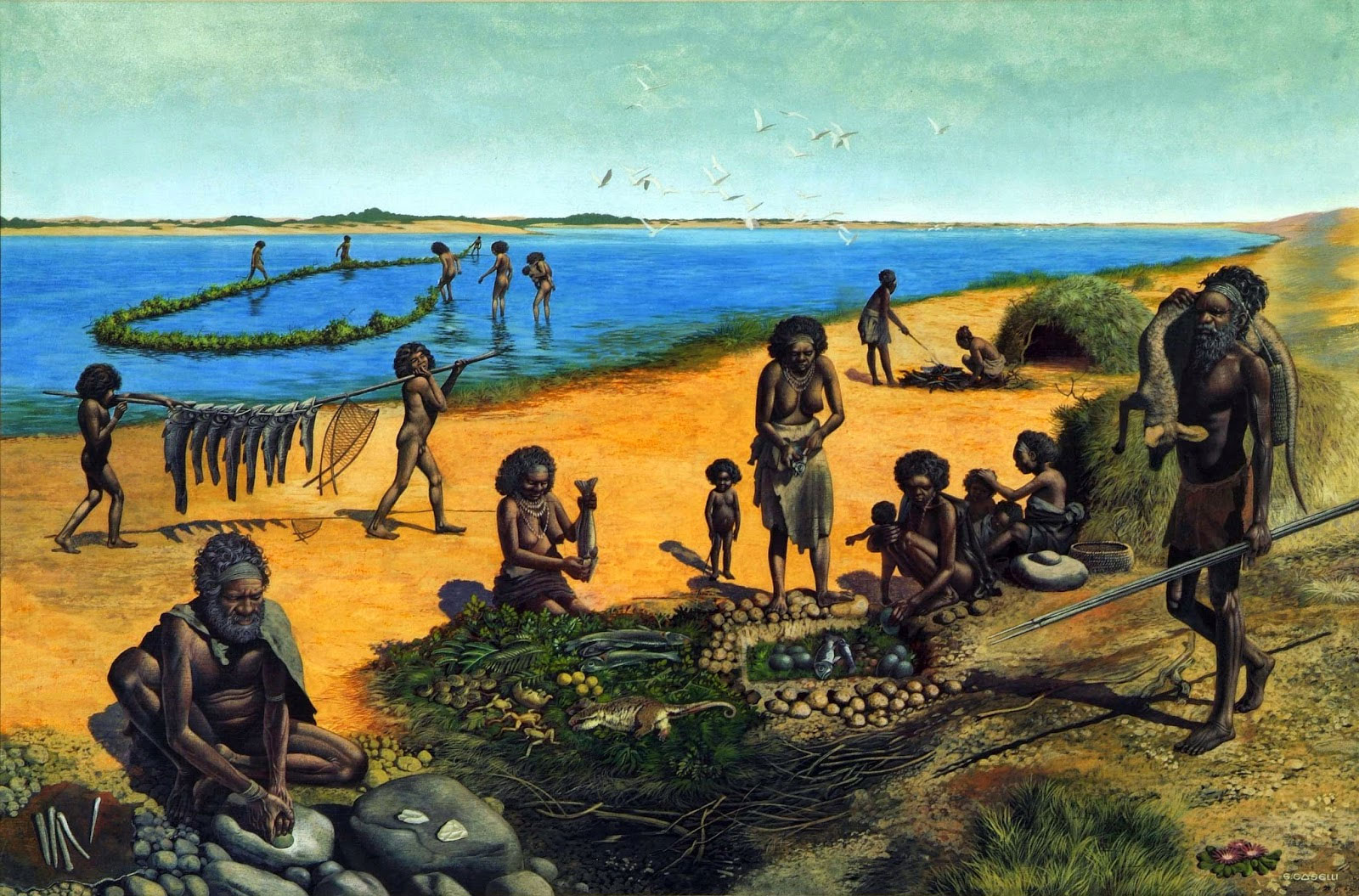
The First Race: Out-of-Australia, Not Africa
by Steve
Strong
The First
Nations peoples of the Great Southern continent now called Australia were not
ignorant savages
stagnating in their primitive inadequacies and laziness, as the British
invaders have been maintaining and indeed teaching for the past 230 years.
Archaeologist's findings together with scientific analogy is now pointing
towards the history of these people as the beginning of what is known as 'modern
man' in this region, at least.
Professor
Clive Gamble (Southampton University) succinctly summarised the current impasse
and polarisation this has caused, when declaring we have to construct "a
completely new map of the world and how we peopled it."1 Granted, our
response to Gambles call may seem radical, however, these discoveries, found
not only in America but throughout the entire Indo-Pacific Region, all point to
the same ancient southern inspiration.
After
extensive consultation and research, we are of the opinion that at some time in
the distant past, no less than 50,000 years ago and possibly much earlier,
Aboriginal men and women set sail from Australia and began exploring foreign
lands. They were the bearers of new insights and options, and bequeathed
humanity the cornerstones of civilisation: religion, culture, gender equality,
art, sailing, democracy, astronomy, surgery, and their genes.
Australian
Aboriginal guardians of traditional Lore and Law have made it clear to us that
they are indeed the "First Race."2 They were not, as assumed by some of
the general public, ignorant savages stagnating in their primitive inertia. As
highly respected Dhungutti Elder Rueben Kelly states, "Centuries ago you
white people chose the path of science and technology. That path will destroy
the planet. Our role is to protect the planet. We are hoping you will discover
that before it’s too late."3
Unlike
others out in the field or laboratory, we’ve discovered nothing: our role is to
act as scribes and faithfully present their history. The rest is easy: find
white-fella proof to substantiate black-fella truth.
'Out of Africa' questioned by one of the leading
proponent of the theory

Christopher
Stringer is one of the world's foremost paleoanthropologists. He is a founder and
most powerful advocate of the leading theory concerning the evolution of modern
man: Recent African Origin or 'Out of Africa.' He now calls the theory into
question: 'I'm thinking a lot about species concepts as applied to humans,
about the "Out of Africa" model, and also looking back into Africa
itself.
I think the idea that modern humans originated in Africa is still a sound
concept. Behaviorally and physically, we began our story there, but I've come
around to thinking that it wasn't a simple origin. Twenty years ago, I would
have argued that our species evolved in one place, maybe in East Africa or
South Africa.
There was a period of time in just one place where a small population of humans
became modern, physically and behaviourally. Isolated and perhaps stressed by
climate change, this drove a rapid and punctuational origin for our species.
Now I don't think it was that simple, either within or outside of
Africa.'"
Stringer studied anthropology at University College London, and holds a PhD in
Anatomical Science, and a DSc in Anatomical Science both from Bristol
University.
Questioning
Out-of-Africa
Before
setting off on this ancient journey there is one destination and exodus that
needs to be repositioned: Africa. According to academics and archaeological
texts, Africa is the place from where modern humans evolved then spread their
genes throughout the continents. The Out-of-Africa theory has over the years,
since first proposed, transformed into fact. One of the original papers laying
claim to charting our ancient ancestors movements and origin, The Recent African Genesis of Humans,
written by Professors Alan Wilson and Rebecca Cann, is acknowledged as the
closing chapter in this mystery. However, amongst the absolutes was one
qualifier that has been conveniently and repeatedly overlooked. Wisely, with
the benefit of hindsight, the authors stated Homo
sapiens "probably,"4 never definitely, evolved in Africa.
Wilson and
Cann proposed all modern humans shared the same ancient mother, who they named
Eve, and according to their calculations she lived in Africa at sometime
between 150-200,000 years ago. Of crucial importance are two of the three
assumptions that underpin their mathematics.
The
aboriginal (sic) populations of New Guinea and Australia are estimated to have
been founded less than 50,000 to 60,000 years ago. The amount of evolution that
has since occurred in each of those places seems about one third of that shown
by the whole human species. Accordingly, we can infer that Eve lived three
times 50,000 to 60,000 years ago, or roughly 150,000 to 180,000 years ago.5
This
declaration was regarded as the final word, and the resolution of "15
years of disagreement"6
between two branches of science. Wilson and Cann triumphantly proclaimed
victory on behalf of the molecular geneticists declaring that "we won the
argument, when the palaeontologists admitted we had been right and they had
been wrong."7
With the
case closed and bragging rights secured in perpetuity, science had once again
provided certainty and an African ancestry. Or so it seemed. But not long after
their paper was published Rebecca Cann realised they were mistaken. In 1982 she
examined the mitochondrial DNA of 112 Indigenous people, including twelve
full-descent Aboriginals, and the results were in total opposition to what they
assumed was fully resolved.
Nevertheless,
Cann was obliged to contradict a central tenet of their paper, stating that
"mitochondrial DNA puts the origin of Homo
sapiens much further back and indicates that the Australian
Aboriginals arose 400,000 years ago from two distinct lineages, far earlier
than any other racial type."8
Not only was the emergence of Aboriginal Homo
sapiens "far earlier"9 than any Africans, she provided a
sequence and motherland.
The
Australian racial group has a much higher number of mutations than any other
racial group, which suggests that the Australians split off from a common
ancestor about 400,000 years ago. By the same theory, the Mongoloid originated
about 100,000 years ago, and the Negroid and Caucasian groups about 40,000
years ago.10
The
realignment and reversals were of immediate concern to Alan Wilson. If Cann was
correct in detecting a "much higher number of mutations"11 they may as well
tear up their original paper.
Desperate to
resolve the obvious inconsistencies, Wilson made two visits to Australia. In
1987, Wilson sampled the mtDNA of 21 full-descent Australian Aboriginals and
provided 15 different strands. This number was well outside what anyone
expected and compelled Wilson to unconvincingly conclude there were more than
15 pregnant females on the first boat. A second visit in 1989 increased the
crew size to levels that quite literally sank the boat as it entered the water,
and forced Wilson to abandon Africa as the place where Homo sapiens originated.
From a second sampling of ten, a similar percentage (70%) of mutation was
present. Upon receiving the results of his second mtDNA sampling Wilson
immediately conceded the Out-of-Africa theory was wrong.
The math
wasn’t complicated: the agreed rate of mtDNA mutation for every new strand is
3,500 years, therefore 22 x 3,500 = 77,000 years. Wilson realised if he
returned and increased the population surveyed, so too would the crew-size
increase. He was left with no other option but to dismiss their original paper.
It seems too
far out to admit, but while Homo
erectus was muddling along in the rest of the world, a few erectus had got to
Australia and did something dramatically different - not even with stone tools
- but it is there that Homo
sapiens have emerged and evolved ... Homo sapiens would have evolved free from
competition out of a small band of Homo
erectus 400,000 years ago.12
Sadly, and
somewhat puzzlingly, these findings were mostly ignored. In fact, opposition to
the Out-of-Africa theory lost momentum. Perhaps this timid climate goes some
way towards explaining the reactions to Alan Thornes research into the genetics
and antiquity of Lake Mungo Man (WLH3). Re-dated to be over 60,000 years old
and the oldest Homo sapiens
yet found, this in itself raises serious doubts relating to the credentials of
any theory claiming the first mariners reached the northern parts of Australia
60,000 years ago. Thousands of kilometres from any potential point of entry,
the practicalities involved in reaching this distant in-land lake within days
after disembarking are insurmountable. This date, coupled with the discovery
that WLH3 had an "extinct DNA"13
which does not resemble any other population, surely calls into question the
reality of an African migration.
Referring
back to Wilson and Cann’s original calculations, their proposed timing of
somewhere between 50-60,000 years stands on no less shaky ground than their
genetic miscalculation. There are at least ten Australian sites claimed to be
older than 60,000 years, granted every date is challenged by conservative
critics, but even so, all are the products of respected academics.
What needs
to be accepted is that if just one date proves to be correct, irrespective of
whatever judgment is passed on the other nine, it can be confidently declared
as a fact that Australia was not settled by African Homo sapiens 60,000 years ago. Whether the
winning site turns out to be Lake George-fire-stick farming (120,000 years);
Lake Eyre-skullcap (135,000 years); Jinmium-tools (176,000 years);
Panaramittee-rock-engraving of saltwater crocodile (75,000 years); Rottnest
Island-tools (70,000 years); Devonport-rock-engravings (>115,000 years);
Jinmium-art (75-116,000 years); Great Barrier Reef-fire-stick farming (185,000
years); Lake Mungo (WLH3)-complete skeleton (61-65,000 years); or
(WLH1)-cremated bones (61,000 years); one out of the ten is sufficient to deny
African entry.
Dating
has put the age of the Mungo Man remains at between 56,000 and 68,000 years
Mungo Man
was discovered at Lake Mungo in far west NSW in 1974. The skeleton had been
covered in red ochre during a burial ritual with the hands interlocked and
positioned over the penis. These remains were found in same area as cremated
remains of female skeleton known by local Aborigines as Mungo Lady
Recent lab
studies of this type have suggested that our most recent common ancestor lived
less than 200,000 years ago in Africa.
Australian
researchers now say that the DNA sequences isolated from Mungo Man's bones show
him to have a genetic lineage that is both older and distinct from the African
line.
Given the
undoubted modern appearance of Mungo Man, they argue, major doubt must now be
cast on the so-called "Out of Africa" hypothesis in which all living
people are said to be descended from a group of modern humans who left their
African homeland no earlier than about 120,000 years ago.
The First Americans
Compounding
the inconsistencies of the Out-of-Africa theory is the recent discoveries of
"hundreds of skeletal remains"14
in America that "look like Australian Aborigines."15
In the
October/November edition of Cosmos,
Jacqui Hayes presented a compelling morphological case in support
of Australian Aboriginal presence in America. According to Hayes, Aboriginal
settlement of the Americas began at an indeterminate time before the second
migration of people "with distinctive Mongoloid features"16 and left, within
her by-line, a series of unresolved questions.
When stating
that "startling new finds suggest Australia’s first people made it all the
way to South America more than 11,000 years ago,"17 the narrative is
incomplete. How far back did these Aboriginal settlements span, and were other
locations settled? If indeed Hayes is right in that Australian Aboriginal
people were in America, any date obtained beyond 11,000 years must be due to
the actions of people bearing Australian Aboriginal genes.
The
impossibility of any African migration, genes or antigens entering America, was
confirmed through the examination of Aboriginal bones establishing the presence
of distinctive antigens.
Arnaiz-Vilena
and his team looked at the human leukocyte antigen (HLA) system, which is a
group of proteins on the surface of human immune cells. The HLAs are what the
doctors test for to determine whether one person’s tissues are compatible for
organ or bone transplants. HLA is a nuclear marker giving an even genealogy and
genetic history for both sexes. The best test showing that HLA is a good
genetic marker for studying population relatedness is that it usually
correlates with geography.18
As expected,
the first nominee was Australian, but just as importantly the comparative
results bore witness to one notable omission: it seems the Africans forgot to
sign on.
"So
what did they find? Unique signatures only found in Australian Aborigines,
Pacific Islanders, and peoples in Asia and even in Europe."19 Missing in action
and mention, the non-appearance of African HLA is yet another inconvenient
piece of evidence that bears an Australian imprint.
When
recalibrating this Australian Aboriginal/American time-line, dates just
exceeding the maximum Clovis (Mongoloid) entry date are certainly inconvenient,
but not demanding of tearing out pages. Corroborating evidence of Aboriginal
presence during the 10,000 years before the second migration from Asian began
can be found at Tlapacoya, 21,700-25,000 B.P., Los Toldos Cave, Patagonia,
14-15,000 B.P., "Meadowbank Rockshelter 19,000 B.P. (southwest
Pennsylvania), Tibito 14,400 B.P. (Columbia), Walker 15,000 B.P. (Minnesota)
and Mud Lake 13,450 B.P. (Wisconsin)."20
But it doesn’t
stop there. Professor Silvia Gonzales, who is a leading advocate of the
Out-of-Australia theory, was quite staggered21 by the dates obtained when analysing
footprints found in a layer of volcanic ash at Lake Vasequillo (Mexico).
"A variety of prints (human and animal) captured in this layer of rock
were dated using O.S.L."22
She found, much to her understandable surprise, that 40,000 years marked the
"last time that these sediments were lit by the suns rays or the last time
that the material was heated."23
Gonzales is adamant these are Australian Aboriginal footprints, and that they
reached America by boat through means of "island hopping"24 around the
Pacific Basin.
Such a date,
40,000 years, pushes the boundaries and affirms an extensive Aboriginal tenure,
and does not stand alone. The corroborative timing at Albert Goodyears site,
accentuated by the considerable distance between locations, cannot be a
coincidence.
Goodyear had
been working at an archaeological site on the Savannah river, near Topper. It
was agreed all the available evidence from the Clovis site had been gathered
and their work was complete ... He kept digging for another four metres before
an assortment of stone tools, along with a hearth, were unearthed. A small
piece of charcoal was then analysed by counting the residual Carbon 14 and a
date of no less than 37,000 years was deemed appropriate.25
Uncomfortable
as these dates are in relation to when ancient Australian Aboriginals first
came to America, it gets worse for any clinging to traditional theories.
Not far from
the Lake Vasequillo footprints Gonzales investigated is another site that was
deliberately ignored for close to 30 years after a comprehensive investigation
conducted by Cynthia Irwin-Williams. The dates are so sensational and numerous,
and so obviously associated with objects made by Homo sapiens artists, the archaeologists
downed tools and clipboards and vowed never to return. The dates returned by a
variety of sound geological analyses were far too ancient, not only for
occupation, but well outside the assumed period when Homo sapiens first
appeared. To some extent the issue isnt just a matter of whether these numbers
are feasible, but more a case of open antagonism between two competing branches
of science.
Christopher
Hardaker, author of The
First American, created a fictional conversation between the two
competing parties that graphically highlights how the argument over which group
of academics is right has blinded the combatants.
ARCHAEOLOGIST:
You are asking us to believe that the sophisticated art and technology of the
Upper Palaeolithic was actually invented over 200,000 years ago in Central
Mexico by Homo erectus?
Ridiculous. GEOLOGIST: You are asking us to believe that Science is off by a
magnitude of 10? Ridiculous.26
Often the
result of cutting-edge technology, the chemicals analysed and computations made
came from extremely reputable institutions and individuals. Some of the
offending techniques and dates (which came from the layer of volcanic ash and
debris deposited above the artefacts/or footprints) include: Uranium Series
Dating (200,000 years); Zircon Fission Track (170-640,000 years); mineral
solutions (200,000 years); Diatom analysis (80,000 years); U-Th/He (200,000
years); tephrahydration (250,000 years); magnetic shifts in rocks (790,000 years);
and argon argon (1,300,000 years).
The facts,
and large figures, demand a response. What if just one date is actually right?
Does that mean Homo sapiens
were, as Christopher Hardaker claims, responsible for "600,000 year old
art?"27
If so, does this alone suggest the often sniggered at talk of Mu, Atlantis and
other ancient civilisations has real geological substance?
As to
whether Gonzales "island hopping"28 route from Australia, up through
Asia, Japan, Siberia then America is plausible, it is often said a picture can
act as a worthy substitute for quite a few words. The photograph (see page 27)
of the Japanese full-descent Ainu Elder was taken in the late 19th
century by German anthropologist Dr. Hermann Klaatsch. The physical
characteristics displayed in this photograph, in association with the recent
discovery of "a very well-preserved skeleton from Gua Gunung,
Malaysia,"29
resonates to one ancient southern inspiration. The Malaysian "specimen is
aged 10,200 B.P. and is said to be a late representative of a non-specialised
morphology, similar to Australian Aborigines."30
The First Boat
For the
appearance of a population "similar to Australian"31 Aboriginals in
Malaysia, Japan, America, or any other place, a boat is needed. The
oft-proposed settlement of Australia from Africa by ramshackle raft, or through
desperately clinging on to driftwood during storms, doesnt measure up. This
vessel must be able to withstand monsoons and weeks at sea, and accommodate a
crew of close to 20 adults to negate in-breeding thus successfully repopulate
an uninhabited continent. Nowhere today is anyone going to discover the actual
ancient wooden remains of such an ancient sophisticated "ocean-going"32 vessel. But if
seeking out everything else bar the planks there is only one place to look.
Graham Walsh
was "the widely recognised authority on the intriguing Bradshaw art of the
Kimberley area ... Within this area, he has discovered the oldest paintings of
boats in the world, dated at a minimum age of 17,000 years, but with the strong
possibility of being up to 50,000 years old ... "33 Walsh insisted
that the "high prow of the boat"34 is "unnecessary for boats used
in calm, inland waters. The design suggests it was used on the open
ocean."35
Walsh was quite shocked by the function, antiquity, and most importantly
dimensions of these vessels: "they are massive boats, totally alien."36 Moreover not only
was the sophistication and technology exhibited difficult for Walsh to
assimilate, he still had to account for the reasons why there were "two
paintings of ocean-going boats, one with 23 people on board, the other
29."37
These are
ideal numbers as foundation populations when sailing towards distant lands,
however diagrams and specifications do not make a boat. To have a clever idea
is a promising first step, but there are some practicalities to be addressed
before any idea takes form. There are materials, tools, and navigation skills
required which supposedly did not exist for at least another 20,000 years.
Irrespective of what is assumed, the first tool needed to build a ship that can
comfortably cater for 30 people, is an axe. Wood in its prime, not the rotting
logs that fall, is essential in manufacturing a vessel strong enough to sail
across oceans.
It should
come as no surprise that the oldest axe in the world, dated at 40,000 years,
was found at Huon Terrace PNG (which was part of the Australian mainland until
8,000 years ago), others discovered in Jaowyn land, Northern Territory (35,500
years), at Sandy Creek, Queensland (32,000 years) and Malangangerr Northern
Territory (23,000), are all at least 8,000 years older than the first axe found
outside Australia (Niah Cave, Sarawak, 15,000 years).
With axe at
hand, plans on the wall, and overseas bookings made, there still remains one vital
navigational skill any journey beyond landfall demands. Hugh Cairns book Dark Sparklers is the
first and only publication dedicated to the sharing of traditional Aboriginal
astronomical knowledge. Cairns won the trust of Wardaman Elder Bill Harnley, who
spoke of his ancestral knowledge of the stars, "great black shapes,"38 the movements and
constellations in between, and of up "on top."39 According to
Cairns, there have been Aboriginal astronomers for "over 30,000
years."40
Not only the
Pacific, but the Indian Ocean, was a path used to navigate then share so many
esoteric gifts, technologies, guidelines, and of course, genes.
"Dr.
Raghavendra Rao and researchers from the Indian-backed Anthropological Survey
of India project found unique mutations were shared between modern-day Indians
and Aborigines."41
They "identified seven people from central Dravidian and Austro-Asiatic
tribes who shared genetic traits only found in Aborigines."42
Much earlier
linguistic studies of the Dravidian language had already identified the same
relationship. Dravidian "fishermen of the Madras coast use almost the same
words for I, thou, he, we, and
you as some
Aboriginal tribes. Many other key words in the Dravidian dialects are identical
in Tasmanian Aboriginal terms both in pronunciation and meaning."43
It needs to
be appreciated that Tasmanian culture and language is a relatively recent
event, and the island is the outcome of the final thawing at the end of the
last Ice Age when the seas covered the low plains between Victoria and
Tasmania. Over the last 8,000 years this isolation has been instrumental in the
development of a distinctive Tasmanian culture.44
With a
language that came into existence no earlier than 8,000 years ago forming a
substantial part of the basic Dravidian vocabulary, this mtDNA connection
strongly suggests the Australian Aboriginals kept in contact with India for
some considerable time.
Especially
since "Australian canoes are constructed identically to those of the
coastal Dravidian tribes of India, and wild tribes in the Deccan region of
India are the only culture known to use the boomerang outside Australia."45 The oldest
boomerang discovered in the world was found at Wyrie Swamp, South Australia,
and is dated at 10,200 years.
The dingo,
accepted to have been brought into Australia from somewhere in Asia about 6,000
years ago, only strengthens the possibility of an extended Australo-Indian
link. It would appear that the Dravidians adopted the Australian boomerang to
hunt with, chose their better designed canoes to assist in fishing, and as is
often the case when two cultures first meet, shared technology, friendship and
genes.
There is so
much more to this ancient Aboriginal narrative. At best we have provided a
brief geographical overview of where ancient Aboriginal people sailed, and
hopefully presented evidence validating their belief that they are descendents
of the "First Race."46
Whether the
African strand of Homo
sapiens emerged 40,000 years ago is of no account, our focus is on
the much earlier Australian genes, journeys and heritage. We have examined a
few of the locations reached, but as for the religious legacy of the Dreaming as evidenced
through the nine shared mystical principles,
underpinned by equality of gender and species, that is yet another chapter of
an ancient story that spans eons and geography. Their intimate awareness of the
divine, along with the lesser gifts of sailing, astronomy, brain surgery,
penicillin, burial/cremation/embalming, amputations, axe-making, democracy,
bows and arrows, and so much more, is part of a forgotten origin that deserves
to be heard once more.
Footnotes
1.
"Australias First Americans," Daily
Telegraph, 8 September 2004, 3 (n).
2. The Nephew of Reuben Kelly, 2010, Recounting
Uncle Rueben Kelly From his Nephew, Personal Communication to Steven Strong.
3. Anne Wilson Schaef, Native
Wisdom for White Minds: Daily Reflections Inspired by the Native Peoples of the
World (Random House, 1995).
4. Allan C. Wilson & Rebecca L. Cann, "The Recent African Genesis of
Humans: Genetic Studies Reveal That an African Woman of 200,000 Years Ago Was
Our Common Ancestor," Scientific
American 266, no. 4. (April 1992), 68.
5. Ibid. 72.
6. Ibid. 68.
7. Ibid. 68.
8. Robert Lawlor, Voices of
the First Day: Awakening in the Aboriginal Dreamtime (Inner
Traditions International, 1991), 26.
9. Ibid. 26
10. Ibid. 26.
11. Ibid. 26.
12. Ibid. 26.
13. Leigh Dayton, "DNA Clue to Mans Origin: How Mungo Man Has Shaken the
Human Family Tree," The
Australian, 9 January 2001, 1(n).
14. Jacqui Hayes, "Ancient Odyssey," Cosmos issue 35, 2010, 42.
15. Ibid. 39.
16. Ibid. 40.
17. Ibid. Front Cover.
18. Ibid. 45.
19. Ibid. 45.
20. Steven Strong & Evan Strong, Constructing
a New World Map, 1st ed. (University Press of America Inc., 2008),
42.
21. Martin Redfern (producer/reporter), Pauline Newman (producer) & Robyn
Williams (presenter), "Oldest American Footprints" (transcript), The Science Show, ABC
Radio National, 11 Feb. 2006, http://abc.net.au/rn/sciencesshow/stories/2006/1564746.htm
(link is external)
22. Strong & Strong, Constructing
a New World Map, 48.
23. Redfern, Newman & Williams, The
Science Show.
24. Ibid.
25. Strong & Strong, Constructing
a New World Map, 49.
26. Christopher Hardaker, The
First American: The Suppressed Story of the People Who Discovered the New World
(New Page Books, 2007), 187.
27. Ibid. 45.
28. Redfern, Newman & Williams, The
Science Show.
29. Walter A. Neves & Mark Hubbe, "Cranial Morphology of Early
Americans from Lagoa Santa, Brazil: Implicatons for the Settlement of the New
World," Proceedings of
the National Academy of Sciences of the United States of America 102,
no. 51 (2005), www.pubmedcentral.nih.gov/articlerender.fcgi?artid=1317934
(link is external), 467.
30. Ibid. 467.
31. Ibid. 467.
32. Michael Winkler, "Rock Star of the Kimberley," The Age, 20 Sept. 2004.
33. Strong & Strong, Constructing
a New World Map, 47.
34. "First Americans Were Australian," BBC News, 26 Aug. 1999, http://news.bbc.co.uk/2/hi/science/nature/430944.stm.
(link is external)
35. Ibid.
36. Winkler, "Rock Star of the Kimberley."
37. Ibid.
38. Hugh Cairns & Bill Yidumbuma, Dark
Sparklers, 2nd ed. (H.C. Cairnes, 2004),
39. Ibid. 39.
40. Ibid. 42.
41. AAP, "First Australians Were Indian: Research," Sydney Morning Herald, 23
July 2009(n); Within Steven Strong & Evan Strong, Forgotten Origin
(University Press of America, Inc., 2010), 16.
42. AAP, "First Australians Were Indian: Research"; Within Strong
& Strong, Forgotten
Origin, 16.
43. Lawlor, Voices of the
First Day, 120.
44. Strong & Strong, Forgotten
Origin, 17.
45. Lawlor, Voices of the
First Day, 120-121.
46. Kelly
- Scroll down
through ‘Older Posts’ at the end of each section
Do you LIKE this uniquely informative site?
Hours of effort by a genuinely incapacitated invalid are
required every day to maintain, write, edit, research, illustrate, moderate and
publish this website from a tiny cabin in a remote forest.
Now that most people use ad blockers and view these posts
on phones and other mobile devices, sites like this earn an ever shrinking
pittance from advertising sponsorship. This site needs your help.
Like
what you see? Please give anything you can -
Contribute any amount and receive at least one
New Illuminati eBook!
(You can use a card securely if you don’t use Paypal)
Please click below -
Spare Bitcoin
change?
And it costs nothing
to share this post on Social Media!
Dare to care and
share - YOU are our only advertisement!
And see
New Illuminati’s OWN Youtube Videos
-
DISGRUNTLED SITE ADMINS PLEASE NOTE –
We provide
a live link to your original material on your site (and links via social
networking services) - which raises your ranking on search engines and helps
spread your info further!
This site
is published under Creative Commons (Attribution) CopyRIGHT (unless an
individual article or other item is declared otherwise by the copyright
holder). Reproduction for non-profit use is permitted & encouraged - if you
give attribution to the work & author and include all links in the original
(along with this or a similar notice).
Feel free
to make non-commercial hard (printed) or software copies or mirror sites - you
never know how long something will stay glued to the web – but remember
attribution!
If you
like what you see, please send a donation (no amount is too small or too large)
or leave a comment – and thanks for reading this far…
Live long
and prosper! Together we can create the best of all possible worlds…