"All the World's a Stage We Pass Through" R. Ayana

Showing posts with label hobbits. Show all posts

Friday, 17 June 2016

The Little People of Kuranda
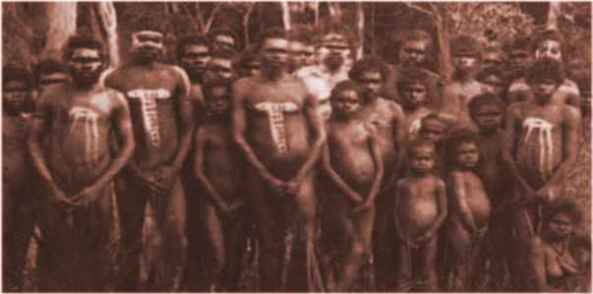

The Little People of Kuranda

little1


Today’s post is about a little known tribe of Little People that still exists today in Far North Queensland, Australia.

In the 1400’s and 1500’s, Dutch and Portuguese sailors sighting the Western Australian coastline noted “tall natives in warfare chasing and killing hordes of “little” native peoples”.

Yet, since then, the Australian pygmies have been totally obliterated from public memory.

The Encyclopedia of Aboriginal Australia (1994), published by the Australian Institute of Aboriginal and Torres Strait Islander Studies, today does its best to disguise these people. It lists some of their tribes, including the Djabuganjdji, Mbarbaram (Barbaram) and Yidinjdji (Indindji), but does not mention a word about their stature. Only its entry “Rainforest Region” records the existence of “small, curly-haired people with languages which have distinctive features”, but the accompanying photograph of Yidinjdji tribesmen taken in 1893 does not give any scale or point of comparison to show that these adult males were only about 140 centimeters (four feet six inches) tall.


little6Joseph Birdsell, height 186 centimetres (six feet one inch), with twenty-four-year-old male of the Kongkandji tribe, height 140 centimetres (four feet six inches). The photograph was taken at Mona Mona Mission, near Kuranda, North Queensland, in 1938.


The Little People are still alive and well in the forests around Kuranda, which any Djabagay or Bulawai will confirm, their survival due to the fact that they cannot be seen by the whitefella.

Kuranda Primary School has the lowest average height amongst Original peoples in any school in the whole of Australia.

Watch this video from 23m15s for more evidence: : https://www.youtube.com/watch?t=1242&v=fisLWLggrcM


little3little5little9


A June 1861 report describes the first colonial encounter with this remote tribe :

“… their strange speech came forward in very soft tones… almost a whisper… a most unusual observance… took to conversation in (known) tongues… they commenced to converse with each other not using language… communication was in hand gestures and tongue “clicking”… tried to communicate with their hand signals… could not take to their unclear meanings… spoke again in (Mary River) Ka’bi language… response came forward finally… learnt that the ancient ones of Dha’muri… taught their ancestors the sign language… found all of this most unusual… able to record that these people were not in size a large clan group only numbering near one hundred and were scattered in the forests… they gave signals to follow them to an area on the shoreline… took to amazement on witnessing a stone structure of columns and an archway of great age… a state of collapse near four ceremonial rings… stonework lay on the ground and in the waters… the name Dha’muri was mentioned… took to quick artistry of the scene and the writings on the pinnacles… made contact with the remaining clan at a place called War’pbunga… the Place of the Frogs…”

What eventually happened to the Cairns rainforest people?

The following (edited) report of June 1864 tells of the “little people’s” shocking demise:

“… awoke to the sound of much gunfire… came across a most despicable act of humanity… as if a great war had been fought… bloodied native corpses covering the grounds and in the stream waters… recognised these were the Dhi’lumi little peoples of … previous acquaintances… peppered with gunshot… his woman bearing signs of harsh raping… throat slashed… their daughter and son… killed part decapitated and hanging over a tree branch – the son less his manly wares… slaughter appears to have been immediate without warning… cooking fires were still burning… their shantys and possessions lay strewn about the ground… utter disgust that these shy, ancient and good people had been shot to their deaths… Who could have done such an evil and dastardly deed?”

“… viewed the bloody scene with much contempt… none had survived. This last group of the Dhi’lumi were all quite dead… 43 members of the clan as I had counted… five old men and eleven other males were shot… their scrotums cut away… five old women and six young women… staked, tied down and then brutalised… signs of virginity lost or rampant bodily attacked then shot in the head… found six young boys and six young girls of the near ages of 9 to 12 years… brutalised in a most cruel manner similar to their mothers… blood seeping from their front and rear orifices. Bastards! Bastards! … The last were found in the tall water bushes of the stream… 4 young babies (2 boys and 2 girls)… their small throats cut open to dye the waters and left to die… lone act with the small children emptied my churning stomach of its full contents. What manner of animal could do such atrocities to another human being?”

The settlement at Yarrabah still exists at Cape Grafton. After 1897 it was not confined to the local people but accommodated Aborigines from all over North Queensland. The missionaries deliberately disrupted traditional tribal betrothals so that a fair amount of inter-marriage took place. It ceased to be a mission in 1960 when it was taken over by the Queensland Government. In 1986 it became a self-governing Aboriginal community but by then a large number of residents had left.

Mona Mona mission continued until 1962 when it was closed down. Its residents were dispersed to other Aboriginal reserves and into the general population. Some former residents now living at Kuranda want the original mission land returned to them.


Today, there are 14,700 Aboriginal people living in the Cairns region. We presume a good proportion of them must be descendants of the original Kongkandji, Barbaram, Indindji and Djabuganjdji tribes.

The first extended contact between Europeans and Australian pygmies occurred in the 1890s at Yarrabah, an Anglican church mission to Aborigines established in 1892 at Cape Grafton, just south of Cairns. The three main tribes in the region were the Kongkandji (Gungganydji), Indindji and Barbaram, whose territories covered, respectively, the coastal area around Cape Grafton, the eastern slopes of the Atherton Tableland from Lake Barrine south to Gordonvale, and the Great Dividing Range behind Cairns. All of them shared the same very short physical stature, as well as similar languages and culture.

In the mission’s first five years, about 150 Kongkandji periodically visited to receive rations but only a small number remained there permanently. After the Queensland Government passed its Aboriginal Protection Act in 1897, which forced Aborigines to be legally confined to reserves and missions, Yarrabah grew to a settlement of 150 residents drawn not only from the three local tribes but also from people all over North Queensland who bore no physical or cultural resemblance to the Cape Grafton Aborigines. Outside the mission, however, no one paid these people any special attention until an Adelaide researcher came across them in the late 1930s.

In 1938, Norman Tindale, an entomologist and anthropologist at the South Australian Museum, was going through a package of old photographs of Aborigines from the Warburton Mission sent him by a friend in Western Australia. One of the photographs of a group of men and women was labeled “Aborigines of north-west Australia”. The Warburton Mission was on the edge of the Gibson Desert, but the background of the photograph was clearly tropical jungle. It showed a wet weather hut thatched with what Tindale, a keen naturalist, recognized as the broad leaves of the wild banana tree. He could also tell that, if these were banana leaves, the people by comparison were very small. He made some enquiries and soon found that the only remaining stands of this plant were in the tropical rainforests on the eastern slopes of the Atherton Tableland in North Queensland.

At the time, Tindale and the American academic, Joseph Birdsell, were engaged in the most extensive project ever mounted in Australian physical anthropology to measure a large sample of Aborigines according to their weight, stature and a number of other bodily characteristics. They found the prospect of discovering a group in the Queensland rainforests so at variance with the norm, irresistible.

They also knew that, since the nineteenth century, there had been a number of theories about the origins of the Aborigines and the migration of ancient peoples to the Australian continent. In 1927, in his book, Environment and Race, the controversial Sydney geographer, Griffith Taylor, had speculated that several waves of Aboriginal migrants had swept before them an even older “Negrito” race. Maybe these rainforest people held the key to the story.

As soon as they could, Tindale and Birdsell drove from Adelaide to Cairns in search of the people in the photograph. They eventually found six hundred of them from twelve different tribal groups living on and around two missions, Yarrabah at Cape Grafton and Mona Mona at Kuranda on the Atherton Tableland. Some of them had only come in from the rainforest within the previous six years and spoke only their native tongue. They said there was still one family living a completely nomadic, hunter-gatherer life in the mountains behind Cardwell.

Tindale and Birdsell examined and measured 52 adults and children at Cape Grafton and 95 at Kuranda. Most adult males were between 140 and 150 centimeters tall (four feet six inches to five feet). The women were shorter by 15 to 30 centimeters (six to twelve inches). Tindale and Birdsell concluded they were not just small but were radically unlike any other Aborigines in Australia. They named them Barrineans, after nearby Lake Barrine. Tindale later said:

Their small size, tightly curled hair, child-like faces, peculiarities in their tooth dimensions and their blood groupings showed that they were different from other Australian Aborigines and had a strong strain of Negrito in them. Their faces bore unmistakable resemblances to those of the now extinct Tasmanians, as shown by photographs and plaster casts of the last of those people.

By 1963, when Tindale wrote these words in his book, Aboriginal Australians, the Barrinean pygmies were no longer an unknown people consigned to the oblivion of distant mission stations. Nor were they mere physical curiosities. They had become the centerpiece of what was then a widely influential explanation of the origins of human settlement on this continent.


References:

http://www.warriors.egympie.com.au/littlepeople.html
https://quadrant.org.au/opinion/history-wars/2002/06/the-extinction-of-the-australian-pygmies/


For more information about indigenous Australians see http://nexusilluminati.blogspot.com/search/label/indigenous%20australians
- Scroll down through ‘Older Posts’ at the end of each section


Do you LIKE this uniquely informative site?
Hours of effort by a genuinely incapacitated invalid are required every day to maintain, write, edit, research, illustrate, moderate and publish this website from a tiny cabin in a remote forest.
Now that most people use ad blockers and view these posts on phones and other mobile devices, sites like this earn an ever shrinking pittance from advertising sponsorship. This site needs your help.
Like what you see? Please give anything you can -  
Contribute any amount and receive at least one New Illuminati eBook!
(You can use a card securely if you don’t use Paypal)
Please click below -


Spare Bitcoin change?

script src="http://coinwidget.com/widget/coin.js">

And it costs nothing to share this post on Social Media!
Dare to care and share - YOU are our only advertisement!


For further enlightening information enter a word or phrase into the random synchronistic search box @ the top left of http://nexusilluminati.blogspot.com


And see


 New Illuminati on Facebook - https://www.facebook.com/the.new.illuminati

New Illuminati Youtube Channel -  https://www.youtube.com/user/newilluminati/playlists

New Illuminati’s OWN Youtube Videos -  
New Illuminati on Google+ @ For New Illuminati posts - https://plus.google.com/u/0/+RamAyana0/posts

New Illuminati on Twitter @ www.twitter.com/new_illuminati


New Illuminations –Art(icles) by R. Ayana @ http://newilluminations.blogspot.com

The Her(m)etic Hermit - http://hermetic.blog.com


DISGRUNTLED SITE ADMINS PLEASE NOTE –
We provide a live link to your original material on your site (and links via social networking services) - which raises your ranking on search engines and helps spread your info further!

This site is published under Creative Commons (Attribution) CopyRIGHT (unless an individual article or other item is declared otherwise by the copyright holder). Reproduction for non-profit use is permitted & encouraged - if you give attribution to the work & author and include all links in the original (along with this or a similar notice).

Feel free to make non-commercial hard (printed) or software copies or mirror sites - you never know how long something will stay glued to the web – but remember attribution!

If you like what you see, please send a donation (no amount is too small or too large) or leave a comment – and thanks for reading this far…

Live long and prosper! Together we can create the best of all possible worlds…


From the New Illuminati – http://nexusilluminati.blogspot.com

Monday, 23 December 2013

Yowie and Eastern Bigfoot, the Solo connection


Yowie and Eastern Bigfoot, the Solo connection

http://upload.wikimedia.org/wikipedia/commons/7/76/Sasquatch_Statue.jpg

  by Dale Drinnon


The article below refers to the Australian Yowies but the first illustration is a "Marked Hominid" - Which calls to mind the curious circumstance that the type specimen for Marked Hominind is a skull that has a braincase that resembles the so-called Solo Man of Java, a presumptive ancestor for Australia's Yowies. This skull is sometimes claimed as a late Homo erectus but is more usually considered the local counterpart to the Neanderthals. It also seems to be similar to the "Homo erectus" element detected in Latin America and spoken of by Austin Whittall.

Above, the normal-sized and larger (to giant-sized) Yowies, Wildmen and Bigfoot all seem to be basically similar to each other in Australia, in North America, and in fact all the way around the pacific. Below: this category also seems to have a smaller subtype that is generally comparable  (But not necessarily identical to) the Flores Island "Hobbit" 


Ivan T. Sanderson in Abominable Snowmen, Legend Come to Life :


Even if we don't know where "sub-man" ends and "man" begins we do know that, quite apart from myth, legend, and folklore, there was once [and in some cases still seems to be] a group of not-quite-humans spread all over a vast area from Morocco to the Pacific, and from the southern border of Eurasia [which, incidentally seems to have remained the domain of the surviving Neanderthalers]..., southern Arabia, Ceylon, the East Indies, New Guinea, and the greater islands immediately beyond.

Everywhere we go throughout this vast swath of the earth's surface we find traces of peoples so primitive that they are variously alleged to have been hairy, to have had tails [a mere profligacy, as we have explained], to dwell in trees, have had no proper language, be cannibals, lack fire and even tools, and generally to be "Those who lived in the land when our ancestors first came from …" Osman Hill has brought to light some exceedingly interesting facts about one of these races called the Nittaewo in Ceylon.

These little, mostly Pigmy, primitives that seem once to have inhabited the whole of the tropical belt of the old world, provide us with most suitable candidates for our Proto-Pigmy Class of ABSMs ... the Sedapa [and] Teh-lmas of the Orient. These little ones are alleged to be really very human in many respects and their footprints are as human as they can be. The facts that they are hairy and gibber do not, as we have seen, necessarily put them into any bestial class nor even out of the human.

They could just be leftovers; the "Devil-Sakai" that can really use the trees as highways. If there really are such Proto-Pigmies in the New World, represented by the Dwendis and the Shirus, they must have traveled around the long way by the Bering Straits land-bridge at an early date, and become isolated. [There are also such Pygmies reported in Australia-DD]

And Earlier:

II. PROTO-PIGMIES (Orient,... and possibly Central and Northwest South America). Smaller than average humans, to tiny; clothed in thick black or red fur but with differentiated head-hair that usually forms a mane. Go about in pairs or family groups; wary but inquisitive; apparently a very primitive form of language; toes sub-equal and heels small or pointed; good tree-climbers and swimmers; tropical forests down to seashores and swamps; omnivorous, insect, fish, and small animal eaters plus fruits, leaves; very nervous. 

 [I am leaving the ones from Africa out of this for now since they seem to be something else-DD]

And then there are the more obviously bestial Sub Hominid (=Pongid)  types also present in Austraila:

IV. SUB-HOMINIDS (south central Eurasia—i.e....Himalayas, and [Central China]). In every way the least human. Somewhat larger than man-sized and much more sturdy, with short legs and long arms; clothed in long rather shaggy fur or hair, same length all over and not differentiated. Naked face and other parts[reddish brown to] jet black; bull-neck and small conical head with heavy brow-ridges; fanged canine teeth; can drop hands to ground and stand on knuckles like gorilla; ... color, dark brown; nocturnal and somewhat inquisitive; usually flees but may make simulated attacks if scared, and carry them through if the person gives ground and is alone; temperamental and bestial when aroused, being destructive like an ape; foot extremely un- or non-humanoid [Descroibed as "Handlike" with an opposed big toe] Omnivorous but with a preference for insects, snails, and small animals; will [occasionally also] kill larger game. Lone hunter and food collector; wide traveler like all carnivores.

And to all appearances the actually-Ape types in Australia are most likely to be displaced orangutans


The Australian Hairy Man, Australian Gorilla, Australian Bigfoot, Yahoo or Yowie

by Gary Opit


Big Hairy Man, Bigfoot, Yowie, Australian Bigfoot

This cryptozoological animal is an unknown species of hominin using both quadrupedal and bipedal perambulation to access its habitat. It is known in English as the Australian hairy man, Australian gorilla and yowie. Occasional descriptions and illustrations of it had appeared in newspapers, books and memoires from the early day of European settlement. Because specimens were not obtained, to be examined and classified by zoologists, and because so few reports were received of it, this remarkable species has been almost forgotten.

Consequently, it was almost completely unknown until Graham Joyner, interested in the history of science and employed as an archivist in Canberra, unearthed several references to yowies and yahoos in old documents and 19th century newspapers. He published a book The Hairy Man of South Eastern Australia in 1977, which contained 29 early references to the animal, dating from 1842 to 1935, listed some of the names that Aboriginal people used for it and succeeded in bringing it to the awareness of some members of the scientific community.’

However, it remained unknown to the general-public until naturalist Rex Gilroy of Katoomba in the Blue Mountains behind Sydney began writing articles for newspapers and magazines in the 1970s, describing his research and requesting reports of observations into the animal. The name yowie was recorded by P. J. Gresser in his 1964 article entitled Manuscripts Relating Principally to the Aborigines of the Bathurst District in which he wrote that the Aborigines of south-eastern Australia, particularly the mountain tribes, feared “the Yahoo or Yowie … an animal of large proportions whose body was covered with masses of long hair…” (Gresser, 1964).

Hair samples, excellent footprints with detailed dermal ridges, photographs and video footage have been obtained. However, no bodies or skeletal remains, essential for identification, have been found.

Homo erectus and Homo palaeojavanicus have been found in Indonesia as million year old fossils, though Homo floresiensis fossils from Flores, on the Australian side of the Wallace Line, are only 13,000 years old.  Homo neanderthalensis is known from fossil evidence to have existed throughout Eurasia until about 28,000 years ago. The Australian, New Guinean and Solomon Island bigfoot and the much smaller njimbin / junjadee are most likely related to these species and may have reached these shores as survivors washed out to sea by tsunamis.

In May 1975 at the base of the Cougals, to the east of Springbrook, on the Queensland / New South Wales border, I heard the roaring voice of an unknown animal, which greatly surprised me. I knew the calls of every species and was amazed that I was hearing something completely unknown. It was a short series of loud distinctive roars that emanated from the rocky, steeply sloping cliff a hundred metres away. I attempted but was unable to climb the cliff from where the call came and then the call was repeated. It was most likely the warning roar of a yowie telling me that I was approaching its core territory, though at the time I was quite unable to imagine what kind of animal could produce such a powerful call and remain completely unknown to science.

A close encounter at 2 pm on 5 March 1978 at Best of all Lookouts on Springbrook by national park head ranger, Percy Window, was very interesting because he was a government employee and in charge of a large and popular national park. The witness was a work colleague of a friend of mine, John Duncan, who was able to relate to me a detailed description. A bipedal, gorilla-like primate standing 2.5 metres (8.2 feet) high was clearly observed in Antarctic Beech rainforest in good light from a distance of 4 metres (13 feet). It had a distinctive odor, a grunting voice, a body covered in long black hair, a flat, shiny-black face, large yellow eyes, a sagittal crest, and huge hands. Several other previous sightings on the same mountain and in surrounding districts were reported in local newspapers.

Then in June 1978 at 3 a.m., on a very quiet night with a full moon, I was awakened by a very powerful, continuously repeated roaring-bellowing call. The voice came from lowland subtropical rainforest in Joalah National Park on Tamborine Mountain 300 metres (984 feet) from our house at an altitude of 500 metres (1,640 feet).

The call was a deep-throated, booming “Yee-yee-yee-yee-yee” that continued without a break for 5 minutes. I could clearly hear the sounds being pumped out of a massive chest and the vocalization sounded more like a big primate call. After approximately 2 minutes, three dingos (Australian wild dogs) broke into their characteristic howling. Two of the dingos were approximately 80 metres (260 feet) to one side of the mysterious animal and the third was howling at a similar distance on the opposite side. The sound of these 4 animals in full cry was the most remarkable natural sound that I have ever heard. I was able to accurately judge the call of the unknown animal with the calls of the dingos that I regularly heard.

The yowie’s call was at least twice as loud as and much more powerful than the dingos and after their howling finished the yowie continued its repetitive bellowing for perhaps another minute. Then only the sound of Curtis Falls, Cedar Creek and the chirping of the crickets remained.

The next time I heard the calls of the yowie was at 3-30 a.m. on 1 June 1996 on the slopes of the Koonyum Range at an elevation of 200 metres (656 feet) at Main Arm in north-eastern NSW. I had walked outside for a view of the full moon illuminating a crystal clear night and heard 100 metres (328 feet) away, near a dry creek bed in eucalypt forest, a series of some 90 loud bark-like calls. The calls were always in a series of three, the middle call was always the loudest and it was followed each time by softer call “arroo-ARROO-arroo.”

The beginning of each of the three barks “ARR” was sudden and intense while the final “oo” portion was cut short as it fell off in volume. Between the sets of three barks, a time of about 5 or 6 seconds, a disturbingly strange soft gurgling call, “gu-gu-gu-gu,” could be heard. It continued with very little variation for about 5 minutes with the last couple of series of calls appearing less loud as if it had begun to move off. It was quite unlike the calls of foxes or barking deer that I had heard in Southeast Asia and once again had more of a primate feel to it. The next day I found 3 toe prints in the earth of a creek bank where it had climbed up the slope and each toe was about the same size as a human big toe, slightly reducing in size as if it were a right foot.

At dusk on 3 November 2008 in the Billinudgel Nature Reserve, Wooyung, I had a yowie, approach me to within 10 metres, as I was walking along a track in coastal bushland with a dense tea tree & sedge grass understorey. I was with my dog Banjo near my home when I heard something moving towards me through thick vegetation.

We could hear the gentle sound of a large body quietly pushing through the dense lower stratum of vegetation, 1 to 2 metre high and once every 30 to 40 seconds we could hear a loud crack sound as if two sticks had been hit together. As it drew closer, after 4 or 5 minutes, my dog suddenly gave a double warning bark. I hissed at him to be quiet.

I was surprised that it continued to approach us with the same sound of sticks being hit together. Then after another 4 or 5 minutes my dog suddenly barked a second time, and again I hissed at him to be quiet. This second bark also failed to deter the approaching animal & it continued to get closer with the same cracking of sticks for another 3 or 4 minutes. I had been carefully viewing through binoculars & saw a brown upright animal 1.5 m tall moving carefully parallel to the track I was on and about 6 metres away and then it moved quietly off.


Figure 14. Yowie researcher Pixie Byrnes is sitting in the position where she first obtained clear views of the yowie that she named ‘Humpty’, at 11.30 am on 10 March 2008. The male yowie squatted on the grass in the small clearing towards the top of the photograph before moving off. With Pixie sitting in the same position the next day at 12.30 pm ‘Humpty’ walked out of the trees towards her, and then turned away.

Pixie’s first encounter with a yowie was even more exciting. She states “I was in a paperbark tree lined creek bed, cooking potatoes and steak on a fire that I had made in the river sand, along a lovely shady bank. I never realized that I was not alone until a mob of dogs came rushing in on the other side of the creek only 15m or so away. Up popped a massive yowie from the long grass above the creek, I had no idea it was there at all. I climbed up into a paperbark tree with a pot lid in my hand. By the time I got up the tree I saw three dogs racing around and around this yowie and another dog was already in the yowie’s hand. It was holding it by the muzzle and head and it looked very dead in a very short time.

The yowie, holding on to the dead dog, flung it around at the other dogs and struck them over and over again until they were yelping. The next thing I saw was that those big ugly, horrible dogs ran away from the struggle with their hair all mattered and with the bristles on their backs standing upright. One of them seemed to have part of his face missing. Then the big dark-haired yowie turned and holding the dog in its hand, walked across the flat ground to a big tree. Then it flung the body up into a fork of a tree. The torso of the large golden dog or dingo seemed to be empty or crushed flat.”


Figure 15. A drawing of ‘Humpty,’ watching wild bush turkeys while holding three sticks in his right hand, by Yowie researcher Pixie Byrnes. This was drawn immediately after the encounter at 11.30 am on 10 March 2008.


Figure 16. A drawing of ‘Humpty’ sitting beside a water hole after having washed himself in the early morning during rainy weather, by yowie researcher Pixie Byrnes. This was drawn immediately after an encounter in March 2008.


Figure 17. Cryptozoological researcher and artist John Opit, 14 May 2012 at Limpinwood, examining a small rainforest tree which a yowie had torn open with its fingers to obtain the wood boring grubs. Two yowies had been heard giving their distinctive howling calls from this exact position within heavily vegetated undisturbed rainforest the night before. Yowies use their fingernails to rip the wood away and the result is more efficient and less destructive than the beak ripping employed by black cockatoos in more open forest.

John encountered a yowie nearby on his property at night in the forest and it ran off. His son Simeon saw a 6 foot tall black-furred yowie early one morning near the house.

G'day, My Name Is Gary


I am the wildlife consultant for ABC North Coast Radio, receiving listener’s calls and identifying animals since 1997. What fascinate me are the reports I receive of encounters with animals that should be extinct. These include ape-man-like creatures called bigfoot or yowies, thylacines, marsupial lions and even mermaid-like animals. See, hear & read about people’s encounters with the unknown. Are they unknown animals, Min Min lights, UFOs, aliens, are there logical explanation?

·         Pages


Copyright 2013 - Gary Opit's Cryptozoological Australia
  [PS, the "Classic" Sasquatch, Neo-Giant of Sanderson or putative Gigantopithecus now seems entirely restricted to the Orient and Wester North America-DD] http://garyopit.com/yowie-bigfoot/


Via Frontiers of Zoology @ http://frontiersofzoology.blogspot.com.au/2013/12/yowie-and-eastern-bigfoot-solo.html

For more information about cryptozoological forms of humankind see http://nexusilluminati.blogspot.com/search/label/bigfoot
- See ‘Older Posts’ at the end of each section


This is a ‘not for profit’ site -
But if you like what we do please buy us a meal or drink if you can
Donate any amount and receive at least one New Illuminati eBook!
Please click below -

Xtra Image – http://upload.wikimedia.org/wikipedia/commons/7/76/Sasquatch_Statue.jpg

Video @ http://youtu.be/BoQPbLYLaLQ


For further enlightening information enter a word or phrase into the random synchronistic search box @ http://nexusilluminati.blogspot.com


And see


 New Illuminati on Facebook - https://www.facebook.com/the.new.illuminati

New Illuminati Youtube Channel - http://www.youtube.com/user/newilluminati/feed


New Illuminati on Twitter @ www.twitter.com/new_illuminati


The Her(m)etic Hermit - http://hermetic.blog.com


The Prince of Centraxis - http://centraxis.blogspot.com (Be Aware! This link leads to implicate & xplicit concepts & images!)


DISGRUNTLED SITE ADMINS PLEASE NOTE –
We provide a live link to your original material on your site - which raises your ranking on search engines and helps spread your info further! This site is published under Creative Commons Fair Use Copyright (unless an individual article or other item is declared otherwise by copyright holder) – reproduction for non-profit use is permitted & encouraged, if you give attribution to the work & author - and please include a (preferably active) link to the original (along with this or a similar notice).
Feel free to make non-commercial hard (printed) or software copies or mirror sites - you never know how long something will stay glued to the web – but remember attribution! If you like what you see, please send a donation (no amount is too small or too large) or leave a comment – and thanks for reading this far…

Live long and prosper!


From the New Illuminati – http://nexusilluminati.blogspot.com