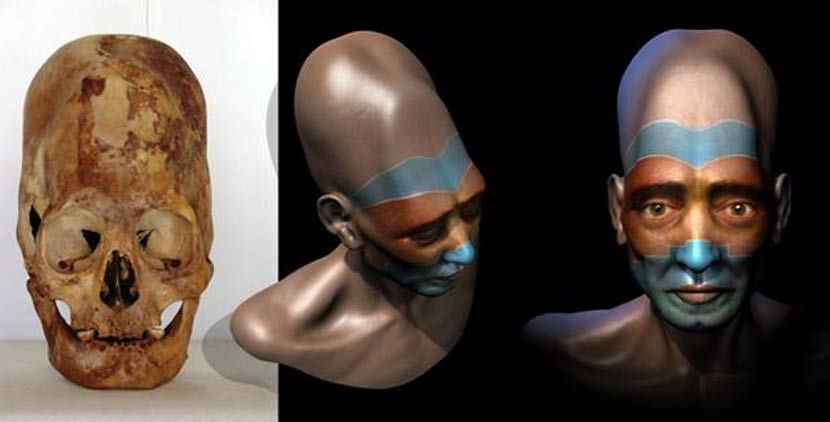
Coneheads Were Real - and Natural
Elongated Skulls in Utero:
A Farewell to the Artificial Cranial
Deformation Paradigm?
Elongated
skulls are usually explained in terms of head-binding or artificial cranial
deformation.
This paradigm emerged in the first half of the 19th century as a way
of explaining unusual skulls discovered in Europe and South America, in places
such as Crimea and Peru respectively. The main idea behind the head-binding
paradigm is that ALL elongated skulls are a result of intentional modification
of the form of the skull by applying external pressure. In other words, ALL
elongated skulls are merely deformed ‘normal’ skulls similar to those of modern
humans.
Elongated Skull from Crimea and other parts
of the worlds, Baer 1860
What
evidence could challenge this paradigm? Right – the existence of fetuses with
elongated skulls, i.e. evidence that such skulls already had an elongated shape
in utero, before
any head-binding was possible. Do we have such evidence? Yes, we do! Moreover,
this evidence has been known to the academic community for over 163 years!
Rivero and
Tschudi in Peruvian
Antiquities (1851 Spanish, 1853 English) argue that the
protagonists of the artificial cranial deformation hypothesis are mistaken,
since they had only considered the skulls of adults. In other words, the
hypothesis fails to take into account the skulls of infants and, most
importantly, foetuses which had similar elongated skull shape.
It is worth
quoting Rivero and Tschudi:
“We
ourselves have observed the same fact [of the absence of signs of artificial
pressure – IG] in many mummies of children of tender age, who, although they
had cloths about them, were yet without any vestige or appearance of pressure
of the cranium. More still: the same formation of
the head presents itself in children yet unborn; and of this truth we have had
convincing proof in the sight of a foetus, enclosed in the womb of a mummy of a
pregnant woman, which we found in a cave of Huichay, two leagues from Tarma,
and which is, at this moment, in our collection [my emphasis – IG].
Lithograph by D. Leopoldo Mueller from the
Spanish 1851 Edition of Peruvian Antiquities
Professor
D’Outrepont, of great Celebrity in the department of obstetrics, has assured us
that the foetus is one of seven months’ age. It belongs, according to a very
clearly defined formation of the cranium, to the tribe of the Huancas. We
present the reader with a drawing of this conclusive and interesting proof in
opposition to the advocates of mechanical action as the sole and exclusive
cause of the phrenological [i.e. cranial – no negative connotation at that time
- IG] form of the Peruvian race.
"The same
proof is to be found in another mummy which exists in the museum of Lima, under
the direction of Don M. E. de Rivero."
Elongated
skulls of infants were available to European researchers as early as 1838. The
skulls of “Ancient Peruvians” were also in Samuel Morton’s collection in
Philadelphia.
Two
elongated infant skulls, which Rivero and Tschudi mention in Peruvian Antiquities were
discovered and brought to England by Captain Blankley and presented to the
Museum of the Devon and Cornwall Natural History Society in 1838. Dr. Bellamy
provided a detailed description of these skulls in 1842, suggesting that they
belonged to two infants – male and female, few months and about a year old
respectively. He indicated substantial structural differences from those of
“normal” infant skulls and the absence of the signs of artificial pressure, as
well as their similarity to other “Titicacan” skulls in the Museum of the
College of Surgeons in London.
Lithographs of the skulls by J. Basire from
Bellamy's article (1842) and Mark Laplume's artistic reconstructions
The evidence
of elongated skulls present in fetuses and children had lead Rivero and
Tschudi, Bellamy, Graves and others to a hypothesis that these skulls belonged
to an extinct race of people, who left their legacy on the populations who
succeeded them as a practice of artificial cranial deformation. I discuss this
hypothesis in more detail in The Looming
Collapse Of The Artificial Cranial Deformation Paradigm. Part 1.
Un/Born With Elongated Head and Part 2. Naturally Elongated.
The question
now is how it happened that the cranial deformation paradigm became so
prevalent? The answer to a large extent consists in the authority of Morton’s
expert opinion and his extensive collection of skulls, which is now located in the University of Pennsylvania Museum of Archaeology and
Anthropology. His influence was significant enough at the time to close the
debate on elongated skulls for the next century and a half; until independent
researchers, and I would like to mention Robert Connolly (who popularized elongated skulls in mid
1990s) and Brien Foerster, in particular, started to raise questions
about the validity of the cranial deformation hypothesis by locating and
showing elongated skulls to the public interested in finding out the true story
of human origins.
Lithographs by John Collins, 1839 from Samuel
Morton's 'Crania Americana'
In Crania Americana Morton
offered a description of peculiar elongated skulls which differed from the
elongated skulls produced by various artificial means. He suggested that the
territory of Peru and Bolivia was previously inhabited by the race of “Ancient
Peruvians”.
“I have been
so fortunate as to have the examination, in my own and other collections, of
nearly one hundred Peruvian crania: and the result is, that Peru appears to
have been at different times peopled by two nations of differently formed
crania, one of which is perhaps extinct, or at least exists only as blended by
adventitious circumstances, in various remote and scattered tribes of the
present Indian race. Of these t wo families, that which was antecedent to the
appearance of the Incas is designated as the Ancient
Peruvian, of which the remains have hitherto been found only in
Peru, and especially in that division of it now called Bolivia.”
Although
Ancient Peruvians had naturally elongated skulls, Morton concluded that they
further tried to articulate this feature by head binding. This is an
interesting observation in itself, since it raises a question why a race with
naturally elongated skulls would aspire to further elongate them. Perhaps they
were also preceded by a race whose skulls were even more elongated?
Morton Collection, Skull #1277, University of
Pennsylvania Museum of Archaeology and Anthropology, the Open Research Scan
Archive at Penn, and Janet Monge and P. Thomas Schoenemann; image in front from
Meigs, 1857
Subsequently,
Morton changed his opinion and started to consider all elongated skulls as an
exclusive result of head-binding. However, in light of Rivero and Tschudi’s
fetuses with elongated skulls, as well as hundreds of infant and children
elongated skulls which are now available to researchers, it is necessary to
open the debate about “Ancient Peruvians” and their counterparts (see my
interview with Mark Laplume) in other part of the world.
Accordingly,
it is necessary to revisit Morton’s original encounter with elongated skulls.
This is how he originally described cranial features of Ancient Peruvians:
“[The head]
is small, greatly elongated, narrow its whole length, with a very retreating
forehead, and possessing more symmetry than is usual in skulls of the American
race. The face projec ts, the upper jaw is thrust forward , and the teeth are
inclined outward . The orbits of the eyes are large and rounded, the nasal bones
salient, the zygomatic arches expanded; and there is a remarkable simplicity in
the sutures that connect the bones of the cranium.”
Morton Collection, Skull #1681, University of
Pennsylvania Museum of Archaeology and Anthropology, the Open Research Scan
Archive at Penn, and Janet Monge and P. Thomas Schoenemann
Given that
there are at least two mummies containing foetuses with elongated skulls, in
addition to hundreds of infant and children with elongated crania (see Children Of
The ‘Elongated Skulls’ As A Challenge To The ‘Artificial Cranial Deformation’
Theory and RootRaceResearch), a priority task for the academic
community would be to identify the physical location of the mummies and proceed
to DNA analysis, which is currently done by independent researcher and
enthusiasts who lack infrastructural and financial resources and face
significant obstacles in obtaining necessary permissions. It is worth noting
that we deal with very old DNA, the analysis of which is a complex and
expensive procedure.
Featured
image: Morton Collection, “Ancient Peruvian” skull #496, University of
Pennsylvania Museum of Archaeology and Anthropology, the Open Research Scan
Archive at Penn, and Janet Monge and P. Thomas Schoenemann
References:
Von Baer,
Karl Ernst. Makrokephalen im
Boden der Krim und Österreichs. St. Petersburg. 1860.
Bellamy, P.
F. A brief Account of two
Peruvian Mummies in the Museum of the Devon and Cornwall Natural History Society.
in ‘Annals and Magazine of Natural History’. Vol. X. October 1842.
Graves,
Robert J. Remarkable
Skulls Found in Peru. No.15 of the Dublin Journal of Medical and Chemical
Sciences. 1835.
Meigs, J.
Aitken. Catalogue of Human
Crania in the Collection of the Academie of Natural Sciences of Philadelphia:
Based Upon the Third Edition of Dr. Morton's " Catalogue of Skulls".
Philadelphia. 1857.
Morton,
Samuel George. Crania
Americana; or, A Comparative View of the Skulls of Various Aboriginal Nations
of North and South America. To which is Prefixed an Essay on the Varieties of
the Human Species. London. 1839.
Rivero,
M.E., Tschudi, J.D. Antigüedades
peruanas. Vienna, 1851 (Spanish). Rivero, M.E., von Tschudi, J.J. Peruvian antiquities. New
York, 1853 (English).
Unravelling the Genetics of Elongated Skulls –
Transcript of Interview with
Brien Foerster

See video below
Here we
present the transcript of an interview conducted between April Holloway of Ancient
Origins, and Brien Foerster, researcher and author, on the subject of elongated
skulls in Paracas. In particular, the interview covers a recent announcement
that was made in relation to genetic testing that was carried out on one of the
Paracas skulls.
April: Brien, thanks very
much for joining Ancient Origins for this interview about the elongated skulls
in Paracas. Some of our viewers will have already seen an interview we had some
time ago about research around elongated skulls, but I am really enthusiastic
about this interview because it relates to a recent announcement you made
relating to some genetic testing that has been done on one of the skulls found
in Paracas. To begin with, could you give just a little bit of background about
the Paracas skulls in particular and what makes them different from other
elongated skulls that have been found?
Brien: Well, what’s kind of
intriguing is if you look on the internet at any photo website, and if you put
in something like ‘alien skull’ or ‘human-hybrid skull’, quite often the
Paracas skulls show up, predominantly because they are so large in size, some
of them are very natural looking, and also there are so many of them that have
been found, which is quite intriguing.
April:
So would you say that some of the features that these skulls have ruled out the
possibility of cranial deformation, processes like head flattening or head
binding, which are known to have happened in other cases of elongated skulls?
Brien:
Well that is the curious point in that cranial deformation is
known to have occurred in many different parts of the world, most prominently
about 2,000 years ago, from the Middle East, even Melanesia, and Central
America, but because I have been intimately engaged with the elongated skulls
at Paracas, and the Paracas culture in general that died out 2,000 years ago, I
have had the opportunity to look in person at numerous of the skulls, as well
as hundreds which are in collections all around the world. And some of them I
would say, possibly between 5 – 10% of them, do not show obvious signs of
cradle boarding or other forms of cranial deformation, which generally tends to
create flat surfaces, either in the forehead or the back of the head. Some of
these literally look like they are natural in appearance.
April: I
have also heard that some of the other features include increased volume and
increased weight compared to other skulls. Is that not something that could
also happen as a result of head flattening, where through the process of
binding, the size actually increases, or is that absolutely not possible?
Brien:
Well from the Doctors that I have spoken to, they have said that you can alter
the shape of the skull but you cannot increase the size of the skull. The skull
is genetically predetermined to have a certain volume and so it is much like…
an analogy I have is pottery where if you have a piece of green ware which is a
pot which is not quite dried yet, you can alter its shape, but you can’t change
the volume of it itself. Some people have stated that the reason why the
Paracas could have had denser skulls or be heavier etc. is the result of their
diet or malnutrition or whatever, and the thing is that they had an incredible
diet of seafood as well as terrestrial plants. They probably actually ate better
than most of us do today.
April:
So the study of these skulls is becoming a lot more interesting now that we
have the technology for extracting DNA and analysing DNA. Before any testing
was undertaken, did you have any theories yourself about what might be found?
Brien:
Well I didn’t want to conjecture anything. Of course, I have had many different
ideas but I’ve been waiting for actual DNA analysis and that has taken an
incredibly long time, mainly due to lack of funding and also finding a geneticist
who is open to studying this, doing it at a fraction of the normal cost that it
would cost commercially, and importantly, we wanted to do this independently
because going through any governmental or private foundation would probably
result in the results either being deleted or altered, or being kept for
purposes other than my intent, and my intent simply is to find the truth as to
who these people were.
April:
Can you explain a bit about the testing process that actually took place or has
taken place so far?
Brien:
Well it is a very complex process and most people don’t realise this because
they think: ‘Well, DNA testing is quite simple now, I can go and have a blood
sample extracted and be told within a few days all of my genetic ancestry’, but
what you have to take into account is that the last of the Paracas died 2,000
years ago, and so you are talking about 2,000 years of the degeneration of the
material. The late Lloyd Pye, who I was acquainted with very personally and
professionally because of his fascination with this, his analogy is that to
take a sample and analyse it from somebody who is living is the equivalent of
looking at or studying a crystal bowl because it is complicated and intact. And
then he said the equivalent of ancient DNA is taking that crystal bowl and
throwing it on a concrete floor because it becomes shattered into tiny little
segments. So it is only the most recent sophisticated, extremely expensive DNA
analysing equipment that can take all of those tiny segments and put them back
together. So it has been very difficult who would pursue that. We actually have
two different geneticists that worked but it happened to be this one who has
had samples for more than two years who has given me this initial result which
complete shocked him.
April:
So the thing most people really want to know is what exactly was found in that
initial result?
Brien:
Basically what I can say is that he speculates that there are segments of the
DNA of the Paracas which do not match anything in GenBank, which is the genetic
database located in the United States that contains all known genetic DNA
information. So he said there are segments which don’t seem to be any haplotype
of human that we know of, also not related to Neanderthal or any other human-like
being that has been studied so far.
April:
Quite incredible really. Now you have emphasised that this is phase one, or
stage one of the testing. What then is the next stage after this one? Is it
possible that this result is contaminated or is not accurate and that further
stages may reveal something different?
Brien:
It is possible. However, this person who lives in the United States and has a
doctorate, he does a lot of contract work for the US government so clearly the
government wouldn’t choose someone who is flaky or sensationalist. He has taken
a lot of time. It has been more than two years for him to give us the initial
result of one sample so far. But he does have samples from three different
skulls from Paracas and so what I am hoping is, and the reason why I released
this information, is to try to generate interest from the public so that we can
do a fundraiser in order to be able to study the other two skulls, as well as
other samples from the three skulls themselves, so that we can replicate the
tests as many times as possible to see whether or not this is an anomaly or
whether it is something which is truly mind-blowing, I guess is the term.
April:
Yes, exactly. Is it possible, the fact that it doesn’t match anything in the GenBank,
could it be that this is just a one-of-a-kind mutation, a mutation that hasn’t
been seen before, and is just unique to that particular race of people?
Brien:
It could be, but again the whole study is so new and the Paracas are very
mysterious people. No one has really studied them for about seventy years. The
people that study them now study their textiles, but the whole idea, the fact
that their skulls seem to be of a different shape, has been dismissed in
general as being cranial deformation, but in fact nobody knows where the
Paracas people came from. They lived on the coast of Peru and through my
studies I believe that there is a certain percentage of their ancestry that
comes from another part of the world because they also, amongst the royalty,
seem to have had reddish-brown hair which is not a native American
characteristic, and they were reasonably tall. Some specimens we found were
5’10 to 6 feet to even taller in height and that is quite atypical of a Native
American person 2,000+ years ago living on the coast of Peru.
April:
So what is your opinion about these findings. Do you have a view about what
this actually means, this result?
Brien:
The theory I am developing is that the Paracas are a mix of different types of
people. The area they chose to live 2,000 years ago was much lusher than it is
now, it would have been a perfect place for a society to live in terms of food
production. The fact that they had totora reeds, and still have totora
growing on the coast of Peru, meant that they were capable of building not only
little boats, but probably large ships out of reeds. They had cotton to
make sails and they could have been great seafarers. I also believe that
the famous Nazca people, who also occupied the area after the demise of the
Paracas, could literally have wiped the Paracas culture out and absorbed their
knowledge, absorbed some of their people who would have interbred with the
Nazca. But elongated skulls disappear in the Paracas area 2,000 years ago
and that corresponds with the arrival of the Nazca who were a very war-like
people.
April:
So you say a different mix of people. Now the thing on everyone’s mind is, are
these skulls alien? Are they extra-terrestrial? When you say a different mix of
people, do you think there is a possibility that a race of beings did arrive in
this part of the country and perhaps bred with humans? What’s your view
on that?
Brien:
Well, I am open to the idea. The thing is, I don’t want to go too far in that
direction yet because again, we’ve only had an initial result, but due to the
fact that the geneticist has found segments of DNA that don’t correspond with
anything, I think it is doubtful that they are a separate breed of humanity,
because where would they have come from? Again, the strange thing is this
predominant aspect of these elongated skulls amongst the royal family is very,
very odd. So future sampling, future results will either reinforce or dismiss
the result we have. I think we are looking at something very intriguing
and I don’t dismiss the idea of there having been off-planet intervention or
something, and Lloyd Pye was very strong with this idea, he simply said ‘these
are not human beings’.
April:
Speaking of Lloyd Pye, are you doing anything to carry forward the research he
was doing or do you know what is being done about the research that was being
undertaken by Lloyd Pye?
Brien:
Yes, several months before his death, he passed the Starchild skull and the
information on to a group of people because he knew he was ill, he wasn’t sure
if he would recover, and so they are doing major fundraising. They have done a
lot of genetic analysis, which people can see on Lloyd’s website. The thing is
people really have to spend the time to read all of the information because you
can’t get a full picture of what the Starchild is or was through 5 or 10
minutes of reading. There has been a lot of money and effort spent on Starchild
and the unfortunate thing is that there is only one Starchild, whereas there
are hundreds of Paracas skull, it’s amazing. And the access is quite
astonishing too because being related with this Paracas History Museum, I have
assisted in building up the collection to 40 skulls so far and we are very open
to researchers from around the world coming, whether they are doctors or
geneticists or whoever, because we honestly want to get to the bottom of this
and any outside help is very greatly appreciated.
April:
Well I guess the quantity really opens up the possibility to replicate these
results and to keep everyone happy by doing those extra studies, having
different researchers, using different skulls because then whatever the result
will be, will be a lot more convincing after all that replication has been
done.
Brien:
Yes, that’s exactly it. And any scientific test means that you have to be able
to replicate it, and that’s why again this is an initial, you could even call
it a teaser result, that I sent out to the public. Also a number of individuals
assisted me in raising $7,000 to do some of the testing and I wanted them to
know after 2 years that we actually did have something, that the money wasn’t
absconded or blown on anything. It 100% went into it. We also have another
geneticist working on completely other samples, that’s Dr Melba Ketchum from
Texas who, of course, is embroiled heavily in Big Foot studies, which she has
got a lot of flack from. But I still believe in her and there may be another
one or two genetic study organisations that may come on board with this and so
the more that do the analysis and the more cross-referencing we can do, the
better for this whole project.
April:
There are a lot of people out there who are sceptical. They do question, or
they want to see these results first-hand on paper, they want to know the name
of the geneticist, the name of the institution, and they do become suspicious
when some of these details aren’t yet available, how would you address those
concerns?
Brien:
Well I have actually spoken to the geneticist about it and he said that he will
be willing to address the public about this, but not after one test, because it
is too easy for sceptics or whoever to rip his information apart and so as a
scientist he wants to make sure that he’s done several replications and then
when he is comfortable, then he will come forward himself and discuss what it
is that he believes we are looking at.
April:
Ok that’s great, that’s really positive. So moving forward from here, what’s
the time scale relating to further testing and also the fundraising process. If
someone did want to get involved in this, what could they do?
Brien:
At the moment, I have been in discussions with someone who wants to set up and
Indiegogo campaign about this and I have been discussing with him for about 5
months but the timing hasn’t been right because we’ve been preoccupied with
other things. So probably within the next 2 or 3 months we will set up a
campaign, very specifically targeted to very specific things, we will have a
complete list where any funds will go, completely itemised. I will get nothing
from it, just as I have received nothing financially from the previous
fundraising that we did, and other samples have recently gone to the geneticist
from a third party and I am still waiting for some kind of result from Dr Melba
Ketchum. She has tried to actually get at least one, if not more, laboratories
in the US to do complete genome studies which is very complicated and
technically would cost an absolute fortune, upwards of at least $100,000 so we
are hoping that other geneticists will be able to volunteer their time and the
use of their equipment for the good of, basically we are doing this for the
good of humanity, not for any kind of personal benefit.
April:
Yes, I mean the knowledge is incredibly important, regardless of what these
skulls end up being, human or otherwise, it is still important for unravelling
the history of our past. These are obviously an incredibly mysterious group of
people.
Brien:
Well definitely. The things is that since elongated skulls have also been found
amongst the Olmecs of Mexico, also in, people have said Russia, it’s not really
Russia, it’s actually the area of Georgia, and in that area there are quite a
number of elongated skulls that have been found there that date back about
2,000 years. And actually, I have been mapping where this process has existed
all over the world and so what I am trying to do is to set up some kind of
concept of migration pattern or, in fact, were these different groups
genetically related? We don’t know yet, it is an ongoing procedure but I am
very thankful that you wanted to cover this story at this time because we are
at the beginning and any time that I get more information I am more than
willing to share it with you.
April:
Thanks very much Brien, we really appreciate you informing us of everything
going on and we really look forward to the updates that you provide as things
progress.
Brien:
Thank you and your organisation. Ancient Origins, is a phenomenal success. I am
very much a fan, many other people are, you are growing very rapidly and it is
wonderful that such a group as yourselves are presenting this information to a
global audience because in the past it’s always been little small groups of
people trying to do what you are attempting and you are doing an incredibly
good job at it.
April:
Thanks very much, really appreciate it.
From Ancient Origins @ http://www.ancient-origins.net/unexplained-phenomena/elongated-skulls-utero-farewell-artificial-cranial-deformation-paradigm-002526
and http://www.ancient-origins.net/news-evolution-human-origins/initial-dna-analysis-paracas-transcript-399284
For more information
about elongated skulls see http://nexusilluminati.blogspot.com/search/label/elongated%20skulls
- Scroll down through ‘Older Posts’ at the end of each section
Hope you like this
not for profit site -
It takes hours of work every day by
a genuinely incapacitated invalid to maintain, write, edit, research,
illustrate and publish this website from a tiny cabin in a remote forest
Like what we do? Please give anything
you can -
Contribute any amount and receive at
least one New Illuminati eBook!
(You can use a card
securely if you don’t use Paypal)
Please click below -
Spare Bitcoin
change?
And see
DISGRUNTLED SITE ADMINS PLEASE NOTE –
We provide a live link to your original material on your site (and
links via social networking services) - which raises your ranking on search
engines and helps spread your info further! This site is published
under Creative Commons Fair Use Copyright (unless an individual article or
other item is declared otherwise by the copyright holder). Reproduction for non-profit use is permitted & encouraged,
- if you give attribution to the work & author. Please include a
(preferably active) link to the original (along with this or a similar notice).
Feel free to make non-commercial hard (printed) or software copies or
mirror sites - you never know how long something will stay glued to the web –
but remember attribution!
If you like what you see, please send a donation (no amount is too
small or too large) or leave a comment – and thanks for reading this far…
Live long and prosper! Together we can create the best of all possible
worlds…