"All the World's a Stage We Pass Through" – R. Ayana

Showing posts with label global extinction. Show all posts

Thursday, 28 July 2016

Shattered records show climate change is an emergency today, scientists warn


Shattered records show climate change is an emergency today, scientists warn
Seven climate records set so far in 2016
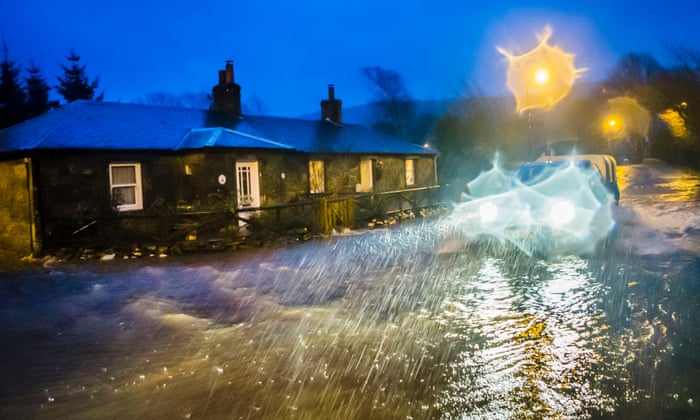
 

Flooding in Straiton, Scotland, in December. Scientists say it will increase in future. Photograph: Danny Lawson/PA


Unprecedented temperature levels mean more heatwaves, flooding, wildfires and hurricanes as experts say global warming is here and affecting us now


May was the 13th month in a row to break temperature records according to figures  that are the latest in 2016’s string of incredible climate records which scientists have described as a bombshell and an emergency.

The series of smashed global records, particularly the extraordinary heat in February and March, has provoked a stunned reaction from climate scientists, who are warning that climate change has reached unprecedented levels and is no longer only a threat for the future.

Alongside the soaring temperatures, other records have tumbled around the world, from vanishing Arctic sea ice to a searing drought in India and the vast bleaching of the Great Barrier Reef. The UK has experienced record flooding that has devastated communities across the country and scientists predict that the flash floods seen by parts of the country in recent days will increase in future.
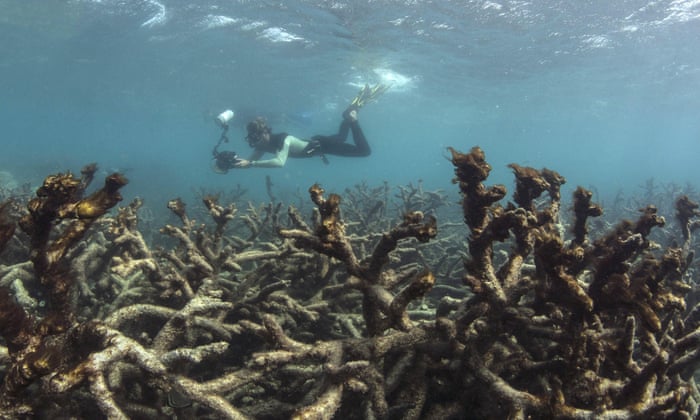

 
Aftermath of coral bleaching in the Great Barrier Reef, which has seen an estimated 22% of the reef’s corals die. Photograph: Xl Catlin Seaview Survey/EPA


“The impacts of human-caused climate change are no longer subtle – they are playing out, in real time, before us,” says Prof Michael Mann, at Penn State University in the US. “They serve as a constant reminder now of how critical it is that we engage in the actions necessary to avert ever-more dangerous and potentially irreversible warming of the planet.”

It was just last December when the world’s nations sealed a deal in Paris to defeat global warming but Prof Stefan Rahmstorf, at the Potsdam Institute for Climate Impact Research in Germany, says: “These [records] are very worrying signs and I think it shows we are on a crash course with the Paris targets unless we change course very, very fast. I hope people realise that global warming is not something down the road, but it is here now and it affecting us now.”

“What is happening right now is we are catapulting ourselves out of the Holocene, which is the geological epoch that human civilisation has been able to develop in, because of the relatively stable climate,” says Rahmstorf. “It allowed us to invent agriculture, rather than living as nomads. It allowed a big population growth, it allowed the foundation of cities, all of which required a stable climate.”
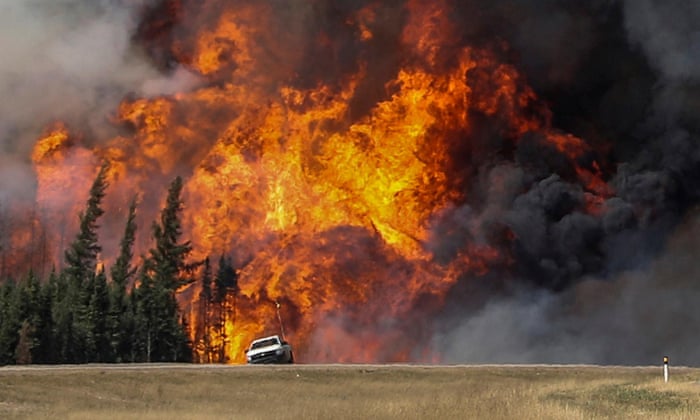

 
Smoke and flames from the wildfires erupt behind a car on the highway near Fort McMurray, Alberta, Canada. Photograph: Mark Blinch/Reuters


But the spikes in global surface temperatures in recent months have been anything but stable. They did not just break the records, they obliterated them. “The numbers are completely unprecedented,” says Adam Scaife, at the Met Office in the UK. “They really stick out like a sore thumb.”

The scorching temperatures mean 2016 is all but certain to be the hottest year ever recorded, beating the previous hottest year in 2015, which itself beat 2014. This run of three record years is also unprecedented and, without climate change, would be a one in a million chance. Scaife says: “Including this year so far, 16 of the 17 warmest years on record have been since 2000 – it’s a shocking statistic.”

Thermometer records go back to 1880, but ice cores, tree rings and corals show global warming driven by humanity’s burning of fossil fuels and forests has left the planet at its hottest for at least 5,000 years. “If we are not above this [temperature] already, we will be in 10 or 20 years’ time and then you have to go back 120,000 years to find higher temperatures than present,” says Rahmstorf.

Another shattered record is the amount of carbon dioxide in the atmosphere, which is on course to rise by a record amount this year, leaving the symbolic landmark of 400 parts per million to history. “We know from Antarctic ice cores that go back almost a million years that CO2 was never even remotely as high as this,” says Rahmstorf, and the rate at which humanity is emitting CO2 is the fastest for 66m years.

Fast-rising CO2 levels are almost entirely the reason for the record-busting year. But the natural climate phenomenon called El Niño has played a part. Cyclical changes in ocean temperatures over decades lead to El Niños during which stored heat is released from the oceans, impacting temperatures and weather around the globe.
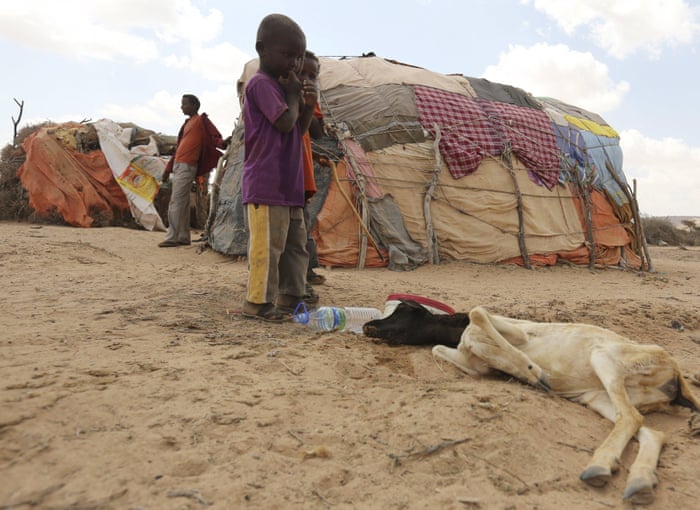

 
Children look at their sheep affected by the El Nino-related drought at a temporary shelter in Somalia’s semi-autonomous Somaliland region. Photograph: Feisal Omar/Reuters


Scientists agree about a fifth of the temperature rise seen in recent months is due to El Niño. However Scaife says: “I suspect some of the months would have still been records, even without the El Niño”. He points out that 1998 saw an ever bigger El Niño, resulting in a record hot year, but that this has now been far surpassed: “It is not even in the running anymore, falling way down the list.”

El Niño is now waning into to its opposite phase, called La Niña. But that does not allay the scientists’ climate concerns: “The La Niña will not be as cool as the El Niño was warm. We are very, very sure of that,” says Scaife. “It probably means that 2017 will not be a record year, but compared to other La Niña years, it is likely to be much warmer than normal.”

Furthermore, there may be more to the record-breaking series than meets the eye. “There is something more going on than the usual global warming trend and El Niño, because in the past El Niño has led to single years breaking records, but it has not caused several years in a row to break records,” says Rahmstorf.

“There is some unexplained part to this and it is concerning, because we don’t understand it and it is hotter than expected,” he says. “I hope the data coming in the next six months or so will bring us some important clues.”

The heat so far has already had major impacts, including a record temperature of 51C in India amid a serious drought and a record warm autumn in Australia, as well as many in the US. “It is in my view highly unlikely that we would be seeing record drought, like we’re seeing in California, record flooding in Texas, unprecedented wildfires in western North America, and the strongest recorded hurricanes in both the northern and southern hemisphere were it not for the impact of human-caused global warming,” says Mann.

Killer heatwaves are increasing too, which is the clearest impact of global warming, says Rahmstorf: “Our analysis of monthly heat records around the globe shows they now occur five times as often. It is those monthly heat records that are representative of heatwaves that last for weeks on end and they are ones that take the highest death toll.”
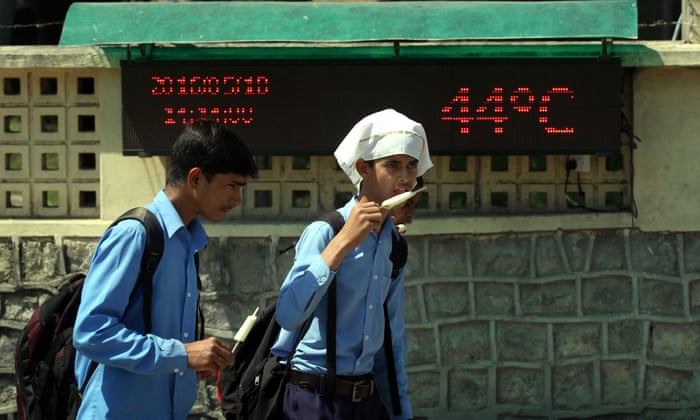

 
Indian schoolchildren eat ice cream as the country suffers a severe heatwave. Photograph: Jaipal Singh/EPA


The UK has been affected too, with December breaking temperature and rainfall records.

“Climate change means more intense rainfall and therefore an increased risk of flooding,” says Bob Ward, policy director at the London School of Economics’ Grantham Research Institute on Climate Change and the Environment.

“The government, which got caught out by two record wet winters in the last three, has suddenly woken up to the fact, which is why they have set up the National Flood Resilience Review. It is now something we are all going to have to come to terms with in the UK.”

Ward says seeing the records broken may mean more people make the connection between action on to cut emissions, such as support for green energy, and the impacts of global warming. He says the global climate deal agreed in December shows every government already knows this is a problem that needs urgent action, but that the high temperatures already occurring will increase the emphasis on adapting to extreme weather events in addition to cutting carbon emissions.

“The impacts we’re beginning to see are just the start and we know we are going to be facing a worsening situation for at least the next couple of decades even if we do cut emissions,” Ward says.

“What’s worrying [about the record-breaking 2016] is that we are in unprecedented territory and we don’t really know what the consequences will be,” he says. “There are likely to be plenty of surprises, some of which will be nasty.”


Top Climate Expert: Crisis is Worse Than We Think & Scientists Are Self-Censoring to Downplay Risk

(15:38)


Climate Change Goes Past Point Of No Return

(13:15)


For more information about catastrophic climate change see http://nexusilluminati.blogspot.com/search/label/climate%20change  
- Scroll down through ‘Older Posts’ at the end of each section


Do you LIKE this uniquely informative site?
Hours of effort by a genuinely incapacitated invalid are required every day to maintain, write, edit, research, illustrate, moderate and publish this website from a tiny cabin in a remote forest.
Now that most people use ad blockers and view these posts on phones and other mobile devices, sites like this earn an ever shrinking pittance from advertising sponsorship.
This site needs your help.
Like what you see? Please give anything you can -  
Contribute any amount and receive at least one New Illuminati eBook!
(You can use a card securely if you don’t use Paypal)
Please click below -


And it costs nothing to share this post on Social Media!
Dare to care and share - YOU are our only advertisement!


For further enlightening information enter a word or phrase into the random synchronistic search box @ the top left of http://nexusilluminati.blogspot.com


And see


 New Illuminati on Facebook - https://www.facebook.com/the.new.illuminati

New Illuminati Youtube Channel -  https://www.youtube.com/user/newilluminati/playlists

New Illuminati’s OWN Youtube Videos -  
New Illuminati on Google+ @ For New Illuminati posts - https://plus.google.com/u/0/+RamAyana0/posts

New Illuminati on Twitter @ www.twitter.com/new_illuminati


New Illuminations –Art(icles) by R. Ayana @ http://newilluminations.blogspot.com

The Her(m)etic Hermit - http://hermetic.blog.com


DISGRUNTLED SITE ADMINS PLEASE NOTE –
We provide a live link to your original material on your site (and links via social networking services) - which raises your ranking on search engines and helps spread your info further!

This site is published under Creative Commons (Attribution) CopyRIGHT (unless an individual article or other item is declared otherwise by the copyright holder). Reproduction for non-profit use is permitted & encouraged - if you give attribution to the work & author and include all links in the original (along with this or a similar notice).

Feel free to make non-commercial hard (printed) or software copies or mirror sites - you never know how long something will stay glued to the web – but remember attribution!

If you like what you see, please send a donation (no amount is too small or too large) or leave a comment – and thanks for reading this far…

Live long and prosper! Together we can create the best of all possible worlds…


From the New Illuminati – http://nexusilluminati.blogspot.com

Monday, 24 November 2014

Half the Planet Has Been Killed in Half a Human Lifetime: How long will it take to kill everything?


Half the Planet Has Been Killed in Half a Human Lifetime
How long will it take to kill everything?

 https://c2.staticflickr.com/4/3185/2841880095_fa0b5f38c7_z.jpg?zz=1

Earth has lost half of its wildlife in the past 40 years, says WWF

Species across land, rivers and seas decimated as humans kill for food in unsustainable numbers and destroy habitats


Rubbish dumped on the tundra outside llulissat in Greenland with icebergs behind from the Sermeq Kujullaq or llulissat Ice fjord. The Ilulissat ice fjord is a Unesco world heritage site

Rubbish dumped on the tundra outside llulissat in Greenland stand in stark contrast to icebergs behind from the Sermeq Kujullaq or llulissat Ice fjord – a Unesco world heritage site. Photograph: Global Warming Images/WWF-Canon


The number of wild animals on Earth has halved in the past 40 years, according to a new analysis. Creatures across land, rivers and the seas are being decimated as humans kill them for food in unsustainable numbers, while polluting or destroying their habitats, the research by scientists at WWF and the Zoological Society of London found.

“If half the animals died in London zoo next week it would be front page news,” said Professor Ken Norris, ZSL’s director of science. “But that is happening in the great outdoors. This damage is not inevitable but a consequence of the way we choose to live.” He said nature, which provides food and clean water and air, was essential for human wellbeing.

“We have lost one half of the animal population and knowing this is driven by human consumption, this is clearly a call to arms and we must act now,” said Mike Barratt, director of science and policy at WWF. He said more of the Earth must be protected from development and deforestation, while food and energy had to be produced sustainably.

The steep decline of animal, fish and bird numbers was calculated by analysing 10,000 different populations, covering 3,000 species in total. This data was then, for the first time, used to create a representative “Living Planet Index” (LPI), reflecting the state of all 45,000 known vertebrates.

“We have all heard of the FTSE 100 index, but we have missed the ultimate indicator, the falling trend of species and ecosystems in the world,” said Professor Jonathan Baillie, ZSL’s director of conservation. “If we get [our response] right, we will have a safe and sustainable way of life for the future,” he said.

If not, he added, the overuse of resources would ultimately lead to conflicts. He said the LPI was an extremely robust indicator and had been adopted by UN’s internationally-agreed Convention on Biological Diversity as key insight into biodiversity.

A second index in the new Living Planet report calculates humanity’s “ecological footprint”, ie the scale at which it is using up natural resources. Currently, the global population is cutting down trees faster than they regrow, catching fish faster than the oceans can restock, pumping water from rivers and aquifers faster than rainfall can replenish them and emitting more climate-warming carbon dioxide than oceans and forests can absorb.

The report concludes that today’s average global rate of consumption would need 1.5 planet Earths to sustain it. But four planets would be required to sustain US levels of consumption, or 2.5 Earths to match UK consumption levels.

The fastest decline among the animal populations were found in freshwater ecosystems, where numbers have plummeted by 75% since 1970. “Rivers are the bottom of the system,” said Dave Tickner, WWF’s chief freshwater adviser. “Whatever happens on the land, it all ends up in the rivers.” For example, he said, tens of billions of tonnes of effluent are dumped in the Ganges in India every year.

As well as pollution, dams and the increasing abstraction of water damage freshwater systems. There are more than 45,000 major dams – 15m or higher – around the world. “These slice rivers up into a thousand pieces,” Tickner said, preventing the healthy flow of water. While population has risen fourfold in the last century, water use has gone up sevenfold. “We are living thirstier and thirstier lives,” he said.

But while freshwater species such as the European eel and the hellbender salamander in the US have crashed, recoveries have also been seen. Otters were near extinct in England but thanks to conservation efforts now live in every county.
  
https://c2.staticflickr.com/4/3150/2931185862_36c24f4ea0_b.jpg


The number of animals living on the land has fallen by 40% since 1970. From forest elephants in central Africa, where poaching rates now exceed birth rates, to the Hoolock gibbon in Bangladesh and European snakes like the meadow and asp vipers, destruction of habitat has seen populations tumble. But again intensive conservation effort can turn declines around, as has happened with tigers in Nepal.

Marine animal populations have also fallen by 40% overall, with turtles suffering in particular. Hunting, the destruction of nesting grounds and getting drowned in fishing nets have seen turtle numbers fall by 80%. Some birds have been heavily affected too. The number of grey partridges in the UK sank by 50% since 1970 due to the intensification of farming, while curlew sandpipers in Australia lost 80% of their number in the 20 years to 2005.

The biggest declines in animal numbers have been seen in low-income, developing nations, while conservation efforts in rich nations have seen small improvements overall. But the big declines in wildlife in rich nations had already occurred long before the new report’s baseline year of 1970 – the last wolf in the UK was shot in 1680.

Also, by importing food and other goods produced via habitat destruction in developing nations, rich nations are “outsourcing” wildlife decline to those countries, said Norris. For example, a third of all the products of deforestation such as timber, beef and soya were exported to the EU between 1990 and 2008.

David Nussbaum, chief executive of WWF-UK said: “The scale of the destruction highlighted in this report should be a wake-up call for us all. But 2015 – when the countries of the world are due to come together to agree on a new global climate agreement, as well as a set of sustainable development goals – presents us with a unique opportunity to reverse the trends.

“We all – politicians, businesses and people – have an interest, and a responsibility, to act to ensure we protect what we all value: a healthy future for both people and nature.”

It's time to shout stop on this war on the living world

Our consumption is trashing a natural world infinitely more fascinating and intricate than the stuff we produce


Endangered species Radiated tortoise with destroyed habitat in Madagascar
Radiated tortoise in Madagascar amid destroyed habitat. Photograph: Gemma Catlin//Rex features


This is a moment at which anyone with the capacity for reflection should stop and wonder what we are doing.

If the news that in the past 40 years the world has lost over 50% of its vertebrate wildlife (mammals, birds, reptiles, amphibians and fish) fails to tell us that there is something wrong with the way we live, it’s hard to imagine what could. Who believes that a social and economic system which has this effect is a healthy one? Who, contemplating this loss, could call it progress?

In fairness to the modern era, this is an extension of a trend that has lasted some 2 million years. The loss of much of the African megafauna – sabretooths and false sabretooths, giant hyaenas and amphicyonids (bear dogs), several species of elephant – coincided with the switch towards meat eating by hominims (ancestral humans). It’s hard to see what else could have been responsible for the peculiar pattern of extinction then.

As we spread into other continents, their megafauna almost immediately collapsed. Perhaps the most reliable way of dating the first arrival of people anywhere is the sudden loss of large animals. The habitats we see as pristine – the Amazon rainforest or coral reefs for example – are in fact almost empty: they have lost most of the great beasts that used to inhabit them, which drove crucial natural processes.

Since then we have worked our way down the foodchain, rubbing out smaller predators, medium-sized herbivores, and now, through both habitat destruction and hunting, wildlife across all classes and positions in the foodweb. There seems to be some kink in the human brain that prevents us from stopping, that drives us to carry on taking and competing and destroying, even when there is no need to do so.

But what we see now is something new: a speed of destruction that exceeds even that of the first settlement of the Americas, 14,000 years ago, when an entire hemisphere’s ecology was transformed through a firestorm of extinction within a few dozen generations, in which the majority of large vertebrate species disappeared.

Many people blame this process on human population growth, and there’s no doubt that it has been a factor. But two other trends have developed even faster and further. The first is the rise in consumption; the second is amplification by technology. Every year, new pesticides, fishing technologies, mining methods, techniques for processing trees are developed. We are waging an increasingly asymmetric war against the living world.

Dead
Dead popocha fish wash up in the Cajititlan lagoon in Tlajomulco de Zuniga, Jalisco state, Mexico in September. Effluent from a wastewater treatment plant may have caused the mass death of fish. Photograph: Hector Guerrero/AFP/Getty Images


But why are we at war? In the rich nations, which commission much of this destruction through imports, most of our consumption has nothing to do with meeting human needs.

This is what hits me harder than anything: the disproportion between what we lose and what we gain. Economic growth in a country whose primary and secondary needs have already been met means developing ever more useless stuff to meet ever fainter desires.

For example, a vague desire to amuse friends and colleagues (especially through the Secret Santa nonsense) commissions the consumption of thousands of tonnes of metal and plastic, often confected into complex electronic novelties: toys for adults. They might provoke a snigger or two, then they are dumped in a cupboard. After a few weeks, scarcely used, they find their way into landfill.

In a society bombarded by advertising and driven by the growth imperative, pleasure is reduced to hedonism and hedonism is reduced to consumption. We use consumption as a cure for boredom, to fill the void that an affectless, grasping, atomised culture creates, to brighten the grey world we have created.

We care ever less for the possessions we buy, and dispose of them ever more quickly. Yet the extraction of the raw materials required to produce them, the pollution commissioned in their manufacturing, the infrastructure and noise and burning of fuel needed to transport them are trashing a natural world infinitely more fascinating and intricate than the stuff we produce. The loss of wildlife is a loss of wonder and enchantment, of the magic with which the living world infects our lives.

Perhaps it is misleading to suggest that “we” are doing all this. It’s being done not only by us but to us. One of the remarkable characteristics of recent growth in the rich world is how few people benefit. Almost all the gains go to a tiny number of people: one study suggests that the richest 1% in the United States capture 93% of the increase in incomes that growth delivers. Even with growth rates of 2 or 3% or more, working conditions for most people continue to deteriorate, as we find ourselves on short contracts, without full employment rights, without the security or the choice or the pensions their parents enjoyed.

Working hours rise, wages stagnate or fall, tasks become duller, more stressful and harder to fulfill, emails and texts and endless demands clatter inside our heads, shutting down the ability to think, corners are cut, services deteriorate, housing becomes almost impossible to afford, there’s ever less money for essential public services. What and whom is this growth for?

It’s for the people who run or own the banks, the hedge funds, the mining companies, the advertising firms, the lobbying companies, the weapons manufacturers, the buy-to-let portfolios, the office blocks, the country estates, the offshore accounts. The rest of us are induced to regard it as necessary and desirable through a system of marketing and framing so intensive and all-pervasive that it amounts to brainwashing.

Elephant Ivory trade and endangered species in Bangkok, Thailand
A man walking past an antique and ivory store in Bangkok, February 28, 2013. Photograph: Pornchai Kittiwongsakul/AFP/Getty Images


A system that makes us less happy, less secure, that narrows and impoverishes our lives, is presented as the only possible answer to our problems. There is no alternative – we must keep marching over the cliff. Anyone who challenges it is either ignored or excoriated.

And the beneficiaries? Well they are also the biggest consumers, using their spectacular wealth to exert impacts thousands of times greater than most people achieve. Much of the natural world is destroyed so that the very rich can fit their yachts with mahogany, eat bluefin tuna sushi, scatter ground rhino horn over their food, land their private jets on airfields carved from rare grasslands, burn in one day as much fossil fuel as the average global citizen uses in a year.

Thus the Great Global Polishing proceeds, wearing down the knap of the Earth, rubbing out all that is distinctive and peculiar, in human culture as well as nature, reducing us to replaceable automata within a homogenous global workforce, inexorably transforming the riches of the natural world into a featureless monoculture.

Is this not the point at which we shout stop? At which we use the extraordinary learning and expertise we have developed to change the way we organise ourselves, to contest and reverse the trends that have governed our relationship with the living planet for the past 2m years, and that are now destroying its remaining features at astonishing speed?

Is this not the point at which we challenge the inevitability of endless growth on a finite planet? If not now, when?


From The Guardian @ http://www.theguardian.com/environment/2014/sep/29/earth-lost-50-wildlife-in-40-years-wwf and Monbiot.com via http://www.theguardian.com/environment/georgemonbiot/2014/oct/01/george-monbiot-war-on-the-living-world-wildlife


For more about the murder of Gaia see http://nexusilluminati.blogspot.com/search/label/ecocide
- Scroll down through ‘Older Posts’ at the end of each section


Hope you like this not for profit site -
It takes hours of work every day by a genuinely incapacitated invalid to maintain, write, edit, research, illustrate and publish this website from a tiny cabin in a remote forest
Like what we do? Please give anything you can -  
Contribute any amount and receive at least one New Illuminati eBook!
(You can use a card securely if you don’t use Paypal)
Please click below -


Spare Bitcoin change?


Xtra images – https://c2.staticflickr.com/4/3185/2841880095_fa0b5f38c7_z.jpg?zz=1
https://c2.staticflickr.com/4/3150/2931185862_36c24f4ea0_b.jpg


For further enlightening information enter a word or phrase into the random synchronistic search box @ the top left of http://nexusilluminati.blogspot.com


And see


 New Illuminati on Facebook - https://www.facebook.com/the.new.illuminati

New Illuminati Youtube Channel - http://www.youtube.com/user/newilluminati/feed


New Illuminati on Twitter @ www.twitter.com/new_illuminati


New Illuminations –Art(icles) by R. Ayana @ http://newilluminations.blogspot.com

The Her(m)etic Hermit - http://hermetic.blog.com


The Prince of Centraxis - http://centraxis.blogspot.com (Be Aware! This link leads to implicate & xplicit concepts & images!)


DISGRUNTLED SITE ADMINS PLEASE NOTE –
We provide a live link to your original material on your site (and links via social networking services) - which raises your ranking on search engines and helps spread your info further! This site is published under Creative Commons Fair Use Copyright (unless an individual article or other item is declared otherwise by the copyright holder). Reproduction for non-profit use is permitted & encouraged,  - if you give attribution to the work & author. Please include a (preferably active) link to the original (along with this or a similar notice).

Feel free to make non-commercial hard (printed) or software copies or mirror sites - you never know how long something will stay glued to the web – but remember attribution!

If you like what you see, please send a donation (no amount is too small or too large) or leave a comment – and thanks for reading this far…

Live long and prosper! Together we can create the best of all possible worlds…


From the New Illuminati – http://nexusilluminati.blogspot.com