Drug Prohibition & Humanism

by: Brett Aho
However, as marijuana legalization enters onto the national stage, the word is quickly becoming associated with a new intoxicant. The religious and non-religious alike find themselves once again faced with a moral question that has haunted humanity since the first caveman stumbled across fermenting fruit: Should drugs be allowed?
For as long as drugs and alcohol have existed, society and religion have weighed judgment on their consumption. In ancient Egypt beer was a gift from Osiris, while in ancient Greece many praises were sung to Dionysus, god of the grape harvest and life of the party. However, many of the world’s younger religions have not been so friendly toward intoxicants. Buddhists, Muslims, and Mormons generally condemn drugs and alcohol as a form of evil, while Christians can’t seem to agree on whether intoxicants are a gift from God or a tool of Satan.
Christianity’s indecision on drug and alcohol policy is directly related to a number of contradictions in the Bible. In the beginning, it seems as if God tacitly accepts the consumption of booze. In Genesis, God’s right-hand man on earth, Noah, loves the stuff. Following the flood, he immediately plants a vineyard and lolls about naked and drunk once his wine has fermented (Genesis 9:20-25). As humanity repopulates, God’s people continue to sing praises for this apparent gift to man.
The Song of Solomon contains beautiful poetry comparing the joys of love to the intoxication of wine (Song of Solomon 1:2, 7:9). Later, when the wine runs out at a wedding, God’s own son goes on a celestial booze-run, reinvigorating the party (John 2:1-11). Given that precedent, one would think that Christians would host keggers every Sunday. However, as Alcoholics Anonymous will tell you, there are many other Bible verses that simultaneously condemn the consumption of intoxicating beverages.
To a nontheist, it seems rather silly to try and divine whether an all-powerful God smiles or frowns when you take a shot of tequila. However, in societies all around the world, religious lawmakers continue to ask that very same question, enacting strict prohibitionist measures as a result. As self-envisioned servants of God, they feel their duty is to bring divine law to his jurisdiction. With religion as their hammer and the law as their chisel, governments the world over actively persecute those nonbelievers who hold their own codes of morality when it comes to inebriating substances.
In the Islamic world, many drug and alcohol laws come straight out of the Koran, which teaches that khamer, or intoxicants, are instruments of Satan. In Saudi Arabia, getting caught with a beer comes with a punishment of forty lashes; a rather mild sentence when one considers that in much of Southeast Asia, drug possession often merits the death penalty. As the prophet Mohammed said, “Whosoever drinks wine, whip him. If he repeats it for the fourth time, kill him.”
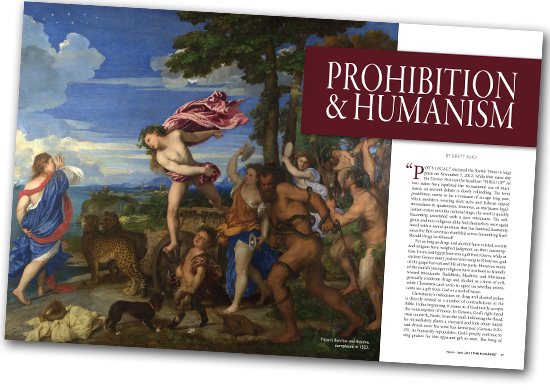
The United States saw its fair share of religiously motivated moral legislation in the early twentieth century, when Evangelical Protestant churches and religious fundamentalists pushed for the prohibition of alcohol, intent on removing this “evil” from society. The Rev. Mark Matthews, a leading figure in the temperance movement, famously noted,
“The saloon is the most fiendish, corrupt, hell-soaked institution that ever crawled out of the slime of the eternal pit. …It takes your sweet innocent daughter, robs her of her virtue, and transforms her into a brazen, wanton harlot. …It is the open sore of this land.” With the ensuing ratification of the Eighteenth Amendment in 1919, religious conservatives believed that God’s will had been done, and that the United States had succeeded in taking a bold step towards achieving heaven on earth.
However, to their dismay, after the law took effect in 1920 people kept on drinking, and the United States was soon facing a rampant problem with organized crime. The “noble experiment,” as it came to be known, ended in 1933 with the passing of the Twenty-first Amendment, and the power to regulate alcoholic beverages was passed back to the states. Today, many of these religiously fueled state laws remain unchanged in rural America. “Dry Counties” are a common occurrence in the South, and all across the United States unusually harsh punishments abound for underage drinking, public intoxication, and other nonviolent alcohol-related offenses.
There are those Americans who view the so-called “war on drugs” as Christianity’s most recent attempt to push moral prohibitionism on the masses. Sam Harris, author of The End of Faith, for example, calls it a “war on sin,” noting that the organizational factor behind current U.S. drug policy is to simply outlaw “anything which might radically eclipse prayer or procreative sexuality as a source of pleasure.” The bottom line, Harris argues, is that intoxicants are perceived by religion as a threat to individual faith.
This begs the question, does current drug policy truly serve the objective betterment of society, or has it been pointedly enacted by religious zealots attempting to push their interpretations of sacred text on the masses? A 2010 Pew Research Center poll found that while 64 percent of the religiously unaffiliated believed marijuana should be legalized, only 33 percent of Christians shared that view. Indeed, it is religious interest groups that have been the driving force behind anti-drug policies in the United States. The two largest Christian lobbying groups, the U.S. Conference of Catholic Bishops and the Family Research Council, are major funding sources for anti-legalization efforts. Just as the temperance and prohibition movements of the early twentieth century were largely fueled by religious fervor, it is reasonable to conclude that the modern war on drugs is in large part fueled by Christian moral interests.
The legislation of morality is widespread; from blasphemy to gay inequality to reproductive rights, religious majorities actively persecute those with differing values through the codification of morality. And while many of these marginalized groups have seen notable public support, the public is largely silent when it comes to the marginalization of those who choose to use drugs. Just as religion often labels those with alternative sexual preferences as morally corrupt or evil, so too does religion judge those who choose to use drugs and alcohol as morally inferior.
Part of the philosophy of humanism is to stand against outdated codes of morality that persecute and make life difficult for people. Just as LGBT issues are humanist issues, so too are drug and alcohol issues. When evaluating how society treats inebriants, science and reason should be the standards by which we create policy, not ancient religious texts. Most comparative policy studies agree that drug and alcohol abuse should be regarded as a public health issue, as opposed to a criminal justice issue, and that public funds are best spent on drug treatment and prevention rather than enforcement and incarceration.
Predominant theocratic norms have so influenced society that tacit acquiescence for religious prejudice has largely replaced critical analysis when it comes to social attitudes towards drug use. Indeed, there is little opposition, even among nontheists, to laws that persecute those who choose to use drugs. However, humanism and human decency afford that individuals with varying values and beliefs should be respected, not shunned.
One example of a largely unopposed, overly harsh drug law in the United States is the Higher Education Act’s Aid Elimination Penalty, which states that any individual with a misdemeanor drug offense is to be barred from receiving federal financial aid to attend college. Because of the provision, hundreds of thousands of promising students have been forced to drop out of college because of minor, nonviolent drug offenses. The penalty was introduced in 1998 by Rep. Mark Souder (R-IN), a Christian conservative whose battles included anti-abortion legislation and the prohibition of online gambling.
Heavily influenced by his religion, when asked about his position on abortion, Souder responded, “the closer to the clearness of the Bible, the less ability I should have to compromise.” Ironically, this moral crusader left office in 2010 after admitting to an affair with a staffer, lamenting in his resignation speech that he had “sinned against God.”

The Obama administration has at least vocalized concerns regarding the failure of national drug policy. As stated in its recently released 2012 National Drug Control Strategy: “science has shown that drug addiction is not a moral failing but rather a disease of the brain that can be prevented and treated.” However, upon review of the actual policy, many have concluded that the only thing changed is the wording. “This strategy is nearly identical to previous national drug strategies,” stated Bill Piper, the director for national affairs at the Drug Policy Alliance.
“While the rhetoric is new, reflecting the fact that three-quarters of Americans consider the drug war a failure, the substance of the actual policies is the same.” Green Party presidential candidate Dr. Jill Stein raised similar concerns, noting that “President Obama promised to use a science-based approach to public policy. But when it comes to marijuana, he has continued the unscientific policies of George Bush, and has even gone far beyond Bush in his attacks upon medical marijuana clinics.”
Eighty-some years ago, the primary motivations for ending the alcohol prohibition were the staggering economic costs of enforcement, as well as the huge impact of lost tax revenues. A 1929 pamphlet distributed by the Association Against the Prohibition Amendment estimated that the total loss of federal tax revenues was $861 million, the equivalent of $108 billion dollars today. The nation, in the midst of the Great Depression, was in desperate need of these tax revenues to implement economic stimulus programs, and so in 1932 a bipartisan effort saw the passing of the Twenty-first Amendment. Perhaps a similar appeal to reason can be made in our current time of financial uncertainty. If nothing else, perhaps religious lawmakers can be made to see that their war on sin has failed in economic terms.
Ideally, a majority of lawmakers may eventually come to realize that drug experimentation is a natural human phenomenon—that humans are instinctively attracted to mind-altering substances.
Archaeologists have uncovered widespread evidence of drug consumption in ancient communities across the globe. The oldest evidence of beer consumption dates back to around 5000 BCE in what is now Iran, while wine consumption goes back even further, to about 6000 BCE. The consumption of betel nut, the fourth-most used drug in the world after nicotine, alcohol, and caffeine, dates back 13,000 years ago in Timor, and 10,700 years ago in Thailand. Coca was domesticated in the western Andes close to 7,000 years ago, and the consumption of tobacco in the Americas, pituri in Australia, and khat in Eastern Africa already represented ancient practices when European colonists made first contact, perhaps dating back 40,000 years or more. Most anthropologists agree that human drug consumption predates human civilization.
.

Indeed, neurological
studies have revealed that drug use has been a part of mammalian societies
since ancient times. According to a study from the Stanford University School
of Medicine, the central nervous system has developed certain receptors that
indicate co-evolutionary activity between mammalian brains and psychotropic
plants. In essence, the human brain has “evolved receptor systems for plant
substances, such as the opioid receptor system, not available by the mammalian
body itself.” The study notes that a common ancestor evolved these receptors at
some point in evolutionary history in order to accommodate substance
consumption. The study also points towards the body’s natural defenses against
drug overdose, such as exogenous substance metabolism and vomiting reflexes, as
further evidence for mammalian coevolution with psychotropic plants. As odd as
it might seem, this suggests that humans are actually hardwired to enjoy drug
consumption.While coevolution explains why humans can experience drugs, it doesn’t explain why humans choose to use drugs despite social stigma against them. Another theory of human drug consumption explores the idea of modern drug experimentation as a form of evolutionarily novel behavior. The theory builds off of what evolutionary psychologist Satoshi Kanazawa calls the Savanna-IQ Interaction Hypothesis. It combines his Savanna Principle, which states that the human brain has difficulty dealing with entities and situations that didn’t exist in the ancestral environment, with the theory of evolution of general intelligence, which suggests that general intelligence evolved as a psychological adaptation to solve evolutionarily novel problems. Within the realm of evolutionary psychology, this hypothesis predicts that individuals of higher intelligence are more likely to engage in novel behavior that goes against cultural traditions or social norms.
Interestingly, the findings of a forty-year-long study funded by the British government paralleled this hypothesis, and found that “very bright” individuals with IQs above 125 were about twice as likely to have tried psychoactive drugs than “very dull” individuals with IQs below 75. As Kanazawa explains, “Intelligent people don’t always do the ‘right’ thing, only the evolutionarily novel thing.”
Other forms of evolutionarily novel behavior that are more prevalent among individuals with higher IQs include vegetarianism and the use of contraceptives. Kanazawa, who is a senior scholar at the London School of Economics, even suggests that liberalism and atheism can fall under the Savanna-IQ Interaction Hypothesis as a form of evolutionarily novel behavior defying the deeply ingrained cultural traditions of humanity.
But whether humans choose to use drugs simply because they are hardwired for it, or because evolution inclines them towards experimentation, it is important to push for the continuation of research into the science behind intoxicating substances in order to better understand the relationship between psychotropic drugs and human beings. Further research into the spiritual effects of many recreational drugs may even lead to a deeper understanding of human spirituality and religion. Unfortunately, as with stem-cell research, religious lawmakers within the U.S. government continue to obstruct research involving recreational drugs in the name of morality.
The government’s primary tool in enforcing modern drug prohibition and monitoring drug research is the Controlled Substances Act (CSA) of 1970. By means of the CSA, the federal government has the final say in the legal status of any and all drugs. Under the CSA, drugs are classified into different groups, schedules I-V, which represent the relative risk each drug poses to society. Schedule-I drugs are generally regarded as the most dangerous, and are classified by the following criteria:
The drug or other substance has a high potential for abuse.
The drug or other substance has no currently accepted medical use in treatment in the United States.
There is a lack of accepted safety for use of the drug or other substance under medical supervision.

 Marijuana still remains
on the Schedule-I list despite countless studies showing it to be
non-addictive, safe for personal consumption, and to have valuable medicinal
properties. Other drugs currently labeled as Schedule-I have also shown
promising medical value even though their recreational use can be dangerous.
MDMA (the primary ingredient in “ecstasy”) has been proven to be an effective
means of treating Post-Traumatic Stress Disorder. LSD (“acid”) and psilocybin
(or psychedelic mushrooms) have shown potential for use in the treatment of
certain psychiatric ailments. Ibogaine (a hallucinogen with psychedelic and
dissociative properties) has been proven to cure heroin addiction, and GHB
(gamma hydroxybutyrate, a recreational depressant also used as a date-rape
drug) is commonly used outside of the United States in the treatment of
narcolepsy.
Marijuana still remains
on the Schedule-I list despite countless studies showing it to be
non-addictive, safe for personal consumption, and to have valuable medicinal
properties. Other drugs currently labeled as Schedule-I have also shown
promising medical value even though their recreational use can be dangerous.
MDMA (the primary ingredient in “ecstasy”) has been proven to be an effective
means of treating Post-Traumatic Stress Disorder. LSD (“acid”) and psilocybin
(or psychedelic mushrooms) have shown potential for use in the treatment of
certain psychiatric ailments. Ibogaine (a hallucinogen with psychedelic and
dissociative properties) has been proven to cure heroin addiction, and GHB
(gamma hydroxybutyrate, a recreational depressant also used as a date-rape
drug) is commonly used outside of the United States in the treatment of
narcolepsy.If science is to be the ideal standard by which policy decisions should be made, more research into the true nature of psychotropic substances is needed. It’s simply counterproductive to mislabel substances in order to stifle research and stiffen penalties. Moreover, to weigh moral judgment on the mere existence of recreational drugs is to presuppose a cosmic struggle between good and evil. As Lewis Lapham writes in the Winter 2013 issue of Lapham’s Quarterly (devoted to the theme of “Intoxication”), the war on drugs is essentially a war on human nature, and that whether declared by church or state, such a war is “by definition lost.” However, as it’s waged, this war against human nature strengthens the fear of one’s fellow humans. “The red, white, and blue pills sell the hope of heaven made with artificial sweeteners,” Lapham opines.
For now, all eyes are on Washington and Colorado. How will their noble experiment fare? Will it result in increased crime rates and social discord? Will pot stores be fiendish, hell-soaked open sores on the land? Or will the law create a safe and legal way to access a friendly substance that makes people feel good? If the latter proves true, it may be necessary to reevaluate how society regards all recreational drug use.
Popularity should not be the standard by which the legality of recreational drugs is decided. Scientists and policymakers alike need to review current motivations behind drug policies. It’s important to recognize that whether it’s drinking coffee in Seattle, smoking hookah in Istanbul, sipping sake in Tokyo, or eating ibogaine in the jungles of Cameroon, drug use is something that is deeply ingrained in the cultural traditions of humanity. Religion tends to breed fear and contempt towards all that it would interpret as evil, be it homosexuality, stem-cell research, or drug consumption. Humanism should challenge that norm, encouraging tolerance and understanding while fighting against religiously motivated bigotry and the moral legislation that goes along with it.
Brett Aho is a freelance writer currently
based in Seattle, Washington and a recent Fulbright scholar who holds degrees
in French, German, and international relations from the University of Redlands.
More of his work can be found at BrettAho.com.
Published
in the March / April 2013 Humanist
From The Humanist @ http://thehumanist.org/march-april-2013/prohibition-humanism/
For more information about drugs see http://nexusilluminati.blogspot.com/search/label/drugs
- See ‘Older Posts’ at the end of each section
YOU can help this unique
independent website survive and stay online in a small cabin in a remote rainforest
Donate any amount and receive at least one New Illuminati eBook!
Please click in the
jar -
Xtra Images by R. Ayana @
http://www.flickr.com/photos/26464152@N05/8299454134/sizes/l/in/photostream/ http://www.flickr.com/photos/26464152@N05/2626339009/sizes/z/in/photostream/
http://www.flickr.com/photos/26464152@N05/8299454134/sizes/l/in/photostream/ http://www.flickr.com/photos/26464152@N05/2626339009/sizes/z/in/photostream/
For further enlightening
information enter a word or phrase into the random synchronistic search box @ http://nexusilluminati.blogspot.com
And see
New Illuminati – http://nexusilluminati.blogspot.com
New Illuminati on Facebook - https://www.facebook.com/the.new.illuminati
New Illuminati Youtube Channel - http://www.youtube.com/user/newilluminati/feed
The Her(m)etic Hermit - http://hermetic.blog.com
The Prince of Centraxis - http://centraxis.blogspot.com (Be Aware! This link leads to implicate &
xplicit concepts & images!)
DISGRUNTLED SITE ADMINS PLEASE NOTE –
We provide a live link to your original material on your site - which
raises your ranking on search engines and helps spread your info further! This site
is published under Creative Commons Fair Use Copyright (unless an individual article
or other item is declared otherwise by copyright holder) – reproduction for non-profit
use is permitted & encouraged, if you give attribution to the work &
author - and please include a (preferably active) link to the original (along
with this or a similar notice).
Feel free
to make non-commercial hard (printed) or software copies or mirror sites - you
never know how long something will stay glued to the web – but remember
attribution! If you like what you see, please send a donation (no amount is too
small or too large) or leave a comment – and thanks for reading this far…
Live long
and prosper!
From the New
Illuminati – http://nexusilluminati.blogspot.com