"All the World's a Stage We Pass Through" R. Ayana

Showing posts with label batteries. Show all posts

Monday, 22 August 2016

Battery revolution empowers consumers, unleashes renewables, imperils Big Energy


Battery revolution empowers consumers, unleashes renewables, imperils Big Energy


 https://www.greenbiz.com/sites/default/files/styles/gbz_article_primary_breakpoints_kalapicture_screen-md_1x/public/images/articles/featured/battery_0.jpg?itok=2lW8swDR


by Emma Howard


Renewable electricity is already undermining the big energy utilities' business model, writes Emma Howard, breaking their monopoly and bringing down energy bills. But with the unfolding battery revolution, it's going to reach a whole new level as wind and solar powered families and communities become ever more self-sufficient, leaving utilities high and dry.


The big six are the dinosaurs of the electricity industry. They've got to evolve very rapidly or they will become extinct. We can now generate electricity ourselves and the role of batteries is to maximise the amount of our generation we can use.

As you'll realise every time your phone runs out of juice, batteries have become fundamental to how we communicate.

When Elon Musk launched Tesla's home battery system one year ago, he promised "a fundamental transformation in how energy is delivered across the Earth".

He is now building a 'gigafactory' in the desert with an ambition to manufacture more batteries by 2020 every year than the whole world produced in 2013.

Musk isn't alone. Big names from Gates to Dyson are now competing in a billion dollar race to discover the next lucrative breakthrough that could revolutionise the energy system.

The technology is changing fast. The cost of lithium-ion batteries - the most common type - plunged by 53% between 2012 and 2015 and are predicted to half again by 2019, according to energy analysts IHS. It's estimated that storage could help to bring about a saving of £8bn to British consumers, secure energy supply for a generation and meet carbon targets.

But what would this 'fundamental transformation' look like? We put the question to some self-confessed battery geeks.


We could run our own mini power stations - and sell electricity to our neighbours


"This is the future", claimed Welsh householder Mark Kerr as he proudly unveiled his Tesla home battery system in February this year - the first of its kind to be installed in the country - which allows him to use the energy from his solar panels when the sun isn't shining.

By enabling householders to use their own supply 24 hours a day, cheap energy storage could be "the final piece in the global energy transition puzzle", to use the words of top financial ratings agency Standard and Poor's.

The public could then become not just energy consumers, but energy producers, like Kerr, with each home effectively running their own individual power stations.

Widespread take-up of batteries could even see neighbours trading electricity between themselves, says Dr Jill Cainey, director of the Electricity Storage Network, which brings together organisations that deploy, design and research storage:

"I'm not suggesting that you would be sitting there on your front lawn selling electricity. You'd do it all through smart technology. You would set the price you're willing to buy at and sell at and there would be a local agent who would look after that for you."

This could save money for consumers and carbon emissions because the 7-10% of electricity wasted in transmission through long centralised lines that connect them to the grid would be saved.

In fact, individual consumers are already starting to trade with each other via sonnencommunities - an online network in Germany that enables those with battery systems to trade energy with each other - but as users are not based in the same physical locality they don't stand to benefit in this way.


It could bankrupt the National Grid and lead to rising inequality


Battery geeks call it 'the death spiral'. As more and more people go off grid, spurred on by the potential of storage to provide them with electricity day and night, the National Grid faces a rising problem - who will pay the costs of their system? At the moment these costs are incorporated into our energy bills.

"We could become lots of isolated units looking after ourselves and the burden of the wires and transformers will fall on those less able to invest so the costs will be spread over fewer and fewer people", says Cainey.

The prospect of the death spiral could upturn the way we pay for our energy. Instead of paying a flat rate on the energy you consume, in the future we could instead pay a one-time 'insurance fee' to connect to the grid for the times when our personal energy systems experience a blackout, if plans being mooted by energy regulator Ofgem become reality. And spell big trouble for the Big Six.

"They can't continue to operate on the business model they currently have", says Cainey. As more and more people start to produce their own energy, she adds, large-scale generators are losing custom to individuals and communities who are going off-grid.

This is already causing them problems. In Germany, where community energy projects are more common, energy prices went negative during a particularly sunny and windy May day and firms had to pay consumers to use electricity.

"You could think of big six as being the dinosaurs of the electricity industry. They've either got to evolve very rapidly or they will become extinct. The real driver is that we can now generate electricity ourselves and the role of batteries is to maximise the amount of our generation we can use", adds Cainey.


It could also fight fuel poverty


It might seem that those with less money have far less to gain from the great future battery revolution. But if somebody can be found to purchase the infrastructure, it could help poorer people to save significant amounts on their energy bills.

In the former coal-mining town of Stanley in County Durham, this somebody has arrived in the form of a partnership between the local authority and a start-up called North Star Solar, which has the former CEO of RWE Npower at its helm.

In the first project of its kind, last month the town's 35,000 residents became the first to be offered solar panels and a home battery system, free of charge. Combined with the effect of replacement LED lightbulbs, the systems are expected to cut residents' energy bills by a fifth.

Renewable installations have long been an attractive proposition for social housing providers, who are to commit to longer contracts and have the incentive to tackle fuel poverty. There are around 45,000 solar panel installations in the UK, according to estimates by the Solar Trade Association.

"The current market for batteries is people more like me - white, middle-class, middle-aged energy geeks", says Arnout Andrews, managing director at Adecoe, which supports energy projects in the social housing sector.

"Now social housing is starting to catch onto the idea. For these people it means delivering affordable warmth. They struggle with their energy bills. They just haven't got that money."


But there might not be enough materials to go around


There is always a catch and, in this case, it's not an environmentally friendly one. Lithium is the best known material used for batteries today, but the substance has also been linked to the use of child labour in conflict zones and poses a significant risk to natural areas such as Bolivia's salt flats.

And if we start to use it on a much wider scale, one day we might run out, says Dr Jacqueline Edge from the Energy Futures Lab at Imperial College:

"Lithium is not a very abundant element on the earth's crust so a lot of research is being done into other chemistries to see if we can replace lithium with sodium, which is very abundant and cheap. If lithium starts to run out the price would go up considerably but if we could switch to another material we might not have that problem."

Sodium isn't the only other option for battery storage, especially when you look beyond the level of the individual consumer. Other technologies are vying for attention, from pumped hydroelectricity, which is already commonplace, to compressing air in underground caverns.

Another promising technology is to use surplus renewable electricity from wind and solar to produce hydrogen, a valuable fuel and feedstock. Cars that run on hydrogen - the world's most abundant element - which are now starting to enter the mass market.

The hydrogen can also be converted in ammonia (the energy dense raw material for nitrate fertiliser, currently made from coal or gas) and methane (the main constituent of natural gas) for long term storage, to be burnt as a renewable fuel in homes, factories, vehicles and power stations.

"We need to consider the system as a whole", says Edge.


http://www.theecologist.org/siteimage/scale/800/600/401256.png

Emma Howard is a journalist at Greenpeace UK / Energydesk. She also writes on social affairs for The Guardian, and serves as a trustee at youth activism charity @Uprising_UK. She tweets  @EmmaEHoward.

This article was originally published by Greenpeace Energydesk. This version includes some additional reporting by The Ecologist.


For more information about govcorp see http://nexusilluminati.blogspot.com/search/label/gov%20corp
- Scroll down through ‘Older Posts’ at the end of each section


Do you LIKE this uniquely informative site?
Hours of effort by a genuinely incapacitated invalid are required every day to maintain, write, edit, research, illustrate, moderate and publish this website from a tiny cabin in a remote forest.
Now that most people use ad blockers and view these posts on phones and other mobile devices, sites like this earn an ever shrinking pittance from advertising sponsorship. This site needs your help.
Like what you see? Please give anything you can -  
Contribute any amount and receive at least one New Illuminati eBook!
(You can use a card securely if you don’t use Paypal)
Please click below -


And it costs nothing to share this post on Social Media!
Dare to care and share - YOU are our only advertisement!


Xtra Image – https://www.greenbiz.com/sites/default/files/styles/gbz_article_primary_breakpoints_kalapicture_screen-md_1x/public/images/articles/featured/battery_0.jpg?itok=2lW8swDR


For further enlightening information enter a word or phrase into the random synchronistic search box @ the top left of http://nexusilluminati.blogspot.com


And see


 New Illuminati on Facebook - https://www.facebook.com/the.new.illuminati

New Illuminati Youtube Channel -  https://www.youtube.com/user/newilluminati/playlists

New Illuminati’s OWN Youtube Videos -  
New Illuminati on Google+ @ For New Illuminati posts - https://plus.google.com/u/0/+RamAyana0/posts

New Illuminati on Twitter @ www.twitter.com/new_illuminati


New Illuminations –Art(icles) by R. Ayana @ http://newilluminations.blogspot.com

The Her(m)etic Hermit - http://hermetic.blog.com


DISGRUNTLED SITE ADMINS PLEASE NOTE –
We provide a live link to your original material on your site (and links via social networking services) - which raises your ranking on search engines and helps spread your info further!

This site is published under Creative Commons (Attribution) CopyRIGHT (unless an individual article or other item is declared otherwise by the copyright holder). Reproduction for non-profit use is permitted & encouraged - if you give attribution to the work & author and include all links in the original (along with this or a similar notice).

Feel free to make non-commercial hard (printed) or software copies or mirror sites - you never know how long something will stay glued to the web – but remember attribution!

If you like what you see, please send a donation (no amount is too small or too large) or leave a comment – and thanks for reading this far…

Live long and prosper! Together we can create the best of all possible worlds…


From the New Illuminati – http://nexusilluminati.blogspot.com

Sunday, 26 July 2015

How to Make a Battery That Lasts (Practically) Forever


How to Make a Battery That Lasts (Practically) Forever


by Joshua Krause


magnesium batteryWhen going off the grid, it’s safe to assume that most folks will be relying on solar panels for much of their electrical needs. However, a lack of sunlight can present a few problems for any would-be prepper. If only there was a cheap and simple way to supplement a solar panel array on those cloudy days.

Fortunately, there is such a way, and I’m willing to bet that most of you reading this have never heard of it (I hadn’t until recently). It’s called a Dickens Magnesium Battery after it’s inventor, Stephen Dickens; though the principles behind its function have been around for a very long time. If anything it may be more of a rediscovery, than a completely novel idea.

This device is also called a “Galvanic Cell,” which has been around since the late 1700s, and possibly even earlier if the theories surrounding the Baghdad Battery are to be believed. It generates small electrical currents by capturing the energy produced by the corrosion of a metal.

In this case, the Dickens battery uses the magnesium as its source of electricity, which many of you probably already know if you’ve ever used a fire starter, is a very energy dense material. The design is simple enough that pretty much anyone can make it.

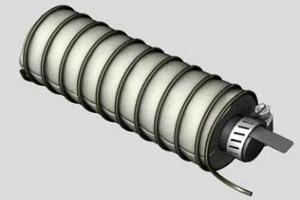
You start out with thick, magnesium rods, which you can buy on Ebay. After that, you’ll need to fasten a metal electrode to the rod with a hose clamp. The metal used for this step is never specified, so feel free to try out a few different metals to see what nets you the best results (more on that in a moment).

After that, you wrap the rod in porous foam, and then coil copper wire around the foam. The idea is to allow water to pass through the foam, but to keep the copper from touching the electrode. Doing so won’t cause anything catastrophic, but your battery will stop producing energy.

After it’s all said and done, it should look like this:

dickens water battery


From there, you’ll need a small jar to store this contraption, and you’ll have to puncture holes in the lid to allow the positive and negative contacts to push through. Fill the jar with tap water up to the top of the foam, and close the lid with the contacts exposed. You’ll also need to use something like caulk to seal the holes in the lid, thus keeping the water from evaporating. And that’s it! Your magnesium battery is all done.

But what is it capable of?

Each cell should produce about 1.5 volts, and anywhere from 20mah to 100mah. You’ll notice that the current has a fairly wide range. That’s because this invention hasn’t been around very long, and it’s hard to say what will allow it operate at its optimum efficiency. That’s what I was talking about before with the metal electrode. You’ll have to try a few different metals to see what works best.

Although it doesn’t produce a whole lot of energy, it is pretty cheap, and it will last a really long time. Depending on the current you get from it, it may last more than a year. Maybe even longer. It’s hard to say because to my knowledge, nobody has ever completely depleted the magnesium.

And with 1.5 volts, you can connect 8 of these to produce 12 volts of direct current. Coincidentally, that is exactly what you need if you want to connect it to a deep cycle battery, which are typically used to store the energy produced by solar panels. If you manage to get 8 of these producing 100mah of current, you’ll be pumping a steady stream of 1.2 watts of energy, 24 hours a day, for at least 9 months.

At that point, you’ll have to take the battery apart, and scrape the corrosion buildup off the magnesium and the copper wire. And that’s pretty much the only maintenance you’ll have to do. It’s not a lot of energy, but it adds up after a while, and it’ll be able to supplement a small portion of your energy needs when the sun isn’t out. Or if you don’t mind rapidly depleting your magnesium, you can also add salt to the tap water, which will produce more energy.

For a more detailed description of this device, check out the full instructions [below] for its construction, and hopefully you’ll soon be enjoying your new magnesium battery bank.


OS: Stephen Dickens Magnesium-Water-Copper Battery


A $3 magnesium rod surrounded by (not touching) a copper coil in water, produces 1.5 V and enough current to power a wall clock.


A $3 magnesium rod surrounded by (not touching) a copper coil in water, produces 1.5 V and enough current to power a wall clock.


Compiled by Sterling D. Allan
Pure Energy Systems News


Would you like to be able to build an AA battery for emergency preparedness, or just for self-reliability? Consider Stephen Dickens' Water Battery/Generator using Magnesium and Copper Electrodes with Foam Insulator.

It's a lot bigger than an AA, but is cheap and easy to build.

Variations of the concept have been around for more than a century. This one, though probably not unique, appears to be noteworthy given its simplicity. A kindergartener could build this and afford to buy the parts needed.

Briefly, it entails approximately 10 turns of 10-12-gauge copper wire loosely over foam around a Magnesium rod of dimensions: ~0.5" diameter by 3.5" long. The rod is loosely wrapped by 1/2-inch foam insulation. An electrode is attached to the top of the Mg rod with a hose clamp. The assembly is immersed in water (with no added electrolyte) up to the top of the foam.

Adding electrolyte, while increasing amperage, diminishes the life of the Mg. Without electrolyte, the battery can last longer. It produces around 1.5 V and a few mA continuously. Every 9 months or so, the magnesium rod and copper wire should be briefly sanded to remove build-up. The Dickens Battery uses no salts, acids, or added chemicals.

Other people have built Mg-Cu-H2O cells and posted them to YouTube. What makes this unusual is that Stephen doesn't use electrolyte, and this enables the Mg to have longevity that makes the battery practical.

Apparently the power output is a function of the Mg depletion. The question is whether the addition of electrolytes merely speeds up the Mg depletion (resulting in increased power), or if the electrolytes themselves speed up the Mg depletion.

The objective here is to characterize the phenomena, optimize the output and efficiency, miniaturize it, identify alternate variations using other materials that might work even better, and facilitate its dissemination as a solution, if it can be made feasible.

Who can come up with the most cost-effective, easy-to build battery design, using materials that are readily available?

Anyone is welcome to participate in this contest. But if you make money based on this concept presented by Stephen Dickens, we ask that you share a royalty.


Non-exclusive license terms


Stephen has agreed to let NEST help him open source this technology, this page being the home page for that project. Since he has graciously chosen to share his technology with the world in this manner, rather than going through the traditional route of confidentiality, patents, etc... (though whether a patent could be awarded is unlikely), we request that you likewise honor him and do the right thing by remitting a 5% royalty for any commercial applications of this technology. Royalties should be remitted to NEST, who has an agreement with Stephen to share 60% with him, while retaining 40% to finance the administration and propagation of this project.


Please direct your royalty payments to:

New Energy Systems Trust
c/o Chip Paul, Treasurer
9717 E 42nd Street
Tulsa, OK 74146 USA

PayPal email: chip.p@energynest.org
email: chip.p@energynest.org
phone: +1-918.289.0000


Note: NEST is not taking donations for Steve. You can donate to his project via his website, listed below.


Cautions

Magnesium is highly flammable. People will whittle shavings of Mg from a rod to use for fire starter. If a Mg rod catches fire (e.g. from a flame source, or even just from grinding), it cannot be doused by submerging in water but will continue to burn very hot until the Mg is consumed. That's why they use Mg rods for under-water welding. You can possibly douse it by covering it in sand, but it can still re-ignite.

As for health or pollution, Mg is not an issue. It is found in food. It is non-polluting.


Official Websites


Interviews


Videos


Instructions

Parts List


5 Pack by GalliumSource.

  • Magnesium rod of dimensions: ~0.5" diameter by 3.5" long.


  • Bare copper wire (e.g. 12- or 14-gauge household wiring ground wire), about 1 foot long.
  • Tap water
  • Small container to hold water, bigger than 6 oz.
  • A way to cap the container to prevent evaporation of the water. The lid will need to be penetrated with wires to connect to the electrodes.
  • Silicon or other sealant to put around the holes in the lid (for the two protruding wires) to make an air-tight connection to prevent evaporation.
  • Alligator clips and wires to run from the electrodes to what is being powered.
  • Sand (enough on hand to completely cover the Mg. rod in case it should catch fire; in order to douse the fire.
  • (Note, no electrolyte is needed or suggested, as it causes corrosion and diminishing of the Mg rod.)


Optional / Supplemental Parts


  • Capacitor, to run in parallel with the electrodes, sometimes helps. 450 V, 100 uF; or 10 V 2200 uF, or 200V 220 uF
    • Note, this needs to be characterized, optimized, in this open source project.


Tools (optional)


  • A multimeter would be good to have to measure volts and amps.
  • A caulk gun for dispensing silicon would come in handy if you wish to make an airtight seal around the electrodes to prevent evaporation of the water.

 Assembly


1.    Fasten a short piece of metal to the end of the Mg rod with the hose clamp.

2.    Use the handle of a screwdriver to wrap around 10 turns of copper wire to then slip over the foam on the Mg rod. It should fit loosely, not tightly.

3.    The rod is wrapped by 1/2-inch foam insulation. The assembly is immersed in water (with no added electrolyte) up to the top of the foam. It produces around 1.5 V and 20-100 mA continuously. Every 9 months or so, the magnesium rod and copper wire should be briefly sanded to remove build-up.


Assembly Diagram


Here's a simplified graphic:

Image:Dickens-Water-Battery-w2.jpg

Operation Instructions


1.    Assemble the device per the above instructions.

2.    Use an alligator clip to connect the positive electrode from the cell to the positive connector of what it is powering, and the negative electrode to the negative connector of what it is powering. (The AA battery container usually has a diagram showing a AA battery, with a "+" on one end and a "-" on the other.) You will sometimes need to be creative in figuring out how to make an electrical connection to the target device +/- connectors.

3.    If there isn't enough juice to run the device, combine two in parallel, or more, until there is enough juice.

4.    One troubleshooting step is to also add a capacitor in parallel with the electrodes.


Designer Profile: Stephen Dickens


Stephen Ralph Dickens was born in Lexington, NC, and grew up in Salisbury, NC. Born May 17, 1969, as of June, 2012, he is 43 years old. His mother was the late Daisy Boone, and his father is Stephen Saddler. His parents split up before Stephen was born, so he ended up with his sister's father's last name, which is Dickens.

Steve's late sister was Ann Ghent. He lives with his wife, Sandra and his daughter Krystal and son, Wayne.

Steve quit school at an early age, so he is self taught in most everything. He has had an interest and has been fiddling with electronics, science and inventing things since he was kid.

Replications…


For more information about clean (and/or free) energy systems see http://nexusilluminati.blogspot.com/search/label/clean%20electricity
- Scroll down through ‘Older Posts’ at the end of each section


Hope you like this not for profit site -
It takes hours of work every day by a genuinely incapacitated invalid to maintain, write, edit, research, illustrate and publish this website from a tiny cabin in a remote forest
Like what we do? Please give anything you can -  
Contribute any amount and receive at least one New Illuminati eBook!
(You can use a card securely if you don’t use Paypal)
Please click below -


Spare Bitcoin change?


For further enlightening information enter a word or phrase into the random synchronistic search box @ the top left of http://nexusilluminati.blogspot.com


And see


 New Illuminati on Facebook - https://www.facebook.com/the.new.illuminati

New Illuminati Youtube Channel - http://www.youtube.com/user/newilluminati

New Illuminati on Google+ @ For New Illuminati posts - https://plus.google.com/u/0/+RamAyana0/posts

New Illuminati on Twitter @ www.twitter.com/new_illuminati


New Illuminations –Art(icles) by R. Ayana @ http://newilluminations.blogspot.com

The Her(m)etic Hermit - http://hermetic.blog.com


DISGRUNTLED SITE ADMINS PLEASE NOTE –
We provide a live link to your original material on your site (and links via social networking services) - which raises your ranking on search engines and helps spread your info further!

This site is published under Creative Commons (Attribution) CopyRIGHT (unless an individual article or other item is declared otherwise by the copyright holder). Reproduction for non-profit use is permitted & encouraged - if you give attribution to the work & author and include all links in the original (along with this or a similar notice).

Feel free to make non-commercial hard (printed) or software copies or mirror sites - you never know how long something will stay glued to the web – but remember attribution!

If you like what you see, please send a donation (no amount is too small or too large) or leave a comment – and thanks for reading this far…

Live long and prosper! Together we can create the best of all possible worlds…


From the New Illuminati – http://nexusilluminati.blogspot.com