"All the World's a Stage We Pass Through" – R. Ayana

Showing posts with label conscious animals. Show all posts

Sunday, 2 February 2014

You Are An Animal: Everything you think you know about animals is probably wrong

You Are An Animal
Everything you think you know about animals is probably wrong


 32591_400243056747447_1374908357_nHuman beings are the most intelligent, and therefore important, of all the world´s species, right? We deserve our superior status over other animals because of the following scientific truths: that only humans are self-aware and feel empathy, that we are unique in our abilities to use language and tools, that only we can recognize ourselves in a mirror and understand the passing of time.

But advances in cognitive ethology (the scientific study of animal intelligence, emotions, behaviors, and social life) have now disproved these ´truths´, showing that many other creatures also display a complex range of emotions, highly evolved communication skills, compassion for others, and even intelligence that rivals- or surpasses- our own. These ground-breaking studies force us to ask some uncomfortable questions about our place in the world, and have caused leading experts to call for a radical rethink of the way we treat other animals.


Communicative mice, kindly rats and compassionate chickens

Among the findings are that yes, fish do feel pain, and not only that but acidic water actually makes them nervous. Chickens are not only very intelligent, they can also feel  each other´s pain and demonstrate physiological signs of concern and distress at the suffering of their young.
Similar conclusions were drawn in a cruel study of mice who were doused in acid. Not only were the empathic rodents more sensitive to the pain of their peers than to their own agony, but researchers also suggested they “might be talking to each other” about their pain, too. Take a moment to let that sink in….

And while rats don´t have the best of reputations, there is much research to suggest they too are compassionate, communicative and highly intelligent. One group of scientists found that, given the choice, rats prefer to free others from a cage rather than help themselves to candy. What´s more, the rats had not been taught to open the cages in advance. Researcher Peggy Mason noted: “That was very compelling … It said to us that essentially helping their cagemate is on a par with chocolate. He can hog the entire chocolate stash if he wanted to, and he does not. We were shocked.”

Older studies from the 1950s and 60s found that both rats and rhesus monkeys will refuse to pull a food lever if it results in an electric shock for another group member. One monkey went without food for 12 days rather than hurt one of his peers. Another researcher who was attempting to free two baby mice trapped in a sink noted how the stronger rodent showed concern for his exhausted friend, even carrying food to him until he was strong enough to move.

Some of the most heart-warming tales of expressive love and empathy come from the great apes, our closest relatives. Moral philosopher Mark Rowlands recounts the following:

Chimps in the Cameroon mourn the passing of their friend Dorothy, October 2009. But why does this ´human-like´behavior surprise us? CREDIT: Monica Szczupider, Daily Mail


“Binti Jua, a gorilla residing at Brookfield Zoo in Illinois, had her 15 minutes of fame in 1996 when she came to the aid of a three-year-old boy who had climbed on to the wall of the gorilla enclosure and fallen five meters onto the concrete floor below. Binti Jua lifted the unconscious boy, gently cradled him in her arms, and growled warnings at other gorillas that tried to get close. Then, while her own infant clung to her back, she carried the boy to the zoo staff waiting at an access gate.”

He also tells the story of Kuni, a captive Bonobo chimpanzee in the UK: “One day, Kuni encountered a starling that had been stunned during some misadventure. Kuni picked up the starling with one hand, and climbed to the top of the highest tree in her enclosure, wrapping her legs around the trunk so that she had both hands free to hold the bird. She then carefully unfolded its wings and spread them wide open. She threw the bird as hard as she could towards the barrier of the enclosure. Unfortunately, it didn’t wake up, and landed on the bank of the enclosure’s moat. While her rescue attempt didn’t succeed, Kuni certainly seemed to act with good intentions, and tried to make amends by guarding the vulnerable, unconscious bird from a curious juvenile for quite some time.”


Love, empathy…and some strange animal friendships

Rowlands argues that humans absolutely do not have the monopoly on moral behavior (if we ever did). The sheer number of incredible stories to back up his claim is impossible to detail in one article, but here are some more examples, summarized by Marc Bekoff Ph.D, award-winning scientist, author and co-founder of Ethologists for the Ethical Treatment of Animals :

“A teenage female elephant nursing an injured leg is knocked over by a teenage male. An older female sees this happen, chases the male away, and goes back to the younger female and touches her sore leg with her trunk. Eleven elephants rescue a group of captive antelope in KwaZula-Natal; the matriarch elephant undoes all of the latches on the gates of the enclosure with her trunk and lets the gate swing open so the antelope can escape. A male Diana monkey who learned to insert a token into a slot to obtain food helps a female who can’t get the hang of the trick, inserting the token for her and allowing her to eat the food reward. A female fruit-eating bat helps an unrelated female give birth by showing her how to hang in the proper way. A cat named Libby leads her elderly deaf and blind dog friend, Cashew, away from obstacles and to food. In a group of chimpanzees at the Arnhem Zoo in The Netherlands individuals punish other chimpanzees who are late for dinner because no one eats until they’re all present.”

Animals can have surprising bedfellows CREDIT: xaxor.com
Animals can have surprising bedfellows
CREDIT: xaxor.com


“Do these examples show that animals display moral behavior, that they can be compassionate, altruistic, and fair?” Asks Bekoff. “Yes, they do. Animals not only have a sense of justice, but also a sense of empathy, forgiveness, trust, reciprocity, and much more as well.” Interestingly, he adds, these “good emotions can be shared by improbable friends, including predators and prey such as a cat and a bird, a snake and a hamster, and a lioness and a baby oryx.” Other cases of strange friendships include a cheetah and a retriever, a lion and a coyote, a dog and a deer, a goat and a horse, and even a tortoise and a goose. Cats have been known to adopt and feed chicks and baby hedgehogs, while one recent case centered on a disabled dolphin who was adopted by a family of sperm whales.

It seems that compassion has no boundaries. Clearly, co-operation in the animal kingdom is not only common, it´s a crucial survival strategy which humans would be wise to learn from. Charles Darwin himself wrote: “Any animal whatever, endowed with well-marked social instincts…would inevitably acquire a moral sense of conscience, as soon as its intellectual powers had become as well-developed…as in man.”

Is this what is happening now, throughout the animal kingdom? According to experts, all birds and mammals, as well as octopuses and too many other species to list, appear to be a whole lot smarter than we ever gave them credit for. The following is an excerpt from the Cambridge Declaration of Consciousness (a prestigious, official recognition of animal sentience) signed in England in 2012 by 15 leading scientists, and overseen by Stephen Hawking himself.

“The field of Consciousness research is rapidly evolving…and this calls for a periodic reevaluation of previously held preconceptions in this field…Birds appear to offer a striking case of parallel evolution of consciousness. Evidence of near human-like levels of consciousness has been most dramatically observed in African grey parrots. Mammalian and avian emotional networks and cognitive microcircuitries appear to be far more homologous than previously thought. Moreover, certain species of birds have been found to exhibit neural sleep patterns similar to those of mammals, including REM sleep and, as was demonstrated in zebra finches, neurophysiological patterns previously thought to require a mammalian neocortex.”


Superhuman chimps…and crows

A Caledonian crow called Betty demonstrated human-like intelligence a few years ago by making complicated hooked tools from bits of wire to fish items out of tubes. To put this into perspective, it´s something chimpanzees (and most humans) are unable to do.

And like Betty, chimpanzees are also cleverer than us in some areas. In a Japanese study to test short-term memory, numbers were shown on a computer screen before being hidden by white squares. The five-year-old chimpanzees (who were taught to count from 1-9 in advance) beat adult humans hands-down in remembering where each number was hidden. Another study of long-term memory in chimpanzees also gave impressive results, proving the average human is not so special after all.

Apes can also learn and understand sign language, and there is evidence that parrots don´t just repeat words; they also understand meaning. Dogs who wait patiently by the door five minutes before their owners return from work are not only expressing an awareness of time, but evidence of a sixth sense too (as a side note, canines even align themselves to the Earth´s magnetic field when doing their business). Scientists have also recently discovered that not only are dolphins math geniuses, but that juveniles also like to chew and pass around pufferfish for no other reason than to ´get high´ with their buddies- not dissimilar from rebellious youth behavior in our own species!


Teenage dolphins have been filmed ´getting high´ on pufferfish..it´s not big but it is clever CREDIT: deviantart.net
Teenage dolphins have been filmed ´getting high´ on pufferfish..it´s not big but it is clever
CREDIT: deviantart.net


Furthermore, magpies, dolphins, great apes and elephants can recognize themselves in a mirror just like us, and many studies show a clear awareness of death in some species. One of the most compelling (and tragic) from Bekoff´s colleague Jane Goodall is detailed here. The behavior of this young chimp who lost his mother and died three days later of a broken heart leaves no room for doubts about his understanding of death.

Depression, grief and mourning affect many animals in exactly the same way as us

Other researchers from Kyoto university witnessed two grieving chimpanzee mothers carrying their dead infants for 68 and 19 days respectively after death, as though they couldn´t bear to say goodbye. To Berkoff, it´s simply “arrogant and wrong” to assume we are the only species in which grief has evolved: the only part we don´t yet know is the why. Elephants are especially known to grieve after the loss of a loved one. They mourn the dead by touching the bones or circling the body. Some researchers have suggested they may even relive memories and understand death in just the same way we do.

Videos of animals exhibiting ´human-like behavior´ have gone viral on YouTube. Among them are a herd of buffaloes who get ´revenge´ on a pride of lions, a heroic dog who risked his life to drag his unconscious companion from the freeway, a baby elephant who cried real tears for five hours after his mother attacked and rejected him, and a cat mourning the loss of a friend.

But skeptics warn against anthropomorphism, the misguided attribution of human-like qualities to animals. They claim we must always look for another, more basic, explanation before claiming other creatures are as complex as us. A skeptic might suggest, for example, that if a rat does not want to hear its companion being tortured, this is simply because the rat is averse to the sound of squealing. Rowlands offers a good debunking of this kind of argument, though. He points out that he, too, is averse to the screams of a tortured man, but it is precisely because he feels empathy that the sound is so unbearable.

“It´s widely accepted that many animals display and feel a wide array of emotions including joy, happiness, pleasure, love, empathy, compassion, sadness and profound grief,” Bekoff states. But, he argues, these are not human expressions at all, they are animal expressions. And the reason we share them with so many other species is because we are animals too, whether we like to admit it or not. “We must never forget that our emotions are the gifts of our ancestors, our animal kin,” Bekoff points out.


Animal rights….or Animal equality?

Yet historically, mankind has always treated animals with great disrespect and cruelty, as nothing more than chattel to be exploited for food, work, ´sport´, protection, entertainment and experimentation. Judaism, Christianity and Islam alike all teach that humans were given the right to use (and abuse) God´s lesser creatures, rather than preaching a sense of responsibility and stewardship towards them. The idea that we are not alone in feeling pain, anxiety, shame and depression is therefore highly uncomfortable for humans. If we accept this, how can we continue to treat animals as we do, or go on believing we are superior?

And in any case, some may ask what right we have to superiority? We are the most destructive and violent species on Earth. As animal rights activist Steven Best rightly argues: “We cannot overlook an amazing paradox. It is an odd but revealing phenomenon that a species which so arrogantly prides itself in its alleged unique skills in reason and communication has not yet attained an accurate understanding of itself. This advanced “intelligence” of humans, moreover, is in the advanced stages of exterminating our closest biological relatives, along with millions of other animal and plant species, thereby ensuring that Homo sapiens will die as it was born – in ignorance of its own nature and the other animal species vital for an accurate self-understanding.”

It´s not what we want to hear, but maybe it´s what we need to hear. But where next? Berkoff is more positive. “We need to work for a science of peace and emphasize the positive, pro social side of other animals and ourselves. It’s truly who we and other animals are.

“People who claim nonhuman animals are inherently aggressive and warlike are wrong,” he goes on. “When they use information from animal studies to justify our own cruel, evil behavior, they’re not paying attention to what we really know about the social life of animals. Do animals fight with one another? Yes. Do they routinely engage in cruel, warlike behavior? Not at all. When people say, ýou´re behaving like an animal, it´s actually a compliment.”

Berkoff adds that we also need to “debunk the myth of human exceptionalism once and for all. It’s a hollow, shallow, and self-serving perspective on who we are…of course we are exceptional in various arenas, as are other animals.”


From True Activist @ http://www.trueactivist.com/everything-you-think-you-know-about-animals-is-wrong/


For more information about animal consciousness see http://nexusilluminati.blogspot.com/search/label/conscious%20animals
- See ‘Older Posts’ at the end of each section


Hope you like this not for profit site -
It takes hours of work every day to maintain, write, edit, research, illustrate and publish this website from a tiny cabin in a remote forest
Like what we do? Please give enough for a meal or drink if you can -  
Donate any amount and receive at least one New Illuminati eBook!
Please click below -


Video - http://youtu.be/oAvJElLFAEQ
http://www.youtube.com/watch?v=VmCc40RmQKs


For further enlightening information enter a word or phrase into the random synchronistic search box @ http://nexusilluminati.blogspot.com


And see


 New Illuminati on Facebook - https://www.facebook.com/the.new.illuminati

New Illuminati Youtube Channel - http://www.youtube.com/user/newilluminati/feed


New Illuminati on Twitter @ www.twitter.com/new_illuminati


The Her(m)etic Hermit - http://hermetic.blog.com


The Prince of Centraxis - http://centraxis.blogspot.com (Be Aware! This link leads to implicate & xplicit concepts & images!)


DISGRUNTLED SITE ADMINS PLEASE NOTE –
We provide a live link to your original material on your site (and links via social networking services) - which raises your ranking on search engines and helps spread your info further! This site is published under Creative Commons Fair Use Copyright (unless an individual article or other item is declared otherwise by the copyright holder) – reproduction for non-profit use is permitted & encouraged, if you give attribution to the work & author - and please include a (preferably active) link to the original (along with this or a similar notice).

Feel free to make non-commercial hard (printed) or software copies or mirror sites - you never know how long something will stay glued to the web – but remember attribution! If you like what you see, please send a donation (no amount is too small or too large) or leave a comment – and thanks for reading this far…

Live long and prosper! Together we can create the best of all possible worlds…


From the New Illuminati – http://nexusilluminati.blogspot.com

Friday, 13 August 2010

Animal Minds: Our Planetary Companions Are Very Like Us

Animal Minds
Our Planetary Companions Are Very Like Us 
http://blog.thirdeyehealth.com/images/animal-mind-1.jpg

Darwin's theory sparked a revolution in how we look at ourselves and our world. A key contention is that human and animal intelligence vary in degree, rather than in kind. Anyone who lives with a cat, a dog or some other kind of animal must surely be convinced that animals are conscious, and no-one can have any doubts that our closest relative, the great apes, are conscious. Canadian journalist Dan Falk looks at what consciousness means in this context.

Dan Falk: I visited the Toronto Zoo last summer soon after they opened their new gorilla rain forest exhibit. The main attraction is a group of 8 western lowland gorillas including a hefty male named Charles who weighs in at nearly 200 kgs. Of course the zoo is full of wonderful creatures from around the world but the apes and chimps seem to hold a special appeal and I think that’s because they remind us so much of ourselves. After all, they are our closest living relatives in the animal kingdom.

When you watch the younger apes running and jumping, climbing trees and swinging on ropes you can’t help thinking how similar they are to children. When you look at their faces you see expressions that seem to match our facial expressions. Behind all of those similarities in behaviour is there also a similarity of mind? How close is the mind of an animal to the mind of a human being? With humans we like to use the word consciousness to describe our complex mental world. Now not everyone agrees on exactly how to define consciousness but most scientists would agree that it goes beyond just responding to our environment, that it involves more than just acting by instinct on what we take in with our senses.

We also have memories and emotions, we can form images in our minds, we can even form abstract concepts and communicate them using language - but can animals do some of those things? What degree of consciousness do they have? John Sorrell is a philosopher at the University of California in Berkeley, he’s written several influential books on the science of consciousness. He says the evidence for animal consciousness is all around us.

John Sorrell: There’s always some philosopher who says that animals can’t have consciousness. Well he hasn’t met my dog Ludwig. I mean, there just isn’t any doubt that Ludwig is conscious. Not just because he behaves in a conscious kind of way, but because I can see that his behaviour is connected to a machinery that’s relatively like mine: those are his eyes, that’s his ears, that’s his nose.

So the reason I’m so confident that some animals at least have consciousness is not just because they have similar behaviour but because I can see they’ve got a relevantly similar causal mechanism. Now, how far down the phylogentic scale does it go? We don’t know. I don’t think it’s useful right now to worry about are snails conscious, we just don’t know enough. But there isn’t any doubt that primates are conscious, go to any zoo.

Dan Falk:
It may well be that some animals experience at least some form of consciousness. Perhaps it’s more evolved in some species than in others. Patricia Churchland is a Canadian philosopher based at the University of California in San Diego. She agrees that animals probably have some form of consciousness but it may not be the same as ours.

Patricia Churchland: My thought about consciousness is that it isn’t one single solitary capacity, that it’s made up of a variety of things; being aware of sensations and perception is one; paying attention is another, being able to imagine and reflect is another and the difference between being in deep sleep and being awake is yet another and so forth. So, granting that there is really a whole range of capacities that are involved in human consciousness undoubtedly there are differences between say, your consciousness and that of a chimpanzee or between that of a chimpanzee and a dog or a newt. But undoubtedly there are some shared features…

Dan Falk: And yet the case for animals having at least some degree of consciousness has been steadily building. For example, we know that dolphins have highly developed social skills that allow them to know their place within their pod; they may even have a basic kind of language. In Arizona there’s an African grey parrot named Alex who can name more than 40 different objects and identify colours and shapes as well as a young child. And certainly most pet owners would claim that their cat or dog not only shows emotions but sympathises with the emotions of its owner.

Some scientists would point to those examples as evidence for animal consciousness. Critics would say they are simply cases of instinctive behaviour or of training an animal to do tricks. But the question of language has drawn special attention from scientists.
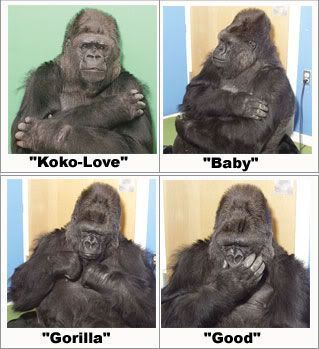
Researchers want to know if animal communication is more than just instinct or training, they want to know if it’s a true signal of sophisticated conscious thought. They’ve been focussing on the great apes, those primates most closely related to humans. A few of those creatures, the so-called linguistic apes, have been taught to communicate using sign language…
The ability to use language is just one aspect of consciousness, another aspect, perhaps the most basic is self consciousness. Some of the first experiments every done on animal cognition looked at this simple problem: the question of whether animals understand the distinction between themselves and others.

The simplest experiments involved nothing more than a mirror. Mark Hauser is a psychologist at Harvard University.

Mark Hauser: The mirror experience actually, as so often is the case, actually started with Charles Darwin. While he was working on the expression of emotions in man and animals he actually went to the one zoo and put a mirror in front of the orang-utan enclosure and simply watched what they did. And the orangs looked in the mirror and they often looked behind and reached behind the mirror and then they made facial expressions towards the mirror. So that was a big ambiguous, you know, the facial expressions could be interpreted as expressing towards another individual but it could also be explained as trying out to see what you look like. So those are simply ambiguous.
So it waited approximately a hundred years before the psychologist Gordon Gallup did a very creative experiment, which was to take a chimpanzee and show the chimpanzee the mirror, watch what they did - and the chimps did basically what the orang-utans did - and then after some period of time of exposure [he] anaesthetised the chimps, put one red mark over one eyebrow, one red mark over an ear, and these marks could not be smelt nor felt, there was no olfactory or tactile cues, and then when they awoke placed the mirror back in front of the chimpanzees and what they immediately do is selectively touch the red mark over the ear and the eyebrow and then begin to use the mirror to see parts of their body they’ve never seen before.

Now the reason why this is important is because it’s been shown, and it’s been shown continuously now, that many animals can use a mirror to find something hidden. That shows they can understand the sort of mechanics of the mirror but this experience says they can not only understand the mechanics of a mirror but they can understand the reflections of themselves.

Dan Falk: In the wake of those first experiments researchers have tried similar studies with all sorts of different animals, including humans. The great apes, chimpanzees, orang-utans or gorillas as well as children respond in the same way. When they see some kind of mark on their mirror image they’ll try to touch that mark. Lower species, including monkeys, don’t do this, they don’t seem to recognise that the image in the mirror is an image of themselves. The question is, what do these mirror tests reveal about the animals sense of self awareness. Mark Hauser.

Mark Hauser: When Gallup originally wrote on this problem, and I think he’s continued to argue this way, he basically argued that recognising one’s mirror image not only says that this animal has a sense of body image: that’s my body in the mirror, but also has a sense of self awareness. Now I think that’s an important distinction to make, because recognising that that’s my body to me doesn’t tell me anything about what the animal thinks about seeing its own body. Does it go, Hey, I’m kind of attractive, I’m ugly, I mean we don’t know, we’ve never learned a thing about that impression but that’s a sense of self awareness that’s the really interesting sense of self awareness.

Dan Falk: After looking at an animal's sense of self the next logical step is to look at whether it acknowledges others. We’re not just asking if it can interact with other animals, obviously every animal on the planet does that, we want to know does an animal understand that some other animal may feel what it feels, that it might see or hear or know what it sees, or hears, or knows.
An example of this is the question of empathy. Can an animal understand what one of its fellow animals is experiencing? In humans this develops only in late childhood but when it does it becomes a very strong response. When we see a starving person on television, for example, we don’t just say that person has a problem, we can really imagine what it would be like to be in that person’s situation. Can animals do that?

Mark Hauser describes an experiment that tested whether certain primates can feel empathy.

Mark Hauser: So you train a rhesus monkey to pull one of two levers to access to food. If the animal does this it gets food and the only way it can get food during a day is by pulling the levers, so it basically is self feeding itself. Once it learns this task, which it does very quickly, now you put another rhesus monkey, into the adjacent cage visible to this individual. Now the experimenter changes one of the levers so that when he pulls it, it shocks the animal next door in a very strong shock, so the consequences are very visible to the animal in charge of the levers.
Here’s the remarkable result. The animal in charge of the levers will stop pulling either lever for five to twelve days: it’s functionally starving itself in order not to shock the guy next door. He will do that more if it’s a familiar cage mate than an unfamiliar rhesus monkey, and if you put in - and this is a little bit comical, but not really if you think about it - if you put a rabbit next door they won’t withhold at all. So it’s species specific; it depends on familiarity and it also depends on whether the animal pulling levers has had experience being shocked. So it really gets very, very close to what it’s like to have an experience like that.

Dan Falk: All of these experiments offer hints at just what it is that separates us from our primate cousins. They give us a glimpse of that period in our history some time between six and four million years ago when our ancestors the early hominids diverged from the great apes, or rather, the time when both the hominids and the great apes diverged from some common ancestor.
But what was it that pushed us down the path towards to high level consciousness? What put us on the path to culture and civilisation but not those other primates? A lot of psychologists have said it must have been language but Herbert Terrace at Columbia has a different idea. He says there must have been an even earlier development in our psychology that paved the way for language. He calls it 'joint attention', the way that one creature can sense that his companion is aware of the same thing that he is,.

Herbert Terrace: In children you can see this develop very clearly. A six month old child will look at a particular object, say a rattle, and just look at it and a parent knows the child wants the rattle. A few months later the child will look at the rattle and then look up at the parent and back and forth indicating please give me the rattle. OK, that’s very much just what an ape would do. Later on, maybe twelve to eighteen months, the child will look at the rattle, look up at the parent to check, Do you see that? and when the parent indicates, Yes, I see that, the child will smile because now the child is no longer interested in the rattle per se, it could be the car outside, it could be the cat, but the child is checking, Does mummy see what I see, is it the same?
Now it’s very easy to put the label 'rattle' on that later on, or cat, but first there is this joint attention and without joint attention which doesn’t require language I don’t see how language could have emerged. Because I know that what I’m saying is going to be received by the listener unless I have a theory of mind that the listener sees the world in a way that overlaps with my view of the world.

Dan Falk: If Terrace is right, then some time in the last few million years our ancestors developed this capacity for joint attention and this special ability allowed us to develop language. But even though our species was the only one to develop a sophisticated use of language we should remember that that’s just one aspect of consciousness. Other animals may have other kinds of mental abilities that also contribute to consciousness. Patricia Churchland of University of Calofornia, San Diego;

Patricia Churchland: On the assumption that the human brain is a product of biological evolution, then it would be very surprising if we alone had a feature that encompassed attention, being able to do visual or other kinds of imagery, awareness of sensations and so forth. You see, I don’t think of consciousness as a light that’s either on or off and consequently, I suspect that probably your consciousness is different from the consciousness of a chimpanzee but it’s possibly also different from the consciousness of say a medieval nun or different from the consciousness of a stone age man.

Dan Falk: Learning about animal minds isn’t just an academic exercise for zoologists and psychologists. One obvious application is on the ethical front: if we can show that animals have sophisticated mental lives it could be used as an argument that they deserve better treatment. Of course, even the great apes aren’t human, but if they’re close to human then they deserve then they deserve something close to human rights. Another application is in anthropology. These studies can help to illuminate the lives of our earliest hominid ancestors, creatures that have left behind a few scattered bones but few other clues about their lives and almost no clues at all about their minds.

And finally, we might just learn something about consciousness itself. If we can learn about the differences between our minds and animal minds then we’ll have taken a small step towards understanding the greatest evolutionary gift of all – the gift of human consciousness. I’m Dan Falk.


 http://i298.photobucket.com/albums/mm248/redmoongraphicnovel/Koko_Vocab_4Signs.jpg

Higher Level Cognition
Excerpts from an AAAS symposium on animal brains and behaviour
Edward Wasserman: We now have a fully developed science of comparative cognition, and the individuals from whom you're going to hear today are some of the leading experts in this field. The science of comparative cognition experimentally evaluates Darwin's hypothesis of mental continuity. It does so not on the basis of cute stories, although some of the evidence is cute to be sure, but on the basis of very carefully conducted scientific studies.
So let me go on and tell you just a little bit about the research that I and my colleagues have been doing for some time. Our research studies what might be called abstraction or abstract behaviour in pigeons and baboons. Humans, for the longest period of time, have underestimated the intelligence of animals, and I think you're going to hear today evidence that these underestimations are not justified. But with regard to abstract thinking, it has been believed that humans are set apart from all other animals.
One cognitive capacity that's vital to human intelligence particularly is the ability to tell whether two or more items are the same or different. So two pennies would be the same, a dime and a nickel would be different. My colleagues and I have conducted extensive behavioural research into same-different discrimination in baboons and pigeons. We've used a variety of different experimental setups involving computerised joysticks and touch screens, and we've discovered that both baboons and pigeons readily learn and more importantly transfer same-different discriminations based on arrays of identical and non-identical items. This is the hallmark of a concept and the animals have passed this test with flying colours.
These findings have clear evolutionary significance. Higher level cognition was once believed to be the unique province of human beings, but we now know that baboons and pigeons show similar intellectual abilities. The roots of abstract thought may thus lie deep in our animal ancestry. These discoveries suggest that we humans should keep our egos in check, we are certainly not the most intelligent animals on Earth.
Robyn Williams: Thank you very much. Our next speaker is Nicola Clayton, Professor of Comparative Cognition and director of studies in natural sciences for Clare College, University of Cambridge.
Nicola Clayton: Thank you. Imagine if an alien had landed on Earth during our Stone Age past and had a peek at us. She'd probably have seen us as these almost hairless creatures, weak and wimpy, with a slow bipedal gait, and really thought the only thing going for us was our oversized brain. The mind is arguably the most distinctive and important feature of our own humanity, and yet we now know, as Ed pointed out, that a number of animals do indeed share a number of properties with us when it comes to minds, despite the lack of language, which is just what Darwin argued. In fact I would say that the last 20 years or so has really seen quite a major revolution in our understanding of the minds of other animals.
Traditionally research on animal cognition focused primarily on primates, and particularly on the great apes because they're our closest relatives, and it's been known for many years that chimpanzees share many cognitive abilities with us, including the use and manufacture of tools. And there's even some evidence now that they can save tools for later use, suggesting that they may even be capable of planning ahead, another feature that was thought to be unique to humans. And the common assumption was that intelligence has evolved just once, but members of the crow family are also capable of forethought and, as Alex will tell you in a moment, of using tools.
I shall argue that food-caching jays, a member of the crow family, can plan ahead for tomorrow's breakfast, and that they can protect their caches from being stolen by others. It was the first evidence of planning ahead in an animal. At first that was thought as being very surprising. You might wonder why. I think perhaps the whole idea about why planning was thought to be so special is best illustrated actually by a poem rather than by any scientific quote, and that's a story that Robbie Burns wrote in his lament Ode to a Mouse.
In this lament he just ploughed over a field mouse's nest, and he felt absolutely rubbish. It was dusk and he saw this mouse wander off into the wilderness, and he thought surely this mouse is going to die and it was all his fault, he'd destroyed the mouse's nest. And then suddenly a thought struck him and he started to smile, and he turned to the mouse and he said:
Still thou art blessed, compared with me!
The present only touches thee,
But, oh, I backward cast my eye
On prospects drear,
And forwards, though I cannot see,
I guess and fear.

So for Robbie Burns and for many psychologists and philosophers, planning ahead was thought to be something that was uniquely human and not without its consequences. Remorse and regrets and worry about the future were all things that were thought to be uniquely human. We now know that's not true.
The finding that crows are as intelligent as chimpanzees also has a number of implications, of course. For one thing I would argue that the derogatory term 'bird-brain' is obsolete, we should be thinking about 'brainy-birds', the other way around. And it also challenges the assumption about the evolution of our own intelligence. Indeed I've argued that when it comes to cognition, crows are feathered apes, and what's more they're right in front of your nose, they're in your backyard, you can see them everywhere.
This thesis raises two other important issues; one concerns the kind of a brain that can support intelligence, because the bird brain has a very different structure from that of mammals. The second issue is whether intelligence is a highly specialised trait or a more general ability. The 'out of Africa' hypothesis suggests that primate intelligence just evolved in one particular niche in the African savannah, whereas a much more general idea would be that it evolved in a range of environments, from land to air.
So perhaps it's just a small evolutionary accident that we ended up with a planet of the apes rather than a planet of the crows. And I'll finish with a quote. In the 1800s the Reverend Henry Beecher was of the opinion that 'if men had wings and wore black feathers, few of them would be clever enough to be crows.' Thank you.
 http://www.scientificamerican.com/media/inline/one-world-many-minds_1.jpg
Guests on Dan Falk’s program:


Dan Falk
Freelance Writer - Print, Television, Radio
Toronto Ontario
Canada

danfalk@pathcom.com


John R Searle
Professor of Philosophy
University of California
Berkeley
searle@cogsci.berkeley.edu

Further information:


Patricia S Churchland
Professor of Philosophy
University of California
San Diego
Tel: +1(858)822-1655
pschurchland@ucsd.edu


Herb Terrace
Pshycholgist
Columbia University
New York

Tel: +1 212 854 4544
Tel: +1 212 854 8785

terrace@columbia.edu


Marc D Hauser
Professor of Psychology
33 Kirkland Street
Department of Psychology
Harvard University
Cambridge MA 02138

Office: +1 617 496 7077
Lab: +1 617 4953886
Fax: +1 617 496 7077
hauser@wjh.harvard.edu

Robyn Williams’ Guests

Edward Wasserman
Professor Experimental Psychology Iowa University
Iowa City
http://www.psychology.uiowa.edu/PeopleSearch/people/DeptWebpage.aspx?personId=138

Nicola Clayton
Professor of Comparative Cognition Cambridge University UK
http://www.psychol.cam.ac.uk/pages/staffweb/clayton/

Alex Kacelnik
University of Oxford UK
http://users.ox.ac.uk/~kgroup/people/alexkacelnik.shtml


Edited from transcripts broadcast on 20/4/2002 and 21/2/2009 on ABC Radio National’s Science Show.

Images - http://blog.thirdeyehealth.com/images/animal-mind-1.jpg
http://media.photobucket.com/image/animal%20minds/redmoongraphicnovel/Koko_Vocab_4Signs.jpg
http://www.scientificamerican.com/media/inline/one-world-many-minds_1.jpg

For further enlightenment see –

The Her(m)etic Hermit - http://hermetic.blog.com


This material is published under Creative Commons Copyright – reproduction for non-profit use is permitted & encouraged, if you give attribution to the work & author - and please include a (preferably active) link to the original along with this notice. Feel free to make non-commercial hard (printed) or software copies or mirror sites - you never know how long something will stay glued to the web – but remember attribution! If you like what you see, please send a tiny donation or leave a comment – and thanks for reading this far…

From the New Illuminati – http://nexusilluminati.blogspot.com