"All the World's a Stage We Pass Through" R. Ayana

Showing posts with label animal consciousness. Show all posts

Friday, 29 July 2016

7 Mind-Blowing Discoveries That Would Touch All Aspects of Humanity and Change the World Forever


7 Mind-Blowing Discoveries That Would Touch All Aspects of Humanity and Change the World Forever

MIND BLOWING


What does it mean to be human? It’s a difficult question to answer. There are so many things which set us apart from one another, yet more still which bind us together, and I think we could all benefit from focusing more on what we share than what we do not. Our differences are important, as they allow each of us to bring something unique to the whole, but it becomes problematic when we use those differences as the basis for judgment, hate, and violence.

We are like a race with amnesia; we seem to  know next to nothing about ourselves — our origins, our purpose, or even how we got here in the first place. We still have so many questions that need answering, and while we have created many theories (all with gaping holes), new discoveries are constantly emerging that challenge what we thought we previously knew. And so every now and then, we come to paradigm shifting realizations that alter our perception of what it means to be human, what we are capable of, and what the true nature of reality is.

So it seems we do have one thing in common: Curiosity. We are constantly searching for ‘what is,’ and as the centuries pass, we seem to inch a little closer to understanding it — to understanding ourselves, our world, and what awaits us beyond it.


1. What If We Are Not Alone?


The Kepler Space Telescope has shown us that our galaxy alone could hold as many as 30 billion planets similar to Earth. That means there are at least 30 billion planets just in this galaxy which could host lifeforms like the ones we know. Yet we don’t even know with certainty that a planet must be ‘Earth-like’ to host extraterrestrial life. Who knows what other biological organisms are out there and what type of planetary environment they need to survive?

One thing is certain, however: Our discovery of extraterrestrial life is right around the corner. It wasn’t long ago when NASA’s chief scientist, Ellen Stofan, predicted that we would have “strong indications of life” on other planets by 2025. And just a couple of years ago, two top astronomers from the SETI Institute (Search For Extraterrestrial Intelligence) appeared in front of the Congressional House Science and Technology Committee for a hearing regarding the search for extraterrestrial intelligence. They told the committee that extraterrestrial life most certainly exists, without question; one of those scientists is Seth Shostak, a well-known senior scientist at the SETI Institute. They said that the chance of discovering life on other planets is inevitable and will most likely occur within the next 20 years.

Their main argument relates to the sheer size of the universe, emphasizing that there are trillions of stars out there, with one in every five most likely harboring an Earth-like planet. Seth explains:

“In the last 50 years, evidence has steadily mounted that the components and conditions we believe necessary for life are common and perhaps ubiquitous in our galaxy,” he said. “The possibility that life has arisen elsewhere, and perhaps evolved intelligence, is plausible and warrants scientific inquiry. . . . If you extrapolate on the planets they discovered, there are a trillion planets in the galaxy. That’s a lot of places for life. We know that the majority of stars have planets . . . [but what] fraction of stars has planets that are more like the earth? It might be one in five.” (source)

(Keep in mind that a planet does not necessarily have to be Earth-like to harbour life.)

But what about the other possibility….

“Yes there have been crashed craft, and bodies recovered . . . We are not alone in the universe, they have been coming here for a long time.”
– Dr. Edgar Mitchell, ScD, 6th man to walk on the Moon (source) (source)


The other possibility — we’ve already been visited…

“There is a serious possibility that we are being visited and have been visited for many years by people from outer space, from other civilizations [and] it behooves us, in case some of these people in the future or now should turn hostile, to find out who they are, where they come from, and what they want. This should be the subject of rigorous scientific investigation and not the subject of ‘rubishing’ by tabloid newspapers.” (source)

– Lord Admiral Hill-Norton, Former Chief of Defence Staff, 5 Star Admiral of the Royal Navy, Chairman of the NATO Military Committee


Just as scientists are certain that the discovery of extraterrestrial life will occur within the next couple of decades, others are certain that we have already been visited by intelligent extraterrestrial lifeforms, and this is ‘mainstream’ knowledge. John Podesta, for example, the former Chief of Staff to Bill Clinton, Councillor to Barrack Obama, and the current head of Hillary Clinton’s presidential campaign, has gone on record stating that it’s time to “pull the curtain back on this subject” and that “we have statements from the most credible sources – those in a position to know – about a fascinating phenomenon, the nature of which is yet to be determined.” You can read more about that here. Even Hillary Clinton stated earlier this year that we have have already been visited. You can read more about that here.

“There is another way, whether it’s wormholes or warping space, there’s got to be a way to generate energy so that you can pull it out of the vacuum, and the fact that they’re here shows us that they found a way.” (source)
– Jack Kasher, Ph.D, Professor Emeritus of Physics, University of Nebraska.


Where is this evidence that Dr. O’Leary speaks of?


“An extraterrestrial influence is investigating our planet. Something is monitoring the planet and they are monitoring it very cautiously.”
—  2008 Presidential Candidate Mike Gravel (source)(source)

We’ve written extensively on this subject, and it is backed by many credible sources. You can read some of these heavily sourced articles to learn more:


“Intelligent beings from other star systems have been and are visiting our planet Earth. They are variously referred to as Visitors, Others, Star People, ETs, etc.  . . . They are visiting Earth NOW; this is not a matter of conjecture or wistful thinking.”
– Theodore C. Loder III, Phd, Professor Emeritus of Earth Sciences, University of New Hampshire (source)


2. What If Most Of Reality Is Hidden Or An Illusion?


This quote from R.C. Henry, Professor of Physics and Astronomy at John Hopkins University, sums up best what many scientists feel:

A fundamental conclusion of the new physics also acknowledges that the observer creates the reality. As observers, we are personally involved with the creation of our own reality. Physicists are being forced to admit that the universe is a “mental” construction. Pioneering physicist Sir James Jeans wrote: “The stream of knowledge is heading toward a non-mechanical reality; the universe begins to look more like a great thought than like a great machine. Mind no longer appears to be an accidental intruder into the realm of matter, we ought rather hail it as the creator and governor of the realm of matter. Get over it, and accept the inarguable conclusion. The universe is immaterial-mental and spiritual.

– (“The Mental Universe” ; Nature 436:29,2005)


Our universe may be nothing but a mental construction, one that doesn’t even exist until we look at it or ‘measure’ it. The quantum double slit experiment is a great experiment that demonstrates this, showing us how factors associated with consciousness play an imperative role in the creation of our reality. (source)

Australian associate professor Dr. Andrew Truscott recently published a paper in the journal Nature Physics which concluded that “at the quantum level, reality does not exist if you are not looking at it.” (source)

There are several other things to consider here, like dark matter, for example — a substance we can’t see or know that makes up the majority of what we call reality. What about other dimensions that we can’t see? What about other universes? Perhaps one day we will be able to experience these other worlds.


3. What If We Discover That We Can See The Future?


It’s no secret that computers are already producing accurate simulations of future realities. Even quantum physics has shown us that an atom can exist in a state of multiple probabilities until it is observed or measured. Perhaps there are multiple probable timelines for what will happen? Perhaps we will develop machines that will be able to accurately predict the future?

Few people are aware that a number of scholarly articles examining precognition and presentiment that have been published in reputable peer-reviewed journals. For example, a recently published study (meta analysis) in the journal Frontiers in Human Neuroscience titled “Predicting the unpredictable: critical analysis and practical implications of predictive anticipatory activity” examined a number of experiments regarding this phenomenon which had been conducted by several different laboratories.

These experiments indicate that the human body can actually detect randomly delivered stimuli that occur 1-10 seconds in advance. In other words, the human body seems to know of an event and can react before it occurs, as evinced by physiological changes in the skin and the cardiopulmonary and nervous systems prior to the event. (source)

It’s important to note that these physiological responses to future events happen on an unconscious level, meaning that the subject (human) is not aware they are taking place. So it is a form of precognition, but not full blown conscious premonitions.

A meta-analysis of forced-choice precognition experiments conducted from 1935-1987 and published in The Journal of Parapsychology makes a strong case for the validity of human precognition.

For a selected list of downloadable peer-reviewed journal articles reporting studies of psychic phenomena, mostly published in the 21st century, you can click HERE. There is a section specifically for precognition and presentiment.

It’s also noteworthy to mention that in 1999 a statistics professor at UC Irvine published a paper showing that parapsychological experiments have produced much stronger results than the those showing a daily dose of aspirin helps prevent a heart attack. She also showed that these results are much stronger than the research behind various drugs like antiplatelets, for example. This begs the question, why are psi experiments only marginally acknowledged or even known of by the mainstream scientific community if the evidence for ESP (for example) is stronger than that of the effectiveness for the administration of popular drugs?

Cassandra Vieten, PhD and President/CEO at the Institute of Noetic Sciences, provides some insight into why this might be the case:

There seems to be a deep concern that the whole field will be tarnished by studying a phenomenon that is tainted by its association with superstition, spiritualism and magic. Protecting against this possibility sometimes seems more important than encouraging scientific exploration or protecting academic freedom. But this may be changing.


4. What If We Came From Space?


This is a theory which remains on the fringe of mainstream science. A number of scientists believe that human life actually originated in outer space, and one of them is leading British scientist Chandra Wickramasinghe. Wickramasinghe is the director of the Buckingham Centre for Astrobiology at the University of Buckingham in the U.K.

This astrobiologist believes that the ‘seeds of life’ were brought here from some outside sources, like a comet, and supports this theory with evidence he discovered a couple of years ago with a team of researchers at the School of Mathematics at Cardiff University and from the Medical Research Institute in Colombo, Sri Lanka. 

They found “a microstructure and morphology characteristic of a wide class of terrestrial diatoms.” The group concluded that “the presence of structures of this kind in any extraterrestrial setting could be constructed as unequivocal proof of biology.” Cardiff University was asked to proof-check and analyze the findings, which it did, concluding that the samples were “unequivocally meteorites” and that the analysis of the material structure showed that algae-like fossils were native to it.

This is the first-ever evidence of extraterrestrial life found in a celestial body. The researchers used sophisticated methods like X-ray diffraction, triple oxygen isotope analysis, and scanning electron microscopy.

English astronomer Sir Fred Hoyle, along with Wickramasinghe, co-developed a theory known as “panspermia,” which suggests that life exists throughout the universe and is distributed by meteoroids and asteroids. It’s a wonderful example of synchronicity that this meteorite happened to fall into their laps, potentially proving their theory correct.

You can read the study here.

He explores this topic in an earlier paper that he co-authored in 2012 titled “Non-terrestrial origin of life: a transformative research paradigm shift” as well. Below is the abstract:

Theories and hypotheses in science are continually subject to verification, critical re-evaluation, revision and indeed evolution, in response to new observations and discoveries. Theories of the origin of life have been more constrained than other scientific theories and hypotheses in this regard, through the force of social and cultural pressures. There has been a tendency to adhere too rigidly to a class of theory that demands a purely terrestrial origin of life. For nearly five decades evidence in favour of a non-terrestrial origin of life and panspermia has accumulated which has not been properly assessed. A point has now been reached that demands the serious attention of biologists to a possibly transformative paradigm shift of the question of the origin of life, with profound implications across many disciplines. (source)

This would be quite the shocker. If we were to determine that we came from space or that we are not alone in the universe, the resulting implications for all fields, from science and technology to religion and philosophy, would be immeasurable.


5. What If We Learn To Talk To Animals


The way we treat animals on this planet is heartbreaking, to say the least. Apart from destroying their world for the sake of economic growth, we also raise billions of animals every single year for the purpose of slaughter. We are now starting to see the dramatic consequences of our actions, but more empathy towards animals is still desperately needed. This isn’t just our planet; we share it with others, and all beings deserve an equal chance to live life and thrive.

There are many efforts underway to change things, and consumers are making a difference by voting with their dollars. SeaWorld has seen profits decline dramatically, as multiple areas in North America have now banned whale captivity. And not long ago, a New York court entertained the idea of granting chimpanzees the legal right to personhood. All thought the lawsuit was a failure, but the judge admitted that “efforts to extend legal rights to chimpanzees . . . are understandable; some day they may even succeed.

If this were to happen, I think we would quickly need to reevaluate our stance on the status of other animals. Why should only chimpanzees be granted rights? If animals were ever granted rights and personhood, we would not be able to keep them captive, or use them for testing.

In the August 2015 edition of New Scientist, Joshua Howgego offers his view on the issue:

If chimps were given rights, we might expect other intelligent species, such as killer whales and elephants, to follow. But why stop there? Our ideas about the inner lives of other animals – their capacity for suffering, autonomy and self-awareness – are based largely on analogy with ourselves; how would we like it in their place?

But what if those animals could tell us? What if a dog or dairy cow could let us know how it felt about its lot in life? The idea may not be as far-fetched as it seems. There are many examples of communication between apes and their human keepers. Researchers are busy decoding dolphin. And cognitive scientists are beginning to study emotional states in animals, It may only be a matter of time before more meaningful communication between species is possible.

If we could converse with animals, would we still eat them? What if we discovered that their intellectual ability to communicate, to show empathy, or to feel emotions were equal to ours? What would happen? What would you do? Would you eat something you could have an intellectual conversation with? I have a difficult time believing many people would.


6. What If We Found Out That ‘Life’ Goes On After ‘Death’


Below is a video of Dr. Bruce Greyson speaking at a conference held by the United Nations. Considered to be one of the fathers of near death studies, he is currently a Professor Emeritus of Psychiatry and Neurobehavioral Science at the University of Virginia.

In the video he describes documented cases of individuals who were clinically dead (showing no brain activity), but observing everything that was happening to them on the medical table below at the same time. He describes how there have been many instances of this – where individuals are able to describe things that should have been impossible to describe. Another significant statement by Dr Greyson posits that doing this type of research has been discouraged due to our tendency to view science as completely materialistic. Seeing is believing, so to speak, in the scientific community. It’s unfortunate that just because we cannot explain something through materialistic means, it must be instantly discredited.


In 2001, international medical journal The Lancet published a 13 year study on Near Death Experiences (NDEs):

Our results show that medical factors cannot account for the occurrence of NDE. All patients had a cardiac arrest, and were clinically dead with unconsciousness resulting from insufficient blood supply to the brain. In those circumstances, the EEG (a measure of brain electrical activity) becomes flat, and if CPR is not started within 5-10 minutes, irreparable damage is done to the brain and the patient will die. (source)(source)

A total of 344 patients was monitored by the team of researchers, and an astounding 18 percent of them had some sort of memory from when they were either dead or unconscious (no brain activity), and 12 percent (1 out of every 8) had a very strong and “deep” experience. Keep in mind that these experiences have occurred when there is no electrical activity in the brain following cardiac arrest.

Another study comes out of the University of Southampton, where scientists found evidence that awareness can continue for at least several minutes after death. In the scientific world this was thought to be impossible. Published in the journal Resuscitation, it is the world’s largest near death experiences study(source)

In 2008, a large-scale study involving 2060 patients from 15 hospitals in the United Kingdom, United States and Austria was launched. The AWARE (AWAreness during REsuscitation) study, sponsored by the University of Southampton in the UK, examined the broad range of mental experiences in relation to death. Researchers also tested the validity of conscious experiences using objective markers for the first time in a large study to determine whether claims of awareness compatible with out-of-body experiences correspond with real or hallucinatory events. (source)(source)

Another great example comes from University of Virginia psychiatrist Jim Tucker, who in 2008 published a review of cases suggestive of reincarnation in the journal Explore. (source)

In the article, he describes a typical reincarnation case, where subjects start reporting a past life experience. One common denominator of these cases is that they all involve children, with the average age being 35 months when subjects begin to report their experiences. The experiences reported are often detailed and extensive, and Tucker points out that many of these children show strong emotional involvement when speaking about their claims, with some crying and begging to be taken to what they say is their previous family. Others show intense anger. But as children age, these memories generally disappear. He explains:

The subjects usually stop making their past-life statements by the age of six to seven, and most seem to lose the purported memories. That is the age when children start school and begin having more experiences in the current life, as well as when they tend to lose their early childhood memories. (source)

Some truly mind altering things to think about..


7. What If We All Have ‘Super Human Potential?’


It’s fascinating to consider just how many ancient teachings tell us that humans have the capacity to gain extraordinary powers through various techniques. In Buddhism, for example, the existence of advanced powers is readily acknowledged; in fact, Buddha expected his disciples to be able to attain these abilities, but also to not become distracted by them.

Is there any scientific evidence that human beings have extraordinary potential beyond what’s commonly known? There definitely is.

During a visit to remote monasteries in the 1980s, Harvard Professor of Medicine Herbert Benson and his team of researchers studied monks living in the Himalayan Mountains who could, by g Tum-mo (a yoga technique), raise the temperatures of their fingers and toes by as much as 17 degrees. It is still unknown how the monks are able to generate such heat. (source)

And it doesn’t stop there — the researchers also studied advanced meditators in Sikkim, India, where they were astonished to find that these monks could lower their metabolism by 64 percent. (source)

What about Wim Hoff? He has demonstrated to scientists that factors associated with consciousness can influence our autonomic nervous system. You can read more about that here.

A study published in the American Journal of Chinese Medicine, as seen in the the US National Library of Medicine, demonstrated that a woman with special abilities was and is able to accelerate the germination of specific seeds for the purposes of developing a more robust seed stock. This is one example of many; you can find the study and read more about it here.

A paper published in the Peoples Republic of China (PRC) in September 1981, in the journal Ziran Zazhi (Nature Journal) tilted “Some Experiments on the Transfer of Objects Performed by Unusual Abilities of the Human Body” (Shuhuang et al., 1981), reported that ‘gifted children’ were able to cause the teleportation of small physical objects from one place to another.

There are also some extraordinary claims from a publication titled “Exceptional Functions of the Human Body.” This study reports of highly accurate parapsychological effects, including clairvoyance, psychokinetic effects, and more. (source)

A report published in 2010 by retired research chemist Dong Shen describes an experiment involving mental teleportation of bits of paper out of a sealed plastic film container. What’s even more fascinating is that these methods were taught to others with a success rate of 40 percent.

“It became known to myself, along with several colleagues both inside and outside of government, that anomalous teleportation has been scientifically investigated and separately documented by the Department of Defense.” (source)

I just wanted to illustrate that the idea of ‘superpowers’ is not as farfetched as some may think it is. Who knows, some day we might all be able to do these things.


For more information about extraterrestrial life see http://nexusilluminati.blogspot.com/search/label/extraterrestrial%20life  
For more information about near death experiences see http://nexusilluminati.blogspot.com/search/label/ndes  
For more information about animal consciousness see http://nexusilluminati.blogspot.com/search/label/animal%20consciousness  
- Scroll down through ‘Older Posts’ at the end of each section


Do you LIKE this uniquely informative site?
Hours of effort by a genuinely incapacitated invalid are required every day to maintain, write, edit, research, illustrate, moderate and publish this website from a tiny cabin in a remote forest.
Now that most people use ad blockers and view these posts on phones and other mobile devices, sites like this earn an ever shrinking pittance from advertising sponsorship.
This site needs your help.
Like what you see? Please give anything you can -  
Contribute any amount and receive at least one New Illuminati eBook!
(You can use a card securely if you don’t use Paypal)
Please click below -


And it costs nothing to share this post on Social Media!
Dare to care and share - YOU are our only advertisement!


For further enlightening information enter a word or phrase into the random synchronistic search box @ the top left of http://nexusilluminati.blogspot.com


And see


 New Illuminati on Facebook - https://www.facebook.com/the.new.illuminati

New Illuminati Youtube Channel -  https://www.youtube.com/user/newilluminati/playlists

New Illuminati’s OWN Youtube Videos -  
New Illuminati on Google+ @ For New Illuminati posts - https://plus.google.com/u/0/+RamAyana0/posts

New Illuminati on Twitter @ www.twitter.com/new_illuminati


New Illuminations –Art(icles) by R. Ayana @ http://newilluminations.blogspot.com

The Her(m)etic Hermit - http://hermetic.blog.com


DISGRUNTLED SITE ADMINS PLEASE NOTE –
We provide a live link to your original material on your site (and links via social networking services) - which raises your ranking on search engines and helps spread your info further!

This site is published under Creative Commons (Attribution) CopyRIGHT (unless an individual article or other item is declared otherwise by the copyright holder). Reproduction for non-profit use is permitted & encouraged - if you give attribution to the work & author and include all links in the original (along with this or a similar notice).

Feel free to make non-commercial hard (printed) or software copies or mirror sites - you never know how long something will stay glued to the web – but remember attribution!

If you like what you see, please send a donation (no amount is too small or too large) or leave a comment – and thanks for reading this far…

Live long and prosper! Together we can create the best of all possible worlds…


From the New Illuminati – http://nexusilluminati.blogspot.com

Tuesday, 28 June 2016

5 Ways Vegetarianism Could Save the World


5 Ways Vegetarianism Could Save the World
5 Buddhist Teachings and Teachers Recommending a Vegetarian Lifestyle;
5 Reasons it’s the Ethical Thing to Do


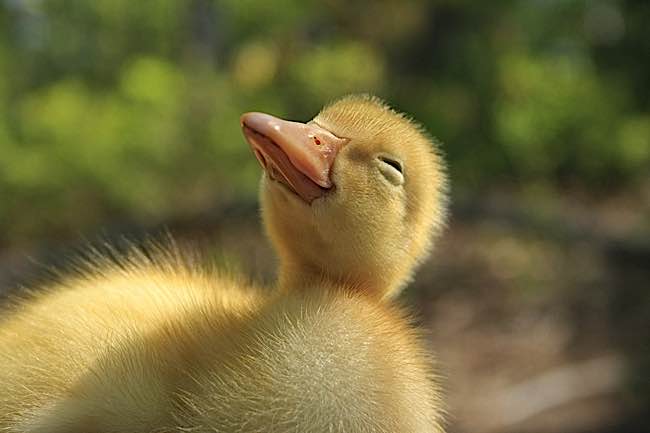
According to scientific consensus, animals are sentient and feel emotions. This chick is a little happier than the one in the chicken factory farm depicted below.
According to scientific consensus, animals are sentient and feel emotions. This duck is a little happier than the birds in the chicken factory farm depicted below.


Not all Buddhists are vegetarians. Did the Buddha actually suggest a vegan lifestyle? And, putting aside Buddhists, why is the meat industry growing when the science says it’s hurting our planet? These are the questions that frame our special feature focusing on Vegetarianism: five ways it could save the world, five Buddhist teachings that recommended veganism, and five reasons it’s just the ethical thing to do. And, since not everyone reading this feature is a Buddhist, let’s start with the science.

The Scientific Buddhist Buddha Weekly Special Report
Over 56 billion farmed animals are killed each year by humans — 10 billion land animals in the U.S. alone. 3,000 die each second. [5] This does not include countless fish. Billions of animals suffer and die painfully — animals who, according to scientists, are sentient and feel emotions. [4]. Put another way, each person who eats meat, is directly responsible for the lives of an average of 95 slaughtered animals each year. [5]


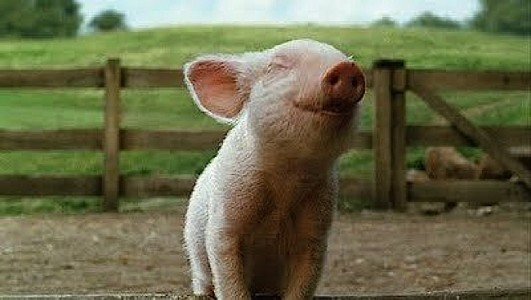
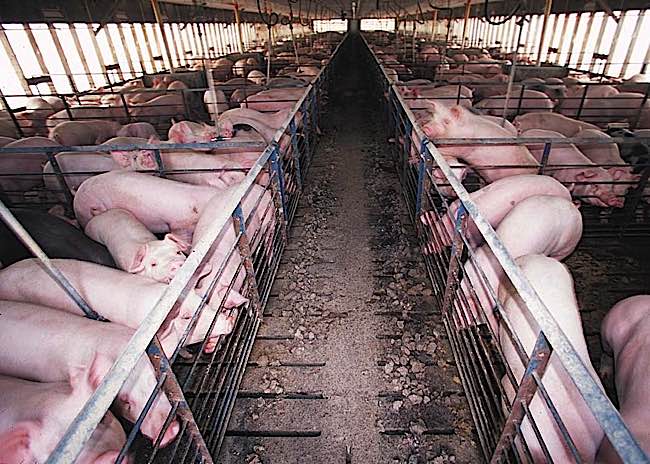
According to most scientists, animals are sentient and feel emotions. Contrast this happy pig to the unhappy pigs on a factory farm below.


The Scientific Buddhist, 5 Ways Vegetarianism Could Save the Planet


The data and science do suggest vegetarianism could indeed save the world. There’s a big “ism” in this statement. The only way vegetarianism could help save the world is if at least 25 percent of us stopped eating our earthly companions — non-human sentient beings. How is it possible that simply reducing demand for meat could save the planet? The most compelling reasons include:

  • emissions — the meat industry is one of our largest polluters, more than all cars and planes put together [1]
  • scarcity of land — 30% of the available ice-free surface area of the planet is now used by livestock, estimated to soon increase to 45%
  • inability to feed our population: perhaps more urgent than the environment is our inability to currently feed the world’s population, in part due to the unbalanced allocation of land: meat production uses 23 times as much land as crop production.
  • overuse of important resources such as water — and pollution of water.

Reduction in demand for meat by any sizeable percentage, would ease many of the issues and pressures identified by experts.


Demand for meat around the world is growing, with over 56 billion animals slaughtered each year, increasingly from factory farms who are major polluters.


If we’re serious about global warming and the environment, even modest reductions in dependence on meat will have a higher impact on the environment than things such as emissions controls on automobiles.

That restaurant steak on the plate could represent 9,000 liters of water, 40 kilograms of poop (waste), 4 kilograms of feed and more emissions pollution than a car might create on an hour-long drive to the restaurant.


Animals are Sentient and Feel Emotions say Prominent Scientists


Science also supports the view that animals are sentient, which makes the ethical arguments all the more compelling. “A prominent international group of cognitive neuroscientists and other experts made a strong declaration, endorsed by Stephen Hawking, affirming that all “nonhuman animals… including octopuses” are sentient and feel emotions such as fear and happiness. We wrote about this in a popular Buddha Weekly feature: “Prominent scientists declare “All non human animals … are conscious beings.” (View here>>)

We challenged readers: “The advance in non-human rights begs the question, from a Mahayana Buddhist perspective, when we promise to liberate all sentient beings — or not to kill — just who do we include? If our definition includes all beings down to insects and octopuses, how do we reconcile our dependence on “lower” beings for survival?”


His Holiness the Gwalwang Karmapa is a vegetarian and recommends the lifestyle to Mahayana Buddhists.


The 17th Gyalwang Karmapa gives a very direct answer: “We say I am going to do everything I can to free sentient beings from suffering. We say I am going to do this. We make the commitment. We take the vow. Once we have taken this vow, if then, without thinking anything about it, we just go ahead and eat meat, then that is not okay. It is something that we need to think about very carefully.”[3] The Dalai Lama also strongly recommends vegetarianism.


5 Ways Vegetarianism Could Save the World; 5 Buddhist Teachings and Teachers Recommending a Vegetarian Lifestyle; 5 Reasons it’s the Ethical Thing to Do


We asked Buddhist teacher Theodore Tsaousidis, of the Grey Bruce Mindfulness Centre, to put this in perspective. He didn’t sugar coat his view:

“If you claim to be a compassionate person or Buddhist in the 21st century and still eat meat, there are possible elements of pathology, hypocrisy and ignorance that beg reflection.”

But, before examining the ethics and Buddhist perspective, let’s start with five ways meat is damaging the environment and our world.


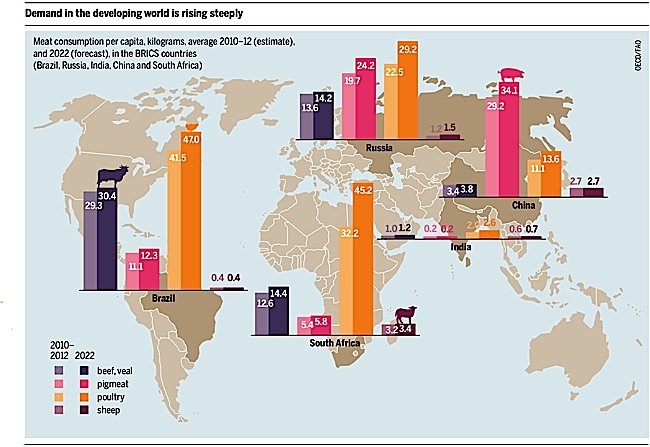
Meat consumption is growing in developing nations. There won't be enough land to support the growth. It is estimated 45% of non-ice land in the world will be used for meat production within a few years.
Meat consumption is growing in developing nations. There won’t be enough land to support the growth. It is estimated 45% of non-ice land in the world will be used for meat production within a few years.


Just the Facts: Why the Meat Industry is Damaging our Environment


The meat industry is one of the largest emissions contributors, producing more emissions than all the automobiles and planes put together. This issue will only be exacerbated by the expected growth of our population 4 billion. As a practical consideration, putting aside environment, ethics and all, there is not enough land to produce that much meat. It’s worth remembering that developing nations are quickly becoming advanced nations, increasing demand for meat.

There are some simple, largely indisputable, well-cited facts, that lead to the concept: “5 Ways Vegetarianism Can Save the Planet” story, only some of which we quote here (we recommend a read of the article of the same name in The Guardian>>)


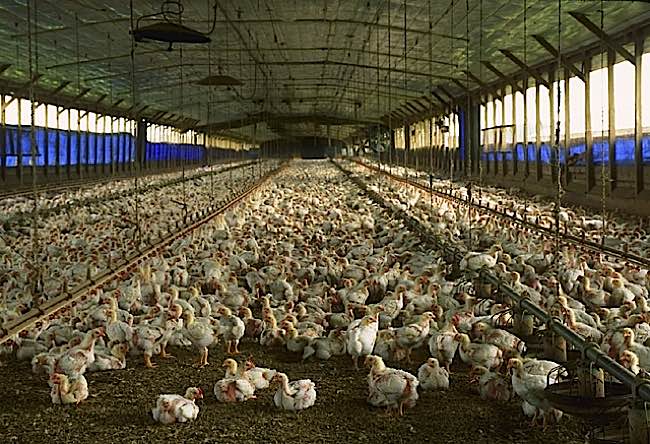
Factory pig farm producing waste products. Unlike organic farms, large scale factory farms product more pollution than a small human city.


Fact One — 18% of Global Climate Emissions are a result of meat production, more if you include supporting factors [1]


Factory farming is responsible for 37% of all methane emissions “which has 20 times the global warming potential of CO2.”[6]

“We humans eat about 230m tonnes of animals a year, twice as much as we did 30 years ago,” according to The Guardian newspaper. “We mostly breed four species – chickens, cows, sheep and pigs – all of which need vast amounts of food and water, emit methane and other greenhouse gases and produce mountains of physical waste… UN calculated that the climate change emissions of animals bred for their meat was… more than cars, planes and all other forms of transport put together.”


The meat industry is currently the largest methane producer, and the biggest contributor to pollution and global warming.


World Bank Scientists pegged the number at much higher, because they include extra considerations like clear-cutting oxygen producing forests to favor animal agriculture, fertilizers and many other factors, such as transport, bringing the total up to 51%.

In other words, if only 25% of the world’s population converted to vegetarianism, the impact on the environment would be staggering. That’s a fact, not even arguable (although certainly some will try. Which brings us to fact Two — the population is increasing.


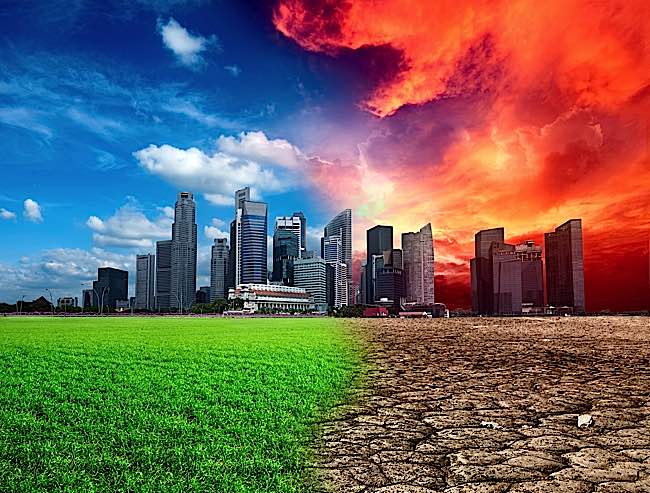
Increasing wildfires and turbulent weather are two of the consequences of global warming.


Fact Two — It takes 23X as much land to grow our vegetables as to raise meat livestock — not enough land to feed the expected increase in world populations.


Currently, according to facts cited in the Guardian feature: “Nearly 30% of the available ice-free surface area of the planet is now used by livestock, or for growing food for those animals. One billion people go hungry every day, but livestock now consumes the majority of the world’s crops.”

In other words, when the population grows by only 3 billion, we’ll need to consume another 15% — assuming demand per person doesn’t increase as nations grow richer—and we’ll have another 500 million starving humans. For livestock, 45% of land in the world — and unlikely possibility, even if we clear cut the few remaining forests (which leads us to the third fact — deforestation). Not all land is suitable for livestock. Of course, speaking facetiously, if the polar icecaps keep melting we may have more land for meat.


Factory farming requires extensive land, water and natural resources.


Put another way, in the US. alone, 13m hectares of land are used to grow vegetables, while it takes nearly 23 times that much, 302m hectares for livestock. “The problem is that farm animals are inefficient converters of food to flesh,” writes the Guardian. For example, pigs need 8.4kg of feed to produce one kilogram of meat.

Fact Three — Millions of hectares of trees cut to produce burgers


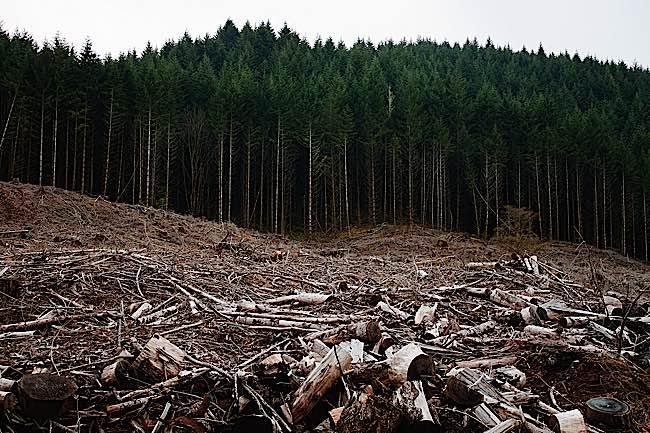
Agriculture in general is causing deforestation, mostly for meat and a few crops such as palm oil and soya. Write the Guardian: “Millions of hectares of trees have been felled to provide burgers for the US and more recently animal feed for farms for Europe, China and Japan.” 6m hectares of forest land a year are lost (roughly twice the size of Belgium) with most converted to farmland. Putting aside the destruction of animal habitat there’s an enormous climate cost. The second largest crop to go on that clear-cut land is soybeans, mostly grown to feed the cattle.


Clear cutting is necessary to create more land for meat production. Currently, 36% of non-ice land in the world is used in meat production, expected to grow to 45%.


Fact Four — A single cow farm can generate as much waste as a small city


The Guardian: ” Industrial-scale agriculture now dominates the western livestock and poultry industries, and a single farm can now generate as much waste as a city. A cow excretes around 40kg of manure for every kilogram of edible beef it puts on and when you have many thousands crowded into a small area the effect can be dramatic. Their manure and urine is funneled into massive waste lagoons sometimes holding as many as 40m gallons.”


Using arable land for crops versus meat production could have more impact on global warming than emission controls on factories and cars.


The article goes on to present shocking pollution statistics, such as “most summers between 13,000 and 20,000 sq km of the sea at the mouth of the Mississippi becomes a “dead zone”, caused when vast quantities of excess nutrients from animal waste, factory farms, sewage, nitrogen compounds and fertilizer are swept down the might river.” There are nearly 400 dead zones that have been identified, largely due to animal farming.

Fact Five: Current meat animals drink too much: producing a pound of beef requires 9,0000 litres of water


It may not be a top of mind issue in North America, where water is somewhat plentiful, if polluted. But in most other parts of the world, water shortage and clean water is a serious, even life-threatening issue.

It requires approximately 9,000 litres of water (20,000 pounds) to produce one pound of beef, 1,000 litres to produce one litre of milk. A broiler chicken “only” consumes 1,500 litres. Pigs are the worst, with the largest pig farms consuming as much water as a normal-sized human city.


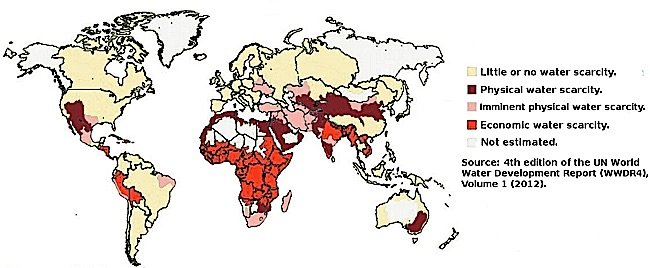
Indicated on map are areas of the world with not enough water for survival. Meat production uses a disproportionate amount of precious water resources and contributes to the pollution of remaining water.


There is no doubt that farming consumes the majority of our water, 70% according to expert estimations, but this number could be dramatically reduced if we transitioned more food output to crops versus meat.

For instance, potatoes take between 60 and 229 pounds of water per pound of produce — as compared to 20,000 pounds of water for a pound of beef. [1]


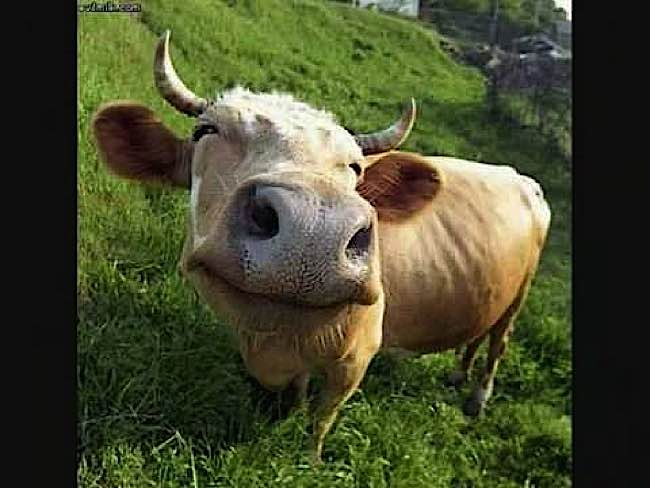
Cows feel emotions, according to the majority of scientists. A glance at this happy cow reinforces this fact.


Bottom Line — Meat a higher negative impact on the environment as compared to other major industries.


If we put aside ethical and Buddhist arguments, the meat industry is harmful to our collective help. Even a modest decrease in demand for meat can result in positive environmental returns. Significant decreases in demand could, literally, save our planet.


5 Buddhist Teachings and Teachers Recommending Vegetarian Lifestyle


Science not only proves horrendous impact of the meat industry on climate change and our environment, it asserts rather forcefully that even fairly simple non-human animals and birds — including fish — are sentient and have emotions. Both positions might be debatable, but these facts are credibly established. Which returns us to ethics and Buddhist teachings, since helping sentient beings is one of the most important compassion foundations of Mahayana Buddhism.


This annual vegetarian festival in Thailand celebrates the good karma of a non-meat lifestyle.


Earlier, we stated the strong position of Buddhist teacher Theodore Tsaousidis: “If you claim to be a compassionate person or Buddhist in the 21st century and still eat meat, there are possible elements of pathology, hypocrisy and ignorance that beg reflection.”

Is this harsh? Not if you consider the First Precept of the Buddha, “Abstain from Taking Life.” And not, as Mahayana Buddhists, when we vow to “benefit all sentient beings.” Practicing Mahayana Buddhists reinforce that vow and belief each day when we take refuge.

Theodore elaborated on his very strong position:

“If one keeps looking to the Buddha for direction as to whether it is permissible to kill and eat animals, then one doesn’t understand the aim of his teachings. If you, on a basic level, understand the fundamental technology and methodology of Buddhist’s teachings, then whether the question is simple or complex, it can be answered strictly by applying the method the Buddha expounded —which is to ask the question and experience the answer for oneself. 

“To do this, one must attend to one’s raw feeling. Without getting entangled in the interpretation of various sources, we can just feel and attend to one question: “Is my action inclusively wholesome, good, compassionate and freeing?” 


Theodore Tsaousidis is a meditation teacher who lectures regularly at Gaden Choling Toronto and a Medicine Buddha Toronto events and retreats.
Theodore Tsaousidis is a meditation teacher from Grey Bruce Mindfulness Centre, who lectures regularly at Gaden Choling Toronto and a Medicine Buddha Toronto events and retreats.


Science asserts that sentient beings include fish, birds and animals. Buddhism might be the middle way, but there is really not much middle ground for a Mahayana Buddhist with regards to eating meat. In Theravadan Buddhism, perhaps, there’s a little leeway, but the Mahayana Buddhist is above all compassionate and working for the benefit of sentient beings.


“If I didn’t ask the butcher to kill the animal, meat is okay, right?”


Generally, early Buddhist monks were instructed by Buddha to eat whatever is given to them. This could include meat, provided they were certain that the animal was not butchered for their benefit. Which, of course, is a wide loop hole, if you consider this to mean “it’s okay as long as I didn’t instruct them to butcher the meat.” However, most reasonable people understand that meat is only butchered due to our demand, so we are all involved in the decision.


Buddha taught the precept to "abstain from taking life." This is defined as any breathing life form.
Buddha taught the precept to “abstain from taking life.” This is defined as any breathing life form.


Specifically, Buddha said, in early Theravadan sutras: “Monks, I allow you fish and meat that are quite pure in three respects: if they are not seen, heard or suspected to have been killed on purpose for a monk. But, you should not knowingly make use of meat killed on purpose for you.” In this case, Buddha is teaching that monks should not reject alms, and also it’s important not to waste meat that is already butchered. Generally, this is not interpreted to mean approval of the practice of eating meat itself.


The hamburger factor. Countless hectares of forest is cleared each year to support the growing popularity of the hamburger.
The hamburger factor. Countless hectares of forest are cleared each year to support the growing popularity of the hamburger.


Technically correct? No intention is a thin argument.


It came down to intention. If monks were given meat, they could eat it because they had no intention to do harm (it was given to them, not requested by them) — therefore there was no negative karma. That’s not saying there was no harm done, only that there is no specific ethical problem if there was no intention to harm. It’s a thin argument, perhaps, considering there is knowledge that harm was done, but it’s technically correct in terms of karma.


Animals feel emotions.


However, since most of us are lay practitioners, we more or less order or buy meat knowing it must be killed for our benefit. Therefore, our middle ground becomes one of — “I’m not ready to be a monk today, but sometime in the future…” If we really want to look the other way, we can also hide behind “no intention to cause harm” but it’s not an easy argument to make when we knowingly buy the meat.


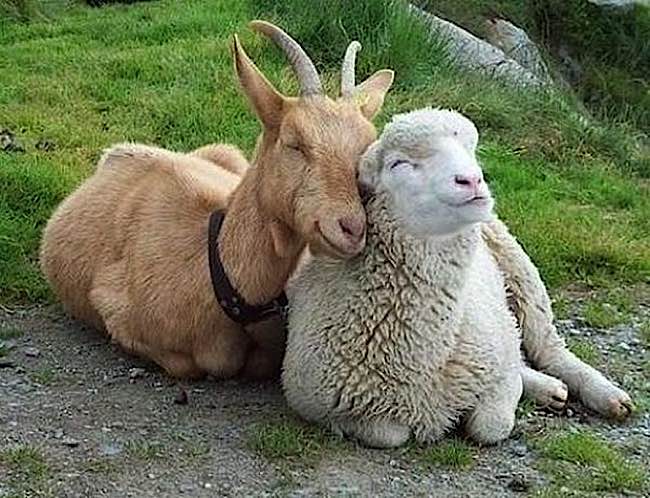
Sentient animals around the world feel happiness, pain and suffering. Here are two happy friends.


Mahayana sutras, on the other hand, for the most part reject meat and emphasize compassion to all sentient beings — which we now know include non-human animals, birds and fish.


The Dalai Lama: “The best thing is to give up meat.”


In answer to the direct question, “Is it permissible for Buddhists to eat meat?” the Dalai Lama replied in November 2009:

“The best thing is to give up meat entirely. Sometimes one’s lifestyle and circumstances provide no alternative but to eat meat, and in these cases one should eat as little meat as possible. Tibetan monasteries and nunneries in south India became entirely vegetarian 15 years ago. Festivals and ceremonies in all Tibetan monasteries and nunneries should be completely vegetarian.” [3]


The Dalai Lama often teaches the topic of meditation on death and wrote books on the topic.
The Dalai Lama often teaches the benefits of vegetarianism, or minimizing the consumption of meat.


His Holiness 17th Gyalwang Karmapa: Doesn’t eat meat because “of the intense suffering that the animals”


The Gyalwang Karmapa, who is a vegetarian, gave two reasons why he suggests not eating meat (on the official website of the Karmapa): The first reason is the intense suffering that the animals who are killed go through. Every single day millions of animals are killed to feed us, and many are subjected to terrible conditions to provide us with food.”

The second reason is even more directly hard-hitting from a Mahayana Buddhist point of view:

“We say I am going to do everything I can to free sentient beings from suffering. We say I am going to do this. We make the commitment. We take the vow. Once we have taken this vow, if then, without thinking anything about it, we just go ahead and eat meat, then that is not okay. It is something that we need to think about very carefully.”


The most Venerable Thich Nhat Hanh.
The most Venerable Thich Nhat Hanh advocates not only vegetarianism, but activism.


What five other notable Buddhist teachers say about eating meat


Here are a few snippets (there are thousands to choose from) from the great teachers:

    What the Buddhist Teachers Say Buddha Weekly
  • Bikkhu Bodhi: The first precept, to abstain from killing, includes the “taking of life of ay being with breath.”
  • Zasep Tulku Rinpoche: “We must not hurt other people and animals.”
  • Thich Nhat Hanh: “No killing can be justified…. We must also learn way to prevent others from killing.”
  • Kyabje Chatral Sangye Dorje Rinpoche: “Meat, the sinful food.”
  • Lama Zopa Rinpoche: ” As there are more and more people becoming vegetarian, that means less and less animals will be killed. So it is very important. In the world people eat meat mainly because of habit; so many people have not thought that the animals experience unbelievable suffering.” [4]


The most Venerable Zasep Tulku Rinpoche teaching at Dorje Ling. Rinpoche often teaches on "death meditation" and "Powa Practice."
The most Venerable Zasep Tulku Rinpoche teaches “we must not hurt other people and animals.”


5 reasons becoming a vegetarian is the ethical thing to do


Some might say we should have started here — with the ethics of meat. In general, most non-sadistic people understand animals suffer. Culturally, we are brought up to accept the practice as “survival” even after it has been demonstrated that vegetarianism is healthier and less expensive.


Factory meat farming produces more methane and green house gases than any other industry.
Factory meat farming produces more methane and greenhouse gases than any other industry.


The root of “immorality” of meat eating lies in two premises, backed by science:

  • that animals are sentient, suffer and feel emotions

  • that the meat industry is unhealthy for our planet.


Happy vegetarians.
Happy vegetarians.


If those are accepted, practicing Mahayana Buddhists should, according to many Buddhist teachers, include meat animals in vow “to free all sentient beings from suffering.” The greater threat — that of the world slowly eaten away by an environmentally dangerous meat industry —also can’t be ignored as explicit in that vow. Suffering is suffering. Sentience is sentience. And each person who becomes a vegetarian saves an average of 95 animals each year. [5]


The environmental consequences of excessive meat production will be felt even in the short term.


The 5 reasons to abstain or cut back on meat eating are simple:

1.    Danger to he environment: the meat industry is one of the world’s greatest threats to the environment in terms of pollution, land and resource consumption, and global warming.
2.    Suffering: Eating animals increases demand for slaughter (approximately 95 animals per year per person), which creates the suffering of billions of sentient beings, all of whom feel emotions.
3.    Scarcity of food: Since meat animals require approximately 23 times more land than equivalent plant crops, dedicating so much land, water and resources to meat animals, makes it difficult to raise enough food for our current world population
4.    Buddhist teachings: Abstain from taking life, defined as any breathing animal, and having compassion for any sentient being.
5.    Economy: As land and resources dwindle, and population grows, meat will become unaffordable, creating inequities around the world.


Even fish feel emotions, according to scientists.


NOTES

[1] The Guardian: “Five Reasons Vegetarians Can Save the World.”
[2] Interview with Theodore Tsaousidis, Buddha Weekly
[3] “Dear Dalai Lama: Is it Permissible for Buddhists to eat meat?” Elephant Journal 
[4] Sources of these quotes found in the Buddha Weekly feature, ” Prominent Scientists Declare “All Non Human Animals… Are Conscious Beings.” The Dalai Lama Protests Chicken Slaughter. An Orangutan Won Non-Human Rights Over Zoo Keeper. What Do the Teachers Say About Non-Human Compassion?”
[5] Animal Equality.


For more information about vegetarianism see http://nexusilluminati.blogspot.com/search/label/vegetarianism  
- Scroll down through ‘Older Posts’ at the end of each section


Do you LIKE this uniquely informative site?
Hours of effort by a genuinely incapacitated invalid are required every day to maintain, write, edit, research, illustrate, moderate and publish this website from a tiny cabin in a remote forest.
Now that most people use ad blockers and view these posts on phones and other mobile devices, sites like this earn an ever shrinking pittance from advertising sponsorship. This site needs your help.
Like what you see? Please give anything you can -  
Contribute any amount and receive at least one New Illuminati eBook!
(You can use a card securely if you don’t use Paypal)
Please click below -


Spare Bitcoin change?


And it costs nothing to share this post on Social Media!
Dare to care and share - YOU are our only advertisement!


For further enlightening information enter a word or phrase into the random synchronistic search box @ the top left of http://nexusilluminati.blogspot.com


And see


 New Illuminati on Facebook - https://www.facebook.com/the.new.illuminati

New Illuminati Youtube Channel -  https://www.youtube.com/user/newilluminati/playlists

New Illuminati’s OWN Youtube Videos -  
New Illuminati on Google+ @ For New Illuminati posts - https://plus.google.com/u/0/+RamAyana0/posts

New Illuminati on Twitter @ www.twitter.com/new_illuminati


New Illuminations –Art(icles) by R. Ayana @ http://newilluminations.blogspot.com
The Her(m)etic Hermit - http://hermetic.blog.com


DISGRUNTLED SITE ADMINS PLEASE NOTE –
We provide a live link to your original material on your site (and links via social networking services) - which raises your ranking on search engines and helps spread your info further!

This site is published under Creative Commons (Attribution) CopyRIGHT (unless an individual article or other item is declared otherwise by the copyright holder). Reproduction for non-profit use is permitted & encouraged - if you give attribution to the work & author and include all links in the original (along with this or a similar notice).

Feel free to make non-commercial hard (printed) or software copies or mirror sites - you never know how long something will stay glued to the web – but remember attribution!

If you like what you see, please send a donation (no amount is too small or too large) or leave a comment – and thanks for reading this far…

Live long and prosper! Together we can create the best of all possible worlds…


From the New Illuminati – http://nexusilluminati.blogspot.com