"All the World's a Stage We Pass Through" – R. Ayana

Showing posts with label apes. Show all posts

Thursday, 10 December 2015

Chimpanzees and monkeys have entered the Stone Age
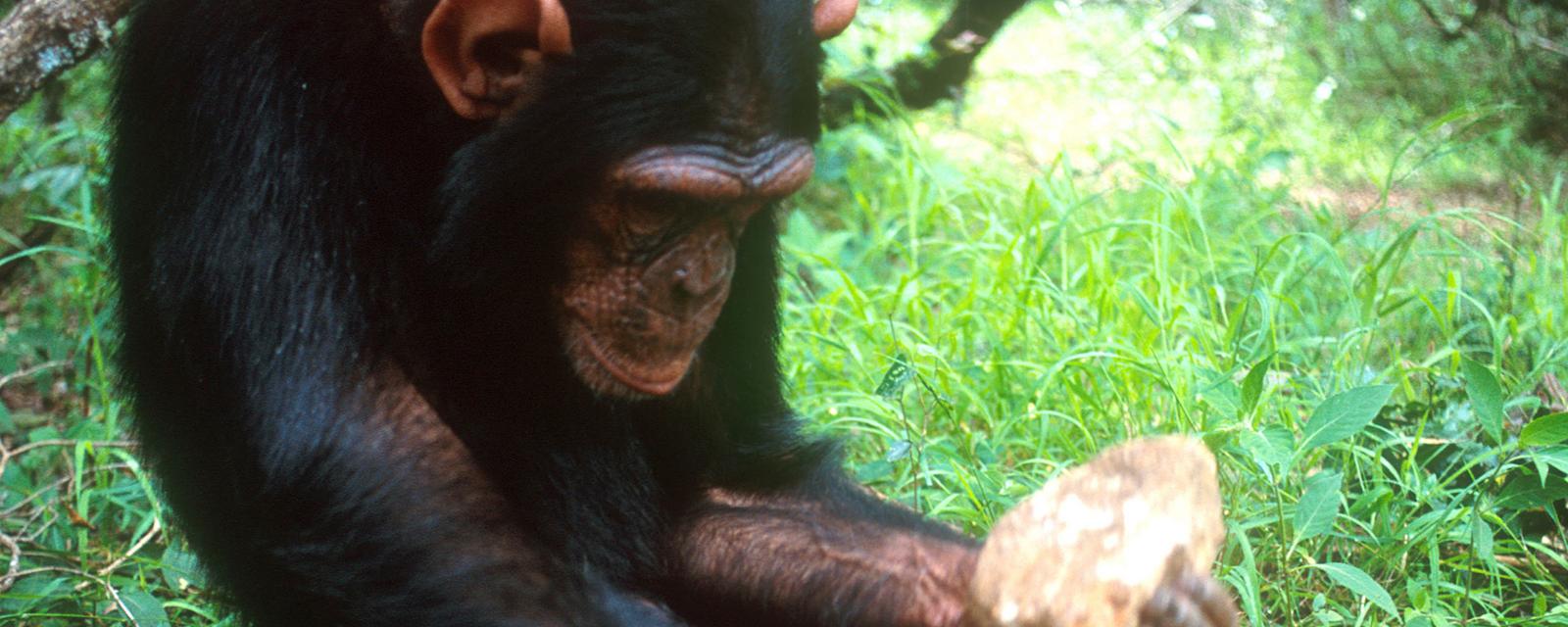

Chimpanzees and monkeys have entered the Stone Age

 Humans are not the only species to have entered the Stone Age (Credit: Karl Ammann/NPL)

We think of the Stone Age as something that early humans lived through. But we are not the only species that has invented it


By Colin Barras


In the rainforests of west Africa, the woodlands of Brazil and the beaches of Thailand, archaeologists have unearthed some truly remarkable stone tools.

It's not the workmanship that makes them special. If anything, a casual observer might struggle to even identify them as ancient tools. It's not their antiquity that's exceptional either: they're only about the same age as the Egyptian pyramids.

What makes these tools noteworthy is that the hands that held them weren't human.

These stone tools were wielded by chimpanzees, capuchins and macaques. The sites where they have been unearthed are the basis of a brand new field of science: primate archaeology.

The tools are crude. A chimpanzee or monkey stone hammer is hardly a work of art to rival the beauty of an ancient human hand axe. But that's not the point. These primates have developed a culture that makes routine use of a stone-based technology. That means they have entered the Stone Age.
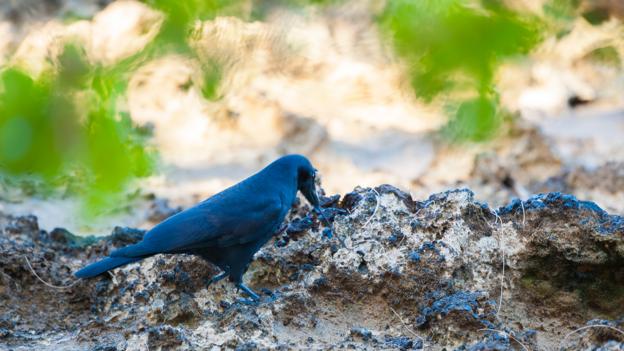

New Caledonian crow (Corvus moneduloides) uses tool to forage (Credit: Roland Seitre/NPL)

New Caledonian crow (Corvus moneduloides) uses tool to forage (Credit: Roland Seitre/NPL)


A few decades ago, biologists thought humans were the only species that made extensive use of tools.


Not any more. We now know that many mammals, birds, fish and even insects use objects in their environment as tools to make their lives easier.

Many primates use tools too. In 2014, for instance, there were reports of a wild gorilla using a twig to fish ants out of a nest. But primates don't, as a rule, turn stones into tools.

"Orang-utans, bonobos and gorillas have been seen using plant tools but never stone tools," says Michael Haslam at the University of Oxford in the UK, and leader of the Primate Archaeology (Primarch) project.
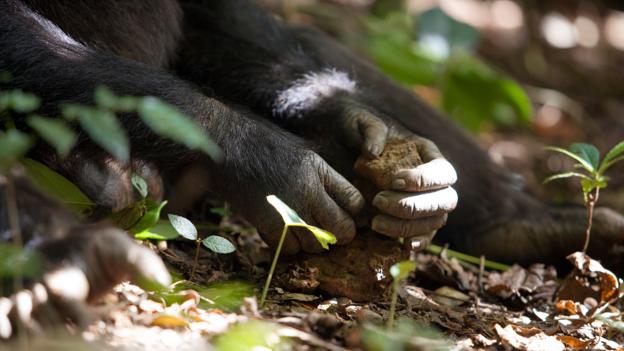

A chimpanzee uses a stone hammer (Credit: Justine Evans/NPL)

A chimpanzee uses a stone hammer (Credit: Justine Evans/NPL)


Exactly why stone tools are so rarely used by great apes is a mystery, he says.

But it might have to do with the fact that stones are not readily available to species that spend much of their time in and around trees. "Plants are ubiquitous in primate habitats but stones are not," says Haslam.
This means that even if a particularly clever great ape does begin using stone tools, there aren't enough rocks around for that tradition to be aped by others in the group, and passed down through the generations.

However, the chimpanzees of west Africa do seem to have managed to pass their stone-based technology – which they use to crack open nuts – down many generations. We know this because of a landmark study in primate archaeology that was published in 2007.


The dense forests of the Ivory Coast (Credit: André Quillien/Alamy)

The dense forests of the Ivory Coast (Credit: André Quillien/Alamy)


"Normal", human archaeology relies on the idea that we can recognise human behaviours in the artefacts we leave behind. Tiny scuffs and marks that might be dismissed by the casual observer carry a wealth of information to the trained observer.

"Primate archaeologists" led by Christophe Boesch at the Max Planck Institute for Evolutionary Anthropology in Leipzig, Germany, set about applying these principles to chimpanzee tools.

In the rainforests of Ivory Coast they excavated an area of the forest floor down to a depth of about 1m, unearthing a 4300-year-old horizon rich in stone artefacts.

Some of those stone artefacts have been worked with a level of precision possessed by humans alone.

But others had marks that suggested they had been used in a cruder way, as pounding tools for cracking open tough nuts: just as chimpanzees in the region use stone tools today.
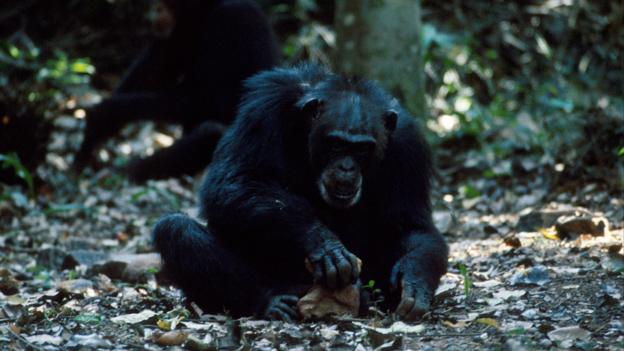

Chimpanzees have been using stone tools for millennia (Credit: Bernard Walton/NPL)

Chimpanzees have been using stone tools for millennia (Credit: Bernard Walton/NPL)


Boesch and his colleagues had previously studied modern chimpanzee stone tool culture in the region. This research revealed that the chimpanzees have an idiosyncratic way of choosing and using their tools.

For instance, chimpanzees will often deliberately opt for particularly large and heavy stone hammers, between 1kg and 9kg, while humans prefer to use stones that weigh 1kg or less. Many of the 4300-year-old stone tools weighed more than 1kg, suggesting they were used by chimpanzees.


Chimpanzees also use their stone tools to crack open certain types of nuts that humans don't eat. Starch residues on some of the ancient tools came from these nuts.

Together, these findings led to an obvious conclusion: chimpanzees have been using stone tools in the rainforests of Ivory Coast for at least 4300 years.

The chimpanzee Stone Age began at least that early, and maybe even earlier, says Boesch. However, "it is very hard to predict where you would find soil layers that would be old enough to look at earlier periods."

In theory, the chimpanzee Stone Age might have begun very early indeed.
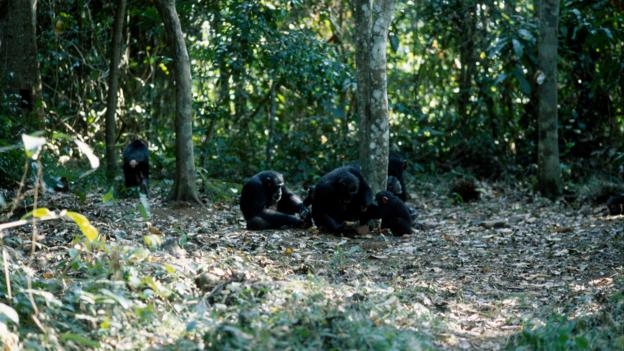

A group of chimpanzees cracking nuts with stones (Credit: Bernard Walton/NPL)

A group of chimpanzees cracking nuts with stones (Credit: Bernard Walton/NPL)


Chimpanzees are our closest living relative. The fact that they, like us, can use stone tools might imply that the common ancestor of chimpanzees and humans was the first to develop a stone based technology.


Haslam says this is unlikely. If that was the case we might reasonably expect all chimpanzees to use stone tools, but only a small number of communities in west Africa do so.

It's more logical to imagine that the chimpanzees of west Africa have developed a stone tool tradition in the time since they split from central and east African chimp communities. Haslam says this happened between 500,000 and 1 million years ago.

It now seems that this west African chimpanzee Stone Age is completely distinct from the human Stone Age.
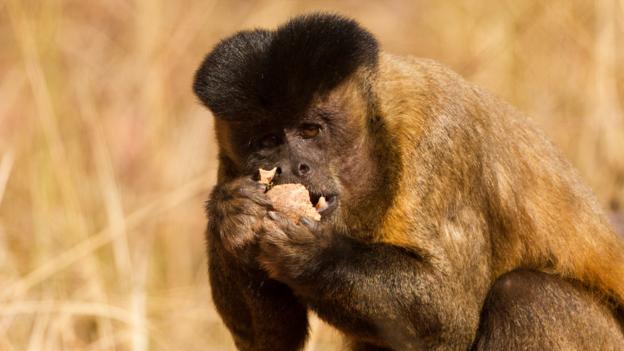

A bearded capuchin eating a nut cracked using a stone (Credit: Mary McDonald/NPL)

A bearded capuchin eating a nut cracked using a stone (Credit: Mary McDonald/NPL)


There have been reports going back a few centuries that bearded capuchin monkeys (Sapajus libidinosus) in Brazil use stone tools. A study in 2004 confirmed that they do.

So do long-tailed macaque monkeys (Macaca fascicularis aurea) in Thailand, according to a study published in May 2015.

Neither species sits particularly near humans in the primate evolutionary tree.

"Capuchins are New World monkeys, separated from us by some 35 million years of evolution," says Haslam. "Even the macaques are separated from us by around 25 million years."

In other words, the Stone Age primates are so widely scattered across the evolutionary tree that they must have each come up with the technology independently. "We have multiple inventions of the same behaviour," says Haslam.
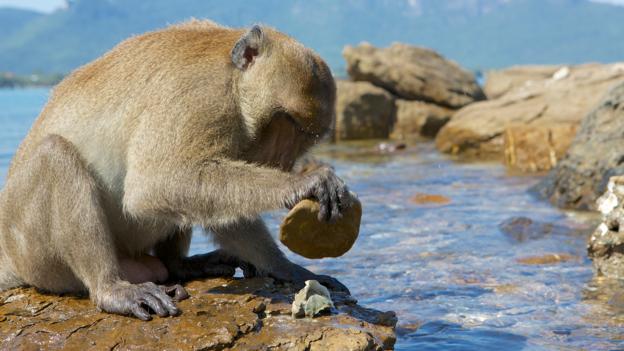

Long-tailed macaques live on islands in Thailand (Credit: Mark MacEwen/NPL)

Long-tailed macaques live on islands in Thailand (Credit: Mark MacEwen/NPL)


His team is now applying the same sorts of techniques that Boesch used to study the chimpanzee archaeological record in Ivory Coast to investigate the history of tool use by the macaques and capuchins. This research, conducted as part of the Primarch project, is not yet published.

"We have now recovered buried stone tools from activity areas of all the stone-tool-using primates," says Haslam.


The capuchins, like the chimpanzees, use their stone tools to crack open nuts, and also to dig for tubers.

"Every time someone has gone to look at wild groups of bearded capuchins in their natural habitat, they've found stone tool use," says Haslam. "This species may be the only one other than humans that has ubiquitous stone artefacts."

By contrast, the macaques live on islands and use their stones to crack open shellfish.

Both species of monkey have apparently passed the tradition down the generations. That means there is a deep history of stone tool use in at least three primates other than humans.

Chimpanzee and monkey stone tools look very primitive. But then again, our ancestors' stone tools were just as primitive too, long ago.
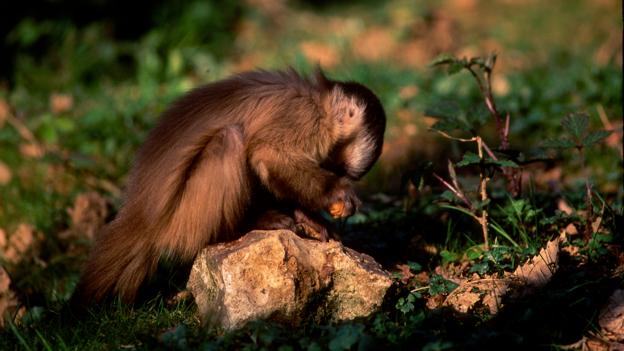

South American capuchin monkeys have learned to use stone tools (Credit: Dave Watts/NPL)

South American capuchin monkeys have learned to use stone tools (Credit: Dave Watts/NPL)


In May 2015, archaeologists working in Kenya published details of the earliest stone tools ever made by members of our lineage.

These "Lomekwian" stone tools were recovered from 3.3-million-year-old deposits. According to the team that found them, they were produced using techniques similar to those used by stone-wielding chimps and monkeys.

This means studying primates that use stone tools could tell us about the nature of early human behaviour. However, drawing conclusions won't be easy: early humans are very different from chimpanzees and monkeys.

Within about 700,000 years of those Lomekwian stone tools, human technology had moved on. First came "Oldowan" tools, including stones that had been deliberately modified to make a sharp edge by "flaking" off small pieces. A million years later, Acheulean hand axes with carefully-shaped cutting edges begin appearing in the archaeological record.

Why did our ancestors learn to make such sophisticated stone tools, and so long ago, while chimps and monkeys never got beyond a Lomekwian-style technology?
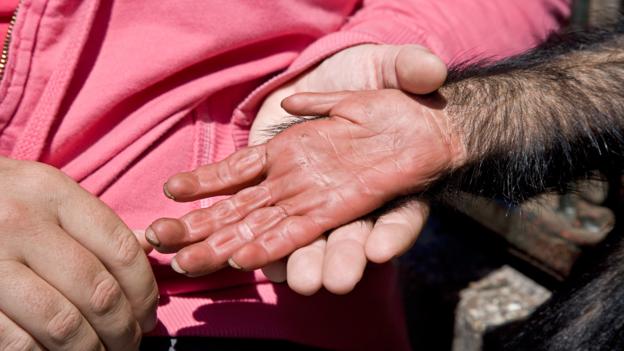

Human hands have changed less than chimps' (Credit: Doug Allan/NPL)

Human hands have changed less than chimps' (Credit: Doug Allan/NPL)


You might think it would be down to evolutionary advances in the anatomy of our hands, perhaps allowing for finer manipulation of objects.

In fact, a July 2015 study by Sergio Almécija of George Washington University in Washington, DC suggests that, if anything, human hands have changed less over the last few million years than chimpanzee hands.

"The ancestor of humans and chimps had hand length proportions more similar, but not equal, to humans than to chimpanzees," says Almécija. "In terms of [digit] length proportions, humans are in fact more primitive than chimps."

If it's not chimpanzees' and monkeys' hands that are holding them back, the problem probably lies in their brains, says Almécija.
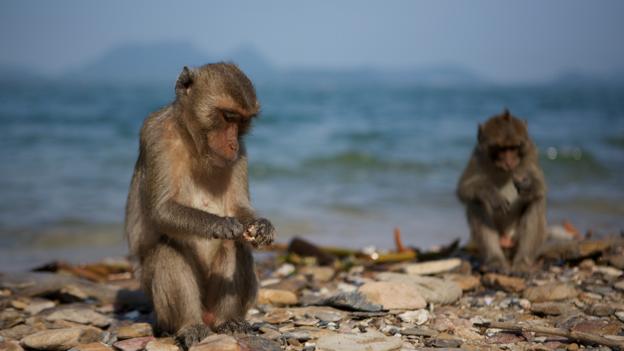

A long-tailed macaque cracks cockles with a stone tool (Credit: Mark MacEwen/NPL)

A long-tailed macaque cracks cockles with a stone tool (Credit: Mark MacEwen/NPL)


"It seems plausible that the ability to create stone tools requires some additional cognitive abilities: not just recognising what would be a useful tool, but also creating it," says Alexandra Rosati at Harvard University in Cambridge, Massachusetts.


Humans' larger brains, and our resulting greater smarts, may be what allowed us to make ever better tools. But it's difficult to say exactly why our ancestors' brains began to swell.

One idea, suggested by primatologist Richard Wrangham, also at Harvard, is that our growing brains were fuelled by the development of cooking. "Larger brains require a lot of energy to grow and maintain, and cooking increases the energy available from food relative to a raw diet," says Rosati.

It's not clear when humans first invented cooking. It may have been long after our brains began swelling, which would mean Wrangham's idea is probably wrong.

But if he is correct, it suggests that a 2015 study by Rosati and her Harvard colleague Felix Warneken is very significant. Chimps might not have learned to control fire, but Rosati and Warneken found that they have enough smarts to appreciate the benefits of cooking.
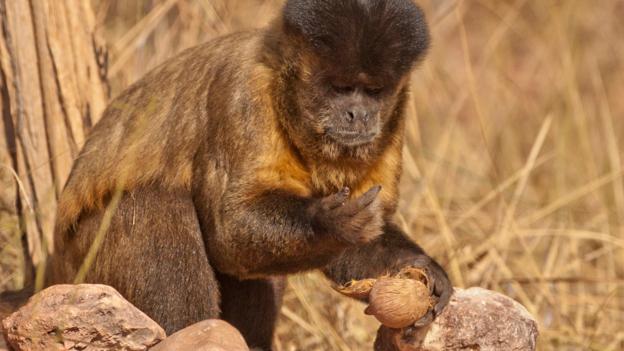

A black-striped capuchin eating a cracked nut (Credit: Mary McDonald/NPL)

A black-striped capuchin eating a cracked nut (Credit: Mary McDonald/NPL)


In a series of experiments, Rosati and Warneken introduced chimps to an "oven": a container into which the apes could place food, which would later be returned to them in a cooked state.

The chimps were far more likely to put raw potato chips into this "oven" than into a second container that returned the food still raw.

What's more, when the chimps were given wood chips as well as raw potato chips, they generally didn't bother placing the wood into the "oven". That suggests they didn't see it simply as a cooked food dispenser, but understood that it would only cook edible things.

The chimps were even prepared to carry raw food from a remote location to the "oven" to have it cooked. This reflects the way our ancestors must have begun transporting food to the fireside millions of years ago.


Control of fire was a major step in human history (Credit: Ariadne Van Zandbergen/Alamy)

Control of fire was a major step in human history (Credit: Ariadne Van Zandbergen/Alamy)


Of course, until chimps do learn to control fire – if they ever make that leap – they won't be able to put their appreciation of cooked food to use. But Rosati and Warneken's work suggests that the relevant brain pathways, which perhaps allowed our ancestors to develop bigger brains and more advanced stone tools, are present in chimpanzees too.

It's possible that chimpanzees – and macaques and capuchins – haven't yet reached the limits of their technological capabilities, says Haslam.

But it's not clear whether they will have the opportunity to advance their Stone Age technology.

"We are shrinking their populations dramatically through habitat destruction and hunting," says Haslam. "Smaller populations cannot spread and sustain complex technologies as well as larger groups."

In other words, chimps and monkeys might have the capacity to make much more sophisticated stone tools, but they may never get the chance to achieve that potential: all because of another group of primates that became master stone tool manufacturers.


For more information about animal intelligence see http://nexusilluminati.blogspot.com/search/label/animal%20intelligence
- Scroll down through ‘Older Posts’ at the end of each section


Hope you like this not for profit site -
It takes hours of work every day by a genuinely incapacitated invalid to maintain, write, edit, research, illustrate and publish this website from a tiny cabin in a remote forest
Like what we do? Please give anything you can -  
Contribute any amount and receive at least one New Illuminati eBook!
(You can use a card securely if you don’t use Paypal)
Please click below -


Spare Bitcoin change?


For further enlightening information enter a word or phrase into the random synchronistic search box @ the top left of http://nexusilluminati.blogspot.com


And see


 New Illuminati on Facebook - https://www.facebook.com/the.new.illuminati

New Illuminati Youtube Channel -  https://www.youtube.com/user/newilluminati/playlists

New Illuminati’s OWN Youtube Videos -  
New Illuminati on Google+ @ For New Illuminati posts - https://plus.google.com/u/0/+RamAyana0/posts

New Illuminati on Twitter @ www.twitter.com/new_illuminati


New Illuminations –Art(icles) by R. Ayana @ http://newilluminations.blogspot.com

The Her(m)etic Hermit - http://hermetic.blog.com


DISGRUNTLED SITE ADMINS PLEASE NOTE –
We provide a live link to your original material on your site (and links via social networking services) - which raises your ranking on search engines and helps spread your info further!

This site is published under Creative Commons (Attribution) CopyRIGHT (unless an individual article or other item is declared otherwise by the copyright holder). Reproduction for non-profit use is permitted & encouraged - if you give attribution to the work & author and include all links in the original (along with this or a similar notice).

Feel free to make non-commercial hard (printed) or software copies or mirror sites - you never know how long something will stay glued to the web – but remember attribution!

If you like what you see, please send a donation (no amount is too small or too large) or leave a comment – and thanks for reading this far…

Live long and prosper! Together we can create the best of all possible worlds…


From the New Illuminati – http://nexusilluminati.blogspot.com

Thursday, 20 September 2012

‘Animal’ Consciousness: Genius female chimpanzee found to be smarter than U.S. high school students


‘Animal’ Consciousness
Genius female chimpanzee found to be smarter than U.S. high school students – and ‘Animal’ Emotions


A twenties-something "genius ape" named Natasha has been found to demonstrate more intelligence than a typical U.S. high school student. The findings have been published in the peer-reviewed science journal Philosophical Transactions of the Royal Society B.

As the paper documents, Natasha repeatedly demonstrates skills and reasoning that escape modern-day high school students. "The caretakers named Natasha as the smartest chimpanzee, precisely the same chimpanzee that our tests had revealed to be exceptional," wrote authors Esther Herrmann and Josep Call of the Max Planck Institute for Evolutionary Anthropology (reported at Discovery.com, link below).

According to these scientists, Natasha has demonstrated the following skills; all of which escape the dumbed-down mental capacity of a typical U.S. high school student:

• An ability to repeatedly escape the chimpanzee enclosure using planning skills.

• An ability to disable an electric fence by throwing branches on it and observing the sparks. Once the sparks stopped, Natasha knew the fence was disabled and then proceeded to climb it. (A typical U.S. high school student cannot figure out how to pull his pants up around his waist.)

• The ability to wield a special tool to avoid a trap while locating hidden food. (U.S. high school students eat toxic food chemicals every day which trap them in a lifetime of chronic disease.)

• According to scientists, "ape intelligence might be a bundling of skills related to learning, tool usage, understanding of quantities, and an ability to reach conclusions based on evidence and reasoning." (http://news.discovery.com/animals/ape-genius-chimpanzee-intelligence-...) U.S. high school students, on the other hand, largely run their lives based on drama, jealousy, sex and emotional reactions to simple stimuli such as corporate logos on basketball shoes.

• Intelligent chimpanzees are well known to manufacture their own tools in order to extract (yummy) termites out of holes in trees. A typical U.S. high school student barely has the skill to open a frozen burrito wrapper and punch "START" on a microwave oven.

On a similar note, it is well known that the U.S. military conducts vaccine medical experiments on human soldiers for the sole reason that "humans are cheaper than monkeys." Lab monkeys actually try to escape from vaccine assaults, while humans actually line up at pharmacies and PAY to be injected with experimental vaccines!

The question isn't whether apes are smarter than humans... it's actually this far more important question: Are many humans dumber than apes?


Chimpanzees are more AWARE than the average human, too


chimpanzeeAccording to the latest science, chimpanzees are conscious, aware beings with just as much awareness as humans (http://news.discovery.com/animals/chimpanzees-self-awareness-110504.h...). Humans, on the other hand, go to great lengths to diminish their awareness with alcohol, drugs and mind-altering psychiatric drugs.

Chimpanzees are acutely aware of their environments, while a typical high-school-aged human seems to exist in a sleepwalking zombie state from which only violent video games or online porn can cause them to awaken. While a typical chimpanzee works to observe reality while attempting to make sense of the world, a typical high school teen tries to escape reality and reject the real world…


That's how stupid humans are: They promote things that harm other humans as long as they make a profit in the process. Chimpanzees don't seek out mind-altering psychiatric drugs. Only a human is stupid enough to assault their brain chemistry with a patented, synthetic chemical made in a factory. You can't brainwash an ape into thinking childhood is a disease. (www.youtube.com/watch?v=NPS9SohzMjw)


Bonobo genius makes stone tools like early humans did

Even a human could manage this <i>(Image: Elizabeth Rubert-Pugh (Great Ape Trust of Iowa/Bonobo Hope Sanctuary))</i>


Kanzi the bonobo continues to impress. Not content with learning sign language or making up "words" for things like banana or juice, he now seems capable of making stone tools on a par with the efforts of early humans.

Eviatar Nevo of the University of Haifa in Israel and his colleagues sealed food inside a log to mimic marrow locked inside long bones, and watched Kanzi, a 30-year-old male bonobo chimp, try to extract it. While a companion bonobo attempted the problem a handful of times, and succeeded only by smashing the log on the ground, Kanzi took a longer and arguably more sophisticated approach.

Both had been taught to knap flint flakes in the 1990s, holding a stone core in one hand and using another as a hammer. Kanzi used the tools he created to come at the log in a variety of ways: inserting sticks into seams in the log, throwing projectiles at it, and employing stone flints as choppers, drills, and scrapers. In the end, he got food out of 24 logs, while his companion managed just two.

Perhaps most remarkable about the tools Kanzi created is their resemblance to early hominid tools. Both bonobos made and used tools to obtain food – either by extracting it from logs or by digging it out of the ground. But only Kanzi's met the criteria for both tool groups made by early Homo: wedges and choppers, and scrapers and drills.

Do Kanzi's skills translate to all bonobos? It's hard to say. The abilities of animals like Alex the parrot, who could purportedly count to six, and Betty the crow, who crafted a hook out of wire, sometimes prompt claims about the intelligence of an entire species. But since these animals are raised in unusual environments where they frequently interact with humans, their cases may be too singular to extrapolate their talents to their brethren.

The findings will fuel the ongoing debate over whether stone tools mark the beginning of modern human culture, or predate our Homo genus. They appear to suggest the latter – though critics will point out that Kanzi and his companion were taught how to make the tools. Whether the behaviour could arise in nature is unclear.

Journal reference: Proceedings of the National Academy of Sciences, DOI: 10.1073/pnas.1212855109


Rats Laugh When Tickled, Animal Emotions Provide Clues to Autism, Other Disorders Says WSU Researcher


Animals might not analyze their emotions the way humans do, but they do experience them, according to Jaak Panksepp, a professor and researcher at Washington State University.


Credit: WSU


A relatively new addition to WSU's Department of Veterinary and Comparative Anatomy, Pharmacology and Physiology, Panksepp believes "people don't have a monopoly on emotion; rather, despair, joy and love are ancient, elemental responses that have helped all sorts of creatures survive and thrive in the natural world."

Since arriving at WSU, he has ushered in a new area of study called "affective neuroscience." It involves the study of the basic processes that create and control moods, feelings and attitudes in both people and animals.

"This doesn't imply that animals think about their feelings like people do," said Panksepp, "but they do experience them in similar ways."

Born in Estonia, he brings with him an extensive portfolio of both domestic and international neuroscience credentials. He also is already something of a celebrity, having been featured on MSNBC and in Psychology Today.

Panksepp's research goal is to offer a scientific strategy for understanding the basic emotional feelings in the mammalian brain, including humans, by accurately studying the instinctual emotional behaviors of animals. He is developing the idea that emotional feelings are closely linked to the instinctual actions animals exhibit.

"All animals have instinctual behaviors, so therefore we target the instinctual circuits," he said. "We can stimulate a circuit - say by gently tickling a rat - to essentially ask the animal if he likes the circuit on or off (rats like it on). They always choose one way or the other. Mother Nature built it in such a way that a feeling component is part of the instinctual system.

Practically speaking, this understanding of animal behavior and the neurochemistry behind emotion may help lead to breakthrough treatments for an array of psychological disorders such as schizophrenia, depression, autism, sleep problems and more, Panksepp said.

In the late 1970s and early 80s, he and his colleagues developed the first animal model for autism. Later, they tested autistic children in Salzburg using an opiate blocking drug called naltrexone. Given very low doses of naltrexone, which mildly shift chemical balances in the body and brain, Panksepp and his team found that some children became more cheerful and responsive.

"We are working with the body's own chemistry in these studies," he said, "so there are few side effects. In general, the drug increases social desire and we speculate that some autistic children have a higher than normal opiate level in their brain, causing them to become socially aloof. In effect, they have become addicted to themselves," he said.

Panksepp is also toying with the idea that low dose naltrexone might be effective in mood regulation, which may be something he plans to investigate in the future. By blocking the opioid system only at night, they effectively hope to encourage the brain's natural opioid system to become more active during the day.

With millions of questions yet to answer in this new area of study, Panksepp plans to continue his investigations at WSU and to collaborate with researchers there and many other universities. He is most interested in the organization of the "social brain" and social emotions - joy and sadness - especially by focusing on the emotional sounds of animals.

In his recent work, Panksepp has found that young rats make chirping sounds outside the range of human hearing, especially while playing. These high-pitched sounds appear to have a deep ancestral relationship to infantile human laughter - the essence of social joy, he said. The brain systems that generate these play sounds feel good, since the animals like to have those brain areas "tickled". The work provides a greater understanding of positive emotions that may eventually help in the development of better antidepressants.

But finding a species in which he could study both systems effectively at the same age has proved to be difficult. Panksepp's group recently started to focus their research on the degu - a small, guinea pig-like rodent native to Chile. The playful degus have a wide repertoire of vocalizations which are the basis for many of Panksepp's current studies at WSU.

Panksepp is a world leader in the new science of how emotions are controlled by the brain. Beside his current work with positive social emotions, he has also helped show how specific brain mechanisms that control desire, anger and separation distress are organized in the brain, and that many animals even have subtler emotions such as the "quest for nurturance and the desire to offer care" - just as anyone who has ever owned and loved a dog might suspect.

Jaak Panksepp, WSU professor and researcher, seeks to offer a scientific strategy for understanding the basic emotional feelings in the mammalian brain, including humans, by accurately studying the instinctual emotional behaviors of animals. He is developing the idea that emotional feelings are closely linked to the instinctual actions animals exhibit.

Contacts and sources: 
By Robert Strenge
Washington State University

From Nano Patents and Innovations @ http://nanopatentsandinnovations.blogspot.com.au/2012/06/rats-laugh-when-tickled-animal-emotions.html

For more information about animal consciousness see http://nexusilluminati.blogspot.com/search/label/animal%20consciousness


Help This Unique Independent Site’s Author Stay Online
Donate any amount and receive at least one New Illuminati eBook!
Just press the button -

Xtra Image – http://www.pbs.org/wgbh/nova/assets/img/posters/ape-genius-prog.jpg
Video @ http://youtu.be/j-admRGFVNM


For further enlightening information enter a word or phrase into the search box @  New Illuminati or click on any label/tag at the bottom of the page @  http://nexusilluminati.blogspot.com


And see


 New Illuminati on Facebook - https://www.facebook.com/the.new.illuminati

New Illuminati Youtube Channel - http://www.youtube.com/user/newilluminati/feed


The Her(m)etic Hermit - http://hermetic.blog.com


The Prince of Centraxis - http://centraxis.blogspot.com (Be Aware! This link leads to implicate & xplicit concepts & images!)


This site is published under Creative Commons Fair Use Copyright (unless an individual item is declared otherwise by copyright holder) – reproduction for non-profit use is permitted & encouraged, if you give attribution to the work & author - and please include a (preferably active) link to the original along with this notice. Feel free to make non-commercial hard (printed) or software copies or mirror sites - you never know how long something will stay glued to the web – but remember attribution! If you like what you see, please send a small but heartfelt donation or leave a comment – and thanks for reading this far…

Live long and prosper!


From the New Illuminati – http://nexusilluminati.blogspot.com