"All the World's a Stage We Pass Through" R. Ayana

Showing posts with label witricity. Show all posts

Thursday, 28 August 2014

WiTricity – The Dawn of Wireless Power


WiTricity – The Dawn of Wireless Power

Within grasp: A world without (charging) wires


Cars, medical devices, industrial machines, and oh yes, your phone—the tech industry is hard at work developing ways to cut the cord. Standing in its way: physics and a nasty war over standards.


Last June, Toyota revealed plans to release a plug-in electric Prius in 2016 that needed no plug at all to recharge, thanks to wireless technology from a U.S. company called WiTricity. The next day, Intel INTC 0.80% announced plans to release a completely wire-free personal computer by 2016—no power cord or monitor cable necessary. Nine days later, Starbucks SBUX 0.26% announced that it would begin installing Duracell Powermat wireless charging pads in tables and counters in its stores across the United States.

It’s not just the month of June that was charged with wireless power headlines. Wireless charging technology is poised to break through in the next few years, dramatically changing our relationship with our mobile, but still power-tethered, electronic devices. Thoratec, a healthcare company, is working with WiTricity on a wireless way to charge heart pumps and other medical equipment. Lockheed Martin, the aerospace and defense giant, is working on a laser-based system to recharge drones in mid-flight. The list goes on.

The wireless power market is expected to explode from a $216 million in 2013 to $8.5 billion in 2018 globally, according to IHS Technology, a market research firm. Why, then, are most of us still wrestling with a pile of cords at home?

“The reality is that the overall wireless charging market for consumer electronics is in the very early stages,” says Kamil Grajski, vice president of engineering at Qualcomm QCOM 0.12% and the founding president of the Alliance for Wireless Power, or A4WP for short, one of three groups working on the development of wireless charging technologies.

Induction, the technology behind wireless charging, isn’t new—it’s been around for well over a hundred years. Here’s how it works: an induction coil creates an electromagnetic field (on a charging dock of some kind) that comes in contact with another induction coil (attached to the device to be charged), transferring electricity to it. It’s the same process used to juice up your electric toothbrush in its charging stand, Grajski says.

But induction technology has limitations that have limited its mainstream appeal. It only allows for a single device to be charged per coil, making it clunky and relatively inefficient in today’s multi-device world, and it requires precise placement of the device to be charged so that the coils are aligned in order to initiate and sustain the charging process.

Proponents of inductive technology like Ran Poliakine, chief executive of Powermat, believe the key to increasing adoption of wireless charging lies not in figuring out the fastest or most efficient connection, but in making the technology available to people where they need it most. “The issue we are trying to address is how do we keep consumers charged throughout the day,” he says. “The barrier to entry was relevancy. Where do we put the charging spots?” He added: “The place you mostly need this service is outside your home and your office.”

He has a point. Placing charging stations in Starbucks locations is one way to do that, saving customers from the inevitable outlet search that comes with a drawn-out session at the café. Placement in airports and hotels, also in the works at Powermat, are two more ways. (One thing people may not know about Powermat’s charging stations: when used in conjunction with a cloud-based management system the company provides, a retailer can monitor who is at which station and for how long. Which means Starbucks could either give you the boot for squatting for six hours or beam you a coupon for a free refill to keep you there.)

Another reason for the technology’s slow adoption? A good old-fashioned standards war between industry groups. The Power Matters Alliance, or PMA, backs one type of induction standard and counts Duracell, Procter & Gamble, Qualcomm, and WiTricity as members. The Wireless Power Consortium, or WPC, backs an induction standard called Qi (pronounced chee) and counts Hitachi, IKEA and Verizon as members. Some companies, such as Microsoft and Samsung, are members of both groups.

The two standards use what is essentially the same technology but apply it with different specifications, creating problems for the companies that must embed the technology in their products. According to John Perzow, vice president of market development for WPC, 63 phones on the market today support the Qi standard, including those from Nokia, Google, and Sony. Meanwhile, Google Nexus and LG phones, among others, will have Powermat compatibility built into them.

To up the ante, Powermat has plans to give away free “charging rings,” similar to those made by the Finnish firm PowerKiss it acquired last year, to Starbucks customers to encourage them to use in-store chargers. (It plans to sell them at retail for less than $10.) Meanwhile, the PMA struck a deal with A4WP in February to support its Rezence standard, which uses another kind of wireless charging technology called magnetic resonance.

Both industry groups look to magnetic resonance technology as the likely second-generation standard for wireless charging, thanks to its ability to transfer larger quantities of energy and therefore support larger devices such as kitchen appliances. (The WPC says it is working on its own version of the tech.) The wireless PC that Intel demonstrated at Computex last month—you can see it in a video here—uses the Rezence standard.

Magnetic resonance technology relies on resonant magnetic coupling, which creates a magnetic field around each coil that transfers power without having to align coils precisely. It can charge a device across small distances (about two inches) rather than requiring near-direct contact—a table can be retrofit with a charging pad attached underneath it instead of embedded in its surface.

Magnetic resonance also allows more than one device to be charged at the same time. The Rezence standard uses the Bluetooth connection already present in many mobile electronics to detect the presence of a compatible charger. The technology is not yet on the market, but Grajski anticipates products using Rezence could be seen in stores as soon as this year. “Some of the barriers are just getting the right players in industry to adopt the technology and make it available at a reasonable price,” he says.

Still, two inches is two inches. What about beaming power across a room? That’s where WiTricity comes in. Born out of the Massachusetts Institute of Technology in 2007, the company continues to develop what Kaynam Hedayat, vice president of product management and marketing, calls “highly resonant wireless power transfer” technology.

Imagine an opera singer who can break glass with her voice—that’s how the technology works, Hedayat says. “Objects have a certain frequency by which they start vibrating,” he says. Tune a receiver and a device to the same frequency and they begin communicating with each other. “The energy is only transferred to devices that are tuned to that frequency,” he says. This allows electricity to transfer over distances of up to four feet. “With that, a lot of possibilities open up,” he adds.

Such as charging vehicles or medical equipment wirelessly. “Wires in hospitals are a big issue because you have to sterilize every device,” Hedayat says.

Or use in military applications, where robots in the field can be recharged while in position. Wireless charging tech could also help soldiers cut down on the nearly 40 pounds of battery that many soldiers carry on their backs, Hedayat says. And charging sensors on submarines would enable battery charging in deep-sea conditions, where it’s unsafe to run wires.

For now, the wireless charging standards war rages on, and the technology remains a novelty at best. But it can’t go on forever. Just as Wi-Fi became the standard protocol for wireless data exchange between computers, so shall one wireless charging standard emerge as the winner. Only then will we see what wireless charging is capable of.

“In four or five years, there will be one standard for wirelessly charging devices,” Hedayat says. ” You will forget about different adapters and connecters. You will find a hotspot and it’s just going to work.”


Things that Go Beep in the Night

The WiTricity® technology story begins late one night with MIT Professor Marin Soljačić (pronounced Soul-ya-cheech) standing in his pajamas, staring at his mobile phone on the kitchen counter. It was the sixth time that month that he was awakened by his phone beeping to let him know that he had forgotten to charge it. At that moment, it occurred to him: “There is electricity wired all through this house, all through my office—everywhere. This phone should take care of its own charging!” But to make this possible, one would have to find a way to transfer power from the existing wired infrastructure to the phone—without wires. Soljačić started thinking of physical phenomena that could make this dream a reality.


Eureka! Coupled Resonators


To achieve wireless power transfer in a way that is both practical and safe, one needs to use a physical phenomenon that enables the power source and the device (in this case, the mobile phone) to exchange energy strongly, while interacting only weakly with living beings and other environmental objects, like furniture and walls. The phenomenon of coupled resonators precisely fits this description. Two resonant objects of the same resonant frequency tend to exchange energy efficiently, while interacting weakly with extraneous off-resonant objects.

A child on a swing is a good example of a resonant system. A swing exhibits a type of mechanical resonance, so only when the child pumps her legs at the natural frequency of the swing is she able to impart substantial energy into the motion of the swing. Another example involves acoustic resonances: imagine a room with 100 identical wine glasses, but each filled with wine up to a different level, so that each resonates at a different frequency (that is, they each emit a different tone or note when tapped, by a utensil, for example). If an opera singer enters that room and sings a very loud single note, the glass having the corresponding resonant frequency can accumulate enough energy to shatter, while the other glasses are unaffected.


Strong Coupling


Coupled resonators are said to operate in a strongly coupled regime if their energy transfer rate is substantially higher than the rate at which they lose energy due to factors such as material absorption and radiation. In the strongly coupled regime, energy transfer can be very efficient. These considerations are universal, applying to all kinds of resonances (e.g., acoustic, mechanical, electromagnetic, etc.). Soljačić and his colleagues at MIT (Karalis and Joannopoulos) set out to explore and develop the physical theory of how to enable strongly coupled magnetic resonators to transfer power over distances to enable the kind of wireless device charging that Soljačić first imagined. Their theoretical results were published first in 2006, and again in 2008 in the Annals of Physics.

Once the physical theories were developed, Soljačić and his team (Kurs, Karalis, Moffatt, Joannopoulos, Fisher) set out to validate them experimentally. The theory was developed to cover a broad range of coupled resonator systems, but the experimental work focused on proving that magnetically coupled resonators could exchange energy in the manner predicted by the theory and required for the wireless charging of devices, such as mobile phones. The team explored a system of two electro-magnetic resonators coupled through their magnetic fields. They were able to identify the strongly coupled regime in this system, and showed that strong coupling could be achieved over distances that greatly exceeded the size of the resonant objects themselves. The team had proven that in this strongly coupled regime, efficient wireless power transfer could be enabled. Their successful experiment was published in the journal, Science, in 2007.


WiTricity Technology is Born


The experimental design consisted of two copper coils, each a self-resonant system. One of the coils, connected to an AC power supply, was the resonant source. The other coil, the resonant capture device, was connected to a 60 watt light bulb. The power source and capture device were suspended in mid-air with nylon thread, at distances that ranged from a few centimeters to over 2.5 meters (8.2 ft). Not only was the light bulb illuminated, but the theoretical predictions of high efficiency over distance were proven experimentally. By placing various objects between the source and capture device, the team demonstrated how the magnetic near field can transfer power through certain materials and around metallic obstacles.

Thus, Prof. Soljačićs dream of finding a method to wirelessly connect mobile electric devices to the existing electric grid was realized. WiTricity Corporation was launched in 2007 to carry this technology forward from the MIT laboratories to commercial production.


WiTricity – The Basics


Understanding what WiTricity® technology is — transferring electric energy or power over distance without wires—is quite simple.


Understanding how it works is a bit more involved, but it doesn’t require an engineering degree. We’ll start with the basics of electricity and magnetism, and work our way up to the WiTricity technology.


2.0_img_earth_field
An illustration of the earth’s magnetic field


Electricity: The flow of electrons (current) through a conductor (like a wire), or charges through the atmosphere (like lightning).  A convenient way for energy to get from one place to another!

Magnetism: A fundamental force of nature, which causes certain types of materials to attract or repel each other. Permanent magnets, like the ones on your refrigerator and the earth’s magnetic field, are examples of objects having constant magnetic fields.

Oscillating magnetic fields vary with time, and can be generated by alternating current (AC) flowing on a wire. The strength, direction, and extent of magnetic fields are often represented and visualized by drawings of the magnetic field lines.

Electromagnetism:  A term for the interdependence of time-varying electric and magnetic fields. For example, it turns out that an oscillating magnetic field produces an electric field and an oscillating electric field produces a magnetic field.

2.0_img_current_wireAs current, I, flows in a wire, it gives rise to a magnetic field,B, which wraps around the wire. When the current reverses direction, the magnetic field reverses its direction.
2.0_img_current_coilThe blue lines represent the magnetic field created when current flows through a coil. When the current reverses direction, the magnetic field also reverses its direction.

Magnetic Induction: A loop or coil of conductive material like copper, carrying an alternating current (AC), is a very efficient structure for generating or capturing a magnetic field. If a conductive loop is connected to an AC power source, it will generate an oscillating magnetic field in the vicinity of the loop.  A second conducting loop, brought close enough to the first, may “capture” some portion of that oscillating magnetic field, which in turn, generates or induces an electric current in the second coil. The current generated in the second coil may be used to power devices. This type of electrical power transfer from one loop or coil to another is well known and referred to as magnetic induction. Some common examples of devices based on magnetic induction are electric transformers and electric generators.


2.0_img_transformer
An electric transformer uses magnetic induction to transfer energy from its primary winding to its secondary winding, without connected to each other. It is used to “transform” AC current at one voltage to AC current at a different voltage.


Energy/Power Coupling:  Energy coupling occurs when an energy source has a means of transferring energy to another object. One simple example is a locomotive pulling a train car—the mechanical coupling between the two enables the locomotive to pull the train, and overcome the forces of friction and inertia that keep the train still—and, the train moves. Magnetic coupling occurs when the magnetic field of one object interacts with a second object and induces an electric current in or on that object. In this way, electric energy can be transferred from a power source to a powered device. In contrast to the example of mechanical coupling given for the train, magnetic coupling does not require any physical contact between the object generating the energy and the object receiving or capturing that energy.

Resonance: Resonance is a property that exists in many different physical systems. It can be thought of as the natural frequency at which energy can most efficiently be added to an oscillating system.

A playground swing is an example of an oscillating system involving potential energy and kinetic energy. The child swings back and forth at a rate that is determined by the length of the swing. The child can make the swing go higher if she properly coordinates her arm and leg action with the motion of the swing. The swing is oscillating at its resonant frequency and the simple movements of the child efficiently transfer energy to the system.
 

2.0_img_wit_mag_coils
Two idealized resonant magnetic coils, shown in yellow. The blue and red color bands illustrate their magnetic fields. The coupling of their respective magnetic fields is indicated by the connection of the colorbands.


Another example of resonance is the way in which a singer can shatter a wine glass by singing a single loud, clear note. In this example, the wine glass is the resonant oscillating system. Sound waves traveling through the air are captured by the glass, and the sound energy is converted to mechanical vibrations of the glass itself.  When the singer hits the note that matches the resonant frequency of the glass, the glass absorbs energy, begins vibrating, and can eventually even shatter. The resonant frequency of the glass depends on the size, shape, thickness of the glass, and how much wine is in it.

Resonant Magnetic Coupling: Magnetic coupling occurs when two objects exchange energy through their varying or oscillating magnetic fields. Resonant coupling occurs when the natural frequencies of the two objects are approximately the same.

WiTricity Technology: WiTricity power sources and capture devices are specially designed magnetic resonators that efficiently transfer power over large distances via the magnetic near-field. These proprietary source and device designs and the electronic systems that control them support efficient energy transfer over distances that are many times the size of the sources/devices themselves.
This diagram shows how the magnetic field can wrap around a conductive obstacle.
The WiTricity power source, left, is connected to AC power. The blue lines represent the magnetic near field induced by the power source. The yellow lines represent the flow of energy from the source to the WiTicity capture coil, which is shown powering a light bulb. Note that this diagram also shows how the magnetic field (blue lines) can wrap around a conductive obstacle between the power source and the capture device.


From Fortune @ http://fortune.com/2014/07/29/within-grasp-a-world-without-wires/ and WiTricity @ http://www.witricity.com/technology/the-witricity-story/ and http://www.witricity.com/technology/witricity-the-basics/


For more information about wireless power see http://nexusilluminati.blogspot.com/search/label/wireless%20electricity
- Scroll down through ‘Older Posts’ at the end of each section


Hope you like this not for profit site -
It takes hours of work every day to maintain, write, edit, research, illustrate and publish this website from a tiny cabin in a remote forest
Like what we do? Please give enough for a meal or drink if you can -  
Contribute any amount and receive at least one New Illuminati eBook!
Please click below -


For further enlightening information enter a word or phrase into the random synchronistic search box @ http://nexusilluminati.blogspot.com


And see


 New Illuminati on Facebook - https://www.facebook.com/the.new.illuminati

New Illuminati Youtube Channel - http://www.youtube.com/user/newilluminati/feed


New Illuminati on Twitter @ www.twitter.com/new_illuminati


New Illuminations –Art(icles) by R. Ayana @ http://newilluminations.blogspot.com

The Her(m)etic Hermit - http://hermetic.blog.com


The Prince of Centraxis - http://centraxis.blogspot.com (Be Aware! This link leads to implicate & xplicit concepts & images!)


DISGRUNTLED SITE ADMINS PLEASE NOTE –
We provide a live link to your original material on your site (and links via social networking services) - which raises your ranking on search engines and helps spread your info further! This site is published under Creative Commons Fair Use Copyright (unless an individual article or other item is declared otherwise by the copyright holder) – reproduction for non-profit use is permitted & encouraged, if you give attribution to the work & author - and please include a (preferably active) link to the original (along with this or a similar notice).

Feel free to make non-commercial hard (printed) or software copies or mirror sites - you never know how long something will stay glued to the web – but remember attribution! If you like what you see, please send a donation (no amount is too small or too large) or leave a comment – and thanks for reading this far…

Live long and prosper! Together we can create the best of all possible worlds…


From the New Illuminati – http://nexusilluminati.blogspot.com

Wednesday, 20 April 2011

WiPower (re)discovers Wireless Electricity

WiPower (re)discovers Wireless Electricity
A company called WiPower (re)discovers Wireless Electricity

by Paul Hochman


I'm standing next to a Croatian-born American genius in a half-empty office in Watertown, Massachusetts, and I'm about to be fried to a crisp. Or I'm about to witness the greatest advance in electrical science in a hundred years. Maybe both. Either way, all I can think of is my electrician, Billy Sullivan. Sullivan has 11 tattoos and a voice marinated in Jack Daniels. During my recent home renovation, he roared at me when I got too close to his open electrical panel: "I'm the Juice Man!" he shouted. "Stay the hell away from my juice!"

He was right. Only gods mess with electrons. Only a fool would shoot them into the air. And yet, I'm in a conference room with a scientist who is going to let 120 volts fly out of the wall, on purpose.

"Don't worry," says the MIT assistant professor and a 2008 MacArthur genius-grant winner, Marin Soljacic (pronounced SOLE-ya-cheech), who designed the box he's about to turn on. "You will be okay."


We both shift our gaze to an unplugged Toshiba television set sitting 5 feet away on a folding table. He's got to be kidding: There is no power cord attached to it. It's off. Dark. Silent. "You ready?" he asks.

If Soljacic is correct -- if his free-range electrons can power up this untethered TV from across a room -- he will have performed a feat of physics so subtle and so profound it could change the world. It could also make him a billionaire. I hold my breath and cover my crotch. Soljacic flips the switch.

Soljacic isn't the first man to try to power distant electronic devices by sending electrons through the air. He isn't even the first man from the Balkans to try. Most agree that Serbian inventor Nikola Tesla, who went on to father many of the inventions that define the modern electronic era, was the first to let electrons off their leash, in 1890.


Tesla based his wireless electricity idea on a concept known as electromagnetic induction, which was discovered by Michael Faraday in 1831 and holds that electric current flowing through one wire can induce current to flow in another wire, nearby. To illustrate that principle, Tesla built two huge "World Power" towers that would broadcast current into the American air, to be received remotely by electrical devices around the globe.

Few believed it could work. And to be fair to the doubters, it didn't, exactly. When Tesla first switched on his 200-foot-tall, 1,000,000-volt Colorado Springs tower, 130-foot-long bolts of electricity shot out of it, sparks leaped up at the toes of passersby, and the grass around the lab glowed blue. It was too much, too soon.

But strap on your rubber boots; Tesla's dream has come true. After more than 100 years of dashed hopes, several companies are coming to market with technologies that can safely transmit power through the air -- a breakthrough that portends the literal and figurative untethering of our electronic age. Until this development, after all, the phrase "mobile electronics" has been a lie: How portable is your laptop if it has to feed every four hours, like an embryo, through a cord? How mobile is your phone if it shuts down after too long away from a plug? And how flexible is your business if your production area can't shift because you can't move the ceiling lights?

The world is about to be cured of its attachment disorder.

WIRELESS JUICE: A PRIMER

TECH 1: Inductive Coupling
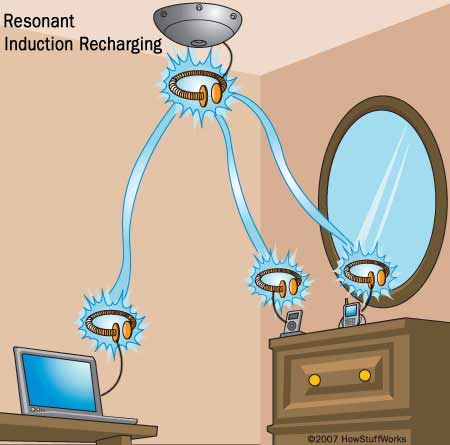
http://stepsandleaps.files.wordpress.com/2009/09/wireless-power-howstuffworks.jpg

THE FIRST WIRELESS POWERING SYSTEM to market is an inductive device, much like the one Tesla saw in his dreams, but a lot smaller. It looks like a mouse pad and can send power through the air, over a distance of up to a few inches. A powered coil inside that pad creates a magnetic field, which as Faraday predicted, induces current to flow through a small secondary coil that's built into any portable device, such as a flashlight, a phone, or a BlackBerry.

The electrical current that then flows in that secondary coil charges the device's onboard rechargeable battery. (That iPhone in your pocket has yet to be outfitted with this tiny coil, but, as we'll see, a number of companies are about to introduce products that are.)

The practical benefit of this approach is huge. You can drop any number of devices on the charging pad, and they will recharge -- wirelessly. No more tangle of power cables or jumble of charging stations. What's more, because you are invisible to the magnetic fields created by the system, no electricity will flow into you if you stray between device and pad. Nor are there any exposed "hot" metal connections. And the pads are smart:

Their built-in coils are driven by integrated circuits, which know if the device sitting on them is authorized to receive power, or if it needs power at all. So you won't charge your car keys. Or overcharge your flashlight. The dominant player in this technology for the moment seems to be Michigan-based Fulton Innovation, which unveiled its first set of wirelessly charged consumer products at the Consumer Electronics Show early this year. Come April, Fulton's new pad-based eCoupled system will be available to police, fire-and-rescue, and contractor fleets -- an initial market of as many as 700,000 vehicles annually.

The system is being integrated into a truck console designed and produced by Leggett & Platt, a $4.3 billion commercial shelving giant; it allows users to charge anything from a compatible rechargeable flashlight to a PDA. The tools and other devices now in the pipeline at companies such as Bosch, Energizer, and others will look just like their conventional ancestors. Companies such as Philips Electronics, Olympus, and Logitech will create a standard for products, from flashlights to drills to cell phones to TV remotes, by the end of this year.

TECH 2: Radio-frequency Harvesting

THE INDUCTION SYSTEMS are only the beginning. Some of the most visually arresting examples of wireless electricity are based on what's known as radio frequency, or RF. While less efficient, they work across distances of up to 85 feet. In these systems, electricity is transformed into radio waves, which are transmitted across a room, then received by so-called power harvesters and translated back into low-voltage direct current. Imagine smoke detectors or clocks that never need their batteries replaced. 

 Sound trivial? Consider: Last November, to save on labor costs, General Motors canceled the regularly scheduled battery replacement in the 562 wall clocks at its Milford Proving Ground headquarters. This technology is already being used by the Department of Defense. This year, it will be available to consumers in the form of a few small appliances and wireless sensors; down the road, it will appear in wireless boxes into which you can toss any and all of your electronics for recharging.

http://www.witricity.com/images/1.0_img_globe_graphic_sm.jpg

TECH 3: Magnetically Coupled Resonance

INVENTED BY MIT'S SOLJACIC (who has dubbed it WiTricity), the technique can power an entire room, assuming the room is filled with enabled devices. Though WiTricity uses two coils -- one powered, one not, just like eCoupled's system -- it differs radically in the following way: Soljacic's coils don't have to be close to each other to transfer energy. Instead, they depend on so-called magnetic resonance. Like acoustical resonance, which allows an opera singer to break a glass across the room by vibrating it with the correct frequency of her voice's sound waves, magnetic resonance can launch an energetic response in something far away.

In this case, the response is the flow of electricity out of the receiving coil and into the device to which it's connected. The only caveat is that receiving coil must be properly "tuned" to match the powered coil, in the way that plucking a D string on any tuned piano will set all the D strings to vibrating, but leave all other notes still and silent. (This explains why Soljacic considers the machinery that create these frequencies, and the shape of the coils, top secret.)

Importantly, then, WiTricity doesn't depend on line-of-sight. A powered coil in your basement could power the rest of the house, wirelessly. Will the cat be okay? "Biological organisms are invisible to, and unaffected by, a magnetic field," Soljacic says. While I am mulling that statement, he tells me the company will not yet reveal the name of its partners because those partnerships haven't been formalized, but they include major consumer electronics brands and some U.S. defense customers.

As has been the tradition since Nikola Tesla and Thomas Edison angrily parted ways in 1885, the enormous consumer demand for wireless electricity is begetting intense competition. Last November, a consortium of manufacturers coalesced around Fulton's eCoupled system. But Fulton and WiTricity aren't the only companies fighting to bring wireless electricity to market. WiPower, in Altamonte Springs, Florida, has also created an induction system and says it, too, is close to announcing partnerships. And Pittsburgh-based Powercast, an RF system, sells wireless Christmas ornaments and is testing industrial sensors for release this summer.

Just as Tesla derided his doubters as "nothing more than microbes of a nasty disease," some name-calling is inevitable in this increasingly heated battle. WiPower, for example, insists that the eCoupled technology approach has several problems. "Their system is very sensitive to alignment, and I've heard there's a heating issue," says CEO Ryan Tseng. "Our system is more elegant, much less expensive, and easier for manufacturers to integrate." Meanwhile, Powercast calls Dave Baarman, Fulton Innovation's director of advanced technologies, "irresponsible" for wondering aloud whether RF power solutions could be dangerous around pacemakers and powered wheelchairs. "It's competitive drivel," says Steve Day, Powercast's VP of marketing and strategic planning. "Baarman has been saying this for a couple of years, because what we do will eventually replace what he does."

But as I stand, covering myself, in that featureless suburban conference room, such bickering fades to background noise. Because with Tesla's 100-foot-long lightning bolts and blue grass vivid in my mind, I have a big question: Will Soljacic, the MacArthur Foundation fellow, be able to turn on that Toshiba TV from across the room? Or will I be bathed in a magnetic field so intense my molecules all align to face true north?
After he flips the switch, the little television, 5 feet away, springs to life. Wirelessly. The DVD player inside spins up to a low whine. Colors flicker on the moving screen. And Soljacic's eyes dance with the reflected light of the image.

Paul Hochman is the gear and tech editor for Today on NBC and host of MSN.com's GearDaddy.

Xtra images - http://stepsandleaps.files.wordpress.com/2009/09/wireless-power-howstuffworks.jpg
http://www.witricity.com/images/1.0_img_globe_graphic_sm.jpg

For further enlightenment enter a word or phrase into the search box @  New Illuminati:


or http://newilluminati.blog-city.com  (this one only works with Firefox)

And see

The Her(m)etic Hermit - http://hermetic.blog.com


This material is published under Creative Commons Copyright (unless an individual item is declared otherwise by copyright holder) – reproduction for non-profit use is permitted & encouraged, if you give attribution to the work & author - and please include a (preferably active) link to the original along with this notice. Feel free to make non-commercial hard (printed) or software copies or mirror sites - you never know how long something will stay glued to the web – but remember attribution! If you like what you see, please send a tiny donation or leave a comment – and thanks for reading this far…

From the New Illuminati – http://nexusilluminati.blogspot.com


Saturday, 24 October 2009

Goodbye wires: WiTricity (Wireless Electricity)

Goodbye wires - WiTricity (Wireless Electricity)


MIT team experimentally demonstrates wireless power transfer, potentially useful for powering laptops, cell phones without cords


 http://adrianmott.com/wp-content/uploads/2009/07/witricity_demo.png

by Franklin Hadley, Institute for Soldier Nanotechnologies

Imagine a future in which wireless power transfer is feasible: cell phones, household robots, mp3 players, laptop computers and other portable electronics capable of charging themselves without ever being plugged in, freeing us from that final, ubiquitous power wire. Some of these devices might not even need their bulky batteries to operate. 

A team from MIT's Department of Physics, Department of Electrical Engineering and Computer Science, and Institute for Soldier Nanotechnologies (ISN) has experimentally demonstrated an important step toward accomplishing this vision of the future. 

The team members are Andre Kurs, Aristeidis Karalis, Robert Moffatt, Prof. Peter Fisher, and Prof. John Joannopoulos (Francis Wright Davis Chair and director of ISN), led by Prof. Marin Soljacic. 

Realizing their recent theoretical prediction, they were able to light a 60W light bulb from a power source seven feet (more than two meters) away; there was no physical connection between the source and the appliance. The MIT team refers to its concept as "WiTricity" (as in wireless electricity). The work will be reported in the June 7 issue of Science Express, the advance online publication of the journal Science.

Late-night beeps

The story starts one late night a few years ago, with Soljacic (pronounced Soul-ya-cheech) standing in his pajamas, staring at his cell phone on the kitchen counter. "It was probably the sixth time that month that I was awakened by my cell phone beeping to let me know that I had forgotten to charge it. It occurred to me that it would be so great if the thing took care of its own charging." To make this possible, one would have to have a way to transmit power wirelessly, so Soljacic started thinking about which physical phenomena could help make this wish a reality.
Radiation methods

Various methods of transmitting power wirelessly have been known for centuries. Perhaps the best known example is electromagnetic radiation, such as radio waves. While such radiation is excellent for wireless transmission of information, it is not feasible to use it for power transmission. Since radiation spreads in all directions, a vast majority of power would end up being wasted into free space. 

One can envision using directed electromagnetic radiation, such as lasers, but this is not very practical and can even be dangerous. It requires an uninterrupted line of sight between the source and the device, as well as a sophisticated tracking mechanism when the device is mobile.

The key: Magnetically coupled resonance
 
In contrast, WiTricity is based on using coupled resonant objects. Two resonant objects of the same resonant frequency tend to exchange energy efficiently, while interacting weakly with extraneous off-resonant objects. A child on a swing is a good example of this. A swing is a type of mechanical resonance, so only when the child pumps her legs at the natural frequency of the swing is she able to impart substantial energy. 

Another example involves acoustic resonances: Imagine a room with 100 identical wine glasses, each filled with wine up to a different level, so they all have different resonant frequencies. If an opera singer sings a sufficiently loud single note inside the room, a glass of the corresponding frequency might accumulate sufficient energy to even explode, while not influencing the other glasses. In any system of coupled resonators there often exists a so-called "strongly coupled" regime of operation. If one ensures to operate in that regime in a given system, the energy transfer can be very efficient. 

While these considerations are universal, applying to all kinds of resonances (e.g., acoustic, mechanical, electromagnetic, etc.), the MIT team focused on one particular type: magnetically coupled resonators. The team explored a system of two electromagnetic resonators coupled mostly through their magnetic fields; they were able to identify the strongly coupled regime in this system, even when the distance between them was several times larger than the sizes of the resonant objects. This way, efficient power transfer was enabled. 

Magnetic coupling is particularly suitable for everyday applications because most common materials interact only very weakly with magnetic fields, so interactions with extraneous environmental objects are suppressed even further. "The fact that magnetic fields interact so weakly with biological organisms is also important for safety considerations," Kurs, a graduate student in physics, points out. 

The investigated design consists of two copper coils, each a self-resonant system. One of the coils, attached to the power source, is the sending unit. Instead of irradiating the environment with electromagnetic waves, it fills the space around it with a non-radiative magnetic field oscillating at MHz frequencies. The non-radiative field mediates the power exchange with the other coil (the receiving unit), which is specially designed to resonate with the field. The resonant nature of the process ensures the strong interaction between the sending unit and the receiving unit, while the interaction with the rest of the environment is weak. 

Moffatt, an MIT undergraduate in physics, explains: "The crucial advantage of using the non-radiative field lies in the fact that most of the power not picked up by the receiving coil remains bound to the vicinity of the sending unit, instead of being radiated into the environment and lost." With such a design, power transfer has a limited range, and the range would be shorter for smaller-size receivers. 

Still, for laptop-sized coils, power levels more than sufficient to run a laptop can be transferred over room-sized distances nearly omni-directionally and efficiently, irrespective of the geometry of the surrounding space, even when environmental objects completely obstruct the line-of-sight between the two coils. Fisher points out: "As long as the laptop is in a room equipped with a source of such wireless power, it would charge automatically, without having to be plugged in. In fact, it would not even need a battery to operate inside of such a room." In the long run, this could reduce our society's dependence on batteries, which are currently heavy and expensive. 

At first glance, such a power transfer is reminiscent of relatively commonplace magnetic induction, such as is used in power transformers, which contain coils that transmit power to each other over very short distances. An electric current running in a sending coil induces another current in a receiving coil. The two coils are very close, but they do not touch. However, this behavior changes dramatically when the distance between the coils is increased. As Karalis, a graduate student in electrical engineering and computer science, points out, "Here is where the magic of the resonant coupling comes about. The usual non-resonant magnetic induction would be almost 1 million times less efficient in this particular system."

Old physics, new demand
 
WiTricity is rooted in such well-known laws of physics that it makes one wonder why no one thought of it before. "In the past, there was no great demand for such a system, so people did not have a strong motivation to look into it," points out Joannopoulos, adding, "Over the past several years, portable electronic devices, such as laptops, cell phones, iPods and even household robots have become widespread, all of which require batteries that need to be recharged often."

As for what the future holds, Soljacic adds, "Once, when my son was about three years old, we visited his grandparents' house. They had a 20-year-old phone and my son picked up the handset, asking, 'Dad, why is this phone attached with a cord to the wall?' That is the mindset of a child growing up in a wireless world. My best response was, 'It is strange and awkward, isn't it? Hopefully, we will be getting rid of some more wires, and also batteries, soon.'"

This work was funded by the Army Research Office (Institute for Soldier Nanotechnologies), National Science Foundation (Center for Materials Science and Engineering), and the Department of Energy.
A version of this article appeared in MIT Tech Talk on June 13, 2007 (download PDF).


image - http://adrianmott.com/wp-content/uploads/2009/07/witricity_demo.png


For further enlightenment enter a word or phrase into the search box @  New Illuminati:

or http://newilluminati.blog-city.com  (this one only works with Firefox)

And see

The Her(m)etic Hermit - http://hermetic.blog.com


This material is published under Creative Commons Copyright (unless an individual item is declared otherwise by copyright holder) – reproduction for non-profit use is permitted & encouraged, if you give attribution to the work & author - and please include a (preferably active) link to the original along with this notice. Feel free to make non-commercial hard (printed) or software copies or mirror sites - you never know how long something will stay glued to the web – but remember attribution! If you like what you see, please send a tiny donation or leave a comment – and thanks for reading this far…

From the New Illuminati – http://nexusilluminati.blogspot.com