Rome Did Not ‘Civilise’
Silchester Iron Age finds reveal
secrets of pre-Roman Britain

A single olive stone unearthed at the ancient town of Silchester is
among the extraordinary finds that are leading archaeologists to rewrite
British history
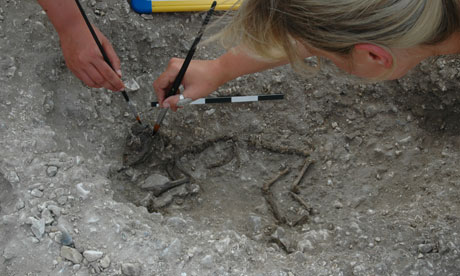
The tiny skeleton of
a sacrificial dog is unearthed at the Silchester dig.
By the gap in a hedge
bordering the entrance off a muddy lane in Hampshire, the young diggers on one
of the most fascinating archaeological sites in Britain have made a herb
garden: four small square plots. The sudden blast of sunshine after months of
heavy rain has brought everything into bloom, and there's a heady scent of
curry plant and dill, marigold and mint.
Many of the plant seeds
are familiar from Roman sites across Britain, as the invaders brought the
flavours and the medical remedies of the Mediterranean to their wind-blasted
and sodden new territory, but there is something extraordinary about the seeds
from the abandoned Iron
Age and Roman town of Silchester.
The excavation run every
summer by Dr Amanda Clarke and Professor Michael Fulford of the archaeology department at
Reading University, using hundreds of volunteer students, amateurs and
professionals, now in its 15th season, is rewriting British history.
The banal seeds are
astonishing because many came from a level dating to a century before the
Romans. More evidence is emerging every day, and it is clear that from around
50BC the Iron Age Atrebates tribe, whose name survived in the Latin Calleva Atrebatum, the wooded place of the Atrebates, enjoyed a
lifestyle that would have been completely familiar to the Romans when they
arrived in AD43.
Their diet would also be
quite familiar to many in 21st-century Britain. The people ate shellfish –
previously thought to have been eaten only in coastal settlements – as well as
cows, sheep, pigs, domesticated birds such as chicken and geese as well as wild
fowl, and wheat, apples, blackberries, cherries and plums. They ate off plates,
again previously thought a finicky Roman introduction, and flavoured their food
with poppy seed, coriander, dill, fennel, onion and celery. They had lashings
of wine, imported not just in clay amphorae but in massive barrels, and olive
oil.
And they had olives. One
tiny shrub in the herb garden represents the recent discovery, news of which
went round the world: a single battered, charred olive stone excavated from the depths
of a well, the earliest ever found in Britain. All the Atrebates needed for the
perfect pizza was tomatoes to arrive from the new world.
They had other luxury
imports, too: glass jugs and drinking glasses, gold from Ireland, bronze
jewellery and weapons from the continent, beautiful delicate pottery from
Germany and France.
They also had town
planning, another presumed later introduction. The Romans were undoubtedly
better road engineers; in the torrential rain earlier this summer, their broad
north-south road, built with a camber and drainage ditches, stayed dry, while
the Iron Age road turned into a swampy river. But the evidence is unarguable:
the Iron Age people lived in regular house plots flanking broad gravelled
roads, aligned with the sunrises and sunsets of the summer and winter
solstices, in a major town a century earlier than anyone had believed.
They feared gods who
demanded sacrifices as startling as anything in a gothic novel. Ravens have
been found buried across the site, as well as dozens of dog burials, not just
slung into a well or cesspit but carefully buried, often with other objects,
one with the body of an infant, one standing up as if on guard for 2,000 years.
Another tiny skeleton, no bigger than a celebrity's handbag dog, was one of a
handful ever found in Europe from such an early date: the evidence suggests it
lived for up to three years, and was then laid curled as if asleep into the
foundations of a house. Only last Friday the skeleton of a cat turned up,
carefully packed into a clay jar.
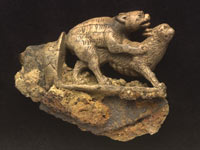
Part of a folding knife carved in exquisite detail from elephant ivory
and found at Silchester.
A unique folding knife
showing two dogs mating, another fabulously expensive import, was also
deliberately buried.
"We are only just
beginning to get a handle on all this, as our excavation is really the first
ever major modern exposure of a late Iron Age town in Britain, and we still
have a long way to go," says Fulford, who has been digging at Silchester
since he was a junior lecturer in the 1970s, and expects the work to continue
long after his day.
Fulford spends the
winters brooding on each summer's finds, and has reached the conclusion, startling
even to him, that the town was at its height of population and wealth before
the Romans arrived.
He believes it was
founded around 50BC by Commius, an Atrobates leader once a trusted ally of
Julius Caesar, who then joined an unsuccessful rebellion against him and had to
leave Gaul sharpish. Whether Commius headed for an existing Atrobates
settlement at Silchester, or started to build on a greenfield site, a
defensible hill with excellent views, near the navigable Kennet and Thames, is,
Fulford suggests, "a million-dollar question – why here?" They have
found nothing earlier than 50BC – yet.
Commius's town
flourished, trading across Britain, Ireland and both Roman and Iron Age tribal
Europe. The Callevans paid for their luxuries with exports of metalwork, wheat
– the site is still surrounded by prime farm land, and there is evidence of
grain-drying on an industrial scale – hunting dogs, and, almost certainly,
slaves: British slaves and dogs were equally prized in continental Europe. They
have also found evidence in little flayed bones for a more exotic craft
industry, puppy-fur cloaks.
Commius was succeeded by
three quarrelsome sons – significantly dubbing themselves on coins as
"rex" or king – who successively deposed one another. The third,
Verica, was toppled by local tribes and made a move that would change the
course of British history: he fled to Rome and asked for help – and in AD43 the
Romans came.
This summer the diggers
are right down at the earliest Roman level, which suggests light, short-lived,
possibly military buildings, in contrast with substantial pre-invasion
structures including one massive rectangular house that may prove to be the
largest Iron Age house in Britain. This week they are clearing a cesspit so
neatly dug it must be military, so may soon know whether the Romans ate British
wheat or Roman fish sauce.
Within 20 years, large
parts of the town were torched, possibly in Boudicca's rebellion of 60-61AD.
More Roman buildings followed, including baths, temples, a forum market place
and a huge basilica, but it would take another two centuries before the
Atrebates street grid was wholly abandoned for the Roman compass points.
People have been
fascinated by Silchester for centuries: there are records of King John visiting
in the 13th century, and an inscribed memorial stone was excavated in the 16th
century. From the 1890s the Society
of Antiquaries mounted a 20-year excavation that uncovered the heart of the
Roman town (missing much beyond the reach of Victorian science) but in the
1860s and 70s the vicar of Stratfield Saye, the memorably named James Joyce, a
passionate amateur antiquarian, had already conscripted local agricultural
labourers as excavators, with the backing of his landlord, the Duke of
Wellington.
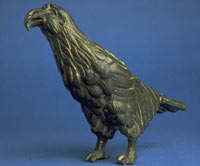
A bronze eagle found at Silchester 1866. Photograph: All Rights
Reserved/Copyright Reading Museum (Reading Borough Council)
Joyce recorded his finds
in beautiful watercolours, including the wonderful bronze eagle he found on 6
October 1866, the single most famous from the site. He interpreted it as a
regimental standard, the pride and honour of its men, wrenched from its post
and buried to save it from whatever disaster came in the scorched layer
overlying it. The find inspired Rosemary Sutcliffe's 1954 novel The Eagle of
the Ninth, and last year's Hollywood movie The
Eagle.
Fulford believes the
bird, though wonderful, is actually part of a monumental sculpture of a god or
an emperor, which escaped being melted down when the great basilica became a
scrapyard and workshop.
The eagle is in a major
gallery in Reading museum
with wonderful finds from the site, but although the gallery was redisplayed
only a few years ago, there is very little on the earliest years of Calleva
Atrebatum: that story is only emerging from the ground now.
Some time between the
fifth and seventh centuries, it all ended. Arguments break out regularly among
the diggers about what happened: with the foundation and the Romanisation of
the town, it is the third great research question that the excavation was set
up to answer.
Jesse Coxey, a
postgraduate archaeologist from Vancouver, who learned of the excavation while
on a dig in Israel – "the folks there said you'd learn more in a fortnight
at Silchester than in your entire degree course, and they were right" –
still holds the traditional view that it was abandoned as the Roman empire
began to disintegrate.
"I think the Romans
just packed up and left – it was all falling apart, and if they didn't go then
they'd be left behind. There might have been a few squatters afterwards, but
basically that was it."
Clarke, after supervising
the excavation of two noisome wells every season, up to six metres deep, and
usually sodden and stinking at the bottom, wonders if they didn't eventually
just poison all their water sources. "We've been digging down through
wells which became latrines over older wells and older latrines, layer upon
layer. There must have been enormous problems with contaminated water on a site
like this with no river. Maybe finally they just ran out of new places to dig
wells."
Whatever the cause,
everyone left. They tumbled the walls of imposing civic buildings that had long
since become workshops or cattle sheds, burying fine mosaic floors already
scorched and cracked by fires lit directly on top of the subtle decoration.
They filled in the wells. They may have cursed the site with ritual burials
including pots symbolically "killed" by holes deliberately punched
through them, so nobody else could live among the ruins.
Windblown soil filled the
ditches and covered the paved roads, grass grew over the forum and the temple
courtyards, and the great Iron Age hall, where once a tiny dog far from the
land where it was born yapped for its share of the coriander-flavoured stew,
became a low mound in a green field. Only the jagged broken teeth of the Roman
brick and flint walls remained above ground.
Towns went on but
Silchester didn't. The settlements reached by the Romans' main roads –
Winchester, Dorchester, Cirencester, and Londinium far to the east –
flourished. With the exception of one small medieval manor, now part of a farm,
and the church of St Mary, which probably stands on a Roman temple, nobody ever
built on or lived at Calleva Atrebatum to this day – except the archaeologists,
who set up their tent city every summer, and resume the attempt to peel back
the earth and time itself.
The site is owned by
Hampshire County Council, and the walls, in the guardianship of English Heritage, are open every day of the year. The annual
excavation is open free to the public every day except Friday until 12 August.
From The Guardian @ http://www.guardian.co.uk/uk/2012/jul/31/silchester-iron-age-roman-britain
For more hidden history
see http://nexusilluminati.blogspot.com/search/label/hidden%20history
- See ‘Older Posts’ at the end of each section
YOU can help this unique
independent website survive!
Donate any amount and receive at least one New Illuminati eBook!
Please click in the
jar -
Xtra Images – http://media.pcgamer.com/files/2013/05/Rome-2-Carthage-Panorama.jpg
http://www.aboutscotland.co.uk/hadrian/wallph/empire.gif
http://orgs.bsc.edu/arthur/silchester.jpg
And see
DISGRUNTLED SITE ADMINS PLEASE NOTE –
We provide a live link to your original material on your site - which
raises your ranking on search engines and helps spread your info further! This site
is published under Creative Commons Fair Use Copyright (unless an individual article
or other item is declared otherwise by copyright holder) – reproduction for non-profit
use is permitted & encouraged, if you give attribution to the work &
author - and please include a (preferably active) link to the original (along
with this or a similar notice).
Feel free
to make non-commercial hard (printed) or software copies or mirror sites - you
never know how long something will stay glued to the web – but remember
attribution! If you like what you see, please send a donation (no amount is too
small or too large) or leave a comment – and thanks for reading this far…
Live long
and prosper!