Technetronic Enslavement:
Life Inside the Matrix of Control
By
PATRICK HENNINGSEN
The march of
modern progress has brought forth many advances for humanity, and yet man is
lost. Technology, automation, and miniaturisation, along with the
micro-processing revolution, allow things to happen that were unimaginable only
ten years ago, let alone a century before. These rapid advances have brought
with them a number of complex problems, some of which challenge the very notion
of progress.
If you
define the level of an advanced civilisation by how much freedom its citizens
experience in their day to day lives – along with the protection of individual
liberties as we have come to expect in the 21st century – then the
march of the mass surveillance state over the last 15 years should be of
serious concern.
Despite
public pleas from our leaders that, ‘if only we pass this next law or security
measure’, or ‘if we can just launch one more month of airstrikes’, or ‘if the
public will allow just a bit more access to their personal information…’ and so
on, the state and its corporate partners have developed a firm grip on power
over, and intrusions into, our personal lives that is only increasing.
In the West,
a type of cognitive dissonance has already set in regard to this and other
related issues – partly due to the sheer dominance of the ‘war on terror’ and national
security narratives that overtook society after 11 September 2001. Since then,
it seems that every six months or so the narrative is revised; as one perceived
threat subsides, another emerges in its place.
What remains
is a stark picture; a society where real time monitoring of every aspect of day
to day home and work life is now expected, and where thought conformity is
rampant. It’s a self-policing, self-perpetuating interdependent, paranoid
system of globalised capitalism governed by the ruling class’s Thatcheresque
trope known as the T.I.N.A. principle1 which stands for: There Is No Alternative. When
challenged on the efficacy of this master default position, most bureaucrats,
technocrats and neoliberal financiers will loyally cling to this mantra as if
it were the only commandment etched in Moses’s stone tablets.
Welcome to
the technetronic age.
Sleepwalking Into a Technetronic Nightmare
 Since its
inception, the dream of technological progress was sold to the West as the new liberation, embodied by
breathtaking advances in automation and increased consumer convenience.
The trap has
been sprung. The micro-processing revolution gave way to the Internet and the
information technology revolution, but it didn’t take long for our most
celebrated advances to turn on society.
A primary
exhibit would be the NSA-Snowden revelations of 2013. For the first time, the
mainstream media and the public at large got a broad scope look at the actual
scale and reach of the digital surveillance state. Instead of fighting back, or
demanding reform, the public cowed instead, as people began self-policing their
speech on social networks. The mass psychological ‘chilling effect’ that so
many contemporary futurists and writers warned us about has finally come to
pass. A century and a half later after his death it seems Jeremy Bentham was
right – the Panopticon actually works.2 20th century
prophets like Eric Blair aka
George Orwell, Aldous Huxley and others all issued vivid warnings about this
dark prospect, but in the end it seems the intense glimmer of technology has
somehow blinded society to its inherent risks.
It’s true
that history often repeats itself but never in the exact same way. During the
post-WWII Cold War era, Soviet citizens maintained a rigid hyper-socialised
system because they feared an existential threat – in this case the possibility
of nuclear attack from its ideological nemesis, the so-called ‘capitalist’
countries. North Americans and western Europeans backed a fifty year-long arms
race because of a perceived existential threat from its ideological opposite
commonly referred to as ‘Communist Russia’ or the Soviet Union. The United
States also used this perceived threat to project power on every continent, and
in nearly every country on the planet. This shaped America’s idea of itself,
and also of its role in the world as a benevolent force for freedom and
democracy.
In today’s
Western threat matrix, yesterday’s communists have been replaced by today’s
Islamic terrorists. Who will it be tomorrow?
How much of
this was true or just public perception is beside the point because the systems
of control erected during this long and dark era are with us today – a full
spectrum of total information awareness, and a technetronic society driven by a
highly mechanised military industrial complex economy.
As
technology advances the fundamental questions remain: are we smarter now than
we used to be? Are we living longer and more fruitful lives? Is this true
progress?
What’s lost
cannot easily be regained.
Since its
inception, the dream of technological progress was sold to the West as the new liberation, embodied by
breathtaking advances in automation and increased consumer convenience.
The trap has
been sprung. The micro-processing revolution gave way to the Internet and the
information technology revolution, but it didn’t take long for our most
celebrated advances to turn on society.
A primary
exhibit would be the NSA-Snowden revelations of 2013. For the first time, the
mainstream media and the public at large got a broad scope look at the actual
scale and reach of the digital surveillance state. Instead of fighting back, or
demanding reform, the public cowed instead, as people began self-policing their
speech on social networks. The mass psychological ‘chilling effect’ that so
many contemporary futurists and writers warned us about has finally come to
pass. A century and a half later after his death it seems Jeremy Bentham was
right – the Panopticon actually works.2 20th century
prophets like Eric Blair aka
George Orwell, Aldous Huxley and others all issued vivid warnings about this
dark prospect, but in the end it seems the intense glimmer of technology has
somehow blinded society to its inherent risks.
It’s true
that history often repeats itself but never in the exact same way. During the
post-WWII Cold War era, Soviet citizens maintained a rigid hyper-socialised
system because they feared an existential threat – in this case the possibility
of nuclear attack from its ideological nemesis, the so-called ‘capitalist’
countries. North Americans and western Europeans backed a fifty year-long arms
race because of a perceived existential threat from its ideological opposite
commonly referred to as ‘Communist Russia’ or the Soviet Union. The United
States also used this perceived threat to project power on every continent, and
in nearly every country on the planet. This shaped America’s idea of itself,
and also of its role in the world as a benevolent force for freedom and
democracy.
In today’s
Western threat matrix, yesterday’s communists have been replaced by today’s
Islamic terrorists. Who will it be tomorrow?
How much of
this was true or just public perception is beside the point because the systems
of control erected during this long and dark era are with us today – a full
spectrum of total information awareness, and a technetronic society driven by a
highly mechanised military industrial complex economy.
As
technology advances the fundamental questions remain: are we smarter now than
we used to be? Are we living longer and more fruitful lives? Is this true
progress?
What’s lost
cannot easily be regained.
Smart Machines, Obsolete Man
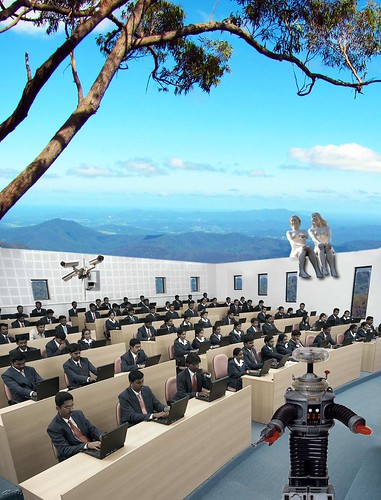 It’s not as
if philosophical and social critics didn’t see it coming. Many did in fact.
Orwell and
others recognised the potential power of applied behavioural science and its
dystopian clinical applications. Should the state ever have the ability and
technology to claim preeminent domain over the technosphere, then a social
malaise might set in not unlike that depicted in the novel 1984, or in Philip K.
Dick’s story The Minority
Report. What Orwell and other futurist visionaries could not fully
calculate, however, was the intimacy that has developed between technology and
the ‘user’. So deep is the personal relationship between these two seemingly
opposite parties that the user becomes one with the technology.
The complete
inversion of their relationship becomes apparent when technology is awarded a personality by society, as
it’s widely celebrated for being ‘personalised’ and ‘smart’ (technological
algorithms appear to predict what the user wants next). Conversely, the human
is stripped of his or her individuality
by being labelled a ‘user’. Here the human side of this transaction
is characterised as a mechanised party, while the robotic or automated actor is
celebrated as the ‘smart’ side of this interactive equation.
As man
becomes increasingly dependent on technology, the difference between man and
machine will become narrower. As artificial intelligence, big data and
algorithm modelling amplify inside the matrix, this fusion of man and machine
will beg the question: Are humans interacting with technology, or is technology
interacting with the ‘user’?
This is an
important fundamental point to consider because it means the difference between
who is considered a superior form – man or machine. Already, today, many argue
that machines have certain distinct advantages over their human creators. As
technology advances, the machines become increasingly independent of man to
perform certain basic functions and tasks. This can be as simple as turning
itself ‘off’ and ‘on’, or as complicated as self-regulating its energy output,
parsing out operational tasks, and processing and self-analysing data streams
in real-time. All of these things were once considered the job of the human
‘operator’ of the machine who has been steadily replaced by programming
instructions in the form of customised software ‘apps’.
Considering
this phenomenon of the changing relationship between man and technology in the
context of the relationship between the state and its citizens, immediately we
can see certain areas that cause concern.
It’s not as
if philosophical and social critics didn’t see it coming. Many did in fact.
Orwell and
others recognised the potential power of applied behavioural science and its
dystopian clinical applications. Should the state ever have the ability and
technology to claim preeminent domain over the technosphere, then a social
malaise might set in not unlike that depicted in the novel 1984, or in Philip K.
Dick’s story The Minority
Report. What Orwell and other futurist visionaries could not fully
calculate, however, was the intimacy that has developed between technology and
the ‘user’. So deep is the personal relationship between these two seemingly
opposite parties that the user becomes one with the technology.
The complete
inversion of their relationship becomes apparent when technology is awarded a personality by society, as
it’s widely celebrated for being ‘personalised’ and ‘smart’ (technological
algorithms appear to predict what the user wants next). Conversely, the human
is stripped of his or her individuality
by being labelled a ‘user’. Here the human side of this transaction
is characterised as a mechanised party, while the robotic or automated actor is
celebrated as the ‘smart’ side of this interactive equation.
As man
becomes increasingly dependent on technology, the difference between man and
machine will become narrower. As artificial intelligence, big data and
algorithm modelling amplify inside the matrix, this fusion of man and machine
will beg the question: Are humans interacting with technology, or is technology
interacting with the ‘user’?
This is an
important fundamental point to consider because it means the difference between
who is considered a superior form – man or machine. Already, today, many argue
that machines have certain distinct advantages over their human creators. As
technology advances, the machines become increasingly independent of man to
perform certain basic functions and tasks. This can be as simple as turning
itself ‘off’ and ‘on’, or as complicated as self-regulating its energy output,
parsing out operational tasks, and processing and self-analysing data streams
in real-time. All of these things were once considered the job of the human
‘operator’ of the machine who has been steadily replaced by programming
instructions in the form of customised software ‘apps’.
Considering
this phenomenon of the changing relationship between man and technology in the
context of the relationship between the state and its citizens, immediately we
can see certain areas that cause concern.
When a Bureaucracy Becomes a Technocracy
It’s
important to both understand and recognise the technocrat and his or her
mindset.
A bureaucrat
can be characterised as a human administrator performing highly impersonal
administrative processes. Bureaucrats will quietly celebrate delays and ‘red
tape’ as proof of the primacy of ‘the process’.
The technocrat takes this
management concept level higher and proselytises about seemingly omnipotent
abilities of technology in performing administrative tasks, all in real time.
With these new ‘smart’ tools of the future in hand, the old bureaucrat will
soon be obsolete. One form of bureaucratic tyranny is replaced by another.
Here the
technocrat engages in a kind of infatuation with his or her machines. For the
technocrat, there is a certain beauty in the perfection and perception of
infallibility of the machine. The bureaucrat’s archaic world of carbon copies,
notaries and stamps seems almost organic
in comparison.
Once again,
the machine is elevated to a higher station than human.
Between Two Ages
When viewed
with a wider social and culture lens, a clearer, albeit more disturbing picture
comes into focus. In this new
world, be it a progressive or free market capitalist future
(depending on which new religion you subscribe to), society’s values are
clearly shifting away from past traditions that were underpinned by
introspection and the inherent spiritual and organic aspects of individual
experience. Regardless of your political or social position, it’s a near given
that most people have become acutely aware of this phenomenon at some point.
That something is happening is not in question, but rather what are we shifting
towards is perhaps a much more profound question. The answer isn’t hard to
find. In fact, it’s right at our finger tips – every hour of every day.
In his book Between Two Ages: America’s Role in
the Technetronic Era,3 globalist luminary and
geostrategist Zbigniew Brzeziński described (back in 1982) the transition
between the 20th and 21st centuries:
“The
technetronic era involves the gradual appearance of a more controlled society.
Such a society would be dominated by an elite, unrestrained by traditional
values. Soon it will be possible to assert almost continuous surveillance over
every citizen and maintain up-to-date complete files containing even the most
personal information about the citizen. These files will be subject to
instantaneous retrieval by the authorities.”
Arguably,
Brzeziński’s vision was stunningly accurate, and some might argue this
globalist architect was speaking with the certainty of a deep state insider.
Indeed, recent state measures in both Australia and the United Kingdom are
indicative of the very system outlined in Between
Two Ages. In both instances, the technocrat state’s over-reliance
on both signature and algorithmical data, coupled with an unhealthy fixation on
computer modelling. Undoubtedly, this has resulted in some cold and brutal social
applications.
In
Australia, odious counter-terrorism laws brought in under former PM Tony Abbott
seem to be going from bad to worse – with the latest power grab being the
extension of “control orders” for children as young as 14 years old.
Writer Daniel
Hurst of The Guardian
describes Australia’s disturbing new legislation rolled out only this year.4
New draconian control order laws would allow the court to consider evidence
that is hidden from the suspect – a reversal of the basic principles of habeas
corpus and due process. This new regressive law would “provide the subject of a
control order and their lawyer with a censored or summarised form of ‘national
security information’ against them even if the court considers other, secret
details when making its decision; or, Provide the subject and lawyer with none
of the information in the source document, even if the court considers all of
that information when making its decision.”
In the UK,
through a new scheme called ‘Prevent’, an obsessive security state has been
attempting to indirectly draft secondary and high school level teachers into
the role of spies in order to profile and report on any young students, namely
Muslims, who “might be candidates for radicalisation.” The Guardian reports that:
“Since last
summer, Prevent has obliged teachers to refer to police pupils they suspect of
engaging in some sort of terrorist activity or radical behaviour. The duty has
been largely considered a failure by teaching leaders, partly because about 90%
of referrals end without action being taken.”5
In both
examples, our freedoms are now being stripped by technocrats and their computer
models.
The Quantification of Everything
In the 21st
century, people have been reduced to numbers, literally. While in the recent
past you may have often felt
like a number, and you sometimes objected to being treated like a number, today you
really are a
number. As society moves along the Maglev track of progress and the hyper
reality of computerisation, now at the very cusp of artificial intelligence
(AI), those old traditional values and deeper human ethics have been replaced
with one singular, all-encompassing, all-knowing and all-powerful principle of
modernity: functionality.
Writer and
philosopher Jay Dyer describes this cultural chasm:
“The trek of
modernity from the Enlightenment has resulted in the mechanisation of society
to such an extent, everything is viewed through that lens. This is the
overriding Grand narrative now – that everything is a version of technology,
including nature itself and so everything is there to be quantified and
measured. This is what the philosopher René Girard talked about in his work –
when you mechanise everything, everything becomes just merely some statistic or
quantity and this is a reflection of the binary aspect of computers. So if
everything is viewed as statistics or quantities within bureaucratic processes,
then you have a kind of atomisation where everything is broken apart.”
In this new
world order, this is the primary principle for all value judgments and remains
the only interest of any technocrat inquiry: is it functional? How well does it
function? Can the outcome be measured? Can we model the data in order to
profile the subject? Welcome to the brave world that is a world of mechanisation.
Notice how
most capital and wealth has flowed into areas of the economy where investors
place the highest value: areas integral to functionality. Big data, digital
apps, social networks and automated computerised trading and transactions. As
the technology becomes faster and more advanced, less emphasis is placed on the
human element, which also means less value is allocated there too.
Dyer adds:
“This is what the dominant mindset of Western imperialism has led to, where
everything is broken apart and it’s then left to the power blocks – corporate,
banking, security, media and social engineering, to take all the broken pieces
and put them back together in a new form by design, and that results in the
notion that you no longer have any collective belongings such as gender, or a
tribe, or family, and by extension, you are no longer part of something called
humanity, because there’s no such thing as human nature anymore.”
Such is the
unstoppable evolution of technology, and only a few visionaries have had the
foresight to see it coming and pose some warning of the inevitable evolutionary
tribulation which is already taking place.
Humanity is
in the process of transformation, from what it used to be – spiritual
individuals part of a family, to what he or she eventually will become – a
component part of a larger mechanised design.
In this new
technetronic age, humans reside below and are subservient to technology within
the mechanised society’s social hierarchy.
Technetronic End Game
Who
shoulders the blame in this dystopian scenario – humans or machines?
One might
argue that once the AI horizon is eclipsed, it’s simply too late to lament,
much less analyse the merits of such advanced technology. The answer to this
question may emerge from a careful psychological analysis of post-modern man.
Author Jay
Dyer explains the dangers that could result from the fetish or perversion
characterised by the blind acceptance of technology as an omnipotent force in
the world, where society and its leaders are unable to question the
manifestation of a new technology. He explains:
“This
dovetails with the idea of techno
fetishism, and the idea that technology can solve all our problems.
The grand narrative that [Richard] Dawkins presents, this is the generic idea
that we are all on this grand track of progress where technology fits into this
scheme where everything is automatically progressive. This fetishism can be
extended even to military applications. For instance, someone detonates a
nuclear bomb and this is seen as high technology, and therefore progressive.”
Dyer is not
merely exaggerating by introducing the prospect of thermonuclear warfare.
Partly due to a mainstream media that is either afraid or too ignorant to
address this issue, the majority of the public are unaware of recent advances
and increased stockpiles of next generation nuclear weaponry, held primarily by
the United States. In all likelihood, these will be eventually sold and
distributed to its strategic geopolitical partners.
Enter the
next generation of nuclear weapons, courtesy of the Pentagon. This year’s $8
billion upgrade includes the new guided B61-12 nuclear bomb which adds features
such as the nuclear yield of the bomb can be adjusted before deployment.
Previously, this fell under the banner of ‘tactical’ or ‘battlefield nukes’,
but now under the heading of ‘smart’ bombs.
Plans are
already underway in Washington to spread these new weapons across the planet
from the year 2024. The
Guardian reports: “The issue has a particular significance for
Europe where a stockpile of 180 B61’s is held in six bases in five countries.
If there is no change in that deployment by the time the upgraded B61-12’s
enter the stockpile in 2024, many of them will be flown out to the bases in Belgium,
the Netherlands, Germany, Italy and Turkey.”12
Former head
of US Strategic Command, US Marine General James Cartwright, reveals what is
perhaps the most insidious aspect of this new generation military tech:
“If I can
drive down the yield, drive down, therefore, the likelihood of fallout, etc,
does that make it more usable in the eyes of some – some president or national
security decision-making process? And the answer is, it likely could be more
usable.”
The
Guardian
article’s author Julian Borger concludes: “The great thing about nuclear
weapons was that their use was supposed to be unthinkable and they were
therefore a deterrent to contemplation of a new world war. Once they become
‘thinkable’ we are in a different, and much more dangerous, universe.”
Imagine
that. If you consider this ‘usability’ talking point within the context of the
previously mentioned prophetic statements about artificial intelligence by an
esteemed panel of innovators, philosophers and scientists, then any sane person
might be concerned we are passing over a dangerous threshold in human history.
It’s an epic
tale, echoed in biblical lore and throughout ancient mythology. Mankind is now,
again, in danger of falling prey to his own creation.
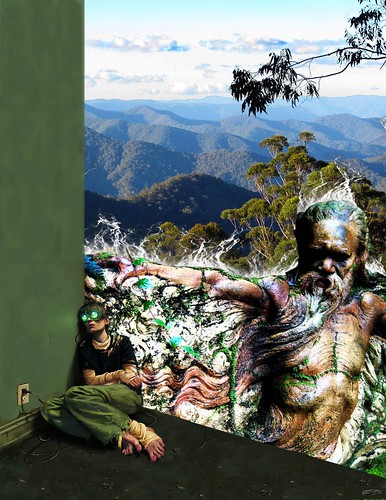 Is jumping
ship an option, at least out of North America or Europe, and other urban
centres around the globe? While fleeing to the remains of the old ‘free world’
in places like South America, Asia or Africa may provide temporary respite from
a pernicious globalised system, it is in no way a long term solution. The long
arm of progress knows no borders and if left unimpeded, it will colonise even
the most remote location.
For those
who truly value their freedom and want to pass on a positive legacy to their
progeny, the final battle is unavoidable: standing up to, and confronting the machine.
Nine out of
ten experts agree: this very well could be mankind’s last stand.
Is jumping
ship an option, at least out of North America or Europe, and other urban
centres around the globe? While fleeing to the remains of the old ‘free world’
in places like South America, Asia or Africa may provide temporary respite from
a pernicious globalised system, it is in no way a long term solution. The long
arm of progress knows no borders and if left unimpeded, it will colonise even
the most remote location.
For those
who truly value their freedom and want to pass on a positive legacy to their
progeny, the final battle is unavoidable: standing up to, and confronting the machine.
Nine out of
ten experts agree: this very well could be mankind’s last stand.
Footnotes
2.
For
more on the Panopticon, see Oceania Forever: Rise of the Global Police State by
Patrick Henningsen, New Dawn
153 (Nov-Dec 2015)
3.
Between Two Ages: America’s Role in the Technetronic Era by Zbigniew K.
Brzezinski, Praeger, 1982
4.
‘Call
for lawyers to speak up for terrorism suspects in closed courts’ by Daniel
Hurst, The Guardian,
15 Feb 2016
5.
‘Teachers
back motion calling for Prevent strategy to be scrapped’ by Richard Adams, The Guardian, 28 Mar 2016
7.
Collectivization and Social Engineering by Zeev Levin, Brill
2015
9.
‘Apple
co-founder on artificial intelligence: “The future is scary and very bad for
people”’ by Peter Holley, The
Washington Post, 24 Mar 2015
10.
‘Stephen
Hawking just got an artificial intelligence upgrade, but still thinks AI could
bring an end to mankind’ by Peter Holley, The
Washington Post, 2 Dec 2014
12.
‘America’s
new, more “usable”, nuclear bomb in Europe’ by Julian Borger, The Guardian, 11 Nov 2015
.
PATRICK
HENNINGSEN
is the founder and editor of the news and analysis website 21st Century Wire,
and is an independent foreign and political affairs analyst for RT
International. He is also the host of the SUNDAY WIRE radio program which airs
live every Sunday on the Alternate Current Radio Network. Learn more about this
author at: www.patrickhenningsen.com.
The
print edition of this article includes three additional sidebars – to read the
full article, purchase
the digital version here.
© New Dawn Magazine and the respective
author.
For our reproduction notice,
click
here.
- Scroll down
through ‘Older Posts’ at the end of each section
Do you LIKE this uniquely informative site?
A genuinely incapacitated invalid maintains, writes, edits,
researches, illustrates, moderates and publishes this website from a tiny cabin
in a remote forest.
Now that most people use ad blockers and view these posts
on phones and other mobile devices, sites like this earn an ever shrinking
pittance from advertising sponsorship.
This site needs your help.
Like what you see? Please give
anything you can -
Contribute any amount and receive at least one New Illuminati eBook!
(You can use a card securely if you don’t use Paypal)
Please click below -
And it costs nothing
to share this post on Social Media!
Dare to care and
share - YOU are our only advertisement!
And see
New Illuminati’s OWN Youtube Videos
-
DISGRUNTLED SITE ADMINS PLEASE NOTE –
We provide
a live link to your original material on your site (and links via social
networking services) - which raises your ranking on search engines and helps
spread your info further!
This site
is published under Creative Commons (Attribution) CopyRIGHT (unless an
individual article or other item is declared otherwise by the copyright
holder). Reproduction for non-profit use is permitted & encouraged - if you
give attribution to the work & author and include all links in the original
(along with this or a similar notice).
Feel free
to make non-commercial hard (printed) or software copies or mirror sites - you
never know how long something will stay glued to the web – but remember
attribution!
If you
like what you see, please send a donation (no amount is too small or too large)
or leave a comment – and thanks for reading this far…
Live long
and prosper! Together we can create the best of all possible worlds…



 Alicia is a full-time freelance writer/blogger and
aspiring multi-hyphenate. She was born in Toronto, raised in Jamaica and now
calls Montreal home. She has a background in Broadcast-Journalism and a Ph.D in
make believe. When she’s not busy writing or curating digital content, she’s
bumping old school reggae, doling out advice or brushing up on her couch potato
skills. She lives in the Plateau with her boyfriend, son and cat.
Alicia is a full-time freelance writer/blogger and
aspiring multi-hyphenate. She was born in Toronto, raised in Jamaica and now
calls Montreal home. She has a background in Broadcast-Journalism and a Ph.D in
make believe. When she’s not busy writing or curating digital content, she’s
bumping old school reggae, doling out advice or brushing up on her couch potato
skills. She lives in the Plateau with her boyfriend, son and cat.