Genetically Modified Organisms Risk Global Ruin
‘Black Swan’ Author Speaks Out
‘Black Swan’ Author Speaks Out
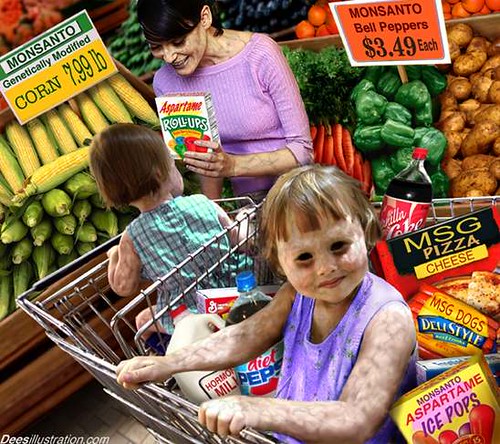
Experts have severely underestimated the risks of genetically modified food, says a group of researchers led by Nassim Nicholas Taleb
It
is 20 years since the FDA approved the Flavr Savr tomato for human consumption, the first
genetically engineered food to gain this status. Since then, genetically
modified food has become a significant part of the human diet in many parts of
the world, particularly in the US. In 2013 roughly 85 per cent of corn and 90
per cent of soybeans produced in the US were genetically modified.
Given
the ubiquity of this kind of foodstuff, you could be forgiven for thinking that
the scientific debate over its safety has been largely settled. It is certainly
true that a large number of scientists seem to take that view. In 2012, for
example, the American Association for the Advancement of Science declared that
genetically modified crops pose no greater risk than the same foods made from
crops modified by conventional plant breeding techniques.
Today,
Nassim Nicholas Taleb at New York University and a few pals say that this kind
of thinking vastly underestimates the threat posed by genetically modified
organisms. “Genetically modified organisms represent a public risk of global
harm,” they say. Consequently, this risk should be treated differently from
those that only have the potential for local harm. “The precautionary principle
should be used to prescribe severe of limits on genetically modified
organisms,” they conclude.
Taleb
and co begin by making a clear distinction between risks with consequences that
are local and those with consequences that have the potential to cause global
ruin. When global harm is possible, an action must be avoided unless there is
scientific near-certainty that it is safe. This approach is known as the
precautionary principle.
The
question, of course, is when the precautionary principle should be applied.
Taleb and co begin by saying that their aim is to place the precautionary
principle within a formal statistical structure that is grounded in probability
theory and the properties of complex systems. “Our aim is to allow
decision-makers to discern which circumstances require the use of the precautionary
principle and in which cases evoking the precautionary principle is
inappropriate.”
Their
argument begins by dividing potential harm into two types. The first is
localised and non-spreading. The second is propagating harm that results in
irreversible and widespread damage. Taleb and co say that traditional
decision-making strategies focus on the first type of risk where the harm is
localised and the risk is easy to calculate from past data.
In
this case, it is always possible to make a mistake when decision-making about
risk. The crucial point is that when the harm is localised, the potential
danger from a miscalculation is bounded.
By
contrast, harm that is able to propagate on a global scale is entirely
different. “The possibility of irreversible and widespread damage raises
different questions about the nature of decision-making and what risks can be
reasonably taken,” say Taleb and co. In this case, the potential danger from a
miscalculation can be essentially infinite. It is in this category of total
ruin problems that the precautionary principle comes into play, they say.
A
key difference between these types of risks is the statistical structure of
their impact. This structure is either dependent on scale or independent of
scale. An example of a scale -dependent distribution is the weight of an adult
human which is generally never greater than about 10 times the weight of an
average human.
However,
a single individual can be richer than the poorest 2 billion humans. So wealth
follows a scale independent distribution.
When
it comes to risk, the harm from scale dependent risks comes from the collective
effect of many events, since no single event alone can dominate the total. “It
is practically impossible for a single data account for 99 percent of all heart
attacks in a given year,” say Taleb and co by way of an example.
By
contrast, the harm from scale independent risks can be dominated by a single
event. For example, the Earth is constantly bombarded by small rocks from space
that have little effect. Nevertheless, a single large rock could wipe out the
entire human race.
Taleb
and co focus on two examples. The first is nuclear energy. They point out that
many people are justifiably concerned about the risk associated with nuclear
energy. Scientists are well aware of the harm that can be caused by radiation
release, core meltdown and the disposal of radioactive waste and these risks
have been studied extensively.
While
the potential harm from a nuclear accident can be large, it is generally scale
dependent and far from global. So when it comes to making decisions about
whether to use nuclear energy on a local scale, the risks involved can be
managed using appropriate safety measures that have been carefully considered.
Taleb
and co contrast this to the case of genetically modified organisms. They argue
that the risk from genetically modified organisms is a potential for widespread
impact on the ecosystem and widespread impact on human health. In other words,
it is scale independent.
One
of the arguments that genetically modified crops are safe is that it is no more
unnatural than the selective farming that people have been doing for generations.
However, Taleb and co argue that this kind of farming is different from the
current practice because any mistake in the form of a harmful variation will
almost certainly be localised and die out as a result. This is the natural
process of selection.
Over
many generations, humans have chosen and adapted biological organisms that are
relatively safe for consumption, even though there are many organisms that are
not safe, including parts of and varieties of the crops that we do cultivate.
By
contrast, genetic engineering works in a very different way. This process
introduces rapid changes on a global scale. But selection cannot operate on
this scale, they argue.
 “There
is no comparison between tinkering with the selective breeding of genetic
components of organisms that have previously undergone extensive histories of
selection and the top-down engineering of taking a gene from a fish and putting
it into a tomato,” they argue. “Saying that such a product is natural misses
the process of natural selection by which things become “natural.””
The
potential impact of genetically modified organisms on human health is even more
worrying. Taleb and co say that the current mechanism for determining whether
or not the genetic engineering of particular protein into a plant is safe is
woefully inadequate.
The
FDA currently does this by considering the existing knowledge of risks
associated with that protein. “The number of ways such an evaluation can be an
error is large,” they say.
That’s
because proteins in living organisms are part of complex chemical networks. In
general, the effect of a new protein on this network is difficult to predict
even though the purpose of introducing it is to strongly impact the chemical
functions of the plant, for example, by modifying its resistance to other
chemicals such as herbicides or pesticides.
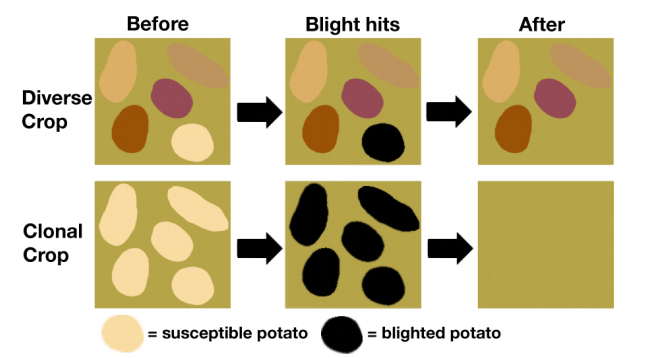
Even
more serious is the introduction of monocultures— the use of single crops over
large areas. This dramatically increases the likelihood that the entire crop
might fail due to the action of some invasive species, disease or change in the
environment.
When
harm is localised, it can be used as part of the learning process to prevent
the same set of circumstances occurring again. Global harm is different. “We
should exert the precautionary principle here because we do not want to
discover errors after considerable and irreversible environmental and health
damage,” conclude Taleb and co.
They
go on to discuss a number of fallacious arguments against using the
precautionary principle. One of these is the Loch Ness fallacy, which states
that the precautionary principle should prevent us from swimming in the Loch
because we have no evidence that the Loch Ness monster does not exist.
Taleb
and co say this is a corruption of the absence of evidence problem and
unrelated to the question of whether the precautionary principle should apply.
That is because the harm associated with the Loch Ness monster is purely local.
“If the Loch Ness monster did exist, it would still be no reason to invoke the
precautionary principle, as the harm he might cause is limited in scope to Loch
Ness itself, and does not present the risk of ruin,” they say.
They
go on to consider numerous other fallacies that confuse the issue over whether
to use the precautionary principle or not. The central point in most of these
is whether the risk involved is one of global ruin or local ruin.
That
is an interesting contribution to the debate over genetically modified
organisms, which has become becalmed in recent years. While the argument itself
is interesting, the fact that the lead author, Nassim Nicholas Taleb is such a
high profile commentator on risk is bound to raise the profile of the debate.
The co-authors include a number of other well-known researchers such as Raphael
Douady at the Institute of Mathematics and Theoretical Physics in Paris and
Yaneer Bar-Yam at the New England Complex Systems Institute in Cambridge.
It
is unlikely, of course, that the other actors in this debate will meekly agree
with this new assessment. In particular, companies with a financial interest in
the future of genetic engineering, such as Monsanto, will want to put their
side of the debate.
More
interesting will be how the FDA takes into account the arguments that Taleb and
co put forward. Expect fireworks in the coming weeks and months.
Ref:
arxiv.org/abs/1410.5787 : The
Precautionary Principle (with Application to the Genetic Modification of
Organisms)

From The Physics arXiv Blog @ https://medium.com/the-physics-arxiv-blog/genetically-modified-organisms-risk-global-ruin-says-black-swan-author-e8836fa7d78
For more information about genetically modified organisms see http://nexusilluminati.blogspot.com/search/label/gmos
- Scroll down through ‘Older Posts’ at the end of each section
Hope you like this
not for profit site -
It takes hours of work every day by
a genuinely incapacitated invalid to maintain, write, edit, research,
illustrate and publish this website from a tiny cabin in a remote forest
Like what we do? Please give anything
you can -
Contribute any amount and receive at
least one New Illuminati eBook!
(You can use a card
securely if you don’t use Paypal)
Please click below -
Spare Bitcoin
change?
Xtra Images – https://c2.staticflickr.com/4/3624/3343795712_a57b736b46.jpg
http://fc06.deviantart.net/fs70/f/2010/038/c/8/GMO___are_you_eating_it__by_A78.jpg
For further enlightening information
enter a word or phrase into the random synchronistic search box @ the top left
of http://nexusilluminati.blogspot.com
And see
New Illuminati – http://nexusilluminati.blogspot.com
New Illuminati on Facebook - https://www.facebook.com/the.new.illuminati
New Illuminati Youtube Channel - http://www.youtube.com/user/newilluminati/feed
New Illuminati on Google+ @ https://plus.google.com/115562482213600937809/posts
New Illuminati on Twitter @ www.twitter.com/new_illuminati
New Illuminations –Art(icles) by
R. Ayana @ http://newilluminations.blogspot.com
The Her(m)etic Hermit - http://hermetic.blog.com
The Prince of Centraxis - http://centraxis.blogspot.com (Be
Aware! This link leads to implicate & xplicit concepts & images!)
DISGRUNTLED SITE ADMINS PLEASE NOTE –
We provide a live link to your original material on your site (and
links via social networking services) - which raises your ranking on search
engines and helps spread your info further! This site is published
under Creative Commons Fair Use Copyright (unless an individual article or
other item is declared otherwise by the copyright holder). Reproduction for non-profit use is permitted & encouraged,
- if you give attribution to the work & author. Please include a
(preferably active) link to the original (along with this or a similar notice).
Feel free to make non-commercial hard (printed) or software copies or
mirror sites - you never know how long something will stay glued to the web –
but remember attribution!
If you like what you see, please send a donation (no amount is too
small or too large) or leave a comment – and thanks for reading this far…
Live long and prosper! Together we can create the best of all possible
worlds…
From the New Illuminati – http://nexusilluminati.blogspot.com


