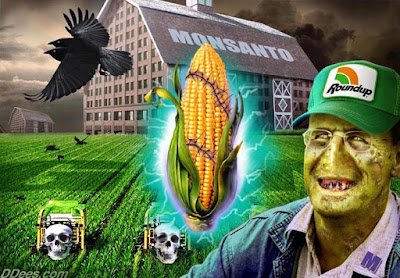
The Failure of Frankenfoods
Doubts About the Promised Bounty
of Genetically Modified Crops

Arnaud Rousseau, a sixth-generation
farmer in France, in a field of rapeseed. Twenty years ago, Europe largely
rejected genetic modification at the same time the United States and Canada
were embracing it. Credit Ed Alcock for The New
York Times
The
controversy over genetically modified
crops
has long focused on[…] fears that they are unsafe to eat. But an
extensive examination by The New York Times indicates that the debate has
missed a more basic problem — genetic modification in the United States and
Canada has not accelerated increases in crop yields or led to an overall
reduction in the use of chemical pesticides.
The
promise of genetic modification was twofold: By making crops immune to the
effects of weedkillers and inherently resistant to many pests, they would grow
so robustly that they would become indispensable to feeding the world’s growing
population, while also requiring fewer applications of sprayed pesticides.
Twenty
years ago, Europe largely rejected genetic modification at the same time the
United States and Canada were embracing it. Comparing results on the two
continents, using independent data as well as academic and industry research,
shows how the technology has fallen short of the promise.
Broken Promises of
Genetically Modified Crops

An
analysis by The Times using United Nations data showed that the United States
and Canada have gained no discernible advantage in yields — food per acre —
when measured against Western Europe, a region with comparably modernized
agricultural producers like France and Germany. Also, a recent National Academy
of Sciences report
found that “there was little evidence” that the introduction of genetically
modified crops in the United States had led to yield gains beyond those seen in
conventional crops.
At
the same time, herbicide use has increased in the United States, even as major
crops like corn, soybeans and cotton have been converted to modified varieties.
And the United States has fallen behind Europe’s biggest producer, France, in
reducing the overall use of pesticides, which includes both herbicides and
insecticides.
One
measure, contained in data from the United States Geological Survey, shows the
stark difference in the use of pesticides. Since genetically modified crops
were introduced in the United States two decades ago for crops like corn,
cotton and soybeans, the use of toxins that kill insects and fungi has fallen
by a third, but the spraying of herbicides, which are used in much higher
volumes, has risen by 21 percent.
By
contrast, in France, use of insecticides and fungicides has fallen by a far
greater percentage — 65 percent — and herbicide use has decreased as well, by
36 percent.
Profound
differences over genetic engineering have split Americans and Europeans for
decades. Although American protesters as far back as 1987 pulled up prototype
potato plants, European anger at the idea of fooling with nature has been
far more sustained. In the last few years, the March
Against Monsanto has drawn thousands of protesters in cities like Paris and
Basel, Switzerland, and opposition to G.M. foods is a foundation of the Green
political movement. Still, Europeans eat those foods when they buy imports from
the United States and elsewhere.

In Rowland, N.C., a worker loads G.M. corn
seed into a planting machine on Bo Stone’s farm. Mr. Stone values genetic
modifications to reduce his insecticide use. Credit Jeremy M. Lange for The New York Times
Fears
about the harmful effects of eating G.M. foods have proved to be largely
without scientific basis. The potential harm from pesticides, however, has
drawn researchers’ attention. Pesticides are toxic by design — weaponized
versions, like
sarin, were developed in Nazi Germany — and have been linked to
developmental delays and cancer.
“These
chemicals are largely unknown,” said David Bellinger, a professor at the
Harvard University School of Public Health, whose
research has attributed the loss of nearly 17 million I.Q. points among
American children 5 years old and under to one class of insecticides. “We do
natural experiments on a population,” he said, referring to exposure to
chemicals in agriculture, “and wait until it shows up as bad.”
The
industry is winning on both ends — because the same companies make and sell
both the genetically modified plants and the poisons. Driven by these sales,
the combined market capitalizations of Monsanto, the largest seed
company, and Syngenta, the Swiss pesticide
giant, have grown more than sixfold in the last decade and a half. The two
companies are separately involved in merger agreements that would lift their
new combined values to more than $100 billion each.
When
presented with the findings, Robert T. Fraley,
the chief technology officer at Monsanto, said The Times had cherry-picked its
data to reflect poorly on the industry. “Every farmer is a smart
businessperson, and a farmer is not going to pay for a technology if they don’t
think it provides a major benefit,” he said. “Biotech tools have clearly driven
yield increases enormously.”
Regarding
the use of herbicides, in a statement, Monsanto said, “While overall herbicide
use may be increasing in some areas where farmers are following best practices
to manage emerging weed issues, farmers in other areas with different
circumstances may have decreased or maintained their herbicide usage.”
Genetically
modified crops can sometimes be effective. Monsanto and others often cite the
work of Matin Qaim, a researcher at Georg-August-University of Göttingen,
Germany, including a meta-analysis of
studies that he helped write finding significant yield gains from genetically
modified crops. But in an interview and emails, Dr. Qaim said he saw
significant effects mostly from insect-resistant varieties in the developing
world, particularly in India.
“Currently
available G.M. crops would not lead to major yield gains in Europe,” he said.
And regarding herbicide-resistant crops in general: “I don’t consider this to
be the miracle type of technology that we couldn’t live without.”
A Vow to Curb Chemicals
First
came the Flavr
Savr tomato in 1994,
which was supposed to stay fresh longer. The next year it was a small number of
bug-resistant russet potatoes. And by 1996, major genetically modified crops
were being planted in the United States.
Monsanto,
the most prominent champion of these new genetic traits, pitched them as a way
to curb the use of its pesticides. “We’re certainly not encouraging farmers to
use more chemicals,” a company executive told The Los Angeles Times in 1994.
The next year, in a news release, the company said that its new gene for seeds,
named Roundup Ready, “can reduce overall herbicide use.”
Originally,
the two main types of genetically modified crops were either resistant to
herbicides, allowing crops to be sprayed with weedkillers, or resistant to some
insects.

Arnaud Rousseau holds non-G.M. corn
seed, produced by Pioneer, a unit of DuPont.
Credit Ed Alcock for The New York Times
Figures
from the United States
Department of Agriculture show herbicide use skyrocketing in soybeans, a
leading G.M. crop, growing by two and a half times in the last two decades, at
a time when planted acreage of the crop grew by less than a third. Use in corn
was trending downward even before the introduction of G.M. crops, but then nearly
doubled from 2002 to 2010, before leveling off. Weed resistance problems in
such crops have pushed overall usage up.
To
some, this outcome was predictable. The whole point of engineering
bug-resistant plants “was to reduce insecticide
use, and it did,” said Joseph Kovach, a retired Ohio State University
researcher who studied the environmental risks of pesticides. But the goal of
herbicide-resistant seeds was to “sell more product,” he said — more herbicide.
Farmers
with crops overcome by weeds, or a particular pest or disease, can
understandably be G.M. evangelists. “It’s silly bordering on ridiculous to turn
our backs on a technology that has so much to offer,” said Duane Grant, the
chairman of the Amalgamated Sugar Company, a cooperative of more than 750 sugar
beet farmers in the Northwest.
He
says crops resistant to Roundup, Monsanto’s most popular weedkiller, saved his
cooperative.
But
weeds are becoming resistant to Roundup around the world — creating an opening
for the industry to sell more seeds and more pesticides. The latest seeds have
been engineered for resistance to two weedkillers, with resistance to as many
as five planned. That will also make it easier for farmers battling resistant
weeds to spray a widening array of poisons sold by the same companies.
Growing
resistance to Roundup is also reviving old, and contentious, chemicals. One is 2,4-D, an ingredient in
Agent Orange, the infamous Vietnam War defoliant. Its potential risks have long
divided scientists and have alarmed advocacy groups.
Another
is dicamba. In Louisiana, Monsanto is spending nearly
$1 billion to begin production of the chemical there. And even though
Monsanto’s version is not yet approved for use, the company is already selling
seeds that are resistant to it — leading to reports that some farmers are damaging
neighbors’ crops by illegally spraying older versions of the toxin.
High-Tech Kernels

Bo Stone, a sixth-generation farmer,
in Rowland, N.C. The seeds on Mr. Stone’s farm brim with genetically modified
traits. Credit Jeremy M. Lange for
The New York Times
Two
farmers, 4,000 miles apart, recently showed a visitor their corn seeds. The
farmers, Bo Stone and Arnaud Rousseau, are sixth-generation tillers of the
land. Both use seeds made by DuPont, the giant chemical company that is merging
with Dow Chemical.
To
the naked eye, the seeds looked identical. Inside, the differences are
profound.
In
Rowland, N.C., near the South Carolina border, Mr. Stone’s seeds brim with
genetically modified traits. They contain Roundup Ready, a Monsanto-made trait
resistant to Roundup, as well as a gene made by Bayer that makes crops impervious
to a second herbicide. A trait called Herculex I was developed by Dow and
Pioneer, now part of DuPont, and attacks the guts of insect larvae. So does
YieldGard, made by Monsanto.
Another
big difference: the price tag. Mr. Rousseau’s seeds cost about $85 for a
50,000-seed bag. Mr. Stone spends roughly $153 for the same amount of biotech
seeds.
For
farmers, doing without genetically modified crops is not a simple choice.
Genetic traits are not sold à la carte.
Manufacturing
the corn seed on the left involves gene modifications by three additional
companies. The seed on the right is created using only conventional breeding
methods.
Mr.
Stone, 45, has a master’s degree in agriculture and listens to Prime Country
radio in his Ford pickup. He has a test field where he tries out new seeds,
looking for characteristics that he particularly values — like plants that
stand well, without support.
“I’m
choosing on yield capabilities and plant characteristics more than I am on
G.M.O. traits” like bug and poison resistance, he said, underscoring a crucial
point: Yield is still driven by breeding plants
to bring out desirable traits, as it has been for thousands of years.
That
said, Mr. Stone values genetic modifications to reduce his insecticide use
(though he would welcome help with stink bugs, a troublesome pest for many
farmers). And Roundup resistance in pigweed has emerged as a problem.
“No
G.M. trait for us is a silver bullet,” he said.
By
contrast, at Mr. Rousseau’s farm in Trocy-en-Multien, a village outside Paris,
his corn has none of this engineering because the European Union bans most
crops like these.
“The
door is closed,” says Mr. Rousseau, 42, who is vice president of one of
France’s many agricultural unions. His 840-acre farm was a site of World War I
carnage in the Battle of the Marne.
As
with Mr. Stone, Mr. Rousseau’s yields have been increasing, though they go up
and down depending on the year. Farm technology has also been transformative.
“My grandfather had horses and cattle for cropping,” Mr. Rousseau said. “I’ve
got tractors with motors.”
He
wants access to the same technologies as his competitors across the Atlantic,
and thinks G.M. crops could save time and money.
“Seen
from Europe, when you speak with American farmers or Canadian farmers, we’ve
got the feeling that it’s easier,” Mr. Rousseau said. “Maybe it’s not right. I
don’t know, but it’s our feeling.”
Feeding the World

Brazilian soybean plants at the end of
their life cycle at Bayer’s research center in Durham, N.C. The plants have
“stacked” traits, meaning they have been genetically modified for more than one
specific trait, like bug resistance. Credit Jeremy M. Lange for The New York Times
With
the world’s population expected to reach nearly
10 billion by 2050,
Monsanto has long held out its products as a way “to help meet the food demands
of these added billions,” as it said in a 1995 statement. That remains an
industry mantra.
“It’s
absolutely key that we keep innovating,” said Kurt Boudonck, who manages
Bayer’s sprawling North Carolina greenhouses. “With the current production
practices, we are not going to be able to feed that amount of people.”
But
a broad yield advantage has not emerged. The Times looked at regional data from
the United Nations Food and Agriculture Organization, comparing main
genetically modified crops in the United States and Canada with varieties grown
in Western Europe, a grouping used by the agency that comprises seven nations,
including the two largest agricultural producers, France and Germany.
For
rapeseed, a variant of which is used to produce canola oil, The Times compared
Western Europe with Canada, the largest producer, over three decades, including
a period well before the introduction of genetically modified crops.
Despite
rejecting genetically modified crops, Western Europe maintained a lead over
Canada in yields. While that is partly because different varieties are grown in
the two regions, the trend lines in the relative yields have not shifted in
Canada’s favor since the introduction of G.M. crops, the data shows.

Stink bugs raised by Bayer for
experimental purposes at its research center in Morrisville, N.C.
Credit Jeremy M. Lange for The New York Times
For
corn, The Times compared the United States with Western Europe. Over three
decades, the trend lines between the two barely deviate. And sugar beets, a
major source of sugar, have shown stronger yield growth recently in Western
Europe than the United States, despite the dominance of genetically modified
varieties over the last decade.
Jack
Heinemann, a professor at the University of Canterbury in New Zealand, did a
pioneering 2013 study comparing trans-Atlantic yield trends, using United
Nations data. Western Europe, he said, “hasn’t been penalized in any way for
not making genetic engineering one of its biotechnology choices.”
Biotech
executives suggested making narrower comparisons. Dr. Fraley of Monsanto
highlighted data comparing yield growth in Nebraska and France, while an
official at Bayer suggested Ohio and France. These comparisons can be favorable
to the industry, while comparing other individual American states can be
unfavorable.
Michael
Owen, a weed scientist at Iowa State University, said that while the industry
had long said G.M.O.s would “save the world,” they still “haven’t found the
mythical yield gene.”
Few New Markets
Battered
by falling crop prices and consumer resistance that has made it hard to win over new
markets, the agrochemical industry has been swept by buyouts. Bayer recently
announced a deal to acquire Monsanto. And the
state-owned China National Chemical Corporation has received American regulatory
approval to acquire Syngenta, though Syngenta later warned the takeover could be delayed by scrutiny from
European authorities.

A research assistant at a Bayer center
in North Carolina, where experiments are carried out to find new toxins to
eradicate pests like stinkbugs, a problem at farms like Mr. Stone’s in Rowland.
Credit Jeremy M. Lange for The New York Times
The
deals are aimed at creating giants even more adept at selling both seeds and
chemicals. Already, a new generation of seeds is coming to market or in
development. And they have grand titles. There is the Bayer Balance GT Soybean Performance
System. Monsanto’s Genuity
SmartStax RIB Complete corn. Dow’s
PhytoGen with Enlist and WideStrike 3 Insect Protection.
In
industry jargon, they are “stacked” with many different genetically modified
traits. And there are more to come. Monsanto has said that the corn seed of
2025 will have 14 traits and allow farmers to spray five different kinds of
herbicide.
Newer
genetically modified crops claim to do many things, such as protecting against
crop diseases and making food more nutritious. Some may be effective, some not.
To the industry, shifting crucial crops like corn, soybeans, cotton and
rapeseed almost entirely to genetically modified varieties in many parts of the
world fulfills a genuine need. To critics, it is a marketing opportunity.
“G.M.O.
acceptance is exceptionally low in Europe,” said Liam Condon, the head of
Bayer’s crop science division, in an interview the day the Monsanto deal was
announced. He added: “But there are many geographies around the world where the
need is much higher and where G.M.O. is accepted. We will go where the market
and the customers demand our technology.”
Correction:
November 2, 2016
A chart on Sunday with the continuation of an article about the unmet promises of genetically modified crops misstated the mode of action of Herculex I, a genetic trait developed by Dow AgroSciences and Pioneer. It breaks down the gut wall of insect larvae; it does not create a bacterium that does so.
A chart on Sunday with the continuation of an article about the unmet promises of genetically modified crops misstated the mode of action of Herculex I, a genetic trait developed by Dow AgroSciences and Pioneer. It breaks down the gut wall of insect larvae; it does not create a bacterium that does so.
A
version of this article appears in print on October 30, 2016, on page A1 of the
New York edition with the headline: Doubts
About a Promised Bounty.
From The New York
Times @ http://www.nytimes.com/2016/10/30/business/gmo-promise-falls-short.html
For more information about frankenfoods see http://nexusilluminati.blogspot.com/search/label/frankenfood
- Scroll down
through ‘Older Posts’ at the end of each section
Do you LIKE this uniquely informative site?
A genuinely incapacitated invalid maintains, writes, edits,
researches, illustrates, moderates and publishes this website from a tiny cabin
in a remote forest.
Now that most people use ad blockers and view these posts
on phones and other mobile devices, sites like this earn an ever shrinking
pittance from advertising sponsorship.
This site needs your help.
Like what you see? Please give
anything you can -
Contribute any amount and receive at least one New Illuminati eBook!
(You can use a card securely if you don’t use Paypal)
Please click below -
And it costs nothing
to share this post on Social Media!
Dare to care and
share - YOU are our only advertisement!
For further enlightening
information enter a word or phrase into the random synchronistic search box @
the top left of http://nexusilluminati.blogspot.com
And see
New Illuminati – http://nexusilluminati.blogspot.com
New Illuminati on Facebook - https://www.facebook.com/the.new.illuminati
New Illuminati Youtube Channel - https://www.youtube.com/user/newilluminati/playlists
New Illuminati’s OWN Youtube Videos
-
New Illuminati on Google+ @ For
New Illuminati posts - https://plus.google.com/u/0/+RamAyana0/posts
New Illuminati on Twitter @ www.twitter.com/new_illuminati
New Illuminations –Art(icles) by
R. Ayana @ http://newilluminations.blogspot.com
The Her(m)etic Hermit - http://hermetic.blog.com
DISGRUNTLED SITE ADMINS PLEASE NOTE –
We provide
a live link to your original material on your site (and links via social
networking services) - which raises your ranking on search engines and helps
spread your info further!
This site
is published under Creative Commons (Attribution) CopyRIGHT (unless an
individual article or other item is declared otherwise by the copyright
holder). Reproduction for non-profit use is permitted & encouraged - if you
give attribution to the work & author and include all links in the original
(along with this or a similar notice).
Feel free
to make non-commercial hard (printed) or software copies or mirror sites - you
never know how long something will stay glued to the web – but remember
attribution!
If you
like what you see, please send a donation (no amount is too small or too large)
or leave a comment – and thanks for reading this far…
Live long
and prosper! Together we can create the best of all possible worlds…
From the New Illuminati – http://nexusilluminati.blogspot.com