I recently watched the
documentary Zeitgeist
(Part 1) as well as Bill Maher’s movie Religulous. Both made mention of claims
often made that there are many stories that predate Jesus but have striking
parallels. I decided to follow up on these claims and see what kind of
information was out there to substantiate these assertions.
As a non-christian, I am
approaching this topic purely as an interested observer. I am assuming half of
the people who read this will automatically say the claims are false and the
other half will say they are true. The truth I found is that it is difficult to
know for sure.
Here are ten of the
figures often sited:
10
Buddha
Both went to their
temples at the age of twelve, where they are said to have astonished all with their wisdom. Both
supposedly fasted in solitude for a long time: Buddha for forty–seven days and
Jesus for forty. Both wandered to a fig tree at the conclusion of their fasts.
Both were about the same age when they began their public ministry:
“When he [Buddha] went
again to the garden he saw a monk who was calm, tranquil, self–possessed,
serene, and dignified. The prince, determined to become such a monk, was led to
make the great renunciation. At the time he was twenty–nine years of age…
“Jesus, when he began his ministry, was about thirty years of age.” (Luke
3:23). Both were tempted by the “devil” at the beginning of their ministry: To
Buddha, he said: “Go not forth to adopt a religious life but return to your
kingdom, and in seven days you shall become emperor of the world, riding over
the four continents.” To Jesus, he said: “All these [kingdoms of the world] I
will give you, if you fall down and worship me” (Matthew 4:9). Buddha answered
the “devil”: “Get you away from me.”
Jesus responded:
“…begone, Satan!” (Matthew 4:10). Both strove to establish a kingdom of heaven
on earth. According to the Somadeva (a Buddhist holy book), a Buddhist
ascetic’s eye once offended him, so he plucked it out and cast it away. Jesus
said: “If your right eye causes you to sin, pluck it out, and throw it away;.”
(Matthew 5:29).
9
Krishna
According to Bhagavata
Purana some believe that Krishna was born without a sexual union, by “mental transmission”
from the mind of Vasudeva into the womb of Devaki, his mother. Christ and
Krishna were called both God and the Son of God. Both were sent from heaven to
earth in the form of a man. Both were called Savior, and the second person of
the Trinity. Krishna’s adoptive human father was also a carpenter. A spirit or
ghost was their actual father. Krishna and Jesus were of royal descent.
Both were visited at
birth by wise men and shepherds, guided by a star. Angels in both cases issued
a warning that the local dictator planned to kill the baby and had issued a
decree for his assassination. The parents fled. Mary and Joseph stayed in
Muturea; Krishna’s parents stayed in Mathura. Both Christ and Krishna withdrew
to the wilderness as adults, and fasted. Both were identified as “the seed of
the woman bruising the serpent’s head.” Jesus was called “the lion of the tribe
of Judah.” Krishna was called “the lion of the tribe of Saki.” Both claimed: “I
am the Resurrection.” Both were “without sin.” Both were god-men: being
considered both human and divine. Both performed many miracles, including the
healing of disease.
One of the first miracles
that both performed was to make a leper whole. Each cured “all manner of
diseases.” Both cast out indwelling demons, and raised the dead. Both selected
disciples to spread his teachings. Both were meek, and merciful. Both were
criticized for associating with sinners. Both celebrated a last supper. Both
forgave his enemies. Both were crucified and both were resurrected.
8
Odysseus
Homeric tales about
Odysseus emphasize his suffering life, just as in Mark Jesus said that he, too, would suffer
greatly. Odysseus is a carpenter like Jesus, and he wants to return his home
just as Jesus wants to be welcomed in his native home and later to God’s home
in Jerusalem. Odysseus is plagued with unfaithful and dim-witted companions who
display tragic flaws. They stupidly open a magic bag of wind while Odysseus
sleeps and release terrible tempests which prevent their return home.
These sailors are
comparable to Jesus’ disciples, who disbelieve Jesus, ask foolish questions,
and show general ignorance about everything. It’s amazing that either Odysseus
or Jesus ever manage to accomplish anything, given the companions they have,
but this simply demonstrates the power and ability of the one true leader who
has a divine mandate to lead the people out of darkness and into a brighter
future.
7
Romulus
Romulus is born of a
vestal virgin, which was a priestess of the hearth god Vesta sworn to celibacy. His mother
claims that the divine impregnated her, yet this is not believed by the King.
Romulus and his twin brother, Remus, are tossed in the river and left for dead.
(A “slaughter of the innocents” tale which parallels that of Matthew 2:13-16).
Romulus is hailed as the son of god. He is “snatched away to heaven” by a
whirlwind (It is assumed that the gods took him), and he makes post mortem
appearances. In his work Numa Pompilius, Plutarch records that there was a
darkness covering the earth before his death (Just as there was during Jesus’
death according to Mark 15:33). He also states that Romulus is to be know
afterwards as ‘Quirinus’; A god which belonged to the Archiac Triad (a “triple
deity” similar to the concept of the Trinity).
6
Dionysus
Dionysus was born of a
virgin on December 25
and, as the Holy Child, was placed in a manger. He was a traveling teacher who
performed miracles. He “rode in a triumphal procession on an ass.” He was a
sacred king killed and eaten in an eucharistic ritual for fecundity and
purification. Dionysus rose from the dead on March 25. He was the God of the
Vine, and turned water into wine. He was called “King of Kings” and “God of
Gods.” He was considered the “Only Begotten Son,” Savior,” “Redeemer,” “Sin
Bearer,” Anointed One,” and the “Alpha and Omega.” He was identified with the
Ram or Lamb. His sacrificial title of “Dendrites” or “Young Man of the Tree”
intimates he was hung on a tree or crucified.
5
Heracles
Heracles is the Son of a
god (Zeus). It is recorded
that Zeus is both the father and great-great- great grandfather of Heracles,
just as Jesus is essentially his own grandpa, being both “The root and
offspring of David” (Revelation 22:16) as he is part of the triune God which is
the father of Adam and eventually of Jesus. Both are doubly related to the
Supreme God.
Diodorus writes that,”For
as regards the magnitude of the deeds which he accomplished it is generally
agreed that Heracles has been handed down as one who surpassed all men of whom
memory from the beginning of time has brought down an account; consequently it
is a difficult attainment to report each one of his deeds in a worthy manner
and to present a record which shall be on a level with labours so great, the
magnitude of which won for him the prize of immortality.”
Jesus is also said to
have done a very large number of good works. John 21:25 says that: “Jesus did
many other things as well. If every one of them were written down, I suppose
that even the whole world would not have room for the books that would be
written.”
Hera tries to kill
Heracles as an infant by sending two serpents after him, yet Heracles survives
by strangling them. This parallels Herod’s slaughter of the innocents in an
attempt to kill Jesus (Matthew 2:13-16).
Heracles makes a descent
into Hades and returns from it with Theseus and Peirithoüs, just as Jesus
descends into the “lower parts of the earth” or Hades (Ephesians 4:7-8); Though
Jesus does not bring anyone up from it. Heracles’ body is not found and he is
assumed to have been taken by the gods:”After this, when the companions of
Iolaüs came to gather up the bones of Heracles and found not a single bone
anywhere, they assumed that, in accordance with the words of the oracle, he had
passed from among men into the company of the gods.”
4
Glycon
In the middle of the 100s
AD, out along the south coast of the Black Sea, Glycon was the son of the God Apollo, who: came to
Earth through a miraculous birth, was the Earthly manifestation of divinity,
came to earth in fulfillment of divine prophecy, gave his chief believer the
power of prophecy, gave believers the power to speak in tongues, performed
miracles, healed the sick, and raised the dead.
3
Zoroaster/Zarathustra
Zoroaster was born of a
virgin and “immaculate conception by a ray of divine reason.” He was baptized in a river.
In his youth he astounded wise men with his wisdom. He was tempted in the
wilderness by the devil. He began his ministry at age 30. Zoroaster baptized
with water, fire and “holy wind.” He cast out demons and restored the sight to
a blind man. He taught about heaven and hell, and revealed mysteries, including
resurrection, judgment, salvation and the apocalypse. He had a sacred cup or
grail. He was slain. His religion had a eucharist. He was the “Word made
flesh.” Zoroaster’s followers expected a “second coming” in the virgin-born
Saoshynt or Savior, who is to come in 2341 AD and begin his ministry at age 30,
ushering in a golden age.
2
Attis of
Phrygia
Attis was born on
December 25 of the Virgin Nana. He was considered the savior who was slain for the salvation of
mankind. His body as bread was eaten by his worshippers. He was both the Divine
Son and the Father. On “Black Friday,” he was crucified on a tree, from which
his holy blood ran down to redeem the earth. He descended into the underworld.
After three days, Attis was resurrected.
1
Horus
Born of a virgin, Isis.
Only begotten son of the God Osiris. Birth heralded by the star Sirius, the morning star.
Ancient Egyptians paraded a manger and child representing Horus through the
streets at the time of the winter solstice (about DEC-21). In reality, he had
no birth date; he was not a human. Death threat during infancy: Herut tried to
have Horus murdered. Handling the threat: The God That tells Horus’ mother
“Come, thou goddess Isis, hide thyself with thy child.”
An angel tells Jesus’
father to: “Arise and take the young child and his mother and flee into Egypt.”
Break in life history: No data between ages of 12 & 30. Age at baptism: 30.
Subsequent fate of the baptiser: Beheaded. Walked on water, cast out demons,
healed the sick, restored sight to the blind. Was crucifed, descended into
Hell; resurrected after three days.
Jamie is the founder of
Listverse. He spends his time working on the site, doing research for new
lists, and cooking. He is fascinated with all things morbid and bizarre.
The Prince of Centraxis - http://centraxis.blogspot.com(Be Aware! This link leads to implicate &
xplicit concepts & images!)
DISGRUNTLED SITE ADMINS PLEASE NOTE –
We provide a live link to your original material on your site - which
raises your ranking on search engines and helps spread your info further! This site
is published under Creative Commons Fair Use Copyright (unless an individual article
or other item is declared otherwise by copyright holder) – reproduction for non-profit
use is permitted & encouraged, if you give attribution to the work &
author - and please include a (preferably active) link to the original (along
with this or a similar notice).
Feel free
to make non-commercial hard (printed) or software copies or mirror sites - you
never know how long something will stay glued to the web – but remember
attribution! If you like what you see, please send a donation (no amount is too
small or too large) or leave a comment – and thanks for reading this far…
Every year on February 15th, natives of Tanna Island in the Republic of Vanuatu hold a grand celebration in honor of an imaginary man named John Frum. Villagers clothe themselves in homemade US Army britches, paint “USA” on their bare chests and backs, and run a replica of Old Glory up the flagpole alongside the Marine Corps Emblem and the state flag of Georgia. Barefoot soldiers then march in perfect step in the shadow of Yasur, the island’s active volcano, with red-tipped bamboo “rifles” slung over their shoulders. February 15th is known as John Frum day on Tanna Island, and these activities are the islanders’ holiest religious service.
The Vanuatu island group lies northeast of Australia and southeast of Malaysia and the Philippines. Prior to contact with Europeans, the people who lived there were primitive tribal societies. Many of history’s stereotypes and legends regarding island cannibals originated from these societies; slain enemies and the occasional missionary were eaten, sometimes in the hopes of gaining magical powers, and other times due to food shortages.
Eventually the New Hebrides islands (as they were then called) were colonized and placed under joint British and French rule. Christian missionaries formed a makeshift government and court system which punished islanders for following many of their long-held customs, such as dancing, swearing, adultery, and polygamy. The colonizers also forbade working and amusement on Sundays. The islanders lived under this oppression for thirty years before a fellow native rallied the people and promised an age of abundance to any who would reject the European ways. He went by the alias “John Frum,” a name possibly derived from the phrase “John from Jesus Christ”– namely John the Baptist. Many islanders joined him, and the cult moved inland to escape the missionaries and return to their old traditions.
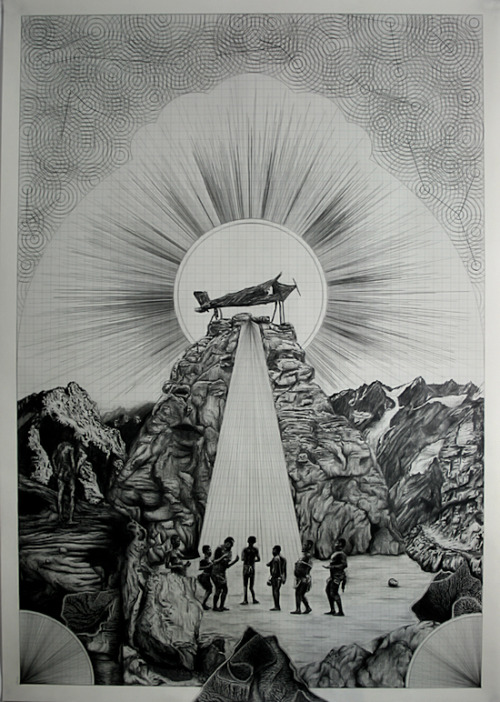
One day in the early 1940s, the relatively isolated group of islands was descended upon by hundreds of thousands of American soldiers who arrived by sea and by air. The world was at war, and America had plans to build bases on the Pacific islands. The newcomers recruited the locals’ assistance in constructing hospitals, airstrips, jetties, roads, bridges, and corrugated-steel Quonset huts, all of which were strange and wondrous to the natives. But it was the prodigious amounts of war materiel that were airdropped for the US bases that drastically changed the lifestyle of the islanders. They observed as aircraft descended from the sky and delivered crates full of clothing, tents, weapons, tools, canned foods, and other goods to the island’s new residents, a diversity of riches the likes of which the islanders had never seen. The natives learned that this bounty from the sky was known to the American servicemen as “cargo.”
These new occupiers proved to be far better guests than the British missionaries had been. The islanders were further astonished at the sight of black GIs among the ranks, enjoying all the benefits of cargo that the white soldiers enjoyed– something that the black islanders had been denied with rare exception. The islanders believed that their own dead ancestors continued to influence the communities of the living, and that their ancestors would one day come back to life and distribute to them unimaginable wealth. Therefore they reasoned that the white people must have had connections to their own ancestors, who would logically be the only ones powerful enough to rain down such wondrous riches.
It was during the war that the John Frum legend changed, recasting the religious icon as a black American infantryman. The black GIs were believed to have been John Frum’s own detachment of the US Army, or perhaps the grown children of islanders believed to have been kidnapped by plantation owners long ago. It was said that John Frum lived inside the island’s volcano, called “Yasur”– the native word for “God.”
When the war ended several years later, the Americans departed as suddenly as they had arrived. Military bases were abandoned, and the steady flow of cargo which had altered the islanders’ lives completely dried up. The men and women of Tanna Island had grown to enjoy the radios, trucks, boats, watches, iceboxes, medicine, Coca-Cola, canned meat, and candy, so they set into motion a plan to bring back the cargo. They had surreptitiously learned the secrets of summoning the cargo by observing the practices of the American airmen, sailors and soldiers.
The islanders set to work clearing their own kind of landing strips, and they erected their own control towers strung with rope and bamboo aerials. They carved wooden radio headsets with bamboo antennae, and even the occasional wooden air-traffic controller. Day after day, men from the village sat in their towers wearing their replica headsets as others stood on the runways and waved the landing signals to attract cargo-bringing airplanes from the empty sky. More towers were constructed, these with tin cans strung on wires to imitate radio stations so John Frum could communicate with his people. Piers were also erected in an effort to attract ships laden with cargo, and the Red Cross emblem seen on wartime ambulances was taken as the symbol of the resurging religion. Today villages surrounding Yasur Volcano are dotted with little red crosses surrounded by picket fences, silently testifying to the islander’s faith.
The priests and prophets of the John Frum cult, called “messengers,” foretold the return of planes and ships bearing cargo for the people of Tanna escorted by John Frum himself. The movement declared that in addition to returning to their “kastom” [custom] ways, money was to be thrown away, gardens be left untended, and pigs killed since all material wealth will be provided in the end by John Frum. Their god has yet to emerge from his home inside the volcano to bring the promised riches, and at least one visitor’s guide offers this advice: “If you question a local about their beliefs, they will most likely reply that you have been waiting for your messiah to return for over 2000 years – while they have been waiting for only 70.”
John Frum Day parade
Yasur the volcano
Despite gaining their independence and becoming familiar with the workings of the world around them, new beliefs arise on the island regularly. A visit to the village of Yaohnanen in 1974 by Prince Phillip resulted in the formation of a Prince Phillip cult. Its followers believe that Phillip originally came from Tanna, albeit in a different form, and that he will eventually return to rule over them. A recent development is the appearance of the Prophet Fred, an actual person who claims to have raised his wife from the dead in early 2006. He preaches a turn to more mainstream Christianity, and his followers have had violent clashes with those of John Frum.
Vanuatu is not the earliest and far from the only place in Melanesia where cargo cults have existed. The origin of the earliest cargo cults in general can be traced back to 1871, when the Russian explorer Nikolai Miklouho-Maclay landed in Papua New Guinea bearing gifts of goods such as steel axe heads and bolts of cloth. Inevitably, missionaries soon arrived and began distributing goods. Initially all efforts to convert the natives proved useless, but one day the natives suddenly started converting in droves. The men and women of the island had theorized that learning the rituals of the Europeans would allow them to gain the secrets of cargo.
The religions introduced by missionaries were completely inconsistent with islanders’ long-held beliefs, yet the natives could not deny the call of the cargo. The people therefore attempted to reconcile their existing beliefs with the missionaries’ teachings, a practice which led to some strange interpretations. In New Guinea, one resulting version of Christianity described a god named Anus who delivered cargo of canned meat, steel tools, rice, and matches to Adam and Eve. When they discovered sex, Anus ejected them from Eden and struck them with a flood.
On the Island of New Hanover in the Bismarck Archipelago, another cargo cult arose in 1968 claiming that the true secret of cargo was known to only one man: President Lyndon Johnson. The natives of this island revolted against their Australian rulers, saved up $75,000, and sent a letter to Johnson offering to buy him and make him King of New Hanover. Strangely enough, he didn’t accept.
Renowned physicist Richard Feynman coined the phrase “cargo cult science” based on such cults. The term draws a metaphor for research which is polluted by the mind’s tendency to cherry-pick evidence that supports the desired outcome. Though it is tempting to look down on these islanders for their misguided assumptions, they are simply an extreme example of this very human bias. For them it was easier to believe that the control towers, headsets, and runways were the cause of the cargo-carrying airplanes rather than an effect, so they closed their minds to alternative explanations.
Some of these cargo cults continue to operate today, such as the parade-marching pseudo-marines of Vanuatu. So far no black US infantryman have crawled from the volcano to deliver the islanders’ salvation, but every year they confidently hoist their flags and don their uniforms, so they’ll be ready when that glorious day finally arrives. Perhaps one day it will.
Throughout Melanesia primitive men awaited a black Messiah who will bring them a largess of "cargo" (European goods). These cults typify the impact of Christendom on premodern society
Editor's Note: This article, published in the May 1959 issue of Scientific American, is a supplement to the 50, 100 & 150 Years Ago column in the May 2009 issue.
Patrols of the Australian Government venturing into the "uncontrolled" central highlands of New Guinea in 1946 found the primitive people there swept up in a wave of religious excitement. Prophecy was being fulfilled: The arrival of the Whites was the sign that the end of the world was at hand. The natives proceeded to butcher all of their pigs-animals that were not only a principal source of subsistence but also, symbols of social status and ritual preeminence in their culture. They killed these valued animals in expression of the belief that after three days of darkness "Great Pigs" would appear from the sky. Food, firewood and other necessities had to be stock-piled to see the people through to the arrival of the Great Pigs. Mock wireless antennae of bamboo and rope had been erected to receive in advance the news of the millennium. Many believed that with the great event they would exchange their black skins for white ones.
This bizarre episode is by no means the single event of its kind in the murky history of the collision of European civilization with the indigenous cultures of the southwest Pacific. For more than 100 years traders and missionaries have been reporting similar disturbances among the peoples of Melanesia, the group of Negro-inhabited islands (including New Guinea, Fiji, the Solomons and the New Hebrides) lying between Australia and the open Pacific Ocean.
Though their technologies were based largely upon stone and wood, these peoples had highIy developed cultures, as measured by the standards of maritime and agricultural ingenuity, the complexity of their varied social organizations and the elaboration of religious belief and ritual. They were nonetheless ill prepared for the shock of the encounter with the Whites, a people so radically different from themselves and so infinitely more powerful. The sudden transition from the society of the ceremonial stone ax to the society of sailing ships and now of airplanes has not been easy to make.
After four centuries of Western expansion [sic], the densely populated central highlands of New Guinea remain one of the few regions where the people still carry on their primitive existence in complete independence of the world outside. Yet as the agents of the Australian Government penetrate into ever more remote mountain valleys, they find these backwaters of antiquity already deeply disturbed by contact with the ideas and artifacts of European civilization. For "cargo" -Pidgin English for trade goods has long flowed along the indigenous channels of communication from the seacoast into the wilderness. With it has traveled the frightening knowledge of the white man's magical power. No small element in the white man's magic is the hopeful message sent abroad by his missionaries: the news that a Messiah will come and that the present order of Creation will end.
The people of the central highlands of New Guinea are only the latest to be gripped in the recurrent religious frenzy of the "cargo cults." However variously embellished with details from native myth and Christian belief, these cults all advance the same central theme: the world is about to end in a terrible cataclysm. Thereafter God, the ancestors or some local culture hero will appear and inaugurate a blissful paradise on earth. Death, old age, illness and evil will be unknown. The riches of the white man will accrue to the Melanesians.
Although the news of such a movement in one area has doubtless often inspired similar movements in other areas, the evidence indicates that these cults have arisen independently in many places as parallel responses to the same enormous social stress and strain. Among the movements best known to students of Melanesia are the "Taro Cult" of New Guinea, the "Vailala Madness" of Papua, the "Naked Cult" of Espiritu Santo, the "John Frum Movement" of the New Hebrides and the "Tuka Cult" of the Fiji Islands.
At times the cults have been so well organized and fanatically persistent that they have brought the work of government to a standstill. The outbreaks have often taken the authorities completely by surprise and have confronted them with mass opposition of an alarming kind. In the 1930s, for example, villagers in the vicinity of Wewak, New Guinea, were stirred by a succession of "Black King" movements. The prophets announced that the Europeans would soon leave the island, abandoning their property to the natives, and urged their followers to cease paying taxes, since the government station was about to disappear into the sea in a great earthquake. To the tiny community of Whites in charge of the region, such talk was dangerous. The authorities jailed four of the prophets and exiled three others. In yet another movement, that sprang up in declared opposition to the local Christian mission, the cult leader took Satan as his god.
Troops on both sides in World War II found their arrival in Melanesia heralded as a sign of the Apocalypse. The G.I.s who landed in the New Hebrides, moving up for the bloody fighting on Guadalcanal, found the natives furiously at work preparing airfields, roads and docks for the magic ships and planes that they believed were coming from "Rusefel" (Roosevelt), the friendly king of America.
The Japanese also encountered millenarian visionaries during their southward march to Guadalcanal. Indeed, one of the strangest minor military actions of World War II occurred in Dutch New Guinea, when Japanese forces had to be turned against the local Papuan inhabitants of the Geelvink Bay region. The Japanese had at first been received with great joy, not because their "Greater East Asia Co-Prosperity Sphere" propaganda had made any great impact upon the Papuans, but because the natives regarded them as harbingers of the new world that was dawning, the Right of the Dutch having already given the first sign. Mansren, creator of the islands and their peoples, would now return, bringing with him the ancestral dead. All this had been known, the cult leaders declared, to the crafty Dutch, who had torn out the first page of the Bible where these truths were inscribed. When Mansren returned, the existing world order would be entirely overturned. White men would turn black like Papuans, Papuans would become Whites; root crops would grow in trees, and coconuts and fruits would grow like tubers.
Some of the islanders now began to draw together into large "towns"; others took Biblical names such as "Jericho" and "Galilee" for their villages. Soon they adopted military uniforms and began drilling. The Japanese, by now highly unpopular, tried to disarm and disperse the Papuans; resistance inevitably developed. The climax of this tragedy came when several canoe-loads of fanatics sailed out to attack Japanese warships, believing themselves to be invulnerable by virtue of the holy water with which they had sprinkled themselves. But the bullets of the Japanese did not turn to water, and the attackers were mowed down by machine-gun fire.
Behind this incident lay a long history. As long ago as 1857 missionaries in the Geelvink Bay region had made note of the story of Mansren. It is typical of many Melanesian myths that became confounded with Christian doctrine to form the ideological basis of the movements. The legend tells how long ago there lived an old man named Manamakeri ("he who itches"), whose body was covered with sores. Manamakeri was extremely fond of palm wine, and used to climb a huge tree every day to tap the liquid from the flowers. He soon found that someone was getting there before him and removing the liquid. Eventually he trapped the thief, who turned out to be none other than the Morning Star. In return for his freedom, the Star gave the old man a wand that would produce as much fish as he liked, a magic tree and a magic staff. If he drew in the sand and stamped his foot, the drawing would become real.
Manamakeri, aged as he was, now magically impregnated a young maiden; the child of this union was a miracle-child who spoke as soon as he was born. But the maiden's parents were horrified, and banished her, the child and the old man. The trio sailed off in a canoe created by Mansren ("The Lord"), as the old man now became known. On this journey Mansren rejuvenated himself by stepping into a fire and flaking off his scaly skin, which changed into valuables. He then sailed around Geelvink Bay, creating islands where he stopped, and peopling them with the ancestors of the present-day Papuans.
The Mansren myth is plainly a creation myth fu II of symbolic ideas relating to fertility and rebirth. Comparative evidence-especially the shedding of his scaly skin-confirms the suspicion that the old man is, in fact, the Snake in another guise. Psychoanalytic writers argue that the snake occupies such a prominent part in mythology the world over because it stands for the penis, another fertility symbol. This may be so, but its symbolic significance is surely more complex than this. It is the "rebirth" of the hero, whether Mansren or the Snake, that exercises such universal fascination over men's minds.
The 19th-century missionaries thought that the Mansren story would make the introduction of Christianity easier, since the concept of "resurrection," not to mention that of the "virgin birth" and the "second coming," was already there. By 1867, however, the first cult organized around the Mansren legend was reported.
Though such myths were widespread in Melanesia, and may have sparked occasional movements even in the preWhite era, they took on a new significance in the late 19th century, once the European powers had finished parceling out the Melanesian region among themselves. In many coastal areas the long history of "blackbirding"-the seizure of islanders for work on the plantations of Australia and Fiji-had built up a reservoir of hostility to Europeans. In other areas, however, the arrival of the Whites was accepted, even welcomed, for it meant access to bully beef and cigarettes, shirts and paraffin lamps, whisky and bicycles. It also meant access to the knowledge behind these material goods, for the Europeans brought missions and schools as well as cargo.
Practically the only teaching the natives received about European life came from the missions, which emphasized the central significance of religion in European society. The Melanesians already believed that man's activities whether gardening, sailing canoes or bearing children-needed magical assistance. Ritual without human effort was not enough. But neither was human effort on its own. This outlook was reinforced by mission teaching.
The initial enthusiasm for European rule, however, was speedily dispelled. The rapid growth of the plantation economy removed the bulk of the able bodied men from the villages, leaving women, children and old men to carry on as best they could. The splendid vision of the equality of all Christians began to seem a pious deception in face of the realities of the color bar, the multiplicity of rival Christian missions and the open irreligion of many Whites.
For a long time the natives accepted the European mission as the means by which the "cargo" would eventually be made available to them. But they found that acceptance of Christianity did not bring the cargo any nearer. They grew disillusioned. The Astor now began to be put about that it was not the Whites who made the cargo, but the dead ancestors. To people completely ignorant of factory production, this made good sense. White men did not work; they merely wrote secret signs on scraps of paper, for which they were given shiploads of goods. On the other hand, the Melanesians labored week after week for pitiful wages. Plainly the goods must be made for Melanesians somewhere, perhaps in the Land of the Dead. The Whites, who possessed the secret of the cargo, were intercepting it and keeping it from the hands of the islanders, to whom it was really consigned. In the Madang district of New Guinea, after some 40 years' experience of the missions, the natives went in a body one day with a petition demanding that the cargo secret should now be revealed to them, for they had been very patient.
So strong is this belief in the existence of a "secret" that the cargo cults generally contain some ritual in imitation of the mysterious European customs which are held to be the clue to the white man's extraordinary power over goods and men. The believers sit around tables with bottles of flowers in front of them, dressed in European clothes, waiting for the cargo ship or airplane to materialize; other cultists feature magic pieces of paper and cabalistic writing.
Many of them deliberately turn their backs on the past by destroying secret ritual objects, or exposing them to the gaze of uninitiated youths and women, for whom formerly even a glimpse of the sacred objects would have meant the severest penalties, even death. The belief that they were the chosen people is further reinforced by their reading of the Bible, for the lives and customs of the people in the Old Testament resemble their own lives rather than those of the Europeans. In the New Testament they find the Apocalypse, with its prophecies of destruction and resurrection, particularly attractive.
Missions that stress the imminence of the Second Coming, like those of the Seventh Day Adventists, are often accused of stimulating millenarian cults among the islanders. In reality, however, the leanest themselves rework the doctrines the missionaries teach them, selecting from the Bible what they themselves find particularly congenial in it. Such movements have occurred in areas where missions of quite different types have been dominant, from Roman Catholic to Seventh Day Adventist. The reasons for the emergence of these cults, of course, lie far deeper in the life-experience of the people.
The economy of most of the islands is very backward. Native agriculture produces little for the world market, and even the European plantations and mines export only a few primary products and raw materials: copra, rubber, gold. Melanesians are quite unable to understand why copra, for example, fetches 30 pounds sterling per ton one month and but 5 pounds a few months later. With no notion of the workings of world-commodity markets, the natives see only the sudden closing of plantations, reduced wages and unemployment, and are inclined to attribute their insecurity to the whim or evil in the nature of individual planters.
Such shocks have not been confined to the economic order. Governments, too, have come and gone, especially during the two world wars: German, Dutch, British and French administrations melted overnight. Then came the Japanese, only to be ousted in turn largely by the previously unknown Americans. And among these Americans the Melanesians saw Negroes like themselves, living lives of luxury on equal terms with white G.I.s. The sight of these Negroes seemed like a fulfillment of the old prophecies to many cargo cult leaders. Nor must we forget the sheer scale of this invasion. Around a million U. S. troops passed through the Admiralty Islands, completely swamping the inhabitants. It was a world of meaningless and chaotic changes, in which anything was possible.
New ideas were imported and given local twists. Thus in the Loyalty Islands people expected the French Communist Party to bring the millennium. There is no real evidence, however, of any Communist influence in these movements, despite the rather hysterical belief among Solomon Island planters that the name of the local "Masinga Rule" movement was derived from the word "Marxian"! In reality the name comes from a Solomon Island tongue, and means 'brotherhood."
Europeans who have witnessed outbreaks inspired by the cargo cults are usually at a loss to understand what they behold. The islanders throwaway their money, break their most sacred taboos, abandon their gardens and destroy their precious livestock; they indulge in sexual license or, alternatively, rigidly separate men from women in huge communal establishments. Sometimes they spend days sitting gazing at the horizon for a glimpse of the long-awaited ship or airplane; sometimes they dance, pray and sing in mass congregations, becoming possessed and "speaking with tongues ."
Observers have not hesitated to use such words as "madness," "mania," and "irrationality" to characterize the cults. But the cults reflect quite logical and rational attempts to make sense out of a social order that appears senseless and chaotic. Given the ignorance of the Melanesians about the wider European society, its economic organization and its highly developed technology, their reactions form a consistent and understandable pattern. They wrap up all their yearning and hope in an amalgam that combines the best counsel they can find in Christianity and their native belief. If the world is soon to end, gardening or fishing is unnecessary; everything will be provided. If the Melanesians are to be part of a much wider order, the taboos that prescribe their social conduct must now be lifted or broken in a newly prescribed way.
Of course the cargo never comes. The cults nonetheless live on. If the millennium does not arrive on schedule, then perhaps there is some failure in the magic, some error in the ritual. New breakaway groups organize around "purer" faith and ritual. The cult rarely disappears, so long as the social situation which brings it into being persists.
At this point it should be observed that cults of this general kind are not peculiar to Melanesia. Men who feel themselves oppressed and deceived have always been ready to pour their hopes and fears, their aspirations and frustrations, into dreams of a millennium to come or of a golden age to return. All parts of the world have had their counterparts of the cargo cults, from the American Indian ghost dance to the communist-millenarist "reign of the saints" in Munster during the Reformation, from medieval European apocalyptic cults to African "witch-finding" movements and Chinese Buddhist heresies. In some situations men have been content to wait and pray; in others they have sought to hasten the day by using their strong right arms to do the Lord's work. And always the cults serve to bring together scattered groups, notably the peasants and urban plebeians of agrarian societies and the peoples of "stateless" societies where the cult unites separate (and often hostile) villages, clans and tribes into a wider religiopolitical unity.
Once the people begin to develop secular political organizations, however, the sects tend to lose their importance as vehicles of protest. They begin to relegate the Second Coming to the distant future or to the next world. In Melanesia ordinary political bodies, trade unions and native councils are becoming the normal media through which the islanders express their aspirations. In recent years continued economic prosperity and political stability have taken some of the edge off their despair. It now seems unlikely that any major movement along cargo-cult lines will recur in areas where the transition to secular politics has been made, even if the insecurity of prewar times returned. I would predict that the embryonic nationalism represented by cargo cults is likely in future to take forms familiar in the history of other countries that have moved from subsistence agriculture to participation in the world economy.
For further enlightening information enter a word or phrase into the search box @ New Illuminati or click on any label/tag at the bottom of the page @ http://nexusilluminati.blogspot.com
The Prince of Centraxis - http://centraxis.blogspot.com(Be Aware! This link leads to implicate & xplicit concepts & images!)
This site is published under Creative Commons Fair Use Copyright (unless an individual item is declared otherwise by copyright holder) – reproduction for non-profit use is permitted & encouraged, if you give attribution to the work & author - and please include a (preferably active) link to the original along with this notice. Feel free to make non-commercial hard (printed) or software copies or mirror sites - you never know how long something will stay glued to the web – but remember attribution! If you like what you see, please send a small but heartfelt donation or leave a comment – and thanks for reading this far…

 Both went to their
temples at the age of twelve, where they are said to have astonished all with their wisdom. Both
supposedly fasted in solitude for a long time: Buddha for forty–seven days and
Jesus for forty. Both wandered to a fig tree at the conclusion of their fasts.
Both were about the same age when they began their public ministry:
Both went to their
temples at the age of twelve, where they are said to have astonished all with their wisdom. Both
supposedly fasted in solitude for a long time: Buddha for forty–seven days and
Jesus for forty. Both wandered to a fig tree at the conclusion of their fasts.
Both were about the same age when they began their public ministry: According to Bhagavata
Purana some believe that Krishna was born without a sexual union, by “mental transmission”
from the mind of Vasudeva into the womb of Devaki, his mother. Christ and
Krishna were called both God and the Son of God. Both were sent from heaven to
earth in the form of a man. Both were called Savior, and the second person of
the Trinity. Krishna’s adoptive human father was also a carpenter. A spirit or
ghost was their actual father. Krishna and Jesus were of royal descent.
According to Bhagavata
Purana some believe that Krishna was born without a sexual union, by “mental transmission”
from the mind of Vasudeva into the womb of Devaki, his mother. Christ and
Krishna were called both God and the Son of God. Both were sent from heaven to
earth in the form of a man. Both were called Savior, and the second person of
the Trinity. Krishna’s adoptive human father was also a carpenter. A spirit or
ghost was their actual father. Krishna and Jesus were of royal descent.  Homeric tales about
Odysseus emphasize his suffering life, just as in Mark Jesus said that he, too, would suffer
greatly. Odysseus is a carpenter like Jesus, and he wants to return his home
just as Jesus wants to be welcomed in his native home and later to God’s home
in Jerusalem. Odysseus is plagued with unfaithful and dim-witted companions who
display tragic flaws. They stupidly open a magic bag of wind while Odysseus
sleeps and release terrible tempests which prevent their return home.
Homeric tales about
Odysseus emphasize his suffering life, just as in Mark Jesus said that he, too, would suffer
greatly. Odysseus is a carpenter like Jesus, and he wants to return his home
just as Jesus wants to be welcomed in his native home and later to God’s home
in Jerusalem. Odysseus is plagued with unfaithful and dim-witted companions who
display tragic flaws. They stupidly open a magic bag of wind while Odysseus
sleeps and release terrible tempests which prevent their return home.  Romulus is born of a
vestal virgin, which was a priestess of the hearth god Vesta sworn to celibacy. His mother
claims that the divine impregnated her, yet this is not believed by the King.
Romulus and his twin brother, Remus, are tossed in the river and left for dead.
(A “slaughter of the innocents” tale which parallels that of Matthew 2:13-16).
Romulus is hailed as the son of god. He is “snatched away to heaven” by a
whirlwind (It is assumed that the gods took him), and he makes post mortem
appearances. In his work Numa Pompilius, Plutarch records that there was a
darkness covering the earth before his death (Just as there was during Jesus’
death according to Mark 15:33). He also states that Romulus is to be know
afterwards as ‘Quirinus’; A god which belonged to the Archiac Triad (a “triple
deity” similar to the concept of the Trinity).
Romulus is born of a
vestal virgin, which was a priestess of the hearth god Vesta sworn to celibacy. His mother
claims that the divine impregnated her, yet this is not believed by the King.
Romulus and his twin brother, Remus, are tossed in the river and left for dead.
(A “slaughter of the innocents” tale which parallels that of Matthew 2:13-16).
Romulus is hailed as the son of god. He is “snatched away to heaven” by a
whirlwind (It is assumed that the gods took him), and he makes post mortem
appearances. In his work Numa Pompilius, Plutarch records that there was a
darkness covering the earth before his death (Just as there was during Jesus’
death according to Mark 15:33). He also states that Romulus is to be know
afterwards as ‘Quirinus’; A god which belonged to the Archiac Triad (a “triple
deity” similar to the concept of the Trinity). Dionysus was born of a
virgin on December 25
and, as the Holy Child, was placed in a manger. He was a traveling teacher who
performed miracles. He “rode in a triumphal procession on an ass.” He was a
sacred king killed and eaten in an eucharistic ritual for fecundity and
purification. Dionysus rose from the dead on March 25. He was the God of the
Vine, and turned water into wine. He was called “King of Kings” and “God of
Gods.” He was considered the “Only Begotten Son,” Savior,” “Redeemer,” “Sin
Bearer,” Anointed One,” and the “Alpha and Omega.” He was identified with the
Ram or Lamb. His sacrificial title of “Dendrites” or “Young Man of the Tree”
intimates he was hung on a tree or crucified.
Dionysus was born of a
virgin on December 25
and, as the Holy Child, was placed in a manger. He was a traveling teacher who
performed miracles. He “rode in a triumphal procession on an ass.” He was a
sacred king killed and eaten in an eucharistic ritual for fecundity and
purification. Dionysus rose from the dead on March 25. He was the God of the
Vine, and turned water into wine. He was called “King of Kings” and “God of
Gods.” He was considered the “Only Begotten Son,” Savior,” “Redeemer,” “Sin
Bearer,” Anointed One,” and the “Alpha and Omega.” He was identified with the
Ram or Lamb. His sacrificial title of “Dendrites” or “Young Man of the Tree”
intimates he was hung on a tree or crucified. Heracles is the Son of a
god (Zeus). It is recorded
that Zeus is both the father and great-great- great grandfather of Heracles,
just as Jesus is essentially his own grandpa, being both “The root and
offspring of David” (Revelation 22:16) as he is part of the triune God which is
the father of Adam and eventually of Jesus. Both are doubly related to the
Supreme God.
Heracles is the Son of a
god (Zeus). It is recorded
that Zeus is both the father and great-great- great grandfather of Heracles,
just as Jesus is essentially his own grandpa, being both “The root and
offspring of David” (Revelation 22:16) as he is part of the triune God which is
the father of Adam and eventually of Jesus. Both are doubly related to the
Supreme God. In the middle of the 100s
AD, out along the south coast of the Black Sea, Glycon was the son of the God Apollo, who: came to
Earth through a miraculous birth, was the Earthly manifestation of divinity,
came to earth in fulfillment of divine prophecy, gave his chief believer the
power of prophecy, gave believers the power to speak in tongues, performed
miracles, healed the sick, and raised the dead.
In the middle of the 100s
AD, out along the south coast of the Black Sea, Glycon was the son of the God Apollo, who: came to
Earth through a miraculous birth, was the Earthly manifestation of divinity,
came to earth in fulfillment of divine prophecy, gave his chief believer the
power of prophecy, gave believers the power to speak in tongues, performed
miracles, healed the sick, and raised the dead. Zoroaster was born of a
virgin and “immaculate conception by a ray of divine reason.” He was baptized in a river.
In his youth he astounded wise men with his wisdom. He was tempted in the
wilderness by the devil. He began his ministry at age 30. Zoroaster baptized
with water, fire and “holy wind.” He cast out demons and restored the sight to
a blind man. He taught about heaven and hell, and revealed mysteries, including
resurrection, judgment, salvation and the apocalypse. He had a sacred cup or
grail. He was slain. His religion had a eucharist. He was the “Word made
flesh.” Zoroaster’s followers expected a “second coming” in the virgin-born
Saoshynt or Savior, who is to come in 2341 AD and begin his ministry at age 30,
ushering in a golden age.
Zoroaster was born of a
virgin and “immaculate conception by a ray of divine reason.” He was baptized in a river.
In his youth he astounded wise men with his wisdom. He was tempted in the
wilderness by the devil. He began his ministry at age 30. Zoroaster baptized
with water, fire and “holy wind.” He cast out demons and restored the sight to
a blind man. He taught about heaven and hell, and revealed mysteries, including
resurrection, judgment, salvation and the apocalypse. He had a sacred cup or
grail. He was slain. His religion had a eucharist. He was the “Word made
flesh.” Zoroaster’s followers expected a “second coming” in the virgin-born
Saoshynt or Savior, who is to come in 2341 AD and begin his ministry at age 30,
ushering in a golden age.
 Born of a virgin, Isis.
Only begotten son of the God Osiris. Birth heralded by the star Sirius, the morning star.
Ancient Egyptians paraded a manger and child representing Horus through the
streets at the time of the winter solstice (about DEC-21). In reality, he had
no birth date; he was not a human. Death threat during infancy: Herut tried to
have Horus murdered. Handling the threat: The God That tells Horus’ mother
“Come, thou goddess Isis, hide thyself with thy child.”
Born of a virgin, Isis.
Only begotten son of the God Osiris. Birth heralded by the star Sirius, the morning star.
Ancient Egyptians paraded a manger and child representing Horus through the
streets at the time of the winter solstice (about DEC-21). In reality, he had
no birth date; he was not a human. Death threat during infancy: Herut tried to
have Horus murdered. Handling the threat: The God That tells Horus’ mother
“Come, thou goddess Isis, hide thyself with thy child.”