Where Are You Really?
What It Means To ‘Be’
© 2011 by Gary Vey exclusively for Viewzone
Right now, as you read this, your attention is focused on the words and phrases as you scan the page with your eyes. You might even hear a familiar voice in your mind, reading the text. At the same time, words and phrases create ideas and visual images associated with memories. All of this information is being provided to you in the comfort of your most private and intimate space. A place so secret that only you can be there. The place where you are conscious... and you know it. But where is that exactly?
If the eyes are really the "window to the soul" then the soul -- and perhaps the conscious "I AM" -- must be located just behind the eyes. This is a reality for most of us who believe, especially when speaking to another person, that we're interacting with a space in back of the eyes, in the center of the brain. Is that where we really are?
The notion that consciousness resides somewhere in the brain is a somewhat modern idea. It was not accepted by the ancients. Some cultures believed that a person's essence was in their heart. The Egyptian mummies had their internal organs carefully preserved for re-indivualization in the afterlife, yet their brains were unceremoniously scooped out through their nose and discarded with what was not unlike a bent coat hanger.
Descartes insisted that the pineal gland was the "seat of the soul" because it was a rare single structure, centrally located in the brain. [See viewzone article The Pineal: Is it the seat of the soul?] Descartes was one of the first anatomist to understand the problem of explaining consciousness since humans have not one, but two brains.
Left Brain or Right Brain: Where is consciousness?

The left side of our body is "wired" to the right side of our brain, and vice versa. For whatever reason nature did this cross-over, it applies even to our eyes, which process a majority of their sensory data on opposite sides of the brain.
We can thank Nobel Prize Winner (1981) Roger Sperry for this next contribution. Sperry conducted what are sometimes called the "split-brain" experiments. Here's how it went: A patient suffering from uncontrolled seizures had an area of his brain removed by surgery in an attempt to control his illness. This area just happened to be the corpus collosum, which was suspected of having developed lesions (short circuits).
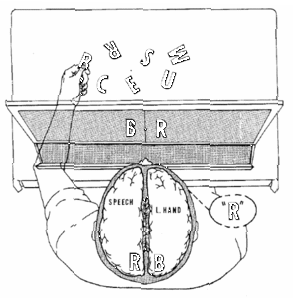 Following his surgery, Sperry's patient seemed completely normal -- almost. A series of tests were conducted where each "half" of the patient was isolated from the other. Different visual and tactile information could then be presented to the patient's left or right side, without the other side knowing. The results were astounding.
With their communications link severed, each side of the patient's brain was functioning independently. Although this did not prevent his ability to walk, talk and eat, some unexpected findings were encountered in some of the higher brain functions when each side was examined independently of the other.
The right hand and eye could name an object, such as a pencil, but the patient could not explain what it was used for. When shown to the left hand and eye, the patient could explain and demonstrate its use, but could not name it. Further studies showed that various functions of thought are physically separated and localized to a specific area on either the left or right side of the human brain. This functional map is consistent for an estimated 70 to 95 percent of us.
"The main theme to emerge... is that there appear to be two modes of thinking, verbal and nonverbal, represented rather separately in left and right hemispheres respectively and that our education system, as well as science in general, tends to neglect the nonverbal form of intellect. What it comes down to is that modern society discriminates against the right hemisphere." --Roger Sperry (1973)
| LEFT BRAIN FUNCTIONS uses logic detail oriented facts rule words and language present and past math and science can comprehend knowing acknowledges order/pattern perception knows object name reality based forms strategies practical safe | RIGHT BRAIN FUNCTIONS uses feeling "big picture" oriented imagination rules symbols and images present and future philosophy & religion can "get it" (i.e. meaning) believes appreciates spatial perception knows object function fantasy based presents possibilities impetuous risk taking |
Our personality can be thought of as dependent on the degree to which the left and right brains interact, or, in some cases, do not interact. It is a simplification to identify "left brain" types who are very analytical and orderly. We likewise certainly know of the artistic, unpredictability and creativity of "right brain" types. But each of us draws upon specific sides of our brain for a variety of daily functions, depending on such things as our age, education and life experiences. The choices of which brain is in control of which situations is what forges our personalities and determines our character.
An important aspect of who we are is the memory of our past experiences. This provides continuity to our concept of self. These memories are stored on one or the other hemisphere -- not both -- depending on the context and importance to the particular hemisphere [1]. Retrieving memories relies upon the willingness of each hemisphere to cooperate and share information. We have no control over the quarrels and stubbornness of the hemispheres. We are only aware of the results from their somehow "working it out."
When one hemisphere learns, has certain experiences, and stores information in memory, this information is not always available to the opposing hemisphere; one hemisphere cannot always gain access to memories stored in the other half of the brain [2].
To gain access to these lateralized memories, one hemisphere has to activate the memory banks of the other brain half via the corpus callosum [3]. This has been demonstrated experimentally in primates. After one hemisphere had been trained to perform a certain task, both hemispheres could respond correctly once it was learned. But when the corpus collosum was subsequently cut in the experiment, only the hemisphere that originally was trained was able to perform. The untrained hemisphere acted as though it never had been exposed to the task; its ability to retrieve the original memories in the opposite hemisphere was now abolished. [4]
If memories can be inhibited prior to consciousness then they are not a reliable indicator of identity. This drama between the brain's hemispheres should not concern our quest for the source of consciousness. It happens and we are aware of it. The drama creates our personality, or more precisely our personna. But consciousness is deeper. It is the awareness of ourselves as an aware person.
Consciousness is NOT Personality
According to Gerald M. Edelman, "Consciousness is neither a thing nor a simple property." Edelman has asserted that a fundamental property of consciousness is that it cannot be broken down into independent components. That is to say, consciousness is integrated within the brain, and involves many widely separated areas. In this model, consciousness is not a location but a process. Personality is the acquired pattern of response to the environment by agreement between both hemispheres and requires no conscious involvement.
While we have learned much about the specific regions of the brain and their functions, we have not discovered the location of the "command center" where the "I" and "Me" resides. It is apparent that most of what happens in our mind is automatic, or reactive in that it can function with little or no consciousness. What we know of as "consciousness" is looking like a passive observer of elaborate and efficient mind systems.
Consciousness is NOT Free Will
We like to think that we use our unique human consciousness to exercise our free-will. We are the masters of our destiny and so control our life from the "Captain's chair" of our consciousness. Not so.
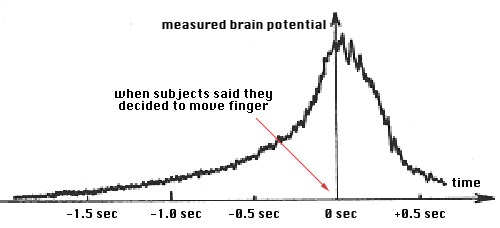
Consider an experiment conducted in 1976. Dr. Kornhuber asked a number of volunteers to be wired with EEG electrodes to measure their brain activity. He then asked the volunteers to flex the index finger of their right hand, suddenly and at various times of their own choosing. He wanted to measure how fast it took for the mental decision to move the finger to actually make the finger move. His results were not what he expected.
Kornhuber expected to find a sharp peak in electrical activity when the decision was consciously made, at which point he would begin timing the trials. However, what he found is remarkable, namely that there is a gradual build-up of recorded electric potential for a full second, or perhaps even up to a second and a half, before the finger is actually flexed. This seems to indicate that the conscious decision process takes over a second in order to act! Even more surprising was that the volunteers were not aware of this delay and believed they were acting spontaneously and instantly.
The experiment received little attention until another experiment conducted by Dr. Libet in 1979 raised questions about our conscious perception of time and the idea of "now."
Everything "now" happened already!
Dr. Libet tested subjects who had to have brain surgery for some reason unconnected with the experiment and who consented to having electrodes placed at points in the brain, in the somatosensory cortex. He monitored the electrical activity while stimulating their skin. To his amazement it took about a half-second before the subjects were able to perceive the stimulation. Further experiments showed that this same delay -- about a half second -- was needed for all sensory input to reach consciousness.
The significance of this is enormous. Everything we know about the external world right now -- the sounds, the sights, the feelings -- are all being delayed. Everything that you think is happening right now actually happened already, about half a second ago!
Consciousness is NOT Perception
Everything about the external world that comes from our senses is filtered. This includes the information about ourselves that feeds back to us from others. But how reliable and accurate is that information?
A novel temporal illusion, in which the cause of an event is perceived to occur after the event itself, provides some insight into the brain mechanisms underlying conscious perception. The illusion, described in the journal Current Biology, suggests that the unconscious representation of a visual object is processed for around one tenth of a second before it enters conscious awareness.
Chien-Te Wu and his colleagues at the Brain and Cognition Research Centre in Toulouse used a visual phenomenon called motion-induced blindness, in which a constantly rotating background causes prominent and motionless visual stimuli to disappear and reappear, as demonstrated in the video [below].
Fixate on the flashing green spot in the centre, and you'll notice that the surrounding yellow spots begin to disappear and reappear after about ten seconds. Then replay the clip and focus on any of the yellow spots. Hmmmm. Perception is fallible. [10]
Consciousness is NOT Thinking
Cogno Ergo Sum -- I think therefore I am.
This strange phenomenon was illustrated in a famous experiment conducted by H. J. Watt [5] in which he showed nouns, printed on a card, to his subjects. They were instructed to give an associated word as soon as possible. It was like a typical word association test but it had one additional step. Before they were shown the target noun, the subjects were told that the association would be of a specific type.
"Subjects were required to associate to the visual word a superordinate (e.g., oak-tree), coordinate (oak-elm), or subordinate (oak-beam); or a whole (oak forest), a part (oak-acorn), or another part of a common whole (oak-path). [6]
"The introspecting observers were asked to confine themselves first to one period and then to another, and thus get a more accurate account of consciousness in each." [ibid.]
Consciousness is NOT Self-Awareness
Self-recognition, once thought to be an ability enjoyed only by select primates, has now been demonstrated in a bird.
| Magpies have awareness of self? 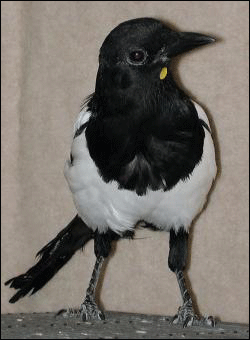 The results of experiments with common magpies suggests that they have developed a sense of identity and self-awareness. This comes as a shock to those who hold humanity at only species to achieve this height. Helmut Prior at Goethe University in Frankfurt and his colleagues applied a red, yellow or black spot to a place on the necks of five magpies. Then he gave the birds mirrors. The feel of the stickers on their necks didn't seem to bother the magpies. But when the birds with coloured neck spots caught a glimpse of themselves, they freaked out and scratched at their necks with claw and beak to remove the colored stickers. This was interpreted as a clear indication that the magpies recognised the image in the mirror as their own. As expected, those who received a black sticker, invisible against the black neck feathers, did not react. Franz de Waal at Emory University in Atlanta points out that the magpies have big brains. "You need a large brain with a lot of connectivity," he says. "If it had been a sparrow, it would have been a problem." But something magpies do not have is a neo-cortex -- the traditional location self-awareness in humans. It has been suggested that self-recognition in birds and mammals may be a case of convergent evolution, where similar evolutionary pressures result in similar behaviors or traits, such as self-awareness, although they arrive at them via different routes. De Waal agrees: "Magpies are known for their ability to steal shiny objects and to hide away their loot. It's not too far-fetched that a master thief like a magpie has that perspective-taking ability," he says, referring to the idea that the birds have a "theory of mind".[11] [7] Not to be outdone, domestic crows appear to have the same remarkable abilities also. In the video below you will see how their ability to recognize faces and share this information with other crows interested the CIA in using them to track down Osama bin Laden! |
Neurorobotics reveals brain mechanisms of self-consciousness
A study, published by Cell Press in the April 2011 issue of the journal Neuron, identifies a brain region called the temporo-parietal junction (TPJ) as being critical for the feeling of being an entity localized at a particular position in space and for perceiving the world from this position and perspective -- in other words "self consciousness."
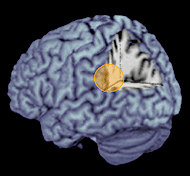 Recent theories of self-consciousness highlight the importance of integrating many different sensory and motor signals from many widely spaced brain regions. But it's not clear how this type of integration focuses to create a subjective state such as self-location ("Where am I in space?") and the first-person perspective ("From where am I perceiving the world?").
 Studies of neurological patients reporting out-of-body experiences have provided some evidence. These patients have witnessed a conscious perspective that was outside of their body. It has been shown that brain damage which disrupts the integration of these multisensory signals may lead to pathological changes of the first-person ("I") perspective and self-location.
Dr. Blanke and colleagues studied healthy subjects and employed specific experimentally sound bodily conflicts that induced changes in self-location and first-person perspective. At the same time they were monitoring brain activity with functional magnetic resonance imaging. They observed that TPJ activity reflected experimental changes in self-location and first-person ("I am") perspective. The researchers also completed a large study of neurological patients with out-of-body experiences and found that brain damage was localized to the TPJ.
"Our findings on experimentally and pathologically induced altered states of self-consciousness present a powerful new research technology and reveal that TPJ activity reflects one of the most fundamental subjective feelings of humans: the feeling that 'I' am an entity that is localized at a position in space and that 'I' perceive the world from here." [8]
What is meant by consciousness?
Most theories of consciousness fail to incorporate the two brains in their psychology. The exception is Julian Jaynes' Bicameral Mind Theory. Jaynes argues that consciousness -- which he describes as the awareness that we are aware -- is a relatively new acquisition for humans and is only about 5,000 years old. Prior to this humans had a bicameral mind which was incapable of introspection.
 According to Janyes, primitive humans first made use of both hemispheres with the evolution of language. Ideas and concepts could be represented by a "sound" (i.e. word) and this allowed the hemispheres to communicate in a most unusual way.
Jaynes theorizes that the two hemispheres in bicameral man acted more independently than in modern humans. Like today, the language centers were located in the dominant hemisphere (usually the left side, for right handed people) but the non-dominant hemisphere made itself known during times of danger or stress.
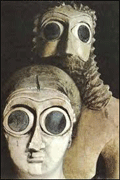
Because the non-dominant hemisphere thinks differently and has a different "take" on the world, it often can perceive things and make judgements which the dominant hemisphere can not. The bicameral mind was more segregated and the non-dominant hemisphere made its views known by sending auditory hallucinations in the form of verbal commands, advice or predictions. These were no different from auditory hallcunations that plague schizophrenics. In fact, Jaynes proposes that schizophrenia is a regression to the bicameral mind of our ancestors. Jaynes believes these bicameral auditory hallucinations were common and were the "voice of God" written about in ancient texts. These auditory hallucinations originating from the non-dominant hemisphere were attributed to the many elders, deceased, deities and statues. [right: Innana]
According to Jaynes, this bicameral mentality began malfunctioning or "breaking down" during the second millennium BC. As people began to live in cities they encountered strangers from different cultures who spoke different languages. Written rules and laws took over the socializing role of the "inner voice" and somehow the bicameral mind morphed into a unified brain where the benefits of both hemispheres could be utilized to understand the world. New concepts -- more abstract concepts -- were possible. This eventually evolved the abstract concept of self, the "I".
Consciousness is NOT the Inner-Voice
With the development of the concept of self or "I", it was possible for the first time to create a verbal narrative of events in the mind. The narrative was from the perspective of the self. The narrative greatly improved the retention of experience in memory.
Sometimes, like me, you probably talk to yourself. You verbalize the inner voice that chides you or recites logical arguments to solve a problem. This constant narration utilizes the same language centers as our normal speech. It's part of the stuff that runs automatically, observed by consciousness.
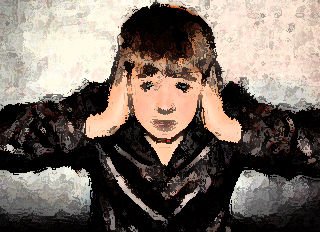 There's was an interesting case study in The Lancet, about a woman who began hearing voices with speech impairments following a bicycle accident. It shows how the voice is really part of the mind and not consciousness.
The 63-year-old woman was treated at the University Hospital of Psychiatry in Bern, Switzerland, after falling from her bicycle and hitting her head. Following the accident, she suffered a brain hemorrhage and lost consciousness.
Upon her arrival at the hospital, it was found that the woman had an aneurysm and was paralyzed on one side of her body. This was treated, and a craniotomy was performed. After which tests showed damage in the frontal and temporal lobes.
After 4 weeks in the hospital's intensive care unit, the woman's paralysis was significantly reduced, but she still had severe speech deficits from damage to her language centers -- she could communicate using single words or incomplete sentences, and could only understand short phrases.
In December 2006, the patient began suffering from auditory hallucinations. She started hearing her thoughts aloud, as well as echoes of earlier conversations, and also hallucinated the voices of hospital staff. These voices appeared several times a day, for a few minutes at a time.
Although the patient understood that the voices were caused by her head injury, she believed them to be real, and heard them coming from a space outside of her body. She reported that they sounded just like other voices, but that they said only very short and simple sentences -- the same speech impediment that she had.
"[Brain injury-induced] epilepsy seems to have caused auditory hallucinations...[which are] widely thought to derive from inner speech that has been misidentified as coming from outside the self, because of defective monitoring. Our patient's experiences are consistent with this hypothesis, since her hallucinations had speech deficits that...were the same as her own. [9]
 Where are you?
After reading all the experiments that have been done, I feel pretty safe in saying that consciousness, if not located in the brain, is surely dependent on it. Rather than looking for the point of absolute consciousness, I think there is enough evidence to consider that it may be a process involving the cooperation and coordination of many different regions of the brain.
"Self" is a concept used to designate the entity which witnesses our life. It is the thing that persists after you have taken away all that is under the control of the mind. Self-hood happens to us, delayed and filtered. In truth, the self is the watcher.
Off on a tangent...
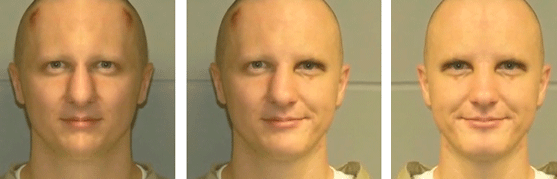
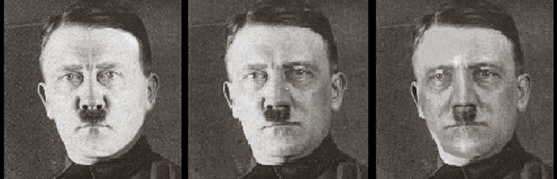
No discussion about hemisphere dominance would be complete without a look at some of the interesting things we can learn about a person by examining each side of their face. The theory is that each side of the face is "wired" to the opposite side of the brain. Since the two hemispheres have different views on the world, it seems logical that their facial expression might reveal something about their personality.
Since the left brain is the dominant side in most right-handed people, the right side of their faces should reveal their dominant characteristics. The left side of their faces will reveal what's going on with the non-dominant side. Here, have a look at some well known people.










Notes:
[1] Bures & Buresova 1960; Doty & Overman 1977; Hasegawa et al., 1998; Kurcharski et al. 1990; Levy, 1974; Risse & Gazzaniga, 1979
[3] Doty & Overman, 1977; Hasegawa et al., 1998
[4] Doty & Overman, 1977; Hasegawa et al., 1998
[5] H. J. Watt, "Experimentelle Beitrage zur einer Theorie des Denkens," Archive fur geschite der Psychologie, 1905, 4: 289-436
[6] Julian Jaynes, "The Origins of Consciousness In The Breakdown of The Bicameral Mind." (1976)
[7] Journal reference: PLoS Biology (DOI:10.1371/journal.pbio.0060202)
[8] http://www.eurekalert.org/pub_releases/2011-04/cp-nrb042511.php
[9] Hubl, D., et al. (2007). Hearing dysphasic voices. Lancet 370: 538.
[10] http://precedings.nature.com/documents/1506/version/1
[11] Theory of mind is the ability to attribute mental states -- beliefs, intents, desires, pretending, knowledge, etc. -- to oneself and others and to understand that others have beliefs, desires and intentions that are different from one's own.
From View Zone @ http://www.viewzone.com/real.html
For further enlightening information enter a word or phrase into the search box @ New Illuminati or click on any label/tag at the bottom of the page @ http://nexusilluminati.blogspot.com
And see
The Her(m)etic Hermit - http://hermetic.blog.com
New Illuminati – http://nexusilluminati.blogspot.com
New Illuminati on Facebook - http://www.facebook.com/pages/New-Illuminati/320674219559
This material is published under Creative Commons Copyright (unless an individual item is declared otherwise by copyright holder) – reproduction for non-profit use is permitted & encouraged, if you give attribution to the work & author - and please include a (preferably active) link to the original along with this notice. Feel free to make non-commercial hard (printed) or software copies or mirror sites - you never know how long something will stay glued to the web – but remember attribution! If you like what you see, please send a tiny donation or leave a comment – and thanks for reading this far…
From the New Illuminati – http://nexusilluminati.blogspot.com