Civilisation Is Sinking Into the Seas
Sea Level Rise Making Floods
Routine for Coastal Cities
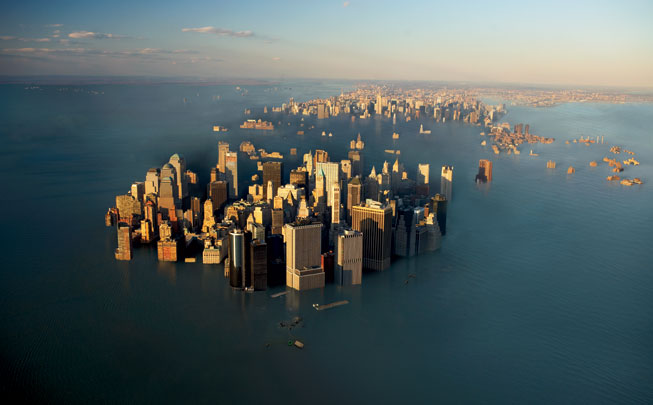

Coastal American cities are sinking into saturated new realities, new analysis has confirmed. Sea level rise has given a boost to high tides, which are regularly overtopping streets, floorboards and other low-lying areas that had long existed in relatively dehydrated harmony with nearby waterfronts. The trend is projected to worsen sharply in the coming years.
A new report, released by the Union of Concerned Scientists, forecasts that by 2030, at least 180 floods will strike during high tides every year in Annapolis, Md. In some cases, such flooding will occur twice in a single day, since tides come in and out about two times daily. By 2045, that’s also expected be the case in Washington, D.C., Atlantic City, N.J. and 14 other East Coast and Gulf Coast locations out of 52 analyzed by the Union of Concerned Scientists.

“The shock for us was that tidal flooding could become the new normal in the next 15 years; we didn’t think it would be so soon,” said Melanie Fitzpatrick, one of three researchers at the nonprofit who analyzed tide gauge data and sea level projections, producing soused prognoses for scores of coastal Americans. “If you live on a coast and haven’t seen coastal flooding yet, just give it a few years. You will.”
“We realized before we even got through the statistics of the last 40 years that tidal flooding is a much bigger story,” Fitzpatrick said. “But nobody’s really telling that story.”
The following interactive could help you assess the future flooding risks in your city.
An interactive analysis from Climate Central showing what
states and cities are most vulnerable to future sea level rise under different
greenhouse gas emission scenarios.
The researchers used intermediate-to-high sea level rise projections from the recent National Climate Assessment to guide their predictions for future coastal flooding rates. Those projections included a rise in sea levels of five inches between 2012 and 2030, and a rise of nearly a foot between 2012 and 2045. To help consider the effects of local conditions, such as the sinking lands of the mid-Atlantic coast, the group used data compiled by Climate Central’s team of scientists.
The 52 locations, from Portland, ME, to Freeport, Texas, were selected because the National Weather Service issues flood advisories based on local tide gauge recordings there. That allowed the researchers to confidently use the tide gauge data to calculate historical flooding rates, and compare those with projected future rates.
In the absence of flood-deflecting marshes, seawalls or levees, two-thirds of the 52 communities studied can expect a tripling in the frequency of high-tide flooding during the next 15 years, the researchers concluded. Half of the communities studied are expected to be flooded more than two dozen times every year by 2030.

Click the image to enlarge. Credit: Union of Concerned Scientists
The research was published as the double decker effects of rising seas and king tides spectacularly flood Floridian shorelines. Without the 8 inches of sea level rise recorded since pre-industrial times — one of the hallmarks of climate change — those king tides would not have the same flooding effects.
The projections were published four months after the National Oceanic and Atmospheric Administration (NOAA) released an analysis of the recent rise of tidal floods, which it calls nuisance floods. That analysis revealed that nuisance floods were occurring now in some places nearly ten times more often than had been the case in the 1960s.
“Impacts from sea level rise are real and now,” said NOAA oceanographer William Sweet, one of the authors of the agency’s June report. “They’re best viewed in terms of an increase of nuisance flood frequencies. These frequencies have risen dramatically over the last several decades, especially along the East Coast and parts of the Gulf Coast.”
Sweet advised the Union of Concerned Scientists team on how to use NOAA’s tide gauge data. He is working with NOAA colleagues to publish their own projections for the future rise in nuisance flood rates. He said the agency’s findings, which he expects to be published in a peer-reviewed journal by the end of this year, would be “similar” to the those published this week by the Union of Concerned Scientists.
Sweet said NOAA is producing the forecasts to provide communities with “environmental intelligence” to help them plan for the fast-growing hazards associated with sea level rise.
The new report provides examples of some of ways in which hard-hit communities are already adapting to rising seas, such as work to raise roads in New York City’s Jamaica Bay. In Annapolis, along the vulnerable Chesapeake Bay coastline, a partnership between the Navy and local authorities has produced what Fitzpatrick called “the most forward thinking” approach to adapting to rising seas, partly because the floods are being viewed as a national security threat.
"Communities need to be talking to each other," Fitzpatrick said. "There's enough happening up and down the coast that communities can learn from places, like Miami and Atlantic City, that are dealing with flooding on a regular basis."
‘Nobody Is Truly Ready’ For Rise of Seas
So might scream tabloid headlines had news of projections for rising seas, which were contained in a bumper climate report by the United Nations, been, well, new. They weren’t. They were a synthesis of previously published research on a decades-old topic. So the latest ringing of multi-decade flood warnings was engulfed in a wash of more general global warming coverage.
But the sea level figures in the report, while not new to experts (and, by many expert accounts, dangerously lowballed), were nonetheless remarkable — and worthy of urgent reflection.

A king tide floods a street in Annapolis, Maryland, in 2012.
Credit: Forsaken Fotos/flickr
Credit: Forsaken Fotos/flickr
The report warns that coastal property and infrastructure could be a foot lower in just a few decades than is the case today, portending an unprecedented crisis for which the nation appears to be frightfully ill-prepared. U.S. coastal cities, established in centuries past when seas were 8 inches lower than they are today, are now flooding regularly during high tides. Despite decades of research and warnings, little has been done to defend against the slow-motion marine invasion of landlubbers’ territory.
“The statistics make clear that people keep moving to the coast, indeed, that people keep moving to Miami, even as the flooding there becomes more regular,” Bill McKibben, a prominent writer who has dedicated himself to raising the profile of climate change, told Climate Central. “I think people imagine that this problem will happen slowly, but it's already well underway.”
Preparedness is improving, albeit at a pace that would seem to rival the gradual rise of the oceans.
A hodgepodge of local, state and national initiatives, while so far woefully insufficient to protect infrastructure and neighborhoods from swelling flood risks, are starting to attempt to adapt to meet the challenges they present. Strategies include efforts to restore marshlands to buffer floods, to raise seawalls to keep pace with sea level, and to retreat from coastlines.
The last time the IPCC published a climate assessment, in 2007, climate adaptation was little more than an abstract idea. Today, it’s an emerging reality, oftentimes framed as “resilience.” Resilience is a concept that describes the boosting of defenses against storms surges, heat waves and other weather disasters, be they amped by greenhouse gases or entirely natural.
“I would say that nobody is truly ready for projected levels of future rise,” said Laura Tam, a climate adaptation expert at the San Francisco-based urban planning think tank SPUR. “But cities are light-years more aware of the threats and challenges of sea level rise than they were just five years ago. You’re seeing many of the densely populated, coastal urban areas taking on major community-wide planning efforts to understand vulnerability and address risks.”

A photorealistic view of the classic Venice Beach Boardwalk under 12
feet of sea level rise.
Credit: Nickolay Lamm. Data: Climate Central
Credit: Nickolay Lamm. Data: Climate Central
Even if the world virtually stopped burning fossil fuels, and rapidly switched over to non-polluting forms of energy, the Intergovernmental Panel on Climate Change’s (IPCC) new synthesis assessment of climate science warns that, between 2046 and 2065, seas would “likely” be between 6 and 13 inches higher than they were between 1986 and 2005.
And that’s the best-case scenario envisioned in the report. Under the heaviest of four pollution scenarios evaluated, the likely heights of the seas during the same two-decade period would be between 8 inches and 15 inches higher than they were a couple of decades ago. Projections for century's end are higher still.
That could more than double the amount of sea level rise since the 1800s, which will lead to what the Union of Concerned Scientists has described as “incessant” flooding in scores of coastal U.S. cities in the coming decades — unless protective measures are put in place.
Not only were the IPCC projections not new, they were so old as to be unreliable. A “flurry of new literature” published after the report’s 2013 cutoff dates suggests they’re conservative projections, said Kelly Levin, a researcher at the World Resources Institute. She recently profiled nine landmark climate studies that were published too recently to be included on Sunday in the IPCC’s synthesis report, including some that related to rising sea levels.
“A lot of the new research that we’ve seen since the cutoff has suggested that both the Greenland and West Antarctic ice sheets are far more vulnerable to some of the dynamics that could lead to higher levels of sea level rise,” Levin said.
Even without the inclusion of those new findings into the IPCC’s projections, however, Levin points out that the international panel’s projections are frightfully high — “pretty stark,” she called them. A gulf-like disconnect between the projections of sea level rise, and levels of preparedness for those projections, is evident, no matter which numbers you’re looking at.
 In a historic acknowledgement of the increasing hazards associated with
rising seas, San Francisco recently adopted new guidelines to help
assess flooding risks when planning infrastructure spending.
In a historic acknowledgement of the increasing hazards associated with
rising seas, San Francisco recently adopted new guidelines to help
assess flooding risks when planning infrastructure spending.Credit: Sudheendra Vijayakumar/flickr
Recently, though, that gulf has been starting to ever so slowly narrow, more so in some states and regions than in others. “It really is sort of a mixed bag,” said Robert Kopp, an associate professor at Rutgers Climate Institute, pointing out that while New York state has a climate adaptation plan, New Jersey, which shares a border and many of the Empire State’s flooding risks, does not. In the five years or so since Kopp, who is a climate scientist, became heavily involved in climate policy, he says sea level rise adaptation efforts “have moved forward more than they’ve moved backwards.”
In a historic acknowledgement of the increasing hazards associated with rising seas, San Francisco recently adopted new guidelines to help assess flooding risks when planning infrastructure spending. California will detail that and other local adaptation programs in an online database that will help coastal planners learn from each other’s efforts.
On the opposite coast, Rebuild by Design, borne from the damage inflicted by Hurricane Sandy, is spending $1 billion of federal funds to foster new ideas for rebuilding near affected coastlines. New York City developed a $19.5 billion climate resiliency plan after Sandy struck. New Jersey is buying up flood-prone properties in some areas and converting them to public open space — even though some state officials there are often barred from publicly discussing climate change or sea level rise.
Further south, frustrated by the government of Florida’s apathy toward climate change’s impacts, South Miami is trying to lead a campaign to carve out a 51st state — one in which sea-level rise is regarded with a sense of urgency.
Federally, the Obama Administration recently published a raft of agency-specific climate adaptation plans, including by NASA, which built launch facilities and other buildings close to vulnerable coastlines.
Experts credit Hurricane Sandy with much of the change in American attitudes toward addressing sea level rise risks. Sandy’s storm surge was more far-reaching and damaging than it would have been had climate change not already led to 8 inches of sea level rise.
Sandy’s wrath followed the devastation wreaked by hurricanes' Katrina and Andrew, and SPUR’s Tam says the high frequency of such storm-whipped disasters on coastal cities, where populations continue to swell, are changing the climate change conversation nationally. “We have so many more people living in cities now, you’re multiplying the impacts,” she said.
 A home is torn down in
Sayreville, N.J. as part of a property
buyout program aiding inland neighborhoods affected by Sandy.
A home is torn down in
Sayreville, N.J. as part of a property
buyout program aiding inland neighborhoods affected by Sandy.Credit: Rosanna Arias/FEMA
So far, coastal planning efforts to better cope with rising seas remain just that — planning efforts. Construction of new coastal defenses and implementation of managed retreats from vulnerable shorelines will, for the most part, come later. “There’s a lot of planning that’s going on,” Tam said. “You’ve got to do the planning first.”
The communities that are planning ahead for sea level rise, however, are often relying on low or short-term projections, said Jessica Grannis, the adaptation program manager at Georgetown Climate Center. The center maintains a database of state climate adaptation efforts on its website. “Politically, I think a lot of people are purposefully not using the high-range scenarios, because they’re so catastrophic,” Grannis said.
Despite their high profile, Grannis cautions against relying on the IPCC’s projections, which she described as “pretty low” compared with some other forecasts. “A lot of folks rely on the IPCC, but they tend to take this very conservative consensus-based approach, and they don’t include some of the more up-to-date science,” she said.
With sea level rise planning so new in America, even just starting to brace for understated projections would seem to be an important, if inadequate, step up from when the IPCC’s last assessment was published.
From Climate Central @ http://www.climatecentral.org/news/coastal-flooding-us-cities-18148 and http://www.climatecentral.org/news/ipcc-sea-level-rise-2-18305
For more information about global heating see http://nexusilluminati.blogspot.com/search/label/global%20warming
- Scroll down through ‘Older Posts’ at the end of each section
Hope you like this
not for profit site -
It takes hours of work every day by
a genuinely incapacitated invalid to maintain, write, edit, research,
illustrate and publish this website from a tiny cabin in a remote forest
Like what we do? Please give anything
you can -
Contribute any amount and receive at
least one New Illuminati eBook!
(You can use a card
securely if you don’t use Paypal)
Please click below -
Xtra image - http://toryardvaark.files.wordpress.com/2010/11/flooded-new-york.jpg
Spare Bitcoin
change?
For further enlightening
information enter a word or phrase into the random synchronistic search box @
the top left of http://nexusilluminati.blogspot.com
And see
New Illuminati – http://nexusilluminati.blogspot.com
New Illuminati on Facebook - https://www.facebook.com/the.new.illuminati
New Illuminati Youtube Channel - http://www.youtube.com/user/newilluminati/feed
New Illuminati on Google+ @ https://plus.google.com/115562482213600937809/posts
New Illuminati on Twitter @ www.twitter.com/new_illuminati
New Illuminations –Art(icles) by
R. Ayana @ http://newilluminations.blogspot.com
The Her(m)etic Hermit - http://hermetic.blog.com
DISGRUNTLED SITE ADMINS PLEASE NOTE –
We provide a live link to your original material on your site (and
links via social networking services) - which raises your ranking on search
engines and helps spread your info further! This site is
published under Creative Commons Fair Use Copyright (unless an individual
article or other item is declared otherwise by the copyright holder). Reproduction
for non-profit use is permitted & encouraged, - if you give attribution to the work &
author. Please include a (preferably active) link to the original (along with
this or a similar notice).
Feel free to make non-commercial hard (printed) or software copies or
mirror sites - you never know how long something will stay glued to the web –
but remember attribution!
If you like what you see, please send a donation (no amount is too
small or too large) or leave a comment – and thanks for reading this far…
Live long and prosper! Together we can create the best of all possible
worlds…
From the New Illuminati – http://nexusilluminati.blogspot.com