"All the World's a Stage We Pass Through" R. Ayana

Showing posts with label flooded world. Show all posts

Wednesday, 31 December 2014

Civilisation Is Sinking Into the Seas


Civilisation Is Sinking Into the Seas
Sea Level Rise Making Floods Routine for Coastal Cities
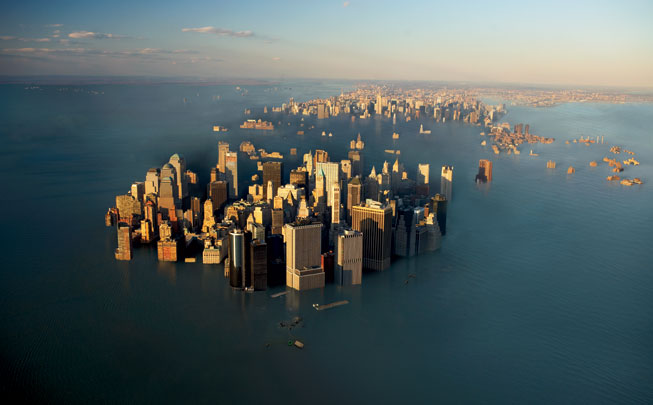
 http://toryardvaark.files.wordpress.com/2010/11/flooded-new-york.jpg


Coastal American cities are sinking into saturated new realities, new analysis has confirmed. Sea level rise has given a boost to high tides, which are regularly overtopping streets, floorboards and other low-lying areas that had long existed in relatively dehydrated harmony with nearby waterfronts. The trend is projected to worsen sharply in the coming years.

A new report, released by the Union of Concerned Scientists, forecasts that by 2030, at least 180 floods will strike during high tides every year in Annapolis, Md. In some cases, such flooding will occur twice in a single day, since tides come in and out about two times daily. By 2045, that’s also expected be the case in Washington, D.C., Atlantic City, N.J. and 14 other East Coast and Gulf Coast locations out of 52 analyzed by the Union of Concerned Scientists.

 
Tidal flooding in Annapolis in 2012.
Credit: Amy McGovern/flickr


“The shock for us was that tidal flooding could become the new normal in the next 15 years; we didn’t think it would be so soon,” said Melanie Fitzpatrick, one of three researchers at the nonprofit who analyzed tide gauge data and sea level projections, producing soused prognoses for scores of coastal Americans. “If you live on a coast and haven’t seen coastal flooding yet, just give it a few years. You will.”


The group originally set out to study increased risks of storm surges and hurricanes as seas rose, but quickly changed tack.

“We realized before we even got through the statistics of the last 40 years that tidal flooding is a much bigger story,” Fitzpatrick said. “But nobody’s really telling that story.”

The following interactive could help you assess the future flooding risks in your city.


An interactive analysis from Climate Central showing what states and cities are most vulnerable to future sea level rise under different greenhouse gas emission scenarios.


The researchers used intermediate-to-high sea level rise projections from the recent National Climate Assessment to guide their predictions for future coastal flooding rates. Those projections included a rise in sea levels of five inches between 2012 and 2030, and a rise of nearly a foot between 2012 and 2045. To help consider the effects of local conditions, such as the sinking lands of the mid-Atlantic coast, the group used data compiled by Climate Central’s team of scientists.

The 52 locations, from Portland, ME, to Freeport, Texas, were selected because the National Weather Service issues flood advisories based on local tide gauge recordings there. That allowed the researchers to confidently use the tide gauge data to calculate historical flooding rates, and compare those with projected future rates.

In the absence of flood-deflecting marshes, seawalls or levees, two-thirds of the 52 communities studied can expect a tripling in the frequency of high-tide flooding during the next 15 years, the researchers concluded. Half of the communities studied are expected to be flooded more than two dozen times every year by 2030.

Click the image to enlarge. Credit: Union of Concerned Scientists


The research was published as the double decker effects of rising seas and king tides spectacularly flood Floridian shorelines. Without the 8 inches of sea level rise recorded since pre-industrial times — one of the hallmarks of climate change — those king tides would not have the same flooding effects.

The projections were published four months after the National Oceanic and Atmospheric Administration (NOAA) released an analysis of the recent rise of tidal floods, which it calls nuisance floods. That analysis revealed that nuisance floods were occurring now in some places nearly ten times more often than had been the case in the 1960s.

“Impacts from sea level rise are real and now,” said NOAA oceanographer William Sweet, one of the authors of the agency’s June report. “They’re best viewed in terms of an increase of nuisance flood frequencies. These frequencies have risen dramatically over the last several decades, especially along the East Coast and parts of the Gulf Coast.”

Sweet advised the Union of Concerned Scientists team on how to use NOAA’s tide gauge data. He is working with NOAA colleagues to publish their own projections for the future rise in nuisance flood rates. He said the agency’s findings, which he expects to be published in a peer-reviewed journal by the end of this year, would be “similar” to the those published this week by the Union of Concerned Scientists.

Sweet said NOAA is producing the forecasts to provide communities with “environmental intelligence” to help them plan for the fast-growing hazards associated with sea level rise.

The new report provides examples of some of ways in which hard-hit communities are already adapting to rising seas, such as work to raise roads in New York City’s Jamaica Bay. In Annapolis, along the vulnerable Chesapeake Bay coastline, a partnership between the Navy and local authorities has produced what Fitzpatrick called “the most forward thinking” approach to adapting to rising seas, partly because the floods are being viewed as a national security threat.

"Communities need to be talking to each other," Fitzpatrick said. "There's enough happening up and down the coast that communities can learn from places, like Miami and Atlantic City, that are dealing with flooding on a regular basis."


‘Nobody Is Truly Ready’ For Rise of Seas


Abandon Seaside! Globe is Flooding! Invest in Arks!

So might scream tabloid headlines had news of projections for rising seas, which were contained in a bumper climate report by the United Nations, been, well, new. They weren’t. They were a synthesis of previously published research on a decades-old topic. So the latest ringing of multi-decade flood warnings was engulfed in a wash of more general global warming coverage.

But the sea level figures in the report, while not new to experts (and, by many expert accounts, dangerously lowballed), were nonetheless remarkable — and worthy of urgent reflection.

 
A king tide floods a street in Annapolis, Maryland, in 2012.
Credit: Forsaken Fotos/flickr


The report warns that coastal property and infrastructure could be a foot lower in just a few decades than is the case today, portending an unprecedented crisis for which the nation appears to be frightfully ill-prepared. U.S. coastal cities, established in centuries past when seas were 8 inches lower than they are today, are now flooding regularly during high tides. Despite decades of research and warnings, little has been done to defend against the slow-motion marine invasion of landlubbers’ territory.

“The statistics make clear that people keep moving to the coast, indeed, that people keep moving to Miami, even as the flooding there becomes more regular,” Bill McKibben, a prominent writer who has dedicated himself to raising the profile of climate change, told Climate Central. “I think people imagine that this problem will happen slowly, but it's already well underway.”

Preparedness is improving, albeit at a pace that would seem to rival the gradual rise of the oceans.

A hodgepodge of local, state and national initiatives, while so far woefully insufficient to protect infrastructure and neighborhoods from swelling flood risks, are starting to attempt to adapt to meet the challenges they present. Strategies include efforts to restore marshlands to buffer floods, to raise seawalls to keep pace with sea level, and to retreat from coastlines.

The last time the IPCC published a climate assessment, in 2007, climate adaptation was little more than an abstract idea. Today, it’s an emerging reality, oftentimes framed as “resilience.” Resilience is a concept that describes the boosting of defenses against storms surges, heat waves and other weather disasters, be they amped by greenhouse gases or entirely natural.

“I would say that nobody is truly ready for projected levels of future rise,” said Laura Tam, a climate adaptation expert at the San Francisco-based urban planning think tank SPUR. “But cities are light-years more aware of the threats and challenges of sea level rise than they were just five years ago. You’re seeing many of the densely populated, coastal urban areas taking on major community-wide planning efforts to understand vulnerability and address risks.”

 
A photorealistic view of the classic Venice Beach Boardwalk under 12 feet of sea level rise.
Credit: Nickolay Lamm. Data: Climate Central


Even if the world virtually stopped burning fossil fuels, and rapidly switched over to non-polluting forms of energy, the Intergovernmental Panel on Climate Change’s (IPCC) new synthesis assessment of climate science warns that, between 2046 and 2065, seas would “likely” be between 6 and 13 inches higher than they were between 1986 and 2005.

And that’s the best-case scenario envisioned in the report. Under the heaviest of four pollution scenarios evaluated, the likely heights of the seas during the same two-decade period would be between 8 inches and 15 inches higher than they were a couple of decades ago. Projections for century's end are higher still.

That could more than double the amount of sea level rise since the 1800s, which will lead to what the Union of Concerned Scientists has described as “incessant” flooding in scores of coastal U.S. cities in the coming decades — unless protective measures are put in place.

Not only were the IPCC projections not new, they were so old as to be unreliable. A “flurry of new literature” published after the report’s 2013 cutoff dates suggests they’re conservative projections, said Kelly Levin, a researcher at the World Resources Institute. She recently profiled nine landmark climate studies that were published too recently to be included on Sunday in the IPCC’s synthesis report, including some that related to rising sea levels.

“A lot of the new research that we’ve seen since the cutoff has suggested that both the Greenland and West Antarctic ice sheets are far more vulnerable to some of the dynamics that could lead to higher levels of sea level rise,” Levin said.

Even without the inclusion of those new findings into the IPCC’s projections, however, Levin points out that the international panel’s projections are frightfully high — “pretty stark,” she called them. A gulf-like disconnect between the projections of sea level rise, and levels of preparedness for those projections, is evident, no matter which numbers you’re looking at.

In a historic acknowledgement of the increasing hazards associated with rising seas, San Francisco recently adopted new guidelines to help assess flooding risks when planning infrastructure spending.
Credit: Sudheendra Vijayakumar/flickr


Recently, though, that gulf has been starting to ever so slowly narrow, more so in some states and regions than in others. “It really is sort of a mixed bag,” said Robert Kopp, an associate professor at Rutgers Climate Institute, pointing out that while New York state has a climate adaptation plan, New Jersey, which shares a border and many of the Empire State’s flooding risks, does not. In the five years or so since Kopp, who is a climate scientist, became heavily involved in climate policy, he says sea level rise adaptation efforts “have moved forward more than they’ve moved backwards.”

In a historic acknowledgement of the increasing hazards associated with rising seas, San Francisco recently adopted new guidelines to help assess flooding risks when planning infrastructure spending. California will detail that and other local adaptation programs in an online database that will help coastal planners learn from each other’s efforts.

On the opposite coast, Rebuild by Design, borne from the damage inflicted by Hurricane Sandy, is spending $1 billion of federal funds to foster new ideas for rebuilding near affected coastlines. New York City developed a $19.5 billion climate resiliency plan after Sandy struck. New Jersey is buying up flood-prone properties in some areas and converting them to public open space — even though some state officials there are often barred from publicly discussing climate change or sea level rise.

Further south, frustrated by the government of Florida’s apathy toward climate change’s impacts, South Miami is trying to lead a campaign to carve out a 51st state — one in which sea-level rise is regarded with a sense of urgency.

Federally, the Obama Administration recently published a raft of agency-specific climate adaptation plans, including by NASA, which built launch facilities and other buildings close to vulnerable coastlines.

Experts credit Hurricane Sandy with much of the change in American attitudes toward addressing sea level rise risks. Sandy’s storm surge was more far-reaching and damaging than it would have been had climate change not already led to 8 inches of sea level rise.

Sandy’s wrath followed the devastation wreaked by hurricanes' Katrina and Andrew, and SPUR’s Tam says the high frequency of such storm-whipped disasters on coastal cities, where populations continue to swell, are changing the climate change conversation nationally. “We have so many more people living in cities now, you’re multiplying the impacts,” she said.

A home is torn down in Sayreville, N.J. as part of a property buyout program aiding inland neighborhoods affected by Sandy.
Credit: Rosanna Arias/FEMA


So far, coastal planning efforts to better cope with rising seas remain just that — planning efforts. Construction of new coastal defenses and implementation of managed retreats from vulnerable shorelines will, for the most part, come later. “There’s a lot of planning that’s going on,” Tam said. “You’ve got to do the planning first.”

The communities that are planning ahead for sea level rise, however, are often relying on low or short-term projections, said Jessica Grannis, the adaptation program manager at Georgetown Climate Center. The center maintains a database of state climate adaptation efforts on its website. “Politically, I think a lot of people are purposefully not using the high-range scenarios, because they’re so catastrophic,” Grannis said.

Despite their high profile, Grannis cautions against relying on the IPCC’s projections, which she described as “pretty low” compared with some other forecasts. “A lot of folks rely on the IPCC, but they tend to take this very conservative consensus-based approach, and they don’t include some of the more up-to-date science,” she said.

With sea level rise planning so new in America, even just starting to brace for understated projections would seem to be an important, if inadequate, step up from when the IPCC’s last assessment was published.


From Climate Central @ http://www.climatecentral.org/news/coastal-flooding-us-cities-18148 and http://www.climatecentral.org/news/ipcc-sea-level-rise-2-18305


For more information about global heating see http://nexusilluminati.blogspot.com/search/label/global%20warming
- Scroll down through ‘Older Posts’ at the end of each section


Hope you like this not for profit site -
It takes hours of work every day by a genuinely incapacitated invalid to maintain, write, edit, research, illustrate and publish this website from a tiny cabin in a remote forest
Like what we do? Please give anything you can -  
Contribute any amount and receive at least one New Illuminati eBook!
(You can use a card securely if you don’t use Paypal)
Please click below - 


 Xtra image - http://toryardvaark.files.wordpress.com/2010/11/flooded-new-york.jpg

Spare Bitcoin change?


For further enlightening information enter a word or phrase into the random synchronistic search box @ the top left of http://nexusilluminati.blogspot.com


And see


 New Illuminati on Facebook - https://www.facebook.com/the.new.illuminati

New Illuminati Youtube Channel - http://www.youtube.com/user/newilluminati/feed


New Illuminati on Twitter @ www.twitter.com/new_illuminati


New Illuminations –Art(icles) by R. Ayana @ http://newilluminations.blogspot.com

The Her(m)etic Hermit - http://hermetic.blog.com


DISGRUNTLED SITE ADMINS PLEASE NOTE –
We provide a live link to your original material on your site (and links via social networking services) - which raises your ranking on search engines and helps spread your info further! This site is published under Creative Commons Fair Use Copyright (unless an individual article or other item is declared otherwise by the copyright holder). Reproduction for non-profit use is permitted & encouraged,  - if you give attribution to the work & author. Please include a (preferably active) link to the original (along with this or a similar notice).

Feel free to make non-commercial hard (printed) or software copies or mirror sites - you never know how long something will stay glued to the web – but remember attribution!

If you like what you see, please send a donation (no amount is too small or too large) or leave a comment – and thanks for reading this far…

Live long and prosper! Together we can create the best of all possible worlds…


From the New Illuminati – http://nexusilluminati.blogspot.com

Thursday, 3 July 2014

The World in Upheaval, 3000 B.C.E.: Velikovsky Vindicated


The World in Upheaval, 3000 B.C.E.
Velikovsky Vindicated

 https://c2.staticflickr.com/4/3323/3514542177_e7ded43b3f_z.jpg


by Leonard Farra


Extraordinary things were happening on our planet 5,000 years ago. There was a major climate change, and flooding, and this was followed by the rise of advanced civilisations. However, there is another fascinating side to this story and it’s been a major influence on many aspects of human life ever since.


Climate change and flooding


The Quelccaya Ice Cap, in the high Andes Mountains in Peru, is the largest glaciated region in the tropics and Lonnie Thompson, Professor of geological sciences at Ohio State, who conducted scientific research there, made the discovery that something had abruptly happened, around 5,200 years ago, and that it influenced climate over a large area. Research at other Ice Caps, around the world, have produced similar results.

El Nino is a cyclical meteorological event in which a rise in the Pacific surface temperature has drastic effects on world weather and scientists have discovered that there was a major El Nino around 5,000 years ago.  River Deltas began to form in different parts of the world. The present level of the Nile valley, for example, is thought to date to that time. (1)  

The North African eco system collapsed and the Meidob volcano in Sudan erupted. According to researcher/ scholar Thor Heyerdahl,  ‘ a geological catastrophe took place in the Atlantic’ ‘ great enough to split Iceland’ (2) and  in a worldwide review of raised beaches, submerged forests, and other evidence, indicates that ‘a date close to 3100  b.c.e is favoured by the sea level evidence.’ (3)


The British Isles


Five thousand years ago there was substantial flooding around the coasts of Britain and tree rings indicate that in Ireland and England there were massive amounts of ash in the atmosphere. Ice core recovered from Greenland’s Camp Century also indicates a ‘ large increase in falling ash worldwide in 3100 b.c.e.’ (4)  

There was also a change in religious beliefs and a bearded male sky-god became the focus of attention. The first phase of Stonehenge was commenced and over a thousand stone circles, probably used for religious and social purposes, began to appear in the British Isles and in lesser numbers in other countries. Important changes occurred in the Orkneys, north of Scotland, where, at Skara Brae, a new type of village community living began near a sacred area comprising two large stone circles, the enormous ‘flying-saucer’ shaped mound of Maes Howe and the amazing Ness of Brodger complex. Huge stone mounds also appeared along Europe’s Atlantic coast. Some archaeologists describe them as burial enclosures but could it be that Irish Celtic legend was nearer to the truth when it described Ireland’s famous New Grange mound as the ‘home of  Old World gods.’ ( 5)


The Middle East, Egypt, and Crete


Around 5,000 years ago, some of the Middle Eastern peoples were on the move such as the sea-faring Phoenician master builders  who settled in the Levant. Further west in the Med, the entire island of Crete was affected by a major upheaval which was so intense that its people sought refuge in caves and settled on high hills.(6) However  ‘after 3000 b.c. the sea level at the eastern end of the Mediterranean dropped, or the land rose’.(7)

Scholars date  Egyptian civilisation to 3,100 b.c.e., when the country’s two kingdoms were united and although Egypt had no flood legend , the catastrophic events that occurred were alluded to in the Egyptian Book of the Dead. (8) The era of Malta’s main temples came to an abrupt end and amateur Maltese archaeologist, Joseph Ellul, suggested that this was caused by a massive wave of water which swept in from the Atlantic and washed away Malta’s topsoil.(9)


The Sumerians


The Sumerians, who arrived in Southern Iraq around 5,000 years ago, were more advanced than people already living there and civilisation rapidly took off . Villages expanded into towns and towns into cities. The Sumerians were a major influence on other cultures in the region but what was it that caused them to  immigrate?  Well, according to their scribes, they were survivors of the Flood and, after leaving their original homeland, they stopped at a land called Dilmun which is generally thought to be Bahrain. (10)

Nobody  knows where they originated. Was it a land that’s submerged beneath the Gulf or was it somewhere further away say in the direction of the Indian sub-continent ? According to the Sumerian scribes, the Flood was caused by certain divine beings called the Anunnaki, or Anannage  (‘The Shining Ones’), who, many alternative scholars believe were aliens. These entities, who were first seen on the summit of a mountain, above a place called Kharsag, helped civilise man and  taught people agriculture, and various useful arts. The reason why they later destroyed mankind, with a flood, was because people had become evil.

Although not generally mentioned by name, but identifiable by their number and high status, the leaders of the Anunnaki were revered as gods in many early Middle Eastern cultures and in later years, various people claimed them to be the ancestors of their tribe or sometimes heroes.(11) This group of ‘gods’ appeared in Egyptian religious traditions and they were alluded to in the symbolic layout of a secret underground complex near the pyramids at Giza.(12)  More on this later.

One of Sumeria’s chief gods, who was claimed to be the ‘ Civiliser of Man’, was known around the world under a variety of names. According to early legends,  he had the appearance of a tall white, white, bearded man and  he dressed in long white robes and, sometimes, he wore white sandals. Some people said that he caused the Flood whilst others said that he helped rescue the survivors or they didn’t associate it with him. The Sumerians called him Ea, or Enki , and they showed him in the form of a horned, bearded, man.

In the Babylonian Flood story he ‘preserved the seed of mankind by rescuing one man.’ (13)


The Dogon, in West Africa, know him as Lebe and, like all other civilisers, he is linked with agriculture.


The Egyptians called him Osiris and although they associated him with agriculture, they also made him the god of the dead and every Egyptian hoped to be united with him when they died. According to early Egyptian legends, after leaving Egypt, Osiris and his companions set off to visit other countries.


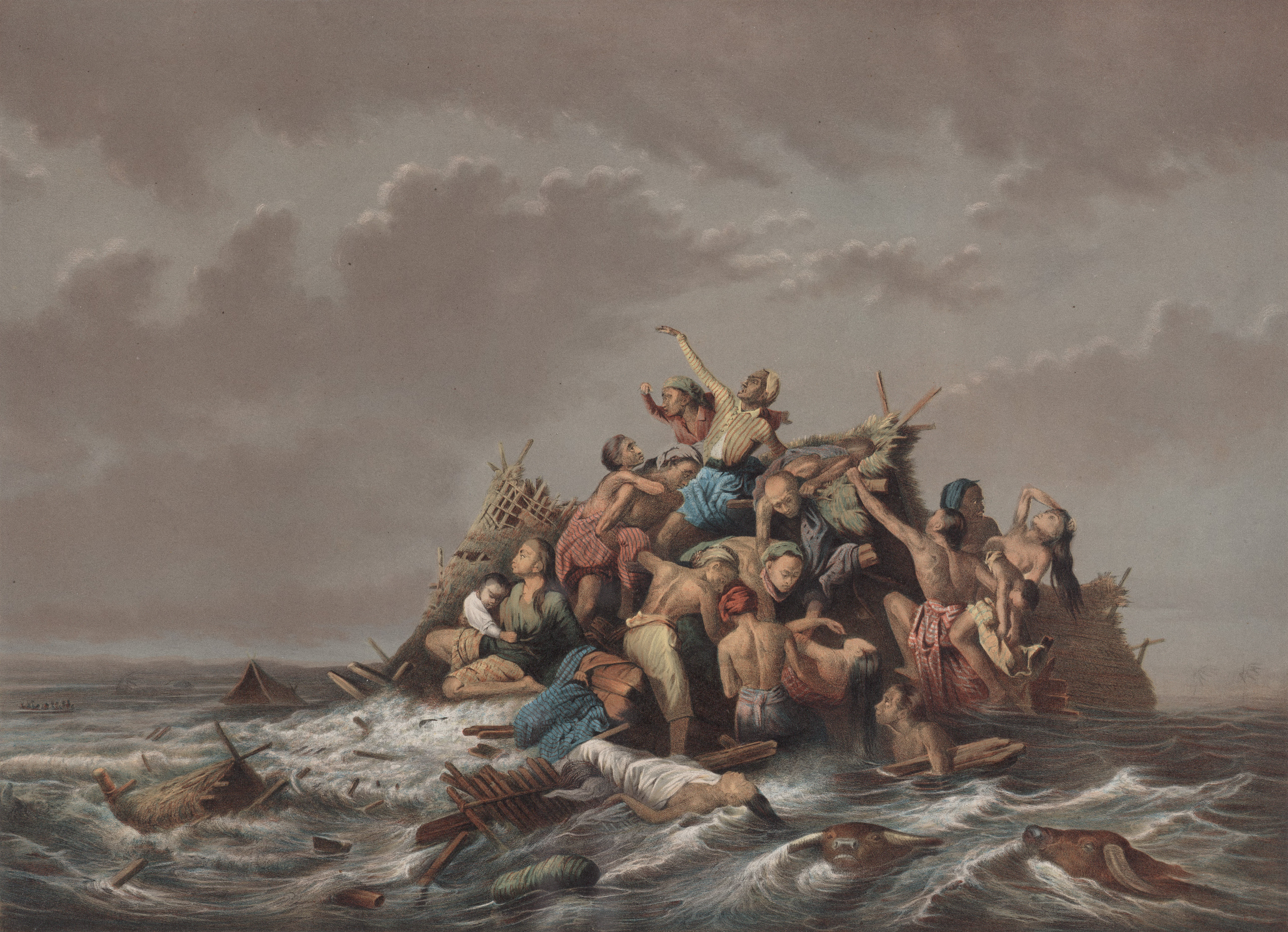
http://upload.wikimedia.org/wikipedia/commons/e/e6/A_Flood_on_Java_1865-1876_Raden_Saleh.jpg 


The Far East


China’s earliest recorded civilisation dates back 5,000 years to the Long Shan culture which spread along the Pacific coast. The Long Shan were more advanced than their predecessors and instead of scattered villages, they lived in walled towns and  herded sheep, cattle, and goats. Waves of settlers began to arrive in Korea and built villages especially on the coast. Korean medicine dates back to this time as do advances in fishing and weaving. Around 5,000 years ago, some of Taiwan’s native people arrived on the island. According to the Ami tribe, their ancestors previously lived on another island, east of Taiwan, but they were blown onto its coast by a terrific storm.(14)

Another Ami legend tells of a frightening time when a boiling flood occurred after an earth-opening earthquake and the eruption flooded the whole Earth .(15) According to Vaughn M Greene, ‘there are many indications that ‘China, like Japan, was visited by astronauts who set up a ruling class. In 3000 b.c. that strange  period when so many ‘Gods’ were walking the earth’, he adds, ‘ a ‘bearded white’ man named ‘Tai-Ko Fe-Kee’ came to China’. Greene says that he taught the people arts and agriculture and gave them their calendar. (16) I haven’t found any mention of him anywhere else but the story is worth repeating.

China also has legends of a great flood and it’s generally dated to around 4,200 years ago. However, as we have seen, there were advances in civilisation, in this region 5000 years ago, as well as in many early cultures, and they occurred in the era of the Great Flood.


The Indian sub-continent


A highly advanced civilisation, which spread over 300,000 square miles, arose and expanded in the Indus River floodplain around 5,000 years ago in what is now north-west India and Pakistan. Its cities were well built with brick and stone and its people had a system of writing. The identity ,and place of origin, of these people is unknown but it’s worth noting that the present Hindu Age, Kali Yuga, began in 3102 b.c.e when there was  climate change, and flooding,  in many parts of the world and when the Sumerians arrived in Southern Iraq. And it’s also interesting that one of the versions of the Indian deluge story suggests that the ‘Celestial Rishis’, who are identifiable as the leaders of the Annunaki, were  involved in the rescue of a highly regarded man, Manu, who was also a seer (17) and  one of the many counterparts of the biblical Noah.  


North and Central America


The Late Archaic period, in North America, began in 3,000 b.c.e, around which time there was an increase in population in parts of the continent, such as on the North-West Pacific coast, and when cultural development and trade expanded. Whilst scholars believe that the ancestors of all the Native Americans crossed over the Bering Straits from Asia thousands of years ago, many of the indigenous people say that they came from a lost flooded land.

There were flood legends throughout North America and some Native Americans say that when the flood came, their ancestors fled to high hills. Others claim that they sheltered underground in caves.  L.Taylor Hansen collected Native American legends about the visit of  a great civiliser. Some people were said to have  called him the miracle worker, or prophet or healer, and they stated that he wore a long white robe. (18) The Mandan Indians said that  he was their first ancestor, and a great civiliser. They also said that he wore clothing made of milk-white wolf skins and that he ‘preserved them from the Flood’.  (19) The Ojibwe called him Manaboza, or Michabo, and they also knew him as The Great White Hare because of his dazzling white appearance. Manabozho had supernatural enemies who destroyed the world with a flood but he protected the survivors and made the water depart.

Traditions, and legends, which seem to be based on the 5,000 year old story of the Anunnaki leaders, were also popular in the New World. They were deeply embedded in the traditions of some of the Native Americans including the Cherokee where they influenced the layout of the tribe’s Council Chambers and the religious aspect of some of their popular games.(20)


The Caribbean and Central America


Around 3000 b.c.e , when the world was in turmoil, there appears to have been flooding in the Caribbean and it may have been the source of the flood legends on some of the islands. According to Paul Dunbavin, mangrove swamps, dated to about 3210-3120 b.c.e can be found there at a depth of 3 metres on the island of Bimini (21) and Maltese scholar Joseph Ellul says that: ‘This severe flooding of the Caribbean islands is quite natural when one considers that the Caribbean lies exactly opposite to Gibraltar and having a horse-shoe shape it reflects the waves concentrating them in the middle of the Caribbean. So this flood in the Caribbean must correspond in time and is the effect of the Great Flood round the Mediterranean basin’. (22)

The North American Hopi have a legend about things that occurred after the Flood and which involved their Bow clan. (23) This story refers to their stay in certain caves and which also happen to be the ‘place of origin’ of some of the Central American Native peoples. The reason why nobody has ever been able to find these caves is because they don’t physically exist. This is an allegorical story, that’s featured in the Mayan creation legend ,and it dates back to 3114 b.c.e  the beginning of the present age, in their calendar. (24) These caves are represented in the form of sacred architecture in some Mayan cities such as Chichen Itza (25) and practically the same symbolism was built into the above mentioned secret underground complex in Giza in Egypt. The Maya had a group of ‘creator gods’ identical in number to the leaders of the Annunaki, and some of their traditions, record in the Popul Vuh, would not be out of place in Ancient Sumeria.

The  Native peoples in Central America also had traditions of the great civiliser and he  appears to  be the same entity who features in the legends of the  tribes in the North. The Aztecs called him Quetzalcoatl and the Maya Kukulcan both of which mean ‘feathered serpent. He was not a serpent-god, though, as some scholars suggest, for many of the Early World civilisers were associated with a snake such as Osiris in Egypt and the Dogon Lebe. When the Spaniards arrived in Mexico, people thought that the white bearded god had returned with his companions. How wrong they were.

  http://upload.wikimedia.org/wikipedia/commons/thumb/8/80/Deluge.png/475px-Deluge.png

South America


Brazil is the largest country in South and Latin America. It’s bordered by several other countries and it has tribal people living in its jungles. Over recent years, researchers have been discovering some of the fascinating mysteries of its past. Several years ago, two rows of six pyramids were spotted on a satellite imagining map in its jungle, near the eastern side of the Andes range, and numerous pyramids, built from sea shells, by unknown people, have recently been found on Brazil’s southern coast. The oldest ones have been dated to the critical era around 3000 b.c.e. when the world was in upheaval. Traces of other lost civilisations have also been found in the jungles of Brazil.


Colombia


The Muiscas in Colombia also had traditions of the civiliser who they called Bochica. They described him as having the appearance of a fair-skinned, long bearded, man who dressed in long flowing robes and who, like many of the other Early World civilisers, carried a staff. They said that he suddenly appeared on a plateau and that when he came to visit them, he instructed them in the arts of hunting and agriculture and how to build their houses and live in villages.

Bochica was also featured in the El Dorado story, which led the Spaniards on a wild goose chase in pursuit of gold, and when the Spaniards first  arrived in Colombia, the Muiscas thought they were his envoys .(26) They also called him  Sua ‘the white one’  (27) and they said that he was a hero because when ‘Chibchacum, the god of the field caused a deluge, he appeared in a rainbow and’ chastised Chibchacum, after lowering the height of the waters’ (28)

Around 5,000 years ago, around the time of the major El Nino event, settlements began to appear on the coast of Peru and there was a surge in monument building. There are also early signs of agriculture along the Supe river valley and at Aspero, near its mouth, an unknown people built large platform mounds. Over the years, several advanced civilisations arose in various parts of Peru the last  one being the Incas who established the largest empire in South America.

In a tradition, which appears to have been inherited from other Peruvian people, the Incas also had legends about the great civiliser. They described him as being a white, bearded, man who wore a white robe, fastened at the waist, and who carried a staff. The name that they gave him was Viracocha.  According to legend, he destroyed a race of giants, which he had created, with a flood and he then created man in his own size. In another Inca story, he appeared after a period of darkness and began to create the landscape and the heavens. He also gave life to man. Were the black skies caused by the worldwide increase in falling ash in 3100 b.c.e’?


The Pacific


Something drastic appears to have happened, around 3000 b.c.e, to cause people to sail across  thousands of miles of ocean in the Pacific to find new homes. Settlers began to arrive in the Philippines, where there are traditions of a great flood, (29) and waves of immigrants began to settle in the islands of Indonesia. Could it be that this movement of people was caused by the El Nino event which affected a wide area?  

Unusual things were also happening in Australia. Stephen Oppenheimer says that : ‘The post-flood foreign arrivals reached Australia around 5000 years ago’.(30) and advanced tools spread across the country. The Aboriginal tribes in East Australia tribes have legends of a great civilising sky-god, called Baime, who had the appearance of an elderly man, who carried a staff, and who was here in the era called Dreamtime .

Baimi was associated with the Rainbow Serpent and ,according to legend, he once caused a flood. The indications are that he was the Early World’s ‘civilising god’ and the circular enclosure associated with him, which was used in Aboriginal rituals, was remarkably similar to the plan of early Stonehenge – one of the numerous monuments of the sky-god religion. (31) There is also reason to suppose that the Aboriginal Wonjini were another version of the Sumerian Annunaki. ( 32)

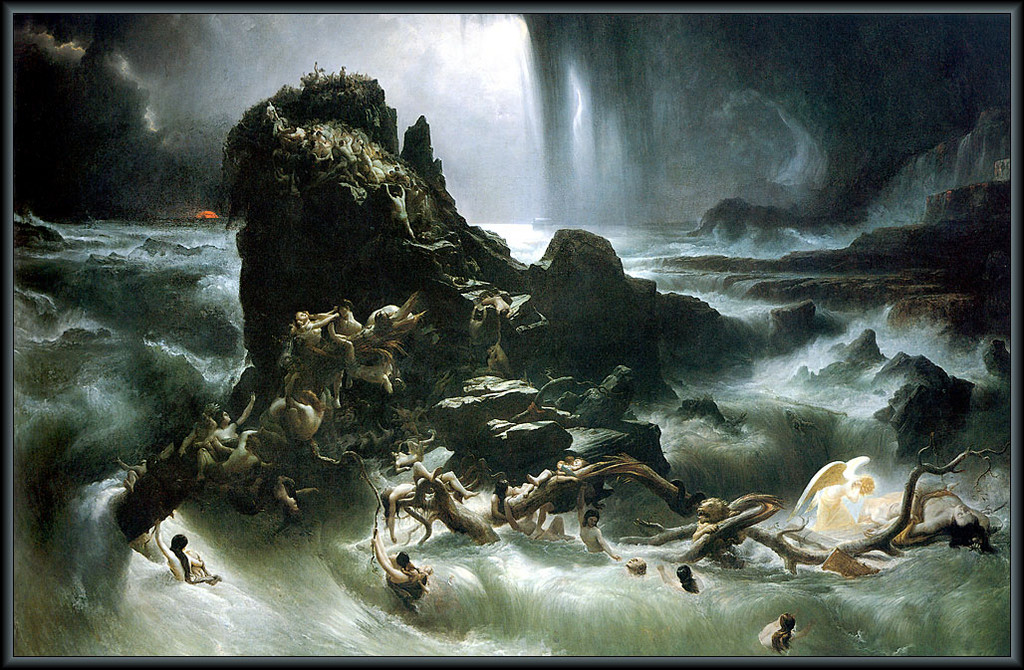
 http://upload.wikimedia.org/wikipedia/commons/c/ce/Danby-deluge.jpg

Hawaii


The Hawaiians had a god who they associated with agriculture, rainfall and fertility. They called him Lono and they represented him with ‘white bark cloth’. Capt.Cook, the 18th century British explorer, arrived in Hawaii at the time when his return was expected. Cook was mistaken for the god and the people gave him a rousing welcome. However, he was killed when he later returned and when the Hawaiians discovered their mistake.


Summary

Five thousand years ago, something incredible happened on this planet. Legends suggest that there was an extra-terrestrial visit to Earth and that among the visitors was a tall white, white bearded, civiliser being who wore a long white robe and who, with his companions, travelled around the world meeting its people. This being taught people agriculture, and many useful arts, and although not mentioned in this article, various sources associated him with the Pleiades.

Whilst the visors were here, there was climate change, and flooding, in many parts of the world. The people blamed the Flood on them and said that they had punished mankind for being evil. After The Flood, civilisation was reborn, in different countries, and many  tribes began to settle into new lands.

These incredible events, and the E.T visit, had a major impact on human life. Numerous versions of the sky-god religion were spread around the world as were hundreds of allegorical deluge stories many of which have been taken literally. (32) And since there were remarkably similar sky-god religions on both sides of the Atlantic, it would seem likely that there was contact between the Old and New Worlds long before Columbus arrived in the Americas. Furthermore, if there was an extra-terrestrial visit to this planet 5,000 years ago, then there is no reason why it should not be happening again in the present.


References:


1.     Paul Dunbavin . Atlantis of the West (p84) Constable and Robinson Ltd.2003
2.     Thor Heyerdahl. Early Man & Ocean (p335) George Allen and Unwin.1978
3.     Paul Dunbavin  Atlantis of the West (p92) Constable and Robinson Ltd.2003
4.     Proofs of Cataclysm.  George Mitrovic.
5.     Charles Squire. Celtic Myth and Legend. (p139)Gresham Publishing Company.
6.     Thor Heyerdahl. Early Man and the Ocean. (p327) George Allen and Unwin, 1978
7.     Paul Dunbavin. Atlantis of the West (p85) Constable and Robinson Ltd.2003
8.     E.A.Wallis Budge. The Book of the Dead.  (p157) University Books. 1977
9.     Leonard Farra.The Pleiades Legacy (The Old World) ( p235) Blurb.2010.
10.                       Geoffrey Bibby. Looking for Dilmun.Penguin Books. 1984.
11.                       A.R.Hope.Classic Myth and Legend. (p206) Gresham Publishing Company.
12.                       Leonard Farra.The Pleiades Legacy (The Old World). (p162-)
13.                       Edmond Sollenger.The Babylonian Legend of the Flood (p16)British Museum Publications Ltd. 1971.
14.                       D.A.Mackenzie. Myths of Melanesia and Indonesia (p340)Gresham Publishing Company
15.                       Stephen Oppenheimer. Eden in the East (p280) Phoenix. 1999
16.                       Vaughan. M.Greene. Astronauts of Ancient Japan.(p119)Merlin Engine Works 1978
17.                       Donald.A.Mackenzie.Indian Myth and Legend. (p141) Gresham Publishing
18.                       L.Taylor Hansen. He Walked the Americas (p91) Neville and Spearman.1963
19.                       Daniel.G.Brinton. Myths of the Americas (p200). Multimedia Publishing Corp
20.                       Cherokee People.Thomas E Mails.Council Oak Books. 1992.
21.                       Paul Dunbavin. Atlantis of the West. (p87) Constable and Robinson Ltd.2003
22.                       Joseph Ellul. Malta’s Prediluvian Culture (p6) Printwell Ltd. 1988.
23.                       Frank Waters. Book of  Hopi (p90.)Penguin Books. 1978
24.                       David Freidal-Linda Schele-Joy Parker.Maya Cosmos (p165) Perennial. 2001
25.                       Leonard Farra.The Pleiades Legacy (The New World) (p49) Blurb.2010
26.                       Thor Heyerdahl. American Indians in the Pacific (p283/4) George Allen and Unwin Limited.1952
27.                       Daniel.G.Brinton.Myths of the Americas (p199) Multimedia Publishing Corp.
28.                       Harold.T.Wilkins.Secret Cities of South America (p93) Rider and Company. 1950
29.                       Donald.A.Mackenzie. Myths of Melanesia and Indonesia  (p341) Gresham  Publishing Company.
30.                       Stephen Openheimer. Eden in the East (p101). Pheonix. 1999
31.                       Leonard Farra. The Pleiades Legacy. (The Stone Age)  ( p216-) Blurb.2010
32.                       Lorraine Mafi Williams.1989/90 Ley Hunter Magazine.


Copyright 2014 by Leonard Farra


From World Mysteries @ http://blog.world-mysteries.com/science/the-world-in-upheaval-3000-b-c-e/


For more information about the global catastrophe of 5,000 years ago see http://nexusilluminati.blogspot.com/search/label/comet%20venus  and http://nexusilluminati.blogspot.com/search/label/great%20flood
- See ‘Older Posts’ at the end of each section


Hope you like this not for profit site -
It takes hours of work every day to maintain, write, edit, research, illustrate and publish this website from a tiny cabin in a remote forest
Like what we do? Please give enough for a meal or drink if you can -  
Donate any amount and receive at least one New Illuminati eBook!
Please click below -


Xtra Images – https://c2.staticflickr.com/4/3323/3514542177_e7ded43b3f_z.jpg 
http://upload.wikimedia.org/wikipedia/commons/e/e6/A_Flood_on_Java_1865-1876_Raden_Saleh.jpg
http://upload.wikimedia.org/wikipedia/commons/thumb/8/80/Deluge.png/475px-Deluge.png 
http://upload.wikimedia.org/wikipedia/commons/c/ce/Danby-deluge.jpg


For further enlightening information enter a word or phrase into the random synchronistic search box @ http://nexusilluminati.blogspot.com

And see


 New Illuminati on Facebook - https://www.facebook.com/the.new.illuminati

New Illuminati Youtube Channel - http://www.youtube.com/user/newilluminati/feed


New Illuminati on Twitter @ www.twitter.com/new_illuminati


New Illuminations –Paintings in Light by R. Ayana @ http://newilluminations.blogspot.com

The Her(m)etic Hermit - http://hermetic.blog.com


The Prince of Centraxis - http://centraxis.blogspot.com (Be Aware! This link leads to implicate & xplicit concepts & images!)


DISGRUNTLED SITE ADMINS PLEASE NOTE –
We provide a live link to your original material on your site (and links via social networking services) - which raises your ranking on search engines and helps spread your info further! This site is published under Creative Commons Fair Use Copyright (unless an individual article or other item is declared otherwise by the copyright holder) – reproduction for non-profit use is permitted & encouraged, if you give attribution to the work & author - and please include a (preferably active) link to the original (along with this or a similar notice).

Feel free to make non-commercial hard (printed) or software copies or mirror sites - you never know how long something will stay glued to the web – but remember attribution! If you like what you see, please send a donation (no amount is too small or too large) or leave a comment – and thanks for reading this far…

Live long and prosper! Together we can create the best of all possible worlds…


From the New Illuminati – http://nexusilluminati.blogspot.com