"All the World's a Stage We Pass Through" R. Ayana

Showing posts with label biochar. Show all posts

Tuesday, 31 May 2016

Soil Is the Solution: Saving the Earth


Soil Is the Solution
Saving the Earth

Flying Sistas Mural - photo by R. Ayana


By Dr. Mercola


It's easy to take soil for granted. That is, until you lose it. The dirt beneath your feet is arguably one of the most under-appreciated assets on the planet. Without it, life would largely cease to exist while, when at its prime, this "black gold" gives life.

In nature, plants thrive because of a symbiotic relationship with their surrounding environment, including microorganisms in the soil.

The rhizosphere is the area immediately around a plant's root. It contains microorganisms that thrive on chemicals released from the plant's roots. These chemicals, known as exudates, include carbohydrates, phytochemicals and other compounds.

In exchange for the exudates, the root microbiome supplies the plant with important metabolites for health, which, along with exposure to pests and pathogens, helps plants produce phytochemicals.

A well-fed root microbiome will also supply plants with ample nitrogen (N), phosphorus (P) and potassium (K) — the three ingredients that also make up most synthetic fertilizer (NPK).

Unfortunately, while nature's system results in handsome rewards, including more nutritious foods and less environmental pollution, modern-day farmers have largely become stuck in a cycle of dousing crops with synthetic chemicals that destroy the soil and, ultimately, the environment.
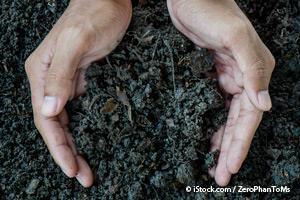

 http://media.mercola.com/ImageServer/Public/2016/May/regenerating-soil.jpg


Why Synthetic Fertilizers Are Ruining the Planet


Synthetic fertilizers make sense in theory, and they do make plants grow bigger and faster. The problem is that the plants are not necessarily healthier. In fact, they miss out on the symbiotic relationship with their root microbiome.

Because they're being supplied with NPK, the plant no longer "wastes" energy producing exudates to feed its microbiome.

Therefore, it receives fewer metabolites for health in return. The end result is plants that look good on the outside but lack minerals, phytochemicals and defenses against pests and disease on the inside.

Further, as reported by Rick Haney, a U.S. Department of Agriculture (USDA) soil scientist, less than 50 percent of synthetic fertilizers applied to crops are used by the plants. Haney told Orion Magazine:1

"Farmers are risk averse … They've borrowed a half million dollars for a crop that could die tomorrow. The last thing they want to worry about is whether they put on enough fertilizer. They always put on too much, just to be safe."

The excess fertlizer runs off into the environment, with disastrous effects. As fertilizer runs off of farms in agricultural states like Minnesota, Iowa, Illinois, Wisconsin, Missouri and others, it enters the Mississippi River, leading to an overabundance of nutrients, including nitrogen and phosphorus, in the water.

This, in turn, leads to the development of algal blooms, which alter the food chain and deplete oxygen, leading to dead zones. One of the largest dead zones worldwide can be found in the Gulf of Mexico, beginning at the Mississippi River delta.2 Fisheries in the Gulf of Mexico have been destroyed as a result.


Soil Health Campaign Educates Farmers How to Work With Nature


USDA's Natural Resources Conservation Service (NRCS) convenes sessions around the U.S. in an effort to improve soil health and teach farmers how to use less fertilizer and produce the same, and in some cases better, yields. Haney told Orion Magazine:3

"Our entire agriculture industry is based on chemical inputs, but soil is not a chemistry set … It's a biological system. We've treated it like a chemistry set because the chemistry is easier to measure than the soil biology."

While standard soil tests measure chemical properties in the soil, Haney developed a test to measure soil biology. A rich microscopic community is what Haney is after. Only this can support the fascinatingly complex process of plant growth and, at the same time, naturally cut carbon emissions by fixing carbon in the soil.

It's estimated that one-third of the surplus carbon dioxide in the atmosphere stems from poor land-management processes that contribute to the loss of carbon, as carbon dioxide, from farmlands.4 Writing in Orion Magazine, Kristin Ohlson, author of "The Soil Will Save Us," explained:5

"When we admire good soil's dark chocolate-cake sponginess and sweet smell, we're admiring the handiwork of trillions of soil microorganisms over time.

They eat carbon and expire carbon dioxide, just as we do, but they also "fix" a percentage of that carbon in the soil. Barring disturbance, it stays there for a very long time.

… Photosynthesis is the only process that safely and inexpensively removes carbon dioxide from the atmosphere, allowing carbon that is a problem in the skies to become a boon for the land.

Based on this principle, one hundred governments and nonprofits launched the 4/1000 Initiative … calling for an increase of carbon in the world's soils by 0.4 percent per year.

This relatively small boost will not only radically improve soil fertility but also, the coalition claims, halt the annual rise of atmospheric carbon dioxide."


Rainforest Gnome by R. Ayana

Three 'Game-Changing' Practices for Agriculture


Carbon farming is a simple premise that involves using agricultural methods that can naturally trap carbon dioxide in the ground (for decades, centuries or more) while also absorbing it from the air. 


The process, known as "carbon sequestration," could help mitigate greenhouse gas emissions and:
Regenerate the soil Limit agricultural water usage with no till and crop covers
Increase crop yields Reduce the need for agricultural chemicals and additives, if not eliminate such need entirely in time
Reduce atmospheric carbon dioxide levels Reduce air and water pollution by lessening the need for herbicides, pesticides, and synthetic fertilizers

A recent study published in the journal Nature further revealed that by managing soils to reduce greenhouse gases, it could lead to a wealth of "side benefits," including healthier soils and ecosystems, less fertilizer runoff and less soil erosion.6

In an interview with The Christian Science Monitor, Phil Robertson of Michigan State University explained three "game-changing" practices that could help make soils "net mitigating," meaning they capture more greenhouse gases than they emit.7

1.    No-till cultivation, in which crops are grown without plowing
2.    Advanced nitrogen fertilizer management, or applying only minimal amounts of fertilizer
3.    Cover crops

The latter strategy alone, cover crops, can virtually eliminate the need for irrigation when done right. The cover crops also act as insulation, so the soil doesn't get as hot or cold as it would if bare. This allows microbes to thrive longer.

Also, the soil biology heats up the soil, which can extend your overall growing season in colder areas, and it helps prevent soil erosion. In 2012, a Census of Agriculture report found just over 10 million acres of farmland (out of 390 million total) were being planted with cover crops, but its use is growing.

In an annual survey of farmers taken in 2014, farmers reported planting double the mean acreage in cover crops reported in 2010.8 Farmers who adopt the technique have reported better soil texture, less erosion, and increased crop yields.


Planting Winter Cover Crops May Make Farmers Money


This is key, because convincing most farmers to change their practices solely for environmental reasons isn't an easy proposition, especially if it also involves increased costs to the farmer. Robertson recommends using conservation payments, which have been in place for decades, to pay farmers to adopt more sustainable agricultural practices.

Some farmers also change their ways after seeing the success of their neighbors' farms. Farmer Doug Anson, who along with his family plants cover crops on 13,000 of their 20,000 acres of Indiana farmland, told The New York Times:9

"In the part of a field where we had planted cover crops, we were getting 20 to 25 bushels of corn more per acre than in places where no cover crops had been planted … That showed me it made financial sense to do this."

A research project that's been ongoing for two decades in Michigan, comparing crop plots using four different farming methods, has also shown promise for cover crops. The fields that received small amounts of fertilizer and were planted with winter cover crops had yields similar to conventional fields with far less nitrogen leaching.10

The U.S. government has even set up a small subsidy system to help farmers offset the costs of cover crops and other regenerative practices, but one major hurdle to cover crops becoming mainstream involves absentee land owners.

Many farmers grow crops on land they do not own but rather lease; they therefore have little incentive to want to improve soil quality on land they do not own. Landowners could, however, offer incentives to farmers to use regenerative practices that would, in turn, increase the value of their land.11


Farmers and Landowners Can Get Paid for 'Carbon Credits'


Conventional farmers have much to gain from trying out carbon-sequestration practices like planting cover crops, applying compost and not tilling; they can accumulate, and be paid for, carbon credits.

Farmers can even use the USDA's COMET-Farm online tool to find out their approximate carbon footprint, as well as experiment to see which land-management practices sequester the most carbon on their farm.12 How does it work? Modern Farmer explained:13

"Land-based carbon sequestration is measured in metric tons per hectare (2.5 acres); one metric ton earns one carbon credit, making the math easy. In California — the only state in the US with a full-fledged cap-and-trade program — the current value of a carbon credit is around $12 to $13. (Farmers in other states, by the way, are eligible to earn credits through the California carbon market.)

Alberta, which has the most robust carbon market in Canada and rewards several agricultural practices with carbon credits, raised the price of carbon credits from $15 to $20 on January 1, 2016; in 2017, the price will go up to $30 per credit."

Unfortunately, the way the system is currently set up, farmers already using beneficial conservation practices are not eligible for carbon credits. Only those switching land from conventional agriculture to soil-conservation practices may receive credits, with the exception of spreading compost over grazed grasslands, which are used to raise grass-fed beef and other pastured animal products.

This recently approved carbon credit "protocol" was largely the result of the Marin Carbon Project, which found a single 1/2-inch dusting of compost on rangeland can boost the soil's carbon storage for at least 30 years.

If you're a farmer interested in receiving carbon credits, you'll need to sign up with a carbon credit registry such as the Climate Action Reserve, the American Carbon Registry, or and the Verified Carbon Standard. An inspector will visit your farm regularly to ensure you've carried out the protocols correctly.14

Over the Hill by R. Ayana


Regenerating Our Soil Is the Solution


It's clear that paying attention to our soils is crucial to our health and future. Fortunately, change is occurring both on large and small scales. The USDA's NRCS has become very committed to understanding and teaching about natural soil health and regenerative agriculture

Not only will regenerating our soils lead to improved food production, it will also address a majority of resource concerns, such as water. When you add carbon back into the soil, such as by adding mulch or cover crops, the carbon feeds mycorrhizal fungi that eventually produce glomalin, which may be even better than humic acid at retaining water. This means you naturally limit your irrigation needs and make your garden or fields more resilient during droughts.

Considering data suggesting we may lose all commercial topsoil, globally, in the next 60 years if we keep going at the current rate, such changes cannot move fast enough. The NRCS website is an excellent resource for anyone interested in learning more about soil health, including farmers wanting to change their system.

At present, about 10 percent of U.S. farmers have started incorporating practices to address soil health. Only about 2 percent have transitioned to full-on regenerative land management, however. On an individual level, you can get involved by growing some of your own food using these regenerative principles on a small scale.


For more information about soil see http://nexusilluminati.blogspot.com/search/label/soil
- Scroll down through ‘Older Posts’ at the end of each section


Do you LIKE this uniquely informative site?
Hours of effort by a genuinely incapacitated invalid are required every day to maintain, write, edit, research, illustrate, moderate and publish this website from a tiny cabin in a remote forest.
Now that most people view these posts on mobile devices, sites like this earn an ever diminishing pittance from advertising…
Like what you see? Please give anything you can -  
Contribute any amount and receive at least one New Illuminati eBook!
(You can use a card securely if you don’t use Paypal)
Please click below -


Spare Bitcoin change?


For further enlightening information enter a word or phrase into the random synchronistic search box @ the top left of http://nexusilluminati.blogspot.com


And see


 New Illuminati on Facebook - https://www.facebook.com/the.new.illuminati

New Illuminati Youtube Channel -  https://www.youtube.com/user/newilluminati/playlists

New Illuminati’s OWN Youtube Videos -  
New Illuminati on Google+ @ For New Illuminati posts - https://plus.google.com/u/0/+RamAyana0/posts

New Illuminati on Twitter @ www.twitter.com/new_illuminati


New Illuminations –Art(icles) by R. Ayana @ http://newilluminations.blogspot.com

The Her(m)etic Hermit - http://hermetic.blog.com


DISGRUNTLED SITE ADMINS PLEASE NOTE –
We provide a live link to your original material on your site (and links via social networking services) - which raises your ranking on search engines and helps spread your info further!

This site is published under Creative Commons (Attribution) CopyRIGHT (unless an individual article or other item is declared otherwise by the copyright holder). Reproduction for non-profit use is permitted & encouraged - if you give attribution to the work & author and include all links in the original (along with this or a similar notice).

Feel free to make non-commercial hard (printed) or software copies or mirror sites - you never know how long something will stay glued to the web – but remember attribution!

If you like what you see, please send a donation (no amount is too small or too large) or leave a comment – and thanks for reading this far…

Live long and prosper! Together we can create the best of all possible worlds…


From the New Illuminati – http://nexusilluminati.blogspot.com

Wednesday, 25 February 2015

Biochar Agriculture: State-of-the-art soil


Biochar Agriculture: State-of-the-art soil

Jeff Hutchens/Getty


A charcoal-rich product called biochar could boost agricultural yields and control pollution. Scientists are putting the trendy substance to the test.


Biochar — a soil additive made by heating biological material — is catching attention as a means to improve crop growth and clean up contaminated water.

For more than 150 years, the Brooklyn Navy Yard constructed vessels that helped to stop the slave trade from Africa, lay the first undersea telegraph cable and end the Second World War. Now, this sprawling industrial facility in New York City is filled with artists, architects, producers of artisanal moonshine and people growing organic vegetables. On a drizzly day in autumn, Ben Flanner tends a sea of red and green lettuce on a 6,000-square-metre rooftop farm.

The soil beneath the plants looks ordinary, but Flanner grabs a handful and holds it up for inspection. Amid the brown clods of dirt are small black particles — remnants of charcoal fragments that were mixed into the soil two years ago. Flanner thinks that this carbon-rich material, known as biochar, has helped the crops to thrive, possibly even increasing their yield, and he hopes for more impressive results over the next few years.

Across the United States, sales of this long-lasting soil additive have surged over the past few years, tripling annually since 2008, according to some estimates. The Biochar Company in Berwyn, Pennsylvania — which supplied Flanner's Brooklyn farm — sells it both wholesale and direct to consumers, through outlets including Amazon and some Whole Foods stores. And countries ranging from China to Sweden are using biochar on agricultural fields and city lawns.

Proponents see big potential for the soil enhancer, which is produced by heating biological material — such as husks and other agricultural waste — in a low-oxygen chamber. Biochar can be made as a by-product of biofuel generation, so some companies are hoping to cash in on both products as demand grows for greener forms of energy.

Interest in biochar is also growing among scientists, who are quickly ramping up studies to test its potential. They are particularly interested in how the chemical and physical properties of biochar particles affect water moving through soil, remove pollutants, alter microbial communities and reduce emissions of greenhouse gases. The hope is that biochar can help farmers around the world, particularly those in Africa and other developing regions, who often struggle with poor soils.

Johannes Lehmann, a crop and soil scientist at Cornell University in Ithaca, New York, says that different types of biochar “have unique potential to mitigate some of the greatest soil-health constraints to crop productivity — for example, in highly weathered and sandy soils”.

But there are still many questions about biochar, particularly in terms of making sure that it is affordable and has positive effects. In some studies, the material has actually reduced yields. Part of the difficulty is that biochar can be produced from all kinds of biomass and at different temperatures and speeds, which leads to huge variation in the substance — and in results. “I always say we should not even use the singular for biochar,” says Lehmann. “There are only biochars.”


Amazonian roots

Although it is just starting to catch on with farmers today, biochar has ancient roots. Hundreds to thousands of years ago, residents of the Amazon produced it by heating up organic matter to create rich, fertile soils called terra preta. But the practice was abandoned around the time that European nations invaded South America, and relatively few farmers elsewhere have routinely used biochar. Scientists first took a big interest in the material about a decade ago, when growing concerns over global warming led some to tout biochar as a way to store huge amounts of carbon underground. Hope for that application has faded somewhat, but soil scientists are now exploring its use in agriculture and remediating pollution.

A particular focus has been explaining how biochar affects water movement through soils. Rebecca Barnes, a biogeochemist at Colorado College in Colorado Springs, and some of her colleagues tested that by adding biochar to different materials1. In sand, through which water typically drains very quickly, biochar slowed the movement of moisture by an average of 92%. In clay-rich soil, which usually retains water, biochar sped up movement by more than 300%.

The researchers suggest that the biochar alters how water moves through the interstitial space — the gaps between grains in the soil.

Enrique Castro-Mendivil/Reuters/Corbis
Workers at the Villa Carmen Biological Station in Peru turn soil containing black flecks of biochar, produced by burning bamboo in metal drums.


“Clays tend to be flat grains and sand tends to be circular grains, but biochar is very amorphous — and so it's not only creating these crazy pathways through the biochar, but it's also creating crazy pathways in that interstitial space,” says Barnes. She and her colleagues suggest that these convoluted pathways help to slow down drainage in sand and speed it up in clays.

That is significant, Barnes says, because even though clays can hold large amounts of water, that moisture has a hard time moving through the grains and reaching plant roots. Some studies have shown that plants grow better in soil with added biochar than in plain soils or those treated just with compost2.

Researchers are also teasing apart how biochars influence microbial activity in soil. Microbes typically act as a community; for example, many pathogenic bacteria attack a plant's roots only when they have sufficient numbers to overwhelm the host's immune response. Caroline Masiello, a biogeochemist at Rice University in Houston, Texas, and her co-workers have found3 that biochar can inhibit this by binding to the signalling molecules that bacterial cells secrete to coordinate their activity.

“They all think they're alone, because the telephone wires have been cut,” says Masiello. With further research, she says, it might be possible to fine-tune this function of biochar to reduce plant infections.

Other researchers are exploring how biochars can cut emissions of nitrous oxide, a greenhouse gas, from agricultural fields. Last year, Xiaoyu Liu, a soil scientist at Nanjing Agricultural University in China, and his colleagues reported4 that after biochar had been applied to maize (corn) and wheat fields once, nitrous oxide emissions declined over the following five crop seasons, a period of three years. Other studies have shown reductions as well, but researchers have not yet been able to determine what exactly causes this effect. Applying biochar “can also improve some soil properties, like it can increase the potassium availability, and the soil organic-matter content”, says Liu, who has obtained some funding from biochar producers.

But not all studies show biochar to be a wonder material. In some cases it has reduced crop yields5, and one study6 suggests that it lowers the activity of plant genes that help to defend against insect and pathogen attacks.

Lehmann says that this may come down to improper applications of biochar. In some of the studies that showed decreases in yields, he says, the soils were perfectly fine to start with. Other work suggests7 that using the wrong type of biochar can negatively impact the soil's microbiota or, potentially, its carbon-storage capacity. A biochar made from rice straw, for example, will function differently in a certain soil than will biochar made from wood or manure.

Overall, however, the positive impacts of biochar seem to outweigh the negative ones. A 2011 meta-analysis8 found an overall average yield increase of 10%, rising to 14% in acidic soils. Biochar's greatest potential might be in places where soils are degraded and fertilizer scarce, in part because it helps the soil to better retain any nutrients that it does have. Andrew Crane-Droesch at the University of California, Berkeley, has been studying the impacts of biochar in such degraded soils in western Kenya. His preliminary data suggest that farms using biochar averaged 32% higher yields than controls.

In June, a World Bank report9 said that biochar probably holds the most potential for small farmers in developing countries, not just because they are working with the soils most likely to benefit, but because biochar may be a key element of 'climate-smart' agriculture — practices that both help to mitigate climate change and reduce vulnerability to its effects.


Pollution wrangler

Biochar's start may have been in agriculture, but researchers are now looking at other applications. Biochar can bind to heavy metals in soil, which helps to keep them from reaching plants or entering water supplies. That has attracted the notice of the US Environmental Protection Agency, other agencies, and companies seeking to reclaim land formerly used in mining. At the Hope Mine near Aspen, Colorado, biochar added in 2010 helped to neutralize the impacts of decades-old mine refuse by immobilizing the metals and increasing the amount of water held on the slope — thereby reducing the opportunity for contaminated water to become run-off. It also helped to spur plant growth on the formerly barren hillside, according to the Aspen Center for Environmental Studies.

Biochar is also showing promise in cleaning up polluted water, perhaps as a much cheaper replacement for activated charcoal, which is used at sites ranging from treatment plants to areas that are heavily contaminated with toxic chemicals. Biochar particles have a relatively large surface area, which expands even further in water, providing a vast number of sites for contaminants to bind to, says Charles Pittman, a retired chemist at Mississippi State University in Starkville. He says that this type of pollution remediation may be particularly beneficial in countries that lack full water-treatment systems. It could also help to remove antibiotics or chemical wastes, which are difficult to strip out with conventional water treatments.

Scientists have even explored biochar's potential for treating fluids used in oil and gas drilling, and as a component of print toners and paint products. “There's a lot of other markets that haven't fully been explored yet,” says Kurt Spokas, a soil scientist with the US Department of Agriculture's Agricultural Research Service in St Paul, Minnesota.


“The hope is that biochar could help farmers, particularly in Africa and other developing regions.”


Experts caution, however, that it is not clear when or whether remediation — or other applications — will be economical, particularly in agriculture. Poor soils and poverty often go together. After demonstrating yield increases in Kenya, Crane-Droesch looked at the economic viability of biochar in the same communities. “What we found was almost nobody was willing to pay for biochar when offered at roughly the price it took to make it,” he says.

Biochar prices vary widely, but in the United States some products cost US$3 per kilogram, comparable to certain fertilizers and more than many composts. On a large scale, biochar production may make economic sense only when biofuel production does — for example if it is subsidized or because policies to reduce carbon emissions drive fossil-fuel prices up.

And if demand ever does surge, there will be questions about the environmental impact of producing biochar. One key concern is the choice of feedstock. China is eager to use agricultural waste, such as rice and wheat straw, and some researchers in the United States are even pushing animal manure, but neither may be the most efficient way to produce it on a massive scale. And using wood could spur deforestation or harmful land-use practices.

“It's an incredibly important question to ask: what is the sustainability of the feedstock?” says Alfred Gathorne-Hardy, research director of the India Centre for Sustainable Development at the University of Oxford, UK. “This is the kind of debate I don't think we're seeing enough about within the biochar world.”


Growth industry

That debate may grow as consumer interest does — something that is slowly happening around the world. Björn Embrén, who is responsible for tree planning and protection in Stockholm, says that the city has been using biochar to boost local vegetation since 2009; he credits it with the city's healthiest tree growth in recent years. In September, the New York-based charity Bloomberg Philanthropies awarded Stockholm €1 million (US$1.2 million) to launch a city-wide programme that will turn residential garden waste, and eventually food waste and even sewage, into biochar.

Back in Brooklyn, Flanner continues to monitor his crops. The lettuces and carrot tops glisten under the rain as he steps carefully between rows in his bright yellow rain jacket. He thinks that the biochar will be good for his soils over the long term because it helps them to retain nutrients and water. “Those are both very important, especially in such a well-drained soil as on a green roof,” he says. “We tend to lose both of those quickly.”

But before he adds more of the black grains to other parts of his farm, he will wait to see how the crops respond over the next few years. Like the scientists studying biochar, he is eager to see whether it will live up to its bright promise or fade like so many other would-be wonder materials.


References


1.    Barnes, R. T., Gallagher, M. E., Masiello, C. A., Liu, Z. & Dugan, B. PLoS ONE 9, e108340 (2014).
o    Article
o    PubMed
o    ChemPort
2.    Liu, J. et al. J. Plant Nutr. Soil Sci. 175, 698707 (2012).
o    Article
o    ChemPort
3.    Masiello, C. A. et al. Environ. Sci. Technol. 47, 1149611503 (2013).
o    Article
o    PubMed
o    ISI
o    ChemPort
4.    Liu, X. et al. Agric. Syst. 129, 2229 (2014).
o    Article
o    ISI
5.    Rajkovich, S. et al. Biol. Fert. Soils 48, 271284 (2012).
o    Article
o    ChemPort
6.    Viger, M., Hancock, R. D., Miglietta, F. & Taylor, G. GCB Bioenergy http://dx.doi.org/10.1111/gcbb.12182 (2014).
7.    Zimmerman, A. R., Gao, B. & Ahn, M.-Y. Soil Biol. Biochem. 43, 11691179 (2011).
o    Article
o    ISI
o    ChemPort
8.    Jeffery, S., Verheijen, F .G. A., van der Velde, M. & Bastos, A. C. Agric. Ecosyst. Environ. 144, 175187 (2011).
o    Article
o    ISI
9.    Scholz, S. M. et al. Biochar Systems for Smallholders in Developing Countries (World Bank, 2014).


From Nature @ http://www.nature.com/news/agriculture-state-of-the-art-soil-1.16699
Nature
517,
258–260
()
doi:10.1038/517258a


What is BioChar? How to Make & Why You shouldn't use Raw Biochar


Biochar Workshop Part 1, How to Make Biochar


For more information about soils see http://nexusilluminati.blogspot.com/search/label/soil
- Scroll down through ‘Older Posts’ at the end of each section


Hope you like this not for profit site -
It takes hours of work every day by a genuinely incapacitated invalid to maintain, write, edit, research, illustrate and publish this website from a tiny cabin in a remote forest
Like what we do? Please give anything you can -  
Contribute any amount and receive at least one New Illuminati eBook!
(You can use a card securely if you don’t use Paypal)
Please click below -


Spare Bitcoin change?


Xtra Images –


For further enlightening information enter a word or phrase into the random synchronistic search box @ the top left of http://nexusilluminati.blogspot.com


And see


 New Illuminati on Facebook - https://www.facebook.com/the.new.illuminati

New Illuminati Youtube Channel - http://www.youtube.com/user/newilluminati


New Illuminati on Twitter @ www.twitter.com/new_illuminati


New Illuminations –Art(icles) by R. Ayana @ http://newilluminations.blogspot.com

The Her(m)etic Hermit - http://hermetic.blog.com


DISGRUNTLED SITE ADMINS PLEASE NOTE –
We provide a live link to your original material on your site (and links via social networking services) - which raises your ranking on search engines and helps spread your info further! This site is published under Creative Commons Fair Use Copyright (unless an individual article or other item is declared otherwise by the copyright holder). Reproduction for non-profit use is permitted & encouraged,  - if you give attribution to the work & author and include all links in the original (along with this or a similar notice).

Feel free to make non-commercial hard (printed) or software copies or mirror sites - you never know how long something will stay glued to the web – but remember attribution!

If you like what you see, please send a donation (no amount is too small or too large) or leave a comment – and thanks for reading this far…

Live long and prosper! Together we can create the best of all possible worlds…


From the New Illuminati – http://nexusilluminati.blogspot.com