"All the World's a Stage We Pass Through" – R. Ayana

Showing posts with label Wal Thornhill. Show all posts

Sunday, 5 October 2014

The New Paradigm Shift: Our Electric Cosmos - Alfvén Triumphs Again (& Again)


The New Paradigm Shift:
Our Electric Cosmos
Alfvén Triumphs Again (& Again)

https://farm9.staticflickr.com/8212/8304150292_63c96eaa6c_b.jpg

by Wal Thornhill


A science journalist dubbed me “the boundary rider of science.” And it is from that broad perspective that I see our sciences like juggernauts speeding down their blind tunnels of specialization and one can only wait for the inevitable crash.

Modern science attempts to describe our reality using meaningless language (e.g. “the fabric of space-time”) and invalid metaphors with the result that ever more forces, unreal dimensions and invisible or virtual matter are invoked. It seems to me that our salvation lies with engineers who must deal with the real world. For it was an outstanding and outspoken electrical engineer and physicist, Hannes Alfvén, who gave us an electrical engineer’s practical explanation of many of the mysteries of the universe—known as plasma cosmology.

But in a classic academic ‘Catch-22,’ because it’s not mainstream students are not given the opportunity to consider it at any university.

Alfvén emphasized the influence upon him of Kristian Birkeland’s earlier research into the electrical nature of the aurora and other phenomena in the solar system. Birkeland seemed to intuitively sense the real electrical nature of space but was too far ahead of his time. The theory of electric discharges was still in a very primitive state. He wrote:

“It seems to be a natural consequence of our point of view to assume that the whole of space is filled with electrons and flying ions of all kinds. We assume each stellar system in evolution throws off electric corpuscles into space. It is not unreasonable therefore, to think that the greater part of the material masses in the universe is found not in the solar systems or nebulae, but in ‘empty’ space.”

Birkeland met overwhelming resistance, particularly from Sydney Chapman who was perhaps the most influential scientist in the field of geophysics in the period 1920-1960. But in 1973 satellites confirmed the existence of electric currents aligned with the magnetic field. These field-aligned currents are now called “Birkeland currents.” In 1987, reflecting his own struggle with orthodoxy, Alfvén wrote tartly:

“Since Chapman considered his theory of magnetic storms and aurora to be one of his most important achievements, he was anxious to suppress any knowledge of Birkeland’s theory. Being a respected member of the proud English tradition in science, and attending – if not organizing – all important conferences in this field, it was easy for Chapman to do so. The conferences soon became ritualized. They were opened by Chapman presenting his theory of magnetic storms, followed by long lectures by his close associates who confirmed what he had said. If finally there happened to be some time left for discussion, objections were either not answered or dismissed by a reference to an article by Chapman. To mention Birkeland was like swearing in the church.”

Many dissident scholars have echoed the comparison of modern institutionalized science with a religious order.

Alfvén’s plasma cosmology is an excellent theory when measured by its successful predictions. Despite this;

“..the continuing resistance to Alfvén’s work is based on a widely held opinion that his predictions are not derived from a plausible physical theory (i.e., a theory that conforms to the dominant paradigm). If a theory is not acceptable, it does not gain credit by making successful predictions. This would imply that the role of prediction as a means of evaluating scientific theories has been exaggerated.”
—Stephen G. Brush, Alfvén’s Programme in Solar System Physics, IEEE Transactions On Plasma Science, Vol. 20, No. 6, December 1992, p. 577.

Now two new reports stand out in relation to Alfvén’s predictions so that ultimately he cannot be ignored. The first concerns the birth of stars and the second the electric circuit of the Sun.


Electric Star Birth
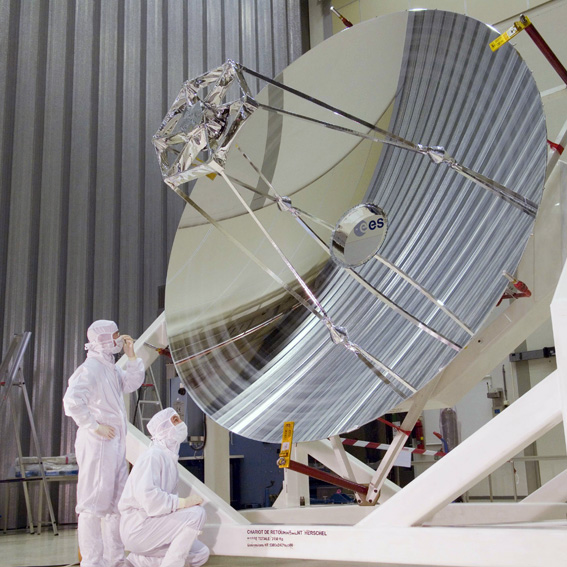
The European Space Agency's Herschel Space Observatory.


The European Space Agency’s Herschel Space Observatory (formerly called Far Infrared and Sub-millimetre Telescope or FIRST) has the largest single mirror, at 3.5-metres in diameter, ever built for a space telescope. It is an infrared telescope, named after Sir William Herschel, the discoverer of the infrared spectrum.

The telescope has been giving astronomers an unprecedented look inside the cosmic womb of stars, known as molecular clouds, to find (surprise, surprise) that stars are formed in “an incredible network of filamentary structures, and features indicating a chain of near-simultaneous star-formation events, glittering like strings of pearls deep in our Galaxy.” Although described as “incredible” by astronomers, this description precisely matches the decades-old expectations of plasma cosmologists!
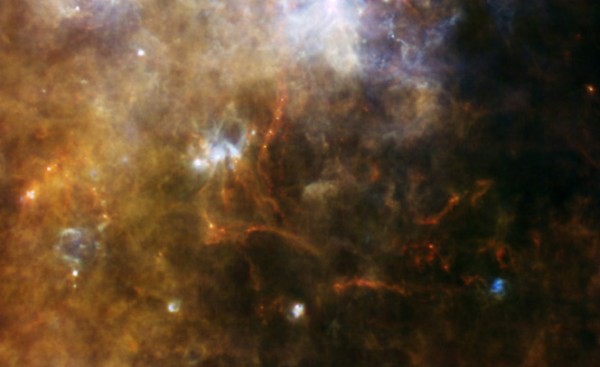
“An incredible network of filamentary structures” seen in a cloud of cold gas in the constellation of the Southern Cross.

“An incredible network of filamentary structures” seen in a cloud of cold gas in the constellation of the Southern Cross. The ESA report dated 2 October 2009. “That a dark, cool area such as this would be bustling with activity, was unexpected. But the images reveal a surprising amount of turmoil: the interstellar material is condensing into continuous and interconnected filaments glowing from the light emitted by new-born stars at various stages of development.”

[2009 ESA report]

In an ESA report last month the high-resolution of the Herschel space observatory produced another surprise:

“The filaments are huge, stretching for tens of light years through space and Herschel has shown that newly-born stars are often found in the densest parts of them… Such filaments in interstellar clouds have been glimpsed before by other infrared satellites, but they have never been seen clearly enough to have their widths measured. Now, Herschel has shown that, regardless of the length or density of a filament, the width is always roughly the same.

“This is a very big surprise,” says Doris Arzoumanian, Laboratoire AIM Paris-Saclay, CEA/IRFU, the lead author on the paper describing this work. Together with Philippe André from the same institute and other colleagues, she analysed 90 filaments and found they were all about 0.3 light years across, or about 20,000 times the distance of Earth from the Sun. This consistency of the widths demands an explanation.”
[Emphasis added]
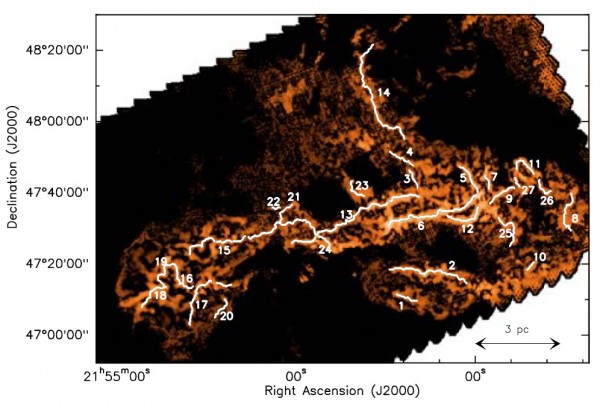

A network of 27 star forming filaments derived from Herschel observations of the IC 5146 molecular cloud.

This diagram shows a network of 27 star forming filaments derived from Herschel observations of the IC 5146 molecular cloud. Credit: Adapted from Characterizing interstellar filaments with Herschel in IC 5146, D. Arzoumanian et al., A&A 529, L6 (2011).

[A&A paper]

So what is the favored conventional explanation? What else but “sonic booms” generated by “exploding stars!” But where are these exploding stars? And explosions should impose some degree of radial curvature on these filaments. But what we see is more like the tortuous paths of cloud-to-cloud lightning bolts. For that is what they are, in fact, on a cosmic scale.

The ‘father’ of plasma cosmology, Hannes Alfvén, wrote in 1986:

“That parallel currents attract each other was known already at the times of Ampere. It is easy to understand that in a plasma, currents should have a tendency to collect to filaments. In 1934, it was explicitly stated by Bennett that this should lead to the formation of a pinch. The problem which led him to the discovery was that the magnetic storm producing medium (solar wind with present terminology) was not flowing out uniformly from the Sun. Hence, it was a problem in cosmic physics which led to the introduction of the pinch effect…

However, to most astrophysicists it is an unknown phenomenon. Indeed, important fields of research, e.g., the treatment of the state in interstellar regions, including the formation of stars, are still based on a neglect of Bennett’s discovery more than half a century ago… present-day students in astrophysics hear nothing about it.”
[Emphasis added]


The constant width over vast distances is due to the current flowing along the Birkeland filaments, each filament constituting a part of a larger electric circuit. And in a circuit the current must be the same in the whole filament although the current density can vary in the filament due to the electromagnetic pinch effect. Therefore the electromagnetic scavenging effect on matter from the molecular cloud, called Marklund convection, is constant along each current filament, which simply explains the consistency of widths of the filaments. The stars form as plasmoids in the Bennett-pinches, also known in plasma labs on Earth as Z-pinches.
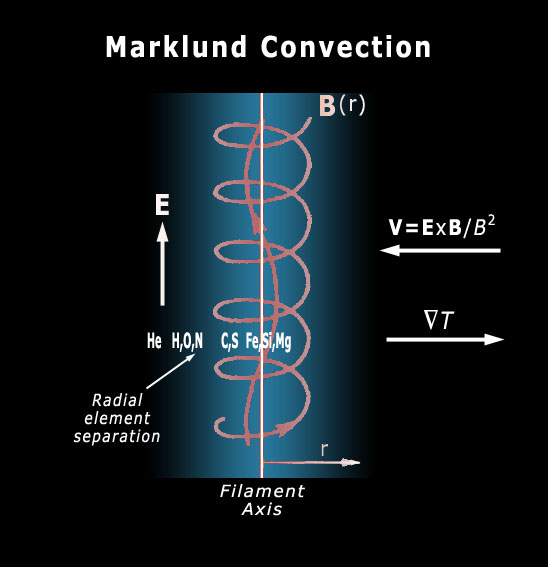
Marklund Convection

This diagram shows the true nature of the filaments inside the molecular cloud. The electric field vector (E) and helical magnetic field configuration (B) are shown. Inward Marklund convection of ions at velocity, V, across a temperature gradient, ∇T, is a mechanism for rapid filament formation and chemical separation in cosmic plasma so the heavy elements (“metals” in astrophysics-speak) are found on-axis and must therefore constitute the core matter of stars, not hydrogen!

In May last year in a similar star-forming cloud, Herschel uncovered an;

“impossible star in the act of formation… This is because the fierce light emitted by such large stars should blast away their birth clouds before any more mass can accumulate. But somehow they do form. Many of these ‘impossible’ stars are already known, some containing up to 150 solar masses, but now that Herschel has seen one near the beginning of its life, astronomers can use the data to investigate how it is defying their theories.”

The answer is simple. Astrophysicists’ theories bear no relation to reality. The luminosity of a star is not related to its massiveness because no nuclear fusion is taking place in its heavy element core. And the massiveness of a star is not related to its size because the photosphere is not a surface in the usual sense but rather an electric discharge phenomenon some distance above the surface of the star. There are no “impossible stars.”

The light of a star comes from the available electrical energy coursing along the enveloping Birkeland filaments. As for “sonic booms” caused by the pressure of light from the star, that force is negligible compared to the electromagnetic forces in the enveloping plasma. And any such collision would serve to further ionise the dust and gas and make it more susceptible to the electromagnetic force. However, if any reservation remains about the electrical environment of the Sun (and therefore all stars) then the following report should dispel that doubt.


Alfvén’s Solar Circuit Confirmed

On May 3, the New Scientist published an important article by Anil Ananthaswamy, “Strange cosmic ray hotspots stalk southern skies.”

Cosmic rays crashing into the Earth over the South Pole appear to be coming from particular locations, rather than being distributed uniformly across the sky. Similar cosmic ray “hotspots” have been seen in the northern skies too, yet we know of no source close enough to produce this pattern.

“We don’t know where they are coming from,” says Stefan Westerhoff of the University of Wisconsin-Madison. Westerhoff and colleagues used the IceCube neutrino observatory at the South Pole to create the most comprehensive map to date of the arrival direction of cosmic rays in the southern skies.
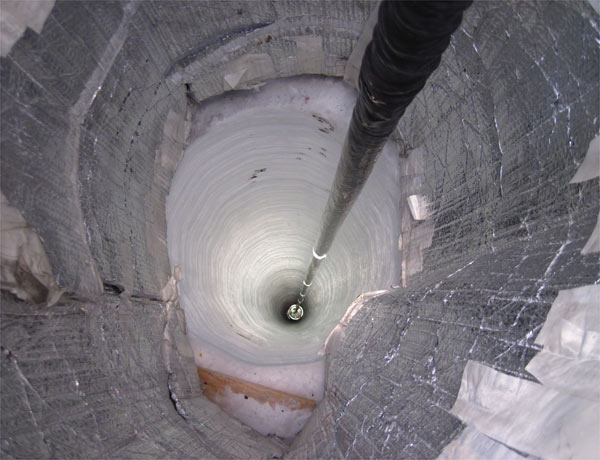
IceCube uses neutrino detectors buried at the South Pole.
IceCube uses neutrino detectors buried at the South Pole. IceCube detects muons produced by neutrinos striking ice, but it also detects muons created by cosmic rays hitting Earth’s atmosphere. These cosmic ray muons can be used to figure out the direction of the original cosmic ray particle. (Image: NSF/B Gudbjartsson).


Between May 2009 and May 2010, IceCube detected 32 billion cosmic-ray muons, with a median energy of about 20 teraelectronvolts (TeV). These muons revealed, with extremely high statistical significance, a southern sky with some regions of excess cosmic rays (“hotspots”) and others with a deficit of cosmic rays (“cold” spots).

Over the past two years, a similar pattern has been seen over the northern skies by the Milagro observatory in Los Alamos, New Mexico, and the Tibet Air Shower array in Yangbajain. “It is interesting that the pattern can be matched between [these experiments], at least qualitatively. They have very different techniques and systematic effects,” says cosmic-ray physicist Paul Sommers at Pennsylvania State University in University Park. “I regard those hotspots as a good mystery.”

It’s a mystery because the hotspots must be produced within about 0.03 light years of Earth. Further out, galactic magnetic fields should deflect the particles so much that the hotspots would be smeared out across the sky. But no such sources are known to exist.

In the 1920s Irving Langmuir and Harold Mott-Smith showed that in a discharge tube the plasma sets up a thin boundary sheath which separates it from a wall or from a probe and shields it from the electric field. The electric field in this sheath, or ‘double layer’ of separated charge, accelerates charged particles. In 1958 Alfvén suggested that this phenomenon might be important in space plasmas. Sources of cosmic rays situated along the Sun’s axes were predicted by Alfvén in 1986 in an IEEE publication and NASA Conference Publication 2469, “Double Layers in Astrophysics.” [Warning: 13 Mb pdf file]. He explains:

“Since the time of Langmuir, we know that a double layer is a plasma formation by which a plasma — in the physical meaning of this word — protects itself from the environment. It is analogous to a cell wall by which a plasma — in the biological meaning of this word — protects itself from the environment. If an electric discharge is produced between a cathode and an anode there is a double layer, called a cathode sheath, produced near the cathode that accelerates electrons which carry a current through the plasma. A positive space charge separates the cathode sheath from the plasma. Similarly, a double layer is set up near the anode, protecting the plasma from this electrode. Again, a space charge constitutes the border between the double layer and the plasma. All these double layers carry electric currents.”
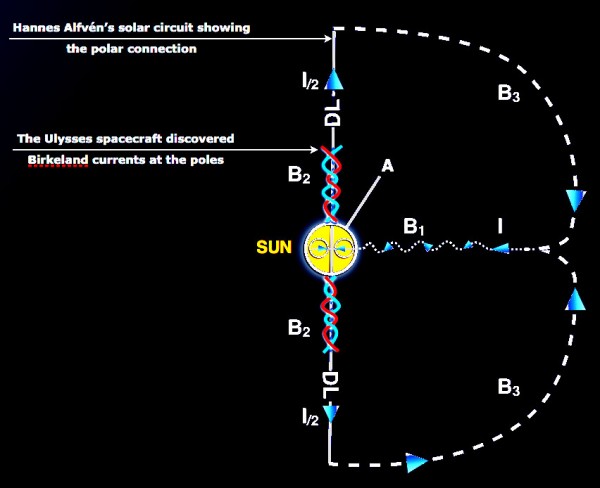
Alfvén’s Heliospheric Circuit.


Alfvén’s Heliospheric Circuit. The Sun acts as a unipolar inductor (A) producing a current which goes outward along both the axes (B2) and inward in the equatorial plane along the magnetic field lines (B1). The current must close at large distances (B3), either as a homogeneous current layer, or — more likely — as a pinched current. Analogous to the auroral circuit, there may be double layers (DLs) which should be located symmetrically on the Sun’s axes. Such double layers have not yet been discovered. Credit: Original diagram by H. Alfvén, NASA Conference Publication 2469, 1986, p. 27.

In the circuit model, it was noted that every circuit that contains an inductance is intrinsically explosive. This is true because a conductive circuit will tend to supply all of the inductive energy to any point of interruption of the circuit. Double layers are known to tend to interrupt current in a plasma. Hence, the entire energy of a circuit can be released at the point where a double layer forms regardless of the source of the energy of the circuit.

Because of their property of generating cosmic rays, synchrotron radiation, radio noise, and occasionally exploding, Alfvén proposed, “DL’s may be considered as a new class of celestial objects… For example, the heliospheric current system must close at large distances, and it is possible — perhaps likely — that this is done by a network of filamentary currents. Many such filaments may produce DL’s, and some of these may explode.” To give an idea of their omnipresence in space, DLs are implicated in the earth’s auroral regions, extragalactic jets, stellar jets, novae and supernovae, X-ray and gamma-ray bursts, X-ray pulsars, double radio sources, solar flares, and the source of cosmic ray acceleration.

It seems that Alfvén’s DLs have been detected in the form of “cosmic ray hotspots” generated in Birkeland current filaments “less than 0.03 light years” from the Sun. The hotspots should be found to align with the local interstellar magnetic field. The median energy of the cosmic rays reported at 20 TeV is within the range expected from a cosmic DL.



POSTSCRIPT: Alfvén didn’t go so far as to consider a star as an electrical discharge phenomenon. But if stars are electrically powered from a galactic circuit then the consequences of this fact alone for science and society are profound. We have been following a mirage of knowledge that leads into a desert of ignorance. Our story of the Sun is a myth. The holy grail of nuclear fusion energy “like the Sun” is a false trail. In fact our entire cosmology of the big bang, galaxy formation, the formation of the Sun and its family of planets, and the history of the Earth is fiction. It ignores the most powerful organizing electric force in favour of the feeblest force— gravity. Most of our ‘big’ science, like the costly fusion experiments and space missions, has been misdirected and wasteful. All sciences must be re-examined from a fresh interdisciplinary perspective based on an interconnected Electric Universe.

Hannes Alfven receiving his Nobel prize from the King of Sweden.

And a final word from Alfvén, who took the unprecedented step of predicting in his December 11, 1970 Nobel prize acceptance speech the eventual crash of astrophysics at the end of its long dark tunnel:

“In conclusion, it seems that astrophysics is too important to be left in the hands of theoretical astrophysicists who have gotten their education from the listed textbooks. The multibillion dollar space data from astronomical telescopes should be treated by scientists who are familiar with laboratory and magnetospheric physics, circuit theory, and, of course, modern plasma physics. More than 99 percent of the Universe consists of plasma, and the ratio between electromagnetic and gravitational forces is 1039.”
—H. Alfvén, NASA Conference Publication 2469, 1986, p. 16.


From Electric  Universe @ http://www.holoscience.com/wp/alfven-triumphs-again-again/


For more information about our electric universe see http://nexusilluminati.blogspot.com/search/label/electric%20universe
- Scroll down through ‘Older Posts’ at the end of each section


Hope you like this not for profit site -
It takes hours of work every day by a genuinely incapacitated invalid to maintain, write, edit, research, illustrate and publish this website from a tiny cabin in a remote forest
Like what we do? Please give anything you can -  
Contribute any amount and receive at least one New Illuminati eBook!
(You can use a card securely if you don’t use Paypal)
Please click below -


For further enlightening information enter a word or phrase into the random synchronistic search box @ the top left of http://nexusilluminati.blogspot.com


And see


 New Illuminati on Facebook - https://www.facebook.com/the.new.illuminati

New Illuminati Youtube Channel - http://www.youtube.com/user/newilluminati/feed


New Illuminati on Twitter @ www.twitter.com/new_illuminati


New Illuminations –Art(icles) by R. Ayana @ http://newilluminations.blogspot.com

The Her(m)etic Hermit - http://hermetic.blog.com


The Prince of Centraxis - http://centraxis.blogspot.com (Be Aware! This link leads to implicate & xplicit concepts & images!)


DISGRUNTLED SITE ADMINS PLEASE NOTE –
We provide a live link to your original material on your site (and links via social networking services) - which raises your ranking on search engines and helps spread your info further! This site is published under Creative Commons Fair Use Copyright (unless an individual article or other item is declared otherwise by the copyright holder). Reproduction for non-profit use is permitted & encouraged,  - if you give attribution to the work & author. Please include a (preferably active) link to the original (along with this or a similar notice).

Feel free to make non-commercial hard (printed) or software copies or mirror sites - you never know how long something will stay glued to the web – but remember attribution!

If you like what you see, please send a donation (no amount is too small or too large) or leave a comment – and thanks for reading this far…

Live long and prosper! Together we can create the best of all possible worlds…


From the New Illuminati – http://nexusilluminati.blogspot.com

Saturday, 24 January 2009

NASA’s Dim View of Stars: Electric Universe

NASA’s Dim View of Stars
Electric Universe

"..astronomers can tell the temperature of the central regions of the Sun and of many other stars within a few percentage points and be quite sure about the figures they quote."  - A Star Called the Sun, George Gamow.


 IMAGE

The Cone Nebula is a column of dark dust, six light-years long, near some newly formed hot blue stars. The edge of the column, especially the tip, is bright with red light from ionized hydrogen. This nebula and the cluster that illuminates it are about 2600 light-years away in Monoceros. Credit: Michael Gariepy/Adam Block/NOAO/AURA/NSF. 
 
The cone nebula shows a star at the top of a conical-shaped dusty plasma, festooned with lights. The image strikes an instinctive chord—the mythical celestial world mountain around which the stars revolve; the cosmic (Christmas) tree with lights; fireworks displays against a night sky. Why? Because it reflects back to us our own prehistory when a strange drama was taking place in the sky. 

The Earth was enveloped in a towering polar auroral plasma, flashing with light and with bright celestial bodies at its distant focus. How do we know? Prehistoric mankind around the globe chiselled representations of what they saw into solid rock. The effort required was prodigious, the motivation extraordinary. Modern astronomy seems unable to address the issue, offering instead a comfortable myth of cosmic stability.

Twentieth century technologies have enabled astronomers to see the stars and planets ever more clearly, but their perceptions are clouded by centuries-old beliefs about celestial harmony; that the heat and light of stars is due to some kind of internal fire; that we understand gravity sufficiently to declare that it obeys a universal law and alone governs cosmic evolution. These perceptions have become dogma and dogma hinders progress. So it is not surprising that a growing number of critics see gravitational cosmology of the “Big Bang” as sterile and irrelevant to any real understanding of our place and history in the universe. The fact that it has nothing to say about life itself—the deepest mystery of the universe—is just one of countless signs that the present field of view is too limited.


For the moment I want to feature two reports in December that show astronomers do not understand stars. The view of stars as ‘fires in the sky’ was understandable when chemical fires were the only source of light that we knew & the only question we asked of stars was ‘how do they shine? But that view failed when we realized that stars had to burn steadily for aeons. The discovery of nuclear energy offered an answer to this new question without having to re-evaluate the accumulation of other assumptions about stars.


The thermonuclear assumption was never proved, and observations that contradicted it were never crucial enough to compel astronomers to doubt it. It came full circle and led to a futile decades-long effort to mimic the conjectured process to provide power on the Earth. All the while, a clue to a better answer stared the experimenters and theoreticians in the face: they were using electricity to trigger thermonuclear reactions; maybe the Sun was doing that, too.


We use electricity as a convenient means of lighting and heating that doesn’t require the power to be generated on site. We’ve discovered that thin transmission lines can carry great amounts of power over long distances from generator to light bulb. Nature is parsimonious in achieving its ends; why wouldn’t stars get power from natural transmission lines? The satisfying answer is that they do. Radio astronomers can trace the telltale magnetic fields in deep space. The magnetic fields mark filamentary cosmic ‘transmission lines’ carrying electrical power between galaxies and stars.


IMAGE
 Planetary nebula M2-9. The complex Z-pinch hourglass shape of the external circuitry of a star becomes visible in a planetary nebula where the galactic power is high enough or the plasma is dusty. Gravitational models of stars fail to explain the fine detail of planetary nebulae.

NASA’s Dim View of Stars
The latest report from NASA is a fitting end to The Year of The Electric Universe. It demonstrates that the electric model of stars envisaged the latest observations while NASA researchers again mask their assumptions by stating them as facts. Ironically, the report refers to some stars as “low-energy fluorescent light bulbs.”

As usual, all the science reporting agencies repeat NASA’s words without critical comment. Mainstream media rarely do investigative science journalism. The NASA report follows, along with my comments.


 Astronomers Find the Two Dimmest Stellar Bulbs


IMAGE
 This artist's concept shows the dimmest star-like bodies currently known -- twin brown dwarfs referred to as 2M 0939. The twins, which are about the same size, are drawn as if they were viewed close to one of the bodies. Picture credit: NASA/JPL-Caltech.
 
It's a tie! The new record-holder for dimmest known star-like object in the universe goes to twin "failed" stars, or brown dwarfs, each of which shines feebly with only one millionth the light of our sun.


Comment: As we shall see, the notion of “twin failed stars” is a theoretical assumption and not a fact!


In an Electric Universe there is no such thing as a “failed” star. They have no thermonuclear “engine” to fail. All bodies in the galaxy receive external electrical energy from the galactic circuit. Radio astronomers (for the most part unwittingly) trace the circuit by mapping the magnetic fields of galaxies and stars, which fields are generated by the electric current flowing in the circuit. The circuits are unrecognized due to the mistaken conviction that magnetic fields can be ‘frozen in’ to plasma. The ‘father’ of plasma physics, Hannes Alfvén, appealed against this mistaken notion in his Nobel Prize acceptance speech in 1970. But to give up this false belief would require discarding decades of theoretical work and reputations built upon it.


The report continues:

Previously, astronomers thought the pair of dim bulbs was just one typical, faint brown dwarf with no record-smashing titles. But when NASA's Spitzer Space Telescope observed the brown dwarf with its heat-seeking infrared vision, it was able to accurately measure the object's extreme faintness and low temperature for the first time. What's more, the Spitzer data revealed the brown dwarf is, in fact, twins.


"Both of these objects are the first to break the barrier of one millionth the total light-emitting power of the sun," said Adam Burgasser of the Massachusetts Institute of Technology, Cambridge. Burgasser is lead author of a new paper about the discovery appearing in the Astrophysical Journal Letters.


Brown dwarfs are the misfits of the cosmos. They are compact balls of gas floating freely in space, but they are too cool and lightweight to be stars, and too warm and massive to be planets. The name "brown dwarf" comes from the fact that these small, star-like bodies change color over time as they cool, and thus have no definitive color. In reality, most brown dwarfs would appear reddish if they could be seen with the naked eye. Their feeble light output also means they are hard to find. The first brown dwarf wasn't discovered until 1995. While hundreds are known today, astronomers say there are many more in space still waiting to be discovered.


Comment: All stars are an electrical phenomenon. There are no “misfits” in an Electric Universe. All of the assumptions being heaped upon the meagre photons received from deep space merely serve, as usual, to force fit the data to the standard model of stars. The very name, brown “dwarf,” assumes that these stars are “compact balls of gas floating freely in space.”


In stark comparison, the electric model describes them as “huge” because the light from a star is a plasma discharge phenomenon with only a loose relationship to the physical size of the star and a strong dependence on the electrical environment. Brown dwarfs do not simply cool down over time and wink out. They are externally powered electric lights.


In December 1999 I wrote, “The apparent size and color of an electric star is an electrical phenomenon. If Jupiter's magnetosphere were lit up it would appear the size of the full Moon… The light of a red star is due to the distended anode glow of an electrically low-stressed star… Red Giants are a more visible and scaled-up example of what an L-type Brown Dwarf star might look like close-up.”


The report continues:
 
Astronomers recently used Spitzer's ultrasensitive infrared vision to learn more about the object, which was still thought to be a solo brown dwarf. These data revealed a warm atmospheric temperature of 565 to 635 Kelvin (560 to 680 degrees Fahrenheit). While this is hundreds of degrees hotter than Jupiter, it's still downright cold as far as stars go. In fact, it is one of the coldest star-like bodies measured so far.


To calculate the object's brightness, the researchers had to first determine its distance from Earth. After three years of precise measurements with the Anglo-Australian Observatory in Australia, they concluded that the star is the fifth-closest known brown dwarf to us, 17 light-years away toward the constellation Antlia. This distance, together with Spitzer's measurements, told the astronomers the object was both cool and extremely dim.

But something was puzzling. The brightness of the object was twice what would be expected for a brown dwarf with its particular temperature. The solution? The object must have twice the surface area. In other words, it's twins, with each body shining only half as bright, and each with a mass of 30 to 40 times that of Jupiter. Both bodies are one million times fainter than the sun in total light, and at least one billion times fainter in visible light alone.


"These brown dwarfs are the lowest power stellar light bulbs in the sky that we know of," said Burgasser. "And like low-energy fluorescent light bulbs, they emit most of their light in a narrow range of wavelengths, in this case in the infrared."


Comment: Burgasser’s description of brown dwarfs as “low-energy fluorescent light bulbs” is the closest he comes to the truth. Like fluorescent lights, brown dwarfs require electricity! And the solution to the problem is simple—a single red dwarf with a distended red anode-glow can provide the extra brightness without postulating an unlikely twin.


The report continues:
 
According to the authors, there are even dimmer brown dwarfs scattered throughout the universe, most too faint to see with current sky surveys. NASA's upcoming Wide-Field Infrared Survey Explorer mission will scan the entire sky at infrared wavelengths, and is expected to uncover hundreds of these inconspicuous characters.


"The holy grail in the study of brown dwarfs is to find out how low you can go in terms of temperature, mass and brightness," said Davy Kirkpatrick, a co-author of the paper at NASA's Infrared Processing and Analysis Center at the California Institute of Technology, Pasadena. "This will tell us more about how brown dwarfs form and evolve."

Comment: In an Electric Universe, stars do not evolve. The notion of stellar evolution and the age of stars is an invention of the standard thermonuclear model of stars. And for so long as scientists cling to an unworkable theory of stellar formation by gravitational accretion, new findings will serve only to add to the confusion.


I predict that further discoveries by the Wide-Field Infrared Survey Explorer in this category will require the same ad hoc assumption that the radiant surface area, based on standard theory, must be accommodated by multiple star systems. The odds against finding so many multiple systems will become astronomical.


 Success for the Electrical Model of White Dwarf Stars

IMAGE
The Hertzsprung-Russell diagram is a plot of observations which must be explained by the chosen model of stars. The electrical model of stars reverses the direction of the x-axis to show the direct relationship between an increase in current density at the surface of a star and the higher temperature of that star, reflected by its change in color from red hot to white hot to blue hot.


The main sequence is the backbone of the observations but there are sharp discontinuities between the main sequence, the giant stars and white dwarfs. In the standard thermonuclear model of stars, the explanations for these discontinuities are beset by many observational discrepancies and ad hoc patches.

In the electric star model such discontinuities are a natural feature of a plasma discharge. Main sequence stars operate like arc lights in a cinema projector. The plasma discharge at their photospheres is in arc mode. The main sequence is a direct result of increasing the current density at the surface of a star.


The white dwarfs operate more like fluorescent lights, where a fainter coronal glow-mode discharge provides the light. If you can imagine the Sun’s bright photosphere being replaced by faint white coronal light, you have the picture. White ‘dwarfs’ are not dwarfs at all. They are faint, not because they are small but because they produce their light in a different mode of plasma discharge from stars like the Sun. The current density scale for white dwarfs is different to that of the main sequence and this is why they are scattered along a lower-luminosity sequence.


In the case of giant stars, the star’s ‘surface’ is bloated like the glow of a neon light as the star seeks to satisfy its current requirements. The red light comes from a low current density at the large diameters of the (virtual) anode of these stars.


The stellar thermonuclear evolutionary story is that a star of intermediate mass (1-8 solar masses) terminates its life as an Earth-sized white dwarf after the exhaustion of its nuclear fuel. During the transition from a nuclear-burning star to the white dwarf stage, the star collapses to about one fiftieth of the solar radius and becomes very hot. Many such objects with surface temperatures around 100,000 Kelvin (K) are known. Theories of stellar evolution predict that these stars can be much hotter. However, the probability of catching them in such an extremely hot state is low, because this phase is short-lived.


An article was published on December 12 this year in Astronomy & Astrophysics Letters which claims to have discovered one of these white dwarfs, “one of the hottest stars ever known with a temperature of 200,000 K at its surface.” The temperature is deduced from the emission from nine-fold ionized calcium atoms thought to be in the star’s photosphere. It is the highest ionization level of a chemical element ever discovered in a photospheric stellar spectrum.


The stellar atmosphere modelling of a white dwarf based on thermodynamic equilibrium will give erroneous conclusions because charged particles in an electric field will be dethermalized (their random motion reduced while their kinetic energy increases). So it easy for a white dwarf to multiply ionize calcium atoms because the electrical energy required is equivalent to a mere 211 electron volts and not random thermal energy equal to a temperature of 200,000 to 300,000 K. Using thermal (mechanical) energy is the most difficult and unlikely way of explaining the data.


The white dwarf also challenges the standard stellar evolution concepts because it has a chemical surface composition rich in calcium and helium that is not predicted by stellar evolution models. A paper in the Astrophysical Journal of February 2005 shows the surprise and confusion created by this star. As usual, mechanical energy in the form of a supposed “shocked wind” is proposed as the origin of weak X-ray emission at 1 keV. And despite the almost infinite number of “knobs” available to twiddle on the standard model, a match with observations has not been reached.


The obstacle to an understanding of white dwarfs comes from using heat (mechanical energy) from within a star to explain highly energetic phenomena outside the star. It is precisely the difficulty encountered with the Sun and its phenomenally hot corona. The conceptual hurdle is exemplified by the paradigm set out in the introduction to the above paper: “The hot 106-107 K coronae on the Sun and other late-type stars are  


believed to be sustained by mechanical energy in their outer convection zones, which is dissipated at the surface through the medium of magnetic fields generated and amplified by differential rotation and convection in the interior.” [Emphasis added].

In other words, our present understanding of the Sun and therefore most other stars is based on this simple belief that to this day has not been verified. In this circumstance it would be scientifically responsible to question that belief when new data fails to satisfy predictions. As Eddington, the theoretician who gave us the standard model of stars, wrote of white dwarfs when first discovered, “Strange objects, which persist in showing a type of spectrum entirely out of keeping with their luminosity, may ultimately teach us more than a host which radiates according to rule.” But beliefs are very difficult to shift.


In July this year I wrote, “A white dwarf is a star that is under low electrical stress so that bright ‘anode tufting’ is not required. The star appears extremely hot, white and under-luminous because it is equivalent to having the faint white corona discharge of the Sun reach down to the star’s atmosphere. As usual, a thin plasma sheath will be formed between the plasma of the star and the plasma of space. The electric field across the plasma sheath is capable of accelerating electrons to generate X-rays when they hit atoms in the atmosphere. And the power dissipated is capable of raising the temperature of a thin plasma layer to tens of thousands of degrees.”


Of course, this model will need to be reviewed in the light of new data. But at least it is a new, quite different model that easily meets the basic observational fact of high-energy phenomena outside a star. The strong magnetic fields of some white dwarfs are diagnostic of external electric currents. The spectral line broadening indicates the presence of a strong electric field in the light-emitting region. The electrical energy focussed on the white dwarf is dissipated in an extensive, cool corona instead of a hot, arc-tufted photosphere.


So it is significant that the spectrum of the white dwarf in the cited paper was interpreted as “evidence that the X-rays originated not from deeper atmospheric layers but from a coronal plasma encircling the star.” The white dwarf “became the first white dwarf thought to have a corona, albeit a cool one.” The weak X-ray emission is attributed, in ad hoc fashion, to “a shocked wind.” It’s like a dentist using a jet engine to X-ray your teeth.


The presence of anomalies in the star’s spectrum, both in the elements present and their state of ionization, is more accurately explained by the electrical model of stars, which have a cool core of heavy elements. The authors note, “a coronal model requires a total luminosity more than two orders of magnitude larger than that of the star itself.” An electric white ‘dwarf’ emits light from both the corona and the thin, brighter plasma sheath that forms its photosphere.


An electric white dwarf is a far simpler model than the “collapsed degenerate stellar corpse” model. The star is not “dying.” It has not evolved from another type of star. It is not an impossible object—a Sun squeezed to twice the diameter of the Earth. Stars cannot suffer gravitational collapse to a theoretical form of ‘degenerate matter’ that has never been observed—where atoms are squeezed together so strongly that only electrons in adjacent atoms prevent further collapse because they cannot share orbits. Just how far-fetched this notion is can be gauged if we consider that the electric repulsive force exceeds the gravitational force by 39 orders of magnitude!!


Subrahmanyan Chandrasekhar was awarded the Nobel Prize in 1983 for his theoretical work on electron degenerate white dwarfs, which predicted the existence of a relationship between mass and radius for a degenerate white dwarf. This theoretical mass-radius relation is a generally accepted underlying assumption in nearly all studies of white dwarf properties. In turn, these studies, including the white dwarf mass distribution and luminosity function, are foundations for such varied fields as stellar evolution and galactic formation. The notion of stellar collapse led on to more extreme theoretical fictions—neutron stars and black holes. The damage wrought by such an assumption for our understanding of stars and the cosmos cannot be overstated! A recent paper in The Astrophysical Journal warned, “One might assume that a theory as basic as stellar degeneracy rests on solid observational grounds, yet this is not the case. Comparison between observation and theory has shown disturbing discrepancies.” The paper cited here adds to the discrepancies. 

 
IMAGE
In summary: nearby red and white stars that appear faint are not different to other stars. Red dwarfs are physically much smaller than the Sun but their visible glow discharge is large and of low current density and energy (red). 
 

White ‘dwarfs,’ on the other hand, are physically larger than red dwarfs but generally smaller than the Sun. Lacking bright anode tufting they have an extended coronal type discharge and photosphere that emits faint whitish light, ultraviolet light and mild X-rays. The spectral lines are broadened, sometimes to the point of disappearance, due to the coronal electric field. This gives the misleading impression that hydrogen (whose spectral lines are smeared the most) is missing in many of these stars and that therefore they are remnants of larger stars that have lost or burned their hydrogen fuel.


Significantly, the larger the white dwarf, the lower the current density and the lower the apparent temperature. This trend has been noted with some puzzlement by researchers. White dwarfs the size of the Sun and a little larger are stars under lower electrical stress than normal. This may occur, for example, in binary star systems like that of Sirius, where one star usurps most of the available electrical energy.


There are no collapsed stars of extraordinary high density. The story of stellar evolution is fiction. The numbers of small red and white stars exceed the number of bright stars. They are formed in the same Z-pinch mechanism in dusty plasma as are all other stars. Or they may be born later by parturition (nova) of an unstable larger star. The economy and success of the Electric Universe model is readily apparent.

The Electric Universe paradigm continues its successful run of discovery and prediction in 2008

In January I declared 2008 The Year of the Electric Universe. And so it has proved to be. Confirming and supportive evidence arrives almost daily. Along with my associated THUNDERBOLTS.INFO website we attract tens of thousands of visitors each month. This month set a new record. The scientific literacy of visitors is exceptionally high, and a consistent pattern has emerged, verified by hundreds of comments. When newcomers compare the direct evidence for the Electric Universe to conventional interpretations of the same data, offered here and in “Thunderbolts Picture of the Day,” the conclusion becomes clear. We do indeed live in an Electric Universe.


The Thunderbolts Project is attracting volunteers and people wanting to undertake serious study to further their understanding of plasma and the Electric Universe. New books, educational e-books and videos are being produced and a Japanese version of Thunderbolts of the Gods is due to go on sale in that country early in the new year.


The future is bright in an Electric Universe! 


 - Wal Thornhill   

From http://www.holoscience.com/news.php?article=b8zgwr0h  


For further enlightening info enter a word or phrase into the search box @  New Illuminati @  http://nexusilluminati.blogspot.com or click on any tag at the bottom of the page for more direct references

And see

The Her(m)etic Hermit - http://hermetic.blog.com


This material is published under Creative Commons Copyright (unless an individual item is declared otherwise by copyright holder) – reproduction for non-profit use is permitted & encouraged, if you give attribution to the work & author - and please include a (preferably active) link to the original along with this notice. Feel free to make non-commercial hard (printed) or software copies or mirror sites - you never know how long something will stay glued to the web – but remember attribution! If you like what you see, please send a tiny donation or leave a comment – and thanks for reading this far…

From the New Illuminati – http://nexusilluminati.blogspot.com