Liberation from Civilization!
Preparing for Civilization's End

,
by Dave Pollard
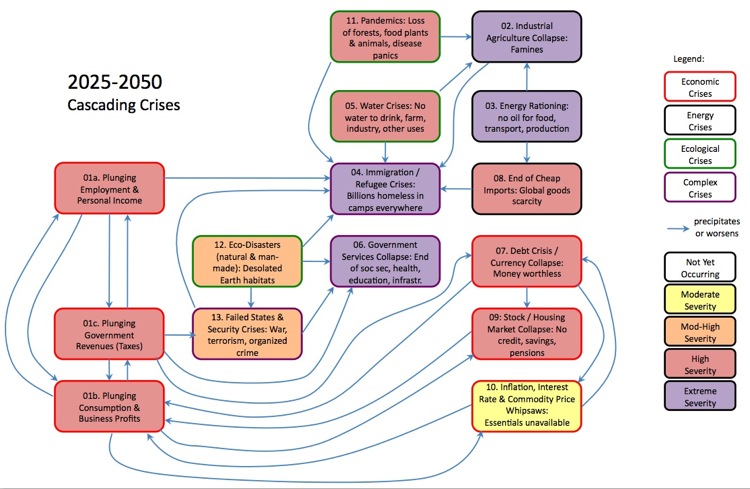
third chart in my collapse
scenario for civilization
For many years the thesis of [my] blog has been: Our civilization is in its final century, and there is nothing we can do to prevent its collapse. When I began writing this, I was largely dismissed as a defeatist and a depressed ‘doomer’ (or worse). As awareness has grown about the now-inevitable end of (a) cheap energy, (b) stable climate and (c) the growth economy, there is a growing acknowledgement that the collapse scenario I have written about is at least conceivable.
This acknowledgement tends to come from people fortunate enough to have the intellectual curiosity, critical thinking ability, undiminished instincts, and time to study and learn how the world really works (not how we are told it works by those powerful and moneyed interests best served by denying the extent and potential impact of these crises and prolonging as long as possible the current unsustainable way we live). And to the extent those knowledgeable people find their way to this blog, they tend to ask the same question:
If the collapse of industrial civilization cannot be prevented, what should we do now?
In a way, much of what I’ve written on this blog is an attempt to answer that question, without being too presumptuous, and appreciating that there is no one right answer to it. My answer: Liberate myself, from civilization’s bonds and destruction, before it collapses on top of me.
Here’s what I’m doing to that end:
1.
Understanding what is really going on now
The newspapers and the other media, including most of the independent and progressive media, are of little help in this regard. Here’s what I have written before about more useful reading:
Our world (like all ecological and social systems) is inherently, staggeringly and wonderfully complex, but everything we are taught about the world and how it works (in schools, and in the mainstream media) is reduced to simplistic, mechanistic terms. We continue to believe that “the environment” (something that is portrayed as somehow apart from us) is just facing “problems” that need “solutions” (political, economic, scientific, technological, or spiritual). In complicated systems (like your car), “problems” can be fixed. But in complex systems there are no problems, only predicaments, unintended consequences of actions that cannot be undone.
Nature teaches us (if we will only listen) that we don’t fix a predicament, we adapt to it. The reason so many of our modern crises are so wicked and intractable is that they are not problems, but predicaments, unintended consequences of (mostly) well-intended human actions. To understand how the world really works, and how we can start to learn to adapt to our modern predicaments, we need to understand complexity.
With that context, of the need for adaptation rather than futilely chasing “solutions”, these are the books and articles that have given me a better understanding of how the world really works and what to do about it. Seven books, which I read in approximately this order, have been the most illuminating:
1. Full House, by Stephen
J. Gould. The improbable emergence of humans on Earth.
2. Story of B, by Daniel Quinn.
A radical revisionist history of civilization, in fictional format, and an
explanation of how we got to where we are now.
3. A Language Older Than
Words, by Derrick Jensen. A dark explanation of the reason for the core of
grief at the heart of the modern age.
4. A Short History of Progess,
by Ronald Wright. Why all civilizations collapse. A survey of past civilizations’
savagery and short-term thinking. Jared Diamond but shorter.
5. Against the Grain, by
Richard Manning. Why Jared Diamond said monoculture agriculture was the
greatest mistake in human history, and what it’s come to now.
6. Straw Dogs, by John Gray.
While we have a responsibility to try to make the world better and joyful, for
those we love and leave behind, we cannot be other than what we are: a fierce,
brilliantly adaptable species destined to bring about the next great
extinction, and annihilate ourselves in the process.
7. The Long Emergency, by James
Kunstler. What the near future will look like when this century’s looming
ecological, economic, political and resource crises begin to cascade.
2. Acquiring
essential knowledge and abilities for living sustainably in community
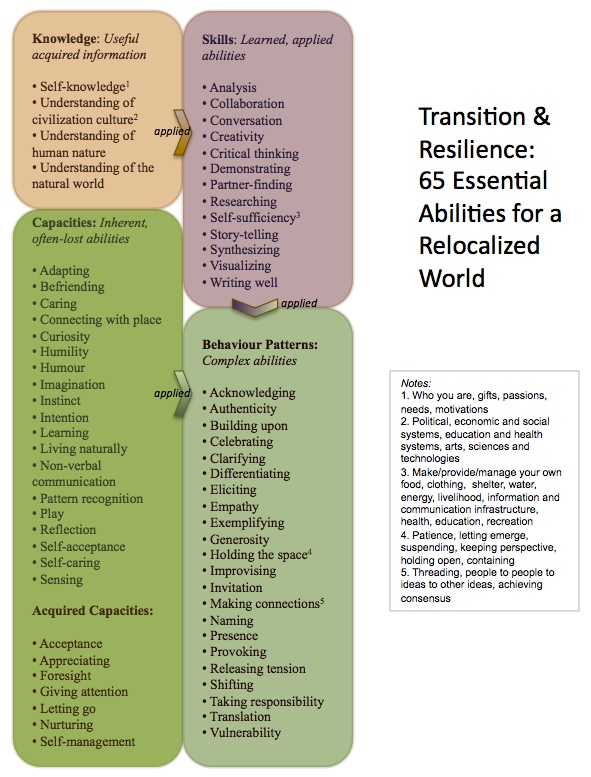
As the collapse worsens, large, centralized institutions (corporations, governments, universities, social services, banks etc.) will start to fall apart, as their analogues did in previous dying civilizations. As this happens we will need to re-acquire the knowledge and skills of resilience and community-based, sustainable self-sufficiency. We will have to reinvent local, small-scale institutions within our communities to do all the things we now depend on large, far-away organizations to do for us.
The knowledge we will need includes, first and foremost, knowledge about ourselves: Our strengths, motivations, needs and personality traits. It also includes knowledge of what we’re meant to do in this world, which entails knowing what we are uniquely good at, what we love doing, and what the world needs now that isn’t being provided, or at least not sustainably so. That kind of self-knowledge can’t be learned in books: It requires experiment, exploration, research, discovery, taking risks, just trying things. It’s taken me a lifetime to figure out. There’s a great Jessica Hische poster circulating on Google+ that suggests “The work you do while you procrastinate is probably the work you should be doing for the rest of your life.”
Some of the skills we’ll need are technical skills (like growing our own food, making our own clothes and repairing things instead of replacing them), but more of them are ‘soft’ skills and personal and collaborative capacities that we were born with (like curiosity), or which our ancestors learned just to get along in their local communities (like presence, and empathy), but which we no longer learn in our disconnected, fragmented, hyper-competitive society. I created the chart above and this downloadable checklist, to self-assess which of these abilities I have, which I would look for in community partners, and which I aspire to acquire or practice.
One of the critical abilities on this list is the ability to learn. To acquire it, and to instill it in our children, we may all need to deschool ourselves and unschool them. I was fortunate enough to experience a year of unschooling, but completely deschooling myself will be a lifelong endeavour.
When our economic systems collapse, our investments, currencies and commodities will become worthless, so I’m investing in learning instead.
3.
Reconnecting with the Earth, with my instincts and senses, with the place I
live and the other creatures who live there
Our civilization tries to break the bond between us and the natural world. We are taught that the “environment” is something apart from us. Before I can really understand what is happening and what I can and must do about it, before I can be ready to face the enormous challenges ahead in ways other than denial and attempts to perpetuate the status quo, I need to reconnect, to re-become a part of all life on Earth, to see just how empty, meaningless and intolerably destructive our consumerist industrial civilization really is. I need to become centred, aware, and outraged.
There are many ways to reconnect, and each of us must find the way that works for us. Joanna Macy teaches courses in reconnection, based on the principles of appreciation, presence, and openness. Eckhart Tolle and Richard Moss describe meditation-based ways to live in the Now, instead of being paralyzed by the past or fixated on the future as so many humans have become. Derrick Jensen talks about listening to the land. David Abram shows us how to rediscover the spell of the sensuous by paying attention to the natural world until we just melt into it, become part of it.
This is a long and difficult journey. I’m still trying to find my own way.
4. Living as
sustainably and responsibly as possible
Here’s Keith Farnish’s summary of how to do this, which is advice I follow seriously:
Don’t buy anything that you don’t need. If you have to buy something, remember the 4 R’s: Reduce, repair, reuse and respect. Become vegan, or as near as you can to remain healthy. Buy local. Eat simply. Reduce the energy used in your home to the bare minimum. Change your behaviour to allow for this. Become energy independent. Have fewer [than replacement level] children. Travel as little as possible. Don’t fly. Don’t drive. Instead: walk, cycle, use the bus, go by train.
I could do better, but I’m working consciously at it, every day. I understand that this is not enough to make much of a difference, even if everyone in the world could and would do so. But it is still necessary. I feel I must try to stop feeding the machine of industrial civilization, and at the same time try to minimize my personal contribution to the damage that civilization inflicts upon the world, as the sixth great extinction of life on Earth continues to accelerate. I am striving to become a model of a better, more responsible, more sustainable way to live.
5. Daring to tell the truth, and showing others how to prepare for collapse
 Talking about the
collapse of industrial civilization as inevitable, in “polite company”, takes courage. Most
people don’t understand, and don’t want to. They want to believe that the
future will be wonderful, that ‘leaders’ will fix what’s broken in the world.
As Kenny Ausubel and Nina Simons explain, I have to get past the internalized
oppression that I carry inside me, the fear of saying and talking about what I
most care about, even though doing so makes me vulnerable and may expose me to
disbelief and even ridicule.
Talking about the
collapse of industrial civilization as inevitable, in “polite company”, takes courage. Most
people don’t understand, and don’t want to. They want to believe that the
future will be wonderful, that ‘leaders’ will fix what’s broken in the world.
As Kenny Ausubel and Nina Simons explain, I have to get past the internalized
oppression that I carry inside me, the fear of saying and talking about what I
most care about, even though doing so makes me vulnerable and may expose me to
disbelief and even ridicule.I have found it easiest to begin by talking with others that seem to get it — people in the Transition initiative, people living in intentional community and people living an alternative culture lifestyle. But I’ve discovered that even these relatively enlightened people don’t really grasp the speed, extent and inevitability of collapse, and, as a result, are mostly clueless about what really needs to be done. It’s easy to get disheartened, and to stay silent, complicit with the inadequacy of our response to the cataclysm we have unleashed on this planet.
I am striving, through this blog and in my daily conversations, to make the discussion of our civilization’s inevitable collapse and the preparations we need to begin now to equip ourselves and our children for a post-collapse world, part of mainstream social discourse. I will continue to do so until a critical mass of people turn off their TVs and stop listening to the propaganda and denial of the media, corporations and politicians. I believe that the creation of the self-sufficient communities we will need after collapse will only begin when we are ready, in large numbers, to talk about it. I am not optimistic that this will happen in time, but I have to try.
And recently, I am beginning to have this discussion in a new light: Not the grim business of surviving a long series of cascading crises, but the joyful business of liberating ourselves from a way of living that has never been right for us, and which has always been constraining, oppressive, debilitating, and horrifically destructive to our world and to our souls.
6. Fighting
back against those destroying the Earth
I have met many of the ‘leaders’ whose actions and organizations are destroying the Earth. I have met few who are doing so intentionally. Many of my post-civ writer colleagues believe that if we’re going to shake ourselves out of our complacency we have to get angry, have to identify the perpetrators of destruction and confront them with all our energy and will. I can’t sustain that kind of anger, but I have no illusions about the fact that we are destroying this planet, so quickly and utterly that its recovery to full health will take centuries, even millennia, after we’re gone. And that destruction is causing unimaginable amounts of suffering.
My passion to reduce suffering motivates me more than anger. So that’s the motivation I’m trying to draw on, to put to work fighting back against the destruction.
The ways in which anyone chooses to fight depend on their personal passions, energy, time and appetite for risk. I’ve decided it’s important to avoid getting sucked into methods of fighting that don’t work (petitions, writing letters, protest demonstrations, and donations to environmental groups seem to me to be usually ineffective, which is why I guess they are the most tolerated forms of activism). I’ve decided it’s equally important that I not exhaust myself quickly (e.g. by getting caught and arrested) — this will be a long fight.
We each must select our own battles and what tactics we’re willing to use. I plan to do my part to fight the Alberta Tar Sands and factory farming, but I’m not yet sure how I will do that. My sense is that I need to meet and collaborate with others who have chosen the same battles. My sense is that guerrilla tactics that capitalize on the vulnerability of civilization’s massively centralized, globalized, hyper-efficient systems will work better than direct confrontation or symbolic actions, no matter how well covered or clever the latter may be.
What matters, I think, is results — less destruction, less suffering, a less ghastly transition to a post-civilization world.
7. Living
joyfully
Lately I have been writing a lot about living more joyfully: Spending time with people I love in gentle, natural, beautiful places. Filling my day with healthy, natural pleasures. Finding and conversing with bright, informed, creative people. Learning to laugh, and let go. Playing.
I don’t see this as being at odds with preparing for civilization’s end. Just as I seek to be a model of responsible, sustainable living, I also want to be a model of joyful living. I want to show others that there is a better way to live, a way that does not depend on consumption and acquisition and ownership of stuff for gratification, for fulfillment, for pleasure, for joy. For all the material wealth it bestows on a fortunate few, our civilization is too often a joyless place, a place of endless insecurity, anxiety, envy and despair. The laughter I hear is mostly forced, mean-spirited, alcohol-induced, and almost desperate.
Living a simple, joyful life is not only exemplary, it is essential, I think, to keeping our sanity and our energy in a world seemingly gone mad with acquisitiveness, escapism, violence, war, competition, arrogance, fear, sadness and anger. We need our wits, and our strength, for the challenges ahead.
. . . . .
Liberation
All seven of these actions — (1) understanding what is really going on, (2) acquiring essential knowledge and abilities, (3) reconnecting with the Earth, (4) living responsibly, (5) showing and telling others why and how to prepare for collapse, (6) fighting back against the destruction, and (7) living joyfully, are aspects of what I am now calling my liberation from civilization. They are analogous to seven steps one might go through to liberate oneself from an abusive spouse or relative.
I feel for that reason ambivalent about liberating myself from civilization. I have become dependent on it. For most of my life I felt it treated me pretty well. Or maybe not — maybe it was just, like an abusive spouse, psychopathically clever at convincing me it was good for me. Part of me says liberation is scary. Not ready to change yet.
But the other part of me, responding to Gaia’s quiet and unwavering voice, cries out for liberation. I long to be feral. As anarchist writer Wolfi Landstreicher wrote:
In a very general way, we know what we want. We want to live as wild, free beings in a world of wild, free beings. The humiliation of having to follow rules, of having to sell our lives away to buy survival, of seeing our usurped desires transformed into abstractions and images in order to sell us commodities fills us with rage. How long will we put up with this misery? We want to make this world into a place where our desires can be immediately realized, not just sporadically, but normally. We want to re-eroticize our lives. We want to live not in a dead world of resources, but in a living world of free wild lovers. We need to start exploring the extent to which we are capable of living these dreams in the present without isolating ourselves. This will give us a clearer understanding of the domination of civilization over our lives, an understanding which will allow us to fight domestication more intensely and so expand the extent to which we can live wildly.
This yearning to be feral is something I feel every time I see a bird or wild animal, every time I harvest and eat wild, raw, pure food, every time I walk in the woods, and every night when I sleep outdoors, naked. It is a yearning to be free, free of a civilization which, with the best of intentions, has abused me, enslaved me, placed a veil between me and the natural world, as it has for everyone.
We can’t prevent civilization’s collapse, but we can still make the world a better place as it falls, and, despite our justifiable fears of the suffering its collapse will surely cause (much as its awesome and brutal reign has) celebrate its fall, and our liberation.
(this article is an attempt to shorten, personalize and update my signature post A Framework for Personal Action)
From How to Save the World @ http://howtosavetheworld.ca/2011/07/19/liberation-from-civilization/
For more information about new views of evolution see http://nexusilluminati.blogspot.com/search/label/
- See ‘Older Posts’ at the end of each section
YOU can help this unique
independent website stay online from a small cabin in a remote rainforest
Donate any amount and receive at least one New Illuminati eBook!
Please click in the
jar -
Xtra Images – http://cdn.thedailybeast.com/content/newsweek/2011/10/30/niall-ferguson-how-american-civilization-can-avoid-collapse/_jcr_content/body/inlineimage.img.503.jpg/1337256000000.cached.jpg
http://1.bp.blogspot.com/_mveHL3n_4ME/S3NocNMZhDI/AAAAAAAADO8/RiQTFwFkFuY/s320/life_after_people.jpg
http://1.bp.blogspot.com/_mveHL3n_4ME/S3NocNMZhDI/AAAAAAAADO8/RiQTFwFkFuY/s320/life_after_people.jpg
For further enlightening
information enter a word or phrase into the random synchronistic search box @ http://nexusilluminati.blogspot.com
And see
New Illuminati – http://nexusilluminati.blogspot.com
New Illuminati on Facebook - https://www.facebook.com/the.new.illuminati
New Illuminati Youtube Channel - http://www.youtube.com/user/newilluminati/feed
The Her(m)etic Hermit - http://hermetic.blog.com
The Prince of Centraxis - http://centraxis.blogspot.com (Be Aware! This link leads to implicate &
xplicit concepts & images!)
DISGRUNTLED SITE ADMINS PLEASE NOTE –
We provide a live link to your original material on your site - which
raises your ranking on search engines and helps spread your info further! This site
is published under Creative Commons Fair Use Copyright (unless an individual article
or other item is declared otherwise by copyright holder) – reproduction for non-profit
use is permitted & encouraged, if you give attribution to the work &
author - and please include a (preferably active) link to the original (along
with this or a similar notice).
Feel free
to make non-commercial hard (printed) or software copies or mirror sites - you
never know how long something will stay glued to the web – but remember
attribution! If you like what you see, please send a donation (no amount is too
small or too large) or leave a comment – and thanks for reading this far…
Live long
and prosper!
From the New
Illuminati – http://nexusilluminati.blogspot.com