"All the World's a Stage We Pass Through" R. Ayana

Showing posts with label organ transplants. Show all posts

Wednesday, 30 March 2016

Bioprinting Body Parts


Bioprinting Body Parts
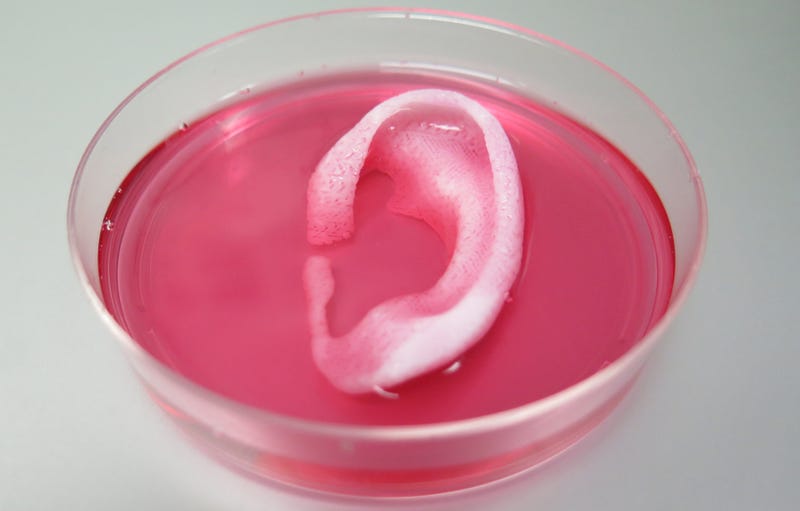
Scientists Just 3D Printed a Transplantable Human Ear
Scientists Just 3D Printed a Transplantable Human Ear 
Credit: Wake Forest Institute for Regenerative Medicine


Scientists have developed an innovative 3D bioprinter capable of generating replacement tissue that’s strong enough to withstand transplantation. To show its power, the scientists printed a jaw bone, muscle, and cartilage structures, as well as a stunningly accurate human ear.
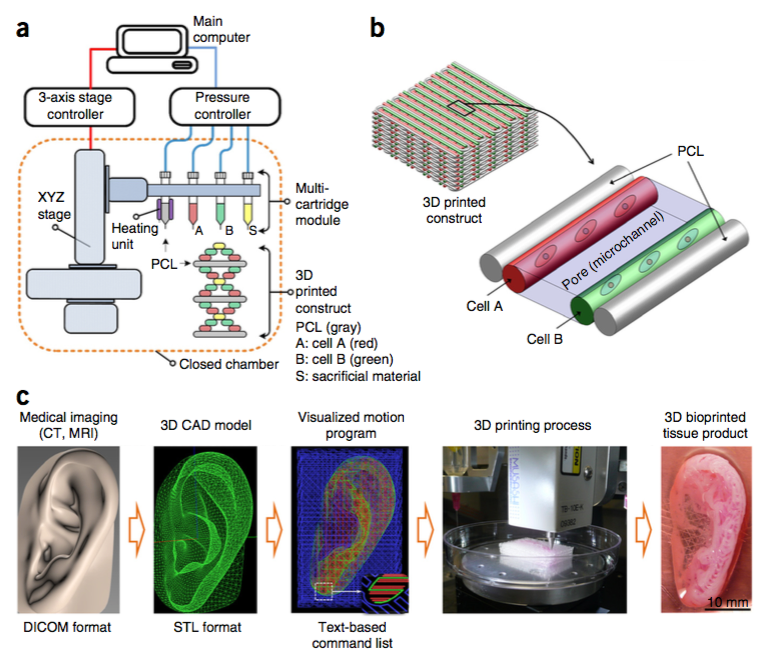
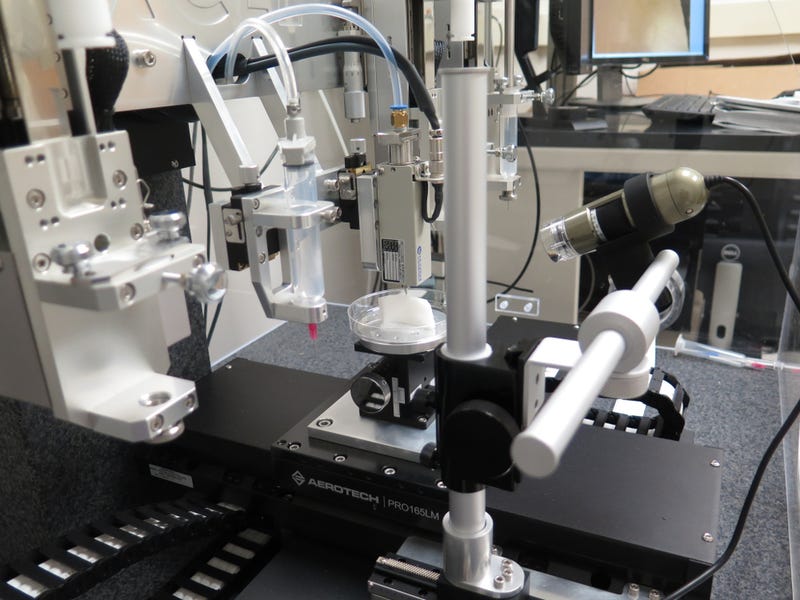
After nearly 10 years in development, a research team led by Anthony Atala from Wake Forest Institute for Regenerative Medicine has unveiled the Integrated Tissue and Organ Printing System (ITOP). Once refined and proven safe in humans, these 3D bioprinted structures could be used to replace injured, missing, or diseased tissue in patients. And because they’re designed in a computer, these replacement parts will be made to order to meet the unique needs of each patient. The details of this breakthrough were published today in Nature Biotechnology.


Scientists Just 3D Printed a Transplantable Human Ear
 Credit: Wake Forest Institute for Regenerative Medicine/Nature Biology


Bioprinters work the same way that conventional 3D printers do, using additive manufacturing to build complex structures layer by layer. But instead of using plastics, resins, and metals, bioprinters use special biomaterials that closely approximate functional, living tissue.

But existing bioprinters cannot fabricate tissues of the right size or strength. Their products end up being far too weak and structurally unstable for surgical transplantation. They also cannot print more delicate structures like blood vessels, or vasculature. Without these ready-made blood vessels, cells cannot be supplied with critical nutrients and oxygen.

“Cells simply cannot survive without a blood vessel supply that’s smaller than 200 microns [0.07 inches], which is extremely small,” Atala told Gizmodo. “That’s the maximum distance. And that’s not just for printing, that’s nature.” He said it’s the “limiting factor” that has made bioprinting a particularly challenging technological proposition.

Scientists Just 3D Printed a Transplantable Human Ear

 Credit: Wake Forest Institute for Regenerative Medicine


The new bioprinting system overcomes each of these shortcomings. Biodegradable plastic-like (polymer) materials are used to form the tissue shape, and a water-based gel delivers the cells to the structure (the gels aren’t toxic to the cells). A temporary outer structure helps to maintain the object’s shape during the printing process. To address the size limit, the researchers embedded microchannels into the design that allow nutrients and oxygen to be transported to cells anywhere within the structure.

“We basically recreated capillaries, creating microchannels that acted like a capillary bed,” said Atala.

Scientists Just 3D Printed a Transplantable Human Ear
 Credit: Wake Forest Institute for Regenerative Medicine


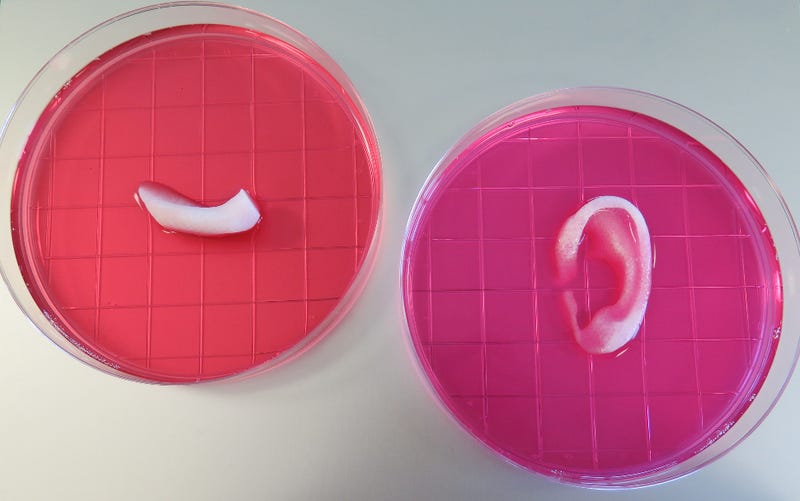
To test their 3D-printed bio-parts, the researchers performed a number of experiments on live animals. Human-sized external ears were implanted under the skin of mice. After two months, the ears still maintained their shape, and cartilage tissue and blood vessels had formed. Printed muscle tissues were implanted in rats, and like the ears, they too maintained structural integrity.

Stem cells were used to create fragments of jaw bones, which were transplanted in rats. Five months later, the structures had formed vascularized bone tissue. In the future, 3D-printed bones could be used for facial reconstructions in humans.
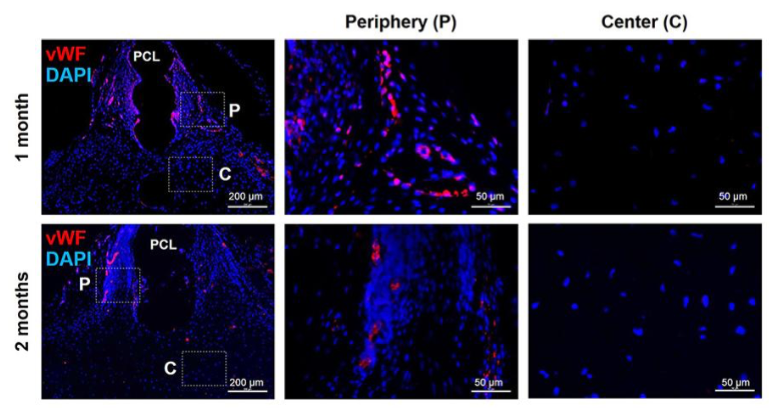

Scientists Just 3D Printed a Transplantable Human Ear


 Vascularization of a 3D printed ear after three months. Credit: Wake Forest Institute for Regenerative Medicine/Nature Biology
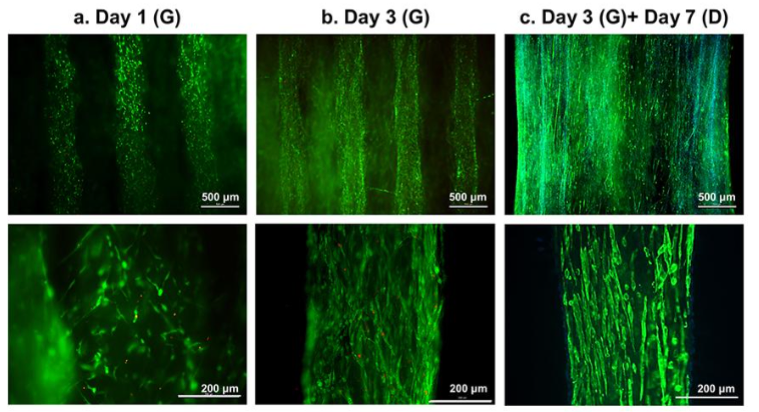

Scientists Just 3D Printed a Transplantable Human Ear

 Immunofluorescent images show 3D printed muscle organization from one to three days. Credit: Wake Forest Institute for Regenerative Medicine/Nature Biology

Atala said his team’s 3D-printed tissues appear to have the right size, strength, and function for use in humans. Their system can generate human-scale, structurally stable tissues in virtually any shape, and parts can be modeled in a computer according to the precise physical needs of a patient.

Once the structures are proven safe and effective, the researchers can start to think about human trials. However, “We’re still looking at the safety of these things,” Atala conceded. “It’s still going to be a while—we still have to go through a lot of testing.”

See [Nature Biotechnology]


Growing New Teeth Could Be A Possibility With These Stem Cell Dental Implants


Credit: Science Burger


Stem cell dental implants that grow right in your mouth could replace artificial implants.


In a promising article published in the Journal of Dental Research, a professor and a group of researchers explained their new method of tooth regeneration and express high hopes for this method in replacing current artificial dental implants.

Stem cell research has been on the rise for quite some time, as these cells are highly transformable and can repair tissue by continually dividing into either a new stem cell for further growth or a specialized cell. The specialized cell would eventually have a job, and includes red blood cells, skin cells, or muscle cells.

In the case of these new stem cell transplants, stem cells from mice were mixed with human gum cells and transplanted into adult mouse kidneys. The cells grew into “recognisable tooth structures coated in enamel with viable developing roots.” The cells taken from human gum tissue were epithelial “surface lining” cells those taken from mouse embryos were mesenchymal stem cells. The mesenchymal cells are very diverse, as they can develop into a wide range of structures such as bone, cartilage, and fat.

Professor Paul Sharpe, who led the research team at King’s College London, explained:

“Epithelial cells derived from adult human gum tissue are capable of responding to tooth-inducing signals from embryonic tooth mesenchyme in an appropriate way to contribute to tooth crown and root formation.”

The research still has some ways to go because the group has the added challenge of finding a way for adult human mesenchymal cells to react in the same ways as embryonic. Leaving embryonic stem cells out of this groundbreaking finding is what could make the dental treatment more viable for the market, since stem cells from embryo raise questions of morality. Sharpe adds:

“We’ve shown in the lab that you can use epithelial adult cells with tooth-inducing mesenchymal cells from embryos and we’ve shown that embryonic epithelial cells with mesenchymal adult cells can grow new teeth. Now we need to combine adult epithelial and adult mesenchymal cells. It’s one of the last pieces of the puzzle.”

If the research team develops a way to make the two adult human cells to work as well as adult and embryonic cells, this could make the treatment more cost effective and better for patients seeking implants. The procedure and healing time are much more efficient than artificial implants, not to mention these stem cell implants will last forever.

Do you think that people will be willing to have a tooth grow in their mouth in the place of having artificial implants surgically inserted?


For more information about 3d printing see http://nexusilluminati.blogspot.com/search/label/3d%20printing 
For more information about artificial organs see http://nexusilluminati.blogspot.com/search/label/artificial%20organs 
- Scroll down through ‘Older Posts’ at the end of each section


Hope you like this not for profit site -
It takes hours of work every day by a genuinely incapacitated invalid to maintain, write, edit, research, illustrate and publish this website from a tiny cabin in a remote forest
Like what you see? Please give anything you can -  
Contribute any amount and receive at least one New Illuminati eBook!
(You can use a card securely if you don’t use Paypal)
Please click below -


Spare Bitcoin change?


For further enlightening information enter a word or phrase into the random synchronistic search box @ the top left of http://nexusilluminati.blogspot.com


And see


 New Illuminati on Facebook - https://www.facebook.com/the.new.illuminati

New Illuminati Youtube Channel -  https://www.youtube.com/user/newilluminati/playlists

New Illuminati’s OWN Youtube Videos -  
New Illuminati on Google+ @ For New Illuminati posts - https://plus.google.com/u/0/+RamAyana0/posts

New Illuminati on Twitter @ www.twitter.com/new_illuminati


New Illuminations –Art(icles) by R. Ayana @ http://newilluminations.blogspot.com

The Her(m)etic Hermit - http://hermetic.blog.com


DISGRUNTLED SITE ADMINS PLEASE NOTE –
We provide a live link to your original material on your site (and links via social networking services) - which raises your ranking on search engines and helps spread your info further!

This site is published under Creative Commons (Attribution) CopyRIGHT (unless an individual article or other item is declared otherwise by the copyright holder). Reproduction for non-profit use is permitted & encouraged - if you give attribution to the work & author and include all links in the original (along with this or a similar notice).

Feel free to make non-commercial hard (printed) or software copies or mirror sites - you never know how long something will stay glued to the web – but remember attribution!

If you like what you see, please send a donation (no amount is too small or too large) or leave a comment – and thanks for reading this far…

Live long and prosper! Together we can create the best of all possible worlds…


From the New Illuminati – http://nexusilluminati.blogspot.com

Saturday, 28 November 2015

What’s So Hard to Believe About China Harvesting the Organs of Living People?


What’s So Hard to Believe About China Harvesting the Organs of Living People?


This photo was purchased by us from Dreamstime


It is difficult to secure a human heart for transplantation. The donor is usually brain dead and on life support, and the donor and recipient must share matching blood and tissue types to prevent rejection.

So Jacob Lavee, a heart transplant surgeon at Sheba Medical Center, Tel Aviv University,  found it hard to believe when a patient in his hospital department in Israel said that he was due in China in two weeks, on a specific date, for a heart transplant.

“I looked at him and I asked: ‘Do you listen to yourself? How can they schedule a heart transplant ahead of time two weeks?'” Dr. Lavee responded.


"The victims of this organ harvesting trade include Uyghurs, and maybe even Tibetans, though most extensive harvesting was carried out against Falun Gong."


That was in 2005. Dr. Lavee recounts the episode in the documentary “Hard to Believe,” the first sustained examination of why the Chinese communist regime’s practice of harvesting the organs of prisoners of conscience—what researchers call a mass murder of at least tens of thousands of victims—is not more widely known.

The documentary, which features interviews with medical professionals, practitioners of the persecuted Chinese spiritual discipline Falun Gong, a United States representative, and others, is now broadcasting on PBS stations across the country.


 The film was released on DVD on Sept. 29.


The Good Doctor


For some time Dr. Lavee was aware that Israelis frequented China for kidney transplants — but he always presumed that poor Chinese villagers were the donors. This is itself a highly problematic ethical scenario—but humans can live with one kidney.


Dr. Jacob Lavee. (Courtesy of Hard to Believe)


Heart donations are an entirely different matter. China was known for using organs from executed criminals, but Dr. Lavee noted that the transplant and execution numbers didn’t tally up.

After doing some research into the source of organ donors in China, he stumbled upon a report written by a Canadian human rights lawyer and a former politician, who investigated allegations of organ harvesting from prisoners of conscience in China—specifically, practitioners of Falun Gong, a spiritual discipline which has been persecuted in its homeland since 1999.

“The new information makes absolute sense,” Dr. Lavee says in the documentary, having become one of the key players in the narrative through his own efforts to limit Israel’s involvement in the activity.

The documentary explores how and why researchers believe it’s clear that mass harvesting of Falun Gong prisoners takes place in China, and seeks to understand why more attention isn’t being paid to the matter—why it’s so “hard to believe,” in the words of Louisa Greve, a vice president of the National Endowment for Democracy, who appears briefly in the film.


Tracing a Blood-Soaked Trail


One answer can be found simply in the nature of the alleged crime: The Chinese regime catalogs and extracts organs from its own citizens in a systematic and brutally efficient manner for sale to wealthy Chinese and transplant tourists.

The victims of this organ harvesting trade include Uyghurs, and maybe even Tibetans, though most extensive harvesting was carried out against Falun Gong.

On July 20, 1999, former Communist Party leader Jiang Zemin launched a sweeping national persecution of Falun Gong, a traditional Chinese meditation exercise that incorporates teachings of truthfulness, compassion, and tolerance.

At once, over 70 million Chinese citizens became targets for brutal torture and grinding forced labor. Nearly 3,900 Falun Gong practitioners have been tortured and beaten to death, and hundreds of thousands more remain in forced detention, according to Falun Gong statistics and human rights researchers.

Allegations that the Chinese regime was profiting from organs harvested from live Falun Gong practitioners surfaced in March 2006 after the wife of a transplant surgeon involved in harvesting, and a Chinese journalist, went public with details of the macabre affair.


‘Hard to Believe’ is the first film that spends more time on the investigators themselves, showing that they are essentially reasonable, objective individuals, with no hidden agenda.
— Ethan Gutmann, investigative journalist


Canadian human rights lawyer David Matas and former Canadian Secretary of State for Asia-Pacific David Kilgour looked into the allegations and tried to disprove them. After considering 33 types of possible proof or disproof, including numerous anonymous calls into China, cross-checking of official transplant numbers, and adopting a simple logical rubric, they concluded in the first ever report on organ harvesting in China that the allegations are true. The Kilgour–Matas report concluded that Falun Gong practitioners were the most likely source for over 41,500 transplantations in the years 2000–2005.


Former Canadian MP David Kilgour (L) and international human rights lawyer David Matas testified on their seven-year investigation into illegal organ harvesting in China at the human rights subcommittee on Feb. 5, 2013. (Matthew Little/The Epoch Times)


Author Ethan Gutmann witnessed firsthand the suppression of Falun Gong in Beijing in 1999, and started his own investigation into organ harvesting in 2006. In his 2014 book, “The Slaughter,” Gutmann traced the history of the Chinese regime’s organ harvesting practice from the crude 1990s experiments in the Chinese frontier province of Xinjiang, to the organ profiling of live Falun Gong practitioners under the guise of “health checks” in present-day China. Gutmann estimates that about 65,000 Falun Gong were harvested from 2000 to 2008.

This year, the film “Human Harvest” won a prestigious Peabody Award for its exploration of the issue, providing perhaps the most prominent acknowledgment of the organ crimes in China to date.


Murder Mystery


The producers of “Hard to Believe” wanted to present a murder-mystery-style narrative that invites watchers to ask why a human rights lawyer, or an Israeli doctor, have come to such jarring conclusions about a mass murder for commercial gain, led by the Chinese state, over the last decade.

Gutmann was initially skeptical about whether that route would be the most impactful, but was ultimately persuaded. Director Ken Stone and co-producer Irene Silber were “sincere in asking the question I couldn’t answer during the writing process,” Gutmann told Epoch Times in a telephone interview.


Author Ethan Gutmann. (Screen shot/Hard to Believe)
Author Ethan Gutmann. (Screen shot via Hard to Believe)


“‘Hard to Believe’ is the first film that spends more time on the investigators themselves, showing that they are essentially reasonable, objective individuals, with no hidden agenda,” Gutmann said. “It’s a thinking man’s film on organ harvesting.”


The Usual Suspects


The trick was to “keep it simple,” Stone told Epoch Times in a telephone interview. “Focus on the people tied to the issue.”


Hard to Believe director Ken Stone. (Provided by Kay Rubacek)
“Hard to Believe” director Ken Stone. (Courtesy of Kay Rubacek)


“If you tell small stories, interesting stories about the people, it eliminates the issue” of the film coming across as a work of advocacy, added Stone, an Emmy Award-winning director and a former television reporter now based in Minnesota.

Of all the stories featured, Stone found the interview with former transplant surgeon Enver Tohti the most compelling. Tohti, a native Uyghur from the west China province of Xinjiang who now drives a bus in London, confessed in recent years to have carried out live organ harvesting in the summer of 1995 on the orders of his immediate superior.

The stories of Ethan Gutmann, Falun Gong practitioners, and Enver Tohti are easily relatable to an American television viewing audience because they are familiar archetypes—the hard-charging, truth-seeking, skeptical journalist, the human rights lawyer, the victims of a brutal persecution, and “Doctor Zero,” the first surgeon they could find who engaged in the practice, Ken Stone explained in a video interview of the producers.

“Part of the story is Epoch Times, Ethan Gutmann’s works, David Matas, Jacob Lavee,” Stone said.


This Newspaper’s Role

Epoch Times broke the story of the forced organ harvesting from prisoners of conscience in March 2006 and has been closely following developments on the issue.

“Hard to Believe” features interviews with Stephen Gregory, the publisher of the U.S. English-language Epoch Times, an independent newspaper headquartered in New York. It also features Matthew Robertson, Epoch Times lead China reporter who was awarded the prestigious Sigma Delta Chi Award from the Society of Professional Journalists for his coverage of the organ harvesting in 2013.

“We’ve done stories about a reporter who is writing for a paper that most Americans have never heard of but who has written extensively about this, and has even been recognized by the Society of Professional Journalists,” Stone said, in a video interview conducted with the producers of the film.

“The organ harvesting story is the story of Falun Gong,” said Gregory in the documentary. “Falun Gong is the most sensitive issue for the Chinese regime. No one in the mainstream press that has offices inside China is covering it inside China.”

In an interview with Epoch Times, Gregory said: “We reported the organ harvesting allegations first and are the go-to source on the issue of organ harvesting.”


Negotiating the Bends


Like many others, director Ken Stone was skeptical of the Chinese regime’s organ crimes when he first learned of it from co-producer Irene Silber in early 2014.

After doing some research, however, Stone felt that there was a story worth telling, and decided to start production just when the World Transplant Congress was being held in San Francisco in July 2014.

Being able to attend the Congress—the largest international event in the field of organ transplantation—was a crucial step for the documentary because the producers were able to meet and interview several key persons for the film, said Kay Rubacek, principal at Swoop Films, which distributes the film.

During production, Rubacek was primarily involved in research and securing interviews, and helped to smooth out the production process by acting as the connection between interviewer and interviewee.

Rubacek, for example, was a troubleshooter keeping the lines of communication open between interviewees and producers for weeks, getting reluctant witnesses to agree to participate.

No small amount of work was put into crafting the documentary’s haunting, pulsing, piano-driven theme by Dafydd Cooksey.

“It’s ominous, foreboding, and there’s a tension in the knowledge being revealed,” said Cooksey, who worked on the score for 12–14 hours a day for a month to produce a score worthy of a murder mystery. “There is something happening, and here’s proof of it happening.”


Dafydd Cooksey, the documentary's sound producer. (Courtesy of Dafydd Cooksey)
Dafydd Cooksey, the documentary’s sound producer. (Courtesy of Dafydd Cooksey)


Cooksey, who also recorded the on-location sound and post-production work, said that the most affecting part of the documentary was from the former surgeon Enver Tohti, who commented on the live organ harvest he participated in.

“As a surgeon, Tohti’s natural instinct is to save lives, but he was told to remove the liver and kidneys of a person who was shot but not dead,” Cooksey said. “What moved me was how years later Tohti showed remorse for doing it: he’d say a prayer for the guy at the mosque or church, or light a candle in a temple.”


Director Ken Stone interviews Enver Tohti, a former organ transplant doctor in the easternmost Chinese province of Xinjiang. (Provided by Kay Rubacek)
Director Ken Stone interviews Enver Tohti, a former organ transplant doctor from the easternmost Chinese province of Xinjiang. (Courtesy of Kay Rubacek)


Organ Harvesting in China - Between Life and Death


For more information about organ 'donations' see http://nexusilluminati.blogspot.com/search/label/organ%20donations
- Scroll down through ‘Older Posts’ at the end of each section


Hope you like this not for profit site -
It takes hours of work every day by a genuinely incapacitated invalid to maintain, write, edit, research, illustrate and publish this website from a tiny cabin in a remote forest
Like what we do? Please give anything you can -  
Contribute any amount and receive at least one New Illuminati eBook!
(You can use a card securely if you don’t use Paypal)
Please click below -


Spare Bitcoin change?


For further enlightening information enter a word or phrase into the random synchronistic search box @ the top left of http://nexusilluminati.blogspot.com


And see


 New Illuminati on Facebook - https://www.facebook.com/the.new.illuminati

New Illuminati Youtube Channel -  https://www.youtube.com/user/newilluminati/playlists

New Illuminati’s OWN Youtube Videos -  
New Illuminati on Google+ @ For New Illuminati posts - https://plus.google.com/u/0/+RamAyana0/posts

New Illuminati on Twitter @ www.twitter.com/new_illuminati


New Illuminations –Art(icles) by R. Ayana @ http://newilluminations.blogspot.com

The Her(m)etic Hermit - http://hermetic.blog.com


DISGRUNTLED SITE ADMINS PLEASE NOTE –
We provide a live link to your original material on your site (and links via social networking services) - which raises your ranking on search engines and helps spread your info further!

This site is published under Creative Commons (Attribution) CopyRIGHT (unless an individual article or other item is declared otherwise by the copyright holder). Reproduction for non-profit use is permitted & encouraged - if you give attribution to the work & author and include all links in the original (along with this or a similar notice).

Feel free to make non-commercial hard (printed) or software copies or mirror sites - you never know how long something will stay glued to the web – but remember attribution!

If you like what you see, please send a donation (no amount is too small or too large) or leave a comment – and thanks for reading this far…

Live long and prosper! Together we can create the best of all possible worlds…


From the New Illuminati – http://nexusilluminati.blogspot.com