Huge Mars Colony Planned by SpaceX
Founder Elon Musk

This
still from a SpaceX mission concept video shows a Dragon space capsule
landing on the surface of Mars. SpaceX's Dragon is a privately built space
capsule to carry unmanned payloads, and eventually astronauts, into space.
CREDIT: SpaceX
by Rob Coppinger
Elon Musk, the billionaire founder and CEO of the private spaceflight company SpaceX, wants to help establish a Mars colony of up to 80,000 people by ferrying explorers to the Red Planet for perhaps $500,000 a trip.
In Musk's vision, the ambitious Mars settlement program would start with a pioneering group of fewer than 10 people, who would journey to the Red Planet aboard a huge reusable rocket powered by liquid oxygen and methane.
"At Mars, you can start a self-sustaining civilization and grow it into something really big," Musk told an audience at the Royal Aeronautical Society in London on Friday (Nov. 16). Musk was there to talk about his business plans, and to receive the Society’s gold medal for his contribution to the commercialization of space.
Mars pioneers
Accompanying the founders of the new Mars colony would be large amounts of equipment, including machines to produce fertilizer, methane and oxygen from Mars’ atmospheric nitrogen and carbon dioxide and the planet's subsurface water ice.
The Red Planet pioneers would also take construction materials to build transparent domes, which when pressurized with Mars’ atmospheric CO2 could grow Earth crops in Martian soil. As the Mars colony became more self sufficient, the big rocket would start to transport more people and fewer supplies and equipment. [Future Visions of Human Spaceflight]
Musk’s architecture for this human Mars exploration effort does not employ cyclers, reusable spacecraft that would travel back and forth constantly between the Red Planet and Earth — at least not at first
"Probably not a Mars cycler; the thing with the cyclers is, you need a lot of them," Musk told SPACE.com. "You have to have propellant to keep things aligned as [Mars and Earth’s] orbits aren’t [always] in the same plane. In the beginning you won’t have cyclers."
Musk also ruled out SpaceX's Dragon capsule, which the company is developing to ferry astronauts to and from low-Earth orbit, as the spacecraft that would land colonists on the Red Planet. When asked by SPACE.com what vehicle would be used, he said, "I think you just land the entire thing."
Asked if the "entire thing" is the huge new reusable rocket — which is rumored to bear the acronymic name MCT, short for Mass Cargo Transport or Mars Colony Transport — Musk said, "Maybe."
Musk has been thinking about what his colonist-carrying spacecraft would need, whatever it ends up being. He reckons the oxygen concentration inside should be 30 to 40 percent, and he envisions using the spacecraft’s liquid water store as a barrier between the Mars pioneers and the sun.
A $500,000 ticket
 Musk’s
$500,000 ticket price for a Mars trip was derived from what he thinks is affordable.
Musk’s
$500,000 ticket price for a Mars trip was derived from what he thinks is affordable."The ticket price needs to be low enough that most people in advanced countries, in their mid-forties or something like that, could put together enough money to make the trip," he said, comparing the purchase to buying a house in California. [Photos: The First Space Tourists]
He also estimated that of the eight billion humans that will be living on Earth by the time the colony is possible, perhaps one in 100,000 would be prepared to go. That equates to potentially 80,000 migrants.
Musk figures the colony program — which he wants to be a collaboration between government and private enterprise — would end up costing about $36 billion. He arrived at that number by estimating that a colony that costs 0.25 percent or 0.5 percent of a nation’s gross domestic product (GDP) would be considered acceptable.
The United States' GDP in 2010 was $14.5 trillion; 0.25 percent of $14.5 trillion is $36 billion. If all 80,000 colonists paid $500,000 per seat for their Mars trip, $40 billion would be raised.
"Some money has to be spent on establishing a base on Mars. It’s about getting the basic fundamentals in place," Musk said. "That was true of the English colonies [in the Americas]; it took a significant expense to get things started. But once there are regular Mars flights, you can get the cost down to half a million dollars for someone to move to Mars. Then I think there are enough people who would buy that to have it be a reasonable business case."

The big reusable rocket
The fully reusable rocket that Musk wants to take colonists to Mars is an evolution of SpaceX's Falcon 9 booster, which launches Dragon.
"It’s going to be much bigger [than Falcon 9], but I don’t think we’re quite ready to state the payload. We’ll speak about that next year," Musk said, emphasizing that only fully reusable rockets and spacecraft would keep the ticket price for Mars migration as low as $500,000.
SpaceX is already testing what Musk calls a next-generation, reusable Falcon 9 rocket that can take off vertically and land vertically. The prototype, called Grasshopper, is a Falcon 9 first stage with landing legs.
Grasshoper has made two short flights. The first was on Sept. 21 and reached a height of 6 feet (2 meters); the second test, on Nov. 1, was to a height of 17.7 feet (5.4 m). A planned milestone for the Grasshopper project is to reach an altitude of 100 feet (30 m). [Grasshopper Rocket's 2-Story Test Flight (Video)]
"Over the next few months, we’ll gradually increase the altitude and speed," Musk said. "I do think there probably will be some craters along the way; we’ll be very lucky if there are no craters. Vertical landing is an extremely important breakthrough — extreme, rapid reusability. It’s as close to aircraft-like dispatch capability as one can achieve."
Musk wants to have a reusable Falcon 9 first stage, which uses Grasshopper technology, come back from orbit in "the next year or two." He then wants to use this vertical-landing technology for Falcon 9’s upper stage.
Musk hopes to have a fully reusable version of Falcon 9 in five or six years, but he acknowledged that those could be "famous last words."
A rocket stepping stone
Another stepping stone toward the planned reusable Mars rocket is SpaceX’s Falcon Heavy launcher. With a first flight planned for next year from Vandenberg Air Force Base in California, the Heavy is a Falcon 9 that has two Falcon 9 first stages bolted on either side.
Musk expects the Falcon Heavy to launch from Florida's Cape Canaveral eventually. This triple-first-stage rocket will be able to put 116,600 pounds (53,000 kilograms) into a 124-mile (200 kilometers) low-Earth orbit. But the Falcon Heavy is still much smaller than Musk’s fully reusable Mars rocket, which will also employ a new engine.
While Musk declines to state what the Mars rocket’s payload capability will be, he does say it will use a new staged combustion cycle engine called Raptor. The cycle involves two steps. Propellant — the fuel and oxidizer — is ignited in pre-burners to produce hot high-pressure gases that help pump propellant into the engine’s combustion chamber. The hot gases are then directed into the same chamber to aid in the combustion of the propellants.
Because Raptor is a staged combustion engine — like the main engines of NASA's now-retired space shuttle fleet — it is expected to be far more efficient than the open-cycle Merlin engines used by the Falcon 9.
While the Falcon 9’s engines use liquid oxygen (LOX) and kerosene, Raptor will use LOX and methane. Musk explained that "the energy cost of methane is the lowest, and it has a slight ISP [specific impulse] advantage over kerosene and doesn’t have any of the bad aspects of hydrogen." (Hydrogen is difficult to store at cryogenic temperatures, makes metal brittle and is very flammable.)
Manned Colony by 2023
by Mike Wall
 |
|
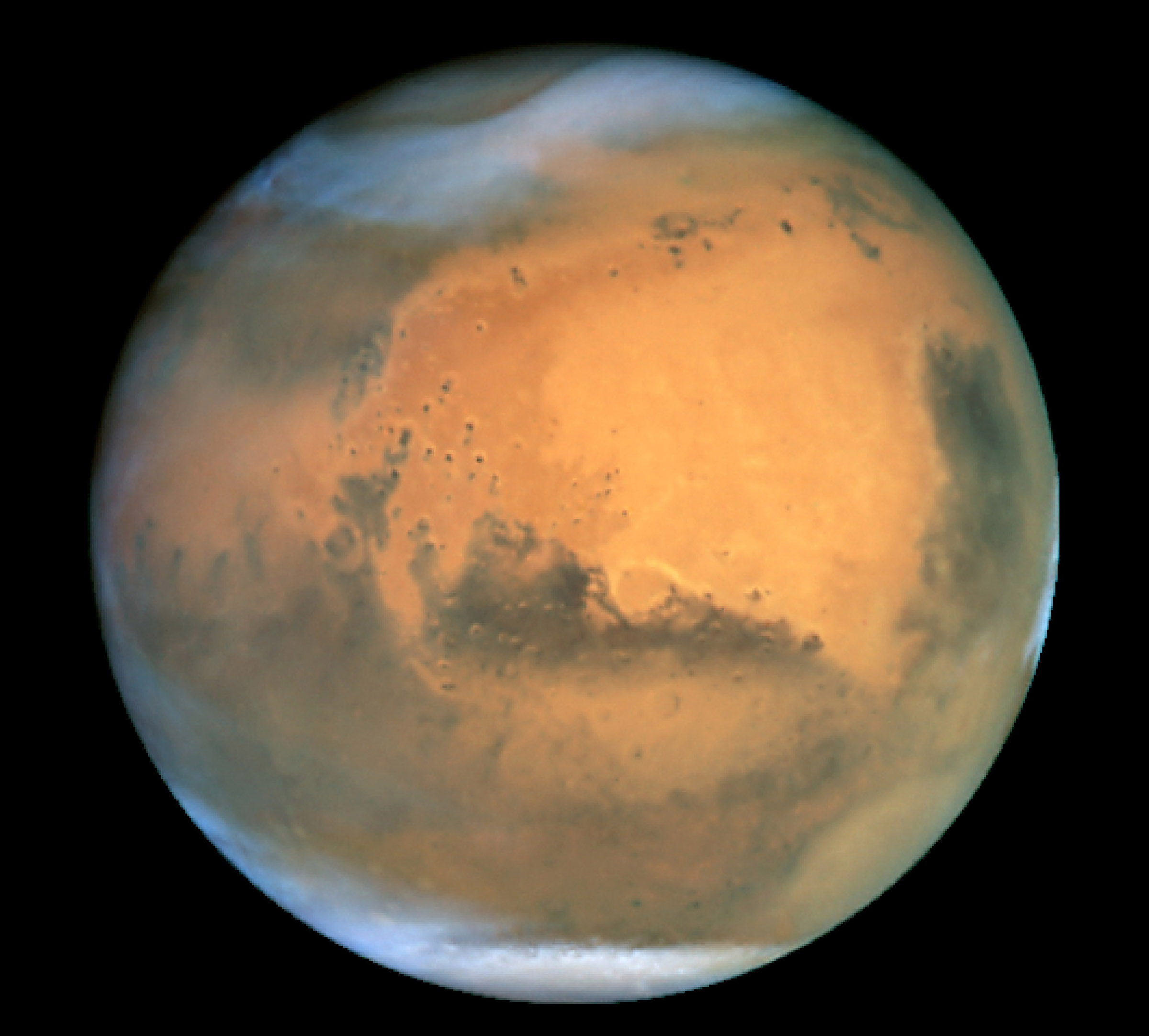
NASA's Hubble Space Telescope snapped this shot of Mars
on Aug. 26, 2003, when the Red Planet was 34.7 million miles from Earth. The
picture was taken just 11 hours before Mars made its closest approach to us
in 60,000 years.
CREDIT: NASA/ESA |
A Dutch company aims to
land humans on Mars by 2023 as the first step toward establishing a permanent colony
on the Red Planet.
To pay for all of this, Mars One says it will stage a media spectacle the likes of which the world has never seen — a sort of interplanetary reality show a la "Big Brother."
"This project seems to be the only way to fulfill humanity's dream to explore outer space," theoretical physicist and Nobel laureate Gerard 't Hooft, an ambassador for Mars One, said in an introductory video posted on the company's website. "It is going to be an exciting experiment. Let's get started." [7 Biggest Mysteries of Mars]
The plan
Mars One hopes to launch a communications satellite and a supply mission to Mars in 2016, then send a large rover to the Red Planet in 2018, according to the video.
This rover will scout out suitable sites for the new Mars colony. The company will then launch settlement components — such as habitat units, life-support equipment and another rover — in 2020. The two rovers will prepare the settlement for the arrival of the first humans in 2023.
Mars One officials say they've talked to a variety of private spaceflight companies around the world and have secured at least one potential supplier for each colony component.
They plan to launch many components on SpaceX's Falcon Heavy rocket, for example, which is expected to be the world's most powerful launch vehicle when it starts flying. The Falcon Heavy is still in development, and SpaceX officials have said the rocket's first test flight could come as early as next year.
A media spectacle
Mars One estimates that it will cost about $6 billion to put the first four astronauts on Mars. While this may seem like a daunting sum for a non-governmental entity, the company is confident it can raise the needed funds by selling corporate sponsorships.
"We will finance this mission by creating the biggest media event ever around it," Mars One co-founder Bas Landorp said in the video. "Everybody in the world can see everything that will happen in the preparations and on Mars."
If all goes according to Mars One's plans, companies looking to advertise will pay big bucks for that exposure.
"This is going to be a media spectacle; 'Big Brother' will pale in comparison," 't Hooft said. "The whole world will be watching and experience this journey."
Mars One will begin selecting its first group of astronauts in 2013, according to its website. Though the company just made its plans public in the last few weeks, it's been developing them in secret since January 2011, officials said.
Mars One isn't the only organization with its eyes on putting boots on Mars. President Barack Obama directed NASA to work on getting astronauts to the vicinity of the Red Planet by the mid-2030s, and SpaceX founder and CEO Elon Musk has said his company hopes to fly people to Mars within the next 10 or 20 years.
From Space.com @ http://www.space.com/18596-mars-colony-spacex-elon-musk.html and http://www.space.com/16300-mars-one-reality-show-colony.html
For more information about space migration see http://nexusilluminati.blogspot.com/search/label/smi2le
- See ‘Older Posts’ at the end of each section
You Can Help This Unique Independent Site Survive
Donate any amount and receive at least one New Illuminati
eBook!
Just click in the jar -
Xtra Image – http://i638.photobucket.com/albums/uu108/keno2012/marscolony51009.jpg
Video @ http://www.space.com/15243-spacex-quest-rocketry-holy-grail-space-exclusive-video.html
Video @ http://www.space.com/15243-spacex-quest-rocketry-holy-grail-space-exclusive-video.html
For further
enlightening information enter a word or phrase into the random synchronistic search
box @ http://nexusilluminati.blogspot.com
And see
New Illuminati – http://nexusilluminati.blogspot.com
New Illuminati on Facebook - https://www.facebook.com/the.new.illuminati
New Illuminati Youtube
Channel - http://www.youtube.com/user/newilluminati/feed
The Her(m)etic Hermit -
http://hermetic.blog.com
The Prince of Centraxis - http://centraxis.blogspot.com
(Be Aware! This link leads
to implicate & xplicit concepts & images!)
This
site is published under Creative Commons Fair Use Copyright (unless an
individual item is declared otherwise by copyright holder) – reproduction for non-profit use is permitted & encouraged, if you give attribution to the work
& author - and please include a (preferably active) link to the original
along with this notice. Feel free to make non-commercial hard (printed) or
software copies or mirror sites - you never know how long something will stay
glued to the web – but remember attribution! If you like what you see, please send
a small but heartfelt donation or leave a comment – and thanks for reading this
far…
Live
long and prosper!
From the
New Illuminati – http://nexusilluminati.blogspot.com