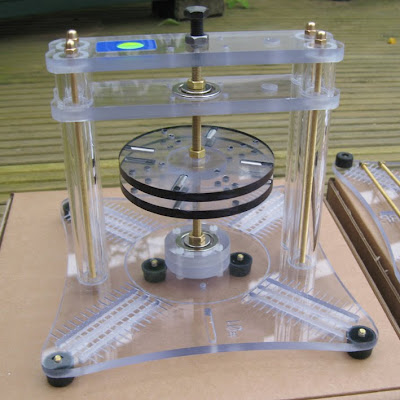
The De Palma-Tewari Free Energy Magnetic Induction Motor
Bruce Eldridge De Palma was the son of noted orthopaedic surgeon Anthony DePalma and the elder brother of film director Brian De Palma. Bruce was a well-known figure in the Free energy suppression community.
Panacea has some brief detail of this energy suppression case profiled on the energy suppression page. His N-machine Homopolar generator is a device based on the Faraday disc and was reported to produce up to five times the energy required to run it.
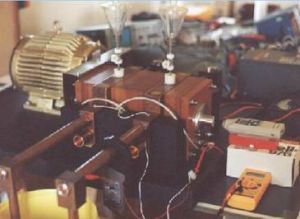
After Bruce's death his research was discontinued. A close friend of Bruce, Paramahamsa Tewari had been under some instruction and was in partnership with Bruce to produce the N machines.
Paramahamsa Tewari made a breakthrough in a method of electrical power generation. He has been granted an Indian Patent (Application number 397/Bom/94) for an increased efficiency homopolar generator.
This device is described by the theoretical papers in this web site as a Space Power Generator (SPG).Both Bruce's, and Tewarie's research and prototypes have been discontinued to this day!
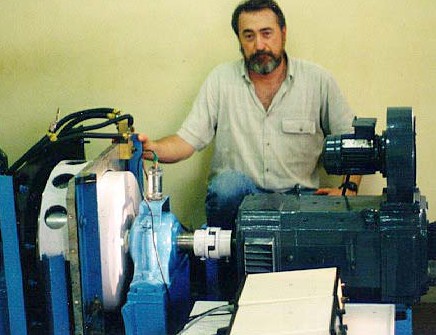
Quote from Tewari's web site:
The Space Power Generator is proven technology that produces 200-300 percent over-unity energy.
Experiments conducted during the last 10 years have indicated that his Space Power Generator (SPG) is operating at over-unity efficiency. Many researchers have performed experiments with these devices, also called homopolar generators or unipolar dynamos. The devices usually consist of a rotating magnetic disk called a Faraday homopolar generator in which electrical current is passed from the center of the disk to its edge.
Toby Grotz, of Wireless Engineering, visited India in December of 1997 to perform an independent set of measurements of the Tewari SPG. Using calibrated high-accuracy instruments, traceable to the National Bureau of Standards, tests were conducted that confirm Tewari's measurements. - End quote - Reference
For further detail please consult the web sites mentioned. Tewari has been shut down, exactly as Bruce was, this can only be due to cartel based influence. This has also been due to the mainstream faculties’ lack of investigation into the process.
The proposed granted Panacea research and development centre will nullify this from happening in future and will conduct all relative tests relating to this technology.
Panacea will pledge grants and engineers support towards this R&D once granted. If you're a member of the public or a scientific group who can aid in grants for the center or help the implosion communities please contact Panacea.
Bruce and Tewari have also done a number of technical papers which are relative to power engineering faculties and will be submitted, investigated and taught in the Panacea centre.
Further technical reference to both devices can be found here:
Link http://www.rexresearch.com/tewari/tewari.htm (see below)
From Panacaea-BOCAF @ http://www.panacea-bocaf.org/depalmatewari.htm

Space Energy Generator
By Paramahamsa TEWARI
"Trombly's design is distinctly different from DePalma's. Trombly used the "closed-path" homopolar design, whereas DePalma used an "open-path" design. Trombly's worked, an DePalma's almost worked. Tewari received Trombly's clsoed path design in the mail, from DePalma, who happened onto an international patent application design, without Trombly's knowledge. Because Tewari's theoretical physics were in line with these technologies, and because, as head of nuclear power safety at the nuclear power station near Bombay, he had time, equipment, and funds, he tried out the Trombly/Kahn design, and succeeded..."
Email from Dr W. S. Eidelman (1-03)
Generation of Electrical Power from Absolute Vacuum
By P. Tewari
The universe can be broadly divided into space and dynamic matter with its motion governed by an intelligent scheme that permits an organized movement of all cosmic material bodies like moons, planets, stars and galaxies In addition to space and matter, another basic entity, energy, was shown to be the constituent of all universal matter as per Einstein's Theory of Relativity, propounded at the start of this century.
The interconvertibility of matter and energy extended the domain of universal reality from visible matter to invisible energy. Some recent experiments performed in USA and India and possibly in other countries too, have produced certain astonishing results as per which electrical power can be generated from absolute vacuum or space which is a phenomenon hitherto unknown. This new finding shall force a positive conclusion on substantial reality of space and will further enlarge the domain of basic reality from matter and energy, as known today, to the whole of the universal space.
The external sources of power in modern technology of power generation are mainly thermal, hydroelectric and nuclear. Electric power production today is a process of conversion of energy from one form to another rather than 'generation' in a true sense. Whereas the newly discovered process of generation of electric power from 'absolute vacuum' does not need any raw material like coal, nuclear fuel or a hydrogen source.
At the face of it, it sounds unbelievable, that vacuum which is considered by current scientific theories as a void or a state of nothingness can ever generate energy out of its own substratum. As per modern physics while 'absolute vacuum' or 'space' can no doubt transmit electromagnetic energy, in the absence of universal matter and its associated energy fields, there can be no energy-content that is ‘reality’ in space.
The concept of ether filling all space and atoms as 'vortices of ether' introduced by Rene Descartes(1596-1650) and developed to a great extent by the close of 19th century found no favour in the early 20th century. Though the domain of reality was extended from matter to energy by Einstein's Relativity Theory, yet space devoid of universal matter ceased to have any substantiality. In the new phenomenon of space power generation (SPG) electrical power is produced by rotating at high speed conducting disc magnets or electromagnets, named as N-Generator by Bruce De Palma, a U.S. inventor. In 1978 he discovered that electrical power produced by such a device did not require an equivalent energy input to the drive motor that rotated the N-Generator. The experimental results are in violation of the 'law of conservation of energy' unless it is supposed that the additional energy is generated within the interatomic vacuum or space in the rotating body of the N-Generator. A new theory on space, energy and matter, Space Vortex Theory (SVT) which posits the concept of dynamic space as the most fundamental substratum of reality, and electrons as 'vortices of space' explains the principles behind SPG phenomenon.

As per SVT, all universal matter is created from substantial space, just as bubbles, vortices and waves are produced in an ocean of water. It is space that has manifested as planets, stars and galaxies is the conclusion of SVT. Space is more fundamental than matter. There is no point in space that is devoid of reality. Thus the domain of reality already extended from matter to energy by Relativity Theory encompasses the whole of the universal space as per SVT.
A space power generator consists of a soft-iron core on which electromagnet coils are wound. Both the coils and the iron core are rotated together, there being no relative motion between the magnetic field and the soft iron conductor of the core. A vortex of space is formed in the rotating iron, due to which electrical charge is produced, which interacts with orbital electrons of the iron atoms and sets them free. The free electrons are interacted with the magnetic field creating positive and negative polarities between which output power at high current and few volts is drawn.
In the future when the newly discovered principles of SPG are made technically viable, electrical generators of capacity in tens of kilowatts and of sizes comparable with conventional electrical generators will be providing electrical power to remote regions, presently with no power distribution network and for such installations where power requirement of each unit is limited to say about 10~ kW.
The space power generators will require initial drive before becoming self-sustaining, for which conventional diesel engines or battery power will be needed. A number of units of N-generators installed at one location can meet larger load requirements for rural electrification and may be smaller towns as well. Modern technology is well advanced to undertake construction of these new machines that do not require any such specialized items of materials that need long time development. High speed rotation of machines and collection of power at few volts but very large currents will require special attention in the development of space power generators.
On space being filled with energy that created matter, Michelson in 1899 had remarked, "Suppose that an ether strain corresponds to an electric charge, an ether displacement to the electric current, ether vortices to the atoms; if we continue these suppositions, we arrive at what may be one of the grandest generalization of modern science, namely, that all the phenomena of the physical universe are only different manifestations of the various modes of motion of one all pervading substance, the ether". At the close of 19th century, the concept of ether filling all space as introduced by Descartes was about to be recognized as the basic reality. Earlier to Descartes, Thales (624-546 B.C) a Greek philosopher considered water as the primary substance in the universe.
The Upanishadic Rishis of Bharat, however, thousands of years ago, proclaimed that 'Akasha’ or space is the first element that gave birth to air. From air was born fire or heat and their various combinations produced water and earth. Very rightly indeed, did the Upanishads discriminate among the five elements pinpointing the akasha as the most fundamental entity potent with energy. This experiment on generation of power from space will reestablish Vedantic philosophy of eternal existence of Akasha as a substratum, the ‘one reality' out of which the cosmic worlds arose. The new science of space power generation will scientifically vindicate the vedantic science on the evolution of the universe.
The N-Generator has been further developed in the USA by De Palma, Trombly and Kahn, who could generate about 45 Kw of power with an input of only 9 Kw, thus getting an incremental power ratio of output further to input, about 5. Bruce De Palma is also further developing his N- generator, trying to achieve perpetual motion. He is quite close to success. The model of space power generator built at Tarapur Atomic Power Station for demonstration of the new principle gave an incremental power ratio of output to input about 2.5. This machine is proposed to be taken to West Germany for demonstration at Hannover in an International Conference for Gravity Field Energy, that will be held there in mid-March 1987.
From letters received from USA, West Germany and many other countries, it is evident that the 'over-unity' system which is the name given to space power generation, is catching attention of world scientists and engineers. Being an entirely new technology, it has presently some controversy too associated with its development, especially in USA. The proposed conference at Hannover being organised by Dr Hans Nieper, President, German Association of Gravity Field Energy, West Germany, Hannover, to which I have been invited to deliver a talk on 'Space Vortex Theory' will hopefully be an interesting forum to discuss with scientists and engineers, the new and novel phenomenon of Space Power generation.
Today's need for power is met by man at the cost of ecological balance that nature inherently devises through its forests, rivers, mountains end oceans, and atmospheric belt of air. The pollution of planet through excessive combustion of coal, oil and gases, deforestation and other hazards to the maintenance of clear environment in populated areas, will be prevented to a good extent with the development of power generation from Vacuum.
Maybe it is the final jump of progress in power generation technology that energy is produced from space, which is not only the cleanest resource for power, but will also outlive all forms of cosmic matter both inanimate and animate.
Violation of Law of Conservation of Charge in Space Power Generation Phenomenon
by P. Tewari
( Chief Project Engineer, Kaiga Project, Nuclear Power Corp., Karwar, India)
( Chief Project Engineer, Kaiga Project, Nuclear Power Corp., Karwar, India)
(Reprinted from Magnets In Your Future )

Introduction ~
It has been hitherto believed in physics that the total electric charge in the Universe is a constant quantity, and if additional charge appears in some region, it is only at the expense of the charge deficit in some other regions. It is a basic law that electric charge is conserved and cannot be destroyed or created. Precise experiments on a Space Power Generator (SPG) which has been now further developed to demonstrate the commercial viability of the newly discovered phenomenon of space power generation however, totally violate the existing law of conservation of charge, by generating output electrical power much in excess of the input electrical power. Since electric charge is a form of basic energy, the law of conservation of energy will need to be enlarged to incorporate in it the dynamics of absolute vacuum (Ref. 1), which in a state of rotation generates fundamental field to produce electrical charge and energy.
Description of the SPG ~
Figure (1): Space Power Generator
~

The SPG shown in Figure (1) is a further developed form of the machines described (Ref. 2,3) in earlier issues of this magazine. A non-magnetic shaft interconnects two mild steel rotors on which two electromagnets are mounted. Electric power at 1.5 volt dc and high amperes is drawn fro each unit, with the help of copper-graphite brushes when the machine runs at 2860 rpm directly coupled and driven by an induction motor. The power is drawn between the inner rotor’s cylindrical surface and the shaft through dc shunts that enable measurements of high dc current.
The SPG weighs about 150 kg and is fabricated out of 120 mm thick mild steel plate. The two units enable generation of power at more than 3 volts dc by appropriate series connections between the two coils. The electromagnet’s coils are 16 swg super enameled wire with 216 turns in each coil. The feature that brings improvements (Ref. 4) in this machine is the larger diameter of the rotors that produce higher dc voltage at comparatively lower speed, not exceeding 3000 rpm. Also the twin units with a single coil in each unit double the amount of power.
Test Results ~
The drive motor (DM) takes no-load current of 2.6 amperes (1300 watts) to rotate itself and the SPG to overcome windage and friction at 2870 rpm. The no-load voltage internally generated in each unit of the SPG is adjusted to 1.5 volts dc between the shaft and the inner rotor by the control of the dc excitation current in the two electromagnets’ coils connected in series. The excitation current is 31 amperes, the total dc resistance of the two coils being 2.5 ohms. The power given to the electromagnets is 31 x 31 x 2.5, that is, 2400 watts.
The two shunts with calibration of 200 amperes for 75 mV are now connected across the two output circuits. The dc currents measured in each circuit are almost equal to 2613 amperes corresponding to 98 mV reading of the shunt. The output electrical power of each unit is 2613 x 1.5 watts, that is 3919 watts. Total electrical power from the two units is 7839 watts. As the SPG is electrically loaded, the current of DM rises to 10 amperes, showing a rise of 7.4 amperes over the no-load current, and corresponding to a rise in input electrical power of 3700 watts.
The load current of the DM of 10 amperes amounts to the total electrical input to the DM of 5000 watts, out of which 1300 watts is utilized to overcome the no-load losses. The remaining electrical input of 3700 watts generates 7839 watts of electrical output power, giving the efficiency of space power generation in this particular machine as 211.8%. Assuming electromagnetic efficiency of the DM as 80%, the efficiency of the electrical energy generation of the SPG will rise to 264.75%
If the excitation power of 2400 watts given to the SPG is deducted from the SPG of 7839 watts, the balance electrical output of 5439 watts still exceeds the total electrical input of 5000 watts by 439 watts, giving the total system efficiency of 105.9% while, in addition the DM-SPG set runs as a perpetual system drawing 1300 watts of power from space.

Quantum of Space Power ~
The quantum of electrical charge produced due to the rotation of space in a rotating electromagnet and the electrical power produced when the power is withdrawn through an electric circuit, as discussed in an earlier article (Ref 2), is given by:
(1) P = (1.8) LNr210-5 kW
where, P is the power in kW, L is the axial length of the SPG in centimeters, N is the revolutions per second, and ‘r’ is the radius in centimeters of the SPG on the inner rotor surface.
The derivation of the above relation was based on the assumption that the radius of the spherical void at the center of the electron as discussed in space vortex theory (Ref. 1, 2) is 1.5 x 10⁻¹¹ cm. More precise measurements in space power generation experiments, however, show that the coefficient 1.8 in equation (1) should be 2.5, and the void radius at the electron’s center should be taken as 10-11 cm. With these corrections the space power equation (1) now becomes:
(2) P = (2.5) LNr210-5 kW
Substituting the values, L = 12, N = 47.6, and r = 11.43 in Eq. (2), P = 5.85 kW.
Since there are two units of the SPG on the shaft, total power from the two units will be 11.7 kW, which is 1.5 times the output power drawn from the machine in the above test. With additional brushes and reduced brush contacts at about 3000 rpm, the above machine will have capacity to produce about 12 kW of power. If the SPG is driven at 6000 rpm both the voltages and currents will be doubled, producing 4 times output of about 48 kW. Since the excitation power remains constant, much higher total system efficiency is expected though the efficiency of the SPG as computed above will remain constant at 211.8%.
Conclusion ~
The mass-energy equation of Einstein brought forth a universal law that an electron like all matter contains energy in its structure. A further enlargement of this law is that the electron itself is energy, where "energy" in physical terms is a state of vacuum in rotation. Even at ordinary speed of rotation of an electromagnet, the interatomic space of the iron core develops velocity fields of vacuum that qualitatively act like additional charge within the rotating system and liberate orbital electrons of the iron atoms. The interaction of the magnetic field and free electrons form polarities (Ref. 2, 3). It is possible to commercially develop a machine that can not only rotate itself perpetually but also generate additional electrical energy in kilowatts and higher range. The law of conservation of charge and the law of conservation of energy are applicable within the systems confined to material interactions alone and not to the medium of space which is a dynamic entity that can rotate and create charge at ordinary speeds, and can rotate and create electrons at the speed of light.
References ~
1) Paramahansa Tewari: Beyond Matter; 1984, Printwell Publications, Aligarh, India.
2) P. Tewari: Magnets In Your Future 1(8), August 1986; P.O. Box 580, Temecula, CA 92390.
3) P. Tewari: Magnets In Your Future 2(12), December 1987.
4) Bruce DePalma: "Report on the Initial Testing Phase of DePalma Energy Corporation"
See India Patent Specification
High Efficiency Space Power Generator
Paramahamsa Tewari
Patent Specification and further information from Borderland Research @ http://www.rexresearch.com/tewari/tewari.htm
Complete patent specifications @ http://depalma.pair.com/Tewari/Tpatent.html
For more information about the De Palma N-Machine see http://nexusilluminati.blogspot.com/ search/label/n-machine
For more information about free energy devices and theories see http://nexusilluminati.blogspot.com/ search/label/free%20energy
Help This Unique Independent Site Survive
Donate any amount and receive at least one New Illuminati eBook!
Just click in the jar -
For further enlightening information enter a word or phrase into the search box @ New Illuminati or click on any label/tag at the bottom of the page @ http://nexusilluminati.blogspot.com
And see
New Illuminati – http://nexusilluminati.blogspot.com
New Illuminati on Facebook - https://www.facebook.com/the.new.illuminati
New Illuminati Youtube Channel - http://www.youtube.com/user/newilluminati/feed
The Her(m)etic Hermit - http://hermetic.blog.com
The Prince of Centraxis - http://centraxis.blogspot.com (Be Aware! This link leads to implicate & xplicit concepts & images!)
This site is published under Creative Commons Fair Use Copyright (unless an individual item is declared otherwise by copyright holder) – reproduction for non-profit use is permitted & encouraged, if you give attribution to the work & author - and please include a (preferably active) link to the original along with this notice. Feel free to make non-commercial hard (printed) or software copies or mirror sites - you never know how long something will stay glued to the web – but remember attribution! If you like what you see, please send a small but heartfelt donation or leave a comment – and thanks for reading this far…
Live long and prosper!
From the New Illuminati – http://nexusilluminati.blogspot.com