From Cancer Cells of Earth
to Brain Cells of Earth:
A Synthesis of Human Society and
the Biosphere

by John Champagne
When political and economic systems reflect an equal ownership of natural wealth, we will have a civilization that is more just and also more likely to be sustainable.
The
History of Life
A noticeable trend throughout the history of life on Earth is the nearly continual, albeit unsteady, progression from simpler, small-scale organization to more complex and large-scale organization. Simple entities elaborate themselves into more complex forms in response to changes in the environment; changes that are often brought about by the very life processes of those simpler entities. [Alberts, et al]
Mitochondria were once free-living cells in symbiotic relationship with one another (much as animals and plants are in symbiosis). Over time, these bacterial cells developed such intimate connections with one another that the relationship evolved from that of separate, interdependent organisms to that of interdependent entities within a larger organism. This transition appears to have been triggered by the accumulation of oxygen in the atmosphere. Oxygen is a highly reactive gas, and would have been poisonous to most of the early life on the planet.
This
accumulation was caused by living things. They changed their environment, by
releasing oxygen into it, and so were compelled to change themselves, or die. [Ibid]
What were at one time separate organisms have integrated to form the eukaryotic
cell. This transformation represents an early example of a meta-system
transition wherein interacting systems or entities become subordinate to and
come under the control of a larger scale emergent system. [Turchin]
Multi-cellular organisms, or meta-organisms, continue the progression toward higher levels of complexity by extending and distributing the various internal processes of a prototypical eukaryotic cell (e.g.: protozoa) to a community of cells in communication with and cooperation with one another. Each cell in the community specializes and concentrates on performing one function, or a narrow range of functions. Every member of the community receives products and benefits from its neighbors; and every member returns some benefits or provides some service to its neighbors.
Multi-cellular organisms, or meta-organisms, continue the progression toward higher levels of complexity by extending and distributing the various internal processes of a prototypical eukaryotic cell (e.g.: protozoa) to a community of cells in communication with and cooperation with one another. Each cell in the community specializes and concentrates on performing one function, or a narrow range of functions. Every member of the community receives products and benefits from its neighbors; and every member returns some benefits or provides some service to its neighbors.
Development of Societies
Members
of societies also share resources. And they share information about their environment (and
about their own actions or state of being) with one another. Through this
sharing they are able to act as an integrated entity, cooperating in the
exploitation of their environment, as if the society itself were a single
organism. The social insects (ants, termites, bees) are a classic example of
this phenomenon. Howler monkeys (and other primates) also illustrate this
point: A call from a single individual can cause the whole troupe to move in a
particular direction, either toward food or away from danger.
Human society and culture present yet another level of this phenomenon of entities organizing themselves into communities to form entities of a higher order. Culture is the product of humans' language, artistic, and tool-making abilities. It represents a quantum leap in the ability of hominid society to share information among its members, and to transmit that information across space and time. Culture greatly expands humans' ability to organize as a single entity and exploit the environment. With the advent of human language, the Tribe became the newest form of the meta-organism.
Language allows naming things; and it allows elaborate mental models of the environment and of social relations to develop. Bringing information about an environment into an entity (in the form of learning for a human being; in the form of social structure and cooperative process for human society) is a step toward integrating that environment with that entity. Integration of interacting systems always involves the transfer of information between those systems. [Turchin]
Living Beyond Means
Culture
and technology have enabled human society to expand into virtually every
ecosystem on the planet.
As we expand into an environment and change it by interacting with it, we adapt
our methods, so that our ability to extract wealth persists, even as we degrade
the resource base and exceed the carrying capacity of the environment.
Increasingly intense extraction methods in the context of a dwindling resource base will result in catastrophic collapse. This tendency of humans to live beyond what is sustainable, with innovations in culture and technology driven by the challenge of adapting to a degrading environment, even as our numbers continue to increase, points to the need for new feedback mechanisms that will enable the human society supra- organism and its members to exist within the limits of the biosphere at large. In the absence of culturally-based (rule-based) limits to our own potentially self-destructive behavior, the physical limits that manifest on the lower levels of organization (soil, air, water and food supply) will become evident. We will face resource depletion and famine--the biological limits to survival.
Increasingly intense extraction methods in the context of a dwindling resource base will result in catastrophic collapse. This tendency of humans to live beyond what is sustainable, with innovations in culture and technology driven by the challenge of adapting to a degrading environment, even as our numbers continue to increase, points to the need for new feedback mechanisms that will enable the human society supra- organism and its members to exist within the limits of the biosphere at large. In the absence of culturally-based (rule-based) limits to our own potentially self-destructive behavior, the physical limits that manifest on the lower levels of organization (soil, air, water and food supply) will become evident. We will face resource depletion and famine--the biological limits to survival.
A Biological Model for Politics and Economics
An ancient city can be seen as a multi-organism organism: City walls are the skin; the grain stores are the stomach; the systems of commerce, roads and sewers are the circulatory and digestive systems; soldiers are like the fists and claws and immune system; and the protocols of behavior that mediate interactions among the various citizens--the records of grain ownership and tax liability, laws, mythology, the beliefs about the intentions of the gods and what the citizens ought to do, people's sense of possibilities--make up the hormonal and nervous systems.
Civilizations rise and fall because they lack the feedback mechanisms that would enable them to moderate their growth and achieve a dynamic equilibrium with their environment. The supra-organism consumes its resource base and then must either find a new resource base to exploit in another location, apply technical innovation to intensify and diversify resource extraction, or die. Neither of the first two options are sustainable long-term on a finite planet.
Of
course, death of a civilization is the end-point of unsustainability. This is
our choice: Death or transformation. Our challenge is to build a sustainable
society. In order to avoid the death of civilization that we find at the end of
the un-sustainable path, we are faced with an apparent need to not merely
moderate growth, but to define certain absolute limits to how much of this and
that natural resource we will take. We must define absolute and sufficiently
conservative limits to what and how much we take from and what and how much we
put into our environment.
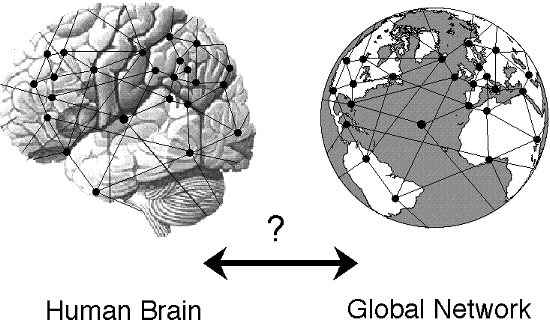
The most complex entity that has yet to arise on the planet--our modern global civilization--is utterly transforming the environment that has thus far sustained it. There is now an urgent need to integrate the entity with the environment, the economy with the ecology--to prevent the one from destroying the other. We need to learn how to live with, how to interact with our environment in a way that promotes our well-being while also preserving the health of the larger living community. The health of the ecosystem, economic health and personal health are all inextricably linked.
Money, in combination with other inventions, such as agriculture, pottery, road systems, writing, etc., makes cities possible. When combined with certain bookkeeping tools and economic and governmental institutions, money makes capitalism possible. And money makes it possible for economic actors to exert pressures that may harm the environment. Such pressures can now be felt even half way around the world. When people buy hamburgers, for example, they exert economic pressure that induces ranchers to cut forests. Soil erodes and biodiversity is lost forever.
The most complex entity that has yet to arise on the planet--our modern global civilization--is utterly transforming the environment that has thus far sustained it. There is now an urgent need to integrate the entity with the environment, the economy with the ecology--to prevent the one from destroying the other. We need to learn how to live with, how to interact with our environment in a way that promotes our well-being while also preserving the health of the larger living community. The health of the ecosystem, economic health and personal health are all inextricably linked.
Money, in combination with other inventions, such as agriculture, pottery, road systems, writing, etc., makes cities possible. When combined with certain bookkeeping tools and economic and governmental institutions, money makes capitalism possible. And money makes it possible for economic actors to exert pressures that may harm the environment. Such pressures can now be felt even half way around the world. When people buy hamburgers, for example, they exert economic pressure that induces ranchers to cut forests. Soil erodes and biodiversity is lost forever.
We now
have a world full of people who are spending money in ways that are exerting
unsustainable pressures on the natural systems that are the very basis of our
survival [Brown];
but there is no mechanism whereby economic actors can get information--relevant
feedback--at the time of purchase about the ecological consequences of their
actions. We cannot tell by looking at a price tag how much ecological damage
was caused in the production of an item. A system of feedback that provides
such information at the moment of decision and in a form that all will pay heed
to would be most effective.
Introducing Mechanisms for Taking Account of
Environmental Impacts
The challenge that we are facing may be the greatest challenge that human beings have faced since the forests receded and we learned to stand up and walk and talk, and carry things and use tools. We must reconcile our ability to extend ourselves into the environment -- with ever increasing impact on that environment -- with the inherent limits of that environment to withstand such impact. We must learn to interact with our environment without destroying its capacity to sustain our lives.
We face a choice either to allow our actions to continue to produce ecologically destructive pressures across the globe, to the point of catastrophic collapse of our civilization, or to remedy this problem with our economic system. We can solve this problem by incorporating a measure of the ecological pressures of human activities into the price of those activities, with the aim of discouraging the harmful impacts, to reduce them to acceptable levels.

Ecology and Economy are Integrated: Creating
a Sensory Nervous System for the Earth
We can
cause ecological costs to be reflected in the price of goods and services by attaching fees to the use or
degradation of natural resources. This would cause the price of things to
reflect the ecological pressures or cost associated with their production. We
would be deterred from doing certain things that are harmful to the biosphere
by the fact that the price that we would have to pay to do these things would
be higher, to more fully reflect the true costs.
The historian, Frederick Jackson Turner, writing more than a hundred years ago, described the movement of civilization across the continent as a nervous system in the process of growth and development. If we follow this analogy, we see that Turner's nervous system is a nervous system of the Earth. As of yet, this nervous system lacks an essential element of a nervous system in a healthy organism: an autonomic feedback system.
The historian, Frederick Jackson Turner, writing more than a hundred years ago, described the movement of civilization across the continent as a nervous system in the process of growth and development. If we follow this analogy, we see that Turner's nervous system is a nervous system of the Earth. As of yet, this nervous system lacks an essential element of a nervous system in a healthy organism: an autonomic feedback system.
The
proposed fees on resource use and pollution would correct this defect by
causing information about injury to Earth, or stress to the biosphere, to be
conveyed to economic actors through the prices of goods and services in the
marketplace. Thus, the resource fees would function as an autonomic or sensory
nervous system for the Earth, conveying information about injury or imbalance
in the Earth organism to society (the neural network) and causing a change in
society and in the behavior of individuals that would tend to reduce the injury
and restore balance.
Any commercial or corporate entity or industrial operation can be seen as subordinate to the larger planet organism, just as mitochondria are subordinate to the cell. Part of the function of a healthy cell is to monitor the productions of its mitochondria, and ration resources according to the needs of the larger organism for those products. From the perspective of the cell, or the larger Earth, what goes into and what comes out of the subordinate entity must be closely monitored, while what actually goes on within the sub-entity is of lessor concern. If we follow this analogy, we might expect governments (the larger community) to take note of what resources are used by an industry, and what pollutants are emitted, but we could decide that the question of what production methods to adopt and what contracts said entity ought to enter into with employees (assuming no coercion) would be outside the purview of government.
Any commercial or corporate entity or industrial operation can be seen as subordinate to the larger planet organism, just as mitochondria are subordinate to the cell. Part of the function of a healthy cell is to monitor the productions of its mitochondria, and ration resources according to the needs of the larger organism for those products. From the perspective of the cell, or the larger Earth, what goes into and what comes out of the subordinate entity must be closely monitored, while what actually goes on within the sub-entity is of lessor concern. If we follow this analogy, we might expect governments (the larger community) to take note of what resources are used by an industry, and what pollutants are emitted, but we could decide that the question of what production methods to adopt and what contracts said entity ought to enter into with employees (assuming no coercion) would be outside the purview of government.
Implementation
Strategies Invite Democratization in Economics and Politics
We must
decide how much the Earth's ecosystems can sustainably take from us in the form
of wastes, and what
they can provide to us as resource. But we do not know the answer to this
question. No one does. So we begin by recognizing that we cannot be certain of
the numbers. If we choose to err on the side of caution, we will be conservative
and err on the side of preserving and restoring ecosystems and reducing natural
resource consumption, for the benefit of future generations and the larger
community of life.
We could take random-sample surveys to discern what overall impacts on the environment are acceptable according to the average opinion of the people. (What impacts are consistent with democratic principles?) We could issue permits for various pollutants, according to how much of each pollutant the people would allow, and auction them in the free market. Likewise for the taking of valuable resources. Thus, those industries which are most successful at conserving resources and cleaning up processes will have an advantage in the market, while those industries which continue to emit large amounts of waste and/or extract large amounts of natural resources will have to include these high costs to ecosystems in the price of their products. [Sharp, et al]
Because nearly everyone will have a different opinion regarding what levels of pollutants should be considered safe and sustainable, and because we are committed to democratic principles that call for all voices to be heard, the actual amount that we decide on ideally would be a summary of the opinions of all the world's people, but more practically would be a summary of a random sample of people. And, because many of us are not able to make an informed decision about appropriate levels of some or all pollutants, we may choose to delegate our vote to someone whose opinion we respect.
We could take random-sample surveys to discern what overall impacts on the environment are acceptable according to the average opinion of the people. (What impacts are consistent with democratic principles?) We could issue permits for various pollutants, according to how much of each pollutant the people would allow, and auction them in the free market. Likewise for the taking of valuable resources. Thus, those industries which are most successful at conserving resources and cleaning up processes will have an advantage in the market, while those industries which continue to emit large amounts of waste and/or extract large amounts of natural resources will have to include these high costs to ecosystems in the price of their products. [Sharp, et al]
Because nearly everyone will have a different opinion regarding what levels of pollutants should be considered safe and sustainable, and because we are committed to democratic principles that call for all voices to be heard, the actual amount that we decide on ideally would be a summary of the opinions of all the world's people, but more practically would be a summary of a random sample of people. And, because many of us are not able to make an informed decision about appropriate levels of some or all pollutants, we may choose to delegate our vote to someone whose opinion we respect.
For
example, if a person believed that it is safe to release 100 million tons of
fossil fuel carbon dioxide into the atmosphere each year, and that no level of
chlorinated hydrocarbon emissions (e.g.: CFC's, Heptachlor, DDT) can be called
safe or sustainable, but this person had no opinion or knowledge about safe
levels of other pollutants, then they might refer to lists of people who share
their views on CO2 or chlorinated hydrocarbons to see what opinions those
people hold regarding other pollutants--either to inform their own opinion, or
to find a knowledgeable and responsible person to whom they could delegate
their 'emissions allowance' vote. If our hypothetical survey respondent were
convinced that the level of emissions that they regard as sustainable could not
be achieved immediately, they may want to structure their vote in the form of a
percent reduction per year, toward a specified target.
Gaia Brain Provides the Tools for Sculpting
Society
With the caveat that control of any particular kind of environmental impact would depend on most people agreeing that such impact ought to be subject to control, we could imagine that, over the decades and beyond, virtually everything we do that impacts the Commons, every way that we apply technology to exploit our environment with potentially negative impact, may need to be measured and rationed, according to the method outlined above or some other method.
Through
our normal participation in the marketplace (which would no longer be hiding
environmental impacts as externalities), human behaviors and lifestyles would
have associated economic costs which would reliably reflect the perceived
environmental costs of those behaviors. Economic forces, which all people
respond to, will induce us to make changes in habits and lifestyle (and, at the
corporate level, changes in production processes and business models) that
actually promote the interests of the larger living community and the interests
of future generations of human beings.
What is true for individuals is true for groups, too. Corporations will increase profits by striving to reduce environmental impacts. What is good for the corporation is good for the larger community of life and for future generations. Profit-seeking behavior by corporations, then, will not so much resemble sociopathic behaviors traditionally associated with corporations.
We could attach or increase a fee on anything that we would like to see less of in the world. If polled in a random survey, we could say: "Less asphalt"; "Less advertising billboards"; "Less outdoor lighting, less interference with our view of the stars in the night sky". Fees would increase and money would flow away from those whose actions or decisions tend to take us in the direction opposite of the people's expressed will. Then we could contribute an agreed-upon portion of our share of the proceeds of natural resource fees toward those things that we would like to see increased. We could say: "More city parks"; "More libraries"; "More schools", and a portion of our share of the fee proceeds could go to those who provide those valued and preferred public services. The economic incentives that would accompany our expressed wishes would result in real change, so that our wishes would be born out in reality. Alienation, in the Marxist sense of living in and creating through our actions and interactions a society that cuts us off from that which sustains us, which has no meaning for us, and which we would not choose, would be eliminated, or at least dramatically reduced, as society evolved to reflect our expressed will.
What is true for individuals is true for groups, too. Corporations will increase profits by striving to reduce environmental impacts. What is good for the corporation is good for the larger community of life and for future generations. Profit-seeking behavior by corporations, then, will not so much resemble sociopathic behaviors traditionally associated with corporations.
We could attach or increase a fee on anything that we would like to see less of in the world. If polled in a random survey, we could say: "Less asphalt"; "Less advertising billboards"; "Less outdoor lighting, less interference with our view of the stars in the night sky". Fees would increase and money would flow away from those whose actions or decisions tend to take us in the direction opposite of the people's expressed will. Then we could contribute an agreed-upon portion of our share of the proceeds of natural resource fees toward those things that we would like to see increased. We could say: "More city parks"; "More libraries"; "More schools", and a portion of our share of the fee proceeds could go to those who provide those valued and preferred public services. The economic incentives that would accompany our expressed wishes would result in real change, so that our wishes would be born out in reality. Alienation, in the Marxist sense of living in and creating through our actions and interactions a society that cuts us off from that which sustains us, which has no meaning for us, and which we would not choose, would be eliminated, or at least dramatically reduced, as society evolved to reflect our expressed will.
Impact of Paradigm Shift on Institutions and Society
This
concept of assigning fees to the use of Earth's natural resources and waste removal services can be
applied to other areas. For example, we could apply gaia brain methods (a fee
mechanism applied according to a public survey) to regulate the use of
non-human animals by human beings. Currently, property rights are recognized by
society as justification for holding animals captive in pursuit of profit, but
these are not absolute rights. Limits to the severity of confinement conditions
are subject to the will and judgement of the people. Such limits cannot be
decided by those who seek to profit from the confinement and commodification of
animals, because of the inherent bias or conflict of interests.
Someday, we may completely eliminate the systematic enslavement and exploitation of non-human animals in industry and agriculture [Singer], but until that time, we may wish to create a system whereby industry and agriculture are subject to economic costs in proportion to how much suffering they inflict on the animals they use. This will give them an incentive to reduce both the numbers of animals they use and the amount of suffering inflicted on each one.
Someday, we may completely eliminate the systematic enslavement and exploitation of non-human animals in industry and agriculture [Singer], but until that time, we may wish to create a system whereby industry and agriculture are subject to economic costs in proportion to how much suffering they inflict on the animals they use. This will give them an incentive to reduce both the numbers of animals they use and the amount of suffering inflicted on each one.
When
neither the numbers of animals held nor the conditions of their
captivity offend the sensibilities or conscience of most people, we will know
that the fees are set at a level consistent with the principles of a democratic
society. (It may be that most people feel that the numbers of animals kept
captive in pursuit of profit and the conditions of their captivity do not
offend the conscience, in which case no fee need be applied. There is an
underlying assumption that conditions of confinement shall be made completely
transparent.)
This model of human society as meta-organism, and as nervous system of the gaia organism, would transform the educational process, if for no other reason than that a citizen veto on spending public funds would likely mean that money would not flow to institutions that fail to follow 'best practices'. Beyond that transformative influence of a system-wide incentive toward excellence, the educational experience will change because children can understand the concepts of 'organism' and 'interaction with environment'. They themselves are organisms. They eat and breathe. They can observe protozoa. This gaia brain model would invite early introduction of ideas about social interaction, and would invite the active involvement of children in the collection of opinions among community members about appropriate levels of pollution and rates of use of natural resources, and about perceived community needs. This model would invite their involvement in the assessment of actual conditions.
A question is a linguistic device for directing one's attention onto a topic [Minsky], therefore, just the act of posing questions about pollution, natural resource use and community needs will cause us to think about these things more. The fact that the questions might be put by young people would help to remind all concerned who it is that will be most affected by the answers: the children who will have to live with the consequences of these decisions (about how much to conserve resources or how to use public funds) for many years to come.
Students could map their neighborhood and larger community. As assessors of actual conditions and of the accuracy of reports issued by industry (they could take air and water samples in their community and map the occurrence of various kinds of impacts on the landscape), they would be involved in the protection of resources that will sustain them in the future, and they would gain valuable knowledge and insight into the workings of society in the process.
Students might cast their own mock votes about what kind of world they would want to live in and what human impacts on the Earth ought to be deemed permissible. If they did so with a clear explication of why they voted as they did, then adults in the community may want to honor their careful research and serious consideration by copying the students' votes--in effect, delegating their own votes to those outstanding students.
This new paradigm will so transform the global economy and society, we probably ought to think in terms of an elimination of government as we know it. With the introduction of significant pollution fees, etc., conventional taxes would be difficult to support financially. And we may decide that such taxes lack philosophical foundation: we may see that a fee according to our use of the Earth's natural resources is well founded on philosophical principles of fairness, while taxes on income or sales do not seem on the face to be eminently fair.
The proceeds of the pollution fees and green fees would be a monetary representation of the value of Earth's air and water, minerals and biota. As these resources can reasonably be said to belong to all, the proceeds of these fees probably ought to be shared equally among all the people of the Earth. This could be the basis of a guaranteed minimum income. Perhaps we could contribute half of our share toward programs that address perceived community needs and put the other half toward meeting our own personal needs. Community programs would be funded according to the priorities of the people, and no one would live in abject poverty.
This new source of economic security would cause the psychological rewards of work to become more prominent as an issue of concern, while job security and pay would become somewhat less important. This would give both employers and employees more freedom to end relationships that they find unsatisfactory; which, in turn, would give them more freedom to enter into relationships that look promising. There would not be any need for the burdensome legal obligations that often accompany the decision to hire, (although binding contracts would remain an option). A more fluid job market will make it easier for both employers and employees to find what they are looking for. This direct democracy, capitalism-communism synthesis that is gaia brain theory would make it easier for all people to follow their bliss.
The pollution fee/gaia brain concept applies ancient principles to today's challenges. All things are connected. We must live in accord with nature. We must give something back in proportion to what we take. We are the stewards of this planet.
The greatest challenges that life presents are those which must be met to ensure the very survival of the organism. The difficult but life-sustaining task before us is to transform ourselves from cancer cells of Earth to brain cells of Earth--to make a healthy, properly functioning world brain; to create anew our global society.
This model of human society as meta-organism, and as nervous system of the gaia organism, would transform the educational process, if for no other reason than that a citizen veto on spending public funds would likely mean that money would not flow to institutions that fail to follow 'best practices'. Beyond that transformative influence of a system-wide incentive toward excellence, the educational experience will change because children can understand the concepts of 'organism' and 'interaction with environment'. They themselves are organisms. They eat and breathe. They can observe protozoa. This gaia brain model would invite early introduction of ideas about social interaction, and would invite the active involvement of children in the collection of opinions among community members about appropriate levels of pollution and rates of use of natural resources, and about perceived community needs. This model would invite their involvement in the assessment of actual conditions.
A question is a linguistic device for directing one's attention onto a topic [Minsky], therefore, just the act of posing questions about pollution, natural resource use and community needs will cause us to think about these things more. The fact that the questions might be put by young people would help to remind all concerned who it is that will be most affected by the answers: the children who will have to live with the consequences of these decisions (about how much to conserve resources or how to use public funds) for many years to come.
Students could map their neighborhood and larger community. As assessors of actual conditions and of the accuracy of reports issued by industry (they could take air and water samples in their community and map the occurrence of various kinds of impacts on the landscape), they would be involved in the protection of resources that will sustain them in the future, and they would gain valuable knowledge and insight into the workings of society in the process.
Students might cast their own mock votes about what kind of world they would want to live in and what human impacts on the Earth ought to be deemed permissible. If they did so with a clear explication of why they voted as they did, then adults in the community may want to honor their careful research and serious consideration by copying the students' votes--in effect, delegating their own votes to those outstanding students.
This new paradigm will so transform the global economy and society, we probably ought to think in terms of an elimination of government as we know it. With the introduction of significant pollution fees, etc., conventional taxes would be difficult to support financially. And we may decide that such taxes lack philosophical foundation: we may see that a fee according to our use of the Earth's natural resources is well founded on philosophical principles of fairness, while taxes on income or sales do not seem on the face to be eminently fair.
The proceeds of the pollution fees and green fees would be a monetary representation of the value of Earth's air and water, minerals and biota. As these resources can reasonably be said to belong to all, the proceeds of these fees probably ought to be shared equally among all the people of the Earth. This could be the basis of a guaranteed minimum income. Perhaps we could contribute half of our share toward programs that address perceived community needs and put the other half toward meeting our own personal needs. Community programs would be funded according to the priorities of the people, and no one would live in abject poverty.
This new source of economic security would cause the psychological rewards of work to become more prominent as an issue of concern, while job security and pay would become somewhat less important. This would give both employers and employees more freedom to end relationships that they find unsatisfactory; which, in turn, would give them more freedom to enter into relationships that look promising. There would not be any need for the burdensome legal obligations that often accompany the decision to hire, (although binding contracts would remain an option). A more fluid job market will make it easier for both employers and employees to find what they are looking for. This direct democracy, capitalism-communism synthesis that is gaia brain theory would make it easier for all people to follow their bliss.
The pollution fee/gaia brain concept applies ancient principles to today's challenges. All things are connected. We must live in accord with nature. We must give something back in proportion to what we take. We are the stewards of this planet.
The greatest challenges that life presents are those which must be met to ensure the very survival of the organism. The difficult but life-sustaining task before us is to transform ourselves from cancer cells of Earth to brain cells of Earth--to make a healthy, properly functioning world brain; to create anew our global society.
Molecular Biology of the Cell, Second Edition; 1989; Bruce Alberts,
Dennis Bray, Julian Lewis, Martin Raff, Keith Roberts,
James D. Watson; Garland Publishing, Inc., New York
Turchin, V.; The Phenomenon of Science;
Columbia University Press, (1977)
Lester Brown; Vital Signs;
WorldWatch Institute, (1996)
Turner, Frederick Jackson;
The Significance of the Frontier in American History;
Paper presented at the American Historical Association meeting, 1893;
Reprented in 'Milestones of Thought', Harold P. Simonson, Ed.; Frederick
Ungar Publishing Co., New York
Sharp, Ansel M., Richard H. Leftwich, Charles A. Register;
Economics of Social Issues, Tenth Ed.; Richard D Erwin, Inc.;
Homewood, Illinois, (1992)
Peter Singer;
Animal Liberation; Oxford University Press, (1973)
Marvin Minsky; The Society of Mind; Simon and
Schuster, New York (1985)
Further Reading:
Costanza, Robert, et al; Science News and Nature
Amit, D. J.; Modeling Brain Function: The World of Attractor Neural Networks; Cambridge University Press, (1989)
Lovelock, James; Gaia: A New Look at Life on Earth; Oxford University Press, (1979)
Formulas for Fairness: Applying the math of cake cutting to
conflict resolution; Science News, vol. 149, May 4, 1996
The Human Numbers Crunch: The next half century promises
unprecedented challenges; Science News, vol. 149, June 22, 1996
Understanding Media: The Extensions of Man, by Marshall McLuhan,
McGraw-Hill, 1964
Gaia Critique and Response
A Capitalism-Communism Synthesis
From The Gaia Brain Paradigm @ http://gaiabrain.blogspot.com.au/2007/09/gaia-brain-integration-of-human-society.html
For more information about the global mind see http://nexusilluminati.blogspot.com/search/label/gaia
- See ‘Older Posts’ at the end of each section
This is a ‘not for
profit’ site -
But if you like what we do please
buy us a meal if you can
Donate any amount and receive at least one New Illuminati eBook!
Please click in the
jar -
Images – http://farm9.staticflickr.com/8072/8404634227_246cd48a9a_b.jpg
http://pespmc1.vub.ac.be/Images/Brain-Earth.GIF
http://pespmc1.vub.ac.be/Images/Brain-Earth.GIF
https://blogger.googleusercontent.com/img/b/R29vZ2xl/AVvXsEgKLSVpGBffcP3ss0ON_u42K5fAg54AXBQ9dVyie7MOd2BaYo7pauTLDJRjDuYgdZggGXUFl7UmF9AzgfNP93ljTRG7jR10dwBpxBwM-DRQICEz08o-Gro8tkzC8ASUNwVpDJSlVogOvHSO/s400/global-grid.jpg
http://farm3.staticflickr.com/2683/4057869922_daecb91343_o.jpg
For further enlightening
information enter a word or phrase into the random synchronistic search box @ http://nexusilluminati.blogspot.com
And see
New Illuminati – http://nexusilluminati.blogspot.com
New Illuminati on Facebook - https://www.facebook.com/the.new.illuminati
New Illuminati Youtube Channel - http://www.youtube.com/user/newilluminati/feed
New Illuminati on Google+ @ https://plus.google.com/115562482213600937809/posts
New Illuminati on Twitter @ www.twitter.com/new_illuminati
The Her(m)etic Hermit - http://hermetic.blog.com
The Prince of Centraxis - http://centraxis.blogspot.com (Be Aware! This link leads to implicate &
xplicit concepts & images!)
DISGRUNTLED SITE ADMINS PLEASE NOTE –
We provide a live link to your original material on your site - which
raises your ranking on search engines and helps spread your info further! This site
is published under Creative Commons Fair Use Copyright (unless an individual article
or other item is declared otherwise by copyright holder) – reproduction for non-profit
use is permitted & encouraged, if you give attribution to the work &
author - and please include a (preferably active) link to the original (along
with this or a similar notice).
Feel free
to make non-commercial hard (printed) or software copies or mirror sites - you
never know how long something will stay glued to the web – but remember
attribution! If you like what you see, please send a donation (no amount is too
small or too large) or leave a comment – and thanks for reading this far…
Live long
and prosper!
From the New
Illuminati – http://nexusilluminati.blogspot.com