"All the World's a Stage We Pass Through" R. Ayana

Showing posts with label german. Show all posts

Friday, 30 April 2010

NAZI's Flying Saucers

NAZI's Flying Saucers


More Details of the Roots of Secreted Sciences


Several types of flying craft we would call flying saucers were built by the NAZI Germans during the Second World War. The exact number is still open for debate but it certainly must vary from between three to seven or possibly eight different types. These different types do not mean experimental models or variants of which there were many.

What is meant here is that there were very different lines of flying machines being built in wartime Germany at different places by different groups of people. Since more than one saucer-type may have been produced by a single group. The progress from saucer projects which are factually better known and which deal in conventional propulsion methods and then move to lesser known projects which deal in more exotic propulsion methods which are less well documented and so more controversial.
vril6bx6.jpg

The Schriever-Habermohl Projects

The best known of these projects is usually referred to as the Schriever-Habermohl project although it is by no means clear that these were the individuals in charge of the project. Rudolf Schriever was an engineer and test pilot. Less is known about Otto Habermohl but certainly he was an engineer. This project was centered in Prag, at the Prag-Gbell airport. Actual construction work began somewhere between 1941 and 1943. This was originally a Luftwaffe project which received technical assistance from the Skoda Works at Prag and at a Skoda division at Letov and perhaps elsewhere. Other firms participating in the project according to Epp were the Junkers firm at Oscheben and Bemburg, the Wilhelm Gustloff firm at Weimar and the Kieler Leichtbau at Neubrandenburg.

This project started as a project of the Luftwaffe, sponsored by second-incommand, Ernst Udet. It then fell under the control of Speer's Armament Ministry at which time it was administered by engineer Georg Klein. Finally, probably sometime in 1944, this project came under the control of the SS, specifically under the purview of General Hans Kammler. According to his own words, Georg Klein saw this device fly on February 14, 1945. This may have been the first official flight, but it was not the first flight made by this device.

According to one witness, a saucer flight occurred as early as August or September of 1943 at this facility. The eyewitness was in flight-training at the Prag-Gbell facility when he saw a short test flight of such a device. He states that the saucer was 5 to 6 meters in diameter (about 15 to 18 feet in diameter) and about as tall as a man, with an outer border of 30-40 centimeters. It was "aluminum" in color and rested on four thin, long legs. The flight distance observed was about 300 meters at low level of one meter in altitude.


The witness was 200 meters from the event and one of many students there at the time. Joseph Andreas Epp, an engineer who served as a consultant to both the Schriever-Habermohl and the Miethe-Belluzzo projects, states that fifteen prototypes were built in all. The final device associated with Schriever-Habermohl is described by engineer Rudolf Lusar who worked in the German Patent Office, as a central cockpit surrounded by rotating adjustable wing-vanes forming a circle. The vanes were held together by a band at the outer edge of the wheel-like device. The pitch of the vanes could be adjusted so that during take off more lift was generated by increasing their angle from a more horizontal setting. In level flight the angle would be adjusted to a smaller angle. This is similar to the way helicopter rotors operate.

The wingvanes were to be set in rotation by small rockets placed around the rim like a pinwheel. Once rotational speed was sufficient, lift-off was achieved. After the craft had risen to some height the horizontal jets or rockets were ignited and the small rockets shut off. After this the wing-blades would be allowed to rotate freely as the saucer moved forward as in an autogyrocopter. In all probability, the wing-blades speed, and so their lifting value, could also be increased by directing the adjustable horizontal jets slightly upwards to engage the blades, thus spinning them faster at the digression of the pilot. Rapid horizontal flight was possible with these jet or rocket engines. Probable candidates were the Junkers Jumo 004 jet engines such as were used on the famous German jet fighter, the Messerschmitt 262. A possible substitute would have been the somewhat less powerful BMW 003 engines. The rocket engine would have been the Walter HWK109 which powered the Messerschmitt 163 rocket interceptor. If all had been plentiful, the Junkers Jumo 004 probably would have been the first choice.

Epp reports Jumo 211/b engines were used. Klaas reports the Argus pulse jet (Schmidt-duct), used on the V-l, was also considered. All of these types of engines were difficult to obtain at the time because they were needed for high priority fighters and bombers, the V-l and the rocket interceptor aircraft. Joseph Andreas Epp reports in his book Die Realitaet der Flugscheiben (The Reality of the Flying Discs) that an official test flight occurred in February of 1945. Epp managed to take two still pictures of the saucer in flight which appear in his book and are reproduced here.

There is some confusion about the date of these pictures. In the video film "UFOs Secrets of the 3rd Reich", Epp states these pictures were taken in the Fall of 1944. In his book the date is given as the official date of February 14, 1945. In personal correspondence to me of December, 30, 1991, he indicated the date of the pictures as August, 1944.

In that correspondence he further revealed that the official flight had been February 14, 1945 but an earlier lift-off had taken place in August of 1944. The pictures show a small disclike object in the distance at some altitude posed above a landscape. The saucer is at too great a distance and altitude to show any mechanical detail. As Klaus-Peter Rothkugel points out, the foliage on the trees indicates the August date as being the most accurate.

Very high performance flight characteristics are attributed to this design. Georg Klein says it climbed to 12,400 meters (over 37,000 feet) in three minutes and attaining a speed around that of the sound barrier. Epp says that it achieved a speed of Mach 1 (about 1200 kilometers per hour or about 750 miles per hour). From his discussion, it appears that Epp is describing the unofficial lift-off in August, 1944 at this point. He goes on to say that on the next night, the sound barrier was broken in manned flight but that the pilot was frightened by the vibrations encountered at that time.

On the official test flight, Epp reports a top speed of 2200 kilometers per hour. Lusar reports a top speed of 2000 kilometers per hour. Many other writers cite the same or similar top speed. There is no doubt of two facts. The first is that these are supersonic speeds which are being discussed. Second, it is a manned flight which is under discussion. But at least one writer has discounted such high performance. It is argued that the large frontal area of one of the possible designs in question makes Mach 2 flight impossible.

The argument seems to be that given the possible power plants the atmospheric resistance caused by this frontal area would slow the craft to a point below the figures stated earlier. Some new information has come to light regarding the propulsion system which supports the original assessment. Although actual construction had not started, wind-tunnel and design studies confirmed the feasibility of building a research aircraft which was designated Project 8-346. This aircraft was not a saucer but a modern looking swept-back wing design. According this post-war Allied intelligence report, the Germans designed the 8-346 to fly in the range of 2000 kilometers per hour to Mach 2. Interestingly enough, it was to use two Walther HWK109 rocket engines.

As an aside, it should be noted that there are those who will resist at any attempt to impugn the official breaking of the sound barrier by Chuck Yeager in 1947 in the Bell X-l rocket aircraft. They had better brace themselves. This record has also been challenged from another direction. This challenge was reported in February, 2001, by the Associated Press, Berlin. It seems that a certain Hans Guido Mutke claims he pushed his Messerschmitt jet fighter, the Me-262, through the sound barrier in 1945. This occurred during an emergency dive to help another German flyer during air combat.

At that time he experienced vibrations and shaking of the aircraft. According to the report, a Hamburg Professor is working on a computer simulation in order to check the validity of this claim. Returning to the topic at hand, Schriever continued to work on the project until April 15, 1945. About this time Prag was threatened by the Soviet Army. The Czech technicians working on this project were reported to have gone amuck, looting the facility as the Russians approached.

The saucer prototype(s) at Prag-Gbell were pushed out onto the tarmac and burnt. Habermohl disappeared and presumably ended up in the hands of the Soviets. Schriever, according to his own statements, packed the saucer plans in the trunk of his BMW and with his family drove into Southern Germany. After cessation of hostilities Schriever worked his way north to his parents house in Bremerhaven-Lehe. There Schriever set up an inventor-workshop.

On August 4, 1948 there was a break in to the workshop in which Schriever's plans and saucer model were stolen. Schriever was approached by agents of "foreign powers" concerning his knowledge of German saucers. He declined their offers, preferring rather menial work driving a truck for the U.S. Army. Schriever is reported to have died shortly thereafter in 1953.

There is a report, however, that his death was reported prematurely and that he was identified by a witness who knew him in Bavaria in 1964 or 1965. Interestingly enough, Schriever never claimed that his saucer ever flew at all! If this true, Schriever's saucer was still in the pre-flight stage at the time of the Russian advance and its ultimate destruction on the Prag-Gbell tarmac. This is in direct contradiction to the sources cited above and the photographic evidence. How can this seeming inconsistency be explained?


The Miethe-Belluzzo Project

This saucer project may have been an outgrowth of flying wing research. It was begun in 1942, and was under the on-site nuthority of Dr. Richard Miethe, sometimes called Dr. Heinrich Richard Miethe. Not much is known about Dr. Miethe before the war. After the war Dr. Miethe is rumored to have worked on the Anglo-American saucer project at the firm of Avro Aircraft Limited of Canada. Such is stated Klein/ Epp, Barton, Lusar, as well as a myriad of other sources. We will return to the Avro projects later.

Working with Dr. Miethe was an Italian engineer, Professor Guiseppe Belluzzo. Belluzzo was the Deputy, Senator and Minister of National Economy under Mussolini. He had written several books on technical matters including Steam Turbines in 1926 and calculations and Installations of Modern Turbine Hydrolics in 1922 (names are English translations of Italian titles). Belluzzo was considered to be an expert in steam turbines. Dr. Belluzzo was not a junior scientist and he was not Dr. Miethe's assistant. He was a senior scientist whose expertise was somehow invaluable on the saucer devices or planned further developments of them.

After the war Belluzzo seems to have led a quiet life in Italy until his death on 5/22/52. Unlike Miethe, however, Belluzzo went on record about German flying discs after the war. He is quoted on the subject in The Mirror, a major Los Angeles newspaper in 1950. This may be the first mention of the subject in the American press.

In his obituary in the New York Times his work on the German saucer program is mentioned. This team worked in facilities in, Dresden, Breslau and Letow/Prag according to Epp. Both this project and the Schriever and Habermohl projects were directed by the same experts and advisors. From Epp's discussion, it is clear that Dr. Walter Dornberger first evaluated and recommended his saucer model for further development. Miethe is described by Epp in translation as a "known V-weapons designer".

The association of both projects to Peenemuende is clear. Both were sanctioned and set up by officials there, probably by Dr. Walter Dornberger himself. Miethe and Belluzzo worked primarily in Dresden and Breslau but for a brief time they may have actually joined forces with Schriever and Habermohl in Prag, as evidenced by Klein's statement that three saucer models were destroyed on the Prag tarmac. One saucer, which Klein he describes as Miethe's was among these.

Klein acknowledges that Peenemuende, and its nearby test facility at Stettin, retained and developed the Miethe design as an unmanned vehicle. Epp tells us that the Miethe-Belluzzo project was organized under exactly the same authority as the Schriever-Habermohl project and he further identifies the very same industrial firms which supported Schriever-Habermohl as supporting this project. In reality, both should be viewed as one project with different aspects. The designs envisioned by Dr. Miethe and Professor Belluzzo were quite different from those of Schriever and Habermohl. Designs of this project consisted of a discus-shaped craft whose outer periphery did not rotate. Two designs have positively been nttributed to Miethe and Belluzzo although three designs exist as part of their legacy.

The first design is made known to us from Georg Klein's article in the October 16, 1954 edition of the Swiss newspaper, Tages- Anzeiger fuer Stadt und Kanton Zuerich, mentioned above. The same design is reproduced in the book by J. Andreas Epp. This saucer was not intended to take-off vertically but at an angle as does a conventional airplane. In this design twelve jet engines are shown to be mounted "outboard" to power the craft. The cockpit was mounted at the rear of the vehicle and a periscope used to monitor directions visually impaired. Notably, a large gyroscope mounted internally at the center of the craft provided stability.
This and other Miethe-Belluzzo designs were said to be 42 meters or 138 feet in diameter. Aeronautical writer Hans Justus Meier has challenged this design on a number of grounds. It is certainly possible, if not probable, that the outboard jet-turbine arrangement is incorrect, one might ask, if this was an outboard jet-turbine design, then what purpose did the bloated central body serve? In reality the twelve jets may simply have been jet nozzles of one engine. Certainly the large central body had a function, it must have housed the engine.

But how could the authenticity of this design come under question when Georg Klein is vouching for it in his article? The answer may be that Klein never saw this design himself and he simply is relying on the descriptions of those that did. If one reads the works of Klein carefully, he never claims to have seen this model in flight. As a matter of fact, he never claims to have actually seen this design at all.


The second Miethe design seems to have originated with a 1975 German magazine article. This version shows a cockpit above and below the center of the craft. Four jet engines lying behind the cockpits are shown as the powerplants. No real detail is supplied in this article. This design is not ever discussed in the text which deals primarily with the Schriever-Habermohl Project. Some writers have speculated on this particular design, supplying detail. For now, however, no named source seems to be able to link this design with the Miethe-Belluzzo Project. Therefore, at least for the time being, we must put this design in suspense and focus on the first and next design in discussing the aforementioned saucer project.

The third design attributed to the Miethe-Belluzzo Project comes to us from and article by Jan Holberg in an August 20, 1966 article in Das Neue Zeitalter and also from Michael X. Barton- Carl F. Mayer-Hermann Klaas connection. This design was capable of vertical take-off. Klaas provides internal detail which has been reproduced here. At first, this appears to be a push-pull propeller system driven by a single engine. It is not. Neither are the twelve jet nozzles unsupported in any way as depicted.

The real answer to this mystery is that this drawing is incomplete. With the completed parts depicted, a radial turbojet engine of special type would appear. Design one differs from design three in that the latter, with its centrally located cabin and symmetrical arrangement of twelve adjustable jet nozzles, is controlled by selectively shutting off various jets through the use of a surrounding ring. This allows the saucer to make turns and to take off vertically.

Recently, a German researcher, Klaus-Peter Kothkugel using Vesco as his source, has proposed an engine which links the designs one and three, and possibly even design two, while supplying the missing pieces needed to make the engine depicted air-worthy and resolves other problems. This engine was invented by a French engineer, Rene Leduc and probably acquired by the Germans during their occupation of France. If a flying saucer equipped with this engine were viewed from the outside, no rotating parts would be visible. This is because the engine was totally contained within the metal skin of the saucer. It did rotate but this rotation was within the saucer itself and not viable from the outside. An air space existed all around the spinning engine, between it and the non-rotating outer skin.

This engine was a type of radial-flow jet engine. It was this type of engine which probably powered all of Dr. Miethe's saucer designs. It is also the prime candidate for the post-war design of John Frost, the "Flying Manta." The Flying Manta actually did fly. Pictures of it during a test flight are unmistakable. They were taken on July 7, 1947 by William A. Rhodes over Phoenix, Arizona. It almost goes without saying that the time frame, July of 1947, as well as the geographical location, the American Southwest, as well as the description of the flying object itself, beg comparisons to the saucer which crashed at Rosewell, New Mexico, earlier that same month.

If one looks at what is known of Dr. Miethe's saucer design, the Leduc engine, and the Frost Manta, it must be acknowledged that a connection between these three not only explains apparent inconsistencies in the existing Miethe designs but also links them to the post-war American Southwest, the precise spot where evaluated.

There is considerable confusion as to where the first test flight of the Miethe-Belluzzo saucer occurred. Epp tells us that models made by this team were flight tested since 1943. Georg Klein, as well as Andreas Epp, state that a test model of this craft took off from Stettin, in northern Germany, near Peenemuende, roughly where the Oder River meets the Baltic, and crashed in Spitsbergen which are the islands to the north of Norway. A manned test flight in December, 1944 has been mentioned by Norbert Juergen-Ratthofer and Ralf Ettl in one of the films on which they worked.

The pilot named was Joachim Roehlicke or perhaps Hans-Joachim Roehlicke. Klaus-Peter Rothkugel reports that Roehlicke was under the direction of none other than Dr. Hans Kammler himself and was stationed at the Gotha Wagonfabrik company. The Gotha Wagonfabrik company is in the Jonas Valley in Thuringia. This valley was packed full of high-tech underground facilities which included nuclear research. Roehlicke confided to his daughter after the war, according to Mr. Rothkugel, that he "had seen the earth from above". Confusion over the test details of the Miethe-Belluzzo saucer start as early as the whole German flying disc controversy itself in the 1950s.

In the English translation of his book, titled Brighter than a Thousand Suns - A Personal History Of The Atomic Scientists, a footnote appeared which deviated from the discussion of atomic weaponry. This 1958 description is one of the first in English and may illustrate some of the difficulties in sorting out this information: "The only exception to the lack of interest shown by authority was constituted by the Air Ministry. The Air Force research workers were in a peculiar position. The produced interesting new types of aircraft such as the Delta (triangular) and "flying discs."

The first of these "flying saucers," as they were later called — circular in shape, with a diameter of some 45 yards — were built by the specialists Schriever, Habermohl and Miethe. They were first airborne on February 14, 1945, over Prague and reached a height of nearly eight miles in three minutes. They had a flying speed of 1250 m.p.h. which was doubled in subsequent tests. It is believed that after the war Habermohl fell into the hands of the Russians. Miethe developed similar "flying saucers" at a later date at A. V. Roe and Company for the United States."

One big difference between the Miethe-Belluzzo design and the Schriever-Habermohl designs is that the former craft was alleged to have, or be designed to have, a longer flight range.

This point is reinforced by the Spitzbergen flight mentioned above. Klein states that the Germans considered long range, remote controlled attack from Germany to New York using this craft. As stated earlier, both projects were under the same authority. Experts and advisors included, according to Epp, among others, head-designer Kalkert of the Gotha Waggonfabrik, head-designer Guenther of Heinkel, engineer Wulf of Arado, engineer Otto Lange of the RLM, and engineer Alexander Lippish of Messerschmitt. Pilots were Holm, Irmler, Kaiser and Lange. The test pilot was Rudolf Schriever. There do exist two alleged still pictures of the Miethe craft in flight. One is reproduced here. It may be the first design.

A picture claiming to be of what is called here the third design can be found in W. Mattern's book, UFO's Unbekanntes Flugobiekt? Letzte Geheimwaffe Des Dritten Reiches?. Politically, in 1944, Heinrich Himmler, head of the SS, replaced Albert Speer's appointee, Georg Klein, with Dr. Hans Kammler as overseer of this combined saucer project. This is a little confusing, however, since Kammler retained Klein as his employee, Perhaps a more practical way to look at this is that Kammler, Himmler's employee, replaced Speer while Klein did what he always did. The result was that the SS took direct and absolute control over these projects from this point until the end of the war. Prior to this happening, news of these designs or application itself was made to the German Patent Office.


All German wartime patents were carried off as booty by the Allies. This amounted to truckloads of information. Fortunately, Rudolf Lusar, an engineer who worked in the German Patent Office during this time period, wrote a book in the 1950s listing and describing some of the more interesting patents and processes based upon his memory of them. They are surprisingly detailed. Included is the Schriever saucer design with detail. Also discussed is the Miethe project. The significance of these two teams cannot be minimized in the history of flying saucers or UFOs. Already in this brief discussion, the evidence, taken as a whole, is overwhelming.

Please compare this to any and all extraterrestrial explanations of flying saucers. Here we have Germans who claim to have invented the idea of the flying saucer. We have Germans who claim to have designed flying saucers. We have Germans who claim to have built flying saucers. We have Germans who claim to have flown flying saucers. We have Germans who claim to be witnesses to flying saucers known beforehand to be of German construction. We have German construction details. And finally, we have a man who took pictures of a known German flying saucer in flight. The facts speak for themselves. During the Second World War the Germans built devices we would all call today "flying saucers". No other UFO explanation can even approach this in terms of level of proof, or we must accept that there is an Extra-Terrestrial Intelligence in our universe.

(
Source : A Guide to German Flying Discs Of The 2nd World War
by Henry Stevens
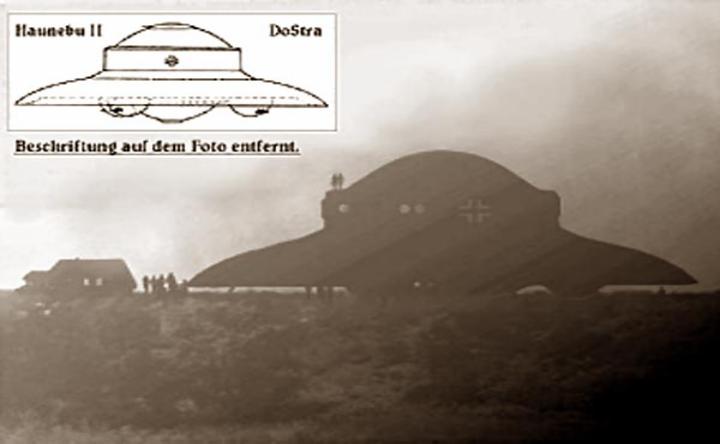
 http://www.thelivingmoon.com/47brotherthebig/04images/Nazi_General/H2_1_-720x444.jpg

From – Unsolved Mysteries in the World:  http://unmyst3.blogspot.com/2008/11/nazis-flying-saucers_05.html


New Illuminati comments: The early rocket-propelled designs by Shriever and others proved too unstable for flight. Most available references to NAZI flying disk designs concentrate on these and similar early models and ignore successful later versions which used entirely different propulsion systems. More stable rotary turbine propulsion followed Shriever’s ill-conceived attempts to build a circular flying wing, but it, too, was soon replaced by the electohydrodynamic  disks we’ve grown familiar with since the end of World War 2 – a natural outgrowth of any planet-bound species’ quest for flight faster than the sound barrier.
Nikola Tesla’s designs - created a few years after the dawn of the 20th century - were the true basis for all later fruitful research by secretive world powers…

For MoreSee – Nazi Ufos: http://newilluminati.blog-city.com/index.cfm?search=nazi+ufo
and

Xtra Images - http://img504.imageshack.us/i/vril6bx6.jpg/
http://www.thelivingmoon.com/47brotherthebig/04images/Nazi_General/H2_1_-720x444.jpg
http://www.royarden.com/blog/pictures/Hitler%20with%20Alien%20UFO%20VRIL%20Haunebu%20WW2%20Nazi.jpg

For further enlightenment enter a word or phrase into the search box @  New Illuminati:

or http://newilluminati.blog-city.com  (this one only works with Firefox)

And see

The Her(m)etic Hermit - http://hermetic.blog.com
 http://newilluminati.blog-city.com (this one only works with Firefox)


 http://www.royarden.com/blog/pictures/Hitler%20with%20Alien%20UFO%20VRIL%20Haunebu%20WW2%20Nazi.jpg

This material is published under Creative Commons Copyright (unless an individual item is declared otherwise by copyright holder) – reproduction for non-profit use is permitted & encouraged, if you give attribution to the work & author - and please include a (preferably active) link to the original along with this notice. Feel free to make non-commercial hard (printed) or software copies or mirror sites - you never know how long something will stay glued to the web – but remember attribution! If you like what you see, please send a tiny donation or leave a comment – and thanks for reading this far…

From the New Illuminati – http://nexusilluminati.blogspot.com


Friday, 19 June 2009

NAZI UFOs Part 2: Terrestrial Constructs

NAZI UFOs
Part 2
 Terrestrial Constructs


The existence of World War Two German field propulsion flying saucers is a topic which is denied by virtually every reputable authority in aviation history. The It is also denied by many researchers studying German saucers. The problem is that in the years immediately following the Second World War the earth's skies suddenly began to be populated by flying craft which did some remarkable things. 
They flew at unheard of speeds. They made very sharp turns, seemingly non-aerodynamic turns, even at this extreme speed. They lacked the glowing tail of jets or rockets but they glowed or gave off light at night from their periphery or from the whole craft. They were silent or almost silent. Sometimes they gave off sounds that an electric generator or motor might make. Sometimes vehicles with electrically based ignition systems ceased to operate in the presence of these saucers. No government claimed these flying craft, yet they were seen all over the world.
The press and popular culture attributed these unusual craft to an extraterrestrial source. Yet, after over fifty years, no real proof for this assertion has ever come forth. Let's come back down to earth. By all accounts these saucers were solid and material in nature. Perhaps it is time to attribute their origin to a solid, material source.


Some individuals see hidden, esoteric or occult knowledge as the inspiration for the breakthroughs the Germans made in field propulsion flying vehicles. Usually coupled with an exotic-theory of UFO origin, it is an equally exotic local from which this exotic theory is said to have originated. We have been presented with this line of reasoning for years in the "UFOs are of extraterrestrial origin" theory. Indeed, some writers see an extraterrestrial origin for German UFOs also as we shall see. But just stating that UFOs are of occult or alien origin is not an explanation in itself. It still begs the question of how they operate. Their method of operation, their technology, must be explained regardless of where they came from in order for the explanation to be a satisfying one.


1. Dzwon, 1A. Biegun YX, 1B. Biegun XY, 2. Generator główny i rozruchowy, 3. Osłona dzwonu, 4. Obrotowa osłona, 5. Ramy, 6. Wirnik, 7. Elektromagnesy, 8. Zasilacz elektryczny i odbiornik, 9. Próżnia, 10. Obrotowy pancerz

Returning to earth, another theory is that the German scientists were influenced by some ideas originating in Asia. Tibet and India are the suspects in question. UFOs have been reported over Mongolia, Tibet and India for centuries. The ancient Indian seven claimed to have constructed aircraft which resemble flying saucers. These saucers are called Vimanas. Ancient Indian texts in Sanskrit speak of the flight and manufacture of these saucers. The German "Ahnenerbe", an organization whose purpose is associated with researching Germanic ancestry, sent out expeditions to the East with the express purpose of acquiring ancient, hidden knowledge. This is precisely what Heinrich Haarer was doing, whose book served as the basis for the film "Seven Years in Tibet". This link between flying saucers of the East and the West is suspected as an influence on German field propulsion vehicles (16). The exact connection, though, has never been demonstrated.

A connection which is more certain involves Viktor Schauberger’s use of Pythagorean geometry. There is no doubt that Schauberger incorporated this mathematics into his work but what is intriguing is what is said about this body of mathematical knowledge. The story goes that it was the Knights Templar who stumbled upon this knowledge in the Holy Land during the Crusades and it was they who kept and incorporated this knowledge through the use of "sacred geometry".


Both the above mentioned schools of thought lead far beyond the parameters of this book but the reader should be aware of what is said about them and their relationship to German flying discs.

Whether it is called "occult technology" or "conventional technology", in the end, it is just simply technology. And in the end, as Dr. Freeman says, "all machines can be reduced to numbers". What is called by some "occult" might be better called "arcane". This is because this technology, which seems to be the basis of field propulsion, is taught only to certain individuals, technologicalinitiates, who use and need this knowledge for their work on government sponsored black projects. These scientists utilize a technology and understanding which are reserved for their use alone. This knowledge is not taught and not made available to the rest of us. We, the great unwashed masses, are given Einstein and the Theory of Relativity and told that this is the pinnacle of learning. As with all secret information, this arcane knowledge is held on a "need to know" basis. Our government believes that we simply don't need to know. It takes a true genius like Dr. Freeman to recognize this knowledge and set it before us in language that we can understand. It is hoped that Dr. Freeman will publish a book sooner rather than later.
Mention of the "occult" brings us to another line of evidence concerning field propulsion, that put forth by Norbert Juergen-Ratthofer and Ralf Ettl. Mr. Ettl became involved while doing research for a film project on Dr. Wernher von Braun. A film company was paying for this research. A package or several packages of information were obtained by the production company which had more to do with UFOs than rocketry. This information was laid aside by Mr. Ettl but he returned to it after enlisting the help of Norbert Juergen-Ratthofer who had a special interest in that subject (17).

The packages contained breathtakingly clear photographs of German saucers in flight. Some of these pictures may be just models but some look authentic and are posed against a landscape. Nowadays, pictures can be generated via computer and these pictures surfaced within modern times. At least one negative from these pictures which was given to Mr. Vladimir Terziski by Mr. Juergen-Ratthofer and seen by this writer, so at least not all of these pictures were computer generated. The pictures have been seen in public and through video film presentation, for about ten years. To the best of my knowledge these pictures have never been debunked using modern technical photo-analysis. Therefore, they have never been shown to be anything less than legitimate. Until they are shown to be less than legitimate, we must accept them as they are represented to us.

Besides the pictures, these writers provide an entire historical and cultural context for these saucers within the Third Reich, This contest involves secret organizations within the SS. Further, the context provided by these writers involving the occult, channeling, and extraterrestrials. This is the weak point of their presentation since the case for these latter connections is really not strong enough to be "in evidence".


Besides the books of Mr. Ettl and Mr. Juergen-Ratthofer, several other German language writers contribute books on a similar or related theme. The more notable are D.H. Haarmann (18) and 0. Bergmann (19). Mr. Ettl and Mr. Juergen-Ratthofer themselves have written several books which are all in German language and available through their publisher (20). Mr. Ettl and Mr. Juergen-Ratthofer have also done two video films, "UFOs Das Dritte Reich Schlaege Zurueck?" and a second film, whose English title is "UFO Secrets of the 3rd Reich". This second film is very well done and contains the pictures mentioned earlier. These films should be seen by anyone seriously interested in German field propulsion saucers (21) (22).


Haunebu 2 Test Flight
Ghostly image of a saucer, said to be a Haunebu 2, on a test flight. Photograph originally from collection of Norbert-Juergen Ratthofer, courtesy of Vladimir Terziski

Mr. Juergen-Ratthofer, Mr. Ettl and allied writers offer two different systems for field propulsion. The smaller saucer-type, which they designate "Vril" was powered by three moving magnetic fields (23). The larger type, designated "Haunebu" was powered by a series of devices according to these writers. In this arrangement, the output of smaller of the Hans Coler "free energy" devices (24), the "Magnetapparat", was used to supply input for the larger Coler device, the "Stromerzeuger". The output of this second device was used to turn a Van de Graaf generator. This energy was directed into something called a Marconi ball dynamo with supplied lift to the saucer (25)(26).

All that seems to have been said about the latter device is that it is mentioned in the same sentence with special saucer condensers developed by T.T. Brown and Professor Paul Biefield in the nineteen twenties and that "such" ("solche") with a rotor system was done by Professor Marconi, in Italy, in the nineteen thirties. Mr. Juergen-Ratthofer goes on to say that this device is to be considered, in principle, a forerunner to the Searl system (27).

The Haunebu pictures strongly resemble the Adamski saucer pictures of the early 1950s. These saucers were seen and pictures of them taken world-wide. There were many different sources for both sighting of Adamski saucers and pictures of them. There were so many in the early 1950s that it is hard to believe that all of them are fakes. Mr. Ettl and Mr. Juergen-Ratthofer maintain that these "Adamski saucers" are really the German-designed Haunebu type saucers (28). Since they were flown after the war, certain questions as to their origin arise. These questions will be treated in an upcoming section of this book.

Besides the Vril and Haunebu designs mention is made by Mr. Juergen-Ratthofer of another type of field propulsion vehicle. This saucer uses a chemical engine to drive a field propulsion generator (29). The type of chemical engine involved is similar to the famous Walter (Walther) engine, which were to be installed on some types of German submarines.

The Walter process involved a closed circuit system activated by the thermal energy produced by the decomposition of a high concentration of hydrogen peroxide. This reaction occurred in the presence of a catalyst, potassium permanganate, in a decomposition chamber. This resulted in a 600 to 700 degree gas composed of steam and oxygen, under natural pressure sufficient to drive a turbine. After the gas had done its work if was fed into a reclamation chamber which recycled at least part of the gas back into the engine. Additional fuel, Juergen-Ratthofer mentions methanol, could be fed into the system for more heat. The system without additional fuel is called the "cold" system while with added fuel it is called the "hot" system. In fact, the cold system was used on the V-2 rocket to drive the turbo-fuel pumps since known pumps could not handle the volume of liquid necessary to feed this new type of rocket.

161

Hybrid Saucer Design

Chemical/Field Propulsion Saucer (N. Juergen-Ratthofer).
1. Plexiglass pilot's cabin.
2. Crew rooms.
3. Intake air slots (hermetically sealed in space).
4. Vacuum ring retainers with high-performance vacuum pumps.
5. Lifting and steering jets connected to the Walter turbine system.
6. Walter turbines and electric generators with connected machine maintenance rooms.
7. Disc rotor wheel, rotating clockwise.
8. Electromagnet outer ring rotating counter-clockwise.
9. Disc wheel, inner part of the electromagnet outer ring.
10. Segmented disc-rotor and wing screw with adjustable flight blades.
11. Axis of saucer with (a) two electric motors to drive the counter rotating disc motors: electro-gravitation plant, (b) various electrical connections,(c) fuel and water tanks.
12. Connection shaft between pilot's cabin and machine room.

In the hybrid saucer Mr. Juergen-Ratthofer
describes, the cold system drives a rotor-stator arrangement which doubles as a blade lifting wing similar to that of a helicopter. The rotor-stator-blade is internally housed in the cowling of the saucer. The output of the rotor-stator is a strong magnetic field which presumably frees the saucer of the constraints of gravity as claimed for the other field propulsion saucers (30). In addition, spaces within the saucer have all air removed by special vacuum pumps with increase the buoyancy of the craft within the atmosphere. Further, some of the hot oxygen-steam mixture is jetted out at the periphery of the saucer while being mixed with methanol for additional heat and therefore thrust. Again, we are reminded of Dr. Belluzzo. We are also reminded of Vesco since he hints at a similar engine (31) which he even vaguely links with "electromagnetic waves" (32). Have we come full-circle?


In the same vane [sic], it would be negligent not to mention that anatomic engine might easily be substituted for the Walter engine. The atomic engine might be one of three types. It might be the type which burned the atmosphere itself. This burning would produce hot air and steam from the water contained in the atmosphere. It might be one which produced steam using water carried in tanks. It might be one which super-heats and ejects a gas such as hydrogen or helium. Any of these mediums could be ejected through the rotor blades yielding the desired result. A device of this type would tie together many of the German saucers-plans so far discussed.

Dr. Freeman points out that Marconi "stole" Tesla's inventions. Tesla also built a power-plant of spherical construction which contained vacuum tubes and so may have been superior to the device of Schappeller which we shall look at next. Surprisingly, some detail exists about this Tesla free energy device (33).Tesla used his engine to successfully power a Pierce Arrow automobile. This means that a spherical, working field propulsion device existed in the USA powering, not a flying saucer but an automobile. Dr. Freeman warns not to be confused by many spherical devices, all of which seem different. The fact is that they all work on the same principles (34).

  
German Field Propulsion Flying Saucers Sources and References

1.     1. X, Michael, 1960, pages 17, 33, We Want You Is Hitler Alive?, Futura Press, reprinted 1969 by Saucerian Books,Clarksburg, WV.
2.     2. Barton, Michael X., 1968, pages 26-36, The German SaucerStory, Futura Press, Los Angeles
3.     3. Zunneck, Karl-Heinz, 1998, pages 120-122, Geheimtechnologien. Wunderwaffen Und Irdischen Facetten Des UFO-Phaaenomens 50 Jahre Desinformaton und die Folaen. CTT-Verlag, Suhl
4.     4. Zunneck, Karl-Heinz, 1998, page 122
5.     5. Lyne, William R., 1999, page 48, Pentagon Aliens. Creatopia Productions, Lamy, New Mexico 87540
6.     6. Lyne, William R., 1999, page 28
7.     7’ Lyne, Willaim R., 1999, page 38
8.     8. Lyne, William R., 1999, page 21
9.     9. Lyne, William R., 1999, pages 20, 41
10. 10. Lyne, William R., 1999, page 42
11. 11, Lyne, William R., 1999, pages 197-200
12. 12. ibid
13. 13. Trinkaus, George, 1988, pages 3-4, Tesla The Lost Inventions. High Voltage Press, Portland, OR.
14. 14. Lyne, William R., 1999, page 215
15. 15. Freeman, Gordon Dr., 3/18/01, personal letter to author
16. 16. Stoll, Axel Ph.D., 2001, pages 15-20, Hochtechnologie imDritten Reich Reichsdeutsche Entwicklunqen und die vermutlich wahre Herkunft der "UFOs". Amun-Verlag, Schleusesiedlung 2,D-98553 Schleusingen
17. 17. Ettl, Ralf, 1999, page 11, "Notes To The Vril-Project" Ursprung und Quellen
18. 18. Haarmann, D.H., 1983, Geheime Wunderwaffenr II Geheime Wunderwaffen. III Geheime Wunderwaffen, Hugin Gesellschaft Fuer Politisch-Philosophische Studien E.V., Postfach 23, D- 48472, Hoerstel 3, Germany
19. 19. Bergmann, O., 1988 and 1989, 1 Deutsche Flugscheiben und U- Boote Ueberwachen Die Weltmeere. 11 Deutsche Fluqscheiben undU-Boote Ueberwachen Die Weltmeere, Hugin Gesellschaft Fuer Politisch-Philosophische Studien E.V., Postfach 23, D-484772, Hoerstel 3, Germany
20. 20. Dr. Michael Daemboeck Verlag, Markt 86, A-3321 Ardaggr, Austria
21. 21. Video Film "UFOs Das Dritte Reich Schlaegt Zurueck?,available through Dr. Michael Daemboeck Verlag, see reference (18)
22. 22. Video Film "UFO Secrets of the 3rd Reich" available through Total Solutions International, Las Vegas, NV.
23. 23. van Helsing, Jan, 1993, page 129, Geheim Gesellschaften und ihre Macht im 20. Jahrhundert, Ewertverlag, Meppen, Germany
24. 24. British Intelligence Objectives Sub-Committee Final ReportNo. 1043 Item No. 31, "The Invention Of Hans Coler, Relating To An Alleged New Source Of Power"
25. 25. Video Film "UFOs Das Dritte Reich Schlaegt Zurueck?,available through Dr. Michael Daemboeck Verlag, see reference(18)
26. 26. Juergen-Ratthofer, Norbert and Ralf Ettl, 1992, page 51, DasVril-Projekt. Dr. Michael Daemboeck Verlag, Ardaggr, Austria
27. 27. Juergen-Ratthofer, Norbert, date unknown, page 16, "GeheimeUFO, 1. Folge: Flugscheibenprojekte aus verschiedenen Staatender Erde", this article was courtesy of Theo Paymans, Holland
28. 28. Juergen-Ratthofer, Norbert, date unknown, pages 84,85,Fluqscheiben und andere deutsche und iapanische Geheim- und Wunderwaffen im Zweiten Weltkrieg, self-published, availablethrough reference (18)
29. 29. Juergen-Ratthofer, Norbert, date unknown, pages 1 and 16,"Geheime UFO, 2. Folge So baut man fliegende Untertassen—und so funktionieren sie", this article was courtesy of TheoPaymans, Holland
30. 30. ibid
31. 31. Vesco, Renato, 1976, pages 163 and 164, Intercept UFO. Pinnacle Books, New York
32. 32. Vesco, Renato, 1976, pages 135-136
33. 33. Nieper, Hans A., 1985, pages 188-189, Conversion of Gravity Field Energy Revolution in Technology, Medicine and Society, MIT Verlag, Oldenburg
34. 34. Freeman, Gordon Dr., 3/18/01, personal letter

          
Archivos Secretos SS
Ovnis del III Reich Nazis
Información secreta de Proyectos del III Reich Nazis Alemanes
(Archivos Secretos SS)


La energía implosiva: un logro ecológico.


Hoy se especula a menudo sobre la forma de encontrar y utilizar energías alternativas que palien la destrucción del medio ambiente provocada por la energía explosiva, los gases tóxicos, los residuos letales, etc.
Pero lo cierto es que en aquellos tiempos ya se hablaba de que los alemanes trataban de hallar una nueva ciencia, una técnica diferente y renovadora con la que sustituir los motores de explosión considerados destructivos en los círculos esotéricos del III Reich por otros de implosión, cuya nocividad es nula.
Aquellas investigaciones se basaban principalmente en la levitación electro gravitacional y la propulsión por terriones (fuerzas cósmico-telúrico-terrestres), en las que, según parece, se encontraba el núcleo de esa otra técnica, que distanció la cosmovisión nacionalsocialista de todas las aún vigentes, en un intento de proporcionar al III Reich una total independencia de materias primas inaccesibles de otro modo y energía abundante, barata y no contaminante.
De hecho, y según se asegura en el misterioso informe, los departamentos de investigación U-13 y E-4 de la SS trabajaban febrilmente para realizar y perfeccionar esas tecnologías, inconcebibles para la mayoría del pueblo y para el resto de la humanidad.


Un buen ejemplo de este trabajo serían las peonzas voladoras Haunebu de Viktor Schauberger, que funcionaban ya con fuerzas de levitación no contaminantes ni generadoras de ruidos perniciosos.
 

Esas peonzas voladoras estaban movidas por un propulsor electro gravitacional de terriones al que se dio el nombre de Terrionador Thule que quedaba acoplado a un generador de bandas de ondas tipo Van Der Graff, a un aparato magnético productor de energía a base de carbón y a una dinamo cónica de energía turbinosa tipo Marconi.

El informe asegura también que la
   

construcción práctica de aparatos basados en esos principios de propulsión se debió a la inventiva del capitán alemán Hans Koheler y que ya en 1944 fueron fabricados en serie los conversores de terriones tanto en fábricas de la empresa AEG como de la Siemens.
 

El propulsor de Koheler se dice en el informe precisaba, para ponerse en funcionamiento, de una energía inicial muy baja y mínima que podía serle proporcionada por un acumulador eléctrico que lo activaba. Después de poco tiempo, el conversor de carbón ya funcionaba automáticamente con plena autonomía, puesto que se convertía en un generador de energía que actuaba, sin consumirse, como un catalizador: en este caso, la energía se produce a partir de nada consumible. Se originaba, eso sí, una transformación de las fuerzas electro gravitacionales existentes en el interior de la Tierra en electricidad utilizable. Un principio de simplicidad genial cuando se ha logrado dominar y se sabe utilizar correctamente.

Los platillos volantes Haunebu.


Esos platillos volantes de las diferentes series Haunebu de los que existen fotografías obtenidas por los aliados cuando invadieron el territorio del III Reich y en cuya incuestionable autenticidad se apoya el informe tienen especial importancia.


Según uno de estos informes que vemos a continuación en 1945 ya estaban construidos contando todos los modelos un total de 261 aparatos:
El aparato volador Haunebu II continúa explicando el informe poseía un cañón de grandes dimensiones que habría de provocar una impresión inolvidable en toda persona que lo contemplase sin estar preparada para ello o sin saber de qué se trataba, y superaba los 25 metros de diámetro, en su eje central alcanzaba los 10 metros de altura.


Prototipo Haunebu II - Dostra.


KT-P2 Cuadro de mandos de navegación celestial Haenebu IV.


El general Patton en el asalto de las instalaciones subterráneas de las montañas de Peenemünde 1945 encontró una serie de aparatos extraños, quería destruirlos pero los mandos lo hicieron llevar a la base científica LASL de los Álamos en Nuevo México, los científicos al examinarlos no salieron de su asombro: encontraron sistemas de navegación desconocidos, manómetros con altitudes y velocidades igualables a la ciencia ficción, sistemas polares y vi direccionales por magnetismo, alto voltaje, iluminación, eléctricos Anti-interferencias etc., las fechas inscritas datan de sistema de navegación celestial alemanes en 1943 y mucho antes de 1942.


KT-P2; Algunas figuras del cuadro de mandos de Navegación Celestial
Bombas en forma de discos y platillos Vril


Que algunos artefactos bélicos alemanes tenían una extraña forma discoidal no es ningún secreto. Así, bajo la designación de V-4 la generalidad del público sólo conoce la V-1 y la V-2 se construyeron varios discos voladores para ser empleados como bombas volantes.


Así, los datos llegados hasta nosotros aseguran que en 1941 ya habían sido acometidos los estudios para diseñar la peonza volante de Schriever-Habermohl, un avión de forma circular y despegue vertical provisto de motores de reacción convencional, efectuándose a finales de 1942 las primeras pruebas de vuelo, durante las cuales se constataron graves errores de construcción.


Paralelamente, y después de una larga serie de ensayos, el ingeniero Richard Miethe comenzó a trabajar también en 1942 en la construcción de aparatos que volaran y tuvieran forma de disco.


De sus investigaciones, realizadas en colaboración con el científico italiano Giuseppe Bellonzo, surgiría una nueva versión de la V-7.


Transcurrido un tiempo, y bajo el apoyo del propio Führer, los equipos Miethe-Bellonzo y Schriever-Habermohl entraron en contacto con el propósito de aunar esfuerzos para realizar coordinadamente sus investigaciones y hacer otras en conjunto. Finalmente sus esfuerzos dieron como fruto la primera, legendaria e increíble V-7, aparato similar a un helicóptero ultrasónico que presentaba doce agregados tipo turbo BMW-028. En su primera prueba se remontó a una altura de 20.813 metros de altitud, alcanzando en la segunda 24.200. Y todo ello utilizando helio como combustible de base.

Por otra parte, se desarrolló también otra línea de discos volantes conocidos como serie Vril. De ella se ocupó el grupo Schumann en íntima relación con el departamento E-4, de la SS, especializado en armas milagrosas.

Planos y Prototipos Vril.


Hoy sabemos que llegaron a construirse 17 aparatos de la serie Vril-1. Su diámetro era de 11,56 metros, podían alcanzar velocidades de 2.900 km./h y llevaban un cañón teledirigido como dotación de combate. El Vril-1 era el equivalente revolucionario de un avión de caza, mientras que el Vril-9 era un caza monoplaza. Curiosamente, su diseño parece coincidir con el del aparato que fue visto en la Luna por el astronauta norteamericano Edwin Aldrige.


Artefactos y estructuras desconocidas y similares en las misiones Soviética 20 julio 1965 y de la Nasa Apolo 12 - 1968 en la Luna.
Bombas de fuego que paralizan los motores de los aviones.


El informe asegura también que, aunque al final de la Segunda Guerra Mundial resultaba evidente
que era imposible coordinar los esfuerzos y mermaban los recursos, los nazis no dejaron en ningún momento de perfeccionar sus armas. Es más, al ir dominando la tecnología de propulsión electro gravitacional se asegura obtuvieron mayor velocidad, maniobrabilidad y otras prestaciones en los aparatos.

Así, se afirma, que en una fase intermedia, en la ciudad alemana de Neustad y bajo el control de tropas técnicamente especializadas de la SS, se desarrolló el proyecto Bola de fuego, al que los estadounidenses denominaron acertadamente Foo-fighter o Combatiente total.


Foo-Fighter o Wasserfall.
Naves nodriza con forma de puros.


Un dato más que parece dar pábulo a la hipótesis nazi es que en algunos informes sobre ovnis se habla también de la existencia de aparatos gigantescos con forma de cigarrillo o puro habano, que se han interpretado como naves nodrizas en las que se alojarían los discos voladores y que suelen viajar con mayor lentitud siguiéndolos.


Pues bien: según el informe, bajo el nombre de Andrómeda, se escondía, en efecto, el proyecto para una nave nodriza; nave que se asegura existía ya en 1944, habiendo sospechas de que las había, incluso, con anterioridad a esa fecha.


Con una eslora de 139 metros, estas naves aéreas gigantescas se afirma en el informe se impulsaban con propulsores tipo Thule y estaban proyectadas con una capacidad interior suficiente como para transportar y alojar un aparato Haunebu y varios de tipo Vril.
 

Todos ellos se añade podían despegar de la nave nodriza durante el vuelo de la misma e, igualmente, retornar a ellas a través de unas escotillas laterales especiales. También se dice que estos gigantescos aparatos iban armados de cañones que podían emerger y recogerse de forma automática.


Y lo cierto es que, tras la guerra, fueron capturados por los aliados dos proyectos de construcción de estas enormes naves Andrómeda; ahora bien, sobre su fabricación real y operativa no se ha podido aportar prueba alguna. Sin embargo, y a pesar de no contarse con vestigios de la época, parece que actualmente existen aparatos tipo Andrómeda o similares y que han podido observarse perfectamente en vuelo. Las fotografías posbélicas de los cigarros voladores son abundantes.


Expedición a la Antartida.


Otro hecho que apoya la tesis del informe sobre el origen nazi de muchos Ovnis es la misteriosa expedición a la Antartida realizada por los alemanes en 1938 bajo el mando del capitán Ritscher. Su objetivo, tanto científico como militar, consistía sobre todo en conquistar un espacio de este inhóspito territorio. Y así fue cómo el nombre del buque en el que se trasladaron los alemanes Neu Schwabenland (Nueva Suabia) fue puesto a una amplia zona de costa antártica que ningún gobierno germano de posguerra ha dejado de reivindicar.

Una derrota inexplicable.


Aprovechando el buen clima invernal antártico, en el invierno de 1946, recién acabada la guerra en Asia, llegó a la Antartida, bajo el mando del almirante estadounidense Richard Byrd, una importante flota estadounidense. Esta expedición tenía como nombre clave High Jump (término deportivo inglés para designar el salto de altura). Después de una meticulosa y larga preparación, el convoy arribó a la Antartida en febrero de 1947; pero se dio por finalizada apresuradamente el día 3 de marzo de ese mismo año. Y en este ínterin, según documentos militares, se perdieron de forma misteriosa varios aviones de combate y hubo bajas de marines. No se informó abiertamente, pero parece que actuaron fuerzas misteriosas que repelieron la presencia militar americana e hicieron imposible su asentamiento.
Tras cancelar la operación, repentinamente, el almirante Byrd comunicó a la prensa algo sumamente extraño y fuera de contexto: Resulta una verdad muy amarga de admitir; pero en caso de un nuevo conflicto bélico, podremos ser agredidos por aviones que tienen la capacidad de volar vertiginosamente desde un Polo a otro. Se precisa tomar urgentemente adecuadas medidas de defensa para interceptar a los aviones enemigos que provengan de regiones polares. Especialmente interesa y se precisa circundar la Antartida de una zona de defensa y seguridad".


Podemos concluir, pues, que la invasión del territorio antártico alemán, la Nueva Suabia, deseado por Estados Unidos como un conveniente botín de guerra, aparentemente fácil de ocupar, resultó un rotundo fracaso; y es ridículo creer que éste se debiera a un ataque de pingüinos asesinos...


Los primeros vuelos espaciales fueron de los nazis.


En 1958 se realizó una nueva expedición estadounidense a la Antartida; pero en esta ocasión portaban armas terriblemente eficaces, incluso nucleares. Llegaron allí en el frío y oscuro verano polar. En tres ocasiones 27 y 30 de agosto y 9 de septiembre se lanzaron misiles atómicos contra el territorio de Neu Schwabenland (o Nueva Suabia), pero en ninguna de las tres ocasiones llegaron a tierra, sino que explosionaron sorpresivamente en pleno vuelo al aproximarse a la vertical de la costa.


¿Qué razón hubo para realizar aquellas empresas bélicas sobre la zona antártica? ¿Y para rodear todo este tema de misticismo, desinformación, descrédito y noticias falsas?


Un último hecho podría aclarar más este enigma: se conservan fragmentos de un informe alemán definitivo. Versa sobre una misión suicida que se llevó a cabo con un único Haunebu-III que se llegó a construir: ¡un vuelo a Marte!


En el periódico de la época se puede leer: ¡ASTRONAUTAS NAZIS LANZADOS EN 1943 RETORNAN A LA TIERRA!


El Haunebu-III tenía 71 metros de diámetro. Matemáticamente se calculó su capacidad de autonomía con propulsión electro gravitacional y resultó ser de 75.274.000 Kms., es decir, que cubría la distancia Tierra-Marte. Pero después el impulsor electro gravitacional quedaba inoperante porque lentamente se ligaba a los metales que entonces se pudieron utilizar en su construcción. Un viaje en tales condiciones significaba, en consecuencia, un viaje a lo desconocido; y lo más probable, sin posibilidad alguna de regresar para la tripulación, compuesta por alemanes y japoneses. Pero así se decidió según el informe mencionado en el departamento E-4 de la SS, en la primavera de 1945; aunque fuese un postrer acto de sacrificio.


Tras zarpar, según el informe, el cohete navegó durante ocho meses y medio alcanzando la superficie de Marte, como estaba previsto, a mediados de enero de 1946. Al parecer, no hubo problemas en el viaje, pero se piensa que con el propulsor electro gravitacional prácticamente agotado, la extremadamente tenue atmósfera marciana y la atracción gravitatoria, el aterrizaje de la nave no debió ser suave. Aún así no hay seguridad de que fuese un aterrizaje forzoso, porque siempre según el informe llegó con la energía mínima suficiente para contrarrestar la relativamente leve fuerza de gravedad marciana.


Imágenes..... Nasa Misión Enterprise 1997, (Pasadena) Mars (Marte).


El Puzzle finalmente resuelto y comparado.... similar proceso de resolución fotográfica a escala...


¿Un tanque alemán Panzer I fosilizado y una calavera de oficial de la SS ?
Hay imágenes de la Nasa, que dan prueba feaciente de que si un Haunebu III del III Reich Nazis, fue al Planeta Marte, pero su aterrizaje fue fatal en la Atmósfera y superficie marciana, no aterrizo en forma normal, se estrello al descender en el suelo marciano y los vestigios de está nave exploradora se encuentran esparcidos por todos lados, se puede apreciar, el simbolo nazis, un cañón, un tanke, y una gorra SS de uno de los cosmonautas que tripularón aquella nave, llamada Ovni.
Tanque Ligero Panzer IA fabricado en 1933; Su Bautismo de fuego en combate fue en la guerra relámpago de 1939 con la invasión de Polonia.


¿Una calavera de Oficial de la SS esta representando a los Estados Unidos en Marte?
Lo cierto, en cualquier caso, es que por ahora sólo podemos especular sobre aquella empresa espacial pionera y el destino de aquellos anónimos primeros cosmonautas. Y es que, por increíblemente fantástica que pueda parecer esta historia, es un acontecimiento contrastado, aunque, eso sí, celosamente ocultado al público.


¿Cabría la posibilidad de que la tripulación del Haunebu-III encontrase algo más de lo que las actuales sondas no tripuladas han descubierto para nosotros, como verdaderos restos de cultura o incluso refugios subterráneos habitables? Imposible saberlo. Aunque lo más probable, todo hay que decirlo, es que el Haunebu-III esté hoy sepultado bajo metros de arena marciana.


¿Hay bases nazis en la Luna?


El informe vienés se refiere también a extrañas fotografías de ovnis tomadas desde naves espaciales... A una nave tipo Haunebu-3 aproximándose desde la Luna a la Tierra..., a una enorme y extraña letra S trazada sobre el suelo lunar... ¿Podría se pregunta el informe ser la inicial del término militar alemán Stützepunkt o punto de apoyo? ¿Puede tratarse de simples alucinaciones cuando estamos ante un insobornable y neutral material fotográfico?


Apolo 17 - Misteriosa y Genuina Cúpula Lunar.
¿Compuerta a Base Interior o Punto de Alunizaje?....


El informe concluye considerando que todo esto, por supuesto, son hipótesis difíciles de creer y hasta de concebir, aunque si observamos en conjunto el mosaico y los hechos que se complementan, unos con otros, ello nos lleva, por una lógica elemental, a reflexionar sobre el conjunto del tema y muchas piezas aisladas pueden convertirse en pruebas irrefutables. Es el caso de los esquemas de platillos volantes alemanes, extraídos del Tomo 1º del libro Deutsche Flugscheiben und U-Boote überwachen die Weltmeere, de O. Bergmann (Editorial Hugin e.V.S., Postfach 13, 5802 Wetter 1, Alemania).


Nazi UFO Technology: Sayfa-1 Sayfa-2 Sayfa-3 Sayfa-4 Sayfa-5 Nazi UFO Sayfa-6
Hiçbir yazı/ resim izinsiz olarak kullanılamaz!! Telif hakları uyarınca bu bir suçtur..! Tüm hakları Çetin BAL' a aittir. Kaynak gösterilmek şartıyla siteden alıntı yapılabilir.
The Time Machine Project © 2005 Cetin BAL - GSM:+90 05366063183 -Turkiye/Denizli


For further enlightening information enter a word or phrase into the search box @  New Illuminati:

@  http://nexusilluminati.blogspot.com (or click on any tag at the bottom of the page for direct references)

or @ http://newilluminati.blog-city.com  (this one only works with Firefox)

And see

The Her(m)etic Hermit - http://hermetic.blog.com


This material is published under Creative Commons Copyright (unless an individual item is declared otherwise by copyright holder) – reproduction for non-profit use is permitted & encouraged, if you give attribution to the work & author - and please include a (preferably active) link to the original along with this notice. Feel free to make non-commercial hard (printed) or software copies or mirror sites - you never know how long something will stay glued to the web – but remember attribution! If you like what you see, please send a tiny donation or leave a comment – and thanks for reading this far…

From the New Illuminati – http://nexusilluminati.blogspot.com