"All the World's a Stage We Pass Through" R. Ayana

Showing posts with label fossil fuel. Show all posts

Saturday, 30 April 2016

The End of “Fossil Fuels”: Catastrophic Coal, Abiotic Oil and Upwelling Methane


The End of “Fossil Fuels”
Catastrophic Coal, Abiotic Oil and Upwelling Methane
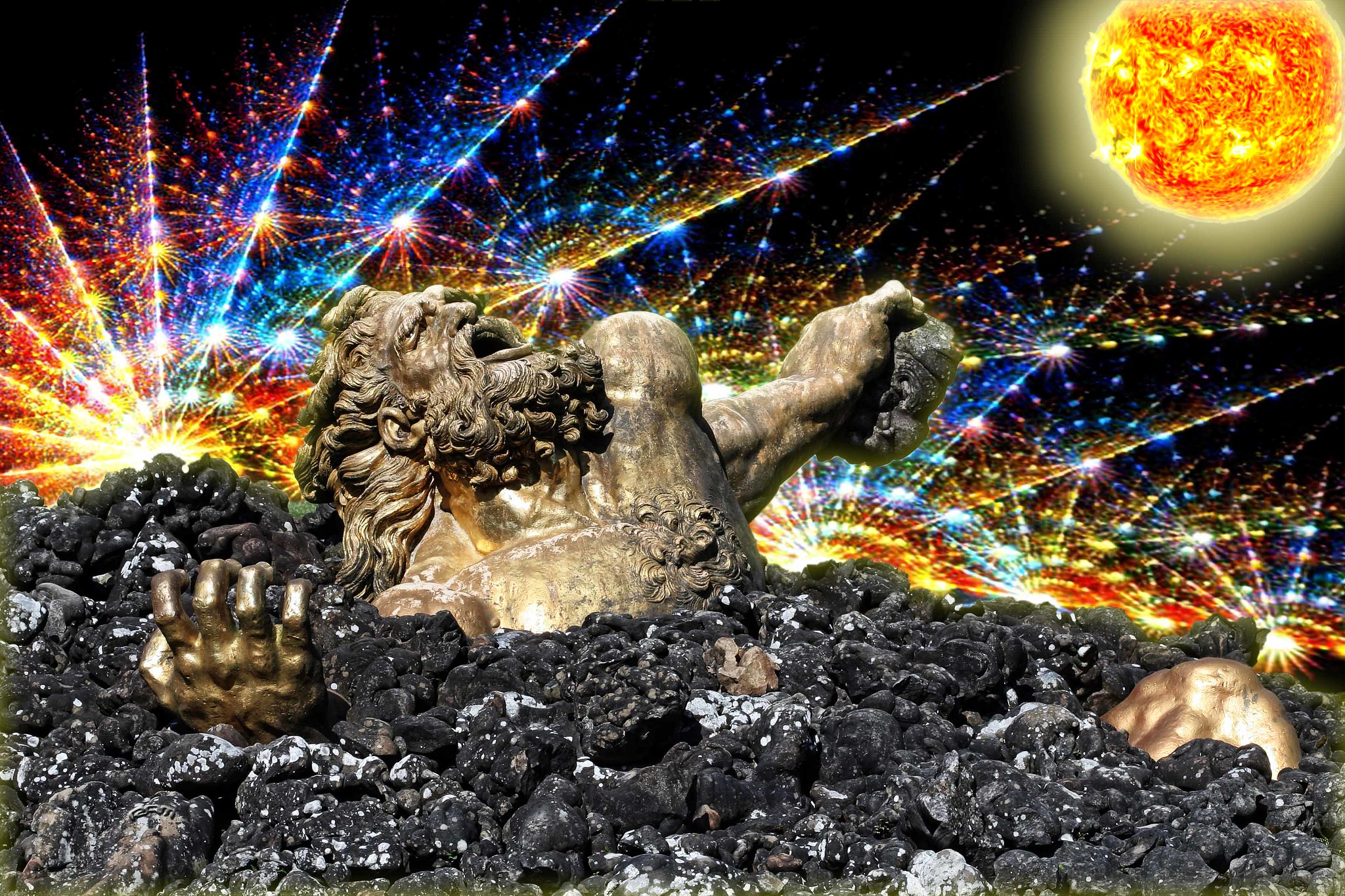
Old King Coal by R. Ayana


by Thomas Joseph Brown


“To the writers of books upon meteorites, it would be as wicked–by which we mean departure from the characters of an established species–quasi-established, of course–to say that coal has fallen from the sky, as would be to something in a barnyard, a temptation that it climb a tree and catch a bird. Domestic things in a barnyard: and how wild things from forests outside seem to them. Or the homeopathist–but we shall shovel data of coal.”

-      Charles Fort, The Book of the Damned
The End


With a title like The End of Fossil Fuels you may think that this is an article about alternative energy or “free” energy, but alas, it is not. It is an attempt to describe the inadequacy of the term “fossil fuel” and to prevent its further usage in the English language through education in the mysteries of the hydrocarbon structures in the earth. I can’t blame people for having used this misleading phrase, being guilty myself. We are regularly taught such misconceptions in school. But one should always be ready to learn new ideas and concepts, especially once the evidence is investigated.


Natural+Refrigerant+-+Airconditioner


The term “fossil fuel” is a standard phrase used in reference to hydrocarbons in their various permutations as petroleum, coals, and natural gas. The argument to be presented here is that hydrocarbon deposits are not “fossilized carbon” at all in the sense implied in the modern usage of that term, that there is a larger “carbon dynamic” eventuating in the earth process. The standard response to this is “well, they FIND fossils in the deposits”. This is scientific fact and will not be disputed, fossils certainly are found in SOME deposits, many of them being quite curious – coal balls and roof balls – and will be discussed in turn as they will further our argument. There are also serious fossil anomalies, evidences of human intelligence which crop up in various coal beds supposedly laid down hundreds of millions of years before humans are supposed to have existed. But we will first look at the hydrocarbon structures themselves.


Universal Carbon


There is a curious picture to be gleaned by considering the diverse distribution of carbon throughout the universe. Carbon is ubiquitous, being the 4th most abundant element in the solar system, along with oxygen, hydrogen and helium. Hydrocarbons have been detected in interstellar gas clouds, in the atmospheres (as methane, CH4) of the superior planets, Jupiter, Saturn, Uranus, Neptune, and in various forms on several moons of these planets and Pluto. A significant percentage of the asteroids exhibit certain optical reflective properties of tar, as was also measured in the core of Comet Halley.

There is such a universal abundance of carbon that it may be reasonably considered that during the formation process of the earth vast amounts of elemental carbon were integrated into the deep earth structure, and cosmic carbon is still being deposited on earth in interplanetary dust grains. Numerous meteorites with carbonaceous content have been reported, including lumps of pure coal, though these are not prominently promoted in science, as their references are usually common rather than scientific. After all such things as extraterrestrial coal simply can’t exist, so why would a scientist bother recording it?

Carbon exists on earth with a dual physical nature as the hardest (diamond) and the softest (graphite) of mineral deposits. Carbon is also a fundamental ingredient of carbonate “sedimentary” rocks (limestone, chalk, graphite, dolomite, etc.), some deposits exhibiting curious and fantastic features which bring into question the normal concepts of sedimentation. Atmospheric and biospheric carbon are integral to our very structure and existence, and it is the acclaimed residue of past biospheric activity, which is the alleged source of earth’s vast and generally pure hydrocarbon deposits.


Coal_Fossil_Fuel


Carbon is everywhere permeating the earth—in “depositional” structures well studied due to the immense economic and political value of usable hydrocarbons, and as rarefied migration and transformation through much of the earth to the surface, where it slowly but constantly outgases. Hydrocarbon deposits are vast and diverse: oil, coal, natural gas, methane hydrate, etc. They appear in all geological strata from Precambrian (pre-life!) to Recent (too young for “fossil” process), and include igneous rocks (deep earth origins, allegedly no life due to heat and pressures involved), with some hydrocarbon deposits completely enclosed in basalts. Oil is also found in bubbles in crystals and geodes.

What could be the source of all this carbon? One current theory is that depositions are resultant from the carbon cycle in the biosphere, which imposes an incredible and curious stability on earth’s chemistry, as oxygen breathing fish are found since the early Paleozoic. Calculations of the carbon budget of the earth indicate that on average 20 kilograms of carbon have been deposited per cubic centimeter (20kg/cm2) over the age of the geological column. That is quite an astounding bit to come from purely biological processes, and the curiosities of the deposits are astonishing as well.


Dinosaur Dung

Geographic distribution of hydrocarbon deposits in the Middle East. Chemical signatures specific to this region are found in all these deposits, regardless of geological "age" and rock type. Black dots indicate location and relative size of deposits.


If hydrocarbon deposits in the earth are not formed from distilled fossils, then what? There is an alternative viewpoint in the abiogenic–non-biological–theory of hydrocarbon deposits (Mendeleev, Sokoloff, Vernadsky, Kudryavtsev, Gold, and others), and that is that the carbon–a primordial earth substance–is constantly upwelling as methane from the deep earth where it was deposited during the original planetary coagulation. In this theory the primordial carbon, deposited from cosmic origin during the formation of the earth, is transformed into petroleum and coal by chemical and bacteriological action in its upward migration from depth. This abiotic theory has been well advanced in our current times by Thomas Gold, a noted and erudite scientist, but is still not provided a fair hearing in the courts of science. Gold has done extensive research, including drilling into Precambrian igneous rocks for hydrocarbons, to prove his theory.


Dinosaurs


In what is known as Kudryavtsev’s Rule “any region in which hydrocarbons are found at one level will be seen to have hydrocarbons in large or small quantities, but at all levels down to and into the basement rock.” Where oil and gas deposits are found, there is often a concordant coal seam or seams above them. Where the vertical stacking of hydrocarbon deposits is found such as in Iran, Java and Sumatra, and Oklahoma amongst other locales, drill shafts for oil and gas wells penetrate shallower coal beds. Gas is usually the deepest in the pattern, and can alternate with oil. All petroleum deposits have a capstone generally impermeable to carbon’s upward migration, and this capstone provides the damming mechanism allowing accumulated deposition.


Under the oceans methane hydrate has accumulated in a semi-stable “frozen” state. This may be the result of the great masses of oceanic water acting as a capstone/reactor with the methane, and methane hydrate is also found under permafrost associated regions. The methane hydrate deposits under the ocean floors are estimated at a staggering one billion cubic kilometres of carbon gas! There is twice as much carbon in this frozen gas under the oceans than in all the land based hydrocarbon deposits (coal, oil, etc) combined.

In considering in our imagination how these deposits are structured in the earth, we can see how one has cause to build a picture of carbon gas migrating up from deep earth sources globally. How and in what form it deposits–if it doesn’t work its way to the surface like much of the gas–depends on geological and chemical structures of both large and small areal extent.


Signposts and signatures


Petroleum and Tectonic Map of Southeast Asia. The relationship of the hydrocarbon deposits to the geological area in whole, independent of geological age and rock type, is easily seen. A common chemical signature links these oils of diverse geological, but close geographical location. The relationship of the deposits to both mountain and volcano formation zones indicates upwelling hydrocarbons as the primary driving force for such diverse geological phenomena.


Oil deposits are claimed to be of marine fossil origin, migrating from fossiliferous shales into other geological strata, generally only sedimentary. One major but little publicized problem–outside of the fact that no actual fossils have ever been found in petroleum–is that there is no known exact chemical process for conversion of biological debris into petroleum! Biological markers are claimed as the proof of biological origins, but perhaps they are contaminants. Some of the “biological markers” in oil are present in cosmic hydrocarbons. Here we find a major scientific belief–that of the biological origins of oil–without the fundamental and most necessary mechanism ever having been accurately described! And you thought it was all figured out, I’ll bet.

Common chemical signatures, based on trace element content ratios, are found in oil from particular regions, such as the Middle East, regardless of geological age of deposit. In fact most oils can be analysed in this fashion to provide information on their regional source. The hydrocarbon deposits of Southeast Asia are found in an arc running from the Himalayas through the volcanic regions of Indonesia, cutting quite a geological swath. Yet the oil from any deposit in this region possesses a characteristic chemical marker, an affinity thus indicating a common regional source. Another dimension is added in that of the common chemical signature of oil found in Ordovician layer source rocks worldwide, said to be caused by a specific microfossil.

Coal and oil are considered to be of differing origins, oil from marine deposits and coal from vegetative land deposits. The two types of deposits are often related, and oil and coal also have significant chemical affinities. Oil and volcanic products have close chemical affinities as well, and it has been proposed (Coste) that hydrocarbon deposits have been injected into the geological column through volcanic solfataric action.

Earthquakes, like volcanos, may also be related to upwelling hydrocarbons. The shifting of large subterranean gas volumes could easily account for earthquake action and could also provide a workable model for tsunamis. Numerous eyewitness accounts over the centuries indicate curious natural phenomena related to earthquakes: lights, sounds, flames. In countries such as China, where pragmatism has the ability to overcome theory, ground gas measurements have been used successfully to predict earthquakes (Haicheng, 1975). A whole range of curious natural phenomena such as earthquake related lights and booming sounds may well be connected to upwelling hydrocarbon gasses.

Gas is produced in commercial quantities from the sides of Mount Taranaki, New Zealand’s largest active volcano, so volcanos and hydrocarbons are known to be directly related.

Diamonds are formed in volcanic pipes, from materials brought from extreme depth in the earth. This shows that pure unoxidised carbon (diamond) and methane, which has been detected as gas bubbles in diamonds, exist at great depth, providing the source material for the abiogenic theory.


2981300_1cd91dda7c


While Thomas Gold has promoted a modern scientific approach to the relationship between hydrocarbon gases, earthquakes and volcanos, we can also thank James Churchward who proposed this link as the cause for the sinking of the hypothetical lost Pacific continent of Mu: it was the collapse of massive gas bubbles in the earth’s crust. Two things to consider here: 1. such gas bubbles exist (commercial gas fields), are related to volcanos in some geographical areas as mentioned, and are being poked to extract the gas–like pins in admittedly thick skinned balloons–with little comprehension of the tremendous power being played with for short term commercial gain; and 2. perhaps many of the mysteries of global geological structures and earth history–mountains, crater remains, mass extinctions, etc–can be explained by the upwardly migrating gas bubble theory. It may well be a major cause of geological activity.
Vast as an inadequate word


But even if the biological theory is true, some of the petroleum reserves are incredibly vast, and one wonders where the even larger accumulations of source rock could possibly be. This “source rock” simply has not been found in many cases.

Prudhoe Bay in Alaska has an estimated retrievable reserve of 15 billion barrels–one of the largest reserves of oil known. However, the oil and tar sand deposits are astounding giants in comparison. The Orinoco heavy oil belt in Venezuela and the Canadian oil sands of the Athabascan deposits both contain estimates of over 1000 billion barrels of oil each. These are deposits of heavy oil completely intermixed with sands over thousands of square miles. There is no way that this extremely vast amount of heavy viscous–flowing only when heated–hydrocarbon material could have formed, “migrated”, and become completely intermixed, into the present sand beds from any “fossil” deposit.

What could be the origin of all this heavy oil? Upwelling transforming carbon? Perhaps, a strong contender. But the trials and tribulations of the carbon element cannot explain the many curiosities and anomalies of the geologic column, of which petroleum and coal are but mere pieces of the puzzle.

The Athabascan sands, which date from the Cretaceous, overlie extensive Devonian bitumen deposits bearing a chemical affinity thus indicating a common origin! It is curious to note that in this general geographical region, there is an unconformity of other Cretaceous rocks conformably overlying Devonian rocks, with outcrops for over 150 miles in one direction. This is quite a bit of the geological column to be missing as though nothing had happened during those vast stretches of time: the carbonaceous Carboniferous itself, the great die-offs of the Permian, the initiation of the age dinosaurs in the Triassic, the dinosaur fluorescence in the Jurassic, all as if not a day had passed. This unconformity, like many others, are best left alone, or cherished notions shall be lost, forever.


tumblr_lqrpmtmjPY1qhswzho1_500


Near Banff, Alberta Lower Cretaceous beds are overlain conformably with Lower Carboniferous. Some of the rock consisting of this dual formation is so similar as to be easily mistaken for the same deposit, save for the difference in fossil content. That is, that if it weren’t for the fossil differences it would appear to be the same bed of deposits, completely lacking Pennsylvanian, Permian, Triassic and Jurassic activities. There are many such anomalies and curiosities in the structure of the earth, some of which make us question the true nature of the geological column, whether or not it truly represents a linear time line of deposits. But for the point at hand we will refer to the accepted layerings and names, and perhaps at another time delve more deeply into the questions arising out of the complex structures of sedimentary deposits.

The Carboniferous period–comprising the Mississippian and Pennsylvanian– is named after the vast amounts of coal and other hydrocarbons found at this horizon level of the geological column. The coal deposits are certainly not limited to the Paleozoic, appearing in progressively younger strata into the Tertiary, but the Pennsylvanian beds are vast and persistent, both in thickness and areal extent. It has been assumed and acclaimed that these vast deposits are merely the remains of ancient forests and swamps, compacted and transformed over time. As a reference, it has been estimated that the present Amazon forest, if compressed into coal, would only comprise a couple inches or so of coal. I shall quote the ever eloquent Velikovsky on the subject:

“Seams of coal are sometimes fifty or more feet thick. No forest could make such a layer of coal; it is estimated that it would take a twelve-foot layer of peat deposit to make a layer of coal one foot thick; and twelve feet of peat deposit would require plant remains a hundred and twenty feet high. How tall and thick must a forest be, then, in order to create a seam of coal not one foot thick but fifty? The plant remains must be six thousand feet thick. In some places there must have been fifty to a hundred successive huge forests, one replacing the other.”

What about an 800 foot thick coal seam in Australia? How many miles thick must the plant matter have been to form such massive pure carbon deposits? What, pray tell, causes these multiple layers and exceptionally thick coals? While peat bogs do have a chemical congruence with coal beds, there are questions of size and structure which leave the fundamental question of origin still open. Would successions of peat bogs and marshes continually be deposited at the same flat area, dozens of times, cycling with shales and limestones, and adding in clays, sands and gravels in more recent deposits? Velikovsky postulates catastrophe spawned hurricanes sweeping burnt forest debris with successive tides sweeping in marine layers and fresh layers of burnt organic materials. Yes, some of the evidence supports his line of thought, but not all of it.

Somehow I think something more organic–or more properly, organised–has happened, or is happening.


Sequential Somethings


An idealized Cyclothem from Illinois. Not all layers occur together, but this chart shows the sequence that is followed in general. What is the origin of these curiously organized layerings in the earth?


Cyclothems are rhythmic sediments, repeated layerings of alternating strata, such as coal, limestone, shale, etc. They are not to be confused with annual, or “varve”, deposits, which indicate seasonal variations. No, the cyclothems are boggling curiosities. The Pennsylvanian cyclothems, which in this case include coal measures in the sequence, cover over 50,000 square miles in areal extent in North America, and further persist in outcrops around the globe. Some of the associated layers are very thin shales less than half an inch thick bedded in layers with pure coal of varying thicknesses, all perfectly dead level and flat, with known continuous segments of over 15,000 square miles! How can these finely layered strata be explained? Certainly not by sedimentation, especially when the fossils are considered. And when we consider that these same coal seam sequences are found in Europe, then their amazing persistence truly boggles the mind. Methinks more than giant hurricanes at work here.

Fusain, or “mother of coal” is a charcoal-like geological layer that appears in coal beds mostly, but not always. Fusain contains “woody” characteristics, indicating a potential vegetative origin, however the exact mechanism has yet to be scientifically described. It is persistent globally, and it has been suggested is the remains of conflagration. What sort of conflagrations create perfectly thin flat carboniferous layers of questionable origin and of great areal extent?

Vein-like deposits of coal have been described, such as the Canadian type known as Albertite, suggesting the possibility that the coal was at one time liquid. This is a further nail in the coffin for the increasingly tenuous conjecture that the coal beds are merely ancient swamps & peat bogs. It is almost a certainty that the coal was injected as a liquid into the fissures. In the case of Albertite, a vein coal from New Brunswick, Canada, liquid petroleum is found in cavities, as well as in cavities of related shales.


Vein-like Coal. Surely this sort of deposit cannot be considered as "sedimentary". Common sense indicates an injection in a liquid state. Liquid petroleum is found in pockets within such formations, suggesting a common origin of coal and petroleum.


Waiter, there’s a fly in my soup!

Fossils are certainly found in coal, but these raise far more questions than they answer. Actually the greater curiosity is the general absence of fossils and source material patterning in coal, save for reports on some Tertiary coals such as the Geiseltal of Germany which has been described as a “veritable graveyard” of flora and fauna of globally diverse geographical and climatological regions deposited in a mixed and disarticulate fashion. Such large deposits of mixed biological debris are not limited to coal beds, and are quite indicative of global catastrophe such as postulated by Velikovsky. Deposition of the Geiseltal must have been quite rapid, as chlorophyll is still found preserved in leaves in the coal, thus indicating that the coal itself is not the leaves! Perhaps it had rained as fire from the sky during or causing suggested catastrophe. Or was squirted wholesale from the bowels of the earth, to punish and extinguish the trees and animals of paradise.

In general however, what fossils that have been found in coal beds are replacement fossils, that is they bear the patterns of the original flora or fauna, but consist of coal itself, or often pyrite and other minerals. Most fossils that do occur are at the top or above the seam, leaving the seam bodies pure. That is, the fossils are found in the non-coal roof or floor rocks!

Coal is amazingly pure carbon, often 90% or more, with mineral contents as low as 4%, and ash residues of less than 3%. Curiously, erratic boulders and rock fragments are found in coal, though soils which the vast coal-forming forests supposedly grew upon are fully absent. It is claimed that the so-called “fireclays” found underlying many coal beds are the soils upon which the vast forests once grew, but in Nova Scotia there is a coal measure three miles thick, whose structure contains 76 coal seams and 90 fireclay layers. The fireclays are occasionally found without related coal as well.

Proceeding into the continually more curious we come across the polystrate (multiple strata) intrusions such as fossil trees. These can penetrate from a carbonate layer–e.g. limestone–into one or more coal layers. This raises the question of how those trees could have stood through successive aeons of forest accumulation and destruction. Shouldn’t the tree have become part of one mere layer of coal, along with its tree brethren? Examples of such trees are described in the literature as “coalified where they are within the coal seam, but are not coalified where they are in the carbonate” (Gold) leaving exact origin open to question. Seriously, how could a tree stand through the complex and long term activities which supposedly caused the finely laid, flat, consistent coal beds and end up partaking of the mineral substance of that and the alternating oceanic layers? There are many examples of polystrate fossils, they are not limited to coal beds, but they raise some important questions. Common sense indicates a new picture must be built.

Coal balls and roof balls are another curiosity. Coal balls are spheroids of plant materials residing in the body of the coal seam and described as “remarkably well preserved” (Corliss). They range in diameter from several feet down to an inch or so. Roof balls are a similar phenomenon, though occurring in the shales overlying the coal beds, and consisting of marine fossils. These two phenomena appear to be related, as they both indicate motionally active, rather than passive, formative processes in the creation of the spheres. The polarity between plant and marine animal indicates a alternation of origin, but yet they are structurally related. Is the formation of the shale directly related to the coal? Can we afford to overlook some wider ranging indications of organised patterning in geological formations? Organised… organic… am I allowed to think in this direction?


Now, for my next trick

But beyond curious and into the really weird we must consider some of the more bizarre objects which have been discovered in coal. Coins and spoons, stone walls and ancient mine tunnels, all have been reported from ancient coal beds. While stone walls and tunnels can be written off as “natural” formations, this is not so easy with the manufactured metal artifacts. A gold chain was found in a lump of Carboniferous coal by Mrs S.W. Culp of Morrisonville, Illinois in June of 1891. Whilst breaking up coal for heating Mrs Culp discovered the chain still partially imbedded in the coal chunk she had just broken. According to standard dating of geological strata, the chain is approximately 300 million years old. An iron cup was found in coal by an electric plant worker in Arkansas in 1912, the coal having come from Oklahoma and being dated at about 312 million years ago. These dates are vastly previous to any accepted human occupation of this planet–dinosaurs had yet to walk the earth–yet fully human remains come from related strata! In 1862 in Macoupin County, Illinois, human male bones were discovered in a slate covered coal bed 90 feet underground. The bones were crusted with a carbonaceous deposit which was easily scraped away to reveal white bone underneath. A similar skeleton found in a coal bed in Leicestershire, England, was reported in 1829. But people didn’t exist when the coal was being formed, so you will not learn of these anomalies in school or encyclopedia, yet.


edconradoldbones2-femur


While bizarre finds such as these are certainly not limited to coal beds, we’ll keep our focus to make our point. When we consider the rhythmic successions of finely layered, perfectly flat, persistent facies of coal, and then further add into our consideration the unique character of fossils actually found in and around coal beds, from the coal and roof balls and polystrate trees to the evidences of humans, then we find cause to disbelieve that these deposits are the remains of ancient forests. Which is further confirmed by deposits such as the vein-like coals.


The Beginning


Perhaps the entire geological column is a Fortean event, or series of events, and if so we would expect the unexpected, and that is what we find, upon scrutiny. If the vast hydrocarbon deposits are the remains of some ancient global life process, then we must work to build a picture of life through forensic examination of the residue: i.e. the geological column. It would not be life as is presently conceived and pictured in numerous books–dinosaur infested swamps, or seas filled with strange flora and fauna. Well researched scientific evidence has given cause for such pictures, but the gaps in the pictures are ignored, to the detriment of knowing the real past. We are left to conjecture over the origins of the earth’s layers, that ancient and wonderful residue so highly appreciated in rugged mountain and desert canyon.

But is not all physical substance the residue of previous life activity? But what sort of life, planetary singular? A planetary being that rains single species deposits of dinosaurs or fishes along with carbonate cements. Why not, such deposits exist. But so do jumbled deposits of diverse animals mixed together as if by massive global turbulence, or single deposits such as the Cambrian Burgess Shale that contains more types of life than the rest of the geological column put together. No easy answers.

Perhaps as Rudolf Hauschka has proposed, carbon is the primal Earth element itself (in the series with Water, Air and Fire), given life and form through the in streaming of cosmic forces when they meet at the earth’s surface. And as this earth element wells up from deep underground on wings of fiery hydrogen, rather than being the residue of life, perhaps it is a necessary precursor. If so, what toll do we take on the future life waves of planet by our abuse of, and degeneration into, hydrocarbon technology. For everything that can be made in “organic” or coal tar chemistry can also be made from plant carbohydrates, from textiles to plastics, dyes to fuels, we can grow it all from the ground without rupturing earth’s vital fluid system. Not only should we stop calling hydrocarbons “fossil fuels”, but we should also stop sucking them out of the earth. And then, perhaps, the natural order of intelligent progress will have cause to eventuate.


References

  • Churchward, Colonel James; The Lost Continent of Mu; Ives Washburn; 1933
  • Corliss, William R.; The Sourcebook Project, Glen Arm, Maryland
  • – Science Frontiers: Some Anomalies and Curiosities of Nature, 1994
Sourcebooks:
  • – Strange Planet: A Sourcebook of Unusual Geological Facts; 1975
Handbooks:
  • – Unknown Earth: A Handbook of Geological Enigmas; 1980
  • – Mysterious Universe: A Handbook of Astronomical Anomalies; 1979
Catalogs:
  • – Anomalies in Geology: Physical, Chemical, Biological; 1989
  • – Inner Earth: A Search for Anomalies; 1991
  • – Neglected Geological Anomalies; 1990
  • – Biological Anomalies: Humans III; 1994 Cremo, Michael A., & Thompson, Richard L.;Forbidden Archeology, Bhaktivedanta Book Trust, 1996
  • Fort, Charles; The Books of Charles Fort; Henry Holt and Company, 1941
Gold, Thomas;
  • The Origin of Methane (and Oil) in the Crust of the Earth; USGS Professional Paper 1570, The Future of Energy Gases, 1993
  • Earthquakes, Gases and Earthquake Prediction, 1994 Hauschka, Rudolf; The Nature of Substance; Rudolf Steiner Press, 1983
  • Velikovsky, Immanuel; Earth In Upheaval; Pocket Book Edition, 1977


For more information about out of place artefacts see http://nexusilluminati.blogspot.com/search/label/ooparts  
For more ideas about catastrophism see http://nexusilluminati.blogspot.com/search/label/catastrophism  
- Scroll down through ‘Older Posts’ at the end of each section


Hope you like this not for profit site -
It takes hours of work every day by a genuinely incapacitated invalid to maintain, write, edit, research, illustrate and publish this website from a tiny cabin in a remote forest
Like what you see? Please give anything you can -  
Contribute any amount and receive at least one New Illuminati eBook!
(You can use a card securely if you don’t use Paypal)
Please click below -


Spare Bitcoin change?


For further enlightening information enter a word or phrase into the random synchronistic search box @ the top left of http://nexusilluminati.blogspot.com


And see


 New Illuminati on Facebook - https://www.facebook.com/the.new.illuminati

New Illuminati Youtube Channel -  https://www.youtube.com/user/newilluminati/playlists

New Illuminati’s OWN Youtube Videos -  
New Illuminati on Google+ @ For New Illuminati posts - https://plus.google.com/u/0/+RamAyana0/posts

New Illuminati on Twitter @ www.twitter.com/new_illuminati


New Illuminations –Art(icles) by R. Ayana @ http://newilluminations.blogspot.com

The Her(m)etic Hermit - http://hermetic.blog.com


DISGRUNTLED SITE ADMINS PLEASE NOTE –
We provide a live link to your original material on your site (and links via social networking services) - which raises your ranking on search engines and helps spread your info further!

This site is published under Creative Commons (Attribution) CopyRIGHT (unless an individual article or other item is declared otherwise by the copyright holder). Reproduction for non-profit use is permitted & encouraged - if you give attribution to the work & author and include all links in the original (along with this or a similar notice).

Feel free to make non-commercial hard (printed) or software copies or mirror sites - you never know how long something will stay glued to the web – but remember attribution!

If you like what you see, please send a donation (no amount is too small or too large) or leave a comment – and thanks for reading this far…

Live long and prosper! Together we can create the best of all possible worlds…


From the New Illuminati – http://nexusilluminati.blogspot.com

Tuesday, 29 January 2013

America's Real Criminal Element: Lead


America's Real Criminal Element: Lead


New research finds lead (Pb) is the hidden villain behind violent crime, lower IQs, and even the ADHD epidemic. And fixing the problem is a lot cheaper than doing nothing.


lead and crime


When Rudy Giuliani ran for mayor of New York City in 1993, he campaigned on a platform of bringing down crime and making the city safe again. It was a comfortable position for a former federal prosecutor with a tough-guy image, but it was more than mere posturing. Since 1960, rape rates had nearly quadrupled, murder had quintupled, and robbery had grown fourteenfold. New Yorkers felt like they lived in a city under siege.

Throughout the campaign, Giuliani embraced a theory of crime fighting called "broken windows," popularized a decade earlier by James Q. Wilson and George L. Kelling in an influential article in The Atlantic. "If a window in a building is broken and is left unrepaired," they observed, "all the rest of the windows will soon be broken." So too, tolerance of small crimes would create a vicious cycle ending with entire neighborhoods turning into war zones. But if you cracked down on small crimes, bigger crimes would drop as well.

Giuliani won the election, and he made good on his crime-fighting promises by selecting Boston police chief Bill Bratton as the NYPD's new commissioner. Bratton had made his reputation as head of the New York City Transit Police, where he aggressively applied broken-windows policing to turnstile jumpers and vagrants in subway stations. With Giuliani's eager support, he began applying the same lessons to the entire city, going after panhandlers, drunks, drug pushers, and the city's hated squeegee men. And more: He decentralized police operations and gave precinct commanders more control, keeping them accountable with a pioneering system called CompStat that tracked crime hot spots in real time.
 
The results were dramatic. In 1996, the New York Times reported that crime had plunged for the third straight year, the sharpest drop since the end of Prohibition. Since 1993, rape rates had dropped 17 percent, assault 27 percent, robbery 42 percent, and murder an astonishing 49 percent. Giuliani was on his way to becoming America's Mayor and Bratton was on the cover of Time. It was a remarkable public policy victory.

But even more remarkable is what happened next. Shortly after Bratton's star turn, political scientist John DiIulio warned that the echo of the baby boom would soon produce a demographic bulge of millions of young males that he famously dubbed "juvenile super-predators." Other criminologists nodded along. But even though the demographic bulge came right on schedule, crime continued to drop. And drop. And drop. By 2010, violent crime rates in New York City had plunged 75 percent from their peak in the early '90s.

All in all, it seemed to be a story with a happy ending, a triumph for Wilson and Kelling's theory and Giuliani and Bratton's practice. And yet, doubts remained. For one thing, violent crime actually peaked in New York City in 1990, four years before the Giuliani-Bratton era. By the time they took office, it had already dropped 12 percent.


The PB Effect


What happens when you expose a generation of kids to high lead levels? Crime and teen pregnancy data two decades later tell a startling story.


Second, and far more puzzling, it's not just New York that has seen a big drop in crime. In city after city, violent crime peaked in the early '90s and then began a steady and spectacular decline. Washington, DC, didn't have either Giuliani or Bratton, but its violent crime rate has dropped 58 percent since its peak. Dallas' has fallen 70 percent. Newark: 74 percent. Los Angeles: 78 percent.

There must be more going on here than just a change in policing tactics in one city. But what?


There are, it turns out, plenty of theories. When I started research for this story, I worked my way through a pair of thick criminology tomes. One chapter regaled me with the "exciting possibility" that it's mostly a matter of economics: Crime goes down when the economy is booming and goes up when it's in a slump. Unfortunately, the theory doesn't seem to hold water—for example, crime rates have continued to drop recently despite our prolonged downturn.


Another chapter suggested that crime drops in big cities were mostly a reflection of the crack epidemic of the '80s finally burning itself out. A trio of authors identified three major "drug eras" in New York City, the first dominated by heroin, which produced limited violence, and the second by crack, which generated spectacular levels of it. In the early '90s, these researchers proposed, the children of CrackGen switched to marijuana, choosing a less violent and more law-abiding lifestyle. As they did, crime rates in New York and other cities went down.

Another chapter told a story of demographics: As the number of young men increases, so does crime. Unfortunately for this theory, the number of young men increased during the '90s, but crime dropped anyway.

There were chapters in my tomes on the effect of prison expansion. On guns and gun control. On family. On race. On parole and probation. On the raw number of police officers. It seemed as if everyone had a pet theory. In 1999, economist Steven Levitt, later famous as the coauthor of Freakonomics, teamed up with John Donohue to suggest that crime dropped because of Roe v. Wade; legalized abortion, they argued, led to fewer unwanted babies, which meant fewer maladjusted and violent young men two decades later.

But there's a problem common to all of these theories: It's hard to tease out actual proof. Maybe the end of the crack epidemic contributed to a decline in inner-city crime, but then again, maybe it was really the effect of increased incarceration, more cops on the beat, broken-windows policing, and a rise in abortion rates 20 years earlier. After all, they all happened at the same time.

To address this problem, the field of econometrics gives researchers an enormous toolbox of sophisticated statistical techniques. But, notes statistician and conservative commentator Jim Manzi in his recent book Uncontrolled, econometrics consistently fails to explain most of the variation in crime rates. After reviewing 122 known field tests, Manzi found that only 20 percent demonstrated positive results for specific crime-fighting strategies, and none of those positive results were replicated in follow-up studies.


Did Lead Make You Dumber?

Even low levels have a significant effect.


So we're back to square one. More prisons might help control crime, more cops might help, and better policing might help. But the evidence is thin for any of these as the main cause. What are we missing?

Experts often suggest that crime resembles an epidemic. But what kind? Karl Smith, a professor of public economics and government at the University of North Carolina-Chapel Hill, has a good rule of thumb for categorizing epidemics: If it spreads along lines of communication, he says, the cause is information. Think Bieber Fever. If it travels along major transportation routes, the cause is microbial. Think influenza. If it spreads out like a fan, the cause is an insect. Think malaria. But if it's everywhere, all at once—as both the rise of crime in the '60s and '70s and the fall of crime in the '90s seemed to be—the cause is a molecule.

A molecule? That sounds crazy. What molecule could be responsible for a steep and sudden decline in violent crime?

Well, here's one possibility: Pb(CH2CH3)4.


In 1994, Rick Nevin was a consultant working for the US Department of Housing and Urban Development on the costs and benefits of removing lead paint from old houses. This has been a topic of intense study because of the growing body of research linking lead exposure in small children with a whole raft of complications later in life, including lower IQ, hyperactivity, behavioral problems, and learning disabilities.

But as Nevin was working on that assignment, his client suggested they might be missing something. A recent study had suggested a link between childhood lead exposure and juvenile delinquency later on. Maybe reducing lead exposure had an effect on violent crime too?

That tip took Nevin in a different direction. The biggest source of lead in the postwar era, it turns out, wasn't paint. It was leaded gasoline. And if you chart the rise and fall of atmospheric lead caused by the rise and fall of leaded gasoline consumption, you get a pretty simple upside-down U: Lead emissions from tailpipes rose steadily from the early '40s through the early '70s, nearly quadrupling over that period. Then, as unleaded gasoline began to replace leaded gasoline, emissions plummeted.

Gasoline lead may explain as much as 90 percent of the rise and fall of violent crime over the past half century.

Intriguingly, violent crime rates followed the same upside-down U pattern. The only thing different was the time period: Crime rates rose dramatically in the '60s through the '80s, and then began dropping steadily starting in the early '90s. The two curves looked eerily identical, but were offset by about 20 years.

So Nevin dove in further, digging up detailed data on lead emissions and crime rates to see if the similarity of the curves was as good as it seemed. It turned out to be even better: In a 2000 paper (PDF) he concluded that if you add a lag time of 23 years, lead emissions from automobiles explain 90 percent of the variation in violent crime in America. Toddlers who ingested high levels of lead in the '40s and '50s really were more likely to become violent criminals in the '60s, '70s, and '80s.

And with that we have our molecule: tetraethyl lead, the gasoline additive invented by General Motors in the 1920s to prevent knocking and pinging in high-performance engines. As auto sales boomed after World War II, and drivers in powerful new cars increasingly asked service station attendants to "fill 'er up with ethyl," they were unwittingly creating a crime wave two decades later.

It was an exciting conjecture, and it prompted an immediate wave of…nothing. Nevin's paper was almost completely ignored, and in one sense it's easy to see why—Nevin is an economist, not a criminologist, and his paper was published in Environmental Research, not a journal with a big readership in the criminology community. What's more, a single correlation between two curves isn't all that impressive, econometrically speaking. Sales of vinyl LPs rose in the postwar period too, and then declined in the '80s and '90s. Lots of things follow a pattern like that. So no matter how good the fit, if you only have a single correlation it might just be a coincidence. You need to do something more to establish causality.

As it turns out, however, a few hundred miles north someone was doing just that. In the late '90s, Jessica Wolpaw Reyes was a graduate student at Harvard casting around for a dissertation topic that eventually became a study she published in 2007 as a public health policy professor at Amherst. "I learned about lead because I was pregnant and living in old housing in Harvard Square," she told me, and after attending a talk where future Freakonomics star Levitt outlined his abortion/crime theory, she started thinking about lead and crime. Although the association seemed plausible, she wanted to find out whether increased lead exposure caused increases in crime. But how?

In states where consumption of leaded gasoline declined slowly, crime declined slowly. Where it declined quickly, crime declined quickly.

The answer, it turned out, involved "several months of cold calling" to find lead emissions data at the state level. During the '70s and '80s, the introduction of the catalytic converter, combined with increasingly stringent Environmental Protection Agency rules, steadily reduced the amount of leaded gasoline used in America, but Reyes discovered that this reduction wasn't uniform. In fact, use of leaded gasoline varied widely among states, and this gave Reyes the opening she needed. If childhood lead exposure really did produce criminal behavior in adults, you'd expect that in states where consumption of leaded gasoline declined slowly, crime would decline slowly too. Conversely, in states where it declined quickly, crime would decline quickly. And that's exactly what she found.

Meanwhile, Nevin had kept busy as well, and in 2007 he published a new paper looking at crime trends around the world (PDF). This way, he could make sure the close match he'd found between the lead curve and the crime curve wasn't just a coincidence. Sure, maybe the real culprit in the United States was something else happening at the exact same time, but what are the odds of that same something happening at several different times in several different countries?

Nevin collected lead data and crime data for Australia and found a close match. Ditto for Canada. And Great Britain and Finland and France and Italy and New Zealand and West Germany. Every time, the two curves fit each other astonishingly well. When I spoke to Nevin about this, I asked him if he had ever found a country that didn't fit the theory. "No," he replied. "Not one."

Just this year, Tulane University researcher Howard Mielke published a paper with demographer Sammy Zahran on the correlation of lead and crime at the city level. They studied six US cities that had both good crime data and good lead data going back to the '50s, and they found a good fit in every single one. In fact, Mielke has even studied lead concentrations at the neighborhood level in New Orleans and shared his maps with the local police. "When they overlay them with crime maps," he told me, "they realize they match up."


Location, Location, Location


In New Orleans, lead levels can vary dramatically from one neighborhood to the next—and the poorest neighborhoods tend to be the worst hit.


Maps by Karen Minot


Put all this together and you have an astonishing body of evidence. We now have studies at the international level, the national level, the state level, the city level, and even the individual level. Groups of children have been followed from the womb to adulthood, and higher childhood blood lead levels are consistently associated with higher adult arrest rates for violent crimes. All of these studies tell the same story: Gasoline lead is responsible for a good share of the rise and fall of violent crime over the past half century.

When differences of atmospheric lead density between big and small cities largely went away, so did the difference in murder rates.

Like many good theories, the gasoline lead hypothesis helps explain some things we might not have realized even needed explaining. For example, murder rates have always been higher in big cities than in towns and small cities. We're so used to this that it seems unsurprising, but Nevin points out that it might actually have a surprising explanation—because big cities have lots of cars in a small area, they also had high densities of atmospheric lead during the postwar era. But as lead levels in gasoline decreased, the differences between big and small cities largely went away. And guess what? The difference in murder rates went away too. Today, homicide rates are similar in cities of all sizes. It may be that violent crime isn't an inevitable consequence of being a big city after all.

The gasoline lead story has another virtue too: It's the only hypothesis that persuasively explains both the rise of crime in the '60s and '70s and its fall beginning in the '90s. Two other theories—the baby boom demographic bulge and the drug explosion of the '60s—at least have the potential to explain both, but neither one fully fits the known data. Only gasoline lead, with its dramatic rise and fall following World War II, can explain the equally dramatic rise and fall in violent crime.

If econometric studies were all there were to the story of lead, you'd be justified in remaining skeptical no matter how good the statistics look. Even when researchers do their best—controlling for economic growth, welfare payments, race, income, education level, and everything else they can think of—it's always possible that something they haven't thought of is still lurking in the background.

But there's another reason to take the lead hypothesis seriously, and it might be the most compelling one of all: Neurological research is demonstrating that lead's effects are even more appalling, more permanent, and appear at far lower levels than we ever thought. For starters, it turns out that childhood lead exposure at nearly any level can seriously and permanently reduce IQ. Blood lead levels are measured in micrograms per deciliter, and levels once believed safe—65 μg/dL, then 25, then 15, then 10—are now known to cause serious damage. The EPA now says flatly that there is "no demonstrated safe concentration of lead in blood," and it turns out that even levels under 10 μg/dL can reduce IQ by as much as seven points. An estimated 2.5 percent of children nationwide have lead levels above 5 μg/dL.


But we now know that lead's effects go far beyond just IQ. Not only does lead promote apoptosis, or cell death, in the brain, but the element is also chemically similar to calcium. When it settles in cerebral tissue, it prevents calcium ions from doing their job, something that causes physical damage to the developing brain that persists into adulthood.

Only in the last few years have we begun to understand exactly what effects this has. A team of researchers at the University of Cincinnati has been following a group of 300 children for more than 30 years and recently performed a series of MRI scans that highlighted the neurological differences between subjects who had high and low exposure to lead during early childhood.

High childhood exposure damages a part of the brain linked to aggression control and "executive functions." And the impact turns out to be greater among boys.

One set of scans found that lead exposure is linked to production of the brain's white matter—primarily a substance called myelin, which forms an insulating sheath around the connections between neurons. Lead exposure degrades both the formation and structure of myelin, and when this happens, says Kim Dietrich, one of the leaders of the imaging studies, "neurons are not communicating effectively." Put simply, the network connections within the brain become both slower and less coordinated.

A second study found that high exposure to lead during childhood was linked to a permanent loss of gray matter in the prefrontal cortex—a part of the brain associated with aggression control as well as what psychologists call "executive functions": emotional regulation, impulse control, attention, verbal reasoning, and mental flexibility. One way to understand this, says Kim Cecil, another member of the Cincinnati team, is that lead affects precisely the areas of the brain "that make us most human."

So lead is a double whammy: It impairs specific parts of the brain responsible for executive functions and it impairs the communication channels between these parts of the brain. For children like the ones in the Cincinnati study, who were mostly inner-city kids with plenty of strikes against them already, lead exposure was, in Cecil's words, an "additional kick in the gut." And one more thing: Although both sexes are affected by lead, the neurological impact turns out to be greater among boys than girls.

Other recent studies link even minuscule blood lead levels with attention deficit/hyperactivity disorder. Even at concentrations well below those usually considered safe—levels still common today—lead increases the odds of kids developing ADHD.

In other words, as Reyes summarized the evidence in her paper, even moderately high levels of lead exposure are associated with aggressivity, impulsivity, ADHD, and lower IQ. And right there, you've practically defined the profile of a violent young offender.

Needless to say, not every child exposed to lead is destined for a life of crime. Everyone over the age of 40 was probably exposed to too much lead during childhood, and most of us suffered nothing more than a few points of IQ loss. But there were plenty of kids already on the margin, and millions of those kids were pushed over the edge from being merely slow or disruptive to becoming part of a nationwide epidemic of violent crime. Once you understand that, it all becomes blindingly obvious. Of course massive lead exposure among children of the postwar era led to larger numbers of violent criminals in the '60s and beyond. And of course when that lead was removed in the '70s and '80s, the children of that generation lost those artificially heightened violent tendencies.

Police chiefs "want to think what they do on a daily basis matters," says a public health expert. "And it does." But maybe not as much as they think.

But if all of this solves one mystery, it shines a high-powered klieg light on another: Why has the lead/crime connection been almost completely ignored in the criminology community? In the two big books I mentioned earlier, one has no mention of lead at all and the other has a grand total of two passing references. Nevin calls it "exasperating" that crime researchers haven't seriously engaged with lead, and Reyes told me that although the public health community was interested in her paper, criminologists have largely been AWOL. When I asked Sammy Zahran about the reaction to his paper with Howard Mielke on correlations between lead and crime at the city level, he just sighed. "I don't think criminologists have even read it," he said. All of this jibes with my own reporting.

Before he died last year, James Q. Wilson—father of the broken-windows theory, and the dean of the criminology community—had begun to accept that lead probably played a meaningful role in the crime drop of the '90s. But he was apparently an outlier. None of the criminology experts I contacted showed any interest in the lead hypothesis at all.

Why not? Mark Kleiman, a public policy professor at the University of California-Los Angeles who has studied promising methods of controlling crime, suggests that because criminologists are basically sociologists, they look for sociological explanations, not medical ones. My own sense is that interest groups probably play a crucial role: Political conservatives want to blame the social upheaval of the '60s for the rise in crime that followed. Police unions have reasons for crediting its decline to an increase in the number of cops. Prison guards like the idea that increased incarceration is the answer. Drug warriors want the story to be about drug policy. If the actual answer turns out to be lead poisoning, they all lose a big pillar of support for their pet issue. And while lead abatement could be big business for contractors and builders, for some reason their trade groups have never taken it seriously.

More generally, we all have a deep stake in affirming the power of deliberate human action. When Reyes once presented her results to a conference of police chiefs, it was, unsurprisingly, a tough sell. "They want to think that what they do on a daily basis matters," she says. "And it does." But it may not matter as much as they think.  


So is this all just an interesting history lesson? After all, leaded gasoline has been banned since 1996, so even if it had a major impact on violent crime during the 20th century, there's nothing more to be done on that front. Right?


Wrong. As it turns out, tetraethyl lead is like a zombie that refuses to die. Our cars may be lead-free today, but they spent more than 50 years spewing lead from their tailpipes, and all that lead had to go somewhere. And it did: It settled permanently into the soil that we walk on, grow our food in, and let our kids play around.

That's especially true in the inner cores of big cities, which had the highest density of automobile traffic. Mielke has been studying lead in soil for years, focusing most of his attention on his hometown of New Orleans, and he's measured 10 separate census tracts there with lead levels over 1,000 parts per million.

To get a sense of what this means, you have to look at how soil levels of lead typically correlate with blood levels, which are what really matter. Mielke has studied this in New Orleans, and it turns out that the numbers go up very fast even at low levels. Children who live in neighborhoods with a soil level of 100 ppm have average blood lead concentrations of 3.8 μg/dLa level that's only barely tolerable. At 500 ppm, blood levels go up to 5.9 μg/dL, and at 1,000 ppm they go up to 7.5 μg/dL. These levels are high enough to do serious damage.

"I know people who have moved into gentrified neighborhoods and immediately renovate everything. They create huge hazards for their kids."

Mielke's partner, Sammy Zahran, walked me through a lengthy—and hair-raising—presentation about the effect that all that old gasoline lead continues to have in New Orleans. The very first slide describes the basic problem: Lead in soil doesn't stay in the soil. Every summer, like clockwork, as the weather dries up, all that lead gets kicked back into the atmosphere in a process called resuspension. The zombie lead is back to haunt us.

Mark Laidlaw, a doctoral student who has worked with Mielke, explains how this works: People and pets track lead dust from soil into houses, where it's ingested by small children via hand-to-mouth contact. Ditto for lead dust generated by old paint inside houses. This dust cocktail is where most lead exposure today comes from.

Paint hasn't played a big role in our story so far, but that's only because it didn't play a big role in the rise of crime in the postwar era and its subsequent fall. Unlike gasoline lead, lead paint was a fairly uniform problem during this period, producing higher overall lead levels, especially in inner cities, but not changing radically over time. (It's a different story with the first part of the 20th century, when use of lead paint did rise and then fall somewhat dramatically. Sure enough, murder rates rose and fell in tandem.)

And just like gasoline lead, a lot of that lead in old housing is still around. Lead paint chips flaking off of walls are one obvious source of lead exposure, but an even bigger one, says Rick Nevin, are old windows. Their friction surfaces generate lots of dust as they're opened and closed. (Other sources—lead pipes and solder, leaded fuel used in private aviation, and lead smelters—account for far less.)

We know that the cost of all this lead is staggering, not just in lower IQs, delayed development, and other health problems, but in increased rates of violent crime as well. So why has it been so hard to get it taken seriously?

There are several reasons. One of them was put bluntly by Herbert Needleman, one of the pioneers of research into the effect of lead on behavior. A few years ago, a reporter from the Baltimore City Paper asked him why so little progress had been made recently on combating the lead-poisoning problem. "Number one," he said without hesitation, "it's a black problem." But it turns out that this is an outdated idea. Although it's true that lead poisoning affects low-income neighborhoods disproportionately, it affects plenty of middle-class and rich neighborhoods as well. "It's not just a poor-inner-city-kid problem anymore," Nevin says. "I know people who have moved into gentrified neighborhoods and immediately renovate everything. And they create huge hazards for their kids."

Tamara Rubin, who lives in a middle-class neighborhood in Portland, Oregon, learned this the hard way when two of her children developed lead poisoning after some routine home improvement in 2005. A few years later, Rubin started the Lead Safe America Foundation, which advocates for lead abatement and lead testing. Her message: If you live in an old neighborhood or an old house, get tested. And if you renovate, do it safely.

Another reason that lead doesn't get the attention it deserves is that too many people think the problem was solved years ago. They don't realize how much lead is still hanging around, and they don't understand just how much it costs us.

It's difficult to put firm numbers to the costs and benefits of lead abatement. But for a rough idea, let's start with the two biggest costs. Nevin estimates that there are perhaps 16 million pre-1960 houses with lead-painted windows, and replacing them all would cost something like $10 billion per year over 20 years. Soil cleanup in the hardest-hit urban neighborhoods is tougher to get a handle on, with estimates ranging from $2 to $36 per square foot. A rough extrapolation from Mielke's estimate to clean up New Orleans suggests that a nationwide program might cost another $10 billion per year.

We can either get rid of the remaining lead, or we can wait 20 years and then lock up all the kids who've turned into criminals.

So in round numbers that's about $20 billion per year for two decades. But the benefits would be huge. Let's just take a look at the two biggest ones. By Mielke and Zahran's estimates, if we adopted the soil standard of a country like Norway (roughly 100 ppm or less), it would bring about $30 billion in annual returns from the cognitive benefits alone (higher IQs, and the resulting higher lifetime earnings). Cleaning up old windows might double this. And violent crime reduction would be an even bigger benefit. Estimates here are even more difficult, but Mark Kleiman suggests that a 10 percent drop in crime—a goal that seems reasonable if we get serious about cleaning up the last of our lead problem—could produce benefits as high as $150 billion per year.

Put this all together and the benefits of lead cleanup could be in the neighborhood of $200 billion per year. In other words, an annual investment of $20 billion for 20 years could produce returns of 10-to-1 every single year for decades to come. Those are returns that Wall Street hedge funds can only dream of.


Memo to Deficit Hawks: Get the Lead Out


Lead abatement isn't cheap, but the return on investment is mind-blowing.


.

 
There's a flip side to this too. At the same time that we should reassess the low level of attention we pay to the remaining hazards from lead, we should probably also reassess the high level of attention we're giving to other policies. Chief among these is the prison-building boom that started in the mid-'70s. As crime scholar William Spelman wrote a few years ago, states have "doubled their prison populations, then doubled them again, increasing their costs by more than $20 billion per year"—money that could have been usefully spent on a lot of other things. And while some scholars conclude that the prison boom had an effect on crime, recent research suggests that rising incarceration rates suffer from diminishing returns: Putting more criminals behind bars is useful up to a point, but beyond that we're just locking up more people without having any real impact on crime. What's more, if it's true that lead exposure accounts for a big part of the crime decline that we formerly credited to prison expansion and other policies, those diminishing returns might be even more dramatic than we believe. We probably overshot on prison construction years ago; one doubling might have been enough. Not only should we stop adding prison capacity, but we might be better off returning to the incarceration rates we reached in the mid-'80s.

So this is the choice before us: We can either attack crime at its root by getting rid of the remaining lead in our environment, or we can continue our current policy of waiting 20 years and then locking up all the lead-poisoned kids who have turned into criminals. There's always an excuse not to spend more money on a policy as tedious-sounding as lead abatement—budgets are tight, and research on a problem as complex as crime will never be definitive—but the association between lead and crime has, in recent years, become pretty overwhelming. If you gave me the choice, right now, of spending $20 billion less on prisons and cops and spending $20 billion more on getting rid of lead, I'd take the deal in a heartbeat. Not only would solving our lead problem do more than any prison to reduce our crime problem, it would produce smarter, better-adjusted kids in the bargain. There's nothing partisan about this, nothing that should appeal more to one group than another. It's just common sense. Cleaning up the rest of the lead that remains in our environment could turn out to be the cheapest, most effective crime prevention tool we have. And we could start doing it tomorrow.

Support for this story was provided by a grant from the Puffin Foundation Investigative Journalism Project.


From Mother Jones Magazine January/February 2013 Issue @ http://www.motherjones.com/environment/2013/01/lead-crime-link-gasoline


You Can Help This Unique Independent Site Survive
Donate any amount and receive at least one New Illuminati eBook!
Just click in the jar -


For further enlightening information enter a word or phrase into the random synchronistic search box @ http://nexusilluminati.blogspot.com


And see


 New Illuminati on Facebook - https://www.facebook.com/the.new.illuminati

New Illuminati Youtube Channel - http://www.youtube.com/user/newilluminati/feed


The Her(m)etic Hermit - http://hermetic.blog.com


The Prince of Centraxis - http://centraxis.blogspot.com (Be Aware! This link leads to implicate & xplicit concepts & images!)


This site is published under Creative Commons Fair Use Copyright (unless an individual item is declared otherwise by copyright holder) – reproduction for non-profit use is permitted & encouraged, if you give attribution to the work & author - and please include a (preferably active) link to the original along with this notice. Feel free to make non-commercial hard (printed) or software copies or mirror sites - you never know how long something will stay glued to the web – but remember attribution! If you like what you see, please send a small but heartfelt donation or leave a comment – and thanks for reading this far…

Live long and prosper!


From the New Illuminati – http://nexusilluminati.blogspot.com