"All the World's a Stage We Pass Through" R. Ayana

Showing posts with label cranial deformation. Show all posts

Thursday, 11 August 2016

New DNA Testing on 2,000-Year-Old Elongated Paracas Skulls Changes Known History

New DNA Testing on 2,000-Year-Old Elongated Paracas Skulls Changes Known History

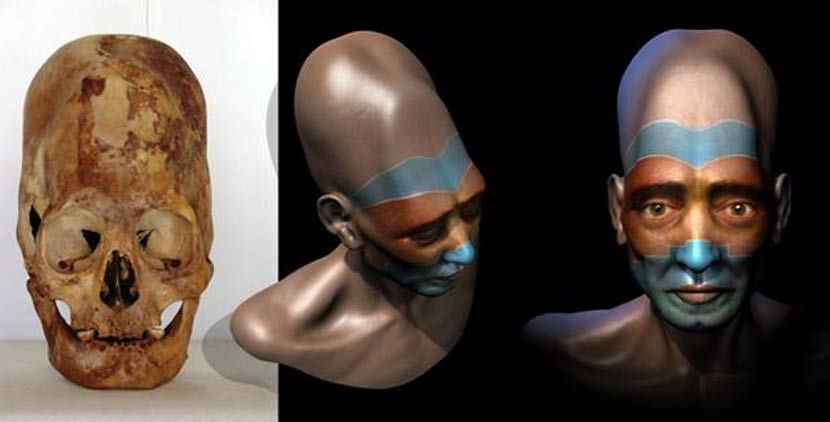
A Paracas elongated skull and an artist’s impression based on a digital reconstruction.  
A Paracas elongated skull and an artist’s impression based on a digital reconstruction. Credit: Marcia Moore / Ciamar Studio


The elongated skulls of Paracas in Peru caused a stir in 2014 when a geneticist that carried out preliminary DNA testing reported that they have mitochondrial DNA “with mutations unknown in any human, primate, or animal known so far”. Now a second round of DNA testing has been completed and the results are just as controversial – the skulls tested, which date back as far as 2,000 years, were shown to have European and Middle Eastern Origin. These surprising results change the known history about how the Americas were populated.

Paracas is a desert peninsula located within Pisco Province on the south coast of Peru.  It is here where Peruvian archaeologist, Julio Tello, made an amazing discovery in 1928 – a massive and elaborate graveyard containing tombs filled with the remains of individuals with the largest elongated skulls found anywhere in the world. These have come to be known as the ‘Paracas skulls’. In total, Tello found more than 300 of these elongated skulls, some of which date back around 3,000 years.
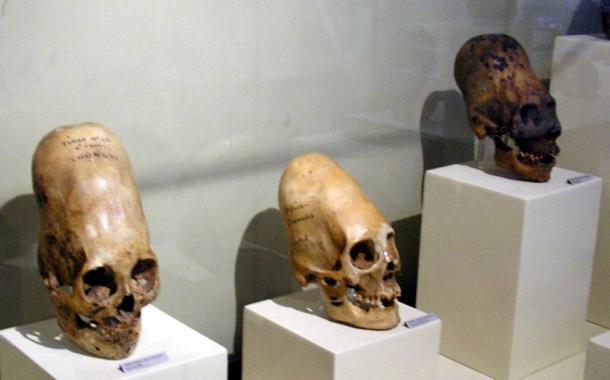

Elongated skulls on display at Museo Regional de Ica in the city of Ica in Peru
Elongated skulls on display at Museo Regional de Ica in the city of Ica in Peru (public domain)


Strange Features of the Paracas Skulls


It is well-known that most cases of skull elongation are the result of cranial deformation, head flattening, or head binding, in which the skull is intentionally deformed by applying force over a long period of time. It is usually achieved by binding the head between two pieces of wood, or binding in cloth. However, while cranial deformation changes the shape of the skull, it does not alter other features that are characteristic of a regular human skull.

In a recent interview with Ancient Origins, author and researcher LA Marzulli describes how some of the Paracas skulls are different to ordinary human skulls:
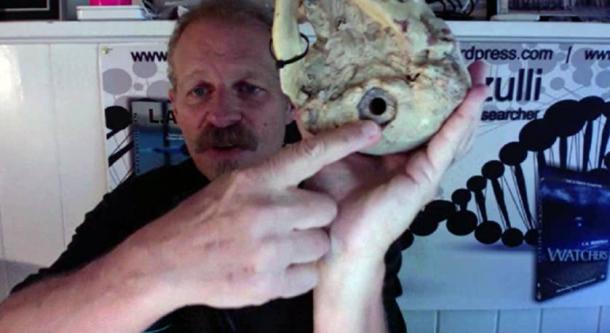
“There is a possibility that it might have been cradle headboarded, but the reason why I don’t think so is because the position of the foramen magnum is back towards the rear of the skull. A normal foramen magnum would be closer to the jaw line…”


LA Marzulli points to the position of the foramen magnum in a Paracas skull which is also the point at which they drilled in order to extract bone powder for DNA testing.


Marzulli explained that an archaeologist has written a paper about his study of the position of the foramen magnum in over 1000 skulls. “He states that the Paracas skulls, the position of the foramen magnum is completely different than a normal human being, it is also smaller, which lends itself to our theory that this is not cradle headboarding, this is genetic.”

In addition, Marzulli described how some of the Paracas skulls have a very pronounced zygomatic arch (cheek bone), different eye sockets and no sagittal suture, which is a connective tissue joint between the two parietal bones of the skull.
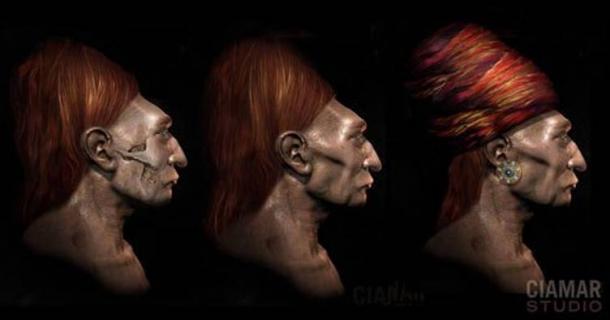

The pronounced cheek bones can be seen in artist Marcia Moore’s interpretation of how the Paracas people looked based on a digital reconstruction from the skulls.
The pronounced cheek bones can be seen in artist Marcia Moore’s interpretation of how the Paracas people looked based on a digital reconstruction from the skulls. Marcia Moore / Ciamar Studio


In a normal human skull, there should be a suture which goes from the frontal plate … clear over the dome of the skull separating the parietal plates - the two separate plates – and connecting with the occipital plate in the rear,” said Marzulli. “We see many skulls in Paracas that are completely devoid of a sagittal suture.

There is a disease known as craniosynostosis, which results in the fusing together of the two parietal plates, however, Marzulli said there is no evidence of this disease in the Paracas skulls.
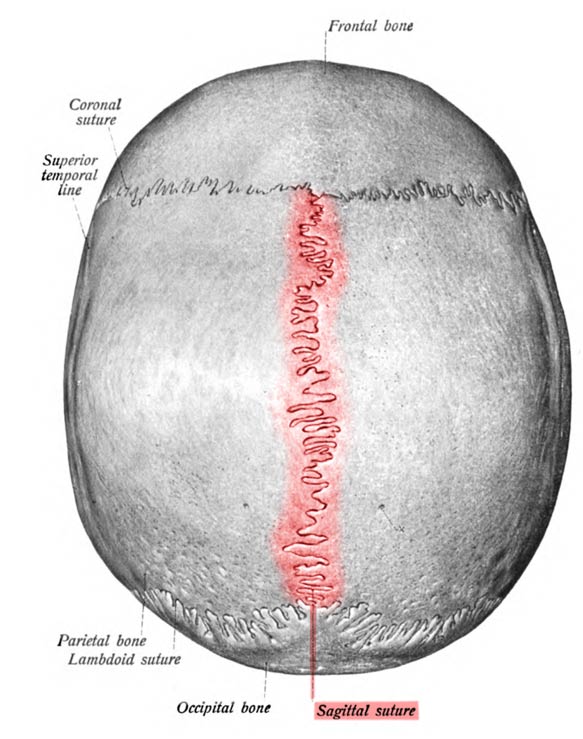

The sagittal suture, highlighted in red, separates the two parietal plates
The sagittal suture, highlighted in red, separates the two parietal plates (public domain)
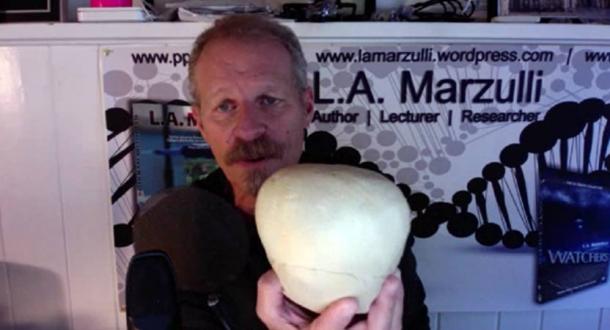
LA Marzulli shows the top of one of the Paracas skulls, which has no sagittal suture.


DNA Testing

The late Sr. Juan Navarro, owner and director of the Museo Arqueologico Paracas, which houses a collection of 35 of the Paracas skulls, allowed the taking of samples from three of the elongated skulls for DNA testing, including one infant. Another sample was obtained from a Peruvian skull that had been in the US for 75 years. One of the skulls was dated to around 2,000 years old, while another was 800 years old.

The samples consisted of hair and bone powder, which was extracted by drilling deeply into the foramen magnum. This process, Marzulli explained, is to reduce the risk of contamination. In addition, full protective clothing was worn.

The samples were then sent to three separate labs for testing – one in Canada, and two in the United States. The geneticists were only told that the samples came from an ancient mummy, so as not to create any preconceived ideas.  
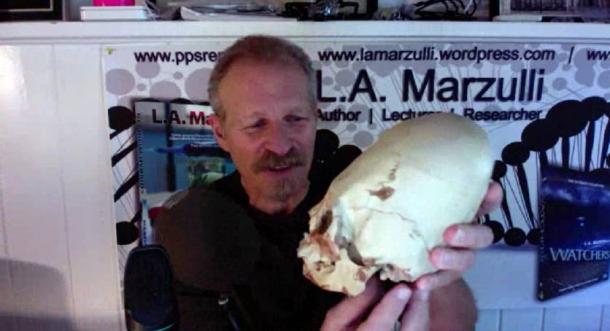

LA Marzulli holding up a replica of one of the Paracas skulls that was tested


Surprising Results


From the samples, only the mitochondrial DNA (DNA from the mother’s side) could be extracted. Out of four hair samples, one of them couldn’t be sequenced. The remaining three hair samples all showed a Haplogroup (genetic population group) of H2A, which is found most frequently in Eastern Europe, and at a low frequency in Western Europe. The bone powder from the most elongated skull tested came back as T2B, which originates in Mesopotamia and what is now Syria, essentially the heart of the fertile crescent. “It rewrites history as we know it,” said Marzulli.

“If these results hold,” writes Brien Foerster on his website Hidden Inca Tours, “the history of the migration of people to the Americas is far more complex than we have been told previously.”

If these results are confirmed through further tests, it means that peoples from Europe and the Middle East migrated to the Americas long before it is conventionally believed.

Marzulli said that mainstream academics will probably attack these results by pointing to the fact that he is not a scientist, but he urges any skeptic to replicate the study. “Attack the evidence folks. Go down and get your own samples, pay for a DNA lab and then come back to me with your science… do some science like we’ve done,” he said. The full lab reports of the DNA tests are available in LA Marzulli’s book Nephilim Hybrids.

The results are also consistent with the fact that many of the Paracas skulls still contain traces of red hair, a color that is not natively found in South America, but originates in the Middle East and Europe.

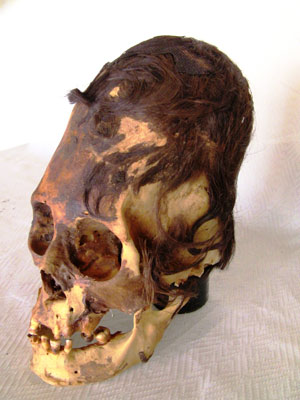
“No academics as far as we can tell can explain why some of the skulls that still have hair are red or even blonde,” writes Brien Foerster, “the idea that this is from time or bleaching has NOW been disproven by 2 hair experts. For the ancient Paracas people, at least, they had blonde to reddish hair that is 30% thinner than NATIVE American hair. It is GENETIC!”
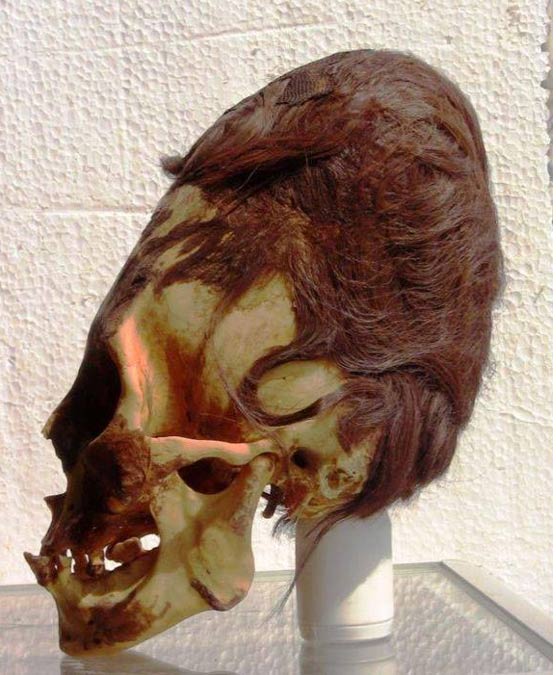

A Paracas skull with its red hair. Credit: Brien Foerster


Extra-terrestrial Hypothesis


Due to the unusual shape and features of the Paracas skulls, there has long been speculation that they are extra-terrestrial in origin, and many have hoped that DNA testing would prove that to be the case.

“As regards an “alien” component or ancestry to the skulls, we may never know,” writes Brien Foerster. “The DNA testing programs can only compare sample DNA with those that are known, and those are held in a huge database called Gentech in the US. Further testing with cooperation from Peruvian archaeologists and the Ministry of Culture are now ongoing.”

Nevertheless, LA Marzulli explained that the DNA results fit perfectly with the hypothesis he has held since before any testing was undertaken. That is that the Paracas people are the Nephilim. The Nephilim, according to ancient Biblical texts, are the offspring of the Fallen Angels and the women of earth, resulting in a hybrid entity, and they said to be based in the area of the Levant, the same place that the Paracas DNA traces to.

Whether or not this hypothesis is correct, the results of the DNA tests are dramatic and history changing and further testing may help to unravel the complex history of the Paracas people.


Next Steps


LA Marzulli and colleagues have plans for further testing and are currently working with Peruvian and American archaeologists. They have verbal permission from the head archaeologist of a Peruvian Museum to take more samples. These will then be presented to the Ministry of Culture for final consent before the samples are taking to US labs for testing. This process is expected to take at least a couple of years to complete.

The full account of the investigation and DNA testing is shown in LA Marzulli’s latest video Watchers 10, which can be ordered here.


Top image: A Paracas elongated skull and an artist’s impression based on a digital reconstruction. Credit: Marcia Moore / Ciamar Studio


For more information about elongated skulls see http://nexusilluminati.blogspot.com/search/label/elongated%20skulls  
- Scroll down through ‘Older Posts’ at the end of each section


Do you LIKE this uniquely informative site?
Hours of effort by a genuinely incapacitated invalid are required every day to maintain, write, edit, research, illustrate, moderate and publish this website from a tiny cabin in a remote forest.
Now that most people use ad blockers and view these posts on phones and other mobile devices, sites like this earn an ever shrinking pittance from advertising sponsorship. This site needs your help.
Like what you see? Please give anything you can -  
Contribute any amount and receive at least one New Illuminati eBook!
(You can use a card securely if you don’t use Paypal)
Please click below -


And it costs nothing to share this post on Social Media!
Dare to care and share - YOU are our only advertisement!


For further enlightening information enter a word or phrase into the random synchronistic search box @ the top left of http://nexusilluminati.blogspot.com


And see


 New Illuminati on Facebook - https://www.facebook.com/the.new.illuminati

New Illuminati Youtube Channel -  https://www.youtube.com/user/newilluminati/playlists

New Illuminati’s OWN Youtube Videos -  
New Illuminati on Google+ @ For New Illuminati posts - https://plus.google.com/u/0/+RamAyana0/posts

New Illuminati on Twitter @ www.twitter.com/new_illuminati


New Illuminations –Art(icles) by R. Ayana @ http://newilluminations.blogspot.com

The Her(m)etic Hermit - http://hermetic.blog.com


DISGRUNTLED SITE ADMINS PLEASE NOTE –
We provide a live link to your original material on your site (and links via social networking services) - which raises your ranking on search engines and helps spread your info further!

This site is published under Creative Commons (Attribution) CopyRIGHT (unless an individual article or other item is declared otherwise by the copyright holder). Reproduction for non-profit use is permitted & encouraged - if you give attribution to the work & author and include all links in the original (along with this or a similar notice).

Feel free to make non-commercial hard (printed) or software copies or mirror sites - you never know how long something will stay glued to the web – but remember attribution!

If you like what you see, please send a donation (no amount is too small or too large) or leave a comment – and thanks for reading this far…

Live long and prosper! Together we can create the best of all possible worlds…


From the New Illuminati – http://nexusilluminati.blogspot.com

Monday, 18 July 2016

Elongated Human Skulls of Peru: Possible Evidence of a Lost Human Species?


Elongated Human Skulls of Peru:
Possible Evidence of a Lost Human Species?

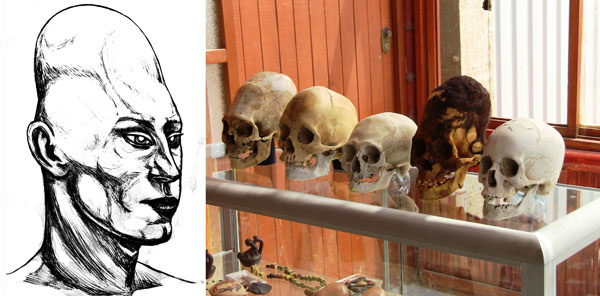
Selection of Paracas Elongated Skulls


Four hours’ drive south of Lima Peru one finds the Paracas Peninsula, part of which is an ecological reserve, where one can see wildlife such as sea lions, and a myriad of various sea bird species. The area is amazingly rich in seafood, and abundant fresh water exists just below the surface of the desert sands, suitable for irrigation free agriculture.

Therefore, it would seem to be a very liveable place for humans.  Stone tools, of various forms and styles of shaping have been found in the area, and cursory analysis has established dates of as old as 8000 years. The greatest of Peruvian archaeologists, Julio Tello, made studies in this area in 1928 and performed excavations on the north side of the peninsula, in the central area of the large semi-circular bay there.

He discovered and excavated a massive and elaborate graveyard, where each tomb contained an entire family, each one ornately wrapped in multiple layers of highly stylized, woven and coloured cotton cloth. He also found the sand filled remains of subterranean houses, which turned out to be numerous; so numerous in fact, that the village stretched out for between 1 and 2 km just above the seashore.

But, the most amazing finds were the skulls, some enormously elongated. The scientific name for this is dolichocephally. Most skulls exhibiting this condition, found in many parts of the world, were clearly the result of the practice of head-binding, the process being known as cranial deformation. And so how was this achieved?

A very young child’s skull is pliant at birth, and remains in this way for months. It is therefore possible, by lashing a rope around the head, with a board placed at the back of the skull, and perhaps the front as well, to alter the shape of the head over time. Many authors state that the time period to perform this shaping was about 6 months to 3 years, but since the practice is no longer performed to my knowledge, no one really knows.

Examples of this technique, supposedly last performed on infants in the Congo of Africa and the Island of Vanuatu in the south Pacific Ocean area known as Melanesia, well into the 20th century, have also been found in Egypt, during the Amarna period, Sudan, Iraq, Syria, Russia, the island of Malta, as well as many places in Peru and Bolivia, and amongst the Olmecs of Mexico.

What you are capable of doing via this technique is to change the shape of the skull, but not the actual volume; you can alter the shape, but not the size. However, Tello found several skulls, at least 300 at the site called Cerro Colorado adjacent to the main graveyard in Paracas, which had cranial volume larger, and in some cases 25 percent larger (and perhaps more) than a conventional modern human skull. How is this possible? As I have said, deformation can alter shape, but not the volume of bone material.

It is therefore obvious that we are dealing with 2 different phenomena; elongation through binding, and elongation via genetics. The Paracas skulls are the largest found in the world, but from what root race stock would they have originated?  

To suggest that the natural elongation was the result of hydrocephaly or some other clinical condition is ridiculous, when one takes into account that again,  at least 300 of them were found by Tello, and no one knows how many are still under the earth, in private collections, or gathering dust in museum warehouses in Peru, and beyond. Hydrocephaly would tend to make the skull expand evenly, making them more round than elongated. What is also intriguing is that these Paracas skulls, on average, weigh 60 percent more than contemporary human skulls from the same area.

Tello believed that the Paracas were related to the people of the Chavin culture, who created the famous megalithic site of Chavin de Huantar, mainly based on the fact that he saw similarities in pottery designs and motifs, especially feline figures. However, to my knowledge, no elongated skulls have been found in the area where the Chavin lived, north of Lima in the Ancash district, so that clearly is not the answer as to their origins. But, since Tello was the expert and main archaeologist at Chavin, where he placed an origin date of at least 3000 years ago, he then simply applied this for the Paracas as well, and no one has dared or bothered to refute his time line until now.

Recent DNA testing, by a German team in 2010 of nearby Nazca skulls, as well as a sampling of Paracas ones, indicate that both the Nazca and Paracas were not genetically related to any other people in what is now known as Peru.

The Paracas people, living by the coast, were clearly fishermen, as evidenced by netting which has been found buried in the sand, as well as ancient middens, which are heaps of sea shells. No actual and extensive carbon 14 dating has been performed on the organic matter of the archaeological sites, and this was certainly not done by Tello, as his work was performed in 1928, whereas carbon 14 dating was not established until the 1940s. Also, very little work has been done at Paracas since the time of Tello, and the subterranean houses have once again filled up with sand.

It seems evident, although unproven at this time, that the Paracas may be the descendants of an earlier culture that were sea farers. Since the Chavin-Paracas link set forth by Tello seems improbable, due to the lack of elongated Chavin skulls, as well as the German DNA testing, it is a worthwhile hypothesis.


I went to the excavation sites, most notably those of the graveyard and adjacent village, which stretches and hugs the shoreline for supposedly 2.5 km, in May of 2011, with the film crew from the US based Ancient Aliens television series. All of the subterranean homes and graves had become filled in with sand, due to the constant wind, blowing in off the ocean.

The site of Cerro Colorado, which was the burial place of the priestly and ruling class of Paracas people, located across the main road which takes visitors through the ecological reserve, is strictly forbidden to visit. This is mainly due to the fact that huaqueros, or grave robbers, have been looting these locations since at least Tello’s time, mainly looking for clay pots, gold and silver figurines, and the finely woven fabrics which the Paracas are famous for having made.


Mr. Juan Navarro, owner and director of the local museum, called the Paracas History Museum, has a fine collection of artefacts from all of the cultures known and believed to have lived in this area, including the Paracas, Nazca, Chincha and Inca. Amongst his displayed collection of stone implements and clay pots is an elongated skull. Upon inquiring as to its age, he stated that he is a firm believer of the time line set forth by Tello, that the skull could possibly be 3000 years old, and not more recent than 2000. That is because the prevailing theory is that the Paracas people died out by about the time of Christ, having been absorbed into the Nazca, who were the next major culture to live there, spreading out from the area that bears their name.

What is intriguing about this, is that we see, from viewing the very large skull collection at the Regional Museum in nearby Ica, that the physical presence of the elongated skulls does dwindle as the time line of the Nazca progresses. This would indicate that either the process of head binding itself died out gradually, and/or that the genetic trait of the elongated cranium faded as fewer and fewer of the Paracas people existed. The Paracas people also seem to have occupied the Nazca area prior to the arrival of the actual Nazca tribal people, and may have been the makers of the famous animal figures on the Nazca plain; the lines themselves having been made later. Amongst the most famous of the figures is one called “The Astronaut,” and it is not only human like in form, but shows signs of having a less than normal shaped head. Whether this was the result of artistic license, or a realistic portrayal is not known.

The only way to establish the actual age, and possible genetic origins of the Paracas people is through DNA analysis of the skulls themselves. Fortunately, Juan Navarro has a somewhat large collection of the elongated skulls in his possession, and just recently put them on display at his museum, due to my urging. Numbering at least 35, and collected as the result of the huaqueros (grave robbers) leaving the skulls abandoned on the surface after looting graves,  Juan has allowed the taking of samples from 5 of the skulls. The samples consisted of hair, including roots, a tooth, skull bone and skin, and this process was carefully documented via photos and video.

The samples were sent to Lloyd Pye in the US, famous as the caretaker of the Star Child skull, who has now delivered the samples to his geneticist in Texas. A further 5 samples, those being molar teeth, one from each of 5 skulls, have just been sent to Mr. Pye, and they will be both DNA as well as C-14 tested, with results to be posted as soon as available.

As I have said, the phenomenon of the elongated skull is not unique to the Paracas area. The Egyptians, at the time of Pharaoh Akhenaton, seem to have exhibited this cranial feature, as did people on the island of Vanuatu in Melanesia, Malta in the Mediterranean, and the Olmec of Mexico, amongst other locations. However, as far as I know, most of these skulls are elongated as the result of artificial binding; whereas a number of the Paracas ones show specific characteristics that would seem to indicate that they were in fact born this way.

Of the 5 physical factors, pointed out by Lloyd Pye and myself, which are not at all common to Homo sapiens, are two that I will mention. One is the presence of 2 small holes in the back of the skull, perpendicular to the cranial suture present in the parietal plate of the skull. Every normal human skull is composed of 3 major bone plates; the frontal plate, which ends at the upper part of the forehead, and the 2 parietal plates which lie behind this, intersecting the frontal plate making a “T” shape. The holes are thought by Lloyd to be natural; every human jaw has a small hole on either side which is for nerves and blood vessels to exit and feed the tissue there; these 2 holes at the back of the skull may perform the same function for the elongated skull.

The other factor is that there is only one parietal plate, where there should be two.

David Hatcher Childress and I have recently published a book, delving into the global phenomenon of cranial elongation, entitled, appropriately, “The Enigma Of Cranial Deformation,” which is available both through Amazon.com, as well as David’s publishing company, namely www.adventuresunlimitedpress.com.

I feel very fortunate to be at the forefront of the research of the elongated skulls of Paracas. Recent information suggests that these people were much more wide spread than just the Paracas area. Many related skulls have been found near Tiwanaku Bolivia, as well as Cusco Peru and the surrounding area. Not coincidentally, these areas are also known for their mysterious and masterful ancient megalithic constructions, whose makers are presently unknown. I contend that the megalithic builders were the elongated skull people, but much more research has to be conducted to verify this.

My ongoing on site investigations have shown that the presence of ancient elongated skulls follow quite a precise geographical pattern, from the mining areas to the southeast of Lake Titicaca near Potosi, Bolivia to the city of Cajamarca far to the northwest in Peru. Curiously, the pattern of sites follows what is called the Path of Viracocha, which is the supposed route taken by very intelligent teachers from the distant past who educated the locals that they met the arts and sciences. But more of this in a future article, which will also cover the intriguing elongated skulls found in the vicinity of the Inca capital of Cusco. Special emphasis will be on the Huayqui skeleton, a mummified child whose skull is almost the size of its torso.

Photos and more information about Huayqui, who is under the care of Sr. Renato Davila , can be found if you look for the Andahuaylillas Museum in a web browser, or Museo Privado Ritos Andinos.

Mark Laplume is an artist living in South America who has been making drawings of the Elongated Skulls, found all over the planet, for about 2 years. Through his keen eyes, he is able to give us a glimpse into what these people may have looked like more than 2000 years ago. You can have a look at his web site here.

The Paracas History Museum welcomes anyone to come and explore this phenomenon, and I can be contacted through my website.


Brien Foerster: The Lost History of The Inca - FULL LECTURE

(57:42) @ https://youtu.be/F3qgqhr-m5w


For more information about elongated skulls see http://nexusilluminati.blogspot.com/search/label/elongated%20skulls  
- Scroll down through ‘Older Posts’ at the end of each section


Do you LIKE this uniquely informative site?
Hours of effort by a genuinely incapacitated invalid are required every day to maintain, write, edit, research, illustrate, moderate and publish this website from a tiny cabin in a remote forest.
Now that most people use ad blockers and view these posts on phones and other mobile devices, sites like this earn an ever shrinking pittance from advertising sponsorship.
This site needs your help.
Like what you see? Please give anything you can -  
Contribute any amount and receive at least one New Illuminati eBook!
(You can use a card securely if you don’t use Paypal)
Please click below -


And it costs nothing to share this post on Social Media!
Dare to care and share - YOU are our only advertisement!


For further enlightening information enter a word or phrase into the random synchronistic search box @ the top left of http://nexusilluminati.blogspot.com


And see


 New Illuminati on Facebook - https://www.facebook.com/the.new.illuminati

New Illuminati Youtube Channel -  https://www.youtube.com/user/newilluminati/playlists

New Illuminati’s OWN Youtube Videos -  
New Illuminati on Google+ @ For New Illuminati posts - https://plus.google.com/u/0/+RamAyana0/posts

New Illuminati on Twitter @ www.twitter.com/new_illuminati


New Illuminations –Art(icles) by R. Ayana @ http://newilluminations.blogspot.com

The Her(m)etic Hermit - http://hermetic.blog.com


DISGRUNTLED SITE ADMINS PLEASE NOTE –
We provide a live link to your original material on your site (and links via social networking services) - which raises your ranking on search engines and helps spread your info further!

This site is published under Creative Commons (Attribution) CopyRIGHT (unless an individual article or other item is declared otherwise by the copyright holder). Reproduction for non-profit use is permitted & encouraged - if you give attribution to the work & author and include all links in the original (along with this or a similar notice).

Feel free to make non-commercial hard (printed) or software copies or mirror sites - you never know how long something will stay glued to the web – but remember attribution!

If you like what you see, please send a donation (no amount is too small or too large) or leave a comment – and thanks for reading this far…

Live long and prosper! Together we can create the best of all possible worlds…


From the New Illuminati – http://nexusilluminati.blogspot.com