"All the World's a Stage We Pass Through" – R. Ayana

Showing posts with label consumers. Show all posts

Tuesday, 17 February 2015

The True Reason behind the 40-Hour Work Week and Why Most People Are Economic Slaves


The True Reason behind the 40-Hour Work Week and Why Most People Are Economic Slaves

The True Reason behind the 40-Hour Work Week and Why We Are Economic Slaves

by EV


Economic slavery, or wage slavery, refers to one’s total and immediate dependence on wages to survive. Although people throughout history have had to work to get by, we now live in a culture where we are led to believe we have economic freedom, when unbeknownst to most citizens, we are in fact bound in servitude. We automatically accept a 40-hour workweek with meagre hourly pay as normal, even though many work overtime and still struggle to survive.

There are also those who make enough to live comfortably but are unable to request less hours—you either work 40 hours a week, or you don’t get to work at all. We submit when told what to wear, when we have to arrive and depart, when we’re allowed to eat, and even when we’re allowed to use the restroom. How is it we have come to allow this?

The 40-hour-work week came about during the Industrial Revolution in Britain when at one point workers were putting in 10 to 16 hour days and began to protest. Working situations for Americans began to worsen as well, and by 1836, labor movement publications were also calling for a 40-hour workweek. Citizens in both situations were so overworked, an eight-hour day was easily accepted. This system is unnecessary now, if it ever was, but we still accept it due to the effects of our capitalist society.

There are many contributing factors that have led to our current economic system and continued acceptance of the 40-hour workweek, three major factors being consumerism, inflation, and debt. First, it’s important to understand exactly what inflation is, how it works, and how it leads to debt.
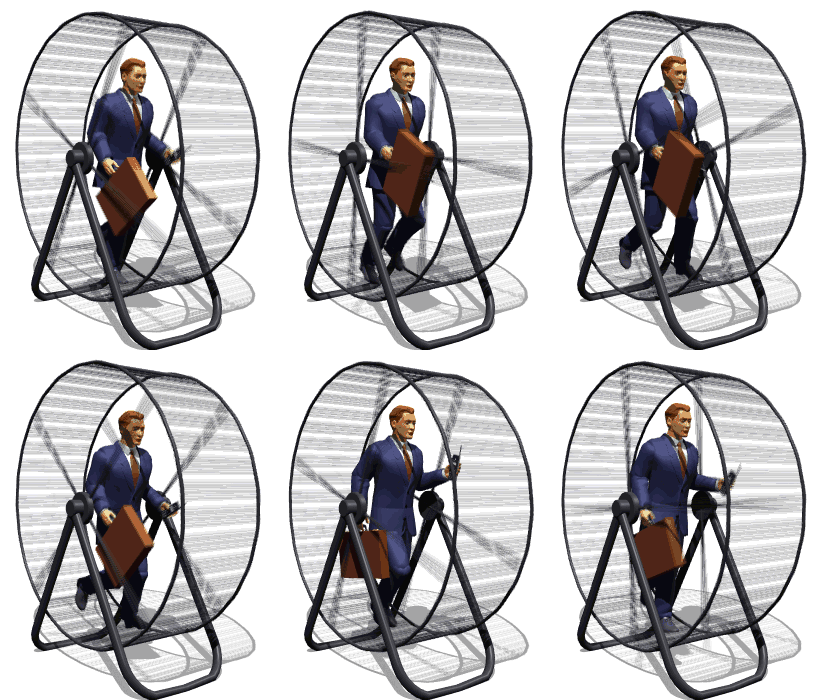
 https://blogger.googleusercontent.com/img/b/R29vZ2xl/AVvXsEiAY8IvB7odokIxizJizRC2gSagEI7PEXPGUQLrgf8aHU1lwPsvJ5iVHv622B3_EtWdfvCQJfQVrygH3U6_jOqn-aL5AGBS2DEooxVzkL2DcR7nPyDo-U2GdEmi87_4yCHIrzCjxAY4X0E/s1600/rat-race.gif

Inflation:


To put inflation simply, let’s say the U.S. government needs money for whatever war they’ve decided to wage this year. They ask the Federal Reserve for a loan, and the Fed agrees to buy bonds (sort of like IOU’s) from the government in the amount of the requested loan. The U.S. government then prints up a bunch of pieces of paper that say “Treasury Bond” while at the same time, the Federal Reserve prints up a bunch of little pieces of paper that we know as money. A trade is made between the government and the Federal Reserve—the bonds for the money—and the U.S. government directly deposits this newly printed money in a different bank, which in turn, takes its cut in fees and interest. Voilà, money has been created out of thin air.

Although this process takes place electronically now (only 3% of money is in physical form, the other 97% exists in computers) the problem either way is that it depletes the worth of the dollar. At one point in time, currency was worth gold. That was what gave money its value, but now the value of money is trusted to the Federal Reserve who has no moral objections to reducing that value by printing more money (basically legal counterfeit). For the cost of printing, the Federal Reserve creates money that the U.S. government has promised to pay back—money that didn’t even exist in the first place.

It works like this with private bank loans to citizens as well. Each time a transaction of this sort happens, it reduces the value of actual currency, and thus we have inflation. One dollar in 1913 required $21.60 in 2007 to match its value. That’s a 96% devaluation since the Federal Reserve came into existence. How does this lead to economic slavery? By the debt inflation has caused.
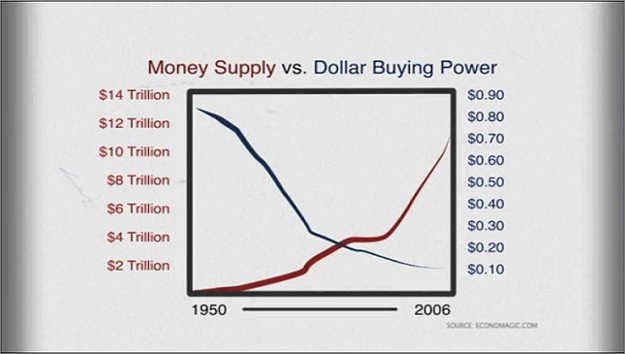
Inf Gra 2


Debt:


Since money is created through loans, that means it’s created through debt. Money equals debt, and debt equals money. So the more money there is, the more debt there is, and vice versa. What this means is, if somehow the government and every citizen in debt were able to pay back those loans, there would not be a single dollar in circulation.

Interest plays an important role in this equation as well. When you take out a loan and the bank gives you money that technically doesn’t exist, they also expect you to pay additional interest with it. If the money loaned is coming from the Federal Reserve, where is the money for the interest supposed to come from?

The answer is nowhere.

That means no matter what, the nation will never be able to get out of debt, and that is exactly the purpose of this meticulously orchestrated system. Like a toss of the coin, somebody somewhere will always go bankrupt to make up for the interest that is being paid with even more debt. And so, as the nation sinks further in the hole while the cost of living increases, surviving in the economy becomes more difficult. This desperation to survive, coupled with the fact that we were born into this system, is ultimately what causes us to accept the 40-hour workweek without a moment’s thought.

So now we understand the element that forces us to accept our predicament, but how does the 40-hour workweek benefit banks and corporations? After all, studies show that the average office worker gets less than three hours worth of work done in an 8-hour work shift, and according to reports, US corporate profits are soaring while wages are declining. Bureau of Labor Statistics figures show that productivity has increased at a 2.3 percent annual rate in the third quarter, while hourly pay only increased 1.3 percent in the third quarter, and this has been the basic pattern for some time—it adds up after a while. Corporate profits are at their highest level in at least 85 years, so why aren’t we being paid more, working less, and providing additional jobs to those who need them? This brings us to consumerism.


Consumerism:


Consumerism is defined by the Merriam-Webster dictionary as: the belief that it is good for people to spend a lot of money on goods and services. At one point in time this belief may have rang true, but with the current capitalist system and cost of living, consumerism has begun to have negative effects on our society, especially when you take inflation and the increasing debt into consideration. The more we buy, the more we feed the corporations and banks who are in turn pushing us into economic slavery.

Since the 1800’s and the Industrial Revolution, “consumers” have been spending increasing amounts of money on frivolous purchases. This over-indulgence has been nurtured and fed by the corporations using commercialism (the attitude or actions of people who are influenced too strongly by the desire to earn money or buy goods rather than by other values—Merriam-Webster) as a tool. Psychological insinuations have been planted into society’s subconscious for generations through consumer advertisements which have ultimately led to certain habits and beliefs. Some examples are:

“Buy now pay later” – The General Motors Acceptance Corporation (GMAC) started this mindset when it was established in 1919 and began to promote giving loans to people who bought cars. Americans eventually started to use the new credit plans on just about everything.

“Keeping up with the Joneses” – Commonly thought to be the beginning of the American consumer culture, this mindset began when GM introduced the yearly automobile model change. People wanted to have the latest model each year, and soon this idea spread out. Most of us, whether we want to admit it or not, are familiar with this mentality. Rather than keeping our old toaster that works perfectly fine, we want the new retro-style stainless steel model because it looks swanky sitting on our kitchen counter.

“1929-1945 Depression and War” – Soon after The Depression came WWII, during which advertisers promised products to be available when there was peace. As a result, customers (consumers) were eager to take up spending immediately after the war was over.

“Peace” – When the war ended, consumer optimism and economic growth accompanied victory.

“Charge it!” – Credit cards were first promoted through the Diners Club—a charge card company that services affluent and well-travelled individuals from around the world. Other companies followed suit and started advertising credit cards as a “time-saving device” rather than a way to spend money that wasn’t actually there.

bigger-is-better


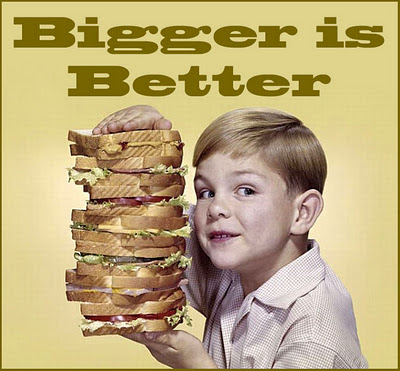
“Bigger is better” – During the 1970’s, companies began to send credit cards out by the masses to those who had not requested them. While Americans had already been developing the idea that “bigger is better”, the credit card boom ended up exploiting that idea. Now people had the means to obtain extravagant items they couldn’t before, even though it put many in colossal debt. Congress soon had to regulate the credit card boom, and ban sending cards to those who never requested them in the first place.

Companies in all kinds of industries hold a huge stake in the public’s penchant to be careless with their money, and they encourage this habit of casual or non-essential spending when they can. For example, in the documentary The Corporation, a marketing psychologist discussed a method she used to increase sales that involved encouraging children to nag their parents to buy toys. Studies showed that 20% to 40% of purchases of this sort resulted after children nagged their parents.


“You can manipulate consumers into wanting, and therefore buying, your products. It’s a game.”
-      Lucy Hughes, co-creator of “The Nag Factor”.

The 40-hour workweek is the ultimate tool for corporations to sustain this culture of over-indulgent spending. Under our current working conditions, people are forced to build a life in the evenings and their days-off. We find ourselves more inclined to spend heavily on entertainment and conveniences because we rarely have any free time. When we do have time to ourselves, it’s usually fleeting, and we eventually find ourselves neglecting those activities which are free—walking, exercising, reading, meditating, sports, hobbies, etc.—because they take too much time.

While having extra money comes at the sacrifice of personal time for some, for others they not only are robbed of their personal freedom, but they struggle to make ends meet on top of it. The “perfect” consumer works full-time, earns a fair amount of money, indulges during their free time, and somehow just makes it by each month. However, even those who don’t earn fair wages sometimes find themselves wasting small increments of money on unnecessary items for the wrong reasons—a cup of Starbucks here, a McDonald’s cheeseburger there, and those really cool fuzzy dice hanging from the rear-view of your 1993 Honda Civic.

Any way you look at it, we have become an unhappy, mindless, over-worked society. We buy silly items for a few moments of happiness before getting bored and moving on. We feel a need to keep up with fads, or to fulfill our childhood vision of what adulthood would be like. We hide our insecurities, avoid issues, and replace psychological needs with material items. By keeping society’s free time scarce, people will pay more for convenience, gratification, and any other relief they can buy.

Keeping America unhealthy has become extremely profitable for big-business, and so far their efforts have paid-off beautifully. Our society has been transformed into an industry fueled by economic slavery, and consumerism is a key factor in this corrupt system—one the people have direct influence over. Consumers are the only ones who can stop consuming.


https://i.chzbgr.com/maxW500/7973940224/h8795C799/ 


Sources:

Cain, David. True Activist. Dec 7, 2014. (http://www.trueactivist.com/your-lifestyle-has-already-been-designed-the-real-reason-for-the-forty-hour-workweek/)
Ethos. Dir. Pete McGrain. Cinema Libre Studio, 2011. Documentary
Graph supplied by: (http://economagic.com/)
Jones, Shannon. World Socialist Web Site. Dec 4, 2014. (http://www.wsws.org/en/articles/2014/12/04/wage-d04.html)
Mt. Holyoke College Research Study. American Consumerism and the Global Environment. 2009. (http://www.mtholyoke.edu/~kelle20m/classweb/wp/index.html)
Zeitgeist: Addendum. Dir. Peter Joseph. GMP LLC, 2008. Documentary.


From We Are Anonymous @ http://anonhq.com/true-reason-behind-40-hour-work-week-economic-slaves/


For more information about wage slavery see http://nexusilluminati.blogspot.com/search/label/wage%20slaves
- Scroll down through ‘Older Posts’ at the end of each section


Hope you like this not for profit site -
It takes hours of work every day by a genuinely incapacitated invalid to maintain, write, edit, research, illustrate and publish this website from a tiny cabin in a remote forest
Like what we do? Please give anything you can -  
Contribute any amount and receive at least one New Illuminati eBook!
(You can use a card securely if you don’t use Paypal)
Please click below -


Spare Bitcoin change?


Xtra Images – https://blogger.googleusercontent.com/img/b/R29vZ2xl/AVvXsEiAY8IvB7odokIxizJizRC2gSagEI7PEXPGUQLrgf8aHU1lwPsvJ5iVHv622B3_EtWdfvCQJfQVrygH3U6_jOqn-aL5AGBS2DEooxVzkL2DcR7nPyDo-U2GdEmi87_4yCHIrzCjxAY4X0E/s1600/rat-race.gif
https://i.chzbgr.com/maxW500/7973940224/h8795C799/


For further enlightening information enter a word or phrase into the random synchronistic search box @ the top left of http://nexusilluminati.blogspot.com


And see


 New Illuminati on Facebook - https://www.facebook.com/the.new.illuminati

New Illuminati Youtube Channel - http://www.youtube.com/user/newilluminati


New Illuminati on Twitter @ www.twitter.com/new_illuminati


New Illuminations –Art(icles) by R. Ayana @ http://newilluminations.blogspot.com

The Her(m)etic Hermit - http://hermetic.blog.com


DISGRUNTLED SITE ADMINS PLEASE NOTE –
We provide a live link to your original material on your site (and links via social networking services) - which raises your ranking on search engines and helps spread your info further! This site is published under Creative Commons Fair Use Copyright (unless an individual article or other item is declared otherwise by the copyright holder). Reproduction for non-profit use is permitted & encouraged,  - if you give attribution to the work & author and include all links in the original (along with this or a similar notice).

Feel free to make non-commercial hard (printed) or software copies or mirror sites - you never know how long something will stay glued to the web – but remember attribution!

If you like what you see, please send a donation (no amount is too small or too large) or leave a comment – and thanks for reading this far…

Live long and prosper! Together we can create the best of all possible worlds…


From the New Illuminati – http://nexusilluminati.blogspot.com

Saturday, 13 November 2010

All Consuming Growth - The Flaw of Western Economies

All Consuming Growth
The Flaw of Western Economies

by Marcin Gerwin


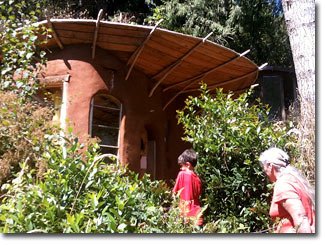
Cob House
Photo, Gerry Thomasen
Let’s imagine a green and responsible consumer. Let’s call him George. George lives in a sleepy town, near the center and the park where he often goes for a walk with his dog.
George built his house with his friends two years ago. It is a very small house, only 320 square feet and it was made with cob – clay mixed with straw and aggregate. The clay for construction was extracted from George’s land behind the house – now you can see a nice pond there with water lilies.
George was fortunate enough to find some recycled timber for the roof from the old garage that his neighbors were demolishing. He considered making a turf roof with wild flowers and herbs, but eventually he decided that a slate roof will be more practical because he will be able to collect rainwater from it and use it for watering his garden during warm summer days.
George buys his food at a local farmers’ market. All food that is sold there is organic and comes from farms within a 50 mile radius and George is happy to know that very little fuel is used to transport the food he purchases. Furthermore, he buys only raw, unpackaged food, which he brings home in his own bag. He doesn’t eat meat or fish. He knows that it takes a lot of land to feed the animals, and “after all” he tells his mom smiling “a cow is a human being too”. He drinks milk, however, and enjoys scrambled eggs on a Sunday morning.
Well, not exactly all his food comes from the market. He buys bread and rolls in the nearby bakery. He tried baking bread on his own, but eventually he concluded that it takes too much energy to bake a single loaf of bread for him alone and that it would be more energy-efficient to buy it from the bakery. Nevertheless, it was his New Year’s resolution to buy local produce only. George is concerned about the amount of fuel that is used for transporting food and he decided to go radical on this one. It was tough at the beginning as he likes to drink tea and coffee, and he loves bananas. He substituted regular coffee with a barley and rye “coffee” and instead of tea he drinks mint or chamomile infusions. Unfortunately, bananas are gone from his table for good, but he discovered new vegetables such as yacon and salsify, so he doesn’t miss them that much.
George doesn’t have a car. He goes to work on a bicycle and if it’s too far for a bicycle he takes a bus or a train. Even when he is going abroad, which was three times in his life, he prefers to take a train rather than an airplane. His electric energy consumption is very low. In his home he installed a solar PV module for 140 Watts and batteries. That’s not much, but sufficient to power 3 lamps, a radio and a small fridge. George doesn’t have a TV, dishwasher or a computer. Some of his friends say that his lifestyle is a bit primitive, but he doesn’t mind.
George has many books on his shelves, but when he discovered that many of them were available in a public library he stopped buying them. Once a month he buys his favorite magazine, but recently he even began reading newspapers in the library. His house contains very little furniture, just a simple, wooden table with chairs and a wardrobe. His sleeping mattress is laid directly on the clay floor. Inside his wardrobe there are only a few worn out shirts and new pair of trousers he got for Christmas. George has only two pairs of shoes and some rubber boots for working in a garden.
George doesn’t have a bath tub, only a shower. He has a smart shower head that reduces the usage of water by almost 60%. But George is most proud of his compost toilet that he designed himself. It fits nicely in the corner of his bathroom and is not smelly at all! The compost is used to fertilize a small elephant grass plantation that he shares with his friends. The elephant grass is cut every year and is used to heat their homes in winter.
George works in a small shop that makes artisan cheese. They make cheddar, gouda and valdeon cheese wrapped in Sycamore leaves. All their produce is sold in two local shops. George doesn’t earn a lot of money, but it is enough for his modest needs. He pays his medical and dental care insurance and he can easily afford going to the movies every Saturday. He meets with his friends after work (he works only 6 hours a day), they play guitar and sing. He goes hiking in the summer and rides a bicycle along the river. George lives a happy and stress-free life.
What if We All Lived Like George?
Now, let’s take this a step further. Let’s imagine that all people in North America, Europe and Japan decided to reduce their levels of consumption and consume only as much as George. What happens?
The massive destruction of the Amazon rainforest stopped. The market for soya and timber shrunk so much that it was no longer profitable to cut down vast areas of the forest. The existing soya farms were forced to compete for the remaining customers in China and India. In Canada and Scandinavia the number of trees cut down within a year has decreased significantly. In Democratic Republic of Congo, however, the rainforest is still cut down to make way for roads to mines sponsored by China which had no intention of abandoning its consumer lifestyle. Nevertheless, in many parts of the world the pressure on the natural forest was reduced enough to remove some birds and mammals from the red list of endangered species.
Positive change was quickly noted in the oceans. The population of fish species started to grow. Cod numbers increased in Baltic Sea and at the coasts of Canada. Also, with adoption of organic farming methods, water in the rivers became less polluted and more fish were able to live there. Life even came back to the Louisiana coast were agricultural runoff borne by the Mississippi River had created a 7000 square-mile dead zone in the Gulf of Mexico.
The levels of air pollution in the cities has changed so much that the air is almost as clean as in the countryside. The level of carbon dioxide has decreased for the first time since the 19th century and scientist began to be more optimistic about human impact on climate change. Oil consumption was reduced so much that one barrel costs only 18 USD.
Now let’s go back to George. How is he?
George lost his job. The artisan cheese turned out to be too expensive for the new consumers and his boss decided to cut personnel. Everyday George cues in a long line waiting for warm soup and 2 slices of bread distributed by the government aid agency. He sold his bike, guitar and solar panels to buy food. He eats the soup and shares the bread with his dog. George’s friends lost their jobs too. His parents don’t have a job, his aunt lost her job. Actually almost everyone that George knows lost their jobs. He meets them all waiting in the long, long line to get warm soup.
How did it happen?
People stopped buying cars and decided to use public transport, so within one year all car factories were closed. Hundreds of thousands of workers were fired in Europe, USA and Japan. All car repair shops, tire making companies, car washing facilities and almost all gas stations were closed. Bicycle making companies recorded record profits but they couldn’t offer new jobs for the workers from the car factories, because they invested in new technologies and now all bicycle parts are made by machines.
Book publishers declared bankruptcy. With people reading books mostly in libraries they were not able to make enough profit. The quantity of books they were able to sell was too low. Along with publishers, bookstores were also forced to close their businesses. Ethical consumers understood that a million daily copies of a newspaper had a tremendous impact on forests. So, people quit buying them as well. As a consequence, journalists and editors lost their jobs. Printers lost their jobs. Producers of ink and printing equipment also lost their jobs. Producers of paper lost their jobs.
Hard times came for the construction industry. People are building small homes, which means that the producers of concrete, paints, windows, doors and roof tiles sell less products. With lower sales they were forced to cut down jobs. Millions of jobs for unqualified workers were no longer available.
The same happened in the clothes industry. Cotton farmers lost their jobs, factory workers in China, Bangladesh and India lost their jobs as well. Small farmers growing coffee, tea and cocoa in the tropics were shocked when the importers told them that they cannot afford to buy their produce. Millions of them lost their source of income.
The stock markets experienced a crisis that was never seen in their history. “The Great Depression Was a Joke” read the headlines. “Record Losses on Wall Street”, “Another Bank Goes Down”, “Sustainability is Killing Us”. But that was only in the first few weeks. Later on the newspapers went bankrupt. The repercussions were felt around the whole world. From Brazil and Argentina to Saudi Arabia and Sri Lanka. The credit crunch was now a pleasant memory of the past – a ‘crisis’ the bankers only wished to experience.
At a government level the situation was equally dramatic. The national budget’s revenue decreased by more than a half! There was not enough money for salaries for school teachers, for doctors, for nurses, for policemen, for the administration and for the army. Not only was construction of new roads stopped, but there was also not enough funds to maintain the existing roads.
At first workers went on strike and protested loudly in front of the president’s office. They burned tires and waved flags of their unions. But soon they understood. There was not enough money in the budget to pay them. The protests were in vain.
The heads of all EU countries, the president of USA and the prime minister of Japan appeared everyday on TV and in the radio. They begged their citizens to consume more. “Please” they said “please, you must go shopping or our countries will perish.”
Our Economic System Relies on Consumption


The point is that the economic model of Western societies relies on consumption. Excessive consumption provides economic development, it provides jobs. The more people consume, the more jobs are created. When people consume less, jobs are lost. There is a famous quote from the retail analyst Victor Lebow who helped to create a vision for the economic reform in the US after World War II:
Our enormously productive economy (…) demands that we make consumption our way of life, that we convert the buying and use of goods into rituals, that we seek our spiritual satisfaction, our ego satisfaction, in consumption (…) we need things consumed, burned up, replaced and discarded at an ever-accelerating rate.
Think about disposable Gillette razors. Would it be such a good business if you could sharpen the blade once a while, rather than buy the whole new product over and over again?
I’m not saying that we shouldn’t reduce our levels on consumption. We must. The natural resources on our planet are used at an unsustainable rate. Too many forests are cut down, too many fish caught, too many soils are degraded, too many species are endangered with extinction – and too many people are appearing on our planet every year. My point is that if we wish to provide a livelihood for every person on this planet, it won’t be enough to promote sustainable levels of consumption. Our current economic model was designed for excessive consumption. Consumption is its engine. Honestly speaking, greed is its engine. If we wish to have a sustainable future we must change the whole economic model, culture and introduce true democratic political systems – or else we will be waiting with George for food handouts.
So, what can we do?
Certainly, it is completely unrealistic that all citizens change their consumption patterns at once in the way that George did. But with a predicted population of 9.2 billion people in 2050 we cannot expect that it will be possible for everyone to have a car, a two-storey house in the suburbs and a large piece of meat for breakfast and lunch. Solutions like zero-waste production, recycling, renewable energy, water and energy efficiency, organic agriculture, preventive medicine and many others are the foundations of sustainability. But where will the jobs come from?
To answer this, let’s look into a something different for a while. Have you ever wondered if there is a country where people enjoy a good life and they keep their consumption within the limits of their local environment? According to the "Happy Planet Index", published by the New Economics Foundation, the no. 1 place like this is Vanuatu – an archipelago of islands on the western Pacific. What makes life so good there? People live in traditional communities with close social ties. They fish, and grow food in their gardens. Some of the food is also gathered from the wild. The land is fertile and a close spiritual contact with the land is a vital part of local culture.
The life is slow-paced and people are content with what they have. Andrew Harding, a BBC reporter, came to the remote Pentecost Island to investigate their lives. “There is no hunger here, no unemployment, no tax, no police, no crime or conflict to speak of,” he says. “It may not be a paradise, but you can see why people here want to keep the outside world at arm’s length.”
Norman Shackley, chair of the British Friends of Vanuatu and a former resident of the islands, recalls meeting a young man who had just returned to his home island after studying at Nottingham University. "I asked him what he was going to do with his life now” says Norman Shackley, “He just pointed at his fishing rod and said ‘this’. He could have been one of the top earners in Vanuatu if he wanted, but he was contented with his simple life and didn’t want anything else.”
Happiness is not dependent on geography, however. We can live a happy life in Poland, USA, Japan or Ukraine. We can live a happy life – and one that doesn’t destroy the natural environment that supports us. What we need for this are: good community relations, secure livelihoods and close contact with nature. As David Korten points out “We (all) want tasty nutritious food uncontaminated with toxins.
We want healthy, happy children, loving families, and a caring community with a beautiful healthy natural environment. We want meaningful work, a living wage, and security in our old age.” Since we know all this then are our governments working hard to achieve this aim? No. They are working hard to increase the gross domestic product (GDP). And what that has got to do with anything? According to the International Monetary Fund Vanuatu is on their list of countries sorted by GDP – and is ranked at 170. That’s below Zimbabwe….
Money is a practical thing. It can be used to facilitate exchange of goods. On the Vanuatu islands people use pig tusks for this purpose. There are even 14 banks storing pig tusks in their vaults. However, their livelihoods are not dependent on money. As Jean Pierre John from the Metoma island in the north of Vanuatu answered when asked what is the secret of their happiness: "Not having to worry about money."
People tend to forget that money is not a real good. You cannot satisfy hunger eating a 100 USD bill or even a pound of coins. The true value is in the goods for which it can be exchanged: in vegetables, fruits, clothes, building materials, tools etc. We can have these things without the use of money. We can grow food, gather wood in the forest, dig clay and make pots, weave fabrics and sow clothes. We can even make our own ketchup.
In traditional local economies people can be independent and self-sufficient. Their livelihoods are not dependent on distant stock exchange markets, on unaccountable governments, on the European Commission in Brussels (an undemocratically elected institution, superior to member countries, often imposing policies that do not have social approval). These local economies existed also in Europe, not that long ago. We can still create local economies where people will be able to live off the land with a very little or no need for money.
Let’s go back to George. He has just finished eating his bean soup and now he is able to think more clearly. “Why wait for someone to give us job?” he says to his friend Lucy. “We will grow our own food!”
“Where?” asks Lucy. “In your backyard? There is not enough space. Maybe enough for basil and thyme, but forget maize or wheat.”
“There is plenty of land near the river.” George replies. “There are hundreds of acres of grasslands, I was riding there on my bicycle.”
“Possibly, but do you have money to buy it?”
“We don’t need to own it. We will use it and care for it. Come on Lucy,” George gets up. “We need seeds and tools, and a wheelbarrow. Let’s go and find some.”
A year later the grasslands by the river were transformed into rich vegetable gardens and vast fields of wheat, barley, rye, maize and oats. George has a right to use 2 acres of land were he planted pumpkins, squash, eggplants, tomatoes, radishes, cucumbers, potatoes, lettuce, broad beans, sunflower, currants, strawberries as well as fruit trees and nuts. He hopes to have a small forest garden there too. The project that he started was not about owning the land, but about land stewardship.
They were very fortunate that the grasslands belonged to the county, or, in other words, to them. So, George organized a meeting in the city hall where people of his community decided how to provide access to this land in a just way. They set up a composting co-operative and a seeds exchange network. To extend the growing season they needed materials to build the greenhouses, so they decided to sell an old warehouse that belonged to the county. The city mayor was hesitant at first about the new way of arranging things, but he checked the constitution and it was expressed clearly, that people govern the state either directly or by their representatives. “So now they are governing it directly,” he concluded.
The food crisis it the city was over. People were able to satisfy their basic needs on their own and in autumn they were celebrating a bumper harvest. George still doesn’t have enough money to buy the solar panels he had before, but he has got an olive oil lamp. With his friends he built an oil press and they don’t need to worry about the lighting.
George is also back in cheese manufacturing. He is back working in the shop part-time. People cannot afford to buy a lot of cheese, so the owner decided to accept vegetables and herbs in exchange for the cheddars they make. In winter they plan to launch a local currency to facilitate exchange of locally produced goods and services.
It may seem backward to suggest that people should farm instead of working in a space station. Nevertheless, in the world where resources are scarce and populations climb fast it is a time-tested solution (thousands of years of practice in all parts of the world) which will enable them to become economically independent and to have a meaningful life.
In the Western culture progress is defined as going from vinyl records to CDs, then to DVDs and finally to Blue-ray Discs. We used to have black and white TV-sets, now we’ve got High Definition television. That’s called progress. People get used to new technologies so fast that they think about them as indispensable parts of their lives. Can you believe that people could actually live without the internet? But that was only 20 years ago! Life must have been so hard back then… Oh no! 20 years ago? There were no cell phones either! To get out of this technological race is considered backward. Or perhaps… this is progress?
When governments try to tackle unemployment they encourage new investments, construction of new factories and generally they do their best to maximize the growth of GDP. More roads, more cars, more consumer goods, more services. In the Western economy, to create new jobs you must increase consumption. New technologies must be constantly invented, fashion changed, cars replaced, office equipment broken down and new needs created. But if the consumption slows down, this will no longer be the option. People will be out of a job for good, with very little hope for change.
The global economy can be more green, use less water and use much less energy. There is no doubt about it, the technologies are ready to be implemented. However, if we consume less then for some people there will be no jobs within the global economic system. Yet, there are opportunities waiting for them in the locally self-sufficient economies.
To create sustainable local economies we should start with ethics. Bad values got us into this mess in the first place. It is not a lack of technology that caused pollution of the rivers. Chevron Texaco used to dump 163 millions liters of toxic wastewater per day directly into the streams of the Ecuadorian Amazon. There was technology available to re-inject the wastewater deep underground. But they wanted to save 3 USD per barrel. Now the whole area of Lago Agrio is poisoned and people are suffering from contamination related diseases. It would have never happened if the values of corporate executives were those of caring for nature, helping one another and interconnectedness with the land.
The ethics for an environmentally-friendly lifestyle are simply exemplified in permaculture. They are: care of the earth, care of people and setting limits to consumption. Permaculture gives emphasis to working with nature, rather than against it, cooperation, caring for soil, water, plants and animals. Based upon these values we can use principles and techniques of permaculture to design gardens, villages or urban communities.
However, even the most appropriate ecological techniques will not do much help if we don’t have the land to start with. Access to land can be provided by land trusts, by local communities directly or in other ways that people find practical. In the land stewardship project that George started the right to use the land was granted in exchange for the care for soil and environment. No pesticides usage was allowed, neither use of industrial farming systems. His community is like the administrator of the land rather than the owner. It grants its members the right to use a certain piece of land, on the condition that it will not become eroded or poisoned. The right to use this land can be passed to the next generation, but if the farmer degrades the land, he or she can lose the right to use it.
In Madagascar the government introduced an innovative program of reforestation where a community that plants trees and cares for them for 3 years can become the owner of reforested land. In Madagascar there are hundreds of thousands of hectares of abandoned lands which can be restored and used by the growing population. The restored lands can be used as a sustainable source of food, fuelwood and timber. Even the most severely degraded lands can be restored, as Geoff Lawton proved by establishing a garden in a desert in Jordan.
Then, if we really think about creating sustainable livelihoods for all people on our planet, not just for our closest relatives or people who happen to live within the borders of the same country, we should allow migration to the places where the land is available. There are countries which are already overpopulated to the extent that they can no longer feed themselves and must rely on imported food. A prime example of this is Japan, which now imports 70 percent of its grain. There are also countries where land in unequally distributed. In Paraguay, for example, 1 percent of the population owns around 70 percent of the agricultural land. In this case farmlands should be re-allocated, in a democratic way.
Our political systems need some improvements as well. True democracy means that people can make decisions regarding their own lives. However, in most cases decisions are made by people’s representatives and too often they don’t keep their promises, lack skills, vision, they represent interests of their parties or business elites rather than the people and they are not accountable. We can organize the political system in a different way. It all starts on the local level, in the municipality. Citizens meet to discuss the daily issues affecting their lives and take decision regarding the budget, local taxation, land use permits etc. The mayor and local administration are employed to put their decisions into practice. In other words, people are like stakeholders of a company and the mayor is like a CEO. When the CEO of a private company doesn’t perform his duties well, he gets fired. In the same way citizens should be able to change the mayor or any other member of local administration. It is the citizens who pay their salaries. Administration must be accountable! Their job is to serve people, not the other way around.
One of the pioneers of the modern participatory democracy is the city of Porto Alegre in Brazil. Since 1989 the citizenry hold meetings where they decide on the priorities that decide how the public money is spent. Gianpaolo Baiocchi writes: “Citizens took over many functions usually reserved for bureaucrats: setting city-wide spending priorities, planning investments, and reviewing payrolls, not to mention setting the rules for the participatory budgeting process itself and monitoring its outcomes.
Because since the 1990s Brazilian cities have assumed responsibility for most social-service provision and infrastructure investments, citizens are able to exert significant control over transportation, education, public health, and public works.” Among the benefits of direct participation in decision making are improved community ties and stronger involvement in the city life. Citizens are often able to choose projects to be funded better than officials as they know what they need, be it sanitation, water supply or a new housing. Research shows that participatory budgeting leads to lower poverty rates and improved education. And above all – community empowerment.
Don’t you think it’s a little odd that people cannot decide on what their tax money is spent on? The concept of taxation in democratic countries is to collect money that will be used to improve the quality of life of the communities. Yet, taxpayers have almost no say in the allocation of their money. True, they can choose the representative who will spend the money for them, and, if he or she turns out to be irresponsible, they can wait 4 years for another election and choose someone different. Well, it doesn’t seem very effective. Imagine a company where a manager must wait 4 years to dismiss an employee. It’s even worse – the manger must pay salary and benefits for all these years and do what his employee tells him to do. Isn’t it strange?
Consequently, people at the local level should be able to decide on nationwide issues. Why not? They meet, discuss, consult with experts, then vote in their own municipalities. Then votes in the whole country are counted and a decision is made. It’s called democracy.
The Transition initiatives that are spreading across the UK and other parts of the world is democracy in action. Participatory democracy doesn’t need a special law to be enforced. Formal regulations may be useful, but they are not obligatory. All it takes is that the mayor of the city accepts the recommendations decided upon by the local community. And when the mayor doesn’t want to listen? Than the local community can dismiss him or her and choose somebody else. The important benefit of the Transition initiatives is that thanks to regular meetings they provide a rich social life and stronger social ties. People living in one city can get to know each other better and work together in many ways.
Our current global economy was not designed to enhance community life. Its aim is to maximize profits. It depends on excessive consumption to provide jobs. We can make it greener, we can improve resource efficiency, energy efficiency, water productivity, we can recycle materials, use biodegradable plastics etc. But still, we need the consumer lifestyle to power it. Yet, the consumer lifestyle is not the way of the human being.… We don’t need all that stuff to be happy. Life can be simple, fun and meaningful with less gadgets, less cars, less stuff. To achieve that we need to create locally self-sufficient economies and to renew democracy.

by Marcin Gerwin, Sopot, Poland. Marcin graduated with a Ph.D. in political studies, from the University of Gdansk, Poland, with his thesis: “The idea and practice of sustainable development in the context of global challenges”.
From http://permaculture.org.au/2008/11/04/the-flaw-of-western-economies/

For further enlightenment see –

The Her(m)etic Hermit - http://hermetic.blog.com


This material is published under Creative Commons Copyright – reproduction for non-profit use is permitted & encouraged, if you give attribution to the work & author - and please include a (preferably active) link to the original along with this notice. Feel free to make non-commercial hard (printed) or software copies or mirror sites - you never know how long something will stay glued to the web – but remember attribution! If you like what you see, please send a tiny donation or leave a comment – and thanks for reading this far…

From the New Illuminati – http://nexusilluminati.blogspot.com
 

Monday, 10 September 2007

Buyer Beware: Plump Greedy Shoppers Consume Entire Planet

Buyer Beware
 Plump Greedy Shoppers Consume Entire Planet


We all know times are changing, that familiar things are slowly being cut out from under us and that the future isn’t what it used to be. A couple of generations ago our current dilemmas – living poised on the brink of climate catastrophe, our debilitating exposure to chemicals and pollution overload, near-complete destruction of our forests and fish, the inexorable disappearance of fresh, clean water and the extinction of a multitude of species, ongoing rises in cancer rates and other debilitating diseases caused by toxic lifestyles, among a host of other nightmares – were problems for the future to deal with.  

Hippies and greenies warned everyone about these obvious looming hassles (and many more you may not have noticed yet) and actively explored alternative solutions; straight people kept supporting the domineering paradigm, working for the Beast so they could could go on living lifestyles that were actually global deathstyles. They knew they could go laughing to their graves and leave the mess for their grandchildren to suffer over or clean up.

 
            No longer. Now we all know where we stand - whether in self-blinded denial or an understanding that we are literally creating our own reality. We’re eating and drinking each other’s poisons, piss and shit on a spaceship with a huge but limited life support system – a system that we’re cannibalizing, like a strange bunch of primitive cargo-cultists, to make toys, trinkets and other entertainment devices.

            We’re all know it’s a good idea to cut our consumption of energy and fuel for a number of great reasons, and that cutting back on poisonous fossil fuel use is a smart move – regardless of which side you may take in arguments involving peak oil, climate change or others topics requiring careful analysis and interpretation. We’re all greenies now - or we’re irresponsible infants. Technological fixes rarely solve anything in our post-modern Millennial world; they’re designed to make money and usually cause even greater problems. For instance, we aren’t told that all those subsidised low-wattage, lousy spectrum light bulbs are actually very bad for our health – that they cause melanomas and other cancers, for instance. We don’t realise that the filters on cigarettes are carcinogenic. We don’t understand that ‘air conditioning’ makes us sick or that additives that replaced lead in petrol are totally poisonous. We aren’t aware that the very atmosphere of most urban centres is so pernicious that it’s unwise to drink water captured from its air in rainwater tanks.

We think that by spending more we can have food and water with less poison in it. We keep on polluting more, year by year, in pursuit of an easier life. We try to treat the symptoms while ignoring the disease and true cause. The cause is simple – insecurity. Fear and insecurity – the ‘need’ to be loved and admired – that’s all there is behind the hollowness, the conspicuous consumption commonly known as ‘shopping’, ‘consumerism’ and ‘progress’. These dumb time-fillers exist to fill the void of pointless modern workaholic lives, to give false meaning to people who have forgotten the point of living. Buying crap to make us feel like we’re loved and being a creative, interesting people. That’s the reason the planet’s going to hell. Sad, isn’t it? And this ‘need’ to buy things is killing the planet faster than anything else.

            In case you needed proof, a recent Australian study shows that while just 20% of all greenhouse pollution comes from our use of gas, coal, oil, electricity and firewood, about 58% comes from our consumption. Food is responsible for around 28% of greenhouse emissions - and a multitude of gee-gaws and a few essentials make up the other 30%. Most of the food component of greenhouse emissions is due to meat consumption - cattle and dairy farms. The biggest single thing we can all do to stop crapping all over the planet is to stop eating meat – which is easy, because, unlike water and air, we don’t need meat to live. We can easily do without it and be far healthier as a result. It’s a very expensive luxury, and a toxic one. And despite the lies told by industry apologists and advertisers, you certainly don’t need it at all.

            We could continue consuming at our current astronomical rates if we had leaders with brains and gumption who could hook our power systems up to clean energy sources and enforce best practice in agriculture, forestry, mining and industry. Then we could all have a great time, living aimless lives of pointless luxury forever. Or we can become a responsibly adult species at last and clean up our own mess while finding ways to do the job without making another horrible mess.Most of us are unaware that a vast number of free energy alternatives already exist – not as urban myths, as you’ve been led to believe, but as easily understood and replicated technologies and you can build or buy many of them yourself (see for instance http://nexusilluminati.blogspot.com/search/label/free%20energy ). Strangely, they remain undeveloped and in many cases are suppressed, sometimes by the murder of the inventor. I’ve seen this happen with my own eyes.  

photo


You can develop a healthy new life in a number of ways. The solution is simple – simplify, stop buying things, don’t work for fuckwits whose products or services make it all worse - and stop filling the emotional void with tinselly crap.Now that governments actually call their citizens ‘consumers’ the joke has gone a little too far – even ignoring, for the moment, the fact that most of these so-called ‘consumers’ actually produce things. Being called a ‘consumer’ takes away your human rights; it’s one step from being called ‘expendable’. It’s not the same as being a ‘citizen’. Stop paying the rich to poison you and your family. Buying something you don’t need is a social and environmental crime. Tell your friends and family not to buy crap for you on birthdays, father’s and mother’s days and other times of pointless mercenary hemorrhage. Have a party together instead. Buy second hand, if you must buy at all – there will still be plenty of people who buy new things, because another sucker (consumer) is born every minute. When the main stream is headed for a waterfall it’s a good idea to swim out of the undertow as if your life depends on it and explore the fringe currents. The hippies always extolled the benefits of independent self-sufficiency, too – and the wisdom of moving back to the land to create your own reality and to plant more trees. It only works if you leave ALL the poisonous crap behind in the cities and towns, where it belongs, and learn to heal the Earth if you’re to heal yourself. You can’t just buy your way out – if you try you’ll bring the worst nightmares with you. Almost everything on sale anywhere in ‘developed’ countries is useless, toxic crap. It’s not the stuff you’d take with you if the water was rising around your home, for instance. 

           Well guess what – it is.

 
“We are born of a tree scarred with the graffiti of our love.”
- R. Ayana-    


For more by R. Ayana see http://nexusilluminati.blogspot.com/search/label/r.%20ayana
- See ‘Older Posts’ at the end of each section


Hope you like this not for profit site - maintainied by an invalid
Please click below - 


It takes hours of work every day to maintain, write, edit, research, illustrate and publish this website from a tiny cabin in a remote forest
Like what we do? Please give enough for a meal or drink if you can -  
Donate any amount and receive at least one New Illuminati eBook!


For further enlightening information enter a word or phrase into the random synchronistic search box @ http://nexusilluminati.blogspot.com

And see


 New Illuminati on Facebook - https://www.facebook.com/the.new.illuminati

New Illuminati Youtube Channel - http://www.youtube.com/user/newilluminati/feed


New Illuminati on Twitter @ www.twitter.com/new_illuminati


The Her(m)etic Hermit - http://hermetic.blog.com


The Prince of Centraxis - http://centraxis.blogspot.com (Be Aware! This link leads to implicate & xplicit concepts & images!)


DISGRUNTLED SITE ADMINS PLEASE NOTE –
We provide a live link to your original material on your site (and links via social networking services) - which raises your ranking on search engines and helps spread your info further! This site is published under Creative Commons Fair Use Copyright (unless an individual article or other item is declared otherwise by the copyright holder) – reproduction for non-profit use is permitted & encouraged, if you give attribution to the work & author - and please include a (preferably active) link to the original (along with this or a similar notice).

Feel free to make non-commercial hard (printed) or software copies or mirror sites - you never know how long something will stay glued to the web – but remember attribution! If you like what you see, please send a donation (no amount is too small or too large) or leave a comment – and thanks for reading this far…

Live long and prosper! Together we can create the best of all possible worlds…


From the New Illuminati – http://nexusilluminati.blogspot.com