Who owns the earth?
Private land ownership is a
beautiful dream gone badly wrong. It’s time to reinstate the forgotten ideal of
the commons
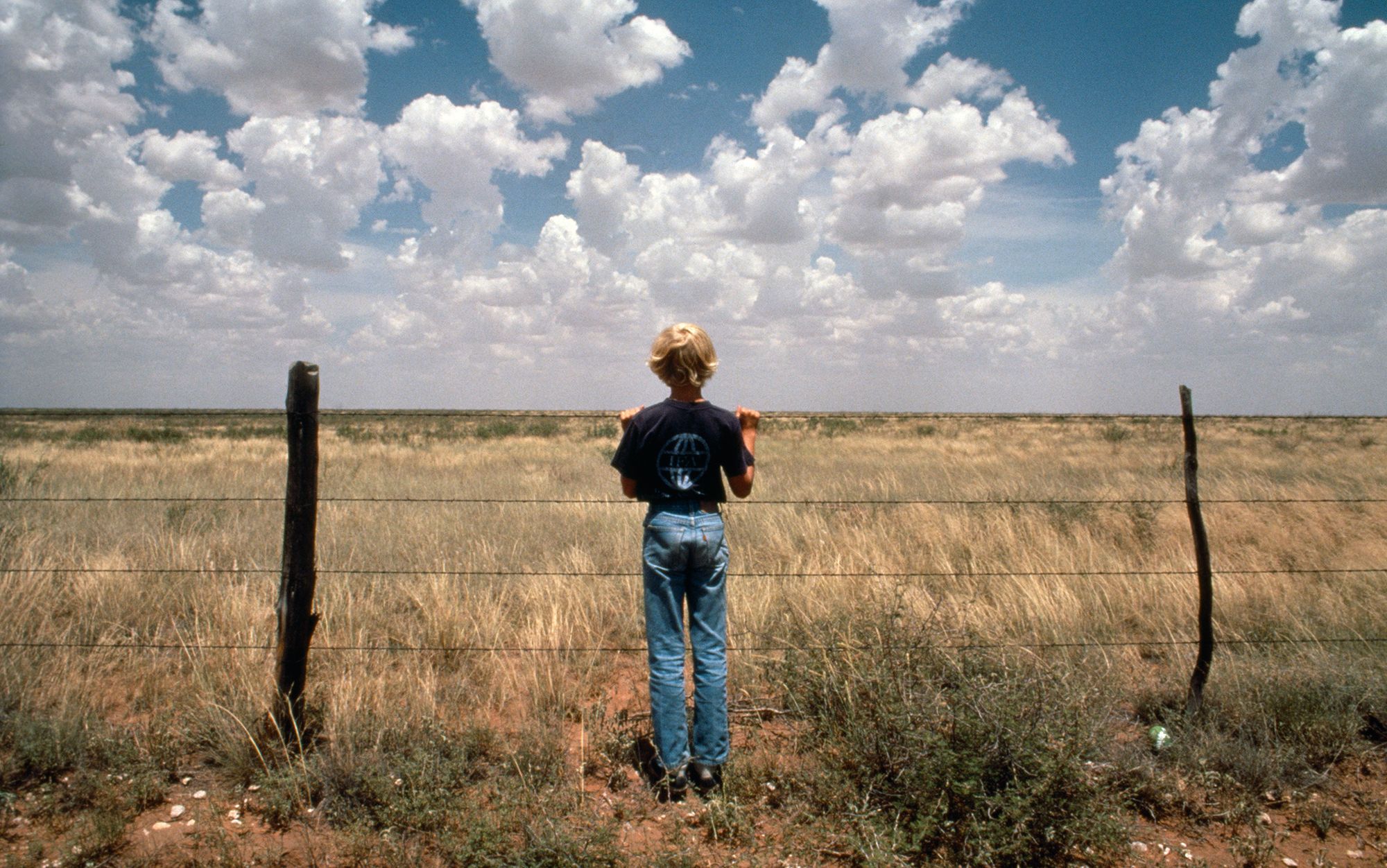
USA.
Montana. 1980. Photo by David Alan Harvey/Magnum
My mother likes to say she was born out of the back of a ’39 Ford. She wasn’t, actually. She was born in a hospital in Chicago. But less than a year later she and her parents returned to the Montana ranch that her family had homesteaded in the early 1900s, and where they still lived. That is where my mother counts her birth, when she got out of the back of that ’39 Ford and came home to the prairie, full of meadowlarks and fragrant soil and a big golden willow. ‘I count how God and nature do things,’ she says of her birth. ‘People have a home, and they know when they get there.’
If there is a greater thrill of belonging, of home, than turning the key in your first house, it’s land ownership. The ranch my mother grew up on still smells of sweet soil. Its acres roll out under Montana’s big sky, harbouring the prairie’s native yellow bells and buttercups. To belong to a place like that, to know it’s yours to care for and live on, is a powerful and steadying force. On your own land, you can send out the kind of roots we often speak of but don’t always treat seriously. ‘I’ve put down roots,’ we say sadly when moving away from a place we’ve become attached to. Those roots are real, and they become stronger and deeper the more closely we belong to a place.
For people like my great-great-grandparents and so many others who had lived under the yoke of tenuous tenancy rights in Europe, the US’s 1862 Homestead Act promised a sense of freedom that these days is almost unimaginable: the freedom to own the land that you worked on, the farm that sustained you, the riverbank where you stood to catch your dinner, the trees that shaded your house. You could lose it through bankruptcy or by giving up – pioneer life was less the delightful, rich adventure depicted in Little House on the Prairie than a stark, cold, lonely, and harsh life that drove many off the land within a few short years – but no capricious lord or absentee owner could take it from you or demand a percentage of your labour. White Americans who benefited from the opening of the West and the brutal, deeply unjust Indian Removal Act, would never again be subject to the equivalent of the Highland Clearances.
For me, like my ancestors, the Montana landscape is part of who I am. It’s beyond price. Love is the one thing about land that cannot be measured by use, real estate markets, or commodity prices. It makes a deep sense of home possible. Once established through the surety of knowing that the land you live on cannot be taken, it then spills out beyond its borders to encompass the surrounding lands. Private property might be the birthplace of husbandry and true sustainability as well as of self-sufficiency and self-determination, but ownership of land also allows us to invest in a community, including public lands and resources owned by all, with a sense of interdependence and mutual cooperation.
The ranch my mother was born on was not built solely by her family’s labour. It relied on water aquifers deep beneath the surface, the health of soil on plains and hills beyond their borders, on hundreds – perhaps thousands – of years of care by the Blackfoot tribe whose land it should have remained, the weather over which they had no control, the sun, seeds, and a community who knew in their bones that nobody could do this alone. These things comprised an ecosystem that was vital to their survival, and the same holds true today. These are our shared natural resources, or what was once known as ‘the commons’.
We live on and in the commons, even if we don’t recognise it as such. Every time we take a breath, we’re drawing from the commons. Every time we walk down a road we’re using the commons. Every time we sit in the sunshine or shelter from the rain, listen to birdsong or shut our windows against the stench from a nearby oil refinery, we are engaging with the commons. But we have forgotten the critical role that the commons play in our existence. The commons make life possible. Beyond that, they make private property possible. When the commons become degraded or destroyed, enjoyment and use of private property become untenable. A Montana rancher could own ten thousand acres and still be dependent on the health of the commons. Neither a gated community nor high-rise penthouse apartments can close a human being from the wider world that we all rely on.
We have been able to ignore and damage the commons without acknowledging the consequences for far too long. But now, the press of human population and the rise of industrialism make the question urgent: how will we own our shared resources? How will we protect them for the benefit of all? There are no more frontiers to run away to, and no more pretending that what we do on one piece of property has no effect not only on neighbours next door but on ecosystems hundreds of miles away. In my great-great-grandparents’ time, a driving question for European immigrants or descendants was how to gain the freedom granted by private property. For our future, it’s not just a question of who owns the earth, but how.
The commons are just what they sound like: land, waterways, forests, air. The natural resources of our planet that make life possible. Societies throughout history have continually relied on varying systems of commons usage that strove to distribute essential resources equitably, like grazing and agricultural land, clean water for drinking and washing, foraged food, and wood for fuel and building. As far back as 555 CE the commons were written into Roman law, which stated outright that certain resources belonged to all, never owned by a few: ‘By the law of nature these things are common to mankind – the air, running water, the sea and consequently the shores of the sea.’
The point was for an individual or family to gain the means for an independent life, not to grow rich from land ownership
The power of this tradition is difficult to explain but even more difficult to overstate, and its practice echoes throughout Western history. The Magna Carta, agreed to in 1215 by England’s King John at the insistence of his barons, protected those nobles from losing their lands at the whim of whatever sovereign they were serving. It also laid down the right to a trial by one’s peers, among other individual rights, and is the document widely cited as the foundation of modern democracy.
What is less well-known is the Charter of the Forest, which was agreed to two years later by the regent for Henry III, King John having died in 1216. With the Charter, ‘management of common resources moves from the king’s arbitrary rule’, says Carolyn Harris, a Canadian scholar of the Magna Carta, ‘to the common good’. The Charter granted what are called subsistence rights, the right that ‘[e]very free man may henceforth without being prosecuted make in his wood or in land he has in the forest a mill, a preserve, a pond, a marl-pit, a ditch, or arable outside the covert in arable land, on condition that it does not harm any neighbour’. Included was the permission to graze animals and gather the food and fuel that one needed to live.
These rights went over to America intact and informed that country’s founding fathers as they developed their own system of laws, with a greater emphasis on the rights of commoners to own enough land to live independently. (That this land belonged to the native people who already lived there didn’t factor much into their reasoning.) For Thomas Jefferson, according to law professor Eric T Freyfogle in his 2003 book The Land We Share, ‘[t]he right of property chiefly had to do with a man’s ability to acquire land for subsistence living, at little or no cost: It was a right of opportunity, a right to gain land, not a right to hoard it or to resist public demands that owners act responsibly.’
Benjamin Franklin, too, believed that any property not required for subsistence was ‘the property of the public, who by their laws, have created it, and who may therefore by other laws dispose of it, whenever the welfare of the public shall demand such disposition’. The point was for an individual or family to gain the means for an independent life, not to grow rich from land ownership or to take the resources of the commons out of the public realm. This idea extended to limiting trespassing laws. Hunting on another’s unenclosed land was perfectly legal, as was – in keeping with the Charter of the Forest – foraging.
The land itself, not just the resources it contained, was part of the commons. Consider the implications of this thinking for our times: if access to the means for self-sustenance were truly the right of all, if both public resources and public land could never be taken away or sold, then how much power could the wealthy, a government, or corporations have over everyday human lives?
The idea of the commons isn’t exclusive to English and American history. In Russia, since at least the 1400s and continuing in various forms until the Bolshevik revolution of 1917, land was managed under the mir system, or ‘joint responsibility’, which ensured that everyone had land and resources enough – including tools – to support themselves and their families. Strips of land were broken up and redistributed every so often to reflect changing family needs. Land belonged to the mir as a whole. It couldn’t be taken away or sold. In Ireland from before the 7th century (when they were first written down) to the 17th, Brehon laws served a similar purpose, with entire septs or clans owning and distributing land until invading English landlords carved up the landscape, stripped its residents of ancestral systems and tenancy rights, and established their estates with suppression and violence. The Scottish historian Andro Linklater examines variations on these collective ownership systems in detail in his 2013 book, Owning the Earth: the adat in Iban, crofting in Scotland, the Maori ways of use in New Zealand, peasant systems in India and China and in several Islamic states, and of course on the North American continent before European invasion and settlement.
But the commons are not relics of dusty history. The Kyrgyz Republic once had a successful system of grazing that benefited both herdsmen and the land. Shattered during Soviet times in favour of intensive production, the grazing commons is slowly being reinstated after passage of a Pasture Law in 2009, replacing a system of private leases with public use rights that revolve around ecological knowledge and are determined by local communities. In Fiji, villages have responded to pressures from overfishing and climate change by adopting an older system of temporary bans on fishing called tabu. An article in the science magazine Nautilus describes the formation of locally managed Marine Protected Areas that use ancient traditions of the commons, and modern scientific understanding, to adapt these communal fishing rights and bans to the changing needs of the ecosystem.

One of the most persuasive and influential critiques of the commons in the second half of the 20th century came from the ecologist and microbiologist Garrett Hardin. In 1968, Hardin published an essay in the magazine Science that argued hard against commons systems of ownership and use. Titled ‘The Tragedy of the Commons’, the essay’s main point was that on a planet of finite resources, the right to reproduce shouldn’t be absolute, but it ranged over many areas of philosophy and morality. ‘The Tragedy of the Commons’ is a seminal piece of work that remained influential up to and beyond Hardin’s death in 2003.
Hardin insisted that a commons system of ownership, incorporating shared access and use, will always lead to disaster because individual selfishness will inevitably prevail over the needs of a community. And, once one individual acts selfishly, all others will follow. Not even Adam Smith, he said, had ever asserted that pursuit of individual interest would always lead to public gain.
Where Hardin’s argument fractures is in his assumption that any system of the commons must necessarily be anarchic. Picturing a pasture open to all, Hardin said that only disease, war, and poaching would keep the population within the land’s healthy carrying capacity. Once social stability had been achieved, and herdsmen could graze as many animals as they wanted, each would have an incentive to increase his individual herd, until the land was destroyed by overgrazing. ‘The inherent logic of the commons,’ Hardin argued, ‘remorselessly generates tragedy.’ What he neglected was the reality of the commons, in which agreed limits that benefit the community are an integral and necessary part of the legal and social system.
There are more stories than I can count of the right to property use destroying the lives, livelihoods, health, or homes of neighbours near and far
In both the Kyrgyz grazing system and Fijian Marine Protected Areas, the point of opening the commons is that the affected community uses scientific, ecological knowledge to agree on limits and ways of use. In the western United States, a system of grazing rights on public land is designed to allow small ranchers to survive by giving them access to ranges wider than they could ever afford to own privately, while at the same time preventing them from overgrazing to the detriment of the ecosystem. These practices simply extend into modern times the way that the commons have functioned throughout history. Unbridled use was never an acceptable part of the system.
What Hardin got right, though, seems almost unintentional. His dismissal of commons systems of ownership ignores how these systems function, but his claim that a commons system of waste and pollution is damaging to humanity goes right to the heart of where we’ve gone wrong with private property. ‘It did not much matter how a lonely American frontiersman disposed of his waste,’ he points out, but modern pressures of population density and industrial pollution put the integrity of the commons at risk. Here is where Hardin’s statement that ‘freedom in a commons brings ruin to all’ starts to ring true. The key to the commons, which should have extended to private property rights when they became widespread, was that they remained true to the ideas enshrined in the Charter of the Forest: use for subsistence was the right of all, but it only extended to activities that would not harm one’s neighbours. The idea of the commons isn’t exclusive to English and American history. A commons system of ownership cannot be a free-for-all; it only works when its use is managed in the interests of all.
In America, the shift to allowing intense industrial uses of land, despite its effects on neighbours, gained legal traction in the early 1800s, when court cases began to trickle out that held the pursuit of economic activity to be a public good. In a seismic upheaval in how property rights were perceived, mining operations could now discharge their waste into waterways, even at the expense of homeowners and fishermen downstream; railroad companies and farmers could act through eminent domain to acquire or use others’ land that they claimed was needed for their own operations, even when the owners were unwilling to sell.
This recognition of private profit as a public good increased globally throughout the 20th century with dizzying speed, leading to extensive loss of the public commons into the 21st century. Just in the past 10 years, Chinese oil companies have been given rights to drill in the last pristine Ecuadoran jungle over the objections of the native people whose home it has been for time out of mind. Decisions in Britain that allowed continued drainage on farmland and grouse-hunting estates put downstream villages at high risk of flooding, while a Cumbrian nuclear plant has contaminated shellfish in Scotland hundreds of miles away. There are more stories than I can count of the right to property use and profit destroying the lives, livelihoods, health, or homes of neighbours near and far. The common thread is in how they ignore, almost completely, the necessity of keeping the commons healthy and stable.
It is ironic that, just as the ancient traditions of successful commons ownership is regaining legitimacy in places like Fiji and the Kyrgyz Republic, the planet-wide commons themselves are under unfettered assault very similar to what Hardin imagined in his ‘Tragedy of the Commons’. The damage we inflict on our own land has never stayed within surveyed property lines. But even as our ecological understanding has increased, our willingness to limit intensive use of private property has shrunk. A coal mine, a hog farm surrounded by extensive waste lagoons that seep into watersheds, a subdivision built on wetlands, an oil well on ground held sacred – whether it’s private land or public, if the use will make money, it must be for the public good. This view is defended even when it destroys everything we need both for physical wellbeing and any sense of deeper connection we might still maintain with the earth beneath our feet and the sky overhead. Even if it severs our roots to the land and discards any sense we might have of ‘home’. We have come, almost inevitably, to a situation where the pursuit of economic growth, enforced by a belief in expansive private property rights, has put in peril the very ecosystems, the very planet, that we rely on for survival.

It’s a warped instinct as expressed here, dismissing others’ desire to enjoy the same rights, neglecting a private user’s or owner’s obligation to neighbours and the surrounding community, and deeply ignorant of the widespread ecological damage caused by unregulated industry. It ignores even the fact that human beings are part of those same ecosystems and become damaged just as nature does. But strip away the Malheur militants’ ignorance of ecology, history, and the absolute necessity of balancing private use with the public’s right to a healthy commons, and we’re left with something familiar: a tiny cry for justice that says the individual right to subsistence from the land – not wealth, just ‘enough’, whatever that means – is one that should belong to us all.
The community benefit of land ownership and use has changed drastically since Roman times, since the Charter of the Forest was agreed, and even since America was first created as a country, and it will continue to do so. For a period of time that in human and geological history is brief but will nevertheless leave lasting harm, governments and courts have come to see a landowner’s most beneficial use of the land as the creation of private profit. But the view of land as a commodity to be exploited rather than part of the public commons is still relatively recent. If we’re to take environmental problems seriously, legal and societal understanding must reinstate the principle that a landowner’s freedom is restricted by the right of that owner’s neighbours to enjoy their own property undisturbed, and by a duty to leave the commons unharmed.
This understanding must necessarily include a more scientific knowledge of ecology. Earth is a sieve. Water flows not just visibly down rivers and streams but through bedrock and across aquifers. So do industrial chemicals. Overworked soil can drift and blow away, as can air pollution, settling on nearby or far-off people who are defenceless against its detrimental health effects. Carving up mountainsides for developments of affordable duplexes or multi-million-dollar vacation homes puts residents downhill at risk of mudslides, while destroying soul-restoring views and forests that could be the birthright of all. The commons saturate every part of our existence.
It is easy, or perhaps convenient, to forget that not so long ago much of the Western world accepted the private ownership of human beings with few twinges of conscience
Will we allow the rights of those commons, of the public trust, of the human being’s access to a simple, sustainable life, to pass out of memory? If we allow the answer to be ‘yes’, then we may find that we lose private property itself, along with the commons. Private property and the public trust coexist; there is no private realm without public, society-wide agreement that enforces rights and laws. Enjoyment of private property is not possible when the common resources that surround it are degraded. A well-ordered society needs both.
This is not purely a matter of dealing with climate change or other environmental damage. Property rights have always stretched long tendrils into every aspect of our lives. It is easy, or perhaps convenient, to forget that not so long ago much of the Western world accepted the private ownership of human beings with few twinges of conscience. Troubling implications of our fetish for private property abound, well beyond the question of land ownership: the rights of companies to patent and therefore privatise seeds, taking access to food out of the public realm. Battles over open-source computer programming and whether libraries should be privatised bring into question who gets access to the powers of information and creation. Rebecca Skloot’s book The Immortal Life of Henrietta Lacks (2010) brought to international attention the point that our very genes and tissues can be collected, traded, tested, and sold as private property, a prospect many people find appalling. It’s a long road from owning a mobile phone or a quarter-acre lot of surveyed subdivision to owning your genetic information, but all of these examples fall into the question of who owns what. Arguments in favour of preserving the public commons against private interest could be made for every one of them.
Decades of pollution and poison from mines, factories, automobiles, power plants, and industrial farms have barely moved the needle away from profit and private property as public benefits. Only the prospect – and now the reality – of global climate change has begun reframing the conversation in terms of society’s right to an undamaged commons.
What these cases have in common – and there will very probably be more of them in the future – is their recognition that private ownership of land and resources needs to be hitched once again to its long-lost partner of owner responsibility. They open up again the acknowledgment that the commons are necessary to human life and remain the interests of all. If we truly believe in a long future for humanity, that we will spread into space and inhabit this planet for millennia beyond imagination, then the pursuit of economic interest and profit, and the right to use one’s land as one wishes, can no longer ride roughshod over the public’s right to an uncontaminated waters, a breathable atmosphere, and a liveable planet.
The question that opened this essay – do we need to relinquish private property to solve our most pressing environmental problems? – was not a proposal. Instead, it was meant to prompt us all to think differently about the relationship between public need and private ownership, between private property rights as regards use and the rights of the public to access and maintain the resources it needs to survive. Private property laws can allow us to own land in such a way that we feel free to invest in it both our work and our affection. A place where we can say, like my mother does, that we have a home, and we know when we get there, even if it’s not out of the back of a ’39 Ford. Those laws will only do so, though, if we at the same time keep the integrity of the commons intact. To say that we cannot eat money has become a cliché, but it is still true. Nor can we drink it, sleep on it or breathe it. The question of land ownership, and therefore of use, comes down to how much we will accept, how far we will go.
For more information about freedom see http://nexusilluminati.blogspot.com/search/label/freedom
- Scroll down
through ‘Older Posts’ at the end of each section
Hope you like this
not for profit site -
It takes hours of work every day by
a genuinely incapacitated invalid to maintain, write, edit, research,
illustrate and publish this website from a tiny cabin in a remote forest.
Now that most viewers see these posts
on mobile devices, sites like this receive an ever diminishing amount of
revenue from advertising… less than a pittance.
Like what you see? Please give anything
you can -
Contribute any amount and receive at
least one New Illuminati eBook!
(You can use a card
securely if you don’t use Paypal)
Please click below -
Spare Bitcoin
change?
Xtra Images by R. Ayana – https://c1.staticflickr.com/9/8339/8161114423_8433832385_h.jpg
https://c2.staticflickr.com/4/3603/5803318098_29c6614117_b.jpg
https://c2.staticflickr.com/4/3603/5803318098_29c6614117_b.jpg
For further enlightening
information enter a word or phrase into the random synchronistic search box @
the top left of http://nexusilluminati.blogspot.com
And see
New Illuminati – http://nexusilluminati.blogspot.com
New Illuminati on Facebook - https://www.facebook.com/the.new.illuminati
New Illuminati Youtube Channel - https://www.youtube.com/user/newilluminati/playlists
New Illuminati’s OWN Youtube Videos
-
New Illuminati on Google+ @ For
New Illuminati posts - https://plus.google.com/u/0/+RamAyana0/posts
New Illuminati on Twitter @ www.twitter.com/new_illuminati
New Illuminations –Art(icles) by
R. Ayana @ http://newilluminations.blogspot.com
The Her(m)etic Hermit - http://hermetic.blog.com
DISGRUNTLED SITE ADMINS PLEASE NOTE –
We provide
a live link to your original material on your site (and links via social
networking services) - which raises your ranking on search engines and helps
spread your info further!
This site
is published under Creative Commons (Attribution) CopyRIGHT (unless an
individual article or other item is declared otherwise by the copyright
holder). Reproduction for non-profit use is permitted & encouraged - if you
give attribution to the work & author and include all links in the original
(along with this or a similar notice).
Feel free
to make non-commercial hard (printed) or software copies or mirror sites - you
never know how long something will stay glued to the web – but remember
attribution!
If you
like what you see, please send a donation (no amount is too small or too large)
or leave a comment – and thanks for reading this far…
Live long
and prosper! Together we can create the best of all possible worlds…
From the New Illuminati – http://nexusilluminati.blogspot.com


