Send a robot into space. Grab an asteroid. Bring it back to Earth orbit.
This may sound like a crazy plan, but it was discussed quite seriously last year by a group of scientists and engineers at the California Institute of Technology. The four-day workshop was dedicated to investigating the feasibility and requirements of capturing a near-Earth asteroid, bringing it closer to our planet and using it as a base for future manned spaceflight missions.
This is not something the scientists are imagining could be done some day off in the future. This is possible with the technology we have today and could be accomplished within a decade.
A robotic probe could anchor to an asteroid made mostly of nickel-iron with simple magnets or grab a rocky asteroid with a harpoon or specialized claws (see video) and then push the asteroid using solar-electric propulsion. For asteroids too big for a robot to handle, a large spacecraft could fly near the object to act as a gravity tractor that deflects the asteroid’s trajectory, sending it toward Earth.
“Once you get over the initial reaction — ‘You want to do what?!’ — it actually starts to seem like a reasonable idea,” said engineer John Brophy from NASA’s Jet Propulsion Laboratory, who helped organize the workshop.
In fact, many of these ideas have been on the drawing board for years as part of NASA’s planetary defense program against large space-based objects that might threaten Earth. And there’s no shortage of potential targets. NASA estimates there are 19,500 asteroids at least 330 feet wide — large enough to detect with telescopes — within 28 million miles of Earth.
Though rearranging the heavens may seem an excessive undertaking, the mission has its merits. The Obama administration already plans to send astronauts to a near-Earth asteroid, a mission that would coop them up in a tiny capsule for three to six months, and involve all the risks of a long deep-space voyage. Instead, robots could shoulder some of that burden by bringing an asteroid close enough for astronauts to get there in just a month.
Parking an asteroid in a gravitationally neutral spot between the Earth and the sun, known as a Lagrange point, would provide a stationary base from which to launch missions further into space. There are several advantages to this. For one, launching materials from Earth requires a lot of power, fuel, and consequently money, to get out of our planet’s deep gravity well. Resources mined from an asteroid with very little gravitational pull could be easily shuttled around the solar system.
And many asteroids have a lot to offer. Some are full of metals such as iron, which can be used to build space-based habitats while others are up to one-quarter water, which would be either used for life-support or broken down into hydrogen and oxygen to make fuel. As well, asteroid regolith placed around a spaceship hull would shield it against radiation from deep space, allowing safer travel to other planets.
An asteroid could be an alternative to setting up camp on the moon, or complement a moon base with more resources for heading further out in the solar system, said engineer Louis Friedman, cofounder of the Planetary Society and another co-organizer of the Caltech workshop.
There’s also the potential for mining asteroid materials to bring back to Earth. Even a small asteroid contains roughly 30 times the amount of metals mined over all of human history, with an estimated worth of $70 trillion. And astronomers would have the chance to get a close-up look at one of the solar system’s earliest relics, generating important scientific data.
Though technically feasible, budging such a hefty target — with a mass in excess of a million tons — would not be easy.
“You’re moving the largest mother lode imaginable,” said former astronaut Rusty Schweickart, cofounder of the B612 Foundation, an organization dedicated to protecting Earth from asteroid strikes.
Most asteroids are irregular chunks of rock that spin chaotically along irregular axes. Engineers would need to be absolutely certain they could control such a potentially dangerous object. “It’s the opposite of planetary defense; if you do something wrong you have a Tunguska event,” said engineer Marco Tantardini from the Planetary Society, referring to the powerful 1908 explosion above a remote Russian region thought to have been caused by a meteoroid or comet. Of course, any asteroid brought back under the proposed plan would be too small to cause a repeat of such an event.
Send a robot into space. Grab an asteroid. Bring it back to Earth orbit.
This may sound like a crazy plan, but it was discussed quite seriously last year by a group of scientists and engineers at the California Institute of Technology. The four-day workshop was dedicated to investigating the feasibility and requirements of capturing a near-Earth asteroid, bringing it closer to our planet and using it as a base for future manned spaceflight missions.
This is not something the scientists are imagining could be done some day off in the future. This is possible with the technology we have today and could be accomplished within a decade.
A robotic probe could anchor to an asteroid made mostly of nickel-iron with simple magnets or grab a rocky asteroid with a harpoon or specialized claws (see video) and then push the asteroid using solar-electric propulsion. For asteroids too big for a robot to handle, a large spacecraft could fly near the object to act as a gravity tractor that deflects the asteroid’s trajectory, sending it toward Earth.
“Once you get over the initial reaction — ‘You want to do what?!’ — it actually starts to seem like a reasonable idea,” said engineer John Brophy from NASA’s Jet Propulsion Laboratory, who helped organize the workshop.
In fact, many of these ideas have been on the drawing board for years as part of NASA’s planetary defense program against large space-based objects that might threaten Earth. And there’s no shortage of potential targets. NASA estimates there are 19,500 asteroids at least 330 feet wide — large enough to detect with telescopes — within 28 million miles of Earth.
Though rearranging the heavens may seem an excessive undertaking, the mission has its merits. The Obama administration already plans to send astronauts to a near-Earth asteroid, a mission that would coop them up in a tiny capsule for three to six months, and involve all the risks of a long deep-space voyage. Instead, robots could shoulder some of that burden by bringing an asteroid close enough for astronauts to get there in just a month.
Parking an asteroid in a gravitationally neutral spot between the Earth and the sun, known as a Lagrange point, would provide a stationary base from which to launch missions further into space. There are several advantages to this. For one, launching materials from Earth requires a lot of power, fuel, and consequently money, to get out of our planet’s deep gravity well. Resources mined from an asteroid with very little gravitational pull could be easily shuttled around the solar system.
And many asteroids have a lot to offer. Some are full of metals such as iron, which can be used to build space-based habitats while others are up to one-quarter water, which would be either used for life-support or broken down into hydrogen and oxygen to make fuel. As well, asteroid regolith placed around a spaceship hull would shield it against radiation from deep space, allowing safer travel to other planets.
An asteroid could be an alternative to setting up camp on the moon, or complement a moon base with more resources for heading further out in the solar system, said engineer Louis Friedman, cofounder of the Planetary Society and another co-organizer of the Caltech workshop.
There’s also the potential for mining asteroid materials to bring back to Earth. Even a small asteroid contains roughly 30 times the amount of metals mined over all of human history, with an estimated worth of $70 trillion. And astronomers would have the chance to get a close-up look at one of the solar system’s earliest relics, generating important scientific data.
Though technically feasible, budging such a hefty target — with a mass in excess of a million tons — would not be easy.
“You’re moving the largest mother lode imaginable,” said former astronaut Rusty Schweickart, cofounder of the B612 Foundation, an organization dedicated to protecting Earth from asteroid strikes.
Most asteroids are irregular chunks of rock that spin chaotically along irregular axes. Engineers would need to be absolutely certain they could control such a potentially dangerous object. “It’s the opposite of planetary defense; if you do something wrong you have a Tunguska event,” said engineer Marco Tantardini from the Planetary Society, referring to the powerful 1908 explosion above a remote Russian region thought to have been caused by a meteoroid or comet. Of course, any asteroid brought back under the proposed plan would be too small to cause a repeat of such an event.

Still, these obstacles are like catnip to engineers, who love to go over every potential difficulty in order to solve it. Actually executing the asteroid retrieval plan would help demonstrate and greatly expand mankind’s space-based engineering capabilities, said Friedman. For instance, the mission would teach engineers how to capture an uncooperative target, which could be good practice for future planetary defense missions, he added.
And if the challenges for a large asteroid seem too daunting, researchers could always start with a smaller asteroid, perhaps six to 30 feet across. Gradually larger objects could be part of a campaign where engineers learn to deal with progressively greater complications.
Last year, Brophy helped conduct a study at JPL to look at the feasibility of bringing a 6.5-foot, 22,000-pound asteroid — of which there might conceivably be millions — to the International Space Station. This mission would help astronauts and engineers learn how to process asteroid materials and ores in space.
The JPL study suggested the asteroid could be captured robotically in something as simple as a large Kevlar bag and then flown to the space station or placed in a Lagrange point. Of course, such a small object might not have the same emotional impact as a larger destination. “NASA isn’t going to want to go to something that is smaller than our spaceships,” said engineer Dan Mazanek from NASA’s Langley Research Center.
No matter the size of the asteroid, these plans would require hefty investments. Even capturing a small asteroid would consume at least a billion dollars and anything larger would be a multi-billion-dollar endeavor. Convincing taxpayers to foot such a bill could be tricky.
Considering the resources available in any asteroid, private industry might be interested in getting involved. One possible mission would be to simply execute the first part of the plan — pushing the asteroid to near-Earth orbit — and then convene a commercial competition inviting anyone who wants to develop the capabilities to reach and mine the object.
Though the undertaking might be scientifically exciting, this wouldn’t be the primary motivation. An asteroid would provide great insight into the solar system’s formation, it’s not enough to justify the expense of bringing one to Earth. Any interesting science can be done much cheaper with an unmanned robotic spacecraft, said chemist Joseph A Nuth from NASA’s Goddard Spaceflight Center.
“Ultimately, we would be developing this target in order to help move out into the solar system,” Brophy said.
Though they did not reach a consensus on all the details, the group will reconvene in January to hammer out further specifications and potentially get the interest of NASA.
In the end, many agreed that bringing an asteroid back to Earth could create an interesting destination for repeated manned missions and that the undertaking would help build up experience for future jaunts into space.
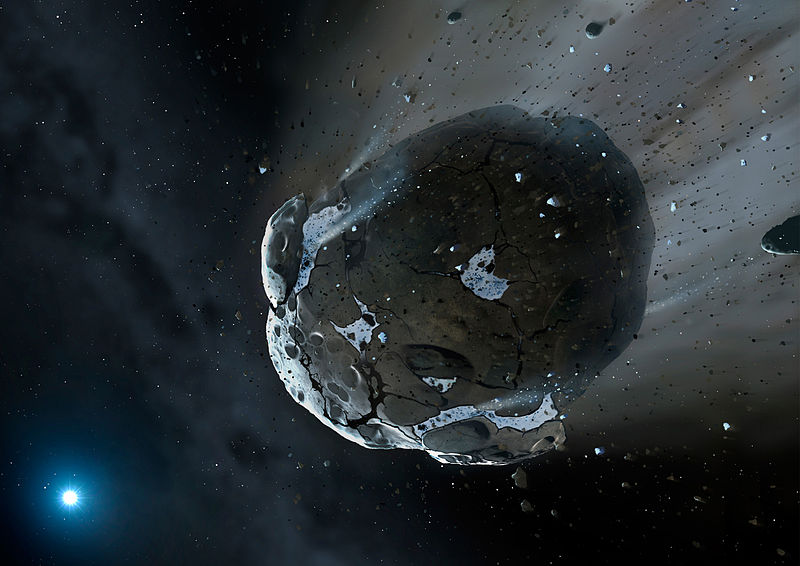
Image: NASA/Denise Watt
From Wired @ http://www.wired.com/wiredscience/2011/10/asteroid-moving/
How asteroid mining could turn billionaires into trillionaires (+video)

A cadre of Silicon Valley tycoons have announced plans to extract water and precious metals from near-Earth asteroids. Could that actually work?
· 
This computer-generated image provided by Planetary Resources, a group of high-tech tycoons that wants to mine nearby asteroids, shows a conceptual rendering of satellites prospecting a water-rich, near-Earth asteroid.
Planetary Resources/AP
Google Inc executives Larry Page and Eric Schmidt and filmmaker James Cameron are among those bankrolling a venture to survey and eventually extract precious metals and rare minerals from asteroids that orbit near Earth, the company said.
Planetary Resources, based in Bellevue, Washington, initially will focus on developing and selling extremely low-cost robotic spacecraft for surveying missions.
A demonstration mission in orbit around Earth is expected to be launched within two years, said company co-founders Peter Diamandis and Eric Anderson.
Planetary Resources' aim is to open deep-space exploration to private industry, much like the $10 million Ansari X Prize competition, which Diamandis created.
The prize, which galvanized the emerging commercial human spaceflight industry, was awarded in 2004 to Scaled Composites' SpaceShipOne for the first flights beyond Earth's atmosphere by a privately developed, manned spaceship. Commercial suborbital spaceflights are expected to begin next year.
Planetary Resources' first customers are likely to be science agencies, such as NASA, as well as private research institutes.
Within five to 10 years, however, the company expects to progress from selling observation platforms in orbit around Earth to prospecting services. It plans to tap some of the thousands of asteroids that pass relatively close to Earth and extract their raw materials.
Not all missions would return precious metals and minerals to Earth. In addition to mining for platinum and other precious metals, the company plans to tap asteroids' water to supply orbiting fuel depots, which could be used by NASA and others for robotic and human space missions.
"We have a long view. We're not expecting this company to be an overnight financial home run. This is going to take time," Anderson said in an interview with Reuters.
The real payoff, which is decades away, will come from mining asteroids for platinum group metals and rare minerals.
"If you look back historically at what has caused humanity to make its largest investments in exploration and in transportation, it has been going after resources, whether it's the Europeans going after the spice routes or the American settlers looking toward the west for gold, oil, timber or land," Diamandis said.
"Those precious resources caused people to make huge investments in ships and railroads and pipelines. Looking to space, everything we hold of value on Earth - metals, minerals, energy, real estate, water - is in near-infinite quantities in space. The opportunity exists to create a company whose mission is to be able to go and basically identify and access some of those resources and ultimately figure out how to make them available where they are needed," he said.
Diamandis and Anderson declined to discuss how much money has been raised for their venture so far. In addition to Google billionaires Page and Schmidt and filmmaker Cameron, Planetary Resources investors include former Microsoft chief software architect Charles Simonyi, a two-time visitor to the International Space Station, Google founding director K. Ram Shriram and Ross Perot Jr.
Planetary Resources also declined to discuss specifics about how and when asteroid mining would begin. A 30-meter long (98-foot) asteroid can hold as much as $25 billion to $50 billion worth of platinum at today's prices, Diamandis said.
The company's first step is to develop technologies to cut the cost of deep-space robotic probes to one-tenth to one-hundredth the cost of current space missions, which run hundreds of millions of dollars, Diamandis said.
Among the targeted technologies is optical laser communications, which would eliminate the need for large radio antennas aboard spacecraft.
"We're taking new approaches at design," Diamandis said. "Part of the philosophy we're taking is building very low cost, very small spacecraft. You put up six or 10 or dozens and you get reliability."
Planetary Resources, which currently employs about 20 people, is overseen by former NASA Mars mission manager Chris Lewicki. It was founded about three years ago, but has been operating quietly behind the scenes until now.
Details around Asteroid Retrieval plans and what is in the Near Earth Asteroids

Self Imposed Rules
1. Launch by the end of this decade
2. Require only a single Evolved Expendable Launch Vehicle (EELV)
3. Total round-‐trip flight time of ~5 years
4. Select an asteroid that has an unrestricted Earth return Planetary Protection categorization
5. Return asteroid to the ISS
Use 40 kilowatt Solar Electric Propulsion system (launch mass of 13.7 tons)
Return a 10 ton asteroid to low earth orbit
But if return to high earth orbit can return 50 times more. 508 tons.
• About 1000 one-kilometer-sized NEAs
• About 400,000 100-meter sized NEAs
• Periods generally 0.9 to 7 years
• Orbital inclinations generally 10-20o
• Eccentricities 0 to 0.9; mostly near 0.5
• About 30% will eventually hit Earth
• About 20% are easier to land on than the Moon
 Easy Access from low earth orbit
• Perihelion (or aphelion) close to 1 AU
• Small eccentricity
• Low inclination
These factors combined allow low outbound ΔVs (from LEO to soft landing)
Easy Return to low earth orbit
• Perihelion (aphelion) close to 1 AU
• Small cross-range distance between orbits
• Favorable orbital phasing (different every time)
• Use of aerocapture at Earth
These factors allow low inbound ΔVs (from asteroid surface to LEO).
Many NEAs have ΔVin < 500 m s-1 (some as low as 60 m s-1, compared to 3000 m s-1 for Moon) Abundance of Useful Materials

What are the most useful materials?
– Water (ice, -OH silicates, hydrated salts) for
• Propellants
• Life support
– Native ferrous metals (Fe, Ni) for structures
– Bulk regolith for radiation shielding
– Platinum-group metals (PGMs) for Earth
– Semiconductor nonmetals (Si, Ga, Ge, As,…) for Earth or Solar Power Satellites
Comparative abundances
– Water
• C, D, P chondrites have 1 to >20% H2O; extinct NEO comet cores may be 60% water ice
• Mature regolith SW hydrogen reaches maximum of about 100 ppm in ilmenite-rich mare basins (water equivalent 0.1% assuming perfect recovery)
– Metals
• To 99% in M asteroids; 5-30% in chondrites
• Lunar regolith contains 0.1 to 0.5 % asteroidal metals
Simple Processing Schemes
“Simple and Efficient” means:
– Low energy consumption per kg of product
– Processes require little or no consumables
– Few mechanical parts
– Modular design for ease of repair
– Highly autonomous operation
– On-board AI/expert systems for process control
– Self-diagnosis and self-repair capabilities
– Maximal use of low-grade (solar thermal) energy
– Regenerative heat capture wherever possible
Examples of Processing Schemes
• Ice extraction by melting and sublimation of native ice using solar or nuclear power
• Water extraction from –OH silicates or hydrated salts by solar or nuclear heating
• Electrolysis of water and liquefaction of H/O
• Ferrous metal volatilization, separation, purification, and deposition by the gaseous Mond process
– Feo(s) +5CO < -- > Fe(CO)5(g)
– Nio(s) + 4CO < -- > Ni(CO)4(g)
Magnitude of what is in Near Earth Asteroids
• Total NEA mass about 4x10^18 g
• About 1x10¹⁸ g ferrous metals
• About 1x10¹⁸ g water
• Earth-surface market value of NEA metals
– Fe iron $300/Mg x 10^12 Mg = $300 T
– Ni $28000/Mg x 7x10^10 Mg = $2000 T
– Co $33000/Mg x 1.5x10^10 Mg = $500 T
– PGMs $40/g x 5 x 10^7 Mg = $2000 T
Highly useful material for use in space
• Structural metals for SPS, bases, etc.
– High-purity iron from Mond process
• 99.9999% Fe: strength and corrosion resistance of stainless steel
– High-precision chemical vapor deposition (CVD) of Ni in molds
• Custom CVD of Fe/Ni alloys
• Bulk radiation shielding
– Regolith, metals, water (best)
• LEO
– Propellants for GTO/GEO/HEEO/Moon/Mars
– Radiation shielding
• GEO
– Structural metals for Solar Power Satellites
– Station-keeping propellants
– Photovoltaics for SPS
• Direct use of water as propellant
– Solar Thermal Propulsion-- STP (“Steam rocket”)
– Nuclear Thermal Propulsion– NTP
• Electrolysis of water to H/O
– H2 STP
– H2 NTP
– H2/O2 chemical propulsion
One Asteroid Amun has over 30 times all the metal mined in human history
• 3554 Amun: smallest known M-type NEA
• Amun is 2000 meter in diameter
• Contains about 30x the total amount of metals mined over human history
• Contains 3x10^16 g of iron
• Contains over 10^12 g of PGMs with Earth surface market value of about $70 Trillion
Near Earth Asteroids as traveling hotels
• Typical NEAs have perihelia near Earth and aphelia in the heart of the asteroid belt
• NEA regolith provides radiation shielding
• Asteroid materials provide propellants
• Earth-Mars transfer orbits possible
• Traveling hotels/gas stations/factories… colonies?
• Typical NEAs have perihelia near Earth
and aphelia in the heart of the asteroid belt
• NEA regolith provides radiation shielding
• Asteroid materials provide propellants
• Earth-Mars transfer orbits possible
• Traveling hotels/gas stations/factories…
colonies?
From Next Big Future @ http://nextbigfuture.com/2012/04/details-around-asteroid-retrieval-plans.html
Donate any amount and receive at least one New Illuminati eBook!
For further enlightening information enter a word or phrase into the search box @ New Illuminati or click on any label/tag at the bottom of the page @ http://nexusilluminati.blogspot.com
And see
This material is published under Creative Commons Fair Use Copyright (unless an individual item is declared otherwise by copyright holder) – reproduction for non-profit use is permitted & encouraged, if you give attribution to the work & author - and please include a (preferably active) link to the original along with this notice. Feel free to make non-commercial hard (printed) or software copies or mirror sites - you never know how long something will stay glued to the web – but remember attribution! If you like what you see, please send a tiny donation or leave a comment – and thanks for reading this far…
 By Lydia Smith