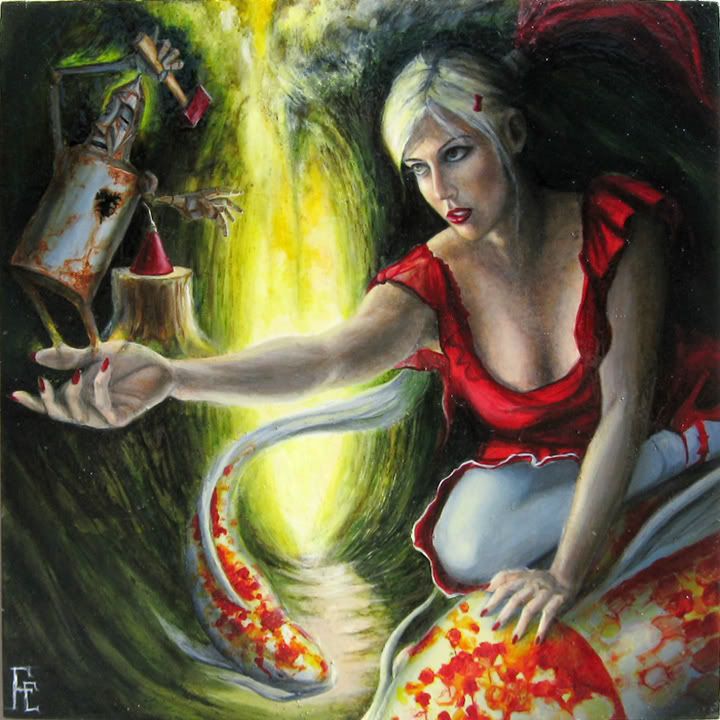
"All the world's a stage we pass through." - R. Ayana

Wednesday, June 30, 2010

YOU are GOD(DESS)!

YOU are GOD(DESS)!

You are the creator of a holographic universe


 Follow the white rabbit !

-The Matrix has you !

-I know why you're here!
-I know what you've been doing!
-I know why you hardly sleep, why you live alone, and why night after night, you sit at your computer.

-You're looking for HIM!

-I know, because I was once looking for the same thing.
-And when he found me, he told me I wasn't really looking for him. I was looking for an answer.
-It's the question that drives us!
-It's the question that brought you here. You know the question, just as I did. WHO AM I?

-Unfortunately, no one can be told what GOD is. You have to see it for yourself.

-There is a difference between knowing the path and walking the path.

-There is no spoon,

-You take the red pill, you stay in Wonderland,
and I show you HOW deep the rabbit hole goes.

-You have to let it all go, Neo. Fear, doubt, and disbelief. Free your mind.!

-Welcome to the real world !


For further enlightenment see –

The Her(m)etic Hermit - http://hermetic.blog.com


This material is published under Creative Commons Copyright (unless an individual item is declared otherwise by copyright holder) – reproduction for non-profit use is permitted & encouraged, if you give attribution to the work & author - and please include a (preferably active) link to the original along with this notice. Feel free to make non-commercial hard (printed) or software copies or mirror sites - you never know how long something will stay glued to the web – but remember attribution! If you like what you see, please send a tiny donation or leave a comment – and thanks for reading this far…

From the New Illuminati – http://nexusilluminati.blogspot.com

Tuesday, June 29, 2010

Arrests are being made 'to expand DNA files'

Arrests are being made 'to expand DNA files'

http://i.current.com/images/asset/891/556/15/KQzooy.jpg

Police are routinely arresting people simply to record their DNA profiles on the [UK] national database...
Three quarters of young black men are on the database. The finding risks stigmatising a whole section of society, the equality watchdog has warned.
The revelations will fuel the debate about the DNA database, the world’s largest. They are included in a report by the Human Genetics Commission, an independent government advisory body. It criticises the piecemeal development of the database and questions how effective it is in helping the police to investigate and solve crimes.
Jonathan Montgomery, commission chairman, said that “function creep” over the years had transformed a database of offenders into one of suspects. Almost one million innocent people are now on the DNA database.
Professor Montgomery said: “It’s now become pretty much routine to take DNA samples on arrest, so large numbers of people on the DNA database will be there not because they have been convicted, but because they’ve been arrested.”
Recorded crime has fallen every year since 2004-05, but the number of people arrested in England and Wales annually is rising. Latest figures show that arrests rose by 6 per cent to 1.43 million in 2005 and a further 4 per cent to 1.48 million in 2006-07.
Professor Montgomery said there was some evidence that people were arrested to retain the DNA information even though they might not have been arrested in other circumstance.
He said that a retired senior police officer told the commission: “It is now the norm to arrest offenders for everything if there is a power to do so. It is apparently understood by serving police officers that one of the reasons... is so that DNA can be obtained.” He said that the tradition of only arresting someone when dealing with serious offences had collapsed.
The Equalities and Human Rights Commission said the proportion of black men on the database created an impression that one race group represented an “alien wedge” of criminality.
The report’s foreword states that the DNA profiles of 75 per cent of black men aged 18 to 35 are recorded. But the commission admitted that it had “hardened up slightly” earlier estimates quoted in Parliament.
The Crime and Security Bill heralded in last [November’s] Queen’s Speech proposes cutting to six years the time that innocent people’s profiles are kept. Those arrested but not charged, or those cleared in court, currently remain on the database for ever. There are no plans to reduce police powers to take samples from everyone arrested.
Chris Grayling, the Shadow Home Secretary, has said that innocent people should not have their DNA retained by the police once they are acquitted of a crime.
The commission report said that the database should be placed on a clear statutory basis and overseen by an independent authority. Isabella Sankey, of Liberty, said: “Not only are we stockpiling the most sensitive information of innocents who have never been charged, let alone convicted, we are also creating a perverse incentive to arrest people solely to get their details on the database.”
The Home Office suggested that the over-representation of young black men on the database was linked to disproportionality in other areas of the criminal justice system.

 http://4.bp.blogspot.com/_tUyhZ8r0ufM/Sw2ynrGKkAI/AAAAAAAABZM/VtwyKb5l7dY/s400/biometric-fingerprint-access-control-image.png

President Obama backs DNA test in arrests

President Barack Obama’s embrace of a national database to store the DNA of people arrested but not necessarily convicted of a crime is heartening to backers of the policy but disappointing to criminal justice reformers, who view it as an invasion of privacy.
Others also worry the practice would adversely affect minorities.
In an interview aired Saturday on “America’s Most Wanted,” Obama expressed strong agreement as host John Walsh extolled the virtues of collecting DNA at the time of an arrest and putting it into a single, national database.
“We have 18 states who are taking DNA upon arrest,” Walsh said. “It’s no different than fingerprinting or a booking photo. ... Since those states have been doing it, it has cleared 200 people that are innocent from jail.”
“It’s the right thing to do,” Obama replied. “This is where the national registry becomes so important, because what you have is individual states — they may have a database, but if they’re not sharing it with the state next door, you’ve got a guy from Illinois driving over into Indiana, and they’re not talking to each other.”
Erin Runnion, whose 5-year-old daughter Samantha was murdered in 2002, was delighted at Obama’s remarks. “I am thrilled that the president seems to be supportive of DNA upon felony arrest. I think we’ll prevent future crimes across this country by doing it,” she said. “I’m absolutely 100 percent in favour of it.”
Some opponents of the idea, though, were taken aback.
“I’m actually surprised he would give an answer like that,” said Deborah Peterson Small of Break the Chains, which studies the impact of drug laws on minority groups. “I’d think he and people around him would know that collecting DNA samples from arrestees is more controversial than collecting it from people who’ve been convicted.”
“It’s a horrible idea — tremendously invasive,” said Bill Quigley of the Center for Constitutional Rights, who also disputed Walsh’s claim that DNA is no different from fingerprints.
“It’s like a hair sample, looking at your health care records and everything else,” Quigley said. “It’s like giving a blank check to the government — a blank check they can cash anytime they feel like it.”


From - http://www.politico.com/news/stories/0310/34097.html
 

http://badgals-radio.com/wp-content/uploads/HLIC/49e8f2d905b788e7d1b0551fd4945e28.jpg

 Images - http://i.current.com/images/asset/891/556/15/KQzooy.jpg
http://4.bp.blogspot.com/_tUyhZ8r0ufM/Sw2ynrGKkAI/AAAAAAAABZM/VtwyKb5l7dY/s400/biometric-fingerprint-access-control-image.png
http://badgals-radio.com/wp-content/uploads/HLIC/49e8f2d905b788e7d1b0551fd4945e28.jpg

For further enlightenment see –

The Her(m)etic Hermit - http://hermetic.blog.com


This material is published under Creative Commons Copyright (unless an individual item is declared otherwise by copyright holder) – reproduction for non-profit use is permitted & encouraged, if you give attribution to the work & author - and please include a (preferably active) link to the original along with this notice. Feel free to make non-commercial hard (printed) or software copies or mirror sites - you never know how long something will stay glued to the web – but remember attribution! If you like what you see, please send a tiny donation or leave a comment – and thanks for reading this far…

From the New Illuminati – http://nexusilluminati.blogspot.com

Monday, June 28, 2010

Corporate atrocities against nature may ultimately destroy human civilization

Corporate atrocities against nature may ultimately destroy human civilization

by Mike Adams, the Health Ranger

natural health
What's most striking about the present BP oil catastrophe is not that it is an aberration but rather part of a dangerous pattern of mankind's propensity to destroy nature. To destroy life in a large region of an ocean isn't even new: The world already has over two hundred "dead zones" where fish can't live because the ocean water has no more oxygen left thanks to the runoff effects of man-made chemicals.

Not content with mere deforestation and the vast destruction of biodiversity on land, Man has now expanded to destroy the oceans through overfishing, ocean acidification from CO2 emissions, agricultural runoff, flushing pharmaceuticals down the drain and unleashing crude oil directly into the ocean waters. It almost seems as if mankind were somehow bent on destroying itself by first destroying everything else on the planet just to see what happens.

Human beings, by any honest accounting, are repeat offenders engaged in crimes against nature. This article, by the way, isn't some clever way to try to push us all toward a U.N.-controlled world government where every human action is regulated by environmental cops; it's merely an observation of what's really happening right now on our planet. I'm a Constitutionalist and remain strongly opposed to UN control as much as any properly-informed American. In no way do I support suppressing our individual freedoms or liberties. In fact, the problems here are not with the People but rather with the corporations.

http://filipspagnoli.files.wordpress.com/2009/06/corporate-social-responsibility.jpg

The criminal corporations
It is the corporations that are committing these crimes against nature: Big Pharma's mass poisoning of the waters, BP's oil catastrophe crime against the planet in the Gulf Coast, the manufacture of Depleted Uranium shells by wealthy "defense" contractors, factory farming by meat producers, the poisoning of our farms by Monsanto and its campaign to dominate nature with genetically modified seeds... you get the picture. If you really look hard at the issues, it's the corporations who are destroying our planet and thereby destroying future survivability for the rest of us.

It is the corporations, in essence, that are the criminals who are now destroying the very world around us, and if We the People continue to let these corporations engage in such actions, it won't be long before we wake up and find ourselves enslaved in a Corporatocracy that has stolen from us the very world in which we had hoped to raise our children.

What is abundantly clear now is that corporations will do anything to make money, from the cruel and inhumane factory farming of cows to dumping millions of gallons of toxic chemicals in the ocean to try to sink the dead sea animals in the Gulf. Corporations would set fire to the entire planet if that act could somehow boost profits by 50% next quarter.

The unbridled greed that drives these corporations is simply incompatible with sustainable life on our planet. Through their careless, greed-driven actions, corporations are threatening YOUR life and the lives of your children.

I say enough is enough.

http://libcom.org/files/images/history/12-31-2007__garrucha_encuentro_mujeres_158cmi%5B2%5D.jpg

An armed revolt against the corporations?
There is already some mainstream talk about arresting the CEO of British Petroleum for his crimes against nature. It will never happen, of course, because these corporations wield too much power over government entities. We've seen it time and time again: Corporations are almost never held accountable for their crimes.

It is becoming increasingly clear that any action to hold these corporations accountable for their actions must come from the People -- most likely in the form of a dedicated revolt, or perhaps even an armed "mass citizens' arrest" of the corporate criminals.

Imagine ten thousand armed, angry citizens from Texas, Louisiana and Florida converging on the BP headquarters in Houston, led by a local Sheriff, marching in and arresting all the top CEOs of British Petroleum. That's the kind of action that needs to start taking place if any justice is ever to be found in our modern world of corporate corruption and government collusion.

When it comes to corporate crimes, the justice system has utterly failed. The corporations that commit crimes are almost never held responsible. Consider the aftermath of the Goldman Sachs fiasco in 2008 - 2009, when Wall Street banksters ripped off the American people to the tune of hundreds of billions of dollars, and then got bailed out by the U.S. government with trillions of dollars in gift money. How is that justice?

Similarly, after drug giant Pfizer was found to have committed massive marketing fraud that violated federal law, the company was deemed "too big to fail" and was simply given a free pass by the government to stay in business, defrauding customers, states and nations. Pfizer set up a shell company to take the fall for its crimes, then went right back to business as usual. Read the story on CNN if you want to learn more: http://www.cnn.com/2010/HEALTH/04/0...

As CNN reports: Imagine being charged with a crime, but an imaginary friend takes the rap for you. That is essentially what happened when Pfizer, the world's largest pharmaceutical company, was caught illegally marketing Bextra, a painkiller that was taken off the market in 2005 because of safety concerns. When the criminal case was announced last fall, federal officials touted their prosecution as a model for tough, effective enforcement. "It sends a clear message" to the pharmaceutical industry, said Kevin Perkins, assistant director of the FBI's Criminal Investigative Division. But beyond the fanfare, a CNN Special Investigation found another story, one that officials downplayed when they declared victory. It's a story about the power major pharmaceutical companies have even when they break the laws intended to protect patients..."

Whether it's Big Pharma, Big Oil, Big Food or Big Agriculture, every large and powerful corporations gets away with murder because laws are never properly applied to them. BP is destroying an entire ocean -- and the livelihoods of millions of people -- and will probably get off with a large fine and a slap on the wrist. In two years, it will all be back to business as usual, polluting the oceans, destroying life and ignoring safety rules and regulations once again while the American people suffer.

More dangerous than terrorists

Corporations are a greater threat to our lives than terrorists. That much should be clear by now: When corporations poison our food supply with toxic chemical ingredients; when they poison our bodies with fraudulently-marketed pharmaceuticals; when they poison our oceans with careless oil drilling... they are threatening our lives and our livelihoods. They are destroying the only world we know, and they are proving themselves to be far more dangerous to our collective future than any terrorist organization.

The real terrorists, it turns out, have "Inc." after their name. And if we really want to go after the terrorists who present a clear and present danger to our health and lives, we must rise up against the corporate machine that now controls our media, our food, our sick-care system, our patents, our elected officials and our energy. We must gather our forces to make legally-justified citizens' arrests of those at the top who are responsible for these atrocities against nature and the People. We must unite out of a common desire for survival against the corporate criminals who are destroying our very futures as we speak.

We must seek the aid of the local Sheriffs, Constables and community law enforcement officials who would join us in making these arrests, and then we must march on the corporate headquarters of these criminal corporations, right through their front doors and into their corporate offices where arrests will be made at gunpoint.

And why gunpoint? Because corporations do not respect law, nor ethics, nor morality, nor compassion towards others. They only respect one thing: force. So we must reluctantly use force -- backed by the common sense of common law -- to make these corporations stop destroying our planet and our livelihoods. I'm not saying we march in there and shoot them; I'm saying we march in and arrest them and bring them to trial in local courts, with local jurors who can make local commonsense decisions about what to do with these criminal corporate executives.

The feds cannot be trusted on this. We must deal with these corporations on a local level, with the widespread support of the everyday people whose lives are being destroyed by these corporations.

http://www.hermes-press.com/RC_gandhi.jpg

The extinction of the human race
This is more than just holding corporations accountable for specific crimes such as poisoning the Gulf Coast; it's about our very survival. We're not merely talking about small, local damage to specific regions or industries here -- we are talking about the possibility of the extinction of the human race.

If the world's powerful corporations are allowed to continue operating as they have done, they will destroy our world and cause the collapse of human civilization. We cannot survive when suffocated under a cloud of chemical toxicity, financial fraud, genetically-modified seeds and widespread environmental destruction. Corporations are incapable of acting within the guidelines of long-term sustainable living. Their power and reach are now so great that they have the capacity to destroy modern civilization (which is quite fragile already).

Rising up against the corporations now means fighting for our very survival. What BP has made as clear as day is that we must now make a choice: We can choose to appease powerful corporations and exempt them from any real enforcement of rules, regulations or common sense; or we can take a stand against them, arrest their top executives, shut down their operations, revoke their corporate charters and set course in a new world without the destructive influence of endless greed backed by incessant profit-taking.

The worship of profit has become a scourge on human civilization. Unbridled greed is now our curse. "Economic activity", taken as a lone figure without the context in which it was generated, holds no measure of real value, and it should never been pursued for its own sake.

We must now shift our consciousness to a new era of the protection of life. We must value quality of life, not imaginary numbers in a bank account, and quality of life is a complex, interdependent equation that necessarily involves the sustaining of all the diverse ecosystems that now remain on our planet. For humans to live sustainably, happily and abundantly, we must stop destroying nature and start protecting it. We must be its steward, not its exploiter. And those corporations engaged in the mass destruction or poisoning of living ecosystems must be courageously arrested as criminals and prosecuted for their crimes against both the People and the planet.

There is no other way that we will survive the next century. Poisoning our planet on such a massive scale is an inexcusable act. We the People will either rise up against it, or we shall be destroyed by it.

I, for one, am willing to fight for our survival. Because I don't want human civilization to just be a sorry footnote in the history of life on planet Earth.


 Xtra Images - http://filipspagnoli.files.wordpress.com/2009/06/corporate-social-responsibility.jpg
http://libcom.org/files/images/history/12-31-2007__garrucha_encuentro_mujeres_158cmi%5B2%5D.jpg
http://www.hermes-press.com/RC_gandhi.jpg
For further enlightenment see –

The Her(m)etic Hermit - http://hermetic.blog.com


This material is published under Creative Commons Copyright (unless an individual item is declared otherwise by copyright holder) – reproduction for non-profit use is permitted & encouraged, if you give attribution to the work & author - and please include a (preferably active) link to the original along with this notice. Feel free to make non-commercial hard (printed) or software copies or mirror sites - you never know how long something will stay glued to the web – but remember attribution! If you like what you see, please send a tiny donation or leave a comment – and thanks for reading this far…

From the New Illuminati – http://nexusilluminati.blogspot.com

Sunday, June 27, 2010

LESSONS FROM THE WIZARD OF OZ: The Web of Debt

LESSONS FROM THE WIZARD OF OZ

The Web of Debt

by Ellen Brown

http://polytricks.files.wordpress.com/2008/09/webofdebt.jpg

"The great Oz as spoken! Pay no attention to that man behind the curtain! I am the great and powerful Wizard of Oz!"
In refreshing contrast to the impenetrable writings of economists, the classic fairytale The Wizard of Oz has delighted young and old for over a century. It was first published by L. Frank Baum as The Wonderful Wizard of Oz in 1900. In 1939, it was made into a hit Hollywood movie starring Judy Garland, and later it was made into the popular stage play The Wiz.
Few of the millions who have enjoyed this charming tale have suspected that its imagery was drawn from that most obscure and tedious of subjects, banking and finance. Fewer still have suspected that the real-life folk heroes who inspired its plot may have had the answer to the financial crisis facing the country today!
The economic allusions in Baum's tale were first observed in 1964 by a schoolteacher named Henry Littlefield, who called the story "a parable on Populism," referring to the People's Party movement challenging the banking monopoly in the late nineteenth century.1 Other analysts later picked up the theme. Economist Hugh Rockoff, writing in the Journal of Political Economy in 1990, called the story a "monetary allegory."2 Professor Tim Ziaukas, writing in 1998, stated:
"The Wizard of Oz"... was written at a time when American society was consumed by the debate over the "financial question," that is, the creation and circulation of money... The characters of "The Wizard of Oz" represented those deeply involved in the debate: the Scarecrow as the farmers, the Tin Woodman as the industrial workers, the Lion as silver advocate William Jennings Bryan and Dorothy as the archetypal American girl.3

[T]here was once a time in history when people acted... [F]armers were trapped in debt. They were the most oppressed of Americans, they experimented with cooperative purchasing and marketing, they tried to find their own way out of the strangle hold of debt to merchants, but none of this could work if they couldn't get capital. So they had to turn to politics, and they had to organize themselves into a party... [T]he populists didn't just organize a political party, they made a movement. They had picnics and parties and newsletters and classes and courses, and they taught themselves, and they taught each other, and they became a group of people with a sense of purpose, a group of people with courage, a group of people with dignity.6
Like the Populists, Dorothy and her troop discovered that they had the power to solve their own problems and achieve their own dreams. The Scarecrow in search of a brain, the Tin Man in search of a heart, the Lion in search of courage actually had what they wanted all along. When the Wizard's false magic proved powerless, the Wicked Witch was vanquished by a defenseless young girl and her little dog. When the Wizard disappeared in his hot air balloon, the unlettered Scarecrow took over as leader of Oz.
The Wizard of Oz came to embody the American dream and the American national spirit. In the United States, the land of abundance, all you had to do was to realize your potential and manifest it. That was one of the tale's morals, but it also contained a darker one, a message for which its imagery has become a familiar metaphor: that there are invisible puppeteers pulling the strings of the puppets we see on the stage, in a show that is largely illusion.

Dorothys_Debt_web.jpg image by franciscoalf
Money in the Land of Oz
The 1890s were plagued by an economic depression that was nearly as severe as the Great Depression of the 1930s. The farmers lived like serfs to the bankers, having mortgaged their farms, their equipment, and sometimes even the seeds they needed for planting. They were charged so much by a railroad cartel for shipping their products to market that they could have more costs and debts than profits.
The farmers were as ignorant as the Scarecrow of banking policies; while in the cities, unemployed factory workers were as frozen as the Tin Woodman from the lack of a free-flowing supply of money to "oil" the wheels of industry. In the early 1890s, unemployment had reached 20 percent. The crime rate soared, families were torn apart, racial tensions boiled. The nation was in chaos. Radical party politics thrived.
In every presidential election between 1872 and 1896, there was a third national party running on a platform of financial reform. Typically organized under the auspices of labor or farmer organizations, these were parties of the people rather than the banks. They included the Populist Party, the Greenback and Greenback Labor Parties, the Labor Reform Party, the Antimonopolist Party, and the Union Labor Party. They advocated expanding the national currency to meet the needs of trade, reform of the banking system, and democratic control of the financial system.7
Money reform advocates today tend to argue that the solution to the country's financial woes is to return to the "gold standard," which required that paper money be backed by a certain weight of gold bullion. But to the farmers and laborers who were suffering under its yoke in the 1890s, the gold standard was the problem. They had been there and done it and knew it didn't work.
William Jennings Bryan called the bankers' private gold-based money a "cross of gold." There was simply not enough gold available to finance the needs of an expanding economy. The bankers made loans in notes backed by gold and required repayment in notes backed by gold; but the bankers controlled the gold, and its price was subject to manipulation by speculators. Gold's price had increased over the course of the century, while the prices laborers got for their wares had dropped. People short of gold had to borrow from the bankers, who periodically contracted the money supply by calling in loans and raising interest rates. The result was "tight" money – insufficient money to go around. Like in a game of musical chairs, the people who came up short wound up losing their homes to the banks.
The solution of Jacob Coxey and his Industrial Army of destitute unemployed men was to augment the money supply with government-issued United States Notes. Popularly called "Greenbacks," these federal dollars were first issued by President Lincoln when he was faced with usurious interest rates in the 1860s. Lincoln had foiled the bankers by funding the government with U.S. Notes that did not accrue interest and did not have to be paid back to the banks.
The same sort of debt-free paper money had financed a long period of colonial abundance in the eighteenth century, until King George forbade the colonies from issuing their own currency. The money supply had then shrunk, precipitating a depression that led to the American Revolution.
To remedy the tight-money problem that resulted when the Greenbacks were halted after Lincoln's assassination, Coxey proposed that Congress should increase the money supply with a further $500 million in Greenbacks. This new money would be used to redeem the federal debt and to stimulate the economy by putting the unemployed to work on public projects.8 The bankers countered that allowing the government to issue money would be dangerously inflationary.
What they failed to reveal was that their own paper banknotes were themselves highly inflationary, since the same gold was "lent" many times over, effectively counterfeiting it; and when the bankers lent their paper money to the government, the government wound up heavily in debt for something it could have created itself. But those facts were buried in confusing rhetoric, and the bankers' "gold standard" won the day.
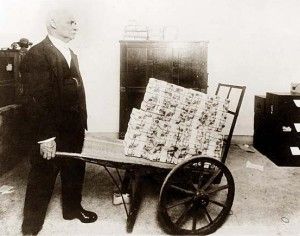
 http://www.sott.net/image/image/s1/21717/full/Web_of_debt_hyperinflation.jpg

The Silver Slippers: The Populist Solution
to the Money Question

The Greenback Party was later absorbed into the Populist Party, which took up the cause against tight money in the 1890s. Like the Greenbackers, the Populists argued that money should be issued by the government rather than by private banks. William Jennings Bryan, the Populists' loquacious leader, gave such a stirring speech at the Democratic convention that he won the Democratic nomination for President in 1896. Outgoing President Grover Cleveland was also a Democrat, but he was an agent of J. P. Morgan and the Wall Street banking interests. Cleveland favored money that was issued by the banks, and he backed the bankers' gold standard. Bryan was opposed to both. He argued in his winning nomination speech:
We say in our platform that we believe that the right to coin money and issue money is a function of government. . . . Those who are opposed to this proposition tell us that the issue of paper money is a function of the bank and that the government ought to go out of the banking business. I stand with Jefferson . . . and tell them, as he did, that the issue of money is a function of the government and that the banks should go out of the governing business. . . . [W]hen we have restored the money of the Constitution, all other necessary reforms will be possible, and . . . until that is done there is no reform that can be accomplished.
He concluded with these famous lines:
You shall not press down upon the brow of labor this crown of thorns, you shall not crucify mankind upon a cross of gold.9
Since the Greenbackers' push for government-issued paper money had failed, Bryan and the "Silverites" proposed solving the liquidity problem in another way. The money supply could be supplemented with coins made of silver, a precious metal that was cheaper and more readily available than gold. Silver was considered to be "the money of the Constitution" although the Constitution only referred to the "dollar," because the dollar was understood to be a reference to the Spanish milled silver dollar coin then in common use. The slogan of the Silverites was "16 to 1": 16 ounces of silver would be the monetary equivalent of 1 ounce of gold. Ounces is abbreviated oz, hence "Oz." The Wizard of the Gold Ounce (Oz) in Washington was identified by later commentators as Marcus Hanna, the power behind the Republican Party, who controlled the mechanisms of finance in the administration of President William McKinley.10 (Hanna was reportedly admired by Karl Rove, who followed the model as political adviser to President George Bush Jr.11)
Frank Baum, the journalist who turned the politics of his day into The Wonderful Wizard of Oz, marched with the Populist Party in support of Bryan in 1896. He is said to have had a deep distrust of big-city financiers. But when his dry goods business failed, he bought a Republican newspaper, which had to have a Republican message to retain its readership.12 That may have been why the Populist message was so deeply buried in symbolism in his famous fairytale. Like Lewis Carroll, who began his career writing uninspiring tracts about mathematics and politics and wound up satirizing Victorian society in Alice's Adventures in Wonderland,
Baum was able to suggest in a children's story what he could not say in his editorials. His book contained many subtle allusions to the political and financial issues of the day. The story's inspirational message was evidently a product of the times as well. Commentators trace it to the theosophical movement, of which Baum was an active member.13 Newly-imported from India, it held that reality is a construct of the mind. What you want is already yours; you need only to believe it, to "realize" it or "make it real."
Looking at the plot of this familiar fairytale, then, through the lens of the contemporary movements that inspired it..

An Allegory of Money, Politics
and Believing in Yourself
The story began on a barren Kansas farm, where Dorothy lived with a very sober aunt and uncle who "never laughed" (the 1890s depression that hit the farmers particularly hard). A cyclone came up, carrying Dorothy and the house into the magical world of Oz (the American dream that might have been). The house landed on the Wicked Witch of the East (the Wall Street bankers and their man Grover Cleveland), who had kept the Munchkins (the farmers and factory workers) in bondage for many years.
For killing the Wicked Witch, Dorothy was awarded magic silver slippers (the Populist silver solution to the money crisis) by the Good Witch of the North (the North was then a Populist stronghold). In the 1939 film, the silver slippers would be transformed into ruby slippers to show off the cinema's new technicolor abilities; but the monetary imagery Baum suggested was lost. The silver shoes had the magic power to solve Dorothy's dilemma, just as the Silverites thought that expanding the money supply with silver coins would solve the problems facing the farmers.
Dorothy wanted to get back to Kansas but was unaware of the power of the slippers on her feet, so she set out to the Emerald City to seek help from the Wizard of Oz (the apparently all-powerful President, whose strings were actually pulled by financiers concealed behind a curtain).
"The road to the City of Emeralds is paved with yellow brick," she was told, "so you cannot miss it." Baum's contemporary audience, wrote Professor Ziaukas, could not miss it either, as an allusion to the gold standard that was then a hot topic of debate.14 Like the Emerald City and the Great and Powerful Oz himself, the yellow brick road would turn out to be an illusion. In the end, what would carry Dorothy home were silver slippers.
On her journey down the yellow brick road, Dorothy was first joined by the Scarecrow in search of a brain (the naive but intelligent farmer kept in the dark about the government's financial policies), then by the Tin Woodman in search of a heart (the factory worker frozen by unemployment and dehumanized by mechanization). Littlefield commented:
The Tin Woodman . . . had been put under a spell by the Witch of the East. Once an independent and hard working human being, the Woodman found that each time he swung his axe it chopped off a different part of his body. Knowing no other trade he "worked harder than ever," for luckily in Oz tinsmiths can repair such things. Soon the Woodman was all tin. In this way Eastern witchcraft dehumanized a simple laborer so that the faster and better he worked the more quickly he became a kind of machine. Here is a Populist view of evil Eastern influences on honest labor which could hardly be more pointed.
The Eastern witchcraft that had caused the Woodman to chop off parts of his own body reflected the dark magic of the Wall Street bankers, whose "gold standard" allowed less money into the system than was collectively owed to the banks, causing the assets of the laboring classes to be systematically devoured by debt.
The fourth petitioner to join the march on Oz was the Lion in search of courage. According to Littlefield, he represented the orator Bryan himself, whose roar was mighty like the king of the forest but who lacked political power. Bryan was branded a coward by his opponents because he was a pacifist and anti-imperialist at a time of American expansion in Asia. The Lion became entranced and fell asleep in the Witch's poppy field, suggesting Bryan's tendency to get side-tracked with issues of American imperialism stemming from the Opium Wars. Since Bryan led the "Populist" or "People's" Party, the Lion also represented the people, collectively powerful but entranced and unaware of their strength.
In the Emerald City, the people were required to wear green-colored glasses attached by a gold buckle, suggesting green paper money shackled to the gold standard. To get to her room in the Emerald Palace, Dorothy had to go through 7 passages and up 3 flights of stairs, an allusion to the "Crime of '73," the congressional Act that changed the money system from bimetallism (paper notes backed by both gold and silver) to an exclusive gold standard. The Crime of '73 proved to all Populists that Congress and the bankers were in collusion.15
Dorothy and her troop presented their requests to the Wizard, who demanded that they first vanquish the Wicked Witch of the West, representing the McKinley/Rockefeller faction in Ohio (then considered a Western state). The financial powers of the day were the Morgan/Wall Street/Cleveland faction in the East (the Wicked Witch of the East) and this Rockefeller-backed contingent from Ohio, the state of McKinley, Hanna, and Rockefeller's Standard Oil cartel. Hanna was an industrialist who was a high school friend of John D. Rockefeller and had the financial backing of the oil giant.16
Dorothy and her friends learned that the Witch of the West had enslaved the Yellow Winkies and the Winged Monkeys (an allusion to the Chinese immigrants working on the Union-Pacific railroad, the native Americans banished from the northern woods, and the Filipinos denied independence by McKinley). Dorothy destroyed the Witch by melting her with a bucket of water, suggesting the rain that would reverse the drought, and the financial liquidity that the Populist solution would bring to the land. As one nineteenth century commentator put it, "Money and debt are as opposite in nature as fire and water; money extinguishes debt as water extinguishes fire."17
When Dorothy and her troop got lost in the forest, she was told to call the Winged Monkeys by using a Golden Cap she had found in the Witch's cupboard. When the Winged Monkeys came, their leader explained that they were once a free and happy people; but they were now "three times the slaves of the owner of the Golden Cap, whosoever he may be" (the bankers and their gold standard). When the Golden Cap fell into the hands of the Wicked Witch of the West, the Witch had made them enslave the Winkies and drive Oz himself from the Land of the West.
Dorothy used the power of the Cap to have her band of pilgrims flown to the Emerald City, where they discovered that the "Wizard" was only a smoke and mirrors illusion operated by a little man behind a curtain. A dispossessed Nebraska man himself, he admitted to being a "humbug" without real power. "One of my greatest fears was the Witches," he said, "for while I had no magical powers at all I soon found out that the Witches were really able to do wonderful things."
If the Wizard and his puppet were Marcus Hanna and William McKinley, who were the Witches they feared? Behind the Wall Street bankers were powerful British financiers, who funded the Confederates in the Civil War and had been trying to divide and conquer America economically for over a century. Patriotic Americans had regarded the British as the enemy ever since the American Revolution. McKinley was a protectionist who favored high tariffs to keep these marauding British free-traders out. When he was assassinated in 1901, no conspiracy was proved; but some suspicious commentators saw the invisible hand of British high finance at work.18
The Wizard lacked magical powers but was a very good psychologist, who showed the petitioners that they had the power to solve their own problems and manifest their own dreams. The Scarecrow just needed a paper diploma to realize he had a brain. For the Tin Woodman, it was a silk heart; for the Lion, an elixir for courage. The Wizard offered to take Dorothy back to Kansas in his hot air balloon, but the balloon took off before she could get on board. Dorothy and her friends then set out to find Glinda the Good Witch of the South, who they were told could help Dorothy find her way home.
On the way they faced various challenges, including a great spider that ate everything in its path and kept everyone unsafe as long as it was alive. The Lion (the Populist leader Bryan) welcomed this chance to test his new-found courage and prove he was indeed the King of Beasts. He decapitated the mighty spider with his paw, just as Bryan would have toppled the banking cartel if he had won the Presidency.
The group finally reached Glinda, who revealed that Dorothy too had the magic tokens she needed all along: the Silver Shoes on her feet would take her home. But first, said Glinda, Dorothy must give up the Golden Cap (the bankers' restrictive gold standard that had enslaved the people).
The moral also worked for the nation itself. The economy was deep in depression, but the country's farmlands were still fertile and its factories were ready to roll. Its entranced people merely lacked the paper tokens called "money" that would facilitate production and trade. The people had been deluded into a belief in scarcity by defining their wealth in terms of a scarce commodity, gold. The country's true wealth consisted of its goods and services, its resources and the creativity of its people. Like the Tin Woodman in need of oil, all it needed was a monetary medium that would allow this wealth to flow freely, circulating from the government to the people and back again, without being perpetually drained into the private coffers of the bankers.
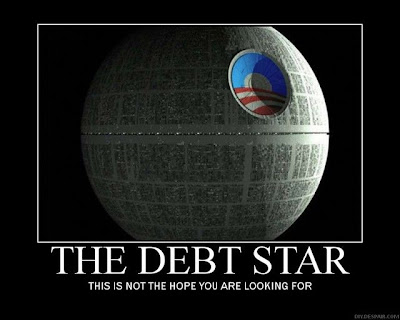
 http://3.bp.blogspot.com/_hh7Y_mOyQH8/ScfCJPSZZqI/AAAAAAAABGI/ONjfBqgbFMc/s400/debt-star.jpg

Sequel to Oz

The Populists did not achieve their goals, but they did prove that a third party could influence national politics and generate legislation. Although Bryan the Lion failed to stop the bankers, Dorothy's prototype Jacob Coxey was still on the march. In a plot twist that would be considered contrived if it were fiction, he reappeared on the scene in the 1930s to run against Franklin D. Roosevelt for President, at a time when the "money question" had again become a burning issue. In one five-year period, over 2,000 schemes for monetary reform were advanced.
Needless to say, Coxey lost the election; but he claimed that his Greenback proposal was the model for the "New Deal," Roosevelt's plan for putting the unemployed to work on government projects to pull the country out of the Depression. The difference was that Coxey's plan would have been funded with debt-free currency issued by the government, on Lincoln's Greenback model. Roosevelt funded the New Deal with borrowed money, indebting the country to a banking cartel that was surreptitiously creating the money out of thin air, just as the government itself would have been doing under Coxey's plan without accruing a crippling debt to the banks.
After World War II, the money question faded into obscurity. Today, writes British economist Michael Rowbotham, "The surest way to ruin a promising career in economics, whether professional or academic, is to venture into the 'cranks and crackpots' world of suggestions for reform of the financial system."19 Yet the claims of these cranks and crackpots have consistently proven to be correct. The U.S. debt burden has mushroomed out of control, until just the interest on the federal debt now threatens to be a greater tax burden than the taxpayers can afford. The gold standard precipitated the problem, but unbuckling the dollar from gold did not solve it. Rather, it caused worse financial ills.
Expanding the money supply with increasing amounts of "easy" bank credit just put increasing amounts of money in the bankers' pockets, while consumers sank further into debt. The problem proved to be something more fundamental: it was in who extended the nation's credit. As long as the money supply was created as a debt owed back to private banks with interest, the nation's wealth would continue to be drained off into private vaults, leaving scarcity in its wake.
Today's monetary allegory goes something like this: the dollar is a national resource that belongs to the people. It was an original invention of the early American colonists, a new form of paper currency backed by the "full faith and credit" of the people. But a private banking cartel has taken over its issuance, turning debt into money and demanding that it be paid back with interest. Taxes and a crushing federal debt have been imposed by a financial ruling class that keeps the people entranced and enslaved.
In the happy storybook ending to the tale, the power to create money is returned to the people, and abundance returns to the land. But before we get there, the Yellow Brick Road takes us through the twists and turns of history and the writings and insights of a wealth of key players. We're off to see the Wizard...

From Web of Debt - http://www.webofdebt.com/


Help This Unique Independent Site Survive
Donate any amount and receive at least one New Illuminati eBook!
Just click in the jar - 


Images -
  http://polytricks.files.wordpress.com/2008/09/webofdebt.jpg http://media.photobucket.com/image/web%20of%20debt/franciscoalf/Dorothys_Debt_web.jpg
http://www.sott.net/image/image/s1/21717/full/Web_of_debt_hyperinflation.jpg
http://3.bp.blogspot.com/_hh7Y_mOyQH8/ScfCJPSZZqI/AAAAAAAABGI/ONjfBqgbFMc/s400/debt-star.jpg

For further enlightenment see –

The Her(m)etic Hermit - http://hermetic.blog.com


This material is published under Creative Commons Copyright (unless an individual item is declared otherwise by copyright holder) – reproduction for non-profit use is permitted & encouraged, if you give attribution to the work & author - and please include a (preferably active) link to the original along with this notice. Feel free to make non-commercial hard (printed) or software copies or mirror sites - you never know how long something will stay glued to the web – but remember attribution! If you like what you see, please send a tiny donation or leave a comment – and thanks for reading this far…

From the New Illuminati – http://nexusilluminati.blogspot.com

Saturday, June 26, 2010

What's wrong with the sun?

What's wrong with the sun?


What's up, sunshine? (Image: SDO/NASA)

SUNSPOTS come and go, but recently they have mostly gone. For centuries, astronomers have recorded when these dark blemishes on the solar surface emerge, only for them to fade away again after a few days, weeks or months. Thanks to their efforts, we know that sunspot numbers ebb and flow in cycles lasting about 11 years.
But for the past two years, the sunspots have mostly been missing. Their absence, the most prolonged for nearly a hundred years, has taken even seasoned sun watchers by surprise. "This is solar behaviour we haven't seen in living memory," says David Hathaway, a physicist at NASA's Marshall Space Flight Center in Huntsville, Alabama.
The sun is under scrutiny as never before thanks to an armada of space telescopes. The results they beam back are portraying our nearest star, and its influence on Earth, in a new light. Sunspots and other clues indicate that the sun's magnetic activity is diminishing, and that the sun may even be shrinking. Together the results hint that something profound is happening inside the sun. The big question is what?
The stakes have never been higher. Groups of sunspots forewarn of gigantic solar storms that can unleash a billion times more energy than an atomic bomb. Fears that these giant solar eruptions could create havoc on Earth, and disputes over the sun's role in climate change, are adding urgency to these studies. When NASA and the European Space Agency launched the Solar and Heliospheric Observatory almost 15 years ago, "understanding the solar cycle was not one of its scientific objectives", says Bernhard Fleck, the mission's project scientist. "Now it is one of the key questions."

Sun behaving badly

Sunspots are windows into the sun's magnetic soul. They form where giant loops of magnetism, generated deep inside the sun, well up and burst through the surface, leading to a localised drop in temperature which we see as a dark patch. Any changes in sunspot numbers reflect changes inside the sun. "During this transition, the sun is giving us a real glimpse into its interior," says Hathaway.
When sunspot numbers drop at the end of each 11-year cycle, solar storms die down and all becomes much calmer. This "solar minimum" doesn't last long. Within a year, the spots and storms begin to build towards a new crescendo, the next solar maximum.
What's special about this latest dip is that the sun is having trouble starting the next solar cycle. The sun began to calm down in late 2007, so no one expected many sunspots in 2008. But computer models predicted that when the spots did return, they would do so in force. Hathaway was reported as thinking the next solar cycle would be a "doozy": more sunspots, more solar storms and more energy blasted into space. Others predicted that it would be the most active solar cycle on record. The trouble was, no one told the sun.
The first sign that the prediction was wrong came when 2008 turned out to be even calmer than expected. That year, the sun was spot-free 73 per cent of the time, an extreme dip even for a solar minimum. Only the minimum of 1913 was more pronounced, with 85 per cent of that year clear.
As 2009 arrived, solar physicists looked for some action. They didn't get it. The sun continued to languish until mid-December, when the largest group of sunspots to emerge for several years appeared. Finally, a return to normal? Not really.
Even with the solar cycle finally under way again, the number of sunspots has so far been well below expectations. Something appears to have changed inside the sun, something the models did not predict. But what?
The flood of observations from space and ground-based telescopes suggests that the answer lies in the behaviour of two vast conveyor belts of gas that endlessly cycle material and magnetism through the sun's interior and out across the surface. On average it takes 40 years for the conveyor belts to complete a circuit (see diagram).
When Hathaway's team looked over the observations to find out where their models had gone wrong, they noticed that the conveyor-belt flows of gas across the sun's surface have been speeding up since 2004.
The circulation deep within the sun tells a different story. Rachel Howe and Frank Hill of the National Solar Observatory in Tucson, Arizona, have used observations of surface disturbances, caused by the solar equivalent of seismic waves, to infer what conditions are like within the sun. Analysing data from 2009, they found that while the surface flows had sped up, the internal ones had slowed to a crawl.
These findings have thrown our best computer models of the sun into disarray. "It is certainly challenging our theories," says Hathaway, "but that's kinda nice."
It is not just our understanding of the sun that stands to benefit from this work. The extent to which changes in the sun's activity can affect our climate is of paramount concern. It is also highly controversial. There are those who seek to prove that the solar variability is the major cause of climate change, an idea that would let humans and their greenhouse gases off the hook. Others are equally evangelical in their assertions that the sun plays only a minuscule role in climate change.
If this dispute could be resolved by an experiment, the obvious strategy would be to see what happens when you switch off one potential cause of climate change and leave the other alone. The extended collapse in solar activity these past two years may be precisely the right sort of test, in that it has significantly changed the amount of solar radiation bombarding our planet. "As a natural experiment, this is the very best thing to happen," says Joanna Haigh, a climatologist at Imperial College London. "Now we have to see how the Earth responds."

 http://www.nationalforestlawblog.com/sunspots.jpg


The climate link

Mike Lockwood at the University of Reading, UK, may already have identified one response - the unusually frigid European winter of 2009/10. He has studied records covering data stretching back to 1650, and found that severe European winters are much more likely during periods of low solar activity (New Scientist, 17 April, p 6). This fits an emerging picture of solar activity giving rise to a small change in the global climate overall, yet large regional effects.
Another example is the Maunder minimum, the period from 1645 to 1715 during which sunspots virtually disappeared and solar activity plummeted. If a similar spell of solar inactivity were to begin now and continue until 2100, it would mitigate any temperature rise through global warming by 0.3 °C on average, according to calculations by Georg Feulner and Stefan Rahmstorf of the Potsdam Institute for Climate Impact Research in Germany. However, something amplified the impact of the Maunder minimum on northern Europe, ushering in a period known as the Little Ice Age, when colder than average winters became more prevalent and the average temperature in Europe appeared to drop by between 1 and 2 °C.
A corresponding boost appears to be associated with peaks in solar output. In 2008, Judith Lean of the Naval Research Laboratory in Washington DC published a study showing that high solar activity has a disproportionate warming influence on northern Europe (Geophysical Research Letters, vol 35, p L18701).
So why does solar activity have these effects? Modellers may already be onto the answer. Since 2003, spaceborne instruments have been measuring the intensity of the sun's output at various wavelengths and looking for correlations with solar activity. The results point to the sun's emissions of ultraviolet light. "The ultraviolet is varying much, much, much more than we expected," says Lockwood.
Ultraviolet light is strongly linked to solar activity: solar flares shine brightly in the ultraviolet, and it helps carry the explosive energy of the flares away into space. It could be particularly significant for the Earth's climate as ultraviolet light is absorbed by the ozone layer in the stratosphere, the region of atmosphere that sits directly above the weather-bearing troposphere.
More ultraviolet light reaching the stratosphere means more ozone is formed. And more ozone leads to the stratosphere absorbing more ultraviolet light. So in times of heightened solar activity, the stratosphere heats up and this influences the winds in that layer. "The heat input into the stratosphere is much more variable than we thought," says Lockwood.
Enhanced heating of the stratosphere could be behind the heightened effects felt by Europe of changes in solar activity. Back in 1996, Haigh showed that the temperature of the stratosphere influences the passage of the jet stream, the high-altitude river of air passing from west to east across Europe.
Lockwood's latest study shows that when solar activity is low, the jet stream becomes liable to break up into giant meanders that block warm westerly winds from reaching Europe, allowing Arctic winds from Siberia to dominate Europe's weather.
The lesson for climate research is clear. "There are so many weather stations in Europe that, if we are not careful, these solar effects could influence our global averages," says Lockwood. In other words, our understanding of global climate change could be skewed by not taking into account solar effects on European weather.
Just as one mystery begins to clear, another beckons. Since its launch 15 years ago, the SOHO spacecraft has watched two solar minimums, one complete solar cycle, and parts of two other cycles - the one that ended in 1996 and the one that is just stirring. For all that time its VIRGO instrument has been measuring the total solar irradiance (TSI), the energy emitted by the sun. Its measurements can be stitched together with results from earlier missions to provide a 30-year record of the sun's energy output. What this shows is that during the latest solar minimum, the sun's output was 0.015 per cent lower than during the previous lull. It might not sound like much, but it is a hugely significant result.
We used to think that the sun's output was unwavering. That view began to change following the launch in 1980 of NASA's Solar Maximum Mission. Its observations show that the amount of energy the sun puts out varies by around 0.1 per cent over a period of days or weeks over a solar cycle.

http://i.dailymail.co.uk/i/pix/2009/04/21/article-1172399-04944753000005DC-421_468x380.jpg


Shrinking star

Despite this variation, the TSI has dipped to the same level during the three previous solar minima. Not so during this recent elongated minimum. Although the observed drop is small, the fact that it has happened at all is unprecedented. "This is the first time we have measured a long-term trend in the total solar irradiance," says Claus Fröhlich of the World Radiation Centre in Davos, Switzerland, and lead investigator for the VIRGO instrument.
If the sun's energy output is changing, then its temperature must be fluctuating too. While solar flares can heat up the gas at the surface, changes in the sun's core would have a more important influence on temperature, though calculations show it can take hundreds of thousands of years for the effects to percolate out to the surface. Whatever the mechanism, the cooler the surface, the less energy there is to "puff up" the sun. The upshot of any dip in the sun's output is that the sun should also be shrinking.
Observations suggest that it is - though we needn't fear a catastrophe like that depicted in the movie Sunshine just yet. Back in the 17th century French astronomer Jean Picard made his mark by measuring the sun's diameter. His observations were carried out during the Maunder minimum, and he obtained a result larger than modern measurements. Was this simply because of an error on Picard's part, or could the sun genuinely have shrunk since then? "There has been a lot of animated discussion, and the problem is not yet solved," says Gérard Thuillier of the Pierre and Marie Curie University in Paris, France.
Any dip in the sun's output means that the sun is shrinking. Observations suggest that it is, though they are controversial
Observations with ground-based telescopes are not precise enough to resolve the question, due to the distorting effect of Earth's atmosphere. So the French space agency has designed a mission, aptly named Picard, to return precise measurements of the sun's diameter and look for changes.
Frustratingly the launch, on a Russian Dnepr rocket, is mired in a political disagreement between Russia and neighbouring Kazakhstan. Until the dispute is resolved, the spacecraft must wait. Every day of delay means valuable data being missed as the sun takes steps, however faltering, into the next cycle of activity. "We need to launch now," says Thuillier.
What the sun will do next is beyond our ability to predict. Most astronomers think that the solar cycle will proceed, but at significantly depressed levels of activity similar to those last seen in the 19th century. However, there is also evidence that the sun is inexorably losing its ability to produce sunspots (see "The sunspot forecast"). By 2015, they could be gone altogether, plunging us into a new Maunder minimum - and perhaps a new Little Ice Age.
Of course, solar activity is just one natural source of climate variability. Volcanic eruptions are another, spewing gas and dust into the atmosphere. Nevertheless, it remains crucial to understand the precise changeability of the sun, and the way it influences the various regional patterns of weather on Earth. Climate scientists will then be able to correct for these effects, not just in interpreting modern measurements but also when attempting to reconstruct the climate stretching back centuries. It is only by doing so that we can reach an unassailable consensus about the sun's true level of influence on the Earth and its climate.

The sunspot forecast

Although sunspots are making a belated comeback after the protracted solar minimum, the signs are that all is not well. For decades, William Livingston at the National Solar Observatory in Tucson, Arizona, has been measuring the strength of the magnetic fields which puncture the sun's surface and cause the spots to develop. Last year, he and colleague Matt Penn pointed out that the average strength of sunspot magnetic fields has been sliding dramatically since 1995.
If the trend continues, in just five years the field will have slipped below the threshold magnetic field needed for sunspots to form.
How likely is this to happen? Mike Lockwood at the University of Reading, UK, has scoured historical data to look for similar periods of solar inactivity, which show up as increases in the occurrence of certain isotopes in ice cores and tree rings. He found 24 such instances in the last few thousand years. On two of those occasions, sunspots all but disappeared for decades. Lockwood puts the chance of this happening now at just 8 per cent.
Only on one occasion did the sunspot number bounce back to record levels. In the majority of cases, the sun continued producing spots albeit at significantly depressed levels. It seems that the sunspot bonanza of last century is over.
Stuart Clark's latest book is The Sun Kings (Princeton). He blogs at stuartclark.com
 http://spiff.rit.edu/classes/phys230/lectures/sun_gross/spot_uv.jpg

Xtra Images - http://www.nationalforestlawblog.com/sunspots.jpg
 http://i.dailymail.co.uk/i/pix/2009/04/21/article-1172399-04944753000005DC-421_468x380.jpg
http://spiff.rit.edu/classes/phys230/lectures/sun_gross/spot_uv.jpg

For further enlightenment see –
 

The Her(m)etic Hermit - http://hermetic.blog.com


This material is published under Creative Commons Copyright (unless an individual item is declared otherwise by copyright holder) – reproduction for non-profit use is permitted & encouraged, if you give attribution to the work & author - and please include a (preferably active) link to the original along with this notice. Feel free to make non-commercial hard (printed) or software copies or mirror sites - you never know how long something will stay glued to the web – but remember attribution! If you like what you see, please send a tiny donation or leave a comment – and thanks for reading this far…

From the New Illuminati – http://nexusilluminati.blogspot.com