Lost Cities Under the Sands of Giza
THE LOST HISTORY OF THE PYRAMIDS
by Tony Bushby
"the Giza-plateau and old Cairo are crisscrossed with subterranean passageways, shafts, natural caverns, lakes and chambers that contain surprising artifacts, but Egyptian authorities are not ready to reveal these to the public" |

To fully comprehend the secret information in the Bible it is important to understand the extent of the subterranean tunnel system and associated chamber facilities existing below the surface of the Pyramid Plateau, for it was there that major elements of Mystery School teachings developed. What happened under the sands thousands of years ago is not reflected in today's history books, and discoveries made in the last eight decades or so verify that point.
The Fayum Oasis district, just a few kilometers outside the boundary of the Memphis Nome, presents a site of unusual interest. It was in that lush, fertile valley that Pharaohs calling themselves the "masters of the royal hunts" fished and hunted with the boomerang (1), Lake Moeris once bordered the Fayum Oasis and on its shores was the famous Labyrinth, described by Herodotus as "an endless wonder to me".
The Fayum Oasis district, just a few kilometers outside the boundary of the Memphis Nome, presents a site of unusual interest. It was in that lush, fertile valley that Pharaohs calling themselves the "masters of the royal hunts" fished and hunted with the boomerang (1), Lake Moeris once bordered the Fayum Oasis and on its shores was the famous Labyrinth, described by Herodotus as "an endless wonder to me".
The Labyrinth contained 1500 rooms and an equal number of underground chambers that the Greek historian was not permitted to inspect, according to Labyrinth priests, "the passages were baffling and intricate", designed to provide safety for the numerous scrolls they said were hidden in subterranean apartments.
That massive complex particularly impressed Herodotus and he spoke in awe of the structure:
There I saw twelve palaces regularly disposed, which had communication with each other, interspersed with terraces and arranged around twelve halls. It is hard to believe they are the work of man, The walls are covered with carved figures, and each court is exquisitely built of white marble and surrounded by a colonnade. Near the corner where the labyrinth ends, there is a pyramid, two hundred and forty feet in height, with great carved figures of animals on it and an underground passage by which it can be entered. I was told very credibly that underground chambers and passages connected this pyramid with the pyramids at Memphis.

Underground passages connecting pyramids
The pyramids at Memphis were the pyramids at Giza, for Giza was originally called Memphis (see reference, "Giza formerly Memphis" on Nordan's map from Travels in Egypt and Nubia, 1757, on page 152 of previous chapter).
Many ancient writers supported Herodotus' record of underground passages connecting major pyramids, and their evidence casts doubt on the reliability of traditionally presented Egyptian history. Crantor (300 BC) stated that there were certain underground pillars in Egypt that contained a written stone record of pre-history , and they lined access ways connecting the pyramids.
In his celebrated study, On the Mysteries, particularly those of the Egyptians, Chaldeans and the Assyrians, Iamblichus, a fourth-century Syrian representative of the Alexandrian School of mystical and philosophical studies, recorded this information about an entranceway through the body of the Sphinx into the Great Pyramid (2):
This entrance, obstructed in our day by sands and rubbish, may still be traced between the forelegs of the crouched colossus. It was formerly closed by a bronze gate whose secret spring could be operated only by the Magi. It was guarded by public respect, and a sort of religious fear maintained its inviolability better than armed protection would have done. In the belly of the Sphinx were cut out galleries leading to the subterranean part of the Great Pyramid.
These galleries were so artfully crisscrossed along their course to the Pyramid that, in setting forth into the passage without a guide throughout this network, one unceasingly and inevitably returned to the starting point.
It was recorded in ancient Sumerian cylinder seals that the secret abode of the Anunnaki was;
"an underground place... entered through a tunnel, its entrance hidden by sand and by what they call Huwana... his teeth as the teeth of a dragon, his face the face of a lion".
That remarkable old text, unfortunately fragmented, added that "He [Huwana] is unable to move forward, nor is he able to move back", but they crept up on him from behind and the way to "the secret abode of the Anunnaki" was no longer blocked.
The Sumerian record provided a probable description of the lion-headed Sphinx at Giza, and if that great creature was built to guard or obliterate ancient stairways and lower passages leading to subterranean areas below and around it, then its symbolism was most appropriate.
Local 19th-century Arab lore maintained that existing under the Sphinx are secret chambers holding treasures or magical objects. That belief was bolstered by the writings of the first-century Roman historian Pliny, who wrote that deep below the Sphinx is concealed the "tomb of a ruler named Harmakhis that contains great treasure", and, strangely enough, the Sphinx itself was once called "The Great Sphinx Harmakhis who mounted guard since the time of the Followers of Horus".
Local 19th-century Arab lore maintained that existing under the Sphinx are secret chambers holding treasures or magical objects. That belief was bolstered by the writings of the first-century Roman historian Pliny, who wrote that deep below the Sphinx is concealed the "tomb of a ruler named Harmakhis that contains great treasure", and, strangely enough, the Sphinx itself was once called "The Great Sphinx Harmakhis who mounted guard since the time of the Followers of Horus".
The fourth-century Roman historian Ammianus Marcellinus made additional disclosures about the existence of subterranean vaults that appeared to lead to the interior of the Great pyramid (3):
Inscriptions which the ancients asserted were engraved on the walls of certain underground galleries and passages were constructed deep in the dark interior to preserve ancient wisdom from being lost in the flood.
A manuscript compiled by an Arab writer named Altelemsani is preserved in the British Museum, and it records the existence of a long, square, underground passage between the Great Pyramid and the River Nile with a "strange thing" blocking the Nile entrance.
He related the following episode:
In the days of Ahmed Ben Touloun, a party entered the Great pyramid through the tunnel and found in a side-chamber a goblet of glass of rare color and texture. As they were leaving, they missed one of the party and, upon returning to seek him, he came out to them naked and laughing said, "Do not follow or seek for me", and then rushed back into the pyramid. His friends perceived that he was enchanted.
Upon learning about strange happenings under the Pyramid, Ahmed Ben Touloun expressed a desire to see the goblet of glass. During the examination, it was filled with water and weighed, then emptied and re-weighed. The historian wrote that it was "found to be of the same weight when empty as when full of water".
If the chronicle is accurate, that lack of additional weight provided indirect evidence of the existence of an extraordinary science at Giza.
According to Masoudi in the 10th century, mechanical statues with amazing capabilities guarded subterranean galleries under the Great Pyramid. Written one thousand years ago, his description is comparable to the computerized robots shown today in space movies. Masoudi said that the automatons were programmed for intolerance, for they destroyed all "except those who by their conduct were worthy of admission".
According to Masoudi in the 10th century, mechanical statues with amazing capabilities guarded subterranean galleries under the Great Pyramid. Written one thousand years ago, his description is comparable to the computerized robots shown today in space movies. Masoudi said that the automatons were programmed for intolerance, for they destroyed all "except those who by their conduct were worthy of admission".
Masoudi contended that;
"written accounts of Wisdom and acquirements in the different arts and sciences were hidden deep, that they might remain as records for the benefit of those who could afterwards comprehend them".
That is phenomenal information, as it is possible that, since the times of Masoudi, "worthy" persons have seen the mysterious underground chambers. Masoudi confessed;
"I have seen things that one does not describe for fear of making people doubt one's intelligence... but still I have seen them".
In the same century, another writer, Muterdi, gave an account of a bizarre incident in a narrow passage under Giza, where a group of people were horrified to see one of their party crushed to death by a stone door that, by itself, suddenly slid out from the face of the passageway and closed the corridor in front of them.

Old records confirmed
Herodotus said Egyptian priests recited to him their long-held tradition of "the formation of underground apartments" by the original developers of Memphis. The most ancient inscriptions therefore suggested that there existed some sort of extensive chamber system below the surface of the areas surrounding the Sphinx and pyramids.
Those old records were confirmed when the presence of a large cavity was discovered in a seismic survey conducted at the site in 1993. That detection was publicly acknowledged in a documentary called The Mystery of the Sphinx, screened to an audience of 30 million people on NBC TV later that year.
The existence of chambers under the Sphinx is well known. Egyptian authorities confirmed another discovery in 1994; its unearthing was announced in a newspaper report that was carried under the headline, "Mystery Tunnel in Sphinx":
Workers repairing the ailing Sphinx have discovered an ancient passage leading deep into the body of the mysterious monument.
The Giza Antiquities chief, Mr Zahi Hawass, said there was no dispute the tunnel was very old. However, what is puzzling is: who built the passage?
Why? And where does it lead...? Mr Hawass said he had no plans to remove the stones blocking the entrance. The secret tunnel burrows into the northern side of the Sphinx, about halfway between the Sphinx's outstretched paws and its tail.(4)
The popular supposition that the Sphinx is the true portal of the Great Pyramid has survived with surprising tenacity. That belief was substantiated by 100-year-old plans prepared by Masonic and Rosicrucian initiates, showing the Sphinx was the ornament surmounting a hall that communicated with all Pyramids by radiating underground passages. Those plans were compiled from information originally discovered by the supposed founder of the Order of the Rosicrucians, Christian Rosenkreuz, who allegedly penetrated a "secret chamber beneath the ground" and there found a library of books full of secret knowledge.
The schematic drawings were produced from information possessed by mystery school archivists before sand-clearing commenced in 1925, and revealed hidden doors to long - forgotten reception halls, small temples and other enclosures. (Those plans are included in "The Master Plan" section at the end of the book.)
The schematic drawings were produced from information possessed by mystery school archivists before sand-clearing commenced in 1925, and revealed hidden doors to long - forgotten reception halls, small temples and other enclosures. (Those plans are included in "The Master Plan" section at the end of the book.)
The knowledge of the mystery schools was strengthened by a series of remarkable discoveries in 1935 that provided proof of
additional passageways and chambers interlacing the area below the Pyramids. The Giza complex showed major elements of being a purposely built, uniting structure with the Sphinx, the Great Pyramid and the Temple of the Solar-men directly related to each other, above and below the ground.

Chambers detected by ground penetrating radar
Chambers and passageways detected by sophisticated seismograph and ground penetrating radar (GPR) equipment in the last few years established the accuracy of the plans. Egypt is also successfully using sophisticated satellites to identify sites buried beneath the surface at Giza and other locations. The novel tracking system was launched at the beginning of 1998 and the location of 27 unexcavated sites in five areas was precisely determined.
Nine of those sites are on Luxor's east bank and the others are in Giza, Abu Rawash, Saqqara and Dashur. The printouts of the Giza area show an almost incomprehensible mass of net-like tunnels and chambers crisscrossing the area, intersecting and entwining each other like latticework extending out across the entire plateau.
With the space surveillance project, Egyptologists are able to determine the location of a major site, its probable entrance and the size of chambers before starting excavations.
With the space surveillance project, Egyptologists are able to determine the location of a major site, its probable entrance and the size of chambers before starting excavations.
Particular attention is being focused on three secret locations:
1. an area in the desert a few hundred meters west/southwest of the original location of the Black Pyramid, around which is currently being built a massive system of concrete walls seven meters high covering eight square kilometers
2. the ancient highway that linked the Luxor temple with Karnak
3. the "Way of Horus" across northern Sinai
HEADLINE NEWS
Among the mystics or members of Egyptian mystery schools, tradition explained that the Great Pyramid was great in many
ways. Despite the fact that it was not entered until the year 820, the secret schools of pre-Christian Egypt insisted that the interior layout was well known to them. They constantly claimed that it was not a tomb nor a burial chamber of any kind, except that it did have one chamber for symbolic burial as part of an initiation ritual.
According to mystical traditions, the interior was entered gradually and in various stages via underground passageways .
ways. Despite the fact that it was not entered until the year 820, the secret schools of pre-Christian Egypt insisted that the interior layout was well known to them. They constantly claimed that it was not a tomb nor a burial chamber of any kind, except that it did have one chamber for symbolic burial as part of an initiation ritual.
According to mystical traditions, the interior was entered gradually and in various stages via underground passageways .
Different chambers were said to have existed at the end of each phase of progress, with the highest and ultimate initiatory stage represented by the now-called King's Chamber .
Little by little, the traditions of the mystery schools were verified by archaeological discoveries, for it was ascertained in 1935
that there was a subterranean connection between the Sphinx and the Great Pyramid and that a tunnel connected the Sphinx to the ancient temple located on its southern side (today called the Temple of the Sphinx).
As Emile Baraize's massive 11-year sand and seashell clearing project neared completion in 1935, remarkable stories started to emerge about discoveries made during the clearing project. A magazine article, written and published in 1935 by Hamilton M. Wright, dealt with an extraordinary discovery under the sands of Giza that is today denied. The article was accompanied by original photographs provided by Dr Selim Hassan, the leader of the scientific investigative team from the University of Cairo who made the discovery. It said:
We have discovered a subway used by the ancient Egyptians of 5000 years ago. It passes beneath the causeway leading between the second Pyramid and the Sphinx. It provides a means of passing under the causeway from the Cheops Pyramid to the Pyramid of Chephren [Khephren]. From this subway, we have unearthed a series of shafts leading down more than 125 feet, with roomy courts and side chambers.
Around the same time, the international news media released further details of the find.
The underground connector complex was originally built between the Great pyramid and the Temple of the Solarmen, for the Pyramid of Khephren was a later and superficial structure. The subway and its apartments were excavated out of solid, living bedrock-a truly extraordinary feat, considering it was built thousands of years ago.
There is more to the story of underground chambers at Giza, for media reports described the unearthing of a subterranean passageway between the Temple of the Solar-men on the plateau and the Temple of the Sphinx in the valley. That passageway had been unearthed a few years before the release and publication of that particular newspaper article.
The discoveries led Dr Selim Hassan and others to believe and publicly state that, while the age of the Sphinx was always enigmatic in the past, it may have been part of the great architectural plan that was deliberately arranged and carried out in association with the erection of the Great Pyramid.
The underground connector complex was originally built between the Great pyramid and the Temple of the Solarmen, for the Pyramid of Khephren was a later and superficial structure. The subway and its apartments were excavated out of solid, living bedrock-a truly extraordinary feat, considering it was built thousands of years ago.
There is more to the story of underground chambers at Giza, for media reports described the unearthing of a subterranean passageway between the Temple of the Solar-men on the plateau and the Temple of the Sphinx in the valley. That passageway had been unearthed a few years before the release and publication of that particular newspaper article.
The discoveries led Dr Selim Hassan and others to believe and publicly state that, while the age of the Sphinx was always enigmatic in the past, it may have been part of the great architectural plan that was deliberately arranged and carried out in association with the erection of the Great Pyramid.

Archaeologists made another major discovery at that time
Around halfway between the Sphinx and Khephren's Pyramid were discovered four enormous vertical shafts, each around eight feet square, leading straight down through solid limestone.
It is called "Campbell's Tomb" on the Masonic and Rosicrucian plans, and "that shaft complex", said Dr Selim Hassan, "ended in a spacious room, in the centre of which was another shaft that descended to a roomy court flanked with seven side chambers ".
Some of the chambers contained huge, sealed sarcophagi of basalt and granite, 18 feet high.
The discovery went further and found that in one of the seven rooms there was yet a third vertical shaft, dropping down deeply to a much lower chamber. At the time of its discovery it was flooded with water that partly covered a solitary white sarcophagus.
That chamber was named the “Tomb of Osiris” and was shown being “opened for the first time” on a fabricated television documentary in March 1999.
The discovery went further and found that in one of the seven rooms there was yet a third vertical shaft, dropping down deeply to a much lower chamber. At the time of its discovery it was flooded with water that partly covered a solitary white sarcophagus.
That chamber was named the “Tomb of Osiris” and was shown being “opened for the first time” on a fabricated television documentary in March 1999.
While originally exploring in this area in 1935, Dr Selim Hassan said:
We are hoping to find some monuments of importance after clearing out this water. The total depth of these series of shafts is more than 40 meters or more than 125 feet... In the course of clearing the southern part of the subway, there was found a very fine head of a statue which is very expressive in every detail of the face.
According to a separate newspaper report of the time, the statue was an excellent sculpted bust of Queen Nefertiti, described as “a beautiful example of that rare type of art inaugurated in the Amenhotep regime”. The whereabouts of that statue today are unknown.
The report also described other chambers and rooms beneath the sands, all interconnected by secret and ornate passageways. Dr Selim Hassan revealed that not only are there inner and outer courts, but they also found a room they named the “Chapel of Offering” that had been cut into a huge rock outcrop between Campbell’s Tomb and the Great Pyramid.
In the centre of the chapel are three ornate vertical pillars standing in a triangular shaped layout. Those pillars are highly significant points in this study, for their existence is recorded in the Bible. The conclusion drawn is that Ezra, the initiated Torah writer (c. 397 BC), knew the subterranean layout of passages and chambers at Giza before he wrote the Torah.
That underground design was probably the origin of the triangular shaped layout around the central altar in a Masonic lodge. In Antiquities of the Jews, Josephus, in the first century, wrote that Enoch of Old Testament fame constructed an underground temple consisting of nine chambers. In a deep vault inside one chamber with three vertical columns, he placed a triangular-shaped tablet of gold bearing upon it the absolute name of the Deity (God ).
That underground design was probably the origin of the triangular shaped layout around the central altar in a Masonic lodge. In Antiquities of the Jews, Josephus, in the first century, wrote that Enoch of Old Testament fame constructed an underground temple consisting of nine chambers. In a deep vault inside one chamber with three vertical columns, he placed a triangular-shaped tablet of gold bearing upon it the absolute name of the Deity (God ).
The description of Enoch’s chambers was similar to the description of the Chapel of Offering under the sand just east of the Great Pyramid.
An anteroom much like a burial chamber, but “undoubtedly a room of initiation and reception” (5) was found higher up the plateau closer to the Great Pyramid and at the upper end of a sloping passage, cut deep into rock on the northwest side of the Chamber of Offering (between the Chamber of Offering and the Great Pyramid). In the centre of the chamber is a 12-foot long sarcophagus of white Turah limestone and a collection of fine alabaster vessels.
The walls are beautifully sculpted with scenes, inscriptions and emblems of particularly the lotus flower. The descriptions of alabaster vessels and the emblematic lotus flower have remarkable parallels with what was found in the temple-workshop on the summit of Mt Sinai/Horeb by Sir William Petrie in 1904.
Additional underground rooms, chambers, temples and hallways were discovered, some with vertical circular stone support columns, and others with wall carvings of delicate figures of goddesses clothed in beautiful apparel. Dr Selim Hassan’s report described other magnificently carved figures and many beautifully colored friezes. Photographs were taken and one author and researcher who saw them, Rosicrucian H. Spencer Lewis recorded that he was “deeply impressed” with the images. It is not known where the rare specimens of art and relics are today, but some were rumored to have been smuggled out of Egypt by private collectors.
The foregoing particulars are but a few contained in Dr Selim Hassan’s extensive report that was published in 1944 by the Government Press, Cairo, under the title Excavations at Giza (10 volumes). However, that is just a mere fragment of the whole truth of what is under the area of the Pyramids. In the last year of sand clearing, workers uncovered the most amazing discovery that stunned the world and attracted international media coverage.
Additional underground rooms, chambers, temples and hallways were discovered, some with vertical circular stone support columns, and others with wall carvings of delicate figures of goddesses clothed in beautiful apparel. Dr Selim Hassan’s report described other magnificently carved figures and many beautifully colored friezes. Photographs were taken and one author and researcher who saw them, Rosicrucian H. Spencer Lewis recorded that he was “deeply impressed” with the images. It is not known where the rare specimens of art and relics are today, but some were rumored to have been smuggled out of Egypt by private collectors.
The foregoing particulars are but a few contained in Dr Selim Hassan’s extensive report that was published in 1944 by the Government Press, Cairo, under the title Excavations at Giza (10 volumes). However, that is just a mere fragment of the whole truth of what is under the area of the Pyramids. In the last year of sand clearing, workers uncovered the most amazing discovery that stunned the world and attracted international media coverage.

At the time of Herodotus' visit, there were two large pyramids
with "colossal" seated figures on top in the centre of Lake Moeris.
This is a pre-1851 engraving of one of those pyramids.
This is a pre-1851 engraving of one of those pyramids.
"The City" deep in huge natural cavern
Archaeologists in charge of the discovery were “bewildered” at what they had unearthed, and stated that the city was the most beautifully planned they had ever seen. It is replete with temples, pastel-painted peasant dwellings, workshops, stables and other buildings including a palace. Complete with hydraulic underground waterways, it has a perfect drainage system along with other modern amenities.
The intriguing question that arises out of the discovery is: where is that city today?
Its secret location was recently revealed to a select group of people who were given permission to explore and film the city. It exists in a huge natural cavern system below the Giza Plateau that extends out in an easterly direction under Cairo. Its main entry is from inside the Sphinx, with stairs cut into rock that lead down to the cavern below the bedrock of the River Nile.
The expedition carried down generators and inflatable rafts and travelled along an underground river that led to a lake one kilometer wide. On the shores of the lake nestles the city, and permanent lighting is provided by large crystalline balls set into the cavern walls and ceiling. A second entry to the city is found in stairs leading up to the basement of the Coptic Church in old Cairo (Babylon). Drawing from narratives of people "living in the Earth" given in the books of Genesis, Jasher and Enoch, it is possible that the city was originally called Gigal.
Film footage of the expedition was shot and a documentary called Chamber of the Deep was made and subsequently shown to private audiences. It was originally intended to release the footage to the general public, but for some reason it was withheld.
A multifaceted spherical crystalline object the size of a baseball was brought up from the city, and its supernatural nature was demonstrated at a recent conference in Australia. Deep within the solid object are various hieroglyphs that slowly turn over like pages of a book when mentally requested to do so by whoever holds the object. That remarkable item revealed an unknown form of technology and was recently sent to NASA in the USA for analysis.
Historical documents recorded that, during the 20th century, staggering discoveries not spoken of today were made at Giza and Mt Sinai, and Egyptian rumors of the discovery of another underground city within a 28-mile radius of the Great Pyramid abound. In 1964, more than 30 enormous, multilevelled subsurface cities were discovered in the old Turkish kingdom of Cappadocia.
Film footage of the expedition was shot and a documentary called Chamber of the Deep was made and subsequently shown to private audiences. It was originally intended to release the footage to the general public, but for some reason it was withheld.
A multifaceted spherical crystalline object the size of a baseball was brought up from the city, and its supernatural nature was demonstrated at a recent conference in Australia. Deep within the solid object are various hieroglyphs that slowly turn over like pages of a book when mentally requested to do so by whoever holds the object. That remarkable item revealed an unknown form of technology and was recently sent to NASA in the USA for analysis.
Historical documents recorded that, during the 20th century, staggering discoveries not spoken of today were made at Giza and Mt Sinai, and Egyptian rumors of the discovery of another underground city within a 28-mile radius of the Great Pyramid abound. In 1964, more than 30 enormous, multilevelled subsurface cities were discovered in the old Turkish kingdom of Cappadocia.
One city alone contained huge caverns, rooms and hallways that archaeologists estimated supported as many as 2,000 households, providing living facilities for 8,000 to 10,000 people. Their very existence constitutes evidence that many such subterranean worlds lie waiting to be found below the surface of the Earth.
Excavations at Giza have revealed underground subways, temples, sarcophagi and one interconnected subterranean city, and validation that underground passageways connected the Sphinx to the Pyramids is another step towards proving that the whole complex is carefully and specifically thought out.

OFFICIAL DENIALS
Because of Dr Selim Hassan's excavations and modern space surveillance techniques, the records and traditions of the ancient Egyptian mystery schools that claim to preserve secret knowledge of the Giza Plateau all rose to the highest degree of acceptability.
However, one of the most puzzling aspects of the discovery of underground facilities at Giza is the repeated denial of their existence by Egyptian authorities and academic institutions. So persistent are their refutations that the claims of mystery schools were doubted by the public and suspected of being fabricated in order to mystify visitors to Egypt.
The scholastic attitude is typified by a Harvard University public statement in 1972:
No one should pay any attention to the preposterous claims in regard to the interior of the Great Pyramid or the presumed passageways and unexcavated temples and halls beneath the sand in the Pyramid district made by those who are as associated with the so-called, secret cults or mystery societies of Egypt and the Orient.
These things exist only in the minds of those who seek to attract the seekers for mystery, and the more we deny the existence of these things, the more the public is led to suspect that we are deliberately trying to hide that which constitutes one of the great secrets of Egypt. It is better for us to ignore all of these claims than merely deny them. All of our excavations in the territory of the Pyramid have failed to reveal any underground passageways or halls, temples, grottos , or anything of the kind except the one temple adjoining the Sphinx.
It was well enough for scholarly opinion to make such a statement on the subject, but in preceding years, official claims were made stating that there was no temple adjoining the Sphinx. The assertion that every inch of the territory around the Sphinx and pyramids had been explored deeply and thoroughly was disproved when the temple adjoining the Sphinx was discovered in the sand and eventually opened to the public.
On matters outside official policy, there appears to be a hidden level of censorship in operation, one designed to protect both Eastern and Western religions.

EVER-BURNING LAMPS
In spite of amazing discoveries, the stark truth is that the early history of Egypt remains largely unknown and therefore unmapped territory. It is not possible, then, to say precisely how miles of underground passageways and chambers beneath the Giza Plateau were lit, but one thing is for sure: unless the ancients could see in the dark, the vast subterranean areas were somehow illuminated. The same question is addressed of the interior of the Great Pyramid, and Egyptologists have agreed that flaming torches were not used, for ceilings had not been blackened with residual smoke.
From what is currently known about subsurface passageways under the Pyramid Plateau, it is possible to determine that there are at least three miles of passageways 10 to 12 storey below ground level. Both the Book of the Dead and the Pyramid Texts make striking references to "The Light-makers", and that extraordinary description may have referred to a body of people responsible for lighting the subterranean areas of their complexes.
Iamblichus recorded a fascinating account that was found on a very ancient Egyptian papyrus held in a mosque in Cairo. It was part of a 100 BC story by an unknown author about a group of people who gained entry to underground chambers around Giza for exploratory purposes.
They described their experience:
We came to a chamber. When we entered, it became automatically illuminated by light from a tube being the height of one man's hand [approx. 6 inches or 15.24 cm] and thin, standing vertically in the corner. As we approached the tube, it shone brighter... the slaves were scared and ran away in the direction from which we had come! When I touched it, it went out.
We made every effort to get the tube to glow again, but it would no longer provide light. In some chambers the light tubes worked and in others they did not. We broke open one of the tubes and it bled beads of silver-colored liquid that ran fastly around the floor until they disappeared between the cracks (mercury?).
As time went on, the light tubes gradually began to fail and the priests removed them and stored them in an underground vault they specially built southeast of the plateau. It was their belief that the light tubes were created by their beloved Imhotep, who would some day return to make them work once again.
As time went on, the light tubes gradually began to fail and the priests removed them and stored them in an underground vault they specially built southeast of the plateau. It was their belief that the light tubes were created by their beloved Imhotep, who would some day return to make them work once again.
It was common practice among early Egyptians to seal lighted lamps in the sepulchres of their dead as offerings to their god or for the deceased to find their way to the "other side". Among the tombs near Memphis (and in the Brahmin temples of India), lights were found operating in sealed chambers and vessels, but sudden exposure to air extinguished them or caused their fuel to evaporate.(6)
Greeks and Romans later followed the custom, and the tradition became generally established - not only that of actual burning lamps, but miniature reproductions made in terracotta were buried with the dead. Some lamps were enclosed in circular vessels for protection, and instances are recorded where the original oil was found perfectly preserved in them after more than 2,000 years. There is ample proof from eyewitnesses that lamps were burning when the sepulchres were sealed, and it was declared by later bystanders that they were still burning when the vaults were opened hundreds of years later.
The possibility of preparing a fuel that would renew itself as rapidly as it was consumed was a source of considerable controversy among mediaeval authors, and numerous documents exist outlining their arguments. After due consideration of evidence at hand, it seemed well within the range of possibility that ancient Egyptian priest-chemists manufactured lamps that burned if not indefinitely then at least for considerable periods of time.
Numerous authorities have written on the subject of ever-burning lamps, with W. Wynn Westcott estimating that the number
of writers who have given the subject consideration as more than 150 and H. P. Blavatsky as 173. While conclusions reached by different authors are at a variance, a majority admitted the existence of the phenomenal lamps. Only a few maintained that the lamps would burn forever, but many were willing to concede that they might remain alight for several centuries without replenishment of fuel.
It was generally believed that the wicks of those perpetual lamps were made of braided or woven asbestos, called by early
alchemists "salamander's wool". The fuel appeared to have been one of the products of alchemical research, possibly produced in the temple on Mt Sinai. Several formulae for making fuel for the lamps were preserved, and in H. P. Blavatsky's profound work, Isis Unveiled, the author reprinted two complicated formulae from earlier authors of a fuel that;
Greeks and Romans later followed the custom, and the tradition became generally established - not only that of actual burning lamps, but miniature reproductions made in terracotta were buried with the dead. Some lamps were enclosed in circular vessels for protection, and instances are recorded where the original oil was found perfectly preserved in them after more than 2,000 years. There is ample proof from eyewitnesses that lamps were burning when the sepulchres were sealed, and it was declared by later bystanders that they were still burning when the vaults were opened hundreds of years later.
The possibility of preparing a fuel that would renew itself as rapidly as it was consumed was a source of considerable controversy among mediaeval authors, and numerous documents exist outlining their arguments. After due consideration of evidence at hand, it seemed well within the range of possibility that ancient Egyptian priest-chemists manufactured lamps that burned if not indefinitely then at least for considerable periods of time.
Numerous authorities have written on the subject of ever-burning lamps, with W. Wynn Westcott estimating that the number
of writers who have given the subject consideration as more than 150 and H. P. Blavatsky as 173. While conclusions reached by different authors are at a variance, a majority admitted the existence of the phenomenal lamps. Only a few maintained that the lamps would burn forever, but many were willing to concede that they might remain alight for several centuries without replenishment of fuel.
It was generally believed that the wicks of those perpetual lamps were made of braided or woven asbestos, called by early
alchemists "salamander's wool". The fuel appeared to have been one of the products of alchemical research, possibly produced in the temple on Mt Sinai. Several formulae for making fuel for the lamps were preserved, and in H. P. Blavatsky's profound work, Isis Unveiled, the author reprinted two complicated formulae from earlier authors of a fuel that;
"when made and lighted, will burn with a perpetual flame and you may set this lamp in any place where you please".
Some believe the fabled perpetual lamps of temples to be cunning mechanical contrivances, and some quite humorous explanations have been extended.
In Egypt, rich underground deposits of asphalt and petroleum exist, and some would have it that priests connected asbestos wicks by a secret duct to an oil deposit, which in turn connected to one or more lamps. Others thought that the belief that lamps burned indefinitely in tombs was the result of the fact that in some cases fumes resembling smoke poured forth from the entrances of newly opened vaults.
In Egypt, rich underground deposits of asphalt and petroleum exist, and some would have it that priests connected asbestos wicks by a secret duct to an oil deposit, which in turn connected to one or more lamps. Others thought that the belief that lamps burned indefinitely in tombs was the result of the fact that in some cases fumes resembling smoke poured forth from the entrances of newly opened vaults.
Parties going in later, and discovering lamps scattered about the floor, assumed that they were the source of the fumes. There were some well-documented stories concerning the discovery of ever-burning lamps not only in Egypt but also in other parts of the world.
De Montfaucon de Villars gave this fascinating account of the opening of the vault of Rosicrucian Christian Rosenkreuz. When the Brethren entered the tomb of their illustrious founder 120 years after his death, they found a perpetual lamp brightly shining in a suspended manner from the ceiling.
De Montfaucon de Villars gave this fascinating account of the opening of the vault of Rosicrucian Christian Rosenkreuz. When the Brethren entered the tomb of their illustrious founder 120 years after his death, they found a perpetual lamp brightly shining in a suspended manner from the ceiling.
"There was a statue in armour [a robot] which destroyed the source of light when the chamber was opened." (7)
That is strangely similar to the accounts of Arab historians who claimed that automatons guarded galleries under the Great Pyramid.
A 17th-century account recorded another story about a robot.
In central England, a curious tomb was found containing an automaton that moved when an intruder stepped upon certain stones in the floor of the vault. At that time, the Rosicrucian controversy was at its height, so it was decided that the tomb was that of a Rosicrucian initiate. A countryman discovered the tomb, entered and found the interior brilliantly lit by a lamp hanging from the ceiling.
As he walked toward the light, his weight depressed the floor stones and, at once, a seated figure in heavy armour began to move. Mechanically it rose to its feet and struck the lamp with an iron baton, destroying it and thus effectively preventing the discovery of the secret substance that maintained the flame. How long the lamp had burned was unknown, but the report said that it had been for a considerable number of years.
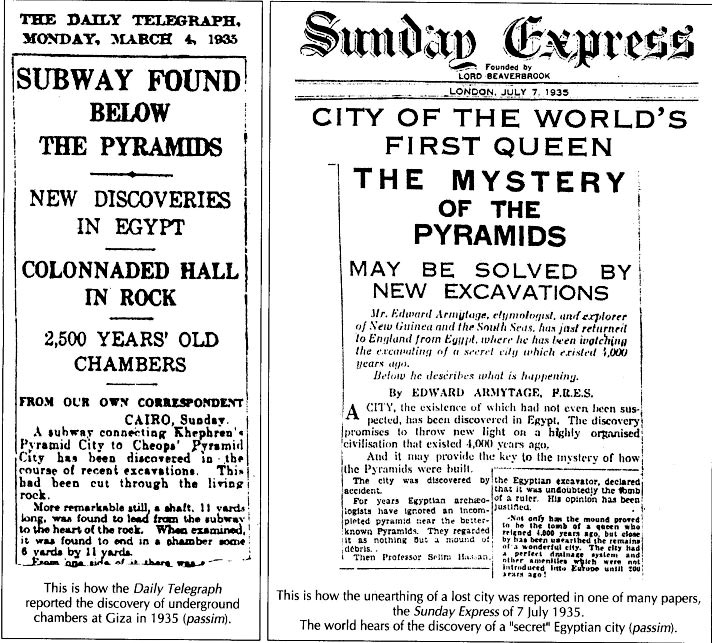
This is how the unearthing of a lost city was reported in one of many papers, the Sunday Express of 7 July 1935.
The world hears of the discovery of a "secret" Egyptian city (1935)
The world hears of the discovery of a "secret" Egyptian city (1935)
Endnotes
1. Professor Gaston Maspero, The Dawn of Civilization, 1901, p. 517
2. Histoire de la Magie; based in part upon the authority of lamblichus, from On the Mysteries, particularly those of the Egyptians, Chaldeans and the Assyrians
3. Ammiani Marcellini Rerum Gestaruum Libri, Leipzig, 1875
4. The Sydney Morning Herald, II October 1994
2. Histoire de la Magie; based in part upon the authority of lamblichus, from On the Mysteries, particularly those of the Egyptians, Chaldeans and the Assyrians
3. Ammiani Marcellini Rerum Gestaruum Libri, Leipzig, 1875
4. The Sydney Morning Herald, II October 1994
5. Dr Selim Hassan
6. Fame and Confession of Rosie-Cross, trans. Thomas Vaughan, 1625
7. Montfaucon de Villars, The Diverting History of the Count of de Gabalis, 1714
7. Montfaucon de Villars, The Diverting History of the Count of de Gabalis, 1714
by Tony Bushby
extracted from chapter 8 of "The Secret of The Bible"
From NEXUS MAGAZINE APRIL-MAY 2004
From NEXUS MAGAZINE APRIL-MAY 2004
( http://www.nexusmagazine.com )
from TheBaseOfRuneØverby Website
from TheBaseOfRuneØverby Website
Not included in the NEXUS-article
Comment:
Comment:
In the book THE CAVE OF THE ANCIENTS - the Tibetan Lobsang Rampa talks about these kind of lamps.
Short extract:
Short extract:
" ...One sequence of pictures showed a group of thoughtful men planning what they termed a "Time Capsule" (what we called "The Cave of the Ancients"), wherein they could store for later generations working models of their machines and a complete, pictorial record of their culture and lack of it. Immense machines excavated the living rock.
Hordes of men installed the models and the machines. We saw the cold light spheres hoisted in place, inert radio-active substances giving off light for millions of years. Inert in that it could not harm humans, active in that the light would continue almost until the end of Time itself.
We found that we could understand the language, then the explanation was shown, that we were obtaining the "speech" telepathically. Chambers such as this, or "Time Capsules", were concealed beneath the sands of Egypt, beneath a pyramid in South America, and at a certain spot in Siberia. Each place was marked by the symbol of the times; the Sphinx. We saw the great statues of the Sphinx, which did not originate in Egypt, and we received an explanation of its form. Man and animals talked and worked together in those far-off days.
We found that we could understand the language, then the explanation was shown, that we were obtaining the "speech" telepathically. Chambers such as this, or "Time Capsules", were concealed beneath the sands of Egypt, beneath a pyramid in South America, and at a certain spot in Siberia. Each place was marked by the symbol of the times; the Sphinx. We saw the great statues of the Sphinx, which did not originate in Egypt, and we received an explanation of its form. Man and animals talked and worked together in those far-off days.
The cat was the most perfect animal for power and intelligence. Man himself is an animal, so the Ancients made a figure of a large cat body to indicate power and endurance, and upon the body they put the breasts and head of a woman. The head was to indicate human intelligence and reason, while the breasts indicated that Man and Animal could draw spiritual and mental nourishment each from the other. That Symbol was then as common as is Statues of Buddha, or the Star of David, or the Crucifix at the present day.
We saw oceans with great floating cities, which moved....
We saw oceans with great floating cities, which moved....
Xtra Images - http://www.lostchord.org/ROSTAU/images/img11.jpg
http://egyptsites.files.wordpress.com/2009/02/khafre-31.jpg?w=480&h=316
http://files.abovetopsecret.com/images/member/9e614f6c4aa7.jpg
http://www.lostchord.org/ROSTAU/images/rostau4.gif
http://www.2012-online.net/images/avatar.gif
For further enlightenment enter a word or phrase into the search box @ New Illuminati:
or http://newilluminati.blog-city.com (this one only works with Firefox)
And see
The Her(m)etic Hermit - http://hermetic.blog.com
New Illuminati – http://nexusilluminati.blogspot.com
http://newilluminati.blog-city.com (this one only works with Firefox)
New Illuminati on Facebook - http://www.facebook.com/pages/New-Illuminati/320674219559
This material is published under Creative Commons Copyright (unless an individual item is declared otherwise by copyright holder) – reproduction for non-profit use is permitted & encouraged, if you give attribution to the work & author - and please include a (preferably active) link to the original along with this notice. Feel free to make non-commercial hard (printed) or software copies or mirror sites - you never know how long something will stay glued to the web – but remember attribution! If you like what you see, please send a tiny donation or leave a comment – and thanks for reading this far…
From the New Illuminati – http://nexusilluminati.blogspot.com


