"All the World's a Stage We Pass Through" R. Ayana

Showing posts with label sunken city. Show all posts

Tuesday, 30 August 2016

Atlantis Found Exactly Where Plato Said it Was


Atlantis Found Exactly Where Plato Said it Was

Cuba’s Sunken Atlantis: The Underwater City Mainstream Scholars Ignore
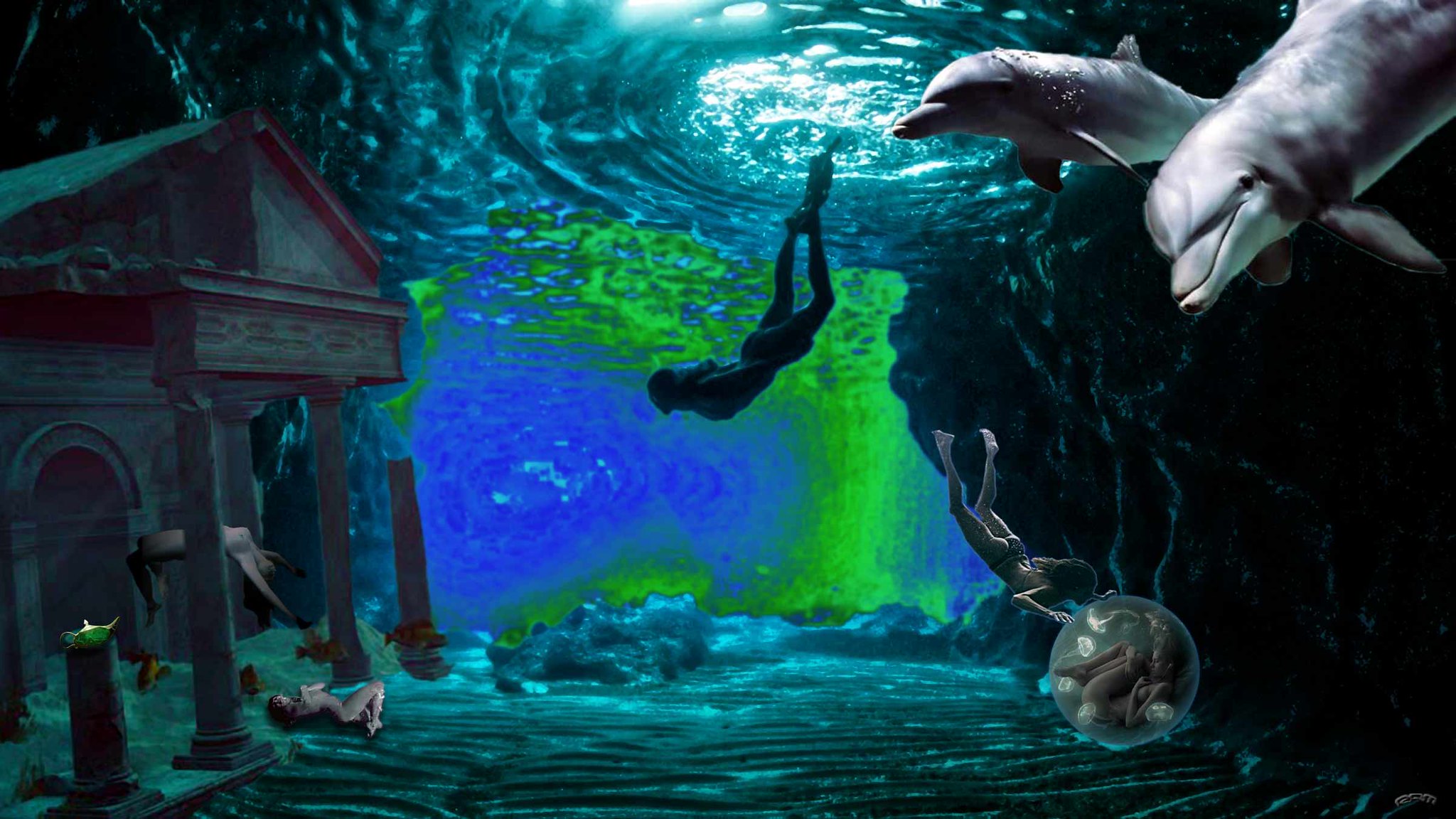
Lost and Found by R. Ayana


Over 15 years ago a team of explorers found anomalous structures off the western Coast of Cuba. Sonar survey showed a set of intricate stone formations 650 meters beneath the Caribbean Sea.


Strangely, no one has ever explored the sunken city after it was found.


National Geographic published an article about the sunken city when it was found and promised to perform follow-up investigations; strangely, they pulled out of the investigation.


you_tube_beta_test_video_speed_art_by_haleydesigns-d9pz78p


It isn’t news anymore that there are countless sunken cities scattered across the globe. From Asia to the Americas, there are legends of great cities that were swallowed by the ocean, forgotten in time and history.

While some of these cities have been found – mostly due to better equipment researchers have in recent years - there are still many more cities waiting to be rediscovered and brought back to life.

Different ancient texts belonging to various ancient cultures speak of massive floods that swept over the earth in the distant past. Evidence of that deluge can be found today, and it is a global phenomenon that is believed to have changed life on Earth forever.

The countless submerged structures found on our planet in recent years point to a much different time on Earth when our planet’s oceans were different then they are today.

Tales and legends of sunken empires like Atlantis, Mu, and Lemuria, have captivated the imagination of past generations and continue to do so presently…

One of the most fascinating discoveries in the last decade was made just off the coast of Cuba, when a team of underwater explorers using sonar equipment picked up a staggering formation of stones located some 600 meters beneath the Caribbean ocean.


remains_of_atlantis_by_haleydesigns-d8uf71g


Over 15 years ago, the company Advanced Digital Communications discovered peculiar structures beneath the Caribbean Sea. Based on sonar surveys, they suggested that the structures found off the western coast of Cuba were ancient monuments of an unknown ancient civilization.

Symmetrically arranged stones, which appeared to be remnants of some ancient urban development indeed point towards a highly developed society that could have inhabited the region in the distant past.

The submerged structures seemed entirely anomalous against the barren ocean floor and seemed to display symmetrically organized structures reminiscent of urban development. All of this was found 600 meters beneath the surface.

When word of the discovery got our, a media flurry soon ensued with media reporting headlines like ‘Atlantis Discovered in Cuba’ and ‘Lost City of the Caribbean Found’, captivating the interest of numerous governments, museum and popular magazines like National Geographic who showed great interest in exploring the sunken ‘city’ and promised further research and exploration.

However, these promises were just that, empty stories that lead nowhere as no one decided to go down there and further investigate the anomalous formations off the coast of Cuba.
“You just don’t make that type of discovery and pull out just like that. If sonar picked up structures underwater than the least we can do is go down there and see if there really is something down there. We could be looking at one of the most important underwater discoveries in history yet for some reason, we aren’t exploring it any further.” —author Ivan Petricevic

Over 15 years after the initial discovery was made, the story about the sunken city of Cuba disappeared into obscurity.

The question no one seems to have asked is… What happened to the alleged sunken city near the coast of Cuba? Were the mysterious structures ever fully investigated? Is it possible that without public knowledge, someone explored these enigmatic sunken structures? And why is it that such a sensational discovery fell into obscurity so fast?

Geologist Manuel Iturralde remains open-minded saying: “These are extremely peculiar structures, and they have captured our imagination,” said Iturralde, who is director of research at Cuba’s Natural History Museum. Iturralde has studied countless underwater formations over the years, but said, “If I had to explain this geologically, I would have a hard time.”

Estimating that it would have taken 50,000 years for such structures to have sunken to the depth at which they were said to be found, Iturralde added: “50,000 years ago there wasn’t the architectural capacity in any of the cultures we know of to build complex buildings.” A specialist in underwater archeology at Florida State University added “It would be cool if they were right, but it would be real advanced for anything we would see in the New World for that time frame. The structures are out of time and out-of-place.”

Here are some images of the discovery:


Pyram

screengrab 2

Screengrab 1


Featured image credit
Mission images 
Atlantis image credit


The Legend of Atlantis: Between Ancient Ruins and a Philosopher’s Tale


The Legend of Atlantis: Between Ancient Ruins and a Philosopher’s Tale

Deriv; Mystery beneath the sea. (Flickr/CC BY-NC 2.0)


Atlantis is many things to many people. To some, it is a fictional island and city that a philosopher with a vivid imagination invented to illustrate a moral point, and nothing more. To others, it is merely a Bronze Age civilization that existed no more than a thousand years before the time of classical Greece whose grandeur and power were exaggerated beyond all proportions. But there are a few who maintain the belief, so ridiculed by most scholars, that Atlantis was not only everything Plato said it was—a spectacularly advanced civilization that existed before the dawn of recorded history as we know it, but more besides, namely, that it was the ancestral mother culture of all known civilizations whose legacy, though forgotten to history, has been preserved in the myths and stories of cultures all across the world and in the mysterious monuments found all around the globe.


The Birth of Nininger City

Plato, who is regarded by Atlantis researchers and skeptics alike as the sole authoritative source on this ancient city, never stated outright that Atlantis was the origin of all civilization. This bold and sweeping claim was made, over two millennia later, by the most unlikely of individuals, separated from the Mediterranean World whence the legend originated by a vast ocean of distance and time, namely by Ignatius Donnelly. An eccentric and idealistic man given to harebrained schemes, Donnelly founded a city named Nininger City which quickly became a ghost town following an economic downturn that swept the country.

Having learned the lesson that it was much more difficult to create a new community than to join an existing one, he entered politics and found considerably greater success: he served as the lieutenant governor of his adopted state of Minnesota on the eve of the Civil War, and also aligned himself with the Radical Republican faction in the war and shortly thereafter. Disillusioned by the increasing corruption of the Republican Party, he later switched parties and then retired from politics altogether, choosing to devote his still considerable energies to writing a book about yet another subject that had captured the attention of his restless mind, namely the lost civilization of Atlantis.


Deriv; Terror Antiquus by L.Bakst (1908) (Public Domain), Translation of Plato's Timaeus. (Public Domain).
Deriv; Terror Antiquus by L.Bakst (1908) (Public Domain), Translation of Plato's Timaeus. (Public Domain).


Enjoying the privilege of unlimited access to the archives of the Library of Congress, Donnelly developed a novel thesis of breathtaking scope. He argued that the apparent similarities between cultures that were separated by vast oceans, and hence were isolated from each other throughout all of recorded history, could be explained by the influence of a worldwide civilization that had existed in remote antiquity and had spread its influence throughout the world before it met its demise. Donnelly's book, titled Atlantis: The Antediluvian World, found a receptive audience and became one of the best-selling books of its time.


The Antediluvian World and Pyramid Civilizations

In Chapter 5 of Part IV of Atlantis: The Antediluvian World, titled The Pyramid, The Cross, and The Garden of Eden, Donnelly argues for the existence of Atlantis as follows: 

"How did the human mind hit upon this singular edifice--the pyramid? By what process of development did it reach it? Why should these extraordinary structures crop out on the banks of the Nile, and amid the forests and plains of America? And why, in both countries, should they stand with their sides square to the four cardinal points of the compass? ... Is it possible to suppose all these extraordinary coincidences to be the result of accident? We might just as well say that the similarities between the American and English forms of government were not the relationship or descent, but that men placed in similar circumstances had spontaneously and necessarily reached the same results." 

The perceptive reader who is well-acquainted with Plato's account of Atlantis may have noticed that Donnelly's argument, strictly speaking, does not support the existence of Atlantis per se, but only the existence of some pyramid-building civilization that bequeathed its legacy to the Egyptians, the Maya and Aztec, and the other known pyramid-building civilizations across the world, as Plato never actually mentions pyramids in his dialogues concerning Atlantis! 


Plato's Atlantis described in Timaeus and Critias.
Plato's Atlantis described in Timaeus and Critias. (Public Domain)


If, on the contrary, Plato had said that Atlantis built pyramids, it would be difficult to deny that Plato's account of Atlantis was a veritable fact, for to maintain that Plato's account was fictional would mean that Plato, by pure chance, happened to invent a story about a prehistoric pyramid building civilization—precisely the civilization whose existence is pointed to by evidence only available in modern times—at a time when there was no evidence to suggest that such a civilization should have existed. Such a coincidence would have been so unlikely that it would have sufficed to demonstrate the veracity of Plato's account of Atlantis beyond reasonable doubt. This raises the question: Is there some structure, motif, or symbol that Plato does mention in his account of Atlantis that is also found in known civilizations, both in the Old World and the New, that Donnelly did not mention? In fact, there is.


Concentric Circles

The motif of concentric circles is found in a remarkably similar form across cultures all around the world, in the Old world and New, in mediums ranging from architecture, pottery, painting, and rock art. It is found in Peru, the Middle East, and on pottery shards found in the ancient city of Tartessos. Out of all of the representations of the concentric rings motif, perhaps the most interesting one is Gilgal Rephaim.

Known as Rujm el-Hiri in Arabic, the structure measures more than 500 feet (30 meters) wide and is made of thousands of basalt rocks that together weigh over 40,000 tons. According to Dr. Uri Berger, a member of the Israel Antiquities Authority, the sunrise on the summer and winter solstices is aligned with openings in the rocks. Experts are divided over whether the site was primarily a burial site or an ancient calendar, but they generally agree that the construction on the structure began as early as 3500 BC, which is older than the commonly accepted date of the building of the Giza Pyramid complex.

Another representation of the concentric circles was found in a Tartessian ceramic. This artifact was originally discovered in the 1950s, but it went unnoticed until Georgeos Diaz-Montexano, an Atlantis researcher noticed that a figure of concentric rings had been emblazoned onto it. Tartessos first appears in the historical record in the first millennium BC, but it is possible that the city was founded long before this date. The concentric circles motif also is found carved onto stone all across the world, including the North and South America, Ireland, China, and all across the Mediterranean. The widespread prevalence of this symbol suggests that there was a civilization whose influence extended across both the New and Old Worlds predating 3500 BC. Since none of the civilizations known to history had this level of influence prior to this date, the only remaining alternative is that a civilization, as yet unidentified and lost to history, must have propagated this symbol across the world. And it is precisely this symbol that is found at the very heart of Plato's Atlantis - in the construction of its capital city.


The prehistoric megalith Rujm el-Hiri / Gilgal Refaim.
The prehistoric megalith Rujm el-Hiri / Gilgal Refaim.  (Flickr/CC BY-SA 2.0)

Tartessian ceramic, Tartessos

Concentric circles rock art


According to Plato, the city of Atlantis was originally carved out of a small mountain to serve as the residence for the god Poseidon and his mortal wife Cleito: 

"Thereon dwelt one of the natives originally sprung from the earth, Evenor by name, with his wife Leucippe; and they had for offspring an only-begotten daughter, Cleito. And when this damsel was now come to marriageable age, her mother died and also her father; and Poseidon, being smitten with desire for her, wedded her; and to make the hill whereon she dwelt impregnable he broke it off all round about; and he made circular belts of sea and land enclosing one another alternately, some greater, some smaller, two being of land and three of sea, which he carved as it were out of the midst of the island; and these belts were at even distances on all sides, so as to be impassable for man; for at that time neither ships nor sailing were as yet in existence." 

He even describes the precise dimensions of each of the rings of land and water later on: 

"The greatest of the circles into which a boring was made for the sea was three stades in breadth, and the circle of land next to it was of equal breadth; and of the second pair of circles that of water was two stades in breadth and that of dry land equal again to the preceding one of water; and the circle which ran round the central island itself was of a stade's breadth.  wherein stood the royal palace, was of five stades in diameter."


Artist’s concept of Atlantis


In the Caribbean Basin, at 17°09'51.16" N  65°03'31.45" W, there is a feature resembling Plato's Atlantis.

Caribbean Basin with ‘city’ location marked.

Caribbean Basin with ‘city’ location marked. Google Earth

Overhead view.

Overhead view. Google Earth

Inclined view.

Inclined view. Image via Google Earth

Moreover, the measurements of the concentric rings precisely match those given by Plato.


Measurements

We may calculate the distance from the center of the central island to the outer edge of each of the concentric rings as follows, converting distances in units of stadia to units of miles using the conversion factor of 1 mile = 8.8 stadia. Also, we may delineate the boundaries between the each of the circular zones on the Google Earth images by observing where the colors change from light to dark, and vice versa.

First, the distance from the center of the central island to its outer edge is simply half the diameter of this central island, or 2.5 stades = 0.28 miles. 


Second, the distance from the center of the central island to the outer edge of the first circle of water is the width of this first circle of water added to the previous distance (the radius of the central island), which amounts to 2.5 stades + 1 stade = 3.5 stades = 0.40 miles.


Third, the distance from the center of the central island to the outer edge of the first circle of land is the width of this first circle of land added to the previous distance, which amounts to 3.5 stades + 2 stades = 5.5 stades = 0.63 miles. 


Fourth, the distance from the center of the central island to the outer edge of the second circle of water is the width of this second circle of water added to the previous distance, which amounts to 5.5 stades + 2 stades = 7.5 stades = 0.85 miles. 


Fifth, the distance from the center of the central island to the outer edge of the outermost circle of land is the width of this circle added to the previous distance, which amounts to 7.5 stadia + 3 stadia = 10.5 stadia = 1.19 miles. 


Finally, the distance from the center of the central island to the outermost circle of water is the width of this circle added to the previous distance, which amounts to 10.5 stadia + 3 stadia = 13.5 stadia = 1.53 miles.


For more information about Atlantis see http://nexusilluminati.blogspot.com/search/label/atlantis  
- Scroll down through ‘Older Posts’ at the end of each section


Do you LIKE this uniquely informative site?
Hours of effort by a genuinely incapacitated invalid are required every day to maintain, write, edit, research, illustrate, moderate and publish this website from a tiny cabin in a remote forest.
Now that most people use ad blockers and view these posts on phones and other mobile devices, sites like this earn an ever shrinking pittance from advertising sponsorship. This site needs your help.
Like what you see? Please give anything you can -  
Contribute any amount and receive at least one New Illuminati eBook!
(You can use a card securely if you don’t use Paypal)
Please click below -


And it costs nothing to share this post on Social Media!
Dare to care and share - YOU are our only advertisement!


For further enlightening information enter a word or phrase into the random synchronistic search box @ the top left of http://nexusilluminati.blogspot.com


And see


 New Illuminati on Facebook - https://www.facebook.com/the.new.illuminati

New Illuminati Youtube Channel -  https://www.youtube.com/user/newilluminati/playlists

New Illuminati’s OWN Youtube Videos -  
New Illuminati on Google+ @ For New Illuminati posts - https://plus.google.com/u/0/+RamAyana0/posts

New Illuminati on Twitter @ www.twitter.com/new_illuminati


New Illuminations –Art(icles) by R. Ayana @ http://newilluminations.blogspot.com

The Her(m)etic Hermit - http://hermetic.blog.com


DISGRUNTLED SITE ADMINS PLEASE NOTE –
We provide a live link to your original material on your site (and links via social networking services) - which raises your ranking on search engines and helps spread your info further!

This site is published under Creative Commons (Attribution) CopyRIGHT (unless an individual article or other item is declared otherwise by the copyright holder). Reproduction for non-profit use is permitted & encouraged - if you give attribution to the work & author and include all links in the original (along with this or a similar notice).

Feel free to make non-commercial hard (printed) or software copies or mirror sites - you never know how long something will stay glued to the web – but remember attribution!

If you like what you see, please send a donation (no amount is too small or too large) or leave a comment – and thanks for reading this far…

Live long and prosper! Together we can create the best of all possible worlds…


From the New Illuminati – http://nexusilluminati.blogspot.com

Sunday, 29 March 2015

Ancient Cities and Megalithic Sites Underwater


Ancient Cities and Megalithic Sites Underwater

 PortRoyal2


A wealth of human history lies submerged in ancient cities at the bottoms of lakes, seas and oceans of the world. Some of these urban centers were sent into the water via earthquakes, tsunamis or other disasters thousands of years ago.

Many ruins have just recently been rediscovered, by accident or through emergent technological innovations. Some have even caused scientists to question the history of human civilization.

Unlike the fabled cities of Atlantis and Lemuria, the underwater ruins of the ancient Greek city of Helike were rediscovered in 2001. Buried underneath the remnants of a primordial lagoon, it is no longer a tantalizing mystery for writers, historians and enterprising explorers. A multitude of ancient cities and buildings have been found underneath the waters of our oceans. In the past couple of years, discovery claims surfaced of ancient underwater sites the size of Pompeii. As convincing as these claims are, no real proof has ever been found for the supposed Japan, Cambay and Cuba anomalies and these sites remain highly controversial. The following ruins serve as a reminder of Mother Nature’s might and of our glorious archaeological ancestry.

Seahenge Norfolk, England


Seahenge, also known as Holme 1, consisted of a ring of fifty-five oak trunks that formed a circular enclosure with a large inverted oak stump in the centre. The trunks were placed in a trench and not in individual holes with their bark facing outwards and split sides facing inwards. Placed about 3 ft into the ground, we will never know how tall the trunks actually were. It was built around the 21st century BC. After its discovery in 1998, the site was excavated despite protests from Neo-pagan groups and the timbers were cleaned and placed in permanent storage. A recreated Seahenge was placed at the original site and a museum opened to the public in 2008.


Seahenge


Sunken ruins of Cleopatra’s palace, Alexandria, Egypt


Off the shores of Alexandria, the city of Alexander the Great, lie what are believed to be the ruins of the royal quarters of Cleopatra. It is believed that earthquakes over 1,500 years ago were responsible for casting this into the sea, along with artifacts, statues and other parts of Cleopatra’s palace. The city of Alexandria even plans to offer underwater tours of this wonder.


Alexandria


Lost more than 1600 ago, Cleopatra’s palace as well as the temple of Isis was discovered in the archaeological waters of Alexandria. Legend holds that Cleopatra and Marc Anthony committed suicide to avoid capture by the Romans, who in turn destroyed and dispersed their belongings. Up to date, archaeologists have found three areas where they believe their tomb to be. More than 140 artifacts have been excavated so far, and excavation work continues to this day at the submerged royal quarters. Archaeologists are also researching the possibility of an underwater museum at the site.


CleopatraPalace

Links: http://www.smithsonianmag.com/science-nature/Raising-Alexandria.html


Herakleion and Canopus, Abu Qir Bay, Egypt


Herakleion and Canopus were the twin cities guarding the gateway to Egypt. Herakleion was also home to Menelaus, king of Sparta, during his famous 10-year war against Troy. More than 1200 years ago, the cities abruptly collapsed when a flood turned the ground on which they were built into silt. Until their discovery in 1999, the only proof of their existence came from the texts of a few venerable historians and Greek mythology. The ancient ruins were discovered at depths of 20 – 23 feet (7 m), frozen in time, with its many temples, statues and other dwellings still demonstrating its former glory.


Link: http://blog.world-mysteries.com/strange-artifacts/thonis-heracleion-legendary-sunken-city-discovered/


Baiae,Bay of Naples, Italy


Baiae was the home port of the Western Imperial fleet of Rome. Playground of the filthy rich and infamous for its corruption and decadence the site has delivered numerous Roman sculptures. As a stockpile of casts were discovered, some believe a workshop probably mass-produced copies of original bronze sculptures for the Roman market. Baiae was annihilated by Muslim invaders in the 8th century AD and completely abandoned by 1500. Due to the volcanic activity of the area, the structure ultimately collapsed into the ocean.


Baiae2


Baiae


Pavlopetri Peloponnese, Greece


Pavlopetri is unique as it is the earliest submerged archaeological city to have been discovered. It had a layout of streets, courtyards, tombs and various buildings that has largely remained as it was millennia ago. Accurately mapped for the first time in 2009, archaeologists were amazed to discover the site sprawled more then 30,000 square meters. The town was engulfed around 1000 BC by an earthquake. A protected underwater cultural heritage site as listed by UNESCO, it remains in danger of being damaged by thieves, tourists and boat anchors.


 Pavlopetri2


The complex mix of expert archaeology, underwater robotics and state of the art graphics allowed the team to piece together the secrets of Pavlopetri, producing spectacular results.


Pavlopetri


Atlit-Yam Haifa, Israel


Dating from around 7000 BC, this is one of the oldest and largest submerged human dwellings ever discovered. In fact, for 9000 years the granular ocean floor preserved the site so well, that bugs can still be found in the grain stores and the skeletons are still lying peacefully in their graves. The ruins were discovered in 1984 and immediately gave rise to different theories as to how the well-developed ancient village met its ultimate demise. From a tsunami to the gradual rise of the ocean due to the systematic melting of the glaciers, the events leading to its ultimate fate will forever be shrouded in mystery.


Atlit_map

 Atlit_yam2

Atlit_Yam


Port Royal, Kingston Harbor, Jamaica


Home to prostitutes and pirates, Port Royal used to be the “Wickedest City on Earth”. Founded in 1518, it was a notorious port city and popular abode for English and Dutch privateers until their governments cancelled their commissions to confiscate Spain’s ships. As the privateers became pirates, the port became the hotspot for pirates from as far away as Madagascar. Destroyed and sunk in part after an earthquake in 1692, excavations have yielded historical documents, various buildings, thoroughfares and actual preserved food. Various plans are in the pipeline to redevelop the town into a main tourist destination.


PortRoyal2


PortRoyal


The Shore Temple Mahabalipuram, India


The famous Mahabalipuram temple has always been encased in folklore. The legends spoke of seven temples that were so dazzling; the gods grew envious and sent a flood that submerged all but one of them, leaving the Shore Temple companionless. After the Tsunami of December 2004, a collapsed temple as well as several other structures and primordial rock sculptures used in the same era to decorate walls and religious shrines were exposed. It revived theories that Mahabalipuram formed part of the Seven Pagodas the first Europeans wrote about.


shore-temple


Bay of Cambay, India


A few years back discovered the remains of a vast 9,500 year old city. This submerged ruin has intact architecture and human remains. More significantly, this find predates all finds in the area by over 5,000 years, forcing historians to reevaluate their understanding of the history of civilazation in the region. The find has been termed Dwarka, or the ‘Golden City,’ after an ancient city-in-the sea said to belong to the Hindu god Krishna.

Link: http://news.bbc.co.uk/1/hi/world/south_asia/1768109.stm


Bimini Road


The Bimini Road, sometimes called the Bimini Wall, is an underwater rock formation near North Bimini island in the Bahamas. The Road consists of a 0.8 km (0.50 mi)-long northeast-southwest linear feature composed of roughly rectangular to subrectangular limestone blocks.

bimini_map 
bimini2

Bimini_road1


Although it is generally considered to be a naturally occurring geological feature, as a result of the unusual arrangement and shape of the stones some believe that the formation is the remains of an ancient road, wall, or some other deliberately constructed feature. For example articles published in Argosy (an American pulp magazine) and either authored or coauthored by Robert F. Marx, a professional diver and visitor to the Bimini Road, argued that the Bimini Road is an artificial structure.


Yonaguni-Jima, Japan


A mysterious undersea structure off the coast of Japan causes controversy – is this a natural geological phenomena or a man-made structure which changes the history books as we know them?

In 1986, a diver near the island of Yonaguni Jima, off the southern tip of Japan (around Okinawa) came across some strange structures about 25 metres below sea level. They appeared to be stepped structures with terraces and ramps. One of the largest pyramid structures is 600 feet wide and 90 feet high –with five separate levels of stone blocks with what appears to be road surrounding the structure.

These structures seem to have been carved right out of bedrock in a teraforming process using tools previously thought unavailable to ancient cultures of the region.


Yonaguni

More:


MEGALITHIC RUINS near Yucatan Channel, Cuba


A team of scientists continues to explore megalithic ruins found in the Yucatan Channel near Cuba. They have found evidence of an extensive urban environment stretching for miles along the ocean shore. Some believe that the civilization that inhabited these predates all known ancient American cultures. So far, only computer models of this mysterious underwater city exist.

YucatanChannel_Ruins

Link >>


Samabaj Lake Atitlán, Guatemala


Discovered in 1996, researchers have concluded that the ruins were originally an island until volcanic activity or a landslide sunk it 1700 years ago.


LakeAtitlan


The buildings were drowned before the era of Mayan rule and artifacts discovered have left the impression that the area was abandoned in a hurry. Several ceremonial monuments have been uncovered as well as altars, incense burners, ceramics and other artifacts. Excavations are extremely demanding as the visibility is close to none and everything is covered with a very thick layer of silt.


Subject Related Books


sunken_realms

Australian researcher Karen Mutton has compiled the world’s most extensive list of sunken cities and megalithic underwater sites currently known around the world. She begins by discussing some of the causes for sunken ruins: super-floods; volcanoes; earthquakes at the end of the last flood; plate tectonics and other theories. She then discusses Plato’s Atlantis and the various areas of the Mediterranean and Atlantic that have been proposed as the location. From there she launches into a worldwide cataloging of underwater ruins by region. She begins with the many underwater cities in the Mediterranean, and then moves into northern Europe and the North Atlantic. She continues with chapters on the Caribbean and then moves through the extensive sites in the Pacific Ocean and Indian Ocean. The final chapters are on ruins and structures in lakes and inland seas plus a brief look at modern and medieval sunken ruins. Comes with plenty of maps, illustrations and rare photos. Places covered in this book include:

Tartessos; Cadiz; Morocco; Alexandria; The Bay of Naples; Libya; Phoenician and Egyptian sites; Roman era sites; Yarmuta, Lebanon; Cyprus; Malta; Thule & Hyperborea; Celtic Realms Lyonesse, Ys, and Hy Brasil; Carnac, Brittany; Isle of Wight; Canaries and Azores; Bahamas; Cuba; Bermuda; Mexico; Peru; Micronesia; California; Japan; Indian Ocean; Sri Lanka Land Bridge; India; Sumer; and inland lakes in Scotland, Russia, Iran, China, Lake Titicaca, Wisconsin, Florida and more. A unique and fascinating book!

Being that mankind, especially in ancient times, liked to live along the coasts, it is not odd that this is where we find countless lost cities. This should be a warning to those who live on coasts now: You are at high risk for catrastrophic flooding caused by earthquakes, impact events, etc.


From World Mysteries Blog @ http://blog.world-mysteries.com/mystic-places/ancient-cities-and-megalithic-sites-underwater/


For more information about lost civilisations see http://nexusilluminati.blogspot.com/search/label/antediluvian%20world
- Scroll down through ‘Older Posts’ at the end of each section


Hope you like this not for profit site -
It takes hours of work every day by a genuinely incapacitated invalid to maintain, write, edit, research, illustrate and publish this website from a tiny cabin in a remote forest
Like what we do? Please give anything you can -  
Contribute any amount and receive at least one New Illuminati eBook!
(You can use a card securely if you don’t use Paypal)
Please click below -


Spare Bitcoin change?


For further enlightening information enter a word or phrase into the random synchronistic search box @ the top left of http://nexusilluminati.blogspot.com


And see


 New Illuminati on Facebook - https://www.facebook.com/the.new.illuminati

New Illuminati Youtube Channel - http://www.youtube.com/user/newilluminati


New Illuminati on Twitter @ www.twitter.com/new_illuminati


New Illuminations –Art(icles) by R. Ayana @ http://newilluminations.blogspot.com

The Her(m)etic Hermit - http://hermetic.blog.com


DISGRUNTLED SITE ADMINS PLEASE NOTE –
We provide a live link to your original material on your site (and links via social networking services) - which raises your ranking on search engines and helps spread your info further! This site is published under Creative Commons Fair Use Copyright (unless an individual article or other item is declared otherwise by the copyright holder). Reproduction for non-profit use is permitted & encouraged,  - if you give attribution to the work & author and include all links in the original (along with this or a similar notice).

Feel free to make non-commercial hard (printed) or software copies or mirror sites - you never know how long something will stay glued to the web – but remember attribution!

If you like what you see, please send a donation (no amount is too small or too large) or leave a comment – and thanks for reading this far…

Live long and prosper! Together we can create the best of all possible worlds…


From the New Illuminati – http://nexusilluminati.blogspot.com