"All the World's a Stage We Pass Through" R. Ayana

Showing posts with label singularities. Show all posts

Saturday, 8 February 2014

Stephen Hawking: 'There are no black holes'


Stephen Hawking: 'There are no black holes'
Notion of an 'event horizon', from which nothing can escape, is incompatible with quantum theory, physicist claims.


The defining characteristic of a black hole may have to give, if the two pillars of modern physics — general relativity and quantum theory — are both correct.


Most physicists foolhardy enough to write a paper claiming that “there are no black holes” — at least not in the sense we usually imagine — would probably be dismissed as cranks. But when the call to redefine these cosmic crunchers comes from Stephen Hawking, it’s worth taking notice. In a paper posted online, the physicist, based at the University of Cambridge, UK, and one of the creators of modern black-hole theory, does away with the notion of an event horizon, the invisible boundary thought to shroud every black hole, beyond which nothing, not even light, can escape.


“There is no escape from a black hole in classical theory, but quantum theory enables energy and information to escape.”


In its stead, Hawking’s radical proposal is a much more benign “apparent horizon”, which only temporarily holds matter and energy prisoner before eventually releasing them, albeit in a more garbled form.

“There is no escape from a black hole in classical theory,” Hawking told Nature. Quantum theory, however, “enables energy and information to escape from a black hole”. A full explanation of the process, the physicist admits, would require a theory that successfully merges gravity with the other fundamental forces of nature. But that is a goal that has eluded physicists for nearly a century. “The correct treatment,” Hawking says, “remains a mystery.”

Hawking posted his paper on the arXiv preprint server on 22 January1. He titled it, whimsically, 'Information preservation and weather forecasting for black holes', and it has yet to pass peer review. The paper was based on a talk he gave via Skype at a meeting at the Kavli Institute for Theoretical Physics in Santa Barbara, California, in August 2013 (watch video of the talk).


Fire fighting

Hawking's new work is an attempt to solve what is known as the black-hole firewall paradox, which has been vexing physicists for almost two years, after it was discovered by theoretical physicist Joseph Polchinski of the Kavli Institute and his colleagues (see 'Astrophysics: Fire in the hole!').

In a thought experiment, the researchers asked what would happen to an astronaut unlucky enough to fall into a black hole. Event horizons are mathematically simple consequences of Einstein's general theory of relativity that were first pointed out by the German astronomer Karl Schwarzschild in a letter he wrote to Einstein in late 1915, less than a month after the publication of the theory. In that picture, physicists had long assumed, the astronaut would happily pass through the event horizon, unaware of his or her impending doom, before gradually being pulled inwards — stretched out along the way, like spaghetti — and eventually crushed at the 'singularity', the black hole’s hypothetical infinitely dense core.

But on analysing the situation in detail, Polchinski’s team came to the startling realization that the laws of quantum mechanics, which govern particles on small scales, change the situation completely. Quantum theory, they said, dictates that the event horizon must actually be transformed into a highly energetic region, or 'firewall', that would burn the astronaut to a crisp.

This was alarming because, although the firewall obeyed quantum rules, it flouted Einstein’s general theory of relativity. According to that theory, someone in free fall should perceive the laws of physics as being identical everywhere in the Universe — whether they are falling into a black hole or floating in empty intergalactic space. As far as Einstein is concerned, the event horizon should be an unremarkable place.


Beyond the horizon

Now Hawking proposes a third, tantalizingly simple, option. Quantum mechanics and general relativity remain intact, but black holes simply do not have an event horizon to catch fire. The key to his claim is that quantum effects around the black hole cause space-time to fluctuate too wildly for a sharp boundary surface to exist.

In place of the event horizon, Hawking invokes an “apparent horizon”, a surface along which light rays attempting to rush away from the black hole’s core will be suspended. In general relativity, for an unchanging black hole, these two horizons are identical, because light trying to escape from inside a black hole can reach only as far as the event horizon and will be held there, as though stuck on a treadmill. However, the two horizons can, in principle, be distinguished. If more matter gets swallowed by the black hole, its event horizon will swell and grow larger than the apparent horizon.

Conversely, in the 1970s, Hawking also showed that black holes can slowly shrink, spewing out 'Hawking radiation'. In that case, the event horizon would, in theory, become smaller than the apparent horizon. Hawking’s new suggestion is that the apparent horizon is the real boundary. “The absence of event horizons means that there are no black holes — in the sense of regimes from which light can't escape to infinity,” Hawking writes.

“The picture Hawking gives sounds reasonable,” says Don Page, a physicist and expert on black holes at the University of Alberta in Edmonton, Canada, who collaborated with Hawking in the 1970s. “You could say that it is radical to propose there’s no event horizon. But these are highly quantum conditions, and there’s ambiguity about what space-time even is, let alone whether there is a definite region that can be marked as an event horizon.”

Although Page accepts Hawking’s proposal that a black hole could exist without an event horizon, he questions whether that alone is enough to get past the firewall paradox. The presence of even an ephemeral apparent horizon, he cautions, could well cause the same problems as does an event horizon.

Unlike the event horizon, the apparent horizon can eventually dissolve. Page notes that Hawking is opening the door to a scenario so extreme “that anything in principle can get out of a black hole”. Although Hawking does not specify in his paper exactly how an apparent horizon would disappear, Page speculates that when it has shrunk to a certain size, at which the effects of both quantum mechanics and gravity combine, it is plausible that it could vanish. At that point, whatever was once trapped within the black hole would be released (although not in good shape).
http://farm9.staticflickr.com/8480/8196107204_6068b68386_k.jpg
If Hawking is correct, there could even be no singularity at the core of the black hole. Instead, matter would be only temporarily held behind the apparent horizon, which would gradually move inward owing to the pull of the black hole, but would never quite crunch down to the centre. Information about this matter would not destroyed, but would be highly scrambled so that, as it is released through Hawking radiation, it would be in a vastly different form, making it almost impossible to work out what the swallowed objects once were.

“It would be worse than trying to reconstruct a book that you burned from its ashes,” says Page. In his paper, Hawking compares it to trying to forecast the weather ahead of time: in theory it is possible, but in practice it is too difficult to do with much accuracy.

Polchinski, however, is sceptical that black holes without an event horizon could exist in nature. The kind of violent fluctuations needed to erase it are too rare in the Universe, he says. “In Einstein’s gravity, the black-hole horizon is not so different from any other part of space,” says Polchinski. “We never see space-time fluctuate in our own neighbourhood: it is just too rare on large scales.”

Raphael Bousso, a theoretical physicist at the University of California, Berkeley, and a former student of Hawking's, says that this latest contribution highlights how “abhorrent” physicists find the potential existence of firewalls. However, he is also cautious about Hawking’s solution. “The idea that there are no points from which you cannot escape a black hole is in some ways an even more radical and problematic suggestion than the existence of firewalls,” he says. "But the fact that we’re still discussing such questions 40 years after Hawking’s first papers on black holes and information is testament to their enormous significance."

Nature
doi:10.1038/nature.2014.14583


From Nature @ http://www.nature.com/news/stephen-hawking-there-are-no-black-holes-1.14583


See Infinite Cosmos of Light and Life: Black Holes Don’t Exist @ http://nexusilluminati.blogspot.com.au/2013/03/infinite-cosmos-of-light-and-life-dark.html
 

For more information about absence of black holes see http://nexusilluminati.blogspot.com/search/label/no%20black%20holes  
- See ‘Older Posts’ at the end of each section


Hope you like this not for profit site -
It takes hours of work every day to maintain, write, edit, research, illustrate and publish this website from a tiny cabin in a remote forest
Like what we do? Please give enough for a meal or drink if you can -  
Donate any amount and receive at least one New Illuminati eBook!
Please click below -


Images by R. Ayana @ http://farm8.staticflickr.com/7457/8732051100_3d3b1951ac_k.jpg
http://farm9.staticflickr.com/8480/8196107204_6068b68386_k.jpg

Videos - http://www.youtube.com/watch?v=KR3Msi1YeXQ
http://www.youtube.com/watch?v=Dz2A4qXJQjc


For further enlightening information enter a word or phrase into the random synchronistic search box @ http://nexusilluminati.blogspot.com


And see


 New Illuminati on Facebook - https://www.facebook.com/the.new.illuminati

New Illuminati Youtube Channel - http://www.youtube.com/user/newilluminati/feed


New Illuminati on Twitter @ www.twitter.com/new_illuminati


The Her(m)etic Hermit - http://hermetic.blog.com


The Prince of Centraxis - http://centraxis.blogspot.com (Be Aware! This link leads to implicate & xplicit concepts & images!)


DISGRUNTLED SITE ADMINS PLEASE NOTE –
We provide a live link to your original material on your site (and links via social networking services) - which raises your ranking on search engines and helps spread your info further! This site is published under Creative Commons Fair Use Copyright (unless an individual article or other item is declared otherwise by the copyright holder) – reproduction for non-profit use is permitted & encouraged, if you give attribution to the work & author - and please include a (preferably active) link to the original (along with this or a similar notice).

Feel free to make non-commercial hard (printed) or software copies or mirror sites - you never know how long something will stay glued to the web – but remember attribution! If you like what you see, please send a donation (no amount is too small or too large) or leave a comment – and thanks for reading this far…

Live long and prosper! Together we can create the best of all possible worlds…


From the New Illuminati – http://nexusilluminati.blogspot.com

Tuesday, 17 July 2012

The Myth of Black Holes

The Myth of Black Holes
20th Century science sucked into a false death trip to nowhere


Black Flares


Artist's conception of flaring black hole GX 339-4
Artist's conception of flaring black hole GX 339-4. Credit: NASA


Black hole theory contradicts itself.

Most astrophysicists try to explain narrow jets erupting from various sources by using words like “nozzle” or “high pressure,” contradicting the known behavior of gases in a vacuum. For example, according to a recent press release, “flares” have been discovered jetting from a source close to the center of our galaxy. Consensus opinions call that source a black hole.

As Poshak Gandhi from the Japan Aerospace Exploration Agency (JAXA) said, “If you think of the black hole’s jet as a fire hose, then it’s as if we’ve discovered the flow is intermittent and the hose itself is varying wildly in size.”

Discovered by the Wide-field Infrared Survey Explorer (WISE), GX 339-4 is approximately 20,000 light-years away. It is conventionally presumed to be at least six times more massive than the Sun, with a gravity field 30,000 times more powerful than Earth. GX 339-4s extreme activity is supposed to be due to a companion star “feeding” its stellar matter into the black hole’s putative gravity well. However, some of that material gets blasted into space at close to light speed.

The mechanisms by which intense gravitational fields eject tightly collimated steams of matter are not understood. It is thought that strong magnetic fields are required, but the source of that magnetism is not known, since no mention of electricity exists in the reports about such phenomena.

Some flares and X-ray jets are thought to be generated by heat from molecular collisions, causing the gas to glow. As theories indicate, gamma rays might also appear when the super-accelerated matter is eventually sucked into the black hole. Excess heat, X-rays, and gamma rays are not created by gravity. In laboratory experiments, it has been found that they are most easily produced when charged particles are accelerated through an electric field.

Previous Picture of the Day articles about black holes suggested that the terminology used to describe “gravitational point sources” is highly speculative: space/time, singularities, and infinite density are abstract concepts, precluding a realistic investigation into the nature of the Universe.

Stars are nodes in electrical circuits. Electromagnetic energy could be stored in the equatorial current sheets surrounding them until some trigger event causes them to switch into a polar discharge. The electric jet could receive its energy from a natural particle-accelerator, a “plasma double layer” with a strong electric field. Toroidal magnetic fields would form because of the polar plasma discharge, confining it into a narrow channel.

Axial electric currents should be flowing along the jet’s entire length. Only electric fields can accelerate charged particles across interstellar space.

There is no evidence that matter can be compressed to “infinite density.” Z-pinches in plasma filaments form plasmoids that become stars and galaxies. Electricity is responsible for star birth, as well as death. When current density gets too high, double layers in the stellar circuit catastrophically release excess energy, appearing as gamma ray bursts, or X-rays, or thermal flares.


Black Hunger


Supposed black hole
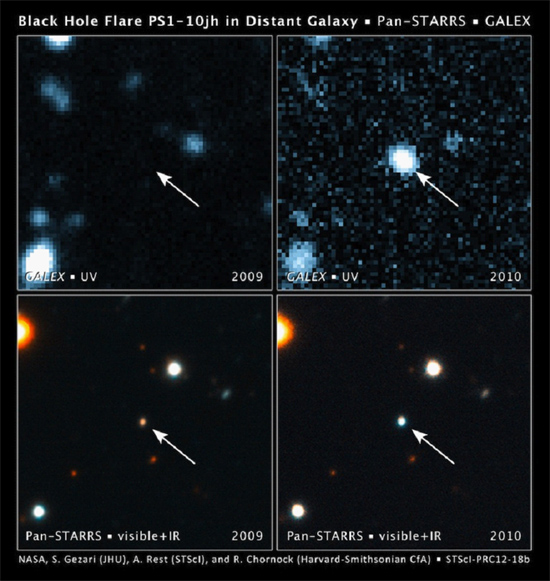
Supposed black hole causes a flare in the nucleus of a distant galaxy. Credit: NASA/JPL-Caltech/JHU/STScI/Harvard-Smithsonian CfA


Problematic black hole physics is in the news again.

In a recent press release from the Galaxy Evolution Explorer and the Pan-STARRS1 telescope in Hawaii, astronomers announced “direct evidence” for the existence of a supermassive black hole (SMBH) in another galaxy. The high frequency ultraviolet spectrum, as well as the infrared light from the two detectors, seems to indicate the “shredding” of a star near the center of a galaxy 2.7 billion light-years away.

Black holes have been discussed many times in previous Picture of the Day articles. They owe their existence to mathematical legerdemain, and can have nothing to do with the substantive Universe because they are said to occupy a region where the laws of space and time break down.

Black holes are said to cause space and time itself to twist and warp so that the past becomes the future and velocity calculations yield impossible solutions. According to standard theories, matter inside of a black hole occupies no volume at all, yet retains gravitational acceleration so great that not even light can escape its attraction—thus they are “black” holes because they cannot be detected with optical telescopes. Although they are impossible to observe directly, over 90% of galaxies in the Universe are supposed to harbor these perilous maws

The terminology used by astrophysicists to describe black holes is highly problematic, relying on “explanations” derived from loose interpretations. Ambiguous labels such as space/time, singularities, infinite density, and other ideas that are not quantifiable have introduced irony into what should be a realistic investigation into the nature of the Universe.

According to Suvi Gezari, an astronomer from Johns Hopkins University, “When the star is ripped apart by the gravitational forces of the black hole, some part of the star’s remains falls into the black hole, while the rest is ejected at high speeds. We are seeing the glow from the stellar gas falling into the black hole over time.”

NASA’s Chandra X-ray Observatory also looked at the hot material in order to see if it matched the emissions normally seen in an “active galactic nucleus”. Their results indicated that the spectrum observed by Gezari’s group did not conform to those prior observations.

Flares and X-ray jets spewing from galaxies are thought to be caused by stars traveling too close to their central supermassive black holes where they are torn apart by tidal forces. Most of the star’s gas escapes the black hole, but a small quantity is captured by the immense gravity and forms a rotating disk. Closer to the black hole, heat generated by molecular collisions tears the atoms apart and the disk of gas glows in extreme ultraviolet and X-rays. When matter eventually falls into the black hole, gamma rays can also explosively burst out.

X-rays in space are not created in gravity fields. Laboratory experiments most easily produce them by accelerating charged particles through an electric field. No gigantic masses compressed into tiny volumes are necessary and they are easily generated with the proper experimental models.

To say that gas can be heated by gravity until it emits X-rays indicates a serious lapse on the part of the GALEX research team. Molecules of gas cannot remain intact at million degree temperatures because electrons are stripped from the atomic nuclei, causing them to become ionized. Instead of hot gas, the galactic radiation should be referred to by its proper name: plasma.

An electric current in plasma generates a magnetic field that constricts the flow of charge. The constricted channel is known as a Bennett pinch, or z-pinch. The “pinched” filaments of electric current remain coherent over large distances, spiraling around each other, forming helical structures that can transmit power through space.

As we have noted in the past, Hannes Alfvén identified the “exploding double layer” as a new class of celestial object. It is double layers in space plasmas that form most of the unusual structures we see. Stellar explosions, jets, rings, and glowing clouds—these are all examples of electricity flowing through dusty plasma confined within Birkeland currents that stretch across the light years.

Retired Professor of Electrical Engineering Donald Scott, author of The Electric Sky, wrote about the way plasma acts in the Universe: “Plasma phenomena are scalable. Their electrical and physical properties remain the same, independent of the size of the plasma. In a laboratory plasma, of course, things happen much more quickly than on, say, galaxy scales, but the phenomena are identical—they obey the same laws of physics. In other words we can make accurate models of cosmic scale plasma behavior in the lab, and generate effects that mimic those observed in space. It has been demonstrated that plasma phenomena can be scaled to fourteen orders of magnitude. (Alfvén hypothesized that they can be scaled to 28 orders or more!) Electric currents flowing in plasmas produce most of the observed astronomical phenomena that remain inexplicable if we assume gravity and magnetism to be the only forces at work.”

Irrespective of their source, X-rays in space are not created by gravitational fields regardless of how strong they are theorized to be. Since plasma is composed of charged particles, the particles are accelerated by electric currents and spiral in the resulting magnetic fields, creating synchrotron radiation that can shine in all high energy frequencies, including extreme ultraviolet, X-rays, and gamma rays.


Stars That Will Not Explode


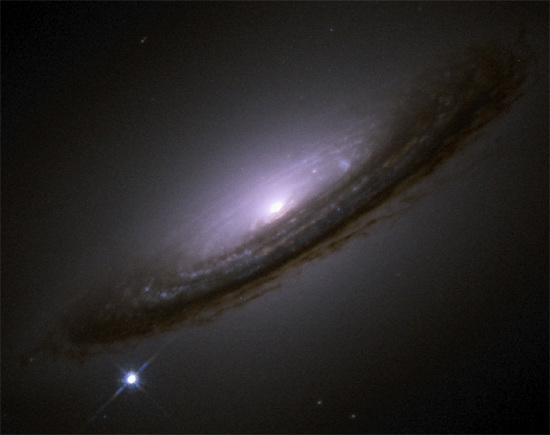
SN1994D, a supernova in NGC 4526
SN1994D, a supernova in NGC 4526. Credit: High-Z Supernova Search Team, HST, NASA


NASA computer simulations are not able to correctly model supernova explosions.

Contemporary astrophysical models of stellar evolution rely on the mechanical action of cold gas collapsing from gravitational impetus. Stars are seen as whirling vortices of compressed matter heated to fusion temperatures by pressure, alone.

Clouds of gas and dust a thousand times less dense than a puff of smoke are said to be drawn into a region of increased density that coaxes even more material to collect there. Eventually, molecules within the cloud fall into a gravity well of nuclear fusion, initiating a self-sustaining reaction.

According to consensus opinions, stars that are extremely massive live fast and die young. They “fuse” their hydrogen and helium into heavier elements that, in turn, fuse into elements that are heavier still. In their senescence, the radiative emissions from such stars are thought to be so intense that gravity can no longer confine their energies and they “blow away” enormous quantities of stellar material in a supernova explosion. In some cases, they lose mass up to a million times faster than our own Sun. However, that process is highly speculative.

According to a recent press release, “Many of the best computer models of supernovas fail to produce an explosion.” Instead of the stellar simulation collapsing and rebounding like a supernova ought to do, gravitational forces are so great that a rebound does not occur after collapse.

On June 13, 2012 NASA launched the Nuclear Spectroscopic Telescope Array (NuSTAR) in an attempt to analyze high-energy X-rays in what are thought to be the remnants of exploded stars. NuStar joins other X-ray space telescopes like Chandra and XMM-Newton, except that it is capable of focusing X-rays to a sharp point, enabling it to “see” energies up to 79,000 electron-volts. That capability makes it more than 100 times more powerful than the others.

Astronomers predict that the titanium-44 isotope will help them improve their computer models. Since titanium-44 is thought to be created by nuclear fusion in stars not quite heavy enough to form hypothetical black holes, in their understanding, it should be visible in the debris left behind by objects such as SN1994D, shown at the top of the page.

Many previous Picture of the Day articles point out that stars are not simplistic balls of gravitationally compressed hot gas, they are composed of plasma. Plasma is ionized, meaning that one or more electrons have been stripped from the atoms in its substance, so it is electrically charged. Plasma does not behave like a pressurized gas, it behaves according to the tenets of plasma physics.

Laboratory experiments confirm that electricity flowing through plasma forms regions separated by thin walls of opposite charge called double layers. This is the “charge separation” so often mentioned in these pages. Could charge separation be the foundation for the electrical explosions known as supernovae?

Electric Universe theory agrees with conventional astrophysics in that a supernova can be referred to as an “exploding star.” However, in an electrically charged plasma star, that explosion is due to the breakdown of double layers. The power that fuels the stars comes from external currents of electric charge flowing through vast circuits in space. Rather than “core rebound” or “white dwarf accretion,” supernovae are the result of a stellar “circuit breaker”, where the stored electromagnetic energy in the circuit is suddenly focused at one point.

When a star’s double layer explodes, the electromagnetic energy stored in a vast galactic circuit flows into the explosion. The resulting supernova radiation is emitted across the entire electromagnetic spectrum from radio to gamma rays.

Electric Universe advocate Wal Thornhill wrote: “How does a star explode? The conventional ‘implosion followed by explosion’ model has many shortcomings. An electric star, on the other hand, has internal charge separation which can power a star-wide, expulsive lightning-flash. The star relieves electrical stress by fissioning or blowing off charged matter. A star also has electromagnetic energy stored in an equatorial current ring. Matter is ejected equatorially by discharges between the current ring and the star. Our own Sun does it regularly on a small scale. However, if the stored energy reaches some critical value it may be released in the form of a bipolar discharge, or ejection of matter, along the rotational axis.”

Since stars can be thought of as the focus for immense energy from the galaxies in which they live, their activity cannot be based on whether they possess a certain mass, or a particular elemental constitution. Rather, they are not internally powered objects at all; they are bodies formed electromagnetically where gigantic plasma filaments have squeezed matter in what is called a “z-pinch.” That is how stars are born and that is where the seeds of supernovae are planted.


Radio Elliptical


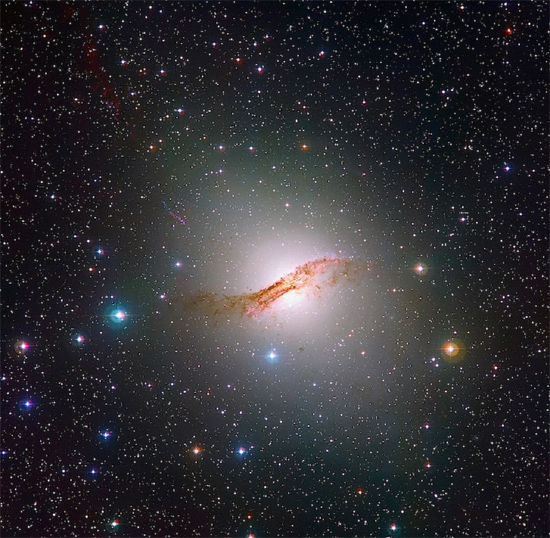
NGC 5128
The Centaurus A galaxy (NGC 5128). Credit: ESO


One of the largest “active galaxies” is thought to be powered by a supermassive black hole. Electrical energy is a more likely driving force.

A recent press release from the European Southern Observatory (ESO) announces that the elliptical galaxy Centaurus A is ejecting a light-years long jet of material because a “supermassive black hole [is] at its heart”. Astronomical theories state that the radio-bright nucleus and the jet come from the compression of interstellar material as it is drawn into a central black hole possessing a mass greater than 100 million average stars.

From gamma-rays down through X-rays and extreme ultraviolet, conventional theories have relied on gravity and acceleration for radiation to be produced in space. Compressing hydrogen gas and dust is supposed to create enough transfer of momentum that it reaches temperatures in the millions of degrees. That high temperature is supposed to make the gas and dust glow brightly and emit high-frequency radiation.

Since the idea that electricity flows through the Universe is commonly met with resistance by today’s consensus, its influence and attributes are unseen. It has long been said that “seeing is believing”. However, it should not be surprising that “believing is seeing” appears to be more apt. When there is no inner experience, outer realities can often remain invisible.

Electric currents surge out along galactic spin axes, forming double layers that, like those in Centaurus A, can be seen as radio “lobes.” The electric charges spread out around the galactic circumference, flowing back to the core along the spiral arms. Since the elements in a galactic circuit radiate energy, that energetic radiance shows that they are powered by larger circuits. The extent of the larger circuits may be traced by radio telescopes through the polarized radio “noise” coming from them.

The fact that moving charges constitute an electric current that can generate magnetic fields has been known since the days of Michael Faraday. However, a lack of appropriate training often means a lack of vision. As previously stated, moving charged particles constitute an electric current, and that current is wrapped in a magnetic field. When more charged particles accelerate in the same direction, the field gets stronger.

Something that researchers do not consider is that for charged particles to move, they must move in a circuit. Energetic events cannot be explained by local conditions, alone. The effects of an entire circuit must be considered. For that reason, while the consensus scientific worldview only permits isolated “islands” in space, the Electric Universe emphasizes connectivity with an electrically active network of “transmission lines” composed of Birkeland current filaments.

Double layers and plasmoids expand and explode, throwing off plasma that can accelerate to near light-speed. Jets from opposite poles of a galaxy end in energetic clouds emitting X-ray frequencies, or radio waves. Those phenomena are based in plasma science and not gas kinetics, gravity, or particle physics. Astrophysicists see magnetic fields but not the underlying electricity, so they are at a loss to explain them.

Astronomers maintain that galaxies are clouds of hydrogen gas and intergalactic dust that were assembled by gravity until they coalesced into glowing thermonuclear fires. The conventional community also proposes that most galaxies contain black holes of unbelievable magnitude. It is those “gravitational point sources” that are supposed to cause the galaxies to spin, jets of gamma-rays to appear, and the radio lobes to form.

The Electric Universe theory does not adhere to the idea of galaxies condensing out of cold, inert hydrogen and specks of zircon no bigger than a molecule. So, what are galaxies?

In 1981, Hannes Alfvén said that galaxies are much like one of Michael Faraday’s inventions, the homopolar motor. A homopolar motor is driven by magnetic fields induced in a circular conducting plate. The plate is mounted between the poles of an electromagnet, causing it to spin at a rate proportional to the input current.

Galaxies move within filamentary circuits of electricity that flow through the cosmos from beginning to end. We see the effects of those electromagnetic fields because electricity organizes itself within masses of plasma sometimes larger than galaxy clusters. That plasma is primarily composed of neutral atoms, but free electrons, protons, and other charged particles are also present.

Plasma’s behavior is governed by those circuits. Double layers with large voltages between them often exist. The electric forces in double layers are incomparably stronger than gravity. Double layers broadcast radio waves over a wide range of frequencies. Most significant to the ESO bulletin, they can accelerate charged particles to extreme energies.

This vision of the cosmos sees various components coupled to and driven by circuits at ever larger scales, so electrons and other ions accelerated through intense electric fields radiate “shouts” of energy in many bandwidths. It is that story that should be told and not the one about omnipotent gravity.

-         Stephen Smith


From http://www.thunderbolts.info/wp/2012/04/10/black-flares-2/  and http://www.thunderbolts.info/wp/2012/05/24/black-hunger/ and http://www.thunderbolts.info/wp/2012/06/19/stars-that-will-not-explode/ and http://www.thunderbolts.info/wp/2012/05/22/radio-elliptical/

For more information on our electric universe see  http://nexusilluminati.blogspot.com/search/label/electric%20universe and http://nexusilluminati.blogspot.com/search/label/electric%20sun
For more about black holes see http://nexusilluminati.blogspot.com/search/label/black%20holes


Help This Unique Independent Site Survive
Donate any amount and receive at least one New Illuminati eBook!
Just click in the jar -


For further enlightening information enter a word or phrase into the search box @  New Illuminati or click on any label/tag at the bottom of the pagehttp://nexusilluminati.blogspot.com


And see


 New Illuminati on Facebook - https://www.facebook.com/the.new.illuminati

New Illuminati Youtube Channel - http://www.youtube.com/user/newilluminati/feed


The Her(m)etic Hermit - http://hermetic.blog.com


The Prince of Centraxis - http://centraxis.blogspot.com (Be Aware! This link leads to implicate & xplicit concepts & images!)


This site is published under Creative Commons Fair Use Copyright (unless an individual item is declared otherwise by copyright holder) – reproduction for non-profit use is permitted & encouraged, if you give attribution to the work & author - and please include a (preferably active) link to the original along with this notice. Feel free to make non-commercial hard (printed) or software copies or mirror sites - you never know how long something will stay glued to the web – but remember attribution! If you like what you see, please send a small but heartfelt donation or leave a comment – and thanks for reading this far…

Live long and prosper!


From the New Illuminati – http://nexusilluminati.blogspot.com


Thursday, 25 February 2010

Crystal Spheres: Universe as Hologram

Crystal Spheres
Universe as Hologram


A 'particle' is a spinning vortex of 'quanta'. Around a so-called 'atomic nucleus' are a series of shells created at intervals of harmonic resonance. Within these shells, other spins of quanta occur as a result of energy density displacement; smaller vortices at the interface planes between disparate energy levels are created, smaller fractals of larger spinning forms (See Vorticles Graphics).

These smaller vortexes (electrons, planets, etc) are really by products and part of the centralised, encompassing spinning field, fully enclosed within its resonance.

The 'electron' cannot be said to have an actual position and course around the 'nucleus' at any given time (according to the uncertainty principle) when viewed from 'outside' the field of spin.

Instead, a cloud of potential positions is visualised around the nucleus, an infinite number of potential positions and vectors - a multitude of potential realities. Inside the 'timespace' field of the spin, actual positions of these satellite vortices is determinable as spinning, orbiting vortices (the geometrical inverse of spheres) around central forms encased in the overall field. In the solar system, accretion of matter occurs at 'tidal' trojan and LaGrange points created by vortexial pressures where gravity wells pre-exist in the field (See Planar Nets).

Our solar system is encased in the Sun’s 'solar bubble', a plasma field; the resonance of this field defines the orbits of the planets - planar nets rolling down the perpetual hill of their orbits (with the exception of Uranus, which spins like a top while doing so).


https://blogger.googleusercontent.com/img/b/R29vZ2xl/AVvXsEi7Gp0MbzSCsZpLkP2nB-oJfzNBBzFVo7gR6-kPjzDKfzJn3berEm3P8qzecZcLnFhaMBATWFITcel-4b3mktorBFkChn9QXWHsMThgeHo-k1qF3GkSmppFu3TXYMR-gIhhcWzAEZWeGd_T/s400/fractal-carnival.jpg


Neither Waves Nor Particles

Light is information in formation. It is not propagated via small massless particles, nor directly by waves. Timespace is packed full of spinning virtual 'vorticles' which affect each other's spin components whenever a signal affects any one of them in the compressible field of timespace; 'light' and other frequencies of information are passed through this alteration in the vorticles at the maximum possible speed - that of the spin rate of the vorticles themselves, the 'speed of light'. This is not a fixed value, as the spin rates themselves are not fixed universally, but alter according to local conditions. The spin rate determines lightspeed and the apparent rate of passage of time itself (see Time Shift). A single vorticle is a model for an electron, an atom, a star and the universe itself.


[fractal-nautilus.gif]


As Above, So Below

At one level or scale of resolution, undisturbed galaxies display harmonic spacing between their 'arms' and inherent spin tends to create an equatorial plane where the material will probably lie - a disc shape, often surrounded by a halo of pin-point clusters above and/or below.

At yet another scale of resolution the spinning vortex is so vast that an individual's perspective point sees what appears to be a self-bounding curved spacetime field with a background hum apparently 'left over from a big bang'. This hum is actually the resonance of the structure of the spactime 'lattice' (the quantum field) oscillating between its core and its extremities (see
Constructing Reality& Magic Net). The frequency of the universe is defined by its volume and mass. The universe is a hologram. So are we.

...All that we may see or seem is but a dream within a dream...

The atom is a vortexial field. On the surface of the rolling accretion sphere, deep in a gravity well/lens, living on the bottom of an atmospheric ocean, the action and attention of human beings is largely flattened onto the horizontal axis. We are polarised into a vertical plane pointing outward toward the source of free light and energy and inward toward patterned matter  (Mater + Pater = Creation).

The field density which determines the interface/compaction of the tetrahedral matrix determines the 'higher' geometric forms the tetrahedra can transform into, through rotations in four dimensions - potential time - and the interlacing of fields produced at each minimal (quantum) interval as an object travels.

Polarity of charge is determined by direction of the quantum spin. Vortexial flow pressures cause quanta (or vortices) spinning in the same direction to repel each other; those spinning in opposite directions (upside-down in relation to each other) are pushed together and attract each other due to the same energic pressures formed by turbulence and drag.

SINGULARITY

What is a singularity? A black hole is postulated to be a singularity, a point with an event horizon and orbiting accretion disc, often with energic jets above and/or below. Matter and energy are rent by the suction of these tiny vacuum cleaners. Where does all this stuff go when it 'enters' the singularity after its long cascade through ever-slowing time? Some postulate that it comes out of 'white holes' somewhere else.

The universe is also a holographic singularity. All true singularities have a holographic commonality with each other; they are all the one, single entity. Thus, while the universe itself is a vast 'white hole' into which matter is continually accreting from 'higher dimensions', the energy poured into black holes - singularities - literally squeezes out everywhere. All the rotating 'quanta' - spinning 'vorticles' - are the corollary of black holes.

The universe is a self-maintaining vortex, having no beginning nor end in timespace. With all the other levels of the fluid tessellated hologram that comprises timespace, the uni-verse is unique among infinite alternative possibilities - the largely unacknowledged corollary of quantum theory.

A 'particle' is a spin of turbulence in timespace; self-bonded nothingness. Light is neither particles nor waves - these effects are both by-products of a bonded field of vorticles in a hologramic whole.


R. Ayana 11/11/00

 http://www.crystalinks.com/manbluelite.jpg

For more TimeSpace Elucidations see


YOU can help this unique independent website’s author survive in a small cabin in a remote rainforest
Donate any amount and receive at least one New Illuminati eBook!
Please click in the jar -


Images -  http://centraxis.blogspot.com/2008/01/hole-is-greater-part-1.html
Magick River: https://blogger.googleusercontent.com/img/b/R29vZ2xl/AVvXsEi7Gp0MbzSCsZpLkP2nB-oJfzNBBzFVo7gR6-kPjzDKfzJn3berEm3P8qzecZcLnFhaMBATWFITcel-4b3mktorBFkChn9QXWHsMThgeHo-k1qF3GkSmppFu3TXYMR-gIhhcWzAEZWeGd_T/s400/fractal-carnival.jpg


https://blogger.googleusercontent.com/img/b/R29vZ2xl/AVvXsEjnMwU9trsoI4n7U42QyyLOF8dGYb1H3JUAppOusz8PwO0Vfpy6Ev5fk6tMcVC5tYwaXa49JFGmzY6sOop6pnAWs3ifa1yW93dTSjMXtggB46CPbGkAIVo5ckcAoyqxeNYD5-FmQmw4J4sU/s1600-h/fractal-nautilus.gif
http://phishna-reinvented-god.blogspot.com/ - http://www.crystalinks.com/manbluelite.jpg


For further enlightenment enter a word or phrase into the search box Here @ The Her(m)etic Hermit

or @  New Illuminati:
or http://newilluminati.blog-city.com  (this one only works with Firefox)

And see

The Her(m)etic Hermit - http://hermetic.blog.com
 http://newilluminati.blog-city.com (this one only works with Firefox)


This material is published under Creative Commons Copyright (unless an individual item is declared otherwise by copyright holder) – reproduction for non-profit use is permitted & encouraged, if you give attribution to the work & author - and please include a (preferably active) link to the original along with this notice. Feel free to make non-commercial hard (printed) or software copies or mirror sites - you never know how long something will stay glued to the web – but remember attribution! If you like what you see, please send a tiny donation or leave a comment – and thanks for reading this far…

From The Her(m)etic Hermit - http://hermetic.blog.com