"All the World's a Stage We Pass Through" – R. Ayana

Showing posts with label plasma astronomy. Show all posts

Thursday, 9 April 2015

Other stars, other worlds, other life?

Other stars, other worlds, other life?

 https://farm9.staticflickr.com/8212/8304150292_63c96eaa6c_b.jpg


Herschel
The astronomer, Herschel, had the crazy notion that people inhabited the Sun beneath the shining clouds. Well, maybe not our Sun, but he might yet have the last laugh.


Ross TaylorEmeritus Professor at the Australian National University, Dr. S. Ross Taylor has concluded after a lifetime’s work on the formation of the solar system:

“When the remote chances of developing a habitable planet are added to the chances of developing both high intelligence and a technically advanced civilization, the odds of finding ‘little green men’ elsewhere in the universe decline to zero.”


The bleak suggestion that we are freaks of chance and probably all the intelligence there is in this immense universe is intuitively unsatisfactory.

The problem with all predictions about intelligent life elsewhere in the universe is that it assumes we have defied history and reached a pinnacle of understanding at the close of the 20th century. History teaches that the peak we have climbed may be atop a house of cards. We might accept Dr. Taylor’s conclusion based on the current model but it could be like pronouncing intelligent life to be highly unlikely in the ruins following the crash of a jumbo-jet. The solar system could be the result of a cosmic traffic accident. Possibly it is not the most hospitable environment for life. So using it as a benchmark must lead to pessimistic forecasts of the solar system:

“When the remote chances of developing a habitable planet are added to the chances of developing both high intelligence and a technically advanced civilization, the odds of finding ‘little green men’ elsewhere in the universe decline to zero.”

The bleak suggestion that we are freaks of chance and probably all the intelligence there is in this immense universe is intuitively unsatisfactory.

Let’s examine a key assumption underlying such speculation – that we understand what constitutes a star. The first presumption appears in the following statement from the Encyclopedia Britannica: “The most basic property of stars is that their radiant energy must derive from internal sources. Given the great length of time that stars endure (some 10,000,000,000 years in the case of the Sun), it can be shown that neither chemical nor gravitational effects could possibly yield the required energies. Instead, the cause must be nuclear events wherein lighter nuclei are fused to create heavier nuclei…”

Astrophysicists have never considered the simpler alternative – that stars are powered externally. All their genius has been directed at modelling how a giant ball of hydrogen could be coaxed into slowly releasing pent up atomic energy in the most difficult way imaginable – heating it to tens of millions of degrees. With one notable exception, no one has bothered to look for an alternative despite the fact that none of the observed features of the Sun have any business being there in the thermonuclear model.

The exception is the work of a remarkable engineer from Flagstaff Arizona, the late Ralph Juergens. In his model, stars simply form a positive electrode (anode) in a galactic glow discharge. The Sun and all stars are lit up by the electrical energy that shapes and flows along the arms of the galaxy. The Sun is a giant ball of lightning! This surprisingly simple model fits all of the observations about our Sun and forms one of the key ideas in the Electric Universe. A star’s size, brightness and color are then largely determined by its electrical environment. That explains the puzzling lack of neutrinos expected from nuclear reactions in the Sun’s core, and how some stars are able to vary their output far more quickly than the thermonuclear model allows.
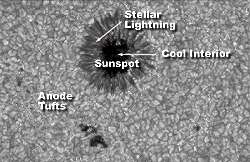
SunspotStellar lightning bolts are effective particle accelerators that can synthesize heavy elements in nuclear reactions at the surface of a star. The heavy elements seen in the Sun’s spectrum are created at the surface of the Sun, along with the few neutrinos we observe. That neutrino numbers seem to follow surface and external effects like sunspots and the solar wind is to be expected in an electric star. It is inexplicable in the thermonuclear model.

In the last few years a new class of faint stars has been discovered. They are called L-Type Brown Dwarfs because the element lithium appears in their spectra. They are the most numerous stellar objects in the galaxy and bridge the gap between stars and Jupiter-sized planets. They are too small to be shining from internal thermonuclear power. A further puzzle is that they radiate blue and ultraviolet light even though they are cool at a temperature around 950K. Water molecules dominate their spectra.

All of these puzzles are simply explained by an electric star. There is no lower limit to the size of a body that can accept electric power from the galaxy so the temperatures of smaller dwarfs will range down to levels conducive to life. The light of a red star is due to the distended anode glow of an electrically low-stressed star. The blue and ultraviolet light come from a low-energy corona. (Our Sun’s more compact red anode glow is seen briefly as the chromosphere during total solar eclipses. And the Sun is electrically stressed to the extent that bright anode “tufting” covers its surface with granulations and the corona emits higher energy ultraviolet light and x-rays as relativistic electrons strike it).
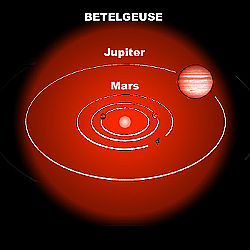
Betelgeuse
At the other extremity of size, Red Giants are a more visible and scaled-up example of what an L-type Brown Dwarf star might look like close-up. The Red Giant Betelgeuse is so huge that if it were to replace our Sun then Mercury, Venus, Earth, Mars and Jupiter would be engulfed by it. Astronomers recognize that such stars could swallow planets yet their plasma envelope is so tenuous that it would not impede the planetary orbits within the star’s atmosphere. However, astronomers believe that any planet it swallowed would be gradually vaporized by intense heat from the star’s core. But the standard stellar model has to be seriously fudged to explain Red Giants, their central temperature turns out to be so low that no known nuclear process can possibly supply the observed energy output. The electric model, on the other hand, works seamlessly from Supergiant star to a planet-sized Brown Dwarf.

Since an electric star is heated externally a planet need not be destroyed by orbiting beneath its anode glow. In fact life is not only possible inside the glow of a small brown dwarf, it seems far more likely than on a planet orbiting outside a star! This is because the radiant energy arriving on a planet orbiting inside a glowing sphere is evenly distributed over the entire surface of the planet.
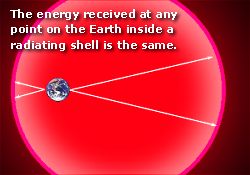
Radiant ShellThere are no seasons, no tropics and no ice-caps. A planet does not have to rotate, its axis can point in any direction and its orbit can be eccentric. The radiant energy received by the planet will be strongest at the blue and red ends of the spectrum. Photosynthesis relies on red light. Sky light would be a pale purple (the classical “purple dawn of creation”). L-type Brown Dwarfs have water as a dominant molecule in their spectra, along with many other biologically important molecules and elements. Its “children” would accumulate atmospheres and water would mist down. It is therefore of particular interest that most of the extra-solar planets discovered are gas giants, several times the size of Jupiter, orbiting their star extremely closely. It is our system of distantly orbiting planets that seems the odd one out. In fact it argues in favor of a galactic traffic accident between the Sun and a sub-Brown Dwarf like Jupiter or Saturn.

So let’s examine a second major plank of standard theory – that we understand where planets come from. The nebula theory of the origin of planets is so problematic that it only survives because no one has been able to come up with a better idea. A many-body system controlled by a single force, gravity, is inherently unstable and should fly to pieces. In an Electric Universe the model is simple. Planets are “born” from stars in a descending hierarchy of size by the highly efficient expedient of electrical splitting of an unstable positively charged core. That is why the majority of stars have partners. It explains why many of the extra-solar planets orbit their star extremely closely – that is where they were created. It is why Jupiter and Saturn have a large number of close-orbiting moons. Close orbits are normal. Distant or highly eccentric orbits are more likely to be a result of capture. An exchange between orbital and electrical energy quickly stabilizes orbits.

It can be seen that the Electric Universe model provides a superior environment for the establishment of life than a planet relying on a distant star and having to be self-sufficient for its atmosphere and surface deposits. Such a planet needs to rotate fairly quickly to even out the energy received and must have a small axial tilt for the same reason. It has only a limited range of orbits and eccentricity for life to survive. It also requires that the star maintains a steady radiance over millions of years. This is the Earth’s present situation and I believe Prof. Taylor is right in considering the chances for life to have begun and to have survived here are close to zero.

If the following sounds like science fiction, so be it. Science fiction writers are far better than experts at predicting future knowledge. What then might be the Earth’s history? The distant orbits from the Sun suggest that we were captured along with our Brown Dwarf parent. In the process, the electric power that drove our parent star was usurped by the Sun. As well as turning out the primordial light, the Sun stripped the Earth from its mother’s womb along with the Moon. Night fell for the first time and stars appeared. Ice ages began suddenly. The polar caps formed. High latitudes became uninhabitable. It is worth adding that many of the moons, or remaining offspring, of the gas giants have surprisingly icy surfaces and some have atmospheres. Life may have existed once on Mars and some of those moons.
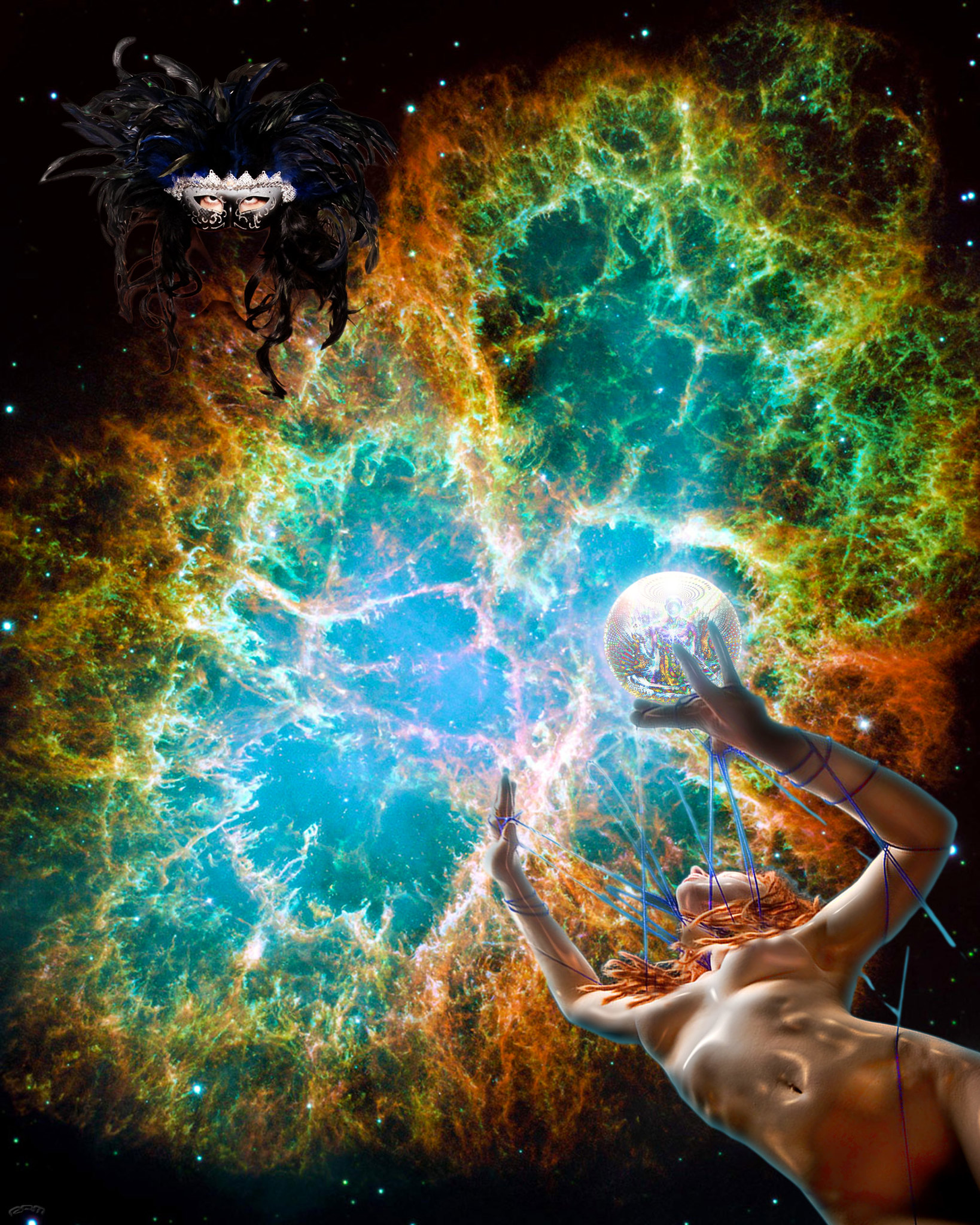
https://farm9.staticflickr.com/8480/8196107204_6068b68386_k.jpg The Electric Universe model has almost biological overtones that favor life. In the process of growing in a galactic electromagnetic pinch, stars are prevented from becoming too massive by “budding off” other stars and gas giant planets. Some progeny remain to form binary or multiple star families. Others escape from their parent. All receive their share of energy from the galaxy. The most common stars in the galaxy are also the dimmest, the L-Type Brown Dwarfs. These stars have the “food” required for life present in their atmospheres. Such a dwarf star/gas giant may undergo a nova outburst to eject part of its core to form dense Earth-like planets and moons. If they remain close to the parent they may be enveloped within the “womb” of the stellar anode glow where it seems the principal conditions for life are present. Our search for intelligent life should therefore focus on the faintest close stars in the sky. But there is a problem in relying on radio signals because they cannot pass through the hot plasma of an anode glow. (That could account for the lack of success of SETI so far). It would limit the ability of intelligent creatures living in that environment to know anything about the wider universe since they would not see stars. There would be no incentive for space travel which, in any case, might be a problem through the anode glow region. Maybe we on Earth are almost a “one off”, as Dr. Taylor says, to have survived an escape from our stellar cocoon to see the wider universe. If so, I hope we learn to use our privileged position wisely.

The most disturbing idea I have left to last: the words used by ancient civilizations that are interpreted today as “the Sun” – like the Egyptian “Ra”, the Greek “Helios”, and the Roman “Sol” – all originally referred to the gas giant Saturn! Was that planet our primordial parent? Was Saturn until recently a much larger brown dwarf? (The apparent size and color of an electric star is an electrical phenomenon. If Jupiter’s magnetosphere were lit up it would appear the size of the full Moon). Was ancient man around to see it as a sun? If not, why would anyone call a faint yellowish speck in the night sky – the Sun? Just how recently did Saturn get its icy ring? Does the discovery that the human race seems to have spread from a handful of survivors in the not so distant past have anything to do with this story? Oddly enough, an interdisciplinary approach can answer many of these questions in surprising detail. But it requires letting go of a lot of “things we know ain’t so”.

The present model of isolated self-powered stars with a family of relatively distant planets gives infinitesimally small windows of opportunity for life to gain a foothold, let alone sustain it for millions of years. An Electric Universe where energy is available to objects throughout the entire volume of a galaxy is an infinitely better environment for life. Faint, dwarf electric stars may be crucial to a radical reassessment of the likelihood of other intelligent life in the universe. Who knows, the Cassini mission to Saturn may be a kind of homecoming? It will return some surprises.

“Meanwhile, following the ages-old tradition of commemorating the Earth’s lucky escape from doom in a cosmic accident and its first new year in the solar system – I wish you all a HAPPY SATURNALIA!”


The Electric Universe - Conference 2014
(Playlist)


Image Credit: Dr. S. Ross Taylor – Photo by Darren Boyd.


For more information about the electric universe see http://nexusilluminati.blogspot.com/search/label/electric%20universe
- Scroll down through ‘Older Posts’ at the end of each section


Hope you like this not for profit site -
It takes hours of work every day by a genuinely incapacitated invalid to maintain, write, edit, research, illustrate and publish this website from a tiny cabin in a remote forest
Like what we do? Please give anything you can -  
Contribute any amount and receive at least one New Illuminati eBook!
(You can use a card securely if you don’t use Paypal)
Please click below -


Spare Bitcoin change?


For further enlightening information enter a word or phrase into the random synchronistic search box @ the top left of http://nexusilluminati.blogspot.com


And see


 New Illuminati on Facebook - https://www.facebook.com/the.new.illuminati

New Illuminati Youtube Channel - http://www.youtube.com/user/newilluminati


New Illuminati on Twitter @ www.twitter.com/new_illuminati


New Illuminations –Art(icles) by R. Ayana @ http://newilluminations.blogspot.com

The Her(m)etic Hermit - http://hermetic.blog.com


DISGRUNTLED SITE ADMINS PLEASE NOTE –
We provide a live link to your original material on your site (and links via social networking services) - which raises your ranking on search engines and helps spread your info further! This site is published under Creative Commons Fair Use Copyright (unless an individual article or other item is declared otherwise by the copyright holder). Reproduction for non-profit use is permitted & encouraged,  - if you give attribution to the work & author and include all links in the original (along with this or a similar notice).

Feel free to make non-commercial hard (printed) or software copies or mirror sites - you never know how long something will stay glued to the web – but remember attribution!

If you like what you see, please send a donation (no amount is too small or too large) or leave a comment – and thanks for reading this far…

Live long and prosper! Together we can create the best of all possible worlds…


From the New Illuminati – http://nexusilluminati.blogspot.com

Tuesday, 17 July 2012

The Myth of Black Holes

The Myth of Black Holes
20th Century science sucked into a false death trip to nowhere


Black Flares


Artist's conception of flaring black hole GX 339-4
Artist's conception of flaring black hole GX 339-4. Credit: NASA


Black hole theory contradicts itself.

Most astrophysicists try to explain narrow jets erupting from various sources by using words like “nozzle” or “high pressure,” contradicting the known behavior of gases in a vacuum. For example, according to a recent press release, “flares” have been discovered jetting from a source close to the center of our galaxy. Consensus opinions call that source a black hole.

As Poshak Gandhi from the Japan Aerospace Exploration Agency (JAXA) said, “If you think of the black hole’s jet as a fire hose, then it’s as if we’ve discovered the flow is intermittent and the hose itself is varying wildly in size.”

Discovered by the Wide-field Infrared Survey Explorer (WISE), GX 339-4 is approximately 20,000 light-years away. It is conventionally presumed to be at least six times more massive than the Sun, with a gravity field 30,000 times more powerful than Earth. GX 339-4′s extreme activity is supposed to be due to a companion star “feeding” its stellar matter into the black hole’s putative gravity well. However, some of that material gets blasted into space at close to light speed.

The mechanisms by which intense gravitational fields eject tightly collimated steams of matter are not understood. It is thought that strong magnetic fields are required, but the source of that magnetism is not known, since no mention of electricity exists in the reports about such phenomena.

Some flares and X-ray jets are thought to be generated by heat from molecular collisions, causing the gas to glow. As theories indicate, gamma rays might also appear when the super-accelerated matter is eventually sucked into the black hole. Excess heat, X-rays, and gamma rays are not created by gravity. In laboratory experiments, it has been found that they are most easily produced when charged particles are accelerated through an electric field.

Previous Picture of the Day articles about black holes suggested that the terminology used to describe “gravitational point sources” is highly speculative: space/time, singularities, and infinite density are abstract concepts, precluding a realistic investigation into the nature of the Universe.

Stars are nodes in electrical circuits. Electromagnetic energy could be stored in the equatorial current sheets surrounding them until some trigger event causes them to switch into a polar discharge. The electric jet could receive its energy from a natural particle-accelerator, a “plasma double layer” with a strong electric field. Toroidal magnetic fields would form because of the polar plasma discharge, confining it into a narrow channel.

Axial electric currents should be flowing along the jet’s entire length. Only electric fields can accelerate charged particles across interstellar space.

There is no evidence that matter can be compressed to “infinite density.” Z-pinches in plasma filaments form plasmoids that become stars and galaxies. Electricity is responsible for star birth, as well as death. When current density gets too high, double layers in the stellar circuit catastrophically release excess energy, appearing as gamma ray bursts, or X-rays, or thermal flares.


Black Hunger


Supposed black hole
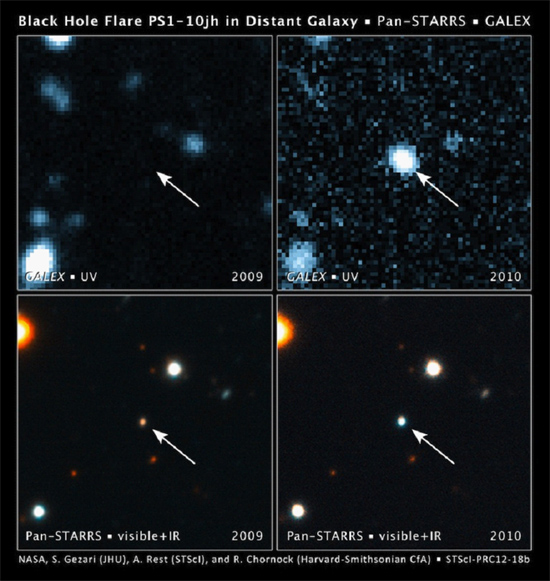
Supposed black hole causes a flare in the nucleus of a distant galaxy. Credit: NASA/JPL-Caltech/JHU/STScI/Harvard-Smithsonian CfA


Problematic black hole physics is in the news again.

In a recent press release from the Galaxy Evolution Explorer and the Pan-STARRS1 telescope in Hawaii, astronomers announced “direct evidence” for the existence of a supermassive black hole (SMBH) in another galaxy. The high frequency ultraviolet spectrum, as well as the infrared light from the two detectors, seems to indicate the “shredding” of a star near the center of a galaxy 2.7 billion light-years away.

Black holes have been discussed many times in previous Picture of the Day articles. They owe their existence to mathematical legerdemain, and can have nothing to do with the substantive Universe because they are said to occupy a region where the laws of space and time break down.

Black holes are said to cause space and time itself to twist and warp so that the past becomes the future and velocity calculations yield impossible solutions. According to standard theories, matter inside of a black hole occupies no volume at all, yet retains gravitational acceleration so great that not even light can escape its attraction—thus they are “black” holes because they cannot be detected with optical telescopes. Although they are impossible to observe directly, over 90% of galaxies in the Universe are supposed to harbor these perilous maws

The terminology used by astrophysicists to describe black holes is highly problematic, relying on “explanations” derived from loose interpretations. Ambiguous labels such as space/time, singularities, infinite density, and other ideas that are not quantifiable have introduced irony into what should be a realistic investigation into the nature of the Universe.

According to Suvi Gezari, an astronomer from Johns Hopkins University, “When the star is ripped apart by the gravitational forces of the black hole, some part of the star’s remains falls into the black hole, while the rest is ejected at high speeds. We are seeing the glow from the stellar gas falling into the black hole over time.”

NASA’s Chandra X-ray Observatory also looked at the hot material in order to see if it matched the emissions normally seen in an “active galactic nucleus”. Their results indicated that the spectrum observed by Gezari’s group did not conform to those prior observations.

Flares and X-ray jets spewing from galaxies are thought to be caused by stars traveling too close to their central supermassive black holes where they are torn apart by tidal forces. Most of the star’s gas escapes the black hole, but a small quantity is captured by the immense gravity and forms a rotating disk. Closer to the black hole, heat generated by molecular collisions tears the atoms apart and the disk of gas glows in extreme ultraviolet and X-rays. When matter eventually falls into the black hole, gamma rays can also explosively burst out.

X-rays in space are not created in gravity fields. Laboratory experiments most easily produce them by accelerating charged particles through an electric field. No gigantic masses compressed into tiny volumes are necessary and they are easily generated with the proper experimental models.

To say that gas can be heated by gravity until it emits X-rays indicates a serious lapse on the part of the GALEX research team. Molecules of gas cannot remain intact at million degree temperatures because electrons are stripped from the atomic nuclei, causing them to become ionized. Instead of hot gas, the galactic radiation should be referred to by its proper name: plasma.

An electric current in plasma generates a magnetic field that constricts the flow of charge. The constricted channel is known as a Bennett pinch, or z-pinch. The “pinched” filaments of electric current remain coherent over large distances, spiraling around each other, forming helical structures that can transmit power through space.

As we have noted in the past, Hannes Alfvén identified the “exploding double layer” as a new class of celestial object. It is double layers in space plasmas that form most of the unusual structures we see. Stellar explosions, jets, rings, and glowing clouds—these are all examples of electricity flowing through dusty plasma confined within Birkeland currents that stretch across the light years.

Retired Professor of Electrical Engineering Donald Scott, author of The Electric Sky, wrote about the way plasma acts in the Universe: “Plasma phenomena are scalable. Their electrical and physical properties remain the same, independent of the size of the plasma. In a laboratory plasma, of course, things happen much more quickly than on, say, galaxy scales, but the phenomena are identical—they obey the same laws of physics. In other words we can make accurate models of cosmic scale plasma behavior in the lab, and generate effects that mimic those observed in space. It has been demonstrated that plasma phenomena can be scaled to fourteen orders of magnitude. (Alfvén hypothesized that they can be scaled to 28 orders or more!) Electric currents flowing in plasmas produce most of the observed astronomical phenomena that remain inexplicable if we assume gravity and magnetism to be the only forces at work.”

Irrespective of their source, X-rays in space are not created by gravitational fields regardless of how strong they are theorized to be. Since plasma is composed of charged particles, the particles are accelerated by electric currents and spiral in the resulting magnetic fields, creating synchrotron radiation that can shine in all high energy frequencies, including extreme ultraviolet, X-rays, and gamma rays.


Stars That Will Not Explode


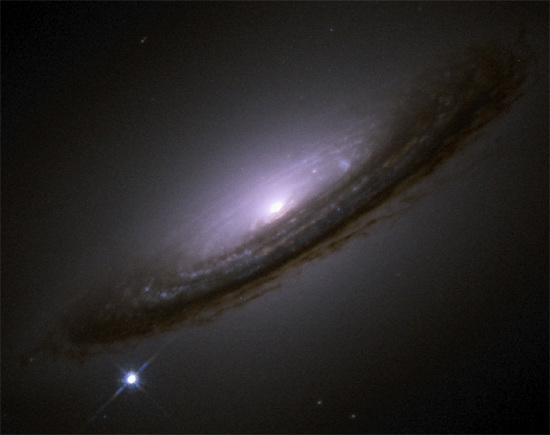
SN1994D, a supernova in NGC 4526
SN1994D, a supernova in NGC 4526. Credit: High-Z Supernova Search Team, HST, NASA


NASA computer simulations are not able to correctly model supernova explosions.

Contemporary astrophysical models of stellar evolution rely on the mechanical action of cold gas collapsing from gravitational impetus. Stars are seen as whirling vortices of compressed matter heated to fusion temperatures by pressure, alone.

Clouds of gas and dust a thousand times less dense than a puff of smoke are said to be drawn into a region of increased density that coaxes even more material to collect there. Eventually, molecules within the cloud fall into a gravity well of nuclear fusion, initiating a self-sustaining reaction.

According to consensus opinions, stars that are extremely massive live fast and die young. They “fuse” their hydrogen and helium into heavier elements that, in turn, fuse into elements that are heavier still. In their senescence, the radiative emissions from such stars are thought to be so intense that gravity can no longer confine their energies and they “blow away” enormous quantities of stellar material in a supernova explosion. In some cases, they lose mass up to a million times faster than our own Sun. However, that process is highly speculative.

According to a recent press release, “Many of the best computer models of supernovas fail to produce an explosion.” Instead of the stellar simulation collapsing and rebounding like a supernova ought to do, gravitational forces are so great that a rebound does not occur after collapse.

On June 13, 2012 NASA launched the Nuclear Spectroscopic Telescope Array (NuSTAR) in an attempt to analyze high-energy X-rays in what are thought to be the remnants of exploded stars. NuStar joins other X-ray space telescopes like Chandra and XMM-Newton, except that it is capable of focusing X-rays to a sharp point, enabling it to “see” energies up to 79,000 electron-volts. That capability makes it more than 100 times more powerful than the others.

Astronomers predict that the titanium-44 isotope will help them improve their computer models. Since titanium-44 is thought to be created by nuclear fusion in stars not quite heavy enough to form hypothetical black holes, in their understanding, it should be visible in the debris left behind by objects such as SN1994D, shown at the top of the page.

Many previous Picture of the Day articles point out that stars are not simplistic balls of gravitationally compressed hot gas, they are composed of plasma. Plasma is ionized, meaning that one or more electrons have been stripped from the atoms in its substance, so it is electrically charged. Plasma does not behave like a pressurized gas, it behaves according to the tenets of plasma physics.

Laboratory experiments confirm that electricity flowing through plasma forms regions separated by thin walls of opposite charge called double layers. This is the “charge separation” so often mentioned in these pages. Could charge separation be the foundation for the electrical explosions known as supernovae?

Electric Universe theory agrees with conventional astrophysics in that a supernova can be referred to as an “exploding star.” However, in an electrically charged plasma star, that explosion is due to the breakdown of double layers. The power that fuels the stars comes from external currents of electric charge flowing through vast circuits in space. Rather than “core rebound” or “white dwarf accretion,” supernovae are the result of a stellar “circuit breaker”, where the stored electromagnetic energy in the circuit is suddenly focused at one point.

When a star’s double layer explodes, the electromagnetic energy stored in a vast galactic circuit flows into the explosion. The resulting supernova radiation is emitted across the entire electromagnetic spectrum from radio to gamma rays.

Electric Universe advocate Wal Thornhill wrote: “How does a star explode? The conventional ‘implosion followed by explosion’ model has many shortcomings. An electric star, on the other hand, has internal charge separation which can power a star-wide, expulsive lightning-flash. The star relieves electrical stress by fissioning or blowing off charged matter. A star also has electromagnetic energy stored in an equatorial current ring. Matter is ejected equatorially by discharges between the current ring and the star. Our own Sun does it regularly on a small scale. However, if the stored energy reaches some critical value it may be released in the form of a bipolar discharge, or ejection of matter, along the rotational axis.”

Since stars can be thought of as the focus for immense energy from the galaxies in which they live, their activity cannot be based on whether they possess a certain mass, or a particular elemental constitution. Rather, they are not internally powered objects at all; they are bodies formed electromagnetically where gigantic plasma filaments have squeezed matter in what is called a “z-pinch.” That is how stars are born and that is where the seeds of supernovae are planted.


Radio Elliptical


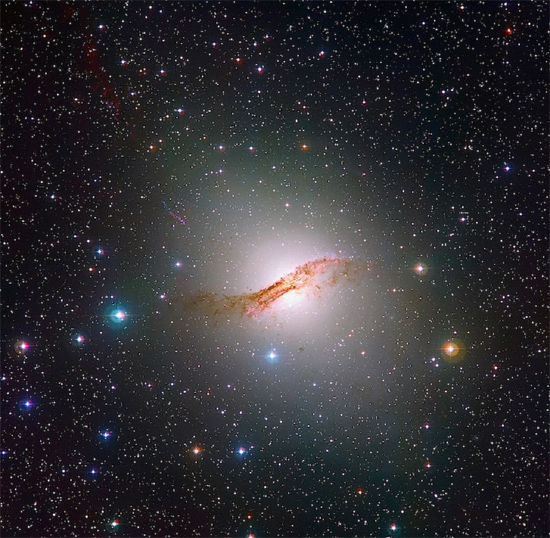
NGC 5128
The Centaurus A galaxy (NGC 5128). Credit: ESO


One of the largest “active galaxies” is thought to be powered by a supermassive black hole. Electrical energy is a more likely driving force.

A recent press release from the European Southern Observatory (ESO) announces that the elliptical galaxy Centaurus A is ejecting a light-years long jet of material because a “supermassive black hole [is] at its heart”. Astronomical theories state that the radio-bright nucleus and the jet come from the compression of interstellar material as it is drawn into a central black hole possessing a mass greater than 100 million average stars.

From gamma-rays down through X-rays and extreme ultraviolet, conventional theories have relied on gravity and acceleration for radiation to be produced in space. Compressing hydrogen gas and dust is supposed to create enough transfer of momentum that it reaches temperatures in the millions of degrees. That high temperature is supposed to make the gas and dust glow brightly and emit high-frequency radiation.

Since the idea that electricity flows through the Universe is commonly met with resistance by today’s consensus, its influence and attributes are unseen. It has long been said that “seeing is believing”. However, it should not be surprising that “believing is seeing” appears to be more apt. When there is no inner experience, outer realities can often remain invisible.

Electric currents surge out along galactic spin axes, forming double layers that, like those in Centaurus A, can be seen as radio “lobes.” The electric charges spread out around the galactic circumference, flowing back to the core along the spiral arms. Since the elements in a galactic circuit radiate energy, that energetic radiance shows that they are powered by larger circuits. The extent of the larger circuits may be traced by radio telescopes through the polarized radio “noise” coming from them.

The fact that moving charges constitute an electric current that can generate magnetic fields has been known since the days of Michael Faraday. However, a lack of appropriate training often means a lack of vision. As previously stated, moving charged particles constitute an electric current, and that current is wrapped in a magnetic field. When more charged particles accelerate in the same direction, the field gets stronger.

Something that researchers do not consider is that for charged particles to move, they must move in a circuit. Energetic events cannot be explained by local conditions, alone. The effects of an entire circuit must be considered. For that reason, while the consensus scientific worldview only permits isolated “islands” in space, the Electric Universe emphasizes connectivity with an electrically active network of “transmission lines” composed of Birkeland current filaments.

Double layers and plasmoids expand and explode, throwing off plasma that can accelerate to near light-speed. Jets from opposite poles of a galaxy end in energetic clouds emitting X-ray frequencies, or radio waves. Those phenomena are based in plasma science and not gas kinetics, gravity, or particle physics. Astrophysicists see magnetic fields but not the underlying electricity, so they are at a loss to explain them.

Astronomers maintain that galaxies are clouds of hydrogen gas and intergalactic dust that were assembled by gravity until they coalesced into glowing thermonuclear fires. The conventional community also proposes that most galaxies contain black holes of unbelievable magnitude. It is those “gravitational point sources” that are supposed to cause the galaxies to spin, jets of gamma-rays to appear, and the radio lobes to form.

The Electric Universe theory does not adhere to the idea of galaxies condensing out of cold, inert hydrogen and specks of zircon no bigger than a molecule. So, what are galaxies?

In 1981, Hannes Alfvén said that galaxies are much like one of Michael Faraday’s inventions, the homopolar motor. A homopolar motor is driven by magnetic fields induced in a circular conducting plate. The plate is mounted between the poles of an electromagnet, causing it to spin at a rate proportional to the input current.

Galaxies move within filamentary circuits of electricity that flow through the cosmos from beginning to end. We see the effects of those electromagnetic fields because electricity organizes itself within masses of plasma sometimes larger than galaxy clusters. That plasma is primarily composed of neutral atoms, but free electrons, protons, and other charged particles are also present.

Plasma’s behavior is governed by those circuits. Double layers with large voltages between them often exist. The electric forces in double layers are incomparably stronger than gravity. Double layers broadcast radio waves over a wide range of frequencies. Most significant to the ESO bulletin, they can accelerate charged particles to extreme energies.

This vision of the cosmos sees various components coupled to and driven by circuits at ever larger scales, so electrons and other ions accelerated through intense electric fields radiate “shouts” of energy in many bandwidths. It is that story that should be told and not the one about omnipotent gravity.

-         Stephen Smith


From http://www.thunderbolts.info/wp/2012/04/10/black-flares-2/  and http://www.thunderbolts.info/wp/2012/05/24/black-hunger/ and http://www.thunderbolts.info/wp/2012/06/19/stars-that-will-not-explode/ and http://www.thunderbolts.info/wp/2012/05/22/radio-elliptical/

For more information on our electric universe see  http://nexusilluminati.blogspot.com/search/label/electric%20universe and http://nexusilluminati.blogspot.com/search/label/electric%20sun
For more about black holes see http://nexusilluminati.blogspot.com/search/label/black%20holes


Help This Unique Independent Site Survive
Donate any amount and receive at least one New Illuminati eBook!
Just click in the jar -


For further enlightening information enter a word or phrase into the search box @  New Illuminati or click on any label/tag at the bottom of the page @  http://nexusilluminati.blogspot.com

And see


 New Illuminati on Facebook - https://www.facebook.com/the.new.illuminati

New Illuminati Youtube Channel - http://www.youtube.com/user/newilluminati/feed


The Her(m)etic Hermit - http://hermetic.blog.com


The Prince of Centraxis - http://centraxis.blogspot.com (Be Aware! This link leads to implicate & xplicit concepts & images!)


This site is published under Creative Commons Fair Use Copyright (unless an individual item is declared otherwise by copyright holder) – reproduction for non-profit use is permitted & encouraged, if you give attribution to the work & author - and please include a (preferably active) link to the original along with this notice. Feel free to make non-commercial hard (printed) or software copies or mirror sites - you never know how long something will stay glued to the web – but remember attribution! If you like what you see, please send a small but heartfelt donation or leave a comment – and thanks for reading this far…

Live long and prosper!


From the New Illuminati – http://nexusilluminati.blogspot.com