Martian Cataclysm:
Impact energy analysis in support
of the origin of multiple anomalies on Mars

Now in a new study aerospace engineer Gary R. Spexarth re-examines the evidence of the Martian cataclysm. The heavily-cratered surface of Mars is generally estimated to be over 3 billion years old, he notes: “But what if it isn’t 3 billion years old. What if the impacts did not occur slowly throughout the life of the planet but rather occurred suddenly, in a short amount of time. We may find that the current surface of Mars may only be thousands of years old instead of billions! Maybe in the near past it still had running water and an atmosphere! The implications of such are astounding!”
Background
Mars has several strange and unique features that have traditionally been explained based on standard geological processes thought to have taken place over billions of years (erosion, mantel convection, etc.) – thus suggesting that the planet has remained unchanged for three billion years. However, by analyzing Mars from an engineering perspective (rather than a geological one), a violent and cataclysmic past is unveiled. This paper looks at multiple anomalies of Mars, shows how they may be interrelated, and describes a very possible scenario, supported by analysis, that could have led to a violent and sudden transformation of the planet – possibly within a more recent timeframe.
In the Southern Hemisphere of the planet is a massive crater called the Hellas Impact Basin. It is approximately 2300 km in diameter and over 5 km deep. [1], [2]. This paper will show that the energy created by this impact was sufficient enough to destroy the planet and leave it in the cataclysmic state that we find it today.
Interestingly enough, there is a massive bulge in the planet exactly 180 degrees from the Hellas Basin [3] called the Tharsis Montes [1]. The Tharsis Montes is a region of “uplift” that rises 10 km above datum (average Mars elevation) and measures 4000 km across [1]. Additionally, located in the Tharsis region are several volcanoes, including Olympus Mons, the largest volcano in the solar system, at an elevation of over 20 km high. Adjacent to Olympus Mons is the Valles Marineris, a massive canyon system in the planet that is approximately 4000 km long and 7 km deep [1] (approximately the distance from California to New York). Another interesting region is the Northern Lowlands, which is located in the northern hemisphere and lies at 8 km below datum.
The above features can be seen in Figures-1 & 6, which were produced by the Mars Orbital Laser Altimeter instrument [4]. The maps are color-coded topography maps, with elevations shown in their legends.
In addition, the rate of rotation of Mars is much slower that expected, compared with the angular momentum of the rest of the terrestrial planets [5]. Also, Mars has a “deficient” magnetic field. It has been estimated that the magnetic field is two orders of magnitude less than is expected, based on its physical properties [6]. There are also evidence of past oceans that are now dried up, and a once-present atmosphere that no longer exist. Another strange feature is that 93% of craters greater than 30 km in diameter lie in the southern hemisphere [7].
Could it be that these anomalies are actually battle scars that have been caused by a massive impact (Hellas Basin) that destroyed the planet? This paper will show, and provide supporting mathematical analysis, that this may be the case.
Although the traditional geological explanation of these features state that Mars has essentially remained unchanged for billions of years, this paper will show that a violent and destructive transformation could have taken place in our near past and we may never know the exact timeframe until we visit and explore the planet firsthand.
 Figure-1: MOLA Topography Globe with
Items of Interest Labeled [4] (labels added by author)
Figure-1: MOLA Topography Globe with
Items of Interest Labeled [4] (labels added by author)Impact Energy of Hellas
First, let’s look at the impact energy of the Hellas Basin so that it may be determined if enough energy was transferred to the planet to cause massive destruction.
The calculation of the Hellas energy of impact is given in Appendix I and is shown to be 5.33×1026 Joules. By comparison, the impact energy of the K/T impact over 65 million years ago that extinguished 75% of life on Earth and excavated a crater at least 200 km in diameter (Chicxulum in Mexico) was 4.21×10²³ Joules [12].
It can be seen that the energy imparted to the Mars system by the Hellas Impactor is over 1200 times more energy than was input into the Earth system by the K/T impactor, and Mars is only 1/8 the volume of Earth! It will be shown that this amount of energy is capable of extensive global transformations and destruction of Mars.
Formation of Valles Marineris and Tharsis Montes
The formations of the Tharsis Montes and the Valles Marineris are still a topic of debate. It has been suggested that they have been formed out of geological processes such as volcanism, erosion, etc [13].
However, Patten suggests that Valles Marineris is a rupture in the Mars surface due to massive multiple impacts in the Southern hemisphere [7]. Similarly, Williams, et. all proposed that the Tharsis Region is a formation of impact-induced features, which are created as the energy of the Hellas Impact is attenuated through the interior of the planet, and focused 180 degrees from the Hellas impact (Tharsis Montes) [3].
But, was there enough energy associated with the massive impact that created the Hellas Basin to bulge the planet on the other side and rupture the surface of the planet? Appendix II derives the equations for, and computes, the energy required to rupture Mars.

Figure-3: Formation of the Tharsis Montes and Valles Marineris
Credit: G. Hancock
For analysis purposes, Mars will be treated as a thin-walled spherical pressure vessel. When performing structural analysis of pressure vessels, the equations for thin-walled pressure vessels should be used when the ratio of the radius to the wall thickness is greater than 10 [14]. Willemann and Turcotte [15] show that the Mars lithosphere thickness is estimated to be anywhere from 110 km to 260 km. Therefore, the ratio of the radius of Mars (3375 km) to the lithosphere thickness may range from 30 to 13 and the equations for thin-walled pressure vessels apply.
Appendix II shows that the energy required to rupture the Martian lithosphere is calculated to be 1.90×1026 to 4.50×1026 Joules (depending on the lithosphere thickness assumed), which is 36% to 84% of the total energy input to the Martian system by the Hellas impactor. In other words, only 36% to 84% of the total energy created by the Hellas impact would be required to rupture the planet. So, yes, there was sufficient energy to rupture the planet and form the Valles Marineris!
Excessive yielding prior to ultimate failure would deform the lithosphere at the location of rupture; thus “bulging the planet” and forming the Tharsis Montes, which is located at the 180 degrees away from the Hellas Basin [3]. This has been discussed by Hancock [18] as illustrated in Figure-3 [18].
Failure Features at the Tharsis Montes
Figure-4: Six-sided star pattern observed in
the rupture of thin-walled pressure vessels in a laboratory experiment [19],
[20].
Hypervelocity impact tests of thin-walled pressure vessels pressurized with liquid have shown that the failure modes of the vessels caused by internal pressure increase produce six-sided petal-shaped formations as shown in Figure-4 [19] [20]. Similarly, Figure- 5 [21] shows six and twelve-sided petal formations during the rupture of an apple due to the pressure build-up of a bullet’s shock wave passing through it.
Figure-5: Six and 12-sided star patterns observed in the rupture of an apple in
a laboratory experiment [21].
The exact same type of six-petal shape formation can be seen in the Tharsis Montes region, as shown in Figures 6 and 7!
In fact, when analyzing the Tharsis Montes region, radial features originating at the center of the Tharsis Montes were discovered by de la Fuente [22]. The volcanoes and crustal fractures lie at 60-degrees to one another, thus forming a typical six-sided rupture formation! (This formation is also observed on 3- dimensional globes, and is not an artifact of 2- dimensional maps).
These radial fractures may have been the source of the massive volcanoes observed in the Tharsis region, as well as the initiation of the Valles Marineris as a rupture in the lithosphere.
In addition, several radial fractures extend to the south, west, and north of the Tharsis uplift that are a few kilometers wide and hundreds of kilometers long. Orientations of these structures are consistent with the stress distribution that is to be expected from regional doming. [23]
 Figure-6: MOLA Topography Map of Mars with 6-Sided Petal Formation Shown. This
pattern is typical during rupture of thin-walled pressure vessels [4] (radial
lines and labels added by author) (formation best observed on color map)
Figure-6: MOLA Topography Map of Mars with 6-Sided Petal Formation Shown. This
pattern is typical during rupture of thin-walled pressure vessels [4] (radial
lines and labels added by author) (formation best observed on color map)The radial fractures identified in the Tharsis Montes region provide evidence that the Tharsis Montes region may have been formed due to an internal pressure build up, rather than through geological processes.
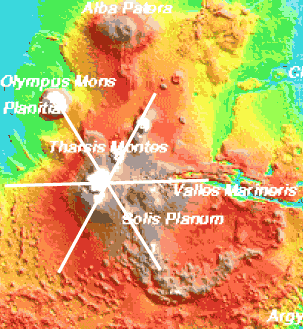
Figure-7: Six-sided star patter observed in the Tharsis region. This pattern is
typical during rupture of thin-walled pressure vessels. [19], [20], [21]
(radial lines added by author) (formation best observed on color map)
In other words, the internal pressure buildup due to the massive Hellas impact quite possibly ruptured the planet (Valles Marineris), bulged the planet (Tharsis Montes), and formed 60-degree radial fractures (typical of pressure failures) with massive volcanoes originating along these fractures.
Formation of the Northern Lowlands
The Northern region of Mars is a topic of much interest because it is 5 km below datum (“sea level”) and the Tharsis Bulge is 10 km above datum [1]. Why is almost half of the planet so much lower in elevation than the rest?
The Tharsis Bulge and the Northern Lowlands can be seen in the topography map and globe produced by MOLA (Figures 1 & 6). These two features have not been previously thought to be directly related. However, one must consider the possibility that the Northern Lowlands are actually a direct result of the planet bulging to create the Tharsis Montes.
The following analysis will show that “bulging” at Tharsis Montes may have actually “pulled” the adjacent region inward, thus forming the Northern Lowlands. Referring to Figure-8, the following arc-lengths are defined as:
A1 = Original arc-length of Tharsis Region (at original elevation of Mars Datum)
A2 = Arc-length of Tharsis Region after formation of bulge
B1 = Original arc-length of Northern Lowlands (at original elevation of Mars Datum)
B2 = Arc-length of Northern Lowlands after formation (due to formation of Tharsis Bulge)
Rdatum = 3375 km = Average diameter of Mars
A1 is 4000 km, which is the diameter of the Tharsis Bulge base [1].
Since the Lowlands occupy approximately 90o of the Mars surface, B1 can be calculated to be 5300 km.
 (25)
(25) (25)
(25)Assuming that this increase in arc-length of the Tharsis Region is taken up by the deformation of the Northern Lowlands, 8 km can be subtracted from B1 to determine B2.
5300 km – 8 km = 5292 km = B2 (26)
The reduction in elevation due to the decrease in arclength of the Northern Lowlands can now be calculated.
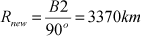 (27)
(27)Rnew = The radius of the Northern Lowlands due to the reduction of arc-length.
Rdatum – Rnew = 5 km, which is the average elevation that the Northern Lowlands lie below datum.
Therefore, the increase of arc-length required to form the Tharsis Bulge (A2-A1) corresponds exactly to the reduction of arc-length of the Northern Lowlands (B1- B2) as well as the lower elevation of the Northern Lowlands, as shown in Figure-8 where A1, A2, B1, and B2 are arc-lengths.
Thus, the Northern Lowlands may, in fact, be a direct result of the “bulging” of the Tharsis region! In other words, as the Tharsis Region “bulged” outward, the adjacent region was “pulled” inwards, thus forming the Northern Lowlands.
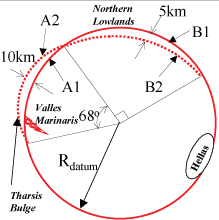
Figure-8: The increase of Arc-length in
the Tharsis Region corresponds to the reduction of arc-length in the
Northern-lowlands, (A2- A1)=(B1-B2). The solid line is the shape of Mars prior
to impact. The dashed line is the exaggerated, deformed shape of Mars after the
impact.
Reduction of Mars Rotation.
The rotational rate of Mars is slower than predicted when compared to the angular momentum of the rest of the terrestrial planets [4], [8].
Was the energy of impact at the Hellas Basin great enough to actually reduce the rate of spin of the planet?
By calculating the kinetic energy of the rotating Martian lithosphere, we can determine the amount of energy that would be required of the Hellas Impact to significantly reduce the Mars spin rate. Only the thickness of the lithosphere is taken into account since it is the only portion of the planet capable of sustaining load, and thus reacting to the force of impact.
Appendix III derives the equations for, and computes, the energy required to reduce the rotational rate of Mars.
The energy required to reduce the Mars spin rate by 20% (19.5 hr day to the current 24.5 hr. day) is computed to be between 4.42×1025 and 9.56×1025 Joules (depending on the thickness of lithosphere assumed, 110 – 260 km). This is only 8% to 18% of the total energy of impact of the Hellas Basin. In other words, there was sufficient amount of energy in the Hellas impact to slow the rate of rotation down by 20%.
Therefore, it can be seen that the Hellas impactor imparted enough energy into the Mars system to substantially reduce its rate of spin.
Loss of Planetary Magnetic Field.
If Mars had an active dynamo at one time, than at least parts of the surface of Mars should possess remnant magnetization [6]. Indeed, the Mars Pathfinder mission produced evidence of surface magnetization during its analysis of the Martian terrain [24]. In addition, the latest Mars Global Surveyor data has led researchers at the NASA Jet Propulsion Lab to conclude that Mars still has a liquid iron core, similar to Earth’s. [25]
Therefore, it is reasonable to conclude that Mars at one time likely had a functioning dynamo process, and in turn, a global magnetic field.
In order for the magnetic field to be sustained in the dynamo process, the contributions of the fluid motion that causes the field to grow must be balanced by the rate of decrease from diffusion [26]. This ratio is on the order of the magnetic Reynolds number [26].
Due to the dynamic nature of the Hellas Impact, one must speculate if the sudden reduction of Mars’ rotation, as well as intense pressure waves passing through the liquid core, may have disrupted the fluid flow of the liquid iron core, and thus alter the magnetic Reynolds Number to such a degree that the dynamo could no longer sustain itself.
Unless specific conditions are met, the planetary dynamo is non-regenerative [26]. Therefore, the planetary magnetic field would remain at a depleted level, and Mars would be in the state that we find it in today.
Loss of Atmosphere and Surface Water
The loss of a planetary magnetic field has planetary-wide implications. One of them is the loss of an entire atmosphere.
It has been estimated that at one time in its past, Mars must have had an atmospheric pressure of approximately 14.5 psi, which is the same as the current atmospheric pressure of Earth! However, without a magnetic field to protect Mars from the Sun’s solar wind, its atmosphere would have been “etched” away and “blown” into space and leave it with the minimal amount of atmosphere that it has today (0.10 psi) [28], [1].
In addition, due to its small radius and low gravitational field, Mars is vulnerable to impact erosion (the process in which the shock waves and/or vapor plumes from impacts etch away portions of the atmosphere). In fact, it has been estimated that the extensive bombardment that Mars has experienced is sufficient to etch away and deplete its atmosphere from 14.5 psi to its current state of 0.10 psi. [27], [29]
With such a low atmospheric pressure, all of the surface water that is believed to once existed, including massive oceans, would have boiled away.
Massive Cratering in the Southern Hemisphere.
The previous sections dealt only with the Hellas crater. But what if the entire Southern Hemisphere experienced massive bombardment in a relatively short period of time?
93% of craters greater than 30 km lie in the southern hemisphere [7]! Why is it that most of the craters lie in the Southern Hemisphere? Current theory suggests mantel convection as the cause [30]. In other words, it is believed that there used to be about the same density of craters in the North, just as in the South, but the mantel overturned due to convection and the craters were lost forever.
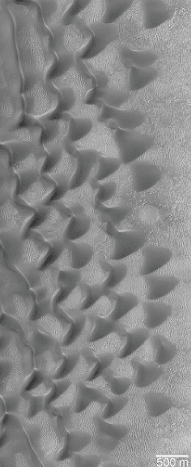
Figure-10: This image, taken in early September 2000 by the Mars Global
Surveyor’s Mars Orbiter Camera, shows a group of sand dunes at the edge of a
much larger field of dark-toned dunes in Proctor Crater. Such sand formations
erosion patterns would make it difficult to distinguish between the ages of
craters based only on the “sharpness” of their rim features.
Recently, it has been proposed that the Southern Hemisphere was bombarded in a relatively short period of time due to an object that broke up prior to impact [7]. It is interesting to note that the two moons of Mars are not spherical, but rather potato shaped. Are they remnants of the object that broke up and impacted the Southern Hemisphere?
Also, the boundary of the Southern Craters forms a great circle (a circle with a circumference that is equal to the distance around the equator). In other words, if Mars were a wet beach ball and a handful of sand was thrown at it, the sand would stick on only one side of Mars. The boundary of the sand would form a great circle. In fact, the boundary of the Southern Craters form a great circle! This can partially be seen in Figure- 1.
In addition, Mars has over 170 elliptical craters greater than 3 km (compared to only 4 or 5 on the Moon). Elliptical craters are formed when an impact occurs at a shallow angle. [31] Shallow angle impacts would be expected if the Southern Hemisphere was bombarded during one massive “blast” of impacts. In fact, many of the elliptical craters are orientated along great circles. [32]
Critics argue that the Southern Hemisphere could not have been bombarded at the same time because some of the crater rims are sharp, while others are eroded. It is thought that this is a clear sign that the impacts occurred at vastly different times, since the older craters would have more of an eroded rim than newly formed craters.
However, shouldn’t different rim patterns be expected on a planet that has dust storms, even if the craters are the same age? The Mars dust storms would surely form all kinds of different erosion formations along crater rims over thousands of years, independent of their true age. In fact, recent Mars photos have shown various erosion patterns and “sand dunes” due to the Mars winds as shown in Figure-10. This type of surface process could conceal the actual age of the craters.
The age of planet surfaces are estimated based on the number of craters that are counted. In other words, the surfaces with the more craters are older. By counting craters on the moon and measuring the amount of solar radiation in the craters during the Apollo missions, the age of the lunar surface was estimated. By assuming that projectiles impacted Mars with the same frequency that they hit the moon, it has been estimated that the surface of Mars is over 3 billion years old [31].
But, what if it isn’t 3 billion years old? What if the impacts did not occur slowly throughout the life of the planet, but rather, they occurred suddenly, in a short amount of time, and the surface erosion is masking their true age to us distant observers? Then we have no way of dating the surface without actually going there and investigating. We may find that the current surface of Mars may only be thousands of years old instead of billions! Maybe in the near past it still had running water and an atmosphere! The implications of such are astounding!
10. Conclusion
Are we sure we understand the cloudy past of Mars? Are we sure we are not making profound mistakes in our assumptions? At one time we were so sure that the Earth was flat, then we were convinced that the Earth was the center of the universe, then we were sure that the Sun was the center of the universe. And now we are “sure” that the features of Mars were formed from geological processes and the surface has been dead for over 3 billion years…
This paper has just laid out an alternative, cataclysmic history of Mars, one in which the implications are profound.
We must explore Mars and challenge our current perceived truths! Only then will we unlock its secrets! The answers that we find may be more surprising than we could ever imagine!
Appendix I (pdf)
Appendix II (pdf)
Appendix III (pdf)
Author: Gary R. Spexarth
gspexarth@gmail.com
Graham Hancock THE MARS MYSTERY Interview
(1:22:28)
References
- Cattermole, P. 1992. Mars, The Story of the Red Planet. Chapman & Hall, London.
- Tanaka, K.L., et al. 1992. Global Stratigraphy. In: Kieffer, H.H., Jakosky, B.M., Snyder, C.W., Mathews, M.S., Mars, The University of Arizona Press, Tuscon, pp. 345-382.
- Williams, D.A. and Greely, R. 1994. Assessment of Antipodal-Impact Terrains on Mars. Icarus 110, 196-202.
- Mars Orbiter Laser Altimeter (MOLA), NASA/GSFC, http://ltpwww.gsfc.nasa.gov/tharsis/mola.html.
- Fish, F. 1967. Angular Momenta of the Planets. Icarus 7, 251-256.
- Luhmann, J.G., et al. 1992. The Intrinsic Magnetic Field and Solar-Wind Interactions of Mars. In: Kieffer, H.H., Jakosky, B.M., Snyder, C.W., Mathews, M.S., Mars, The University of Arizona Press, Tuscon, pp. 1090- 1134.
- Patten, D.W. 1991. The Scars of Mars. In: Luckerman, M.A., Catastrophism and Ancient History, Vol. 13, Part 1.
- Chabai, A.J. 1977. Influence of Gravitational Fields and Atmospheric Pressures on Scaling of Explosion Craters. In: Roddy, D.J., Pepin, R.O., Merrill, R.B., Impact and Explosion Cratering, Pergamon Press, pp. 1191-1214. [9] Holsapple, K.A. and Schmidt, R. M. 1982. On the scaling of Crater Dimensions 2. J. Geophys. Res. 87, 1849- 1870.
- Remo, J.L. 1994. Classifying and Modeling NEO Material Properties and Interactions. In: Gehrels, T., Hazards Due to Comets & Asteroids, The University of Arizona Press, Tuscon, pp. 551-596 (avg. values listed).
- Neukum, G., Ivanov, B.A. 1994. Crater Size, Distributions, and Impact Probabilities on Earth from Lunar, Terrestrial-Planet, and Asteroid Cratering Data. In: Gehrels, T., Hazards Due to Comets & Asteroids, The University of Arizona Press, Tuscon, pp. 359-416.
- Sharpton, V.L. and Grieve, R.A.F. 1990. Meteorite Impact, Cryptoexplosion, and Shock Metamorphism: A Perspective on the Evidence at the K/T boundary. In: Sharpton, V.L., Ward, P.D., Global Catastrophes in Earth History, Geological Soc. Of America Special Paper 247, Boulder, Colorado, pp. 301-318.
- Schubert, G., et al, 1992. Origin and Thermal Evolution of Mars. In: Kieffer, H.H., Jakosky, B.M., Snyder, C.W., Mathews, M.S., Mars, The University of Arizona Press, Tuscon, pp. 147-183.
- Young, W.C., 1989. Roark’s Formulas for Stress and Strain. McGraw-Hill, Inc.
- Willemann, R.J., Turcotte, D.L. 1982. The Role of Lithosppheric Stress in the Support of the Tharsis Rise. J. Geophys. Res. 87 No. B12, 9793-9801.
- Shigley, J.E., Mischke, C.R, 1989. Mechanical Engineering Design, Fifth Ed. McGraw-Hill, Inc.
- Comer, P.R., et al. 1985. Mars: Thickness of the Lithosphere From Tectonic Response to Volcanic Loads. Rev. of Geophys. 23, 61-92.
- Hancock, G. 1998. The Mars Mystery. Crown Publishers, Inc., New York.
- Whitney, J.P. 1993. Hypervelocity Impact Tests of Shielded and Unshielded Pressure Vessels. NASA-JSC 32294.
- Friesen, L.J. 1985. Hypervelocity Impact Tests of Shielded and Unshielded Pressure Vessels, Part II. NASA Johnson Space Center, JSC 27081.
- Kirkwood, J. 2001. Ways of Seeing. Discover 22 No. 5, 78-79.
- de la Fuente, H. (2000), NASA, Johnson Space Center, Structural Engineering Division, Personnel Interview.
- Carr, M.H., 1974. Tectosism and Volcanism in the Tharsis Region of Mars. J. Geophys. Res. 79, 3943-3949.
- Results from Mars Pathfinder Magnetic Experiment, NASA/JPL.
- Yoder, C.F., Konopliv, A.S., Yuan, D.N., Standish, E.M., Folkner, W.M., 1993. Fluid Core Size of Mars from Detection of the Solar Tide. Science 300, 299-303.
- Russell, C.T. 1986. Solar and Planetary Magnetic Fields. In: Kivelson, M.G., The Solar System, Observations and Interpretations, Prentice-Hall, New Jersey, pp. 311-358.
- Meosh, H.J., Vickery, A.M., 1989. Impact Erosion of the Primordial Atmosphere of Mars. Nature 338, 487- 489.
- Luhmann, Janet G., 1996. Solar Wind Effects on the Atmospheres of the Weakly Magnetized Bodies: Mars, Titan, and the Moon. NASA Contractor Report 202224.
- McKinnon, W.B., 1989. Impacts Giveth and Impacts Taketh Away. Nature 338, 465-466.
- Wise, D.U., Golombek, M P., McGill, G.E. 1979. Tharsis Province of Mars: Geologic Sequence, Geometry, and a Deformation mechanism, Icarus 38, 456-472.
- Strom, R.G., et al., 1992. The Martian Impact Cratering Record. In: Kieffer, H.H., Jakosky, B.M., Snyder, C.W., Mathews, M.S., Mars, The University of Arizona Press, Tuscon, pp. 383-423.
- Schultz, P.H., and Lutz-Garihan, A.B. 1982. Grazing Impacts on Mars: A Record of Lost Satellites. Proceedings of Lunar and Planet. Sci. conf. 13, J. Geophys. Res. Suppl 87, pp A84-A96.
From Graham Hancock
@ https://grahamhancock.com/spexarthg1/
For more information about Mars see http://nexusilluminati.blogspot.com/search/label/mars
For more information about our unstable solar system see http://nexusilluminati.blogspot.com/search/label/comet%20venus
- Scroll down
through ‘Older Posts’ at the end of each section
Do you LIKE this uniquely informative site?
Hours of effort by a genuinely incapacitated invalid are
required every day to maintain, write, edit, research, illustrate, moderate and
publish this website from a tiny cabin in a remote forest.
Now that most people use ad blockers and view these posts
on phones and other mobile devices, sites like this earn an ever shrinking
pittance from advertising sponsorship.
This site needs your help.
Like what you see? Please give anything you can -
Contribute any amount and receive at least one
New Illuminati eBook!
(You can use a card securely if you don’t use Paypal)
Please click below -
And it costs nothing
to share this post on Social Media!
Dare to care and
share - YOU are our only advertisement!
Xtra Image – http://img.ceskatelevize.cz/program/porady/10391317150/foto09/212382553450025_06_srazky.jpg
Video Podcast - https://youtu.be/QkawjjQJQLc
For further enlightening
information enter a word or phrase into the random synchronistic search box @
the top left of http://nexusilluminati.blogspot.com
And see
New Illuminati – http://nexusilluminati.blogspot.com
New Illuminati on Facebook - https://www.facebook.com/the.new.illuminati
New Illuminati Youtube Channel - https://www.youtube.com/user/newilluminati/playlists
New Illuminati’s OWN Youtube Videos
-
New Illuminati on Google+ @ For
New Illuminati posts - https://plus.google.com/u/0/+RamAyana0/posts
New Illuminati on Twitter @ www.twitter.com/new_illuminati
New Illuminations –Art(icles) by
R. Ayana @ http://newilluminations.blogspot.com
The Her(m)etic Hermit - http://hermetic.blog.com
DISGRUNTLED SITE ADMINS PLEASE NOTE –
We provide
a live link to your original material on your site (and links via social
networking services) - which raises your ranking on search engines and helps
spread your info further!
This site
is published under Creative Commons (Attribution) CopyRIGHT (unless an
individual article or other item is declared otherwise by the copyright
holder). Reproduction for non-profit use is permitted & encouraged - if you
give attribution to the work & author and include all links in the original
(along with this or a similar notice).
Feel free
to make non-commercial hard (printed) or software copies or mirror sites - you
never know how long something will stay glued to the web – but remember
attribution!
If you
like what you see, please send a donation (no amount is too small or too large)
or leave a comment – and thanks for reading this far…
Live long
and prosper! Together we can create the best of all possible worlds…
From the New Illuminati – http://nexusilluminati.blogspot.com