"All the World's a Stage We Pass Through" – R. Ayana

Showing posts with label volcanic eruption. Show all posts

Wednesday, 30 May 2012

The Next Yellowstone Supereruption Is Closer Than You Think

The Next Yellowstone Supereruption Is Closer Than You Think


By Jesus Diaz


The good news: scientists have discovered that "the Yellowstone super-volcano is a little less super than previously thought." The bad news: the Yellowstone super-volcano is "more active than previously thought." That means eruptions are more frequent. So the next one is likely closer than previously predicted. Gulp.

According to the the researchers from Washington State University and the Scottish Universities Environmental Research Centre, the next eruption may not wipe out half of the United States, covering the rest in 3 feet of ash and pushing the world into hundreds of years of nuclear winter, challenging human civilization to a game of death and survival. That's what a previous study from the journal Earth and Planetary Science Letters posited. Again, very good news.

But on the other hand, as Ben Ellis—a post-doctoral researcher at Washington State University's School of the Environment and co-author of this most recent study—says: "the Yellowstone volcano's previous behavior is the best guide of what it will do in the future. This research suggests explosive volcanism from Yellowstone is more frequent than previously thought."


Multiple eruptions


Their new research shows that what scientists thought was Yellowstone's biggest eruption, the origin of the the 2 million year old Huckleberry Ridge deposit, was actually two eruptions 6,000 years apart from each other. They used a new high-precision argon isotope dating technique to find this difference. This technology, says co-author Darren Mark, is "like getting a sharper lens on a camera. It allows us to see the world more clearly."

The result is that the first eruption that created Huckleberry Ridge was "only" 2,200 cubic kilometers, roughly 12 percent less than what geologists thought. Then a second eruption happened 6,000 years later, adding the remaining 290 cubic kilometers.

For comparison, Mount St. Helens produced 1 cubic kilometer of ash in its 1980 eruption. And the latest comparable eruption registered in the United States were the 116 cubic kilometers of ash produced by Mount Mazama in Oregon, 6,850 years ago.

Somehow, the idea of the Yellowstone super-volcano eruption being 12-percent less powerful than previously thought but more frequent doesn't make me feel much better.


From Gizmodo @ http://gizmodo.com/5906622/the-yellowstone-supereruption-is-closer-than-you-think


Is the world's largest super-volcano set to erupt for the first time in 600,000 years, wiping out two-thirds of the U.S.?


  • The super-volcano beneath Yellowstone National Park in Wyoming has been rising at a record rate since 2004.
  • It would explode with a force a thousand times more powerful than the Mount St Helens eruption in 1980.

Spewing lava far into the sky, a cloud of plant-killing ash would fan out and dump a layer 10ft deep up to 1,000 miles away.

Two-thirds of the U.S. could become uninhabitable as toxic air sweeps through it, grounding thousands of flights and forcing millions to leave their homes.


On the verge of a catastrophe? Yellowstone National Park's caldera has erupted three times in the last 2.1million years and scientists monitoring it say we could be in for another eruption (file picture)


This is the nightmare that scientists are predicting could happen if the world’s largest super-volcano erupts for the first time in 600,000 years, as it could do in the near future.

Yellowstone National Park’s caldera has erupted three times in the last 2.1million years and researchers monitoring it say we could be in for another eruption.

They said that the super-volcano underneath the Wyoming park has been rising at a record rate since 2004 - its floor has gone up three inches per year for the last three years alone, the fastest rate since records began in 1923.

But hampered by a lack of data they have stopped short of an all-out warning and they are unable to put a date on when the next disaster might take place.

When the eruption finally happens it will dwarf the effect of Iceland’s Eyjafjallajökull volcano, which erupted in April 2010, causing travel chaos around the world.

The University of Utah's Bob Smith, an expert in Yellowstone's volcanism told National Geographic: ‘It's an extraordinary uplift, because it covers such a large area and the rates are so high.

‘At the beginning we were concerned it could be leading up to an eruption.’


Area of outstanding natural beauty: The Yellowstone caldera (circled in red) in Wyoming is the world's largest super-volcano

Scorched earth: An artist's interpretation of how the Midway Basin in the park might look after an eruption


But he added: ‘Once we saw the magma was at a depth of ten kilometres, we weren't so concerned.

‘If it had been at depths of two or three kilometre we'd have been a lot more concerned.’

Robert B. Smith, professor of geophysics at the University of Utah, who has led a recent study into the volcano, added: ‘Our best evidence is that the crustal magma chamber is filling with molten rock.

‘But we have no idea how long this process goes on before there either is an eruption or the inflow of molten rock stops and the caldera deflates again’.

The Yellowstone Caldera is one of nature’s most awesome creations and sits atop North America’s largest volcanic field.

Its name means ‘cooking pot’ or ‘cauldron’ and it is formed when land collapses following a volcanic explosion.

In Yellowstone, some 400 miles beneath the Earth’s surface is a magma ‘hotspot’ which rises to 30 miles underground before spreading out over an area of 300 miles across.

Atop this, but still beneath the surface, sits the slumbering volcano.


July 22, 1980: Mount St Helens in Washington erupts. A Yellowstone caldera eruption would explode with a force a thousand times more powerful


Scientists monitoring it believe that a swelling magma reservoir six miles underground may be causing the recent uplifts.

They have also been keeping an eye on a ‘pancake-shaped blob’ of molten rock he size of Los Angeles which was pressed into the volcano some time ago.

But due the extreme conditions it has been hard to work out what exactly is going on down below, leading researchers unable to say with certainty what will happen - or when.

Since the most recent blast 640,000 years ago there have been around 30 smaller eruptions, the most recent of which was 70,000 years ago.

They filled the caldera with ash and lava and made the flat landscape that draws thousands of tourists to Yellowstone National Park every year.

‘Clearly some deep source of magma feeds Yellowstone, and since Yellowstone has erupted in the recent geological past, we know that there is magma at shallower depths too,’ said Dan Dzurisin, a Yellowstone expert with the U.S. Geological Survey at Cascades Volcano Observatory in Washington State.

‘There has to be magma in the crust, or we wouldn't have all the hydrothermal activity that we have.

‘There is so much heat coming out of Yellowstone right now that if it wasn't being reheated by magma, the whole system would have gone stone cold since the time of the last eruption 70,000 years ago.’


Help This Unique Independent Site Survive
Donate any amount and receive at least one New Illuminati eBook!
Just click in the jar - 


For further enlightening information enter a word or phrase into the search box @  New Illuminati or click on any label/tag at the bottom of the page @  http://nexusilluminati.blogspot.com


And see


 New Illuminati on Facebook - https://www.facebook.com/the.new.illuminati

New Illuminati Youtube Channel - http://www.youtube.com/user/newilluminati/feed


The Her(m)etic Hermit - http://hermetic.blog.com


The Prince of Centraxis - http://centraxis.blogspot.com (Be Aware! This link leads to implicate & xplicit concepts & images!)


This site is published under Creative Commons Fair Use Copyright (unless an individual item is declared otherwise by copyright holder) – reproduction for non-profit use is permitted & encouraged, if you give attribution to the work & author - and please include a (preferably active) link to the original along with this notice. Feel free to make non-commercial hard (printed) or software copies or mirror sites - you never know how long something will stay glued to the web – but remember attribution! If you like what you see, please send a small but heartfelt donation or leave a comment – and thanks for reading this far…

Live long and prosper!


From the New Illuminati – http://nexusilluminati.blogspot.com


Saturday, 12 February 2011

Violent Seismic Activity Tearing Africa in Two

Violent Seismic Activity Tearing Africa in Two

by Axel Bojanowski
Spiegel Online
volcano Africa
image © University of Bristol / Lorraine Field

Africa is starting to split apart. The first tear came in the last million years, resulting in the Red Sea and the Gulf of Aden. And now the earth is opening up in a massive expanse of land stretching south from Ethiopia to Mozambique.

High-Speed Geology

The fissures began appearing years ago. But in recent months, seismic activity has accelerated in northeastern Africa as the continent breaks apart in slow motion. Researchers say that lava in the region is consistent with magma normally seen on the sea floor -- and that water will ultimately cover the desert.

Cynthia Ebinger, a geologist from the University of Rochester in New York, could hardly believe what the caller from the deserts of Ethiopia was saying. It was an employee at a mineralogy company -- and he reported that the famous Erta Ale volcano in northeastern Ethiopia was erupting. Ebinger, who has studied the volcano for years, was taken aback. The volcano's crater had always been filled with a bubbling soup of silver-black lava, but it had been decades since its last eruption.

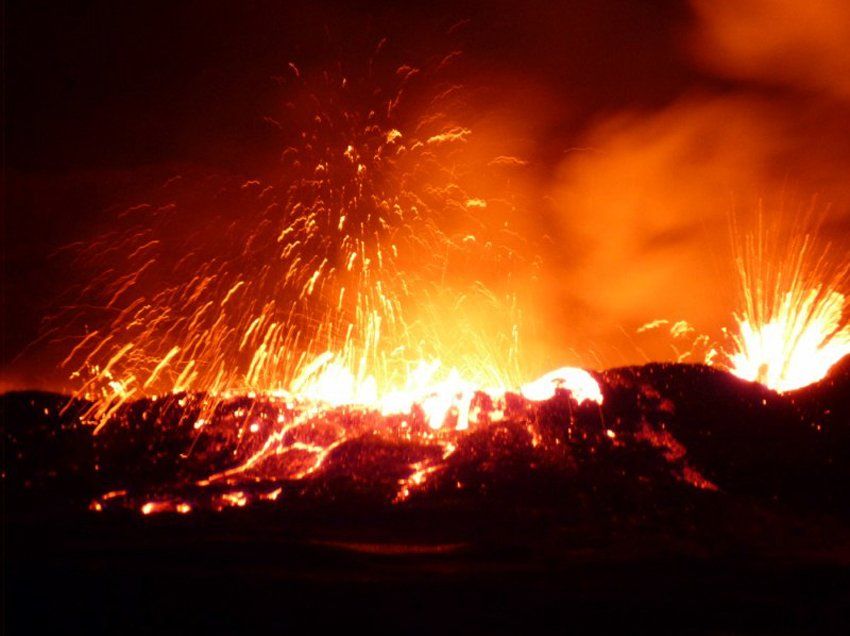
The call came last November. And Ebinger immediately flew to Ethiopia with some fellow researchers. "The volcano was bubbling over; flaming-red lava was shooting up into the sky," Ebinger told Spiegel Online.

The earth is in upheaval in northeastern Africa, and the region is changing quickly. The desert floor is quaking and splitting open, volcanoes are boiling over, and seawaters are encroaching upon the land. Africa, researchers are certain, is splitting apart at a rate rarely seen in geology.

The first fracture appeared millions of years ago, resulting in the Red Sea and the Gulf of Aden. The second fracture, stretching south from Ethiopia to Mozambique, is known as the Great Rift Valley, and it is lined with several volcanoes. Millions of years from now, it too will be filled with seawater.

http://images-mediawiki-sites.thefullwiki.org/11/1/5/4/3553675110385209.gif

Could Go Quickly

But in the Danakil Depression, in the northern part of the valley, the ocean could arrive much sooner. There, low, 25 meter (82 foot) hills are the only thing holding back the waters of the Red Sea. The land behind them has already dropped dozens of meters from previous levels and white salt deposits on the desert floor testify to past encroachments of the sea. But lava soon choked off its access.

For now, no one can really say when the sea will finally flood the desert. But when it does, it could go quickly. "The hills could sink in a matter of days," Tim Wright, a fellow at the University of Leeds' School of Earth and Environment, said at a recent conference hosted by the American Geophysical Union (AGU) in San Francisco.

In the last five years, the geologic transformation of northeastern Africa has "accelerated dramatically," says Wright. Indeed, the process is going much faster than many had anticipated. In recent years, geologists had measured just a few millimeters of movement each year. "But now the earth is opening up by the meter," says Loraine Field, a scholar at the University of Bristol who also attended the conference.

Earth tremors cause deep fissures to form in the desert floor and the ground in East Africa is shattering like broken glass. Researchers in the Gulf of Tadjoura, which juts into Djibouti from the Gulf of Aden, have recently registered a barrage of seismic shocks. "The quakes are happening on the mid-ocean ridge," Ebinger reports.

http://mm04.nasaimages.org/MediaManager/srvr?mediafile=/Size2/nasaNAS-10-NA/74007/eafrica_ndvia_2006003_lrg.jpg&userid=1&username=admin&resolution=4&servertype=JVA&cid=10&iid=nasaNAS&vcid=NA&usergroup=Earth_Observatory_(nasa)-10-Admin&profileid=46

Shifting Tectonic Plates

Lava gushes out of fissures in these underwater
mountain ranges to constantly create new earth crust -- when it hardens it becomes part of the sea floor. As the magma surges upward, it spreads the ocean floor on both sides, shifting tectonic plates and causing tremors.

In recent months, the quaking in the Gulf of Tadjoura has been getting closer and closer to the coastline. As Ebinger explains, the splitting of the ocean floor will gradually extend to dry land. This is already the case along some fault lines in the Ethiopian desert, creating a geological spectacle that can otherwise only be witnessed deep below the surface of the ocean.

Even the pattern of earthquakes supports the conclusion that the desert landscape is transforming into a deep seafloor, according to a recent article in the Journal of Geophysical Research published by Zhaohui Yang and Wang-Ping Chen, two geologists at the University of Illinois at Urbana-Champaign. The researchers have recorded several strong earthquakes at a shallow depth in northeastern Africa similar to ones that are otherwise only seen on mid-ocean ridges far out at sea.

In recent months, researchers have also recorded an up-tick in volcanic activity. Indeed, geologists have discovered volcanic eruptions near the Earth's surface at 22 places in the Afar Triangle in northeastern Africa. Magma has caused fissures up to eight meters (26 feet) wide to open up in the ground, reports Derek Keir from the University of Leeds. While most of the magma remains beneath the surface, in places like Erta Ale it has made its way above ground.
http://img.skitch.com/20100711-qf9r936wfbq29b7racjthqa7gm.jpg

An Ocean Without Water

Scientists have also noted that the kind of magma
bubbling up in the region is the type otherwise only seen spewing forth from mid-ocean ridges deep below the water's surface. One of its signature characteristics is a low proportion of silicic acid. The magma coming out of Erta Ale has the same chemical composition as the kind that emerges from deep-sea volcanoes. The entire region increasingly resembles an ocean floor -- one without water.

The new burst in activity began in 2005, when a 60-kilometer-long fissure suddenly formed in the Afar Depression. Since then, roughly 3.5 cubic kilometers of magma have gushed forth, according to Tim Wright -- enough to cover the entire area of London to an average person's height.

From a geological perspective, the speed with which the magma is pushing forth is astonishing. It has been channeling its way through the rock below the earth's surface at speeds of up to 30 meters per minute, reports Eric Jacques from the Institute of Earth Physics of Paris. Satellite measurements attest to the consequences: In one 200-kilometer stretch welling up with magma, the ground looks like asphalt on a hot summer day. Magma is also pooling up under the Dabbahu Volcano in northern Ethiopia, Lorraine Field reported in San Francisco.

http://www.greenfudge.org/wp-content/uploads/2010/06/Afar-rift-Ethiopia.jpg

Continuing to Expand

The satellite data has also shown that a much larger
area has been scarred by fissures than previously assumed, says Keir. Subterranean currents of magma are also causing ground temperatures to spike in eastern Egypt, a team of geologists from Egypt's National Research Institute of Astronomy and Geophysics recently reported in Seismological Research Letters. At the AGU conference, Columbia University's James Gaherty reported that magma eruptions have ripped a 17-kilometer gash into the desert floor in the northern part of Malawi and that the lateral pressure they have exerted has even lifted the surrounding earth up to 50 centimeters (20 inches) in places.

The most violent upsurge of magma in recent years, though, happened in an unexpected place. In May 2009, a subterranean volcano erupted in Saudi Arabia. A strong earthquake with a magnitude of 5.7 accompanied by tens of thousands of milder tremors forced 30,000 to seek shelter. Magma spewed out of the ground in an area about the size of Berlin and Hamburg combined, Sigurjon Jonsson from the King Abdullah University of Science and Technology reported at the AGU meeting.

The fact that the eruption took place almost 200 kilometers (124 miles) away from the fault line in North Africa "surprised all of us," says Cynthia Ebinger. And the world's largest geological construction site continues to expand. Loraine Field confirms that more and more magna is pushing its way to the earth's surface, adding that: "The magma chamber is reloading."

Oxford University's David Ferguson predicts a considerable increase in volcanic eruptions and earthquakes in the region over the next decade. They will, he says, "become of increasingly large magnitude."


 And for what it's worth a pseudo-sceptical contrarian view:


Xtra Images - http://images-mediawiki-sites.thefullwiki.org/11/1/5/4/3553675110385209.gif 
http://mm04.nasaimages.org/MediaManager/srvr?mediafile=/Size4/nasaNAS-10-NA/74007/eafrica_ndvia_2006003_lrg.jpg&userid=1&username=admin&resolution=4&servertype=JVA&cid=10&iid=nasaNAS&vcid=NA&usergroup=Earth_Observatory_%28nasa%29-10-Admin&profileid=46
http://img.skitch.com/20100711-qf9r936wfbq29b7racjthqa7gm.jpg
http://www.greenfudge.org/wp-content/uploads/2010/06/Afar-rift-Ethiopia.jpg

For further enlightenment enter a word or phrase into the search box @  New Illuminati:


And see

The Her(m)etic Hermit - http://hermetic.blog.com


This material is published under Creative Commons Copyright (unless an individual item is declared otherwise by copyright holder) – reproduction for non-profit use is permitted & encouraged, if you give attribution to the work & author - and please include a (preferably active) link to the original along with this notice. Feel free to make non-commercial hard (printed) or software copies or mirror sites - you never know how long something will stay glued to the web – but remember attribution! If you like what you see, please send a tiny donation or leave a comment – and thanks for reading this far…

From the New Illuminati – http://nexusilluminati.blogspot.com