The Pleistocene-Holocene Event:
The Sixth Great Extinction

“Soon a millennium will end. With
it will pass four billion years of evolutionary exuberance. Yes, some species
will survive, particularly the smaller, tenacious ones living in places far too
dry and cold for us to farm or graze. Yet we must face the fact that the
Cenozoic, the Age of Mammals which has been in retreat since the catastrophic
extinctions of the late Pleistocene is over, and that the Anthropozoic or
Catastrophozoic has begun."
--Michael Soulè (1996)
Extinction is the gravest conservation problem of our era. Indeed, it is the gravest problem humans face. The following discussion is adapted from Chapters 1, 2, and 4 of Dave Foreman’s Rewilding North America.]
The Crisis
The most important—and gloomy—scientific discovery of the twentieth century was the extinction crisis. During the 1970s, field biologists grew more and more worried by population drops in thousands of species and by the loss of ecosystems of all kinds around the world. Tropical rainforests were falling to saw and torch. Wetlands were being drained for agriculture. Coral reefs were dying from god knows what. Ocean fish stocks were crashing. Elephants, rhinos, gorillas, tigers, polar bears, and other “charismatic megafauna” were being slaughtered. Frogs were vanishing. Even Leviathan—the great whales—were being hunted down in their last redoubts of the Antarctic and Arctic seas, and their end was in sight. These staggering losses were in oceans and on the highest peaks; they were in deserts and in rivers, in tropical rainforests and Arctic tundra alike.
A few biologists—including geneticist Michael Soulè (who was later the founder of the Society for Conservation Biology) and Harvard's famed E. O. Wilson—put these worrisome anecdotes and bits of data together. They knew, through paleontological research by others, that in the 570 million years or so of the evolution of modern animal phyla there had been five great extinction events. The last happened 65 million years ago, at the end of the Cretaceous when dinosaurs became extinct. Wilson and company calculated that the current rate of extinction is one thousand to ten thousand times the background rate of extinction in the fossil record.
That discovery hit with all the subtlety of an asteroid striking Earth: RIGHT NOW, TODAY, LIFE FACES THE SIXTH GREAT EXTINCTION EVENT IN EARTH HISTORY. The cause is just as unsettling and unprecedented: eating, manufacturing, traveling, warring, consuming, and breeding by six billion human beings. For the first time in the history of life on Earth, one species is killing countless others. For the first time, one species—Homo sapiens; that's us—is waging a war against Nature.
The crisis we face is biological meltdown. Wilson (1992) warns that the proportion of species driven to extinction “might easily reach 20 percent by 2022 and rise as high as 50 percent or more thereafter.” Soulè (1980) has said that soon the only large mammals left will be those we consciously choose to protect; that, “[The twentieth] century will see the end of significant evolution of large plants and terrestrial vertebrates in the tropics.” He writes (1996), “The end of speciation for most large animals rivals the extinction crisis in significance for the future of living nature. As [Bruce Wilcox and I] said in 1980, ‘Death is one thing, an end to birth is something else.’”
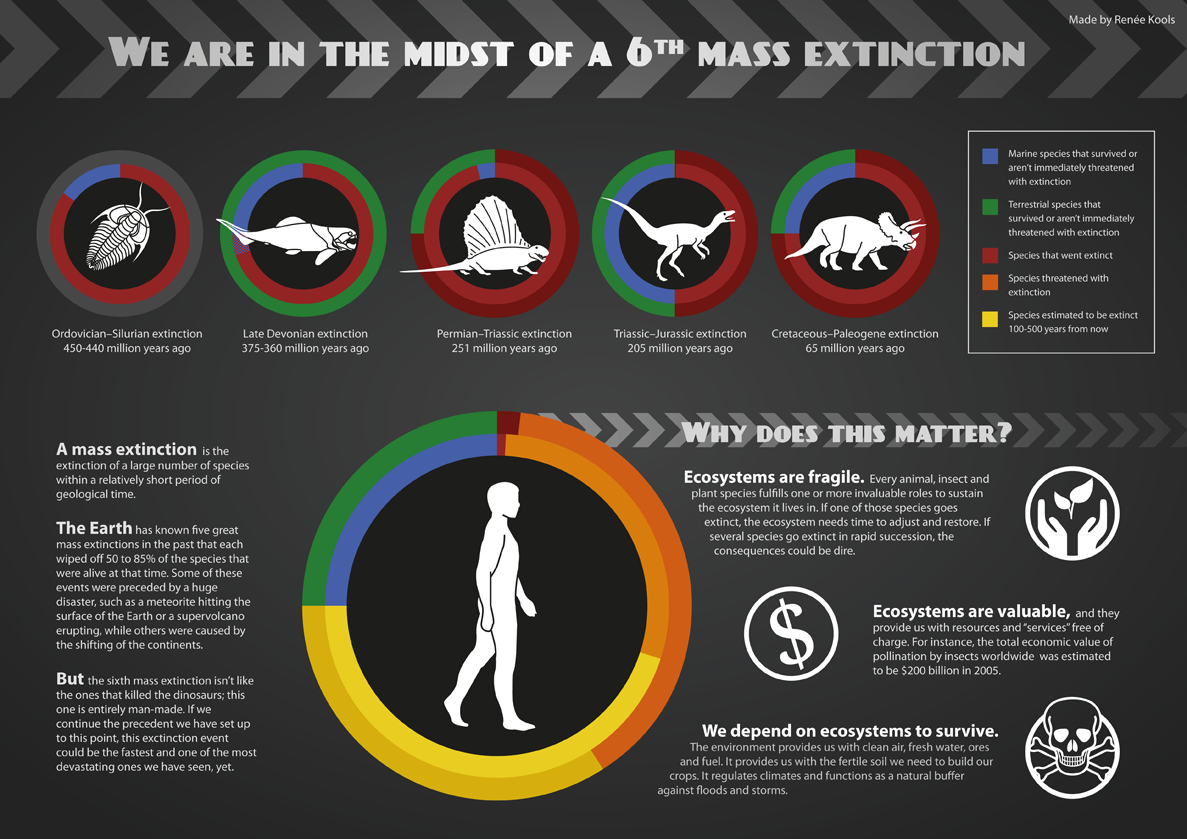
Five Great Extinctions
The fossil record reveals five great extinction episodes in the last half-billion years. They are:
Ordovician—500 million years ago, 50 percent of animal families became extinct, including many trilobites (a dominant kind of marine organism that looked sort of like a horseshoe crab).
Devonian—345 million years ago, 30 percent of animal families became extinct, including some types of early fishes.
Permian—250 million years ago, 50 percent of animal families, 95 percent of marine species, many amphibians, and many trees became extinct.
Triassic—180 million years ago, 35 percent of animal families became extinct, including many reptiles and marine mollusks.
Cretaceous—65 million years ago, dinosaurs and many mollusks became extinct.

The Three Waves of the Pleistocene-Holocene Extinction Event
The First Wave: Spread of Modern Humans 40,000
years to 200 years BP
|
||||
| Location | Date | Affected Species | ||
| Europe and Northern Asia | 40,000 to 13,000 BP | Megafauna, including Homo neanderthalensis | ||
| Australia and New Guinea | 40,000 to 25,000 BP | Large marsupials, reptiles, and birds | ||
| North and South America | 11,000 to 10,000 BP | Megafauna | ||
| Caribbean Islands | 7,000 to 3,000 BP | Giant ground sloths, monkeys, tortoises | ||
| Mediterranean Islands | 5,000 BP | Dwarf megafauna, including elephants | ||
| Wrangel Island (Siberian Arctic) | 3,500 BP | Mammoths | ||
| Pacific Islands | 3,000 to 200 BP (AD 1800) | Birds | ||
| New Zealand | 1500 to 200 BP (AD 1800) | Moas, other flightless birds | ||
| Madagascar | 1000 to 200 BP (AD 1800) | Large birds, tortoises, lemurs, small hippos | ||
The Second Wave: Spread of Europeans 500 BP (AD
1500) to 30 BP (AD 1970)
|
||||
| Islands | Tortoises, birds, mammals | |||
| Continents | Freshwater taxa, and steep population declines of remaining megafauna | |||
| Oceans | Steep population declines of marine mammals, large fish, and other species | |||
The Third Wave: Overpopulation and Globalization
AD 1970 to 2100
|
||||
| Everywhere | All taxa | |||
(From Rewilding North America by Dave
Foreman. Copyright © 2004 by the author. Reproduced by permission of Island
Press, Washington, D.C.)
The Causes And Processes Of Extinction
Many things can push a species into the long, dark night of extinction. However, only a few things can cause mass extinction. For past mass extinctions, cataclysmic events—either terrestrial or extraterrestrial—so altered or harmed the biosphere that many species and whole groups of organisms died out. Scientists have found convincing evidence that the extinction of the dinosaurs 65 million years ago came suddenly (perhaps in a matter of days or weeks) when an asteroid struck Earth in a shallow sea where today's Yucatan Peninsula of Mexico lies.
But what causes “normal” extinctions, the kind that make up the background rate between the few big catastrophes? A species can become “extinct” by evolving into a new species or several new species (speciation driven by natural selection), or a species can become extinct by dying out and not continuing its evolutionary experiment. The latter is real extinction.
Extinction, or evolution into daughter species, is the fate of all species. Careful study of the fossil record of marine invertebrates shows that species usually last for one million to ten million years. What may cause species to become extinct? Michael Soulè lists the possible factors: rarity (low density); rarity (small, infrequent patches); limited dispersal ability; inbreeding; loss of heterozygosity (genetic diversity); founder effects; hybridization; successional loss of habitat; environmental variation; long-term environmental trends (such as climate change); catastrophe; extinction or reduction of mutualist populations; competition; predation; disease; hunting and collecting; habitat disturbance; and habitat destruction.
Soulè (1983) points out that some of these factors “do not become operative until one or more of the other factors have reduced the local populations to a very small size.” Note that he lumps the natural and human causes. Most of these factors are at play in today's mass extinction.
Soulè warns, however, that “It is disappointing that we know so little about natural extinction.” Why does modern science know so little about this fascinating subject? It is because “no biologist has documented the extinction of a continental species of a plant or animal caused solely by nonhuman agencies.”
The grim truth is that we humans are the cause of modern extinctions. How do we do it?
Extinction expert David Wilcove and his colleagues list five anthropogenic causes of extinction in the United States, in order of current importance: habitat destruction; non-native (alien) species; pollution; overexploitation; disease. (Worldwide, however, overexploitation is far more important than in the United States today.)
Here are a few examples of the ways humans cause extinction in each of these categories.
Habitat Destruction. We reduce, modify, degrade, or transform natural habitat upon which species depend by burning, agricultural clearing, logging, mining, grazing by domestic animals, preventing natural fire, damming rivers, dewatering rivers through irrigation diversion, drying up springs and streams through groundwater pumping, eliminating keystone species like beaver and prairie dogs whose activities create habitat for other species, and urban and suburban development. Furthermore, we fragment habitat—thereby disrupting necessary patterns of movement of many species—through the above activities and by building roads, clearing power-line rights-of-way, and driving vehicles.
Non-native (Alien) Species. As humans have spread into new lands, we have brought with us disruptive alien species that are generally well adapted to human disturbance and that outcompete native species, in part because their normal enemies, such as predators and diseases, are left behind. Such damaging invaders include plants and animals, both deliberately introduced species such as domestics or ornamentals, and accidentally introduced species such as weeds or pests. These non-native species include predators (cats, rats, pigs) and competitors (starlings, tamarisk, zebra mussels.
Pollution. Pollution, whether localized or global (acid rain, greenhouse gases), can poison the waters and soils that are habitat for sensitive species, or leach away needed nutrients. Global warming and atmospheric ozone depletion—major threats to life forms worldwide—are caused largely by air pollution.
Overexploitation. Hunting, fishing, trapping, collecting, and government “pest” eradication programs have caused the extinction of many species and seriously endanger others today.
Disease. As humans have spread around the world, we have brought exotic diseases with us. Global trade is spreading many new diseases. An exotic disease caused the loss of the American chestnut in the wild. The black-footed ferret was nearly wiped out by canine distemper, a disease not native to the Americas.
Ernst Mayr, perhaps the biological giant of the twentieth century, writes (2001):
Background extinction and mass extinction are drastically different in most respects. Biological causes and natural selection are dominant in background extinction, whereas physical factors and chance are dominant in mass extinction. Species are involved in background extinction, and entire higher taxa in mass extinction.
As the cause of today's mass extinction, we humans are no longer just a biological phenomenon, but are now a physical factor equivalent to an asteroid or continental drift in radically changing biological diversity. We are not exterminating only individual species, but “entire higher taxa.”

The Three Waves of Extinction
We can see the Sixth Great Extinction occurring in three waves, each caused by new groups of humans armed with new technologies spreading over new lands. The First Wave, the Spread of Modern Humans, ran from 40,000 to about 3,500 years ago as skilled big game hunters first entered lands where Homo sapiens had not previously existed. It continued from 3,000 years ago until 200 years ago, as Stone Age farmers found previously unpeopled islands in the Pacific and Indian oceans. The Second Wave, the Spread of Europeans, began in 1500 and ended around 1970 as European colonial and then industrial civilization spread over the world. The Third Wave, Overpopulation and Globalization, began about 1970 as human population exploded and new technologies and business practices tied the world into one exponentially expanding agro-techno-economy.
In the First Wave, extinctions were caused mostly by hunting, and perhaps by fire-setting and introductions of dogs and diseases into areas that had not previously experienced them. The victims were primarily large mammals, birds, and reptiles on continents and islands. In the second phase of the First Wave, Stone Age farmers settled Hawaii, New Zealand, Madagascar, and other islands, and extinctions were caused by agricultural clearing, fire-setting, hunting, and introductions of dogs, rats, pigs, goats, and diseases into areas that had not previously experienced them. The victims were primarily birds and reptiles.
The Second Wave was caused by hunting with guns; large-scale fishing; massive habitat destruction by agriculture, forestry, and domestic livestock grazing; river damming and diversion; introduction of exotic predators, browsers, grazers, parasites, and diseases; and later by industrial pollution. Islands lost birds, giant tortoises, and small mammals. On continents, some birds, fish, and large mammals have been driven into extinction, but many more species of birds, freshwater fish, and large mammals have had their numbers drastically reduced to possibly nonviable remnants. In the oceans, sea mammals, shellfish, and many fish have been wastefully exploited so that their populations are mere shadows of what they were 400 years ago.
The Third Wave has just begun. Its agents of extinction are those of the other waves, but now the human population explosion—from about 10 million 10,000 years ago to over six billion today—and a globalized agro-techno-economy spread over the whole Earth threaten everything from the last megafauna to plants to insects to coral reef ecosystems.
In 40,000 years, fully modern humans have spread across the Earth three times, with devastating consequences for the rest of life.
The Evidence For Mass Extinction Today
Even if we grudgingly acknowledge past human-caused extinctions, what proof is there that a mass extinction continues today? We can take at least three different tacks in answering this question. First is the area-species relationship and the evidence of habitat destruction. Second is the decline of specific living species. Third is the accounting of our takeover of Earth's terrestrial and marine net primary productivity (NPP) and our overshooting of ecological carrying capacity.
Species-Area Relationship
Michael Soulè writes (1999-2000), “One of the principles of modern ecology is that the number of species that an area can support is directly proportional to its size. A corollary is that if area is reduced, the number of species shrinks.” In 1980, John Terborgh and Blair Winter wrote that research showed that “extinction is strongly area dependent.” The species-area relationship has been shown with birds, mammals, reptiles, and other kinds of animals on the Greater Sunda Islands (the Indonesian archipelago), Caribbean islands, and elsewhere. An ecological rule of thumb is that if a habitat is cut by 90 percent, it will lose 50 percent of its species, or, if 50 percent of the area is lost, 10 percent of the species will disappear.
Known Loss of Species
Another way of showing that mass extinction is real comes from looking at historic extinctions and the number of species that are in danger of extinction today. Let’s just consider mammals.
In 1997, Ross MacPhee and Clare Flemming of the American Museum of Natural History Department of Mammalogy published the results of their careful review of mammal extinctions since 1500 AD. They identified 90 species of mammals that have become extinct during the modern era of European expansion, although they think it likely that the number will be “revised upward to 110 or 115 confirmed losses” or “close to 2 percent of all mammal species on Earth.” Using the highest estimate for the rate of natural or background extinction of one mammal species every 400 years, the loss of 90 species in 500 years is “a minimum 7,100 percent increase over the natural rate.”
What of the near future? In 1995, 22 of Earth's 30 surviving species of large mammalian carnivores were listed as “endangered by either the United States or the World Conservation Union.” There are only some 2,000 breeding adult African wild dogs left in the wild, and the Ethiopian wolf is down “to fewer than 500 individuals.” According to the World Wildlife Fund, there may be no more than 1,000 giant pandas left in the wild. BBC News reports that “India's Minister of Social Justice and Empowerment has warned that by 2007 ‘there would be no breeding elephants left in India…and the species would die out’” because of poaching, capturing, and habitat destruction. Ten percent of the 608 species and subspecies of primates are in grave and immediate danger of extinction. Cambridge University's primatologist David Chivers says, “I've spent 30 years on [primate conservation], and now we don't seem to be getting anywhere. It's ridiculous.”

Net Primary Productivity
The third area of evidence for the reality of mass extinction is to add up humans’ impact. But is it really possible to calculate the human impact on Earth? Actually, we can, and we can even put a number on it. A group at Stanford University, including Paul and Anne Erhlich, published the results of their research in BioScience that showed human beings were using about 40 percent of Earth's Net Primary Productivity (NPP) in 1986. This basic ecological measure is defined by Paul and Anne Ehrlich as “[a]ll the solar energy annually captured worldwide by photosynthesizers and not used by them to run their own lives.”
The Stanford group's calculations were strongly confirmed in 2001 by Stuart Pimm with his book, The World According to Pimm: a scientist audits the Earth. Pimm gives a detailed accounting of our appropriation of Net Primary Productivity.
Forty percent is how much of NPP we are taking now with 6 billion humans. However, we continue to pile baby upon baby. The exponential growth of human population multiplied by rising affluence and more invasive technology is the main driver of the Third Wave of Extinction. Where will it all end? Many demographers predict that human population will stabilize at 11-12 billion—twice what it is today. If we double our population, and affluence and technology continue to increase as world leaders, corporate heads, and economists believe, what becomes of our taking of NPP? Double our population and we will take over 80 percent. This is conservative because it does not incorporate increasing affluence and technology. Is this sustainable? How many species could continue to exist on less than 20 percent of the Net Primary Productivity? Clearly an ecological crash will happen before we reach this point.
(From Rewilding North America by Dave Foreman [chapters 1, 2, and 4]. Copyright © 2004 by the author. Reproduced by permission of Island Press, Washington, D.C. Except for some direct quotes, references in the book have been deleted here. Any citations given are from the books and papers below.
Click Here For Full PDF Report...
From The Rewilding Institute @ http://www.rewilding.org/thesixthgreatextinction.htm
For more information about the sixth great extinction see http://nexusilluminati.blogspot.com/search/label/sixth%20great%20mass%20extinction
- See ‘Older Posts’ at the end of each section
YOU can help this unique
independent website’s author survive in a small cabin in a remote rainforest
Donate any amount and receive at least one New Illuminati eBook!
Please -
Images – http://churchandstate.org.uk/wordpressRM/wp-content/uploads/2011/03/sixth-extinction.jpg
http://fc02.deviantart.net/fs71/f/2012/263/a/e/we_are_in_the_midst_of_a_sixth_mass_extinction_by_armonah-d5fc0pt.png
http://salsa.democracyinaction.org/o/2167/images/eeo_images/473/ExtinctionAndPopulationGraph.jpg
http://www.truthmove.org/workspace/photos-news/i-hyo2.gif
https://blogger.googleusercontent.com/img/b/R29vZ2xl/AVvXsEhzG9rN7DceqrI81Ue7oVeRk5j5qGrnh4t_kFOK64Jn1960bff3sGEPtZQ5_HE0X1oGcqIUBNPdj47M6uAqcqbN33U-iHkFWN-hyRQXiR8582PFQSqtE1xJVqBkbuwMH4devechzS4UVEM/s1600/sixth_extinction_ny_times_june2012.jpg
http://fc02.deviantart.net/fs71/f/2012/263/a/e/we_are_in_the_midst_of_a_sixth_mass_extinction_by_armonah-d5fc0pt.png
http://salsa.democracyinaction.org/o/2167/images/eeo_images/473/ExtinctionAndPopulationGraph.jpg
http://www.truthmove.org/workspace/photos-news/i-hyo2.gif
https://blogger.googleusercontent.com/img/b/R29vZ2xl/AVvXsEhzG9rN7DceqrI81Ue7oVeRk5j5qGrnh4t_kFOK64Jn1960bff3sGEPtZQ5_HE0X1oGcqIUBNPdj47M6uAqcqbN33U-iHkFWN-hyRQXiR8582PFQSqtE1xJVqBkbuwMH4devechzS4UVEM/s1600/sixth_extinction_ny_times_june2012.jpg
For further enlightening
information enter a word or phrase into the random synchronistic search box @ http://nexusilluminati.blogspot.com
And see
New Illuminati – http://nexusilluminati.blogspot.com
New Illuminati on Facebook - https://www.facebook.com/the.new.illuminati
New Illuminati Youtube Channel - http://www.youtube.com/user/newilluminati/feed
The Her(m)etic Hermit - http://hermetic.blog.com
The Prince of Centraxis - http://centraxis.blogspot.com (Be Aware! This link leads to implicate &
xplicit concepts & images!)
DISGRUNTLED SITE ADMINS PLEASE NOTE –
We provide a live link to your original material on your site - which
raises your ranking on search engines and helps spread your info further! This site
is published under Creative Commons Fair Use Copyright (unless an individual article
or other item is declared otherwise by copyright holder) – reproduction for non-profit
use is permitted & encouraged, if you give attribution to the work &
author - and please include a (preferably active) link to the original (along
with this or a similar notice).
Feel free
to make non-commercial hard (printed) or software copies or mirror sites - you
never know how long something will stay glued to the web – but remember
attribution! If you like what you see, please send a donation (no amount is too
small or too large) or leave a comment – and thanks for reading this far…
Live long
and prosper!
From the New
Illuminati – http://nexusilluminati.blogspot.com


