A New Vision Emerges At Last
Science’s Looming ‘Tipping Point’
It is essential in these
exuberant times to pay critical attention to both the observational constraints and to the basic
mathematical laws, with a clear sense of what is solid theory and what is only
unsupported speculation. This seeming platitude is offered here without jest, because
at the present time there are ‘theories’ – scenarios sometimes quite detailed –
seriously and often passionately held, for almost every exotic astronomical
object that is not resolved in the telescope. In contrast, the one star that
can be properly resolved – the pedestrian Sun – exhibits a variety of phenomena
that defy contemporary theoretical understanding.
A ‘tipping point’ in
science is supposed to happen when the weight of evidence against a theory tips
the balance of opinion against it. But we are dazzled in this space age by
computer-generated ‘virtual reality’ and the sheer technological brilliance of applied science. So it can come as a
surprise to be told that modern theoretical
science is in crisis. Today’s inverted science pyramid rests on the mathematics
of imaginary particles and energy described by an acausal quantum theory that
no one can explain. Occasionally, the more candid scientists admit they don’t
understand basic phenomena like mass, gravity, magnetism, lightning, galaxies
and even the Sun!
So it is not surprising that planets, stars and galaxies are
being discovered that ‘shouldn’t exist’
and most of the visible universe seems to be a mere impurity overwhelmed by
mysterious ‘dark matter’ and ‘dark energy.’ In its role as a consensual belief
system today’s ‘settled science’ is now confronted with surprising
contradictions more frequently than they can be fitted to the dogmas. And
because the fundamental mysteries persist unrecognized, Nobel Prizes are awarded for purely
imaginary discoveries in physics. The weird nature of those discoveries should
serve to warn us that science is at a tipping point of unparalleled magnitude.
Dysfunctional
Science
Science is at a tipping
point because, having fragmented into specialties and sub-specialties, it is no longer equipped to deal
with falsifying data. The barricades of technical jargon and self-serving
politics prevent the specialists from seeing what would be all too obvious from
a higher vantage point. Such a system is averse to outside challenges by ‘those who transcend the conventional,’
and leading authorities feel free to ignore them.
Of course, before the
modern barriers went up, crucial scientific contributions were accepted from
many ‘outsiders’ like William Herschel and Michael Faraday, those who “may be free of current dogmas and prejudices, able
to see the world with fresh eyes.” [Albert Einstein] Few
universities have shown the courage to insist on a broad and balanced picture
of present knowledge or an even-handed comparison of theoretical assumptions
and available alternatives. To apply such basic standards today would risk
discrediting entire departments.
Dysfunctional
Education
In truth we could be as
far from a meaningful “theory of
everything”
as stone-age man was from setting foot on the Moon. Our universities foster
narrow, theoretical lockstep. Essential self-correction would require the
opposite, a broader horizon, with an eye to ideas and critical facts across
many disciplinary boundaries. That would, in fact, mean a return to the
interdisciplinary ways of natural philosophy. Knowledge should be open to
criticism, and criticism should not be limited to one’s closest peers.
It is one of the worst
failings of modern education that students are not encouraged to cultivate
critical thinking or to explore broader possibilities. Today’s ‘good student’
is asked to conform, to absorb pre-packaged knowledge much like modern fast
food. But instead of certainties, we should be feeding students with doubts and
mysteries, for they stimulate the imagination and motivate individual research.
That is the way to achieve breakthroughs;
“Intensive and narrow
scientific training will guarantee that you will never make a scientific
breakthrough. We must forge a pioneering education, whose purpose is to produce
the imaginative generalists who can take us into the uncharted future.” [Root-Bernstein —Sparks of Genius]
Computer
Games and the Media
Researchers today have
computers to simulate almost anything they can imagine. The combination of computing
power and imagination produces the ultimate computer games, a virtual world
where unbridled fantasy can flourish. “You
can sell anything if you dress it up correctly… You can give a result which is
complete ‘garbage’ but taken out of context, reviewers can’t tell the
difference,” says one astrophysicist.
Harsh words? Not if you
read the numerous papers where simulations are said to ‘prove’ a theory. Each
‘surprising’ discovery results in ad hoc computer models built from
‘off-the-shelf’ ideas and software that are forced to approximate what it is
imagined has been discovered. Attractive computer-generated ‘artists’
impressions’ help with funding. The design of research labs revolves around
simulation and visualization technology, the Large Hadron Collider (LHC) for
example.
So science libraries are
now filled with an excess of unreadable and unread technical literature, while
the distinction between nature itself and the ‘virtual worlds’ of the popular
media grows increasingly blurred. In this deadly loop the virtual world gets
the publicity and funding. And all the while the inspiration that attracts
young minds to true discovery progressively declines.
In
How Einstein Ruined Physics, Roger
Schlafly, himself a PhD in Mathematics from Berkeley, writes, “Modern physics has been taken over by academic
researchers who call themselves theoretical physicists but who are really doing
science fiction. They are not mathematicians who prove their results with
logic, and they are not scientists who test their hypotheses with experiments.
They make grand claims about how their fancy formulas are going to explain how
the world works, and yet they give no way of determining whether there is any
validity to their ideas.”

Mathematics is a great
tool but it isn’t physics. A lucrative prize has been recently awarded to an
Australian astrophysicist who encourages students to emulate him and “look at things as math problems rather than as
physical problems.” This is from a person who gave us imaginary
‘dark matter’ to allow the math to match the physical problem. To his credit,
Albert Einstein showed better understanding, “To
the extent that the laws of mathematics refer to reality, they are not true;
and to the extent that they are true, they do not refer to reality.”
Research
Funding
Consensus science and the
desperate need to publish papers in a few ‘recognized’ journals drives peer-review censorship,
selective data publication, confirmatory bias, and in some cases fraud.
Requests for research funding should be subject to public cross-examination. If
the research cannot be explained and justified to well-educated arbitrators,
drawing upon qualified criticism, what is the basis for confidence in today’s
multi-billion dollar scientific adventures?
“Trust us, we’re the
experts,” is not acceptable. Blind trust has led to misbegotten multi-billion
dollar projects like the $9 billion Large Hadron Collider and the $16 billion,
30 year long International Thermonuclear Experimental Reactor (ITER), which when
viewed critically, fall far short of the scientific justification the public
has every right to expect.
Cosmology as
Myth
Today’s cosmology, in
attempting to give us the biggest picture, competes with religion by investing in an alternative
creation myth, one that shatters the observed laws of physics. The myth is
called ‘the big bang’ and it makes no sense. What we observe is that matter
‘locks up’ electromagnetic energy, which manifests as mass according to E = mc2
(no hypothetical Higgs boson is required). But we have no idea
how energy can create matter (whatever that ultimately is). So we can say
nothing about creation of the universe.
Though it purports to explain observed
phenomena, the big bang requires one to rationalize an immense field of accumulating
anomalies, forcing cosmologists to devote most of their time to inventing ways
around the contradictions by introducing purely theoretical constructs like
dark matter, dark energy, black holes and much more. The exotic vocabulary that
has emerged fails every reasonable test of Occam’s Razor. Unexpected results
are met with ad hoc solutions. There is always an
answer.
The big bang myth, with
its bizarre portrayal of our situation in the universe, afflicts society
through its hopelessness and waste of money and resources. Modern cosmology is
exposed as a competing secular religion with its creationism and end of the
world scenarios. Science has not yet thrown off the shackles of our misunderstood
past.
Cosmology by
Computer Models
One measure of a
successful cosmology is its ability to predict probable new discoveries and avenues for research in other
disciplines. Big Bang cosmology fails this test. Today, incessant surprise at
discordant astronomical data never causes a radical rethink of basic
assumptions. “Back to the drawing board” never means starting afresh. The
mysteries mentioned earlier are untouched. No one reads the original papers
from which dogma sprang. Surprises merely drive the science-media-funding
circus to further improvised absurdities — ‘proven’ by computer models. But
computer models cannot prove anything. Most are based on invalid concepts, such
as treating space plasma as a magnetized gas, and have so many adjustable parameters
that the models are not falsifiable.
Physicists are trained to
work in an intellectual vacuum. The result is a lack of real progress that is
disguised by increasingly bizarre scientific headlines and promises of future
success, which never arrive. Consider the decades-old pledge of limitless clean
thermonuclear energy, ‘like the Sun.’ Failure to deliver has never caused any
second thoughts about the Sun. But that may be a clue.
First
Understand the Sun
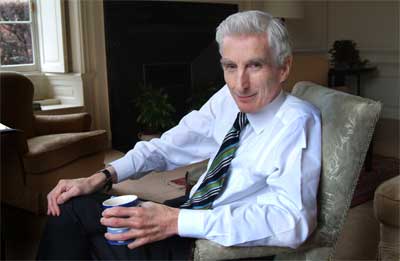
 Martin Rees, one of the
world’s most eminent astronomers, is a professor of cosmology and astrophysics at the
University of Cambridge and the UK’s Astronomer Royal. In his book, New Perspectives in
Astrophysical Cosmology [C.U.P. 2000] he writes, “The best understood cosmic structures are the
smaller ones: the individual stars.” Nothing could be further from
the truth! Not one of our own star’s features — the corona — the chromosphere —
the granular photosphere — sunspots — is to be expected based on the standard
thermonuclear fusion model. As new data floods in from solar probes and those
focused on the Sun’s boundary with interstellar space it becomes blindingly
obvious — we don’t understand the Sun. And without understanding the
Sun we know nothing about the universe!
The Sun is the tipping
point, the point of departure from old big bang cosmology. Rees writes in the
introduction to his book, “Gravity,
almost undetectable between laboratory-scale bodies, is the dominant force in
astronomy and cosmology. The basic structures in our cosmic environment –
stars, galaxies, and clusters of galaxies – all involve a balance between
gravitational attraction and the disruptive effect of pressure or kinetic
energy.”
Three things stand out immediately. First, gravity is the
weakest force in the universe. Second, gravity is not
understood. And third, although magnetic fields are detected on the Sun and
everywhere in space, there is no mention of the necessary generative electric
currents in plasma, which constitutes 99.999 per cent of the visible universe!
This is a doctrinaire failure to notice the obvious.
Astrophysicists have
equations describing what gravity does and a
meaningless hyper-geometric story about space being warped by the presence of
matter. There is no thought given to the most basic problem — how matter
produces the effects of mass and gravity. Nowhere in cosmology is the
electrical structure of matter and the electric force, which is 39
orders of magnitude stronger than gravity, considered
important. So long as we cling to mistaken and out-dated concepts we will never
understand the Sun or any other star.
Martin Rees, one of the
world’s most eminent astronomers, is a professor of cosmology and astrophysics at the
University of Cambridge and the UK’s Astronomer Royal. In his book, New Perspectives in
Astrophysical Cosmology [C.U.P. 2000] he writes, “The best understood cosmic structures are the
smaller ones: the individual stars.” Nothing could be further from
the truth! Not one of our own star’s features — the corona — the chromosphere —
the granular photosphere — sunspots — is to be expected based on the standard
thermonuclear fusion model. As new data floods in from solar probes and those
focused on the Sun’s boundary with interstellar space it becomes blindingly
obvious — we don’t understand the Sun. And without understanding the
Sun we know nothing about the universe!
The Sun is the tipping
point, the point of departure from old big bang cosmology. Rees writes in the
introduction to his book, “Gravity,
almost undetectable between laboratory-scale bodies, is the dominant force in
astronomy and cosmology. The basic structures in our cosmic environment –
stars, galaxies, and clusters of galaxies – all involve a balance between
gravitational attraction and the disruptive effect of pressure or kinetic
energy.”
Three things stand out immediately. First, gravity is the
weakest force in the universe. Second, gravity is not
understood. And third, although magnetic fields are detected on the Sun and
everywhere in space, there is no mention of the necessary generative electric
currents in plasma, which constitutes 99.999 per cent of the visible universe!
This is a doctrinaire failure to notice the obvious.
Astrophysicists have
equations describing what gravity does and a
meaningless hyper-geometric story about space being warped by the presence of
matter. There is no thought given to the most basic problem — how matter
produces the effects of mass and gravity. Nowhere in cosmology is the
electrical structure of matter and the electric force, which is 39
orders of magnitude stronger than gravity, considered
important. So long as we cling to mistaken and out-dated concepts we will never
understand the Sun or any other star.
A New Sun
Rises in the Electric Universe
There is a new cosmology
poised for recognition.
The Electric Universe is inspiring people of all ages. It is easy to
understand. It is an expansive and inclusive science that motivates ‘garage
tinkerers’ to perform their own experiments. It merges science and the
humanities at a deep level. Those who know it say, “It just makes sense.” For the first time we begin to
understand our existence on this fragile blue planet and our connection to the
Sun and the amazing universe.
Even at this early stage
in its development, the Electric Universe has been successfully predicting and
explaining surprising discoveries. It is unique in the space age in that it
grew from forensic investigation of the earliest astronomical references. It
did not assume that the sky has always appeared like today or that the orbits
of the planets can be simply retro-calculated into prehistory. The research
culminated in the identification of weird prehistoric petroglyphs as faithful
recordings of mighty electrical discharges in prehistoric skies. When combined
with modern plasma science and recent discoveries from space probes it was
evident that electricity plays a key role in celestial dynamics. This raised
the issue of the electrical nature of the central body in the solar system —
the Sun.
There is practically no
scientific or cultural activity that is untouched by the Electric Universe,
which is the hallmark of a real
cosmology. The Electric Universe is based on real-world experiment and
observation and not on oxymoronic ‘thought experiments’ or unfettered
speculation about what might be going on unseen inside a star or in deep space.
It shows more clearly what remains to be discovered and the preferred
directions for future study and exploration.
A Disturbing
Electrical Solar System
This interdisciplinary
investigation climaxed in 2000 at a meeting in Portland, Oregon when the electrical nature of the
solar system was confirmed. Such evidence had been accumulating since comet nuclei came under close scrutiny by spacecraft. But
at the meeting, a leading authority in plasma science established that unusual
powerful electrical activity had once involved the entire Earth. He recognized
enigmatic prehistoric petroglyphs as representing evolving plasma instabilities
he had seen in images from the most powerful lab-generated electrical discharges.
The scientific papers announcing the discovery termed the phenomenon a
‘super-aurora,’ implying the Sun was responsible, and dated sometime about the
end of the last ice age.
However, it confirmed
other converging evidence that globally, ancient peoples identified certain
planets with a dreadful weapon called the ‘thunderbolt of the gods.’ The many
descriptions and artistic representations of these ‘thunderbolts’ showed they
were high-energy plasma discharges. Those now distant planets were associated
with chaos and terror on Earth. Certain planets were also depicted in a closely
spaced ‘grand conjunction’ that is impossible in a gravity-only universe but
was chiselled by the thousands into rock. The Sun was not responsible for the
‘super-auroras.’
“The Great Day of His Wrath” — John Martin c. 1853
All the evidence supported
an earlier analysis that we are the descendants of deeply traumatised survivors
of prehistoric celestial ‘doomsday’ experiences. Those cataclysms seemed to
trigger the mysterious sudden rise of the first civilizations. The events were
memorialized in the early religions and prodigious architecture and monuments;
and they were re-enacted in destructive wars. The mysterious stories of
planetary gods battling in the heavens with thunderbolts is dismissed today
without a second thought because it doesn’t fit the comforting myth of an
electrically sterile, Newtonian clockwork planetary system wound up billions of
years ago.
Yet in the 21st century
we still instinctively inflict war and senseless destruction while invoking
those forgotten planetary gods. Perhaps the most important lesson from the
Electric Universe is societal. Healing the compulsion to revisit
doomsday-inspired insanity requires that we face the reality of our chaotic
past on this planet. The implications for science, the humanities, and our future
survival are profound.
An Electric
Sun?
Powerful electrical
exchanges between planets on eccentric orbits in the time of prehistoric humans imply an
electrical mechanism at work in the solar system to swiftly restore order. Gravity,
working alone, tends to increase chaos rather than restore and maintain order.
Therefore the central issues are the true nature of gravity and the body
central to our existence – the Sun.
In the past some
scientists have drawn analogies between lightning and features on the Sun. The
British physicist C. E. R. Bruce wrote, “It
is not coincidence that the photosphere has the appearance, the temperature and
spectrum of an electric arc; it has arc characteristics because it an electric
arc, or a large number of arcs in parallel.” The Italian solar
astronomer Giorgio Abetti wrote, “It is
likely that the problem of the dynamics of the explosions affecting the
prominences will only be solved when the electrical conditions obtaining in the
chromosphere and inner corona are better understood.”
However, our most
cherished belief is that we understand how the Sun works with no reference to
electricity. Unconsciously, perhaps out of our existential fears, scientists
have produced a comforting story that the Sun will continue to shine steadily
for billions of years, courtesy of nuclear fusion. But is this so? A century
will soon have elapsed since the promise of fusion power ‘like the Sun’ began
to drive energy research. It has cost the public dearly while producing
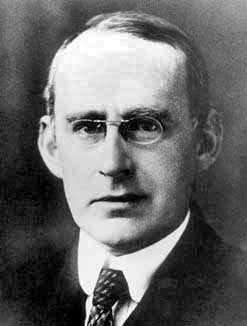
nothing. Sir Arthur Stanley Eddington gave us the basis for the Standard Solar
Model in The Internal Constitution of the Stars,
published in 1926. The Standard Solar Model refers to specific calculations
based on a set of basic assumptions that are accepted as valid. Eddington
wrote,
 “In seeking a source of
energy other than contraction the first question is whether the energy to be
radiated in future is now hidden in the star or whether it is being picked up
continuously from outside. Suggestions have been made that the impact of
meteoric matter provides the heat, or that there is some subtle radiation
traversing space which the star picks up. Strong objection may be urged against
these hypotheses individually; but it is unnecessary to consider them in detail
because they have arisen through a misunderstanding of the nature of the
problem. No source of energy is of any avail unless it liberates energy in the
deep interior of the star.
It is not enough to
provide for the external radiation of the star. We must provide for the
maintenance of the high internal temperature, without which the star would
collapse.”
Having dismissed external
inputs, Eddington simplified the problem by defining the Sun as an isolated
‘ideal gas sphere’ subject to self-gravitation and a central heat source to
‘blow it up’ to the size we see. His model was limited because he had no practical experience of electric
discharge phenomena in a near vacuum, otherwise he might have seen the
photosphere as an atmospheric
electric discharge phenomenon and not the surface
of the Sun.
This highlights a
fundamental problem with modern computer modelling. How well do we understand
what we are looking at? Our interpretation is limited by our experience and
imagination. No one has any experience of the interior of a star so the complex
Standard Solar Model is purely imaginary. Never mind that it’s not understood
how to collapse a molecular cloud to form a star and no known physical body
transfers internal heat through a ‘radiation zone.’ Nevertheless, the
complexities involved in trying to get the Standard Solar Model to mimic what
we observe have kept theorists busy for a century — without success! Surely
it’s overdue for a total rethink?
“In seeking a source of
energy other than contraction the first question is whether the energy to be
radiated in future is now hidden in the star or whether it is being picked up
continuously from outside. Suggestions have been made that the impact of
meteoric matter provides the heat, or that there is some subtle radiation
traversing space which the star picks up. Strong objection may be urged against
these hypotheses individually; but it is unnecessary to consider them in detail
because they have arisen through a misunderstanding of the nature of the
problem. No source of energy is of any avail unless it liberates energy in the
deep interior of the star.
It is not enough to
provide for the external radiation of the star. We must provide for the
maintenance of the high internal temperature, without which the star would
collapse.”
Having dismissed external
inputs, Eddington simplified the problem by defining the Sun as an isolated
‘ideal gas sphere’ subject to self-gravitation and a central heat source to
‘blow it up’ to the size we see. His model was limited because he had no practical experience of electric
discharge phenomena in a near vacuum, otherwise he might have seen the
photosphere as an atmospheric
electric discharge phenomenon and not the surface
of the Sun.
This highlights a
fundamental problem with modern computer modelling. How well do we understand
what we are looking at? Our interpretation is limited by our experience and
imagination. No one has any experience of the interior of a star so the complex
Standard Solar Model is purely imaginary. Never mind that it’s not understood
how to collapse a molecular cloud to form a star and no known physical body
transfers internal heat through a ‘radiation zone.’ Nevertheless, the
complexities involved in trying to get the Standard Solar Model to mimic what
we observe have kept theorists busy for a century — without success! Surely
it’s overdue for a total rethink?
An Engineer’s
Model of the Sun
Ralph E. Juergens (6 May 1924 – 2 November 1979)
It seems not to have
occurred to anyone since Eddington, with the notable exception of an engineer, the late
Ralph Juergens of Flagstaff, Arizona, that sunshine may be produced by “some subtle radiation traversing space which the
star picks up.” Juergens was involved in the interdisciplinary
research mentioned earlier and he saw the need to investigate the electrical
nature of the Sun and solar system. He published a seminal paper in 1979, The
Photosphere: Is it the Top or the Bottom of the Phenomenon we call the Sun?
He emphasised the fact that none of the observed features of the Sun such as
the corona, chromosphere, spicules, granulation, sunspots etc., had any
business being there in the Standard Solar Model. For example, “..the established theory of stellar energy is
embarrassed by the mild behavior of the Sun’s photospheric granules.”
The photospheric granules are supposed conventionally to be the tops of
vigorous convection cells driven by the Sun’s central nuclear furnace. Internal
convection is essential to the Standard Solar Model because convection is
supposed to ‘somehow’ generate the Sun’s complex magnetic fields.
Juergens’ observation
about the “mild behavior of the Sun’s
photospheric granules” foreshadowed a recent discovery by a team of
scientists who have developed an ‘MRI’ of the Sun’s interior plasma motions.
Shravan Hanasoge, an associate research scholar in geosciences at Princeton
University and a visiting scholar at NYU’s Courant Institute of Mathematical
Sciences is reported as saying,
“..our results suggest
that convective motions in the Sun are nearly 100 times smaller than these current
theoretical expectations. If these motions are indeed that slow in the Sun,
then the most widely accepted theory concerning the generation of solar
magnetic field is broken, leaving us with no compelling theory to explain its
generation of magnetic fields and the need to overhaul our understanding of the
physics of the Sun’s interior.” [reprinted
from materials provided by New York University.]
This discovery alone
should be a ‘tipping point’ for the Standard Solar Model. But foundational
beliefs die hard. Earlier there was ‘the solar neutrino problem,’ which for many decades
directly discounted the thermonuclear model of the Sun when the neutrino fluxes
were found to be 3 or more times less than expected. That problem has been swept under the
carpet by assuming that neutrinos change on their way from the Sun’s core
to the detectors on Earth. Conveniently for theorists, there is no way of
verifying this for the foreseeable future. Meanwhile it has been found that the
neutrino count varies inversely with sunspot number, which is a photospheric
effect that cannot be influenced by anything going on in the Sun’s core. All of
the action seems to be happening in the photosphere itself, which emphasizes
Juergens’ unusual question.
A recent article in Nature (28 June 2012), Swirls
in the corona, unintentionally answers both Juergens’
question and the most intractable problem for the Standard Solar Model: “The high temperatures associated with the Sun’s
corona have made explaining its existence one of the most long-standing
problems in astrophysics.”
Visualization of the spiralling ionized plasma using 3D numerical
simulations of a magnetic tornado in the solar atmosphere. (Courtesy:
Wedemeyer-Böhm et al.)
The article highlights the
discovery of ‘super-tornadoes’ in the chromosphere, between the corona and the
photosphere. It is estimated there are more than 10,000 of them continuously
present in the quiet Sun. The researchers have leapt to a possible heating
mechanism for the corona via these super-tornadoes, which are connected
magnetically to vortexes in the photosphere. However, it is not clear how the
tornadoes are formed or how energy is transferred from the super-tornadoes to
the corona. Predictably, all of this energy is supposed to be driven by
convective motion and trapped magnetic fields beneath the photosphere. But we
have just seen there is insufficient photospheric convection to produce the
Sun’s magnetic fields.
More recently another
report in Science (28
September 2012), How Oblate is the Sun, notes, “…the Sun appears not to be as flattened as it
should be… The new oblateness measurements beg explanation.” This
is a measure of the uselessness of the Standard Solar Model to predict or
explain even the most basic observations about the Sun. “Observations give a wealth of detail about the
photosphere, chromosphere and the corona. Yet we have difficulty in matching
the observations with a theory.” [Solar
Interior & Atmosphere, J.-C. Pecker] But students and
the public through the media are unaware of this. It seems that scientists
forget this unpleasant truth too when they sign off on research that will
produce thermonuclear power ‘like the Sun.’
These recent discoveries
support Juergens’ external electrical powering of the Sun. Together with
findings about the Sun’s
interface with the galaxy at the heliopause that deny all previous
theoretical models, they put an emphatic end to standard solar theory. The
photosphere is the bottom of the phenomenon we call the Sun. The Sun may now be
easily understood and the electrical model confirmed empirically since what we
can see is all we need to know. The Thunderbolts Project is dedicated to this task.
The following paragraphs
briefly demonstrate the simplicity and unity of the electrical model of the
Sun. It is a single model that explains long-standing mysteries of the Sun and
can be applied to all stars, from brown through red to blue-white,
and dwarf to giant. Stellar differences can all be understood in terms of the
three different modes of plasma discharge — dark, glow and arc. The Electric
Universe meets all of the demands of a good theory. It follows sound electrical
engineering principles and space plasma science as recognized by the Institute
of Electrical and Electronic Engineers (IEEE)
Electrical
Star Birth
Glossy media
presentations show the Sun and planets forming from a rotating dusty cloud. So it will surprise most people
that experts consider star formation an “open
question,” and as “the most
important challenge in astronomy over the next decade.” [R. de
Grijs (2012)] The challenge becomes more difficult as telescopes improve. I
predict that it will become impossible when new instruments like the James Webb Telescope and
the Square Kilometer Array become operational. Unexplained
magnetic fields are involved.
“Something creates
and maintains micro-Gauss coherent magnetic fields on an enormous scale.” [B. Gaensler (2008)] So common
sense suggests we should turn to plasma cosmology, which explains star
formation simply in electromagnetic
terms.
A network of 27 star forming filaments derived from Herschel
observations of the IC 5146 molecular cloud. Credit: D. Arzoumanian et al.
Stars form in molecular
clouds by a process of Marklund convection toward current filaments that look just
like a cosmic form of cloud-to-cloud lightning. This discovery was a surprise
to theorists who rely on spherical 1/r2 gravitational accretion of
matter toward a center of mass. In sharp contrast, Marklund convection
concentrates matter along a current filament with a long-range and more powerful
1/r electromagnetic force. Significantly, Marklund convection separates the
chemical elements with the coolest and most easily ionized elements, such as
iron and silicon, nearest the axis. With sufficient matter along the filament,
gravity assists in forming separate stars and smaller bodies rather like
glowing beads along a lightning channel with cool cores of heavy elements and
atmospheres of hydrogen and helium. Note that a thermonuclear reaction cannot
ignite in a cool heavy element stellar core!
Electrical
Planet Origins
If the heavy elements are
concentrated in stellar cores, how do we account for planet formation with heavy element cores?
With over 800 ‘exoplanets’ discovered the standard accretion model is in
increasing difficulties. The first problem was finding ‘hot Jupiters’ orbiting
stars closely. The accretion model says that it’s impossible for them to form
there. So the gas giants must have somehow ‘migrated’ inwards from a more
distant orbit. But the accretion model requires our gas giants to migrate before they formed so that the
inner planets have the time necessary to achieve their elemental composition!
But what of stars that
sport ‘accretion disks?’ It is simply assumed that the disks are due to
gravitational in-fall. However, gravity is easily overcome by electromagnetic
repulsion, as we observe in solar mass ejections. Consequently, stars
have expulsion jets and disks rather than accretion disks.
Sometimes, for dynamic reasons or to spread the electrical load over a greater
surface area, forming stars will electrically fission into binaries or multiple
star systems. This scenario may explain some of the surprising abundance of
multiple star systems and close orbiting ‘hot Jupiters.’
Also, the birth of
plentiful brown dwarf stars and smaller bodies in proximity along an electrical
umbilical cord provides the opportunity for capture by bright stars to form
planetary systems. Capture is greatly
enhanced by electrical energy exchange where the cross-section for
capture is that of a star’s huge electrical boundary, called the heliosphere
(~200 AU wide), or ‘astrosphere.’ Brown dwarfs captured by a bright star will
have their power source stolen, lose their radiance and become gas giants. This
explains a mystery known as the ‘brown dwarf desert,’ around main sequence
stars.
The capture process of a
brown dwarf involves drastic electrical readjustment from being an anode to a
cathode, which the captured star achieves by a cometary-type electrical
expulsion of matter from its heavy-element core and atmosphere, forming
satellites and rings. Some of the expelled debris escapes to become families of
comets, asteroids and meteoroids. It is a process entirely analogous to the
observed electrical splitting of comet nuclei, often as they too approach the
Sun.
The applicability of this
model to the solar system is obvious with the distant gas giants sporting rings
and many satellites. Saturn, with its spectacular ring system, appears to be
the most recently captured. The inner planets are satellites lost to the gas
giants/former dwarf stars. Astronomers have recently begun to suggest that the
environment close to a dwarf star is conducive to life. But there is far more to this idea in an Electric Universe. So the Sun’s
weird assortment of planets and their satellites are an adopted family and not
primordial. Comparing gyroscopically stable axial tilts may show some familial
associations. Significantly, Saturn,
Mars and Earth seem related via this hypothesis.
Gravitational systems are
essentially chaotic because orbital perturbations are not corrected. With
intruders upsetting the solar system the obvious question is how come the
planets move like clockwork? It is important that an effective ‘damping’
mechanism operates to enforce order in the solar system. The Electric Universe
simply proposes that protons, neutrons and electrons, like the atoms they form,
have orbital structures too and can be distorted in an electric field to form
tiny electric dipoles. Gravity can then be understood, like a form of molecular
bonding, as the force between induced weak electric dipoles in all subatomic
particles in a body. This gives the crucial ability to modify a planet’s
gravity and orbit by altering the charge on its surface. Such a gravity model
mitigates against collisions by spacing orbits so that planets exchange
electric charge the least via their cometary plasma sheaths.
Electrical
Star Light
The Electric Universe
model of a star proceeds where plasma cosmologists left off. It seems that stars continue to
receive electrical energy from the galactic current filament in which they
formed. This has been recently
established by the ‘surprising’ influx of energetic neutral atoms (ENAs)
from a ring about the solar system, aligned across the interstellar magnetic
field. The ring with its ‘bright spots’ indicates the presence of an
electromagnetic ‘pinch’ in the co-axial interstellar current cylinders that
power the Sun.
This ‘planetary nebula’ shows a
typical star’s co-axial circuit in a more active ‘glow mode.’ The
electromagnetic plasma ‘pinch’ centered on the star is clearly evident.
So the photospheres of
stars should be viewed as a global electric discharge phenomenon at the very
top of their gravitationally stratified atmospheres where the lightest
elements, hydrogen and helium, are in abundance. The problem for solar
theorists is that there is no explanation for lightning in the Earth’s
gravitationally stratified atmosphere! Much less are the weird phenomena above lightning storms understood. And
lacking that understanding the relevance of electrical activity in the
photosphere goes unnoticed today, although several scientists in the past
sensed it.
For example the solar
physicist Giorgio Abetti wrote, “[Solar]
prominences can be explained as electrical discharges.” [The
Sun (1963)] And Eddington himself wrote, “If there is no other way out we may have to
suppose that bright line spectra in the stars are produced by electric
discharges similar to those producing bright line spectra in a vacuum tube.”
[1926]
A fundamental mistake is
that students are taught the conductivity of space plasma is so high that any
electric field in it can be set to zero. But experience in gaseous discharges
shows that currents and not electric fields in plasma are important. Everywhere
we look in space we find magnetic fields, which are the result of electric
currents. So it is not correct, as Hannes Alfvén pointed out, to merely treat
the solar wind as a magnetized gas, which is the conventional approach. Alfvén
showed that the solar ‘wind’ must be a ‘dark’ current that flows in a circuit
between the Sun and its galactic environment. Most importantly, the electric
field in the bulk of the plasma within the heliosphere is not zero, but
vanishingly small — just sufficient to accelerate the solar ‘wind’ protons away
from the Sun and then reversing direction to bring the solar wind mysteriously
to a halt at the heliosphere boundary, or ‘virtual cathode’ of the solar
discharge. The latter recent discovery was a total surprise. “There no longer exists any guidance on what
constitutes getting out of the Solar System and into the Galaxy.”
[S. Krimigis, Nature
489:21, 2012]
Stars as Positive
Anodes
Juergens identified the
many observed discharge phenomena on the Sun as characteristic of those above a positive anode. The
interplanetary plasma potential ‘locks’ to that of the anode — the Sun. So the
electric driving potential of the Sun is confined largely to the distant
heliosphere boundary — in the region being encountered by the two Voyager spacecraft, where the solar wind has ‘mysteriously’
come to a halt. It is not a mystery when the electrical model is applied to the Sun.
The heliospheric plasma
sheath is the ‘virtual cathode’ in the Sun’s circuit. The electric field first
reverses on approaching the cathode, causing the protons to decelerate with no
evidence of a galactic ‘head wind.’ Beyond that region the protons will
accelerate rapidly away to become cosmic rays. The electrons coming from that
vast ‘virtual cathode’ sphere are focused down a trillion times by the time
they reach the photosphere and produce the radiance of the Sun.
The evidence to look for
is filamentary currents following the ambient magnetic field direction down to
the photosphere. Such filaments are seen at all scales in the Sun’s corona,
chromosphere and photosphere. The Sun’s corona is simply a coronal discharge
effect where diffuse plasma is apparently heated to millions of degrees by the
electric current flowing through it. Referring back to Swirls in the corona,
energy is not transferred from the Sun up to the corona via magnetic “super
tornadoes” but in the opposite direction, down toward the Sun by
electromagnetic tornadoes. The “super tornadoes” are typical of plasma self-organization at high current densities, in
which the current filaments take a helical path, or ‘tornado.’ This phenomenon
is important when we look in detail at the photosphere.
Photospheric
“Granulation”
The photosphere can now
be examined for anode phenomena. The solar plasma
discharge switches from dark-mode in interplanetary space, where it is
referred to inaccurately as the ‘solar wind,’ to glow-mode in the corona and
chromosphere, to arc-mode in the photosphere. The photosphere exhibits complex
structure in the form of granulation and sunspots, neither of which are explained
or to be expected if the Sun were simply radiating internal energy. Juergens
wrote,
“..the idea of thermal
convection as the explanation for granulation in the photosphere – a concept
that at first seemed handsomely supported by a resemblance between granules and
blocky cells in molten wax – fares rather badly when subjected to scrutiny.
Nevertheless, so compelling is the conviction that the Sun generates its own
energy that such practical difficulties are generally disregarded. The
consensus has it that convection there must be, and therefore photospheric
granulation must somehow be a manifestation of the process.”
Instead, Juergens
identified solar granulation as a “tufted anode discharge” phenomenon where a
“dense, highly luminous, secondary plasma springs into being in the embrace of
a thinner, less luminous, primary plasma.”
The plasma tufts float and move about above the anode. Having a net
positive charge they space themselves symmetrically apart on the anode surface.
[F. H. Clauser, Plasma Dynamics]
Irving
Langmuir explained anode tufts as a region of increased ionization of the
plasma in response to excessive current to the anode. It seems the granulations
of the photosphere are the tops of millions of closely packed anode tufts
separated by their plasma sheaths from the primary plasma of the Sun’s
ionosphere, which forms the dark lanes between the granulations.
The body of the Sun is
much smaller than that occupied by the photosphere. So the Sun’s almost perfect
spherical shape can perhaps be attributed to electromagnetic forces combined
with the need to achieve the highest packing density of the anode tufts at the
top of the Sun’s ionosphere. The resultant spherical symmetry of the discharge
following magnetic field lines in ‘force free’ mode down to the photosphere
results in the Sun’s dipole magnetic field not having the predicted bar-magnet
shape, or crowding of field lines near the poles. This answers the surprising
fact that the Sun’s magnetic field lines spread out uniformly from the
photosphere.
Anode Tufts
and the Solar Constant
Juergens refers to the
curve of the electrical potential distribution across an anode tuft. Electrical engineer Dr. Donald
Scott recognized the curve as characteristic of the voltage curve across a
transistor. This insight offers a simple explanation for another mystery of the
Sun — how does the heat and light of the Sun remain steady to within 0.1
percent (the ‘solar constant’) while its output in X-rays varies markedly with
the solar activity cycle? The answer is ‘electronically!’
The X-rays come from the corona and solar flares, which respond directly to the
varying galactic power input. However, a small shift in voltage of the tuft
plasma relative to the body of the Sun is sufficient to regulate the current
through the tuft, and hence the heat and light from the photosphere.
Schematic of the photospheric tuft transistor analog. The cool body of
the sun is at the origin. Courtesy of D. Scott.
Mysterious
Sunspots
To have any confidence in our understanding
of the Sun, and stars
in general, we must first be able to explain simply the things we can see. Therefore it is crucially
important to understand a sunspot because it is the only place on the
Sun that gives a glimpse below the bright photosphere. Sunspots show a
formation like the pupil and iris of an eye, the pupil being the dark umbra and
the iris the filamentary penumbra.
Closeup of section of a sunspot.
Sunspots have been
described as “a phenomenon lacking
scientific explanation.” [E. N. Parker] The lack stems from narrow
training that doesn’t recognize plasma discharge phenomena. Anyone who has seen
the snaking filaments in a novelty plasma ball will have seen how electric
currents in plasma naturally form filaments. Filamentary structure is seen at
all heights in sunspots. But astrophysicists talk instead of magnetic ‘flux
tubes’ as if magnetism can be present without an electric current.
Notably, sunspots of the
same magnetic polarity do not repel each other. This requires that sunspots are
bundles of parallel current filaments drawn together according to Ampère’s law
and punching through the photosphere. Sunspots are the footprints of
concentrated discharges from a plasma doughnut or ‘plasmoid’ electromagnetic
energy storage ring encircling the Sun above its equator.
The
solar plasmoid has been imaged in UV by SOHO. Kristian Birkeland performed his
Terrella experiment demonstrating the effect more than one hundred years ago.
Anode Tufts
have Structure
High-resolution images of
sunspots allow us to see the structure of anode tufts below the photosphere. They show the photospheric
granulations sit atop glowing penumbral filaments. The invisible twisting
tornadic form of plasma discharge detected in the corona is visible
in arc-mode on a finer scale in the penumbral filaments. It is typical
for plasma phenomena to scale the same patterns over a vast magnitude range.
A penumbral
filament is a semi-transparent tornadic plasma discharge. Where the filament
current density is high it brightens to form moving striations. The darker core
is visible only at favorable angles of the filament axis to the observer.
Time-lapse
movies of penumbral filaments show steady downward movement of their bright
point-like lower ends called ‘penumbral grains,’ which are generally brighter
than the photosphere. Conventionally, the observed
vertical velocities of matter do not suffice to transport the energy radiated
away by penumbrae. So convection is not the answer.
Can we find electric discharge activity in the Earth’s gravitationally
stratified atmosphere for analogs to the activity seen in the penumbral
filaments? Earthly tornadoes suppress lightning activity over a wide area by
providing an intense but slow helical discharge path to ground, which can
account for their powerful effects and longevity. And like a tornado, the solar
atmosphere is lofted up the penumbral filament to produce the enigmatic
‘Evershed flow’ out of the sunspot.
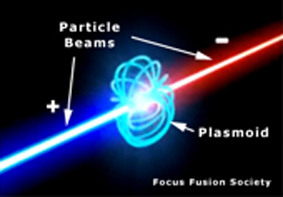
 By analogy, the bright
penumbral grains may be lightning in the more dense atmosphere at the base of a
glowing tornadic funnel. Or more likely, they may be a further stage of plasma
instability called a dense plasma focus (DPF) where both matter and
electromagnetic energy is intensely concentrated in a tiny ‘plasmoid.’ In the
lab the DPF is
the simplest and most promising fusion energy source.
By analogy, the bright
penumbral grains may be lightning in the more dense atmosphere at the base of a
glowing tornadic funnel. Or more likely, they may be a further stage of plasma
instability called a dense plasma focus (DPF) where both matter and
electromagnetic energy is intensely concentrated in a tiny ‘plasmoid.’ In the
lab the DPF is
the simplest and most promising fusion energy source.
All Bright
Stars Produce Heavy Elements
Experimentally, a DPF
produces nuclear fusion and is a copious source of neutrons. Neutron capture in a dense
plasma environment of protons and positive ions is necessary to ‘build’ the
heavy elements from the lighter elements. So here we have a straightforward
possible solution to the continuous production of heavy elements by
all stars. The resultant complex nucleosynthesis in the
photospheric granules can also be expected to produce a mix of different
neutrino types. The observed neutrino modulation by sunspots is then easily
explained because the sunspots clear areas of the photosphere of granulation.
Common sense demands an alternative to the conventional story of heavy-element
production only from rare dispersive supernova explosions, followed by somehow
accreting the scattered matter to form the ‘next generation’ of stars
containing more heavy elements. Clearly, the electrical model of the Sun does
not require the unverifiable complexity of stellar thermonuclear cookery and
stellar evolution through self-immolation.
Umbral ‘Dots’
Viewing the Sun as a body
with global electrical activity in its ionosphere provides a clue to another solar mystery. Sunspots
have an intense magnetic field, which identifies the umbra as the imprint of a
powerful field-aligned plasma discharge punching through the bright photosphere
to lower levels. So the dark umbra is not uniformly dark. It is packed with a
kind of granulation known as ‘umbral dots,’ which are finer and longer lived
than photospheric granules and are hotter (~6200K) than the photosphere. These
are characteristics we might expect from a lightning discharge at higher
current and atmospheric densities than are present in the photosphere above.
Significantly, penumbral
filaments tend to split in a ‘Y’ shape at their bases and seem involved in the
formation of umbral dots. At higher atmospheric density a plasma discharge
tends to split into thinner filaments. It is a phenomenon observed stretching
between the glows in the ionosphere to the lightning at ground level in major
Earthly thunderstorms. Lightning also heats and accelerates gas upwards in the
lightning channel from the higher-pressure region to the lower. That may
account, in part, for the hot umbral dots against the dark background of the
cool body of the Sun.
The Solar
Cycle
The solar cycle is an
enigma for the standard solar model. “The solar
activity cycle has fascinated scientists and amateurs alike for over a century,
but its mystery remains, and even deepens, as we collect new data that reveals
its full complexity.” [D. M. Rabin et al., Solar
Interior & Atmosphere] Attempts to model the solar
cycle have relied on a hypothetical dynamo inside the Sun, in other words, the
inductive action of fluid motions pervading the solar interior, to explain
features that occur outside the Sun. But nothing remotely resembling consensus
currently exists as to the mode of operation of the solar dynamo. And the coup
de grace seems to have been delivered by the recently discovered lack of fluid
motions beneath the photosphere.
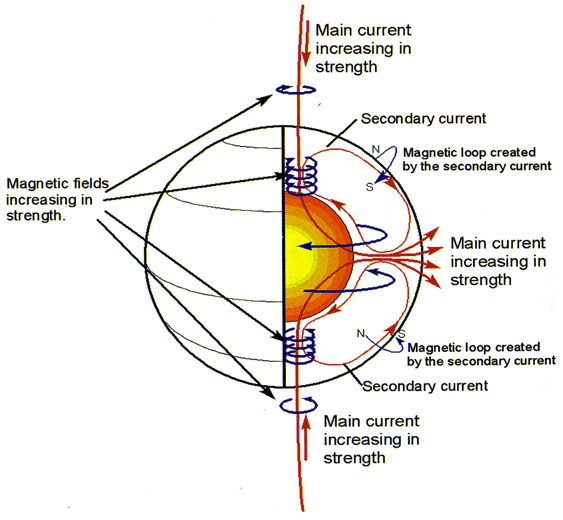
 In the Electric Universe
model, the solar sunspot cycle is simply the result of varying the direct
current (DC) input to a plasma discharge focused on the Sun. For a continuous
current to flow there must be a circuit. Hannes Alfvén provided the circuit but
misidentified the Sun as a generator in
a local closed circuit instead of a load in
a galactic circuit. Dr. D. Scott provided an electrical engineer’s perspective
of the Sun’s magnetic field changes due to a changing input current.The
simplicity is obvious. The reversal of the Sun’s dipole field and sunspot order
during the solar cycle is a natural result of a transformer action as the main
current increases and decreases but never reverses. The solar cycle is to be
expected since plasma circuits are notorious for their oscillatory tendency.
In the Electric Universe
model, the solar sunspot cycle is simply the result of varying the direct
current (DC) input to a plasma discharge focused on the Sun. For a continuous
current to flow there must be a circuit. Hannes Alfvén provided the circuit but
misidentified the Sun as a generator in
a local closed circuit instead of a load in
a galactic circuit. Dr. D. Scott provided an electrical engineer’s perspective
of the Sun’s magnetic field changes due to a changing input current.The
simplicity is obvious. The reversal of the Sun’s dipole field and sunspot order
during the solar cycle is a natural result of a transformer action as the main
current increases and decreases but never reverses. The solar cycle is to be
expected since plasma circuits are notorious for their oscillatory tendency.
Stellar Mass
Hidden in plain sight is
the well-known relationship between mass and energy, E = mc2, which tells
us that mass is an electromagnetic variable. The higher the electrical stress
on a body, the greater is the internal charge polarization and hence the
greater is the body’s mass. The mass of a star cannot tell us how much matter
is in the star.
So estimates of the
composition of celestial objects based on their measured mass and the volume of
their photosphere are invalid. The mass of a star gives no information about
the size or composition of its heavy element core or the internal
structure of the star. The fact that the relation breaks down for white dwarfs
and red stars is due to the fact that their luminosity is generated by
extensive coronal and chromospheric glow mode discharges respectively.
The
Mass-Luminosity Relation
The stellar mass–luminosity relation
is important in the conventional model because, in an attempt to match observations, a tottering
tower of theory has been built. The model is impossible to verify and requires
an ad hoc system of complex thermonuclear ‘cookery’ and the effects of the
resulting ‘burnt ashes’ on the internal structure of stars. If we discard
standard theory, we require an electrical explanation.
The mass-luminosity relation for bright
stars indicates that both variables are related to the degree of electrical
stress suffered by a main-sequence star. Variations in the M-L relation for
different mass ranges may be attributed to differences in the manner of a
plasma discharge to cope with the current density at the photosphere. For
example, the luminosity depends on the brightness and size of the photosphere,
which expands and changes color from yellow to blue-white to meet increasing
electrical stress.
Beyond the
Tipping Point
What is it going to take
to tip out the old beliefs? Change can occur slowly from the bottom up or rapidly from the top
down. Unfortunately, forces from the top tend to favour stasis over change.
Modern science has become a monolithic structure funded by governments and tied
to political outcomes. Radical change is arguably more difficult to achieve in
such a situation than at any time in the past. Funding of dissident scientists
is not available, their publication in leading science journals disallowed by
the anonymous peer review system and their careers jeopardized. Meanwhile the
media lazily accept what they are fed by ‘experts.’
It is perhaps a fitting
irony that the Internet, which was built for communication between scientists,
now provides the means to bypass censors to reach a global audience. Powerful
news organizations are finding this to their great discomfort. So while the emperors
of science strut their nakedness, scholars from many disciplines have been
converging on a new science called the Electric Universe, which offers an
unparalleled scientific and cultural Renaissance. The Thunderbolts
Project was established as a focal point for this movement.
It now has funded scholarships for students, experiments and an annual
conference. Join us at the Thunderbolts Project’s January 2013 annual conference
called “The Tipping Point.”
“We shall not cease from exploration, and the end of all
our exploring will be to arrive where we started and know the place for the
first time.”
—T. S. Eliot
Wal Thornhill
From Electric Universe @ http://www.holoscience.com/wp/sciences-looming-tipping-point/
For more information
about our electric universe (with videos) see http://nexusilluminati.blogspot.com/search/label/electric%20universe
- Scroll down through ‘Older Posts’ at the end of each section
Hope you like this
not for profit site -
It takes hours of work every day by
a genuinely incapacitated invalid to maintain, write, edit, research,
illustrate and publish this website from a tiny cabin in a remote forest
Like what we do? Please give enough
for a meal if you can -
Contribute any amount and receive at
least one New Illuminati eBook!
Please click below -
And see
DISGRUNTLED SITE ADMINS PLEASE NOTE –
We provide a live link to your original material on your site (and
links via social networking services) - which raises your ranking on search
engines and helps spread your info further! This site is
published under Creative Commons Fair Use Copyright (unless an individual
article or other item is declared otherwise by the copyright holder). Reproduction
for non-profit use is permitted & encouraged, - if you give attribution to the work &
author. Please include a (preferably active) link to the original (along with
this or a similar notice).
Feel free to make non-commercial hard (printed) or software copies or
mirror sites - you never know how long something will stay glued to the web –
but remember attribution!
If you like what you see, please send a donation (no amount is too
small or too large) or leave a comment – and thanks for reading this far…
Live long and prosper! Together we can create the best of all possible
worlds…