"All the World's a Stage We Pass Through" R. Ayana

Showing posts with label paganism. Show all posts

Thursday, 22 December 2016

The Truth Behind the Christ Myth: Ancient Origins of the Often Used Legend


The Truth Behind the Christ Myth:
Ancient Origins of the Often Used Legend

The Coming Gnostic Civilization, and his most recent book, Sedona: City of the Star People.

Green Man painted on a ceiling (CC BY-NC 2.0)


What is the origin of the legend of the Christed Son who was born of a virgin on December 25th? I am sure you are familiar with his legend which states that he was born in a manger surrounded by shepherds and then grew up to be One with his Father in Heaven.  And most certainly you recall the sequence of events when this Christed Son gathered together his important disciples before enduring his death by torture and his subsequent resurrection. And, finally, there is the scene at the end of his time on Earth when he prophesied his return and then ascended into Heaven.

Now for my question to you: Who amongst you is now mumbling under his or her breath “This can only be the legend of the Christians’ Jesus Christ”?  Well…to the rest of you, I would like to inform you that many years before the birth of Jesus a legend identical to his was the accepted life story of the Persian Son of God, Mithras. And before Mithras, a very similar legend was ascribed to various other Sons of God worldwide, including the Greek Dionysus, the Egyptian Osiris, the Sumerian Dammuzi, and the Hindu Murugan. In fact, if we keep going back in time many thousands of years earlier we will discover that this universal legend actually began with the Green Man, the Son of a virgin Goddess who was born, died, and finally resurrected each and every year.     

So how did this oft-used legend eventually become chosen to be the legend of Jesus? Let us begin when it was the life story of the ancient Green Man and work forward to the time of the Christian Son of God. 


The Ancient Green Man


During the Neolithic Age, which was the era when, as some say, “God was a Woman,” the Goddess and Her Son, the Green Man, were venerated by people worldwide for annually bringing forth the Earth’s material abundance. A universal legend about them arose that began with the annual impregnation of the “virgin” Earth Goddess by the Sun, the “Father in Heaven,” and the subsequent birth of Her Son, the Green Man. This important event occurred annually at the time of the Winter Solstice, when the spirit of the Green Man that had been slumbering underground in the underworld was shaken back to life. But although his dormant spirit had been stirred, it was not yet fully awake. This did not occur until a few days later, on December 25th, when the Sun or Solar Spirit completely reversed its downward path and took measurable steps along a northerly route.

This was an important “As Above, So Below” event. It was believed the renewed and revitalized Solar Spirit above in the Heavens had re-awakened and revitalized the spirit of his Son below and inside the Earth.  And now the future Green Man could begin his annual gestation period with the womb of his mother, the virginal Earth, in anticipation of receiving a new, resurrected body in the spring. 


Sculpture of Green Man at festival.
Sculpture of Green Man at festival. (CC BY-NC-SA 2.0)


The legend of the Goddess and Green Man then skips to the Vernal Equinox, when the Green Man is ready to finally emerge from the womb of his mother. This is the time when the “male” light equals the “female” darkness, and their male-female polarity fully unites to produce a fresh infusion of life force to cover and fertilize the land. The fetal body of the Green Man is now ready to push out of the womb of his mother Earth in the form of the new tender sprouts of spring. Soon, his annual resurrection will be complete. This will occur on or around the same day as our Easter, a modern holiday associated with the much more recent resurrection of another Son of a virgin. 

The legend of the Green Man then covers the hot summer months, when the Son rapidly matures as the rapidly maturing vegetative growth of nature. He matures so fast, in fact, that the Green Man not only becomes One with his Father in Heaven, but he even mates with and inseminates his own mother. Their co-habitation produces a second infusion of the fructifying life force on Earth and manifests as a second proliferation of vegetation and accompanying harvest. Ultimately, this event would serve to hasten the Green Man’s demise, and soon he would die again with the decaying vegetation and the falling of leaves of autumn. The cause of his death? The sacerdotal interpreters of his legend would later assert that it occurred because of the sins of humanity. It was believed through original sin humanity had given up not only its own right, but the right of all life on Earth, to achieve eternal life.    

At the close of the Neolithic Age, when civilizations arose in place of a purely agrarian culture, the ancient legend of the Goddess and Green Man expanded and took on religious overtones. It became a standard myth that was annually recited and dramatically staged in the temples and the mystery schools of the new fledgling cities, nations and empires. A feature of its evolving storyline was that the Green Man now took on the additional role of King of the World, which he governed under the authority of his Earth mother. And in some renditions of the legend the Son was said to have met his death in the fall at the hands of his unscrupulous brother or a dark, evil lord. 


Ishtar and Tammuz


In the cities of Meopotamia the Neolithic legend transformed into the story of the Goddess as Inanna or Ishtar who annually gave birth to a Green Man Son and future king under the name of Dammuzi or Tammuz. It was said that Dammuzi/Tammuz grew up to mate with his own mother while also governing the Earth for her. In order that this ancient legend be reflected in their culture, the inhabitants of the Fertile Crescent enthroned rulers of their city-states who were acknowledged to be the embodiments of Dammuzi/Tammuz and the royal servants of Goddess Inanna/Ishtar.


“Unearthed in the main room of the palace of Arad. It depicts two almost identical images of a man with a branch- or sheaf shaped head, one lying down and the other standing. It may represent the fertility god Tammuz or a similar deity, who died in summer and was resurrected in spring, Museum of Israel.”
“Unearthed in the main room of the palace of Arad. It depicts two almost identical images of a man with a branch- or sheaf shaped head, one lying down and the other standing. It may represent the fertility god Tammuz or a similar deity, who died in summer and was resurrected in spring, Museum of Israel.” (CC BY-NC-SA 2.0)


This was also true in Egypt, where the ruling pharaohs were regarded to be incarnations of Horus, the Son of Goddess Isis, and governed under her authority. But in the land of Khemit, although the spirit of the incumbent pharaoh was Horus, his physical body was formed by Seth, the god who governed the crystallization of energy into physical flesh. Together, Horus and Seth as the “Twins” created and comprised the physical body of the pharaoh, thus making the Egyptian monarchs modern representatives of the first and greatest king, Green Man Osiris.


Egyptian deity, Osiris as Green Man.
Egyptian deity, Osiris as Green Man. (Public Domain)


Like the ancient Green Man, Osiris was similarly said to die and become resurrected annually in concert with the life and death of nature’s vegetation. Osiris’s annual resurrection ceremony took place during the annual flood of the Nile River, when the first tender sprouts of nature initially stuck their fragile heads above the surface of the Earth.  


Semele and Dionysus


One version of Osiris’s popular Egyptian myth had him annually murdered by his jealous and evil brother Set each fall. This event was reflected in the legend of Osiris’s counterpart in Greece, Green Man Dionysus, who was annually slain by his relatives, the evil Titans, but later resurrected. Similar to Green Man Osiris, the mother of Dionysus was an Earth Goddess named Semele, meaning “Earth,” and his father was Zeus, the Father in Heaven.


Dionysus as the Green Man
Dionysus as the Green Man (Public Domain)


In order to awaken Dionysus from his slumber at the time of the Winter Solstice, female representatives of the Goddess would loudly bang pots and pans as they danced their way in ritual procession to the snowy summit of Mount Parnassus.  And then after receiving his new set of clothes at the following spring equinox, the Divine Son would cavort in nature along with his own reflection and alter-ego, Pan, a name meaning “the All,” as in “All of Nature.”

Like Osiris, Dionysus became the King of the World, and like his Egyptian counterpart, Dionysus was reputed to have once completely covered the globe while teaching his diverse subjects the art of making and ritually consuming wine.


A young Dionysus.
A young Dionysus. (Public Domain)


Wine made from grapes was recognized as the blood of nature, and since Dionysus was all of nature, it was his blood. Thus began the ritual of a holy communion through consuming the body and blood of the Divine Son. 


Green Man in the Louvre
Green Man in the Louvre (CC BY-NC 2.0)


The Hindu Divine Son


When the Greek conqueror Alexander the Great arrived in India he was surrounded by an abundance of rituals and venerated effigies of a Divine Son that reminded him of his beloved Dionysus. These reminders were so prevalent that that Alexander and his men were finally compelled to exclaim, “We know your Divine Son, he is also ours. We call him Dionysus.”


Dionysus with Thrysus Spear.
Dionysus with Thrysus Spear. (Public Domain)


In fact, so close was the Hindu Divine Son to Dionysus that a story arose that the Greek Son had himself either been born in India or spent much of his early upbringing there before going to Greece. A town named Nyssa, which is the same name as Dionysus’s birth town in the west, was subsequently discovered in India and the Divine Son of the Greeks and Hindus became synonymous. The name Dionysus denotes “the God of Nyssa.”    

Similar to his counterpart, the forever young and effeminate Dionysus, the Hindus’ Divine Son was the pre-pubescent Murugan, meaning the “beautiful.”


His other names included Sanat Kumara and Karttikeya, a title denoting “Son of the Pleiades.” Both the Greek Dionysus and the Hindu Karttikeya were intimately associated with the Seven Sisters, who during their infancy manifested physically as their nursemaids. And like Dionysus, Karttikeya/Murugan had been born from the Earth mother, the Hindu Shakti, meaning “Energy,” through mating with the invisible Father in Heaven, Shiva.


Dionysus on cross with seven stars of the Pleiades above him.
Dionysus on cross with seven stars of the Pleiades above him. (Public Domain)


Both Dionysus and Murugan became monarchs of Earth, but they were also recognized as the greatest of warriors who carried and fought with versions of their favored weapon, the spear. Dionysus carried the Thrysus Spear and Murugan met his opponents on the battlefield with his Vel Spear. Both Dionysus and Murugan eventually became the commanders of great armies of righteous soldiers that fought for Zeus or Shiva, the Father in Heaven. 


Dionysus with Thrysus Spear. (Public Domain)

Murugan with Vel Spear
Murugan with Vel Spear (Public Domain)


The Solar Heritage of Mitra


While Alexander and his men were linking Karttikeya and Dionysus, the counterpart of these two Divine Sons was being venerated in both India and then Persia. This was the Christed Son, Mitra. The name Mitra denotes friendship, contracts, mediation and balance.


The Solar God, Mitras.
The Solar God, Mitras. (Public Domain)


It refers to the balance that is created through the union of the universal male-female polarity. Like Karttikeya and Dionysus, Mitra was a product of the universal polarity. His mother was of the Earth and his Solar Father in Heaven was known by the name of Ahura Mazda. Both Murugan and Mitra explicitly displayed their solar heritage through their distinctive solar flags, as well as by counting the colorful cock as their most sacred animal. Recognized worldwide as the quintessential solar animal, the cock daily crows to ensure the rising of the morning Sun. 


Mithra (left) in a 4th-century investiture sculpture at Taq-e Bostan in western Iran.
Mithra (left) in a 4th-century investiture sculpture at Taq-e Bostan in western Iran. (CC BY 2.5)


Mitra was eventually taken west by the Persians and then became known as Mithras, the beloved monarch-warrior-general of the Roman Legions. Mitra as Mithras became identified as the spirit embodied by the many Roman Emperors who sat upon the throne of the world while proclaiming themselves to be its universal king. By another name, Mithras was Sol Invictus, an epithet synonymous with the Solar Father in Heaven. In order to honor his beloved Mithras, the Emperor Charlemagne chose his day of Sunday, the day of the Sun, to be the holiest day of the week. 


Jesus, incarnation of the Green Man


Now it is time to draw in the legend of Jesus, believed to be the Christian Son of God, who remains today one of the last incarnations of the ancient Green Man.  His rise to fame began at the height of Mithras’s popularity, when a future Roman Soldier named Saul was born in Tarsus of Cilicia, the great bastion of Mithras worship in the Middle East. From a young age, Saul or Paul, was indoctrinated into the mysteries of Mithras by the Roman Soldiers, whom he daily served as their tent maker. While growing up in Tarsus, Paul learned from these soldiers that Mithras had been born in a manger to a virgin on December 25th and that he was surrounded by shepherds. He learned that Mithras was One with Ahura Mazda, the Father in Heaven, and had arrived on Earth to do his Father’s work.  And he was informed that after a prolonged battle with Ahriman, the Evil One, Mithras gathered together 12 devotees for a Last Supper, during which a communion of wine and bread representing his blood and body were consumed by all those present. Mithras died soon after this event, but then he arose from the dead three days later. Then, while preparing for his Ascension, Mithras prophesied his return at the End of Time for one last battle against Ahriman.  

When Paul was old enough he was sent to Jerusalem with other Roman Soldiers to guard some of the Jewish temples in the city. According to the early Christian historian Epiphanius, Paul was not a Jew when he subsequently arrived in Jerusalem, but converted to the faith after falling in love with the daughter of a Jewish priest and seeking her hand in marriage. When his proposal was subsequently rejected, Paul took out his rage on many Jews, including the Ebionites, the “Poor Ones,” a Jewish sect that championed the life story of a recently deceased Jewish holy man named Jeshua ben Joseph.  When Paul learned the entire legend he soon began to associate Jeshua with the Persian Son. His suspicions of their special link grew stronger when he remembered a Persian prophecy – that Mithras would return to Earth at the End of Time for one last battle with Ahriman. According to the temple priests of Jerusalem, the world was at the end of the Age of Aries and the End of Times had indeed arrived, so it made perfect sense that Mithras would have incarnated as Jeshua.

The most convincing event that influenced Paul’s thinking was yet to come, however. This occurred during his journey to Damascus, when the Roman Soldier was blinded by an overwhelming light, and thrown off his horse. As an inveterate lover of Mithras, Paul would have instantly associated the intense light as being a manifestation of his beloved solar deity. And then, when a voice emerged from the light calling itself Jeshua and imploring him not to persecute his followers anymore, Paul knew for certain that Mithras must indeed be synonymous with Jeshua.


Detail, The Conversion of St. Paul. Paul and companions are knocked to the ground during the profound event.
Detail, The Conversion of St. Paul. Paul and companions are knocked to the ground during the profound event. (Public Domain)


When Paul retired from military service soon afterwards he traveled throughout the Middle East in order to alert the gentiles of his discovery—that the world’s savior had come and gone—and in the process of his travels he created the new religion of “Christianity.” Within this new faith Mithras was fully assimilated into Jesus, who then wielded the life story, titles and characteristics once solely ascribed to the ancient Persian Son. His new titles included “One with the Father” and “the One and the Only Son of God.” 

Thanks to Saint Paul and his Christ Myth, the ancient Green Man received a new suit of clothes. As Jesus, the ancient Green Man could now begin his tenure as one of the most adored religious figures the world has ever known.


Mark Amaru Pinkham is the author of six books that cover any of the world’s mysteries. They include: The Return of the Serpents of Wisdom, The Truth Behind the Christ Myth, Guardians of the Holy Grail, World Gnosis: The Coming Gnostic Civilization, and his most recent book, Sedona: City of the Star People.   See the entire catalogue at: http://store.gnostictemplars.org/catalog/


Jesus as the Sun God

https://youtu.be/iX7_1UqshaA


For more information about Christianity see http://nexusilluminati.blogspot.com/search/label/christinanity
For more information about the Green Man see http://nexusilluminati.blogspot.com/search/label/green%20man  
- Scroll down through ‘Older Posts’ at the end of each section


Do you LIKE this uniquely informative site?
A genuinely incapacitated invalid maintains, writes, edits, researches, illustrates, moderates and publishes this website from a tiny cabin in a remote forest.
Now that most people use ad blockers and view these posts on phones and other mobile devices, sites like this earn an ever shrinking pittance from advertising sponsorship.
This site could really use your help.
Like what you see? Please give anything you can -  
Contribute any amount and receive at least one New Illuminati eBook!
(You can use a card securely if you don’t use Paypal)
Please click below -


And it costs nothing to share this post on Social Media!
Dare to care and share - YOU are our only advertisement!


For further enlightening information enter a word or phrase into the random synchronistic search box @ the top left of http://nexusilluminati.blogspot.com


And see


 New Illuminati on Facebook - https://www.facebook.com/the.new.illuminati

New Illuminati Youtube Channel -  https://www.youtube.com/user/newilluminati/playlists

New Illuminati’s OWN Youtube Videos -  
New Illuminati on Google+ @ For New Illuminati posts - https://plus.google.com/u/0/+RamAyana0/posts

New Illuminati on Twitter @ www.twitter.com/new_illuminati


New Illuminations –Art(icles) by R. Ayana @ http://newilluminations.blogspot.com

The Her(m)etic Hermit - http://hermetic.blog.com


DISGRUNTLED SITE ADMINS PLEASE NOTE –
We provide a live link to your original material on your site (and links via social networking services) - which raises your ranking on search engines and helps spread your info further!

This site is published under Creative Commons (Attribution) CopyRIGHT (unless an individual article or other item is declared otherwise by the copyright holder). Reproduction for non-profit use is permitted & encouraged - if you give attribution to the work & author and include all links in the original (along with this or a similar notice).

Feel free to make non-commercial hard (printed) or software copies or mirror sites - you never know how long something will stay glued to the web – but remember attribution!

If you like what you see, please send a donation (no amount is too small or too large) or leave a comment – and thanks for reading this far…

Live long and prosper! Together we can create the best of all possible worlds…


From the New Illuminati – http://nexusilluminati.blogspot.com

Wednesday, 20 April 2016

Beginners Guide to Metaphysics


Beginners Guide to Metaphysics

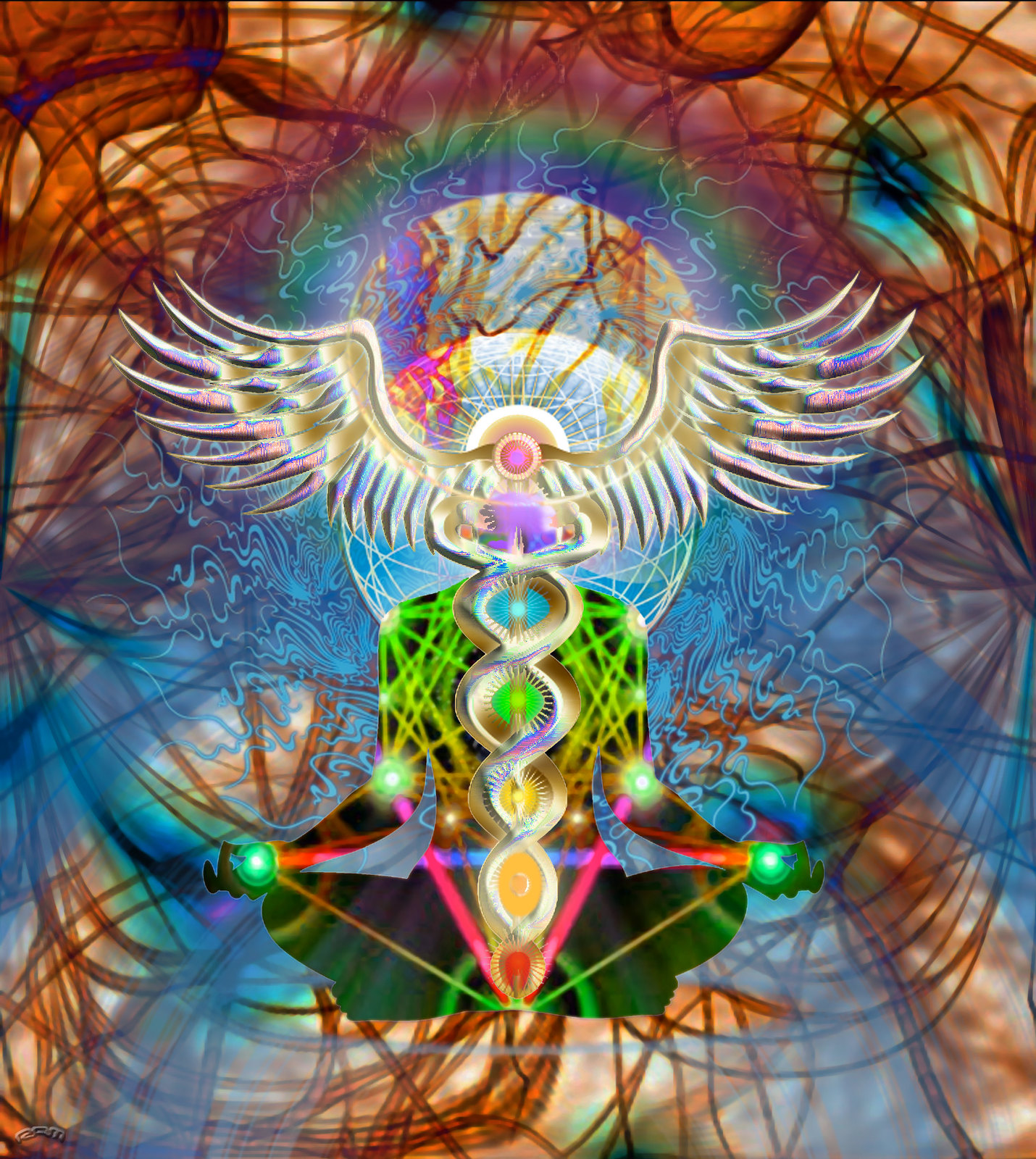
Caduceus by R. Ayana


by Anthony Tyler 


“That’s why we look behind appearances, see the world like the eye on the pyramids”

– Raiza Biza


In today’s society, “magic” and “religion” have become loaded words. From a scientific perspective, they have become akin to fairy-tales, folklore, and psychological simplicity. Those who find the value in it are sometimes treated with a condescending nature, or politely asked how they could put some much merit into “blind faith.” While it’s true that at times it does misplace and mis-interpret the idea of faith, considering religion and magic (or mysticism, as they will be referred to together from here on out for scholastic reasons) a psychological crutch is not only incredibly conceited, but also incredibly illogical and irrational.

The mind of the modern, science-exclusive person, paints as many broad strokes in ideology as the mysticism it critiques, and today the theories of the Big Bang and even Darwinism and Relativity are indeed contested due to their scientific discrepancies. This is not to say that they are entirely untrue, but that they are merely incomplete in their current representations. 

Some may scoff at the idea, but there is a great deal of philosophy (most notably David Hume) that strongly argues how the idea of “empiricism” (empirical deduction in science) cannot be a truly objective form of investigation. This is not meant to discredit the value of empirical thought, but rather to equate ideas of mysticism and science through the common denominator of theory–nothing is set in stone, and so all is subject to change. After all, the data may be accurate, but human error in translation of the data will be ever-pervasive.

The problem here is that “Ideas” have been compartmentalized into a million different names. What started out simply as “Philosophy” in ancient societies has now become religion, politics, science, psychology, medicine, et cetera–not even counting all the secular schools of thought within these topics. The ideas of human progress must once again be reunited under one banner. It doesn’t matter what it’s called, the important part is that not a single piece of data is excluded from the process–all must be taken into account, and filtered through the context of two ways of action:

1) Helping life flourish
2) Helping life diminish
 

This is a fundamental truth of the Earth and the life she carries, as demonstrated by the classical thought-experiment of watching a lion, for instance, stalk its prey so that it may feed its cubs later. If the lion, in this case, were stalking its prey to rape and murder them, this would be an evident example of #2.


Mysticism is such a difficult field to enter into from a research-perspective because its ideas are always tossing around concrete resolutions that were developed to contain doublespeak–Mysticism is allegorical/analogical thought, and without the knowledge of the allegory, the ideas held about the mystical/religious principles are incomplete–this is the equation of symbolism and the context of its knowledge. This is why a person cannot equate one specific deity or entity to “Good” and “Evil” because the deity is only half of the equation–when considering “God” only as a monotheistic deity, the allegory that this image was meant to evoke has become lost, and what is left is merely and incomplete concept. 

Likewise, there are ideas like “the Devil.” While this could upset a lot of people’s understandings here: just because a person is a Luciferian does not mean that they do things like sacrifice virgins, drink blood, and have orgies in the name of evil. To briefly explain this before moving on, the allegory that the image of Lucifer represents in Christianity serves an entirely different purpose to the pupil than what Lucifer represents to an actual Luciferian. 

To a Luciferian, Lucifer is not considered a Christian “Satanic Devil” but a “Light Bringer” synonymous with the archetype that the Greek titan Promeutheus as well represents. The archetype of the Light Bringer (Light Bringer being what Lucifer literally translates to) is meant to represent a bringer of truth, knowledge, and wisdom, thus becoming two totally separate entities in their function, despite sharing symbolism. This is not to say that the Satan/Lucifer of Catholicism is something that anyone should ever consider “worshipping” because this would be an entirely separate archetype represented by a Luciferian’s representation of the Light Bringer, which is an inherently positive thing to the Luciferian.

(More information on this concept can be read in Part 8 of this series.)

What follows in this 8-part article series “Beginner’s Guide to Metaphysics,” will be a brief, connective roadmap between the recurring ideologies of the surviving schools of mysticism in order to bring to discussion the second half of mysticism as a whole–its allegory. This allegory is what occultists, mystics, and scholars alike consider the “Old Religion” or “Prisca Theologia,” which is described as the recurring, underlying and fundamental truths that can be found in all forms of mysticism throughout human history. In fact, the idea of this Prisca Theologia is the actual definition of what is considered “the Occult,” and those considering the Occult to have a negative connotation have yet to breach one of the barriers to understanding metaphysics.

The important thing to remember from here on out, is that the choice in religion/mysticism was never meant to be either “Right” or “wrong” in and of themselves, only their interpretations can be bent around an individual’s good or evil wills. A dogmatic person will, of course, vehemently disagree with this, but progress has never been made through dogma, and in order to empirically assess the body of metaphysics from a scientific viewpoint, they all must be considered from the same objective viewpoint, with good and evil separated from the data and left in the realm of human emotion.

Perhaps a disappointment to some, a beginner’s guide to metaphysics does not come with any answers. The beginning of metaphysics is not finding hidden truths about the world or yourself–that comes later. The real beginning is learning to ask the right questions. True to this idea, the following analysis focuses on the mindset that each ideology is aimed to cultivate within an individual, and what types of questions that these mindsets are aimed to pose.


Eastern Mysticism – Taoism, Buddhism and Hinduism


Eastern Mysticism can be considered as three major schools of thought, more or less: Taoism, Buddhism and Hinduism. Their precursor, generally speaking, was the ancient Indian mysticism “Jainism,” which is the origin of the Swastika as a symbol of the union with the Cycle of Life, and is one of the oldest recorded religions on the planet. Jainism quickly evolved, and developed under the variety of Eastern metaphysics that is with society today.  Like most ideologies, Taoism, Buddhism, and Hinduism tend to break off into a variety of interpretations; and in the case of Buddhism, for instance, it was developed as a protest to the “religious flare” that Hinduism brought with its variety of gods under different human incarnations, and ritualism.

To the original Buddhists, the rituals and symbols of the Veda (Hindus) was a convolution of the mental faculties, and that a deeper form of metaphysic asceticism was required in order to truly understand reality. As the Hindus sought to understand the microcosm of human psychology in relation to the macrocosm of the cosmos, Buddhists attempted to do the exact opposite by analyzing the macrocosm of the cosmos (and human society) in order to gain a deeper understanding of the self. Of course, this is a bit of a generalization as well, since both philosophies focused on both aspects; but to explain this a step further: while Hinduism used their theology and symbolism in allegory to the experience, the Buddhists tended to perceive the human experience as allegory for the divine. 

Meanwhile, in China, ancient metaphysicists like Lao-Tze took these ideas of the microcosm and macrocosm to an entirely different, perhaps more applicable level. Using an asceticism likened to Buddhism, and a mystical, selfless awareness likened to Hinduism, Taoism can perhaps be considered the most pragmatic of the metaphysics, producing such works as the I-Ching, which serves as a geometric codex to understand and decipher the nature of the Tao (reality, so to speak), and can be seen in full right here.

All these discussed forms of mysticism were heavily contingent upon the idea of reincarnation as a spiritual-evolutionary progress through the illusions of the dualism between the physical and metaphysical, the “Veil of Maya” in Buddhism. It was taught that energy created cannot be destroyed, only recycled, and so did the cognizant soul perspective’s present moment continue to be recycled through life experiences, until the individual shed the confines of its karmic limitations, on its path towards “enlightenment.” To the Eastern mystics, karma was seen as sort of physical limitation to the mental faculties, impeding a person’s deeper understanding of themselves and the universe, in order to achieve a state of metaphysical transcendence. This state of transcendence is generally considered as an overall integration into the “Tao” or the “divine essence” in all things.

On a final note in this section, it is a common misconception that Eastern mystics did not have traditions of “Heaven” and “Hell,” or “angels” and “demons,” and there is basically no form of mysticism that does not involve supernatural entities and varying metaphysical states of consciousness. To the East, this is exactly what Heaven and Hell were: states of consciousness that occurred during and after physical incarnation. A person had the choice between Heaven and Hell at all times in the present moment, and whether they realized it or not, they were always making the decision between the two. Eastern Mysticism made the effort to train the thought processes toward divine potential and away from human illusion. In this respect, states of karmic thought-process were considered a determinant factor between Heaven and Hell, a notion that Dr. Stanislav Grof has put 50 years of psychiatric research into through his ideas of “Condensed Experience System” (CoEx Systems). 

All in all, Eastern Metaphysics can be considered the mindset that requires cultivation during times of spiritual famine. A man bereft of his amenities would be forced to find the value in asceticism if he wanted to prosper; a man bereft of love and affection would be forced to find these things within himself, alone, before he could discover anything more; and a man with the turbulent wind of restless thoughts would only find peace and solace in his discipline of emptying his mind, so that he may place new and better ideas within it.


Witchcraft – Paganism, Voodoo and Native American Mysticism


Paganism, Voodoo, and the spirituality of Native Americans are put in the same category in this part of the series not to generalize them as completely the same, but because so much of the cause and effect within the mysticisms are the same, and unite under the same method of spirituality: witchcraft.

Witchcraft, from the anthropological definition, is a spiritual belief in the presence of Nature itself, very generally speaking. Witchcraft was developed as peasant religions during times of cultural and philosophical discrimination, and because of this, witches developed an intimate and observation-based connection between themselves, the world around them, and the metaphysical world of “spirits” that connected them. 

Witchcraft in the West had been around long before the Catholic church, and because of this, it was considered one of its primary targets–as well, because of the Church’s detest for Witchcraft, it is one of the first times in recorded history that the ideology becomes more of a recorded social philosophy. Up until that point, Witchcraft (Paganism, in this case) had been more of a collection of ideas that different people pursued in very different ways, for very different reasons. There was never any set gods or goddesses and witchcraft perceived the god of individual worship to be dependent on the individual–because it was meant to be a reflection of the individual’s higher self, something akin to Plato’s “ideal forms.”

Spirits were seen in everything everywhere, because they were the divinity in all things–and the capacity for all things to be engaged with (magick). Those who practice Witchcraft and Voodoo alike, considered the ability of magick to be an engagement between their spirit and the spirit within the object. In consideration of “magick,” it is an endlessly convoluted term, and has as many broad applications as the term “science.” 

Magick from a historical point of view involves knowledge of plant medicines and poisons for “potions,” an understanding of occult knowledge/symbolism to any varying degree, a manipulative charisma that could practically “charm” people, and understandings of psychology and things like hypnotism. Beyond that, there is plenty of argument for extra-sensory perceptions as well, like clairvoyance, precognition, astral travel, telepathy, and communion with metaphysical entities to a varying physical degree–but for brevity, it will be left at that.

Voodoo, which was born out of the juxtaposed African culture in slave society, can be seen as a conjugation of orthodox Catholicism and African tribal shamanism, by using the Christian explanations of angels and demons, et cetera, to map out their shamanistic traditions. In an attempt to generalize here, both African and Native American (including Mesoamerican) mysticism can be seen under the same context as the origins of pagan witchcraft (although it is undeniable that there was a trickle effect of the Mystery Initiations and their esoteric knowledge into peasant-oriented witchcraft– see Part VI for more details).

Witchcraft, being the anthropological definitions of the mysticism of the Pagans, the Voodoo, and the Native Americans, is characterized as a peasant religion, based on the observation of nature, and the integration of its patterns into human life on a personal and social level. This is enacted by a variety of symbolism and ritual that is predominantly associated with shamanism. However, it cannot be denied that all forms of witchcraft can and were used for nefarious activities, as black sabbaths and black magick have been a recurring theme throughout all of human mysticism. To the adepts of witchcraft, the fields of study also involved various modes of alchemy, astrology, and numerology, depending on cultural context of these ideas.


Author’s Note: This 8-part series was written while smoking blunts exclusively.

Doors of Perception by R. Ayana


For more information about consciousness see http://nexusilluminati.blogspot.com/search/label/consciousness  
- Scroll down through ‘Older Posts’ at the end of each section


Hope you like this not for profit site -
It takes hours of work every day by a genuinely incapacitated invalid to maintain, write, edit, research, illustrate and publish this website from a tiny cabin in a remote forest
Like what you see? Please give anything you can -  
Contribute any amount and receive at least one New Illuminati eBook!
(You can use a card securely if you don’t use Paypal)
Please click below -


Spare Bitcoin change?


For further enlightening information enter a word or phrase into the random synchronistic search box @ the top left of http://nexusilluminati.blogspot.com


And see


 New Illuminati on Facebook - https://www.facebook.com/the.new.illuminati

New Illuminati Youtube Channel -  https://www.youtube.com/user/newilluminati/playlists

New Illuminati’s OWN Youtube Videos -  
New Illuminati on Google+ @ For New Illuminati posts - https://plus.google.com/u/0/+RamAyana0/posts

New Illuminati on Twitter @ www.twitter.com/new_illuminati


New Illuminations –Art(icles) by R. Ayana @ http://newilluminations.blogspot.com

The Her(m)etic Hermit - http://hermetic.blog.com


DISGRUNTLED SITE ADMINS PLEASE NOTE –
We provide a live link to your original material on your site (and links via social networking services) - which raises your ranking on search engines and helps spread your info further!

This site is published under Creative Commons (Attribution) CopyRIGHT (unless an individual article or other item is declared otherwise by the copyright holder). Reproduction for non-profit use is permitted & encouraged - if you give attribution to the work & author and include all links in the original (along with this or a similar notice).

Feel free to make non-commercial hard (printed) or software copies or mirror sites - you never know how long something will stay glued to the web – but remember attribution!

If you like what you see, please send a donation (no amount is too small or too large) or leave a comment – and thanks for reading this far…

Live long and prosper! Together we can create the best of all possible worlds…


From the New Illuminati – http://nexusilluminati.blogspot.com