"All the World's a Stage We Pass Through" R. Ayana

Showing posts with label mark of the beast. Show all posts

Friday, 11 June 2010

Chipless Mark Of The Beast?

Chipless Mark Of The Beast?
Invisible RFID Ink Safe for Humans, Cattle Co. Says

Mark of the Beast now available in Invisible to the eye INK?
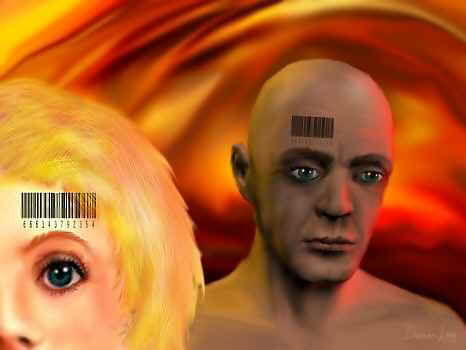
image © Duncan Long


The process developed by Somark involves a geometric array of micro-needles and an ink capsule, which is used to 'tattoo' an animal. The ink can be detected from 4 feet away.

A startup company developing chipless RFID ink has tested its product on cattle and laboratory rats.

Somark Innovations announced this week that it successfully tested biocompatible RFID ink, which can be read through animal hairs. The passive RFID technology could be used to identify and track cows to reduce financial losses from Bovine Spongiform Encephalopathy (mad cow disease) scares. Somark, which formed in 2005, is located at the Center for Emerging Technologies in St. Louis. The company is raising Series A equity financing and plans to license the technology to secondary markets, which could include laboratory animals, dogs, cats, prime cuts of meat, and military personnel.

Chief scientist Ramos Mays said the tests provide a true proof-of-principle and mitigate most of the technological risks in terms of the product's performance. "This proves the ability to create a synthetic biometric or fake fingerprint with biocompatible, chipless RFID ink and read it through hair," he said.

Co-founder Mark Pydynowski said during an interview Wednesday that the ink doesn't contain any metals and can be either invisible or colored. He declined to say what is in the ink, but said he's certain that it is 100% biocompatible and chemically inert. He also said it is safe for people and animals.

The process developed by Somark involves a geometric array of micro-needles and a reusable applicator with a one-time-use ink capsule. Pydynowski said it takes five to 10 seconds to "stamp or tattoo" an animal, and there is no need to remove the fur. The ink remains in the dermal layer, and a reader can detect it from 4 feet away.

"Conceptually, you can think of it in the same way that visible light is reflected by mirrors," he said, adding that the actual process is slightly different and proprietary.

The amount of information contained in the ink depends on the surface area available, he said. The U.S. Department of Agriculture calls for a 15-digit number to track cattle. The first three digits are "840" for the U.S. country code. The remaining digits are unique identifiers. The numbers would link to a database containing more information.


For further enlightenment enter a word or phrase into the search box @


And see

The Her(m)etic Hermit - http://hermetic.blog.com


This material is published under Creative Commons Copyright (unless an individual item is declared otherwise by copyright holder) – reproduction for non-profit use is permitted & encouraged, if you give attribution to the work & author - and please include a (preferably active) link to the original along with this notice. Feel free to make non-commercial hard (printed) or software copies or mirror sites - you never know how long something will stay glued to the web – but remember attribution! If you like what you see, please send a tiny donation or leave a comment – and thanks for reading this far…
From the New Illuminati – http://nexusilluminati.blogspot.com
 

Wednesday, 17 March 2010

Hands-free way to steal a credit card: Unsecured RFID Technology

The hands-free way to steal a credit card

Unsecured RFID Technology 


http://www.peratech.com/press/RFIDBiometricPassport_SkimStory.jpg


WASHINGTON D.C.--Adam Laurie, an RFID security expert, used the Black Hat DC 2008 conference here, to demonstrate a new Python script he's working on to read the contents of smart-chip-enabled credit cards.

As part of his presentation Laurie asked for someone from the audience to volunteer a smart card. Without taking the card out of the volunteer's wallet, Laurie both read and displayed its contents on the presentation screen--the person's name, account number, and expiration clearly visible. 

Demonstrations like that show the potential misuse of RFID technology in the near future. Without touching someone, a thief could sniff the contents of an RFID-enabled credit card just in passing. The same is true for embedded RFID chips in the human body, work access badges, some public transit cards, and even the new passports in use in more than 45 countries. 

(As a disclaimer, Laurie said he spoke to American Express, the company that issued the volunteer's card. Laurie said that American Express told him: "We are comfortable with the security of our product." Laurie added that the company told him the number he displayed on the presentation screen was not the account number printed on the card, which Laurie proved by opening the wallet and comparing. 

"The alias number on American Express' ExpressPay cannot be used for online transactions," said Molly Faust, American Express' Public Affairs representative, in an e-mail to CNET News.com. "ExpressPay has multiple security mechanisms. As the payment host, American Express would not verify/authorize an online transaction using just the alias account number. There are several other security mechanisms that would be required in order for payment authorization to take place.")

The credit card industry has argued that use of the RFID-enabled cards will save customers time when processing payments. 

An extreme example can be found in Spain. Laurie said a public beach there encourages visitors to have RFID tags injected into their bodies. The point? Merchants along the beach scan your wrist to obtain a unique ID from which they can debit your account. The advantage? You won't have to go to the beach with your wallet, which might get stolen. 

Laurie, who has an injected RFID-tag, showed how easy it was not only to read the tag, but also to re-write the tag. During his demo, he used the coding sequence reserved for animal tagging to have his RFID chip declare him an animal. 

On his RFIDiot Web site, Laurie offers the Python scripts free of charge and also sells the hardware necessary to read and write to RFID tags and cards. 

See Adam Laurie’s site d3f3nc3 in d3pth at http://news.cnet.com/defense-in-depth/?keyword=Adam+Laurie&tag=mncol;tags


Update from February 22, 2008, at 3:20 p.m PST: This was updated to include a response from American Express.

Xtra Image - http://www.peratech.com/press/RFIDBiometricPassport_SkimStory.jpg


For further enlightenment enter a word or phrase into the search box @  New Illuminati:

or http://newilluminati.blog-city.com  (this one only works with Firefox)

And see

The Her(m)etic Hermit - http://hermetic.blog.com
 http://newilluminati.blog-city.com (this one only works with Firefox)


This material is published under Creative Commons Copyright (unless an individual item is declared otherwise by copyright holder) – reproduction for non-profit use is permitted & encouraged, if you give attribution to the work & author - and please include a (preferably active) link to the original along with this notice. Feel free to make non-commercial hard (printed) or software copies or mirror sites - you never know how long something will stay glued to the web – but remember attribution! If you like what you see, please send a tiny donation or leave a comment – and thanks for reading this far…

From the New Illuminati – http://nexusilluminati.blogspot.com

Sunday, 7 March 2010

Human I.D. Implants: Verichip is now called PositiveID

Verichip is now called PositiveID!

Roll up your sleeve for the implantable human microchip, it's now Positive?

 An ELECTRONIC IDENTIFICATION CHIP made to be surgically implantated into human beings... this technology approaches the level of real-time satellite tracking of EVERYONE...    

By Greg Nikolettos (about the author)


No Verichip Campaign

As sure as the sun rises, so Verichip keeps spawning and shape shifting to gain market acceptance as people from across the globe unite and reject the IBM seed-funded, Raytheon-manufactured Human Implantable microchip company. 

To "mark' a new year, Verichip is now called PositiveID!. If you have followed this company's progress as we have and cited the damning evidence showcasing a casual link between microchipping and cancer, Verichip is certainly not positive. But in this world of semantics and double speak, no doubt a CEO meeting along with other top execs decided that throwing the word "Positive" in the title would make Alzheimer patients who get microchipped without their consent less hesitant as their sleeve was rolled up in the name of "wander protection'. "Was that a needle?" asks the patient? "No! it was a mosquito bite, you have Alzheimer's, remember?"
What has changed in 2010?
Well, Verichip/PositiveID has a new marketing and media relations company! Just as all actors in Hollywood require an agent to handle their image as they enter the market, so Verichip/PositiveID has decided to do the same.
The company taking over Verichips/PositiveID media relations and corporate communications is Gibraltar. A company who has close ties with the Clinton administration, expertise in biotech, energy and of course as a company who has excellent inroads into government, Gibraltar even has the mandatory Washington office!
Why this recent appointment?
Verichip/PositiveID has been pummeled on the NASDAQ , having been delisted in March 2009, but staging a comeback to have their stock regain NASDAQ Compliance in October 2009. Verichip/PositiveID stock has been crushed from a high of just over $10 down to a humiliating low of $0.24 cents.9
Why this backlash? It's a human implantable microchip and that does not sit well with the Ma and Pa investor. Who in their right mind invests in a company whose product causes tumors? Who in their right mind invests in a company that microchips Alzheimer patients without their consent? As Verichip/PositiveID's stock price today indicates, not many individuals and certainly not investment companies who are minimizing risk in the current economy.
Regardless of what happens on the stock market, the fact is Verichip is not going away. Why? Because their seed funding originates from the information giant IBM who has over 407,000 employees worldwide. Nothing like having a Big Blue Sugar Daddy watching over you in this financial climate, especially one that writes off a $60 million dollar loan to ensure the human microchipping agenda is in place for "future' generations. $60 million is chickenfeed to a company who turns over 100 billion US dollars a year. Yes sir, the IBM Hollerith Machine Punch Card system was very profitable in WWII, cleverly "leased" to the Nazi regime to create enabling technologies to identify and catalog non-compliant peoples.
IBM custom-designed and constantly updated the Hollerith Machine using the punch-card system and thus Hitler was able to automate his persecution of the undesirables. But let's remember Hitler’s Mantra "Jews are evil, Negroes are despicable, Gypsies simply could not stay put, wandering all over the place and homosexuals, well we all know what filthy acts they get up to!! Hitler’s remedy? Zyklon B, the brand name of the cyanide-based pesticide used in the Holocaust gas chambers !
The Zyklon B patents were owned by a little company called IG Farben who was also in bed with John D. Rockefeller's United States based Standard Oil Co. during the reign of the Third Reich, but that's another story altogether.
Agfa, BASF, and Bayer continue today after the buyout of IG Faben Western Assets, showing that you can't keep a good criminal company down. But let's remember, we all need to be more forgiving as BASF manufactured excellent magnetic recording cassette tapes in the 80s-90s as acid house music merged and fused into techno.
 http://justgetthere.us/blog/uploads/VeriChip.jpg
A crash course in Verichip/PositiveID! Buckle Up!
Verichip/PositiveID is manufactured by Raytheon Microelectronics España/ECLAN from Tomahawk Missile fame thus creating a synergy between the fifth largest defense government contractor and the human implantable microchip. 16
VeriChip Corporation acquires Steel Vault Corporation to Form PositiveID Corporation thus creating a synergy between identity theft and the human implantable microchip
VeriChip Corporation acquires credit monitoring company, NationalCreditReport.com, thus creating a synergy between credit monitoring and the human implantable microchip
Verichip includes the VeriPay System which is designed to be used as a swipe and go payment method for cash and credit-card transactions as seen at the Baja nightclub, thus creating a synergy between "scan and go" electronic payments and the human implantable microchip.19
Verichip can be linked to Google Health and Microsoft HealthVault, thus creating a synergy between the Electronic Health Records Government stampede and the human implantable microchip.
Verichip/PositiveID/RECEPTORS LLC manufactures Virus Triage Detection System for the H1N1 Virus thus creating a synergy between the WHO hyped flu pandemic and the human implantable microchip.
Verichip/PositiveID announced it would expand its HealthID division with a range of products, including an implantable RFID microchip in phase 2 development which can detect glucose levels in the body, thus creating a synergy between HealthCare , Diabetic Patients and the human implantable microchip
Verichip/PositiveID announced it is working closely with HealthScreenDirect, a company that offers screening for diabetes and high cholesterol . We soon predict a cholesterol sensor announcement via the Verichip Receptors alliance thus creating a synergy between the 106 million Americans who suffer from high cholesterol and the human implantable microchip.
Verichip/PositiveID formed VeriGreen Energy Corporation, to invest in the clean and alternative energy sector.Following the recently signed stimulus package, which invested $79 billion in renewable energy. Verichip/PositiveID created a synergy between their new marketing company Gibraltar , the stimulus bill , cap and trade, the global warming agenda and the human implantable microchip.
But relax...after all these acquisitions, name changes and synergies created, Scott Silverman CEO of Verichip/PositiveID states to the market with a straight face:
"Using the chip to relate to the credit-reporting services of NationalCreditReport.com, or even using it for financial transactions" has not been a part of our business model for five years or more, since Sullivan's been gone, and is not part of our business model moving forward."
Scott Silverman continued "I can tell you that" putting [the chips] into children and immigrants for identification purposes, or putting them into people, especially unwillingly, for financial transactions, has [not] been and never will be the intent of this company as long I'm the chairman and CEO,"
Greg Nikolettos, founder of We The People Will Not Be Chipped Movement, responded critically. "Enough of the lies Scott, we have reached breaking point with how your company conducts itself in the market. As people worldwide unite and spend more time researching Verichip and the human microchipping agenda, the more it becomes evident you are a shoe-in for Lying-CEO-of-the-year and for the Verichip to be awarded the Lemon-of-the-Decade product award. Nothing has changed with your market tactics since we released the short film "Operation Lie and Deceive - Verichip Style' 6 exposing the companies unethical practices...although we do concede that something has changed: the length of your nose'
The WorldWide Human Microchipping Agenda
"Conspiracy theory" is a term often thrown at the human microchipping issue when it is discussed in the mainstream news to deflect one of the most invasive and dehumanizing psychopathic agendas. The goal? To strip you of your inalienable human rights and reduce you to a 16 digit number that's scanned like a can of chili beans at a supermarket . Could this Orwellian nightmarish agenda ever come to fruition?
Let's pause and reflect on the words of IBM's CEO Sam Palmisano when he addressed the Council of Foreign Relations with the following statement: "Indeed, almost anything--any PERSON , any object, any process or any service, for any organization, large or small--can become digitally aware and networked"
If you're naïve enough to believe that Verichip and IBM--the world's largest and most profitable information technology company, whose CEO states they want to network humans-- is not hunting you and your family down to microchip them, you must be delusional.
For those that can read the writing on the wall, now is the time to support the preventative microchipping Bodily Integrity Act drafted by RFID expert and privacy advocate Katherine Albrecht and get it signed into law on a Federal Level in every country across the globe.
With the current Socialism trend in supposedly democratic governments, how long will it be before Government mandates that their citizens will be unable to receive healthcare or access government services unless they get micro-chipped?
The time has come to act now and cut off Verichip at the pass.
Please contact Greg Nikolettos through the We The People Will Not Be Chipped website, as he has drafted templates and will advise you on whom to contact in your country and how to get this legislation signed into law.

http://electricalandelectronics.org/wp-content/uploads/2008/11/verichip.gif

References
[1] Applied Digital Solutions Senior Lender , IBM Credit Corporation http://www.encyclopedia.com/doc/1G1-92425698.html
One Mainframe To Rule Them All IBM and Verichip The Human Microchipping Agenda www.youtube.com/noverichip
[3] VeriChip Corporation Completes Acquisition of Steel Vault Corporation http://www.positiveidcorp.com/pr/pr_111009.html
[7] The Gibraltar team combines experience and diverse expertise. http://www.gibraltar-llc.com/experience.php
[8] VeriChip Corporation Regains NASDAQ Compliance http://www.verichipcorp.com/press_releases.html
[12] Applied Digital Solutions Makes $30 Million Payment to IBM Credit, LLC, Satisfying All Outstanding Debt Obligations to IBM. http://www.thefreelibrary.com/Applied+Digital+Solutions+Makes+$30+Million+Payment+to+IBM+Credit,...-a0104535532
[13]IBM and the Holocaust www.ibmandtheholocaust.com
[14] Gas chambers and Crematoria," in Berenbaum, Michael & Gutman, Yisrael (eds). Anatomy of the Auschwitz Death Camp, Indiana University Press and the United States Holocaust Memorial Museum, 1994 http://www.vho.org/GB/c/DC/gcgvcole.html
[15] Trading With the Enemy (1983), Charles Higham: Delacorte Press, New York NY; ISBN 0-440-09064-4

[16] VeriChip, Steel Vault merge toform PositiveID

[18] VeriChip Corporation Agrees to Acquire Steel Vault Corporation to Form PositiveID Corporation http://www.verichipcorp.com/pressreleases/090809.html
[21]Microchip Implant to Link Your Health Records, Credit History, Social Security
[22] VeriChip Corporation and RECEPTORS LLC Announce Further Details of Development Plan for Virus Triage Detection System for H1N1 Virus
[23] VeriChip Corporation and RECEPTORS LLC to Unveil Development Details of Virus Triage Detection System for the H1N1 Virus and In Vivo Glucose-Sensing RFID Microchip
[24] PositiveID Corporation Partners with HealthScreenDirect, LLC to Offer Health Link to 120,000 New Patients per Year and Study Health Link's Role in Improving Disease Management
[25] VeriGreen Energy Corporation click here
[26] Operation Lie and Deceive Verichip Style www.youtube.com/noverichip

For OpEdNews: Greg Nikolettos - Writer


See Also - Verichip & Implants

Extra Images - http://justgetthere.us/blog/uploads/VeriChip.jpg
http://electricalandelectronics.org/wp-content/uploads/2008/11/verichip.gif


For further enlightenment enter a word or phrase into the search box @  New Illuminati:

or http://newilluminati.blog-city.com  (this one only works with Firefox)

And see

The Her(m)etic Hermit - http://hermetic.blog.com
 http://newilluminati.blog-city.com (this one only works with Firefox)


This material is published under Creative Commons Copyright (unless an individual item is declared otherwise by copyright holder) – reproduction for non-profit use is permitted & encouraged, if you give attribution to the work & author - and please include a (preferably active) link to the original along with this notice. Feel free to make non-commercial hard (printed) or software copies or mirror sites - you never know how long something will stay glued to the web – but remember attribution! If you like what you see, please send a tiny donation or leave a comment – and thanks for reading this far…

From the New Illuminati – http://nexusilluminati.blogspot.com
the new illuminati DO NOT endorse this product!


Sunday, 18 October 2009

How RFID Tags Could Be Used to Track Unsuspecting People

How RFID Tags Could Be Used to Track Unsuspecting People

A privacy activist argues that the devices pose new security risks to those who carry them, often unwittingly

By Katherine Albrecht

http://cache.gizmodo.com/assets/images/gizmodo/2008/08/rfid_xray.jpg
Radio-frequency identi­fication (RFID) tags are embedded in a growing number of personal items and identity documents.
Because the tags were designed to be powerful tracking devices and they typically incorporate little security, people wearing or carrying them are vulnerable to surreptitious surveillance and profiling.
Worldwide, legislators have done little to address those risks to citizens.

If you live in a state bordering Canada or Mexico, you may soon be given an opportunity to carry a very high tech item: a remotely readable driver’s license. Designed to identify U.S. citizens as they approach the nation’s borders, the cards are being promoted by the Department of Homeland Security as a way to save time and simplify border crossings. But if you care about your safety and privacy as much as convenience, you might want to think twice before signing up.

The new licenses come equipped with radio-frequency identification (RFID) tags that can be read right through a wallet, pocket or purse from as far away as 30 feet. Each tag incorporates a tiny microchip encoded with a unique identification number. As the bearer approaches a border station, radio energy broadcast by a reader device is picked up by an antenna connected to the chip, causing it to emit the ID number. By the time the license holder reaches the border agent, the number has already been fed into a Homeland Security database, and the traveler’s photograph and other details are displayed on the agent’s screen.

Although such “enhanced” driver’s licenses remain voluntary in the states that offer them, privacy and security experts are concerned that those who sign up for the cards are unaware of the risk: anyone with a readily available reader device—unscrupulous marketers, government agents, stalkers, thieves and just plain snoops—can also access the data on the licenses to remotely track people without their knowledge or consent. 

What is more, once the tag’s ID number is associated with an individual’s identity—for example, when the person carrying the license makes a credit-card transaction—the radio tag becomes a proxy for that individual. And the driver’s licenses are just the latest addition to a growing array of “tagged” items that consumers might be wearing or carrying around, such as transit and toll passes, office key cards, school IDs, “contactless” credit cards, clothing, phones and even groceries.

RFID tags have been likened to barcodes that broadcast their information, and the comparison is apt in the sense that the tiny devices have been used mainly for identifying parts and inventory, including cattle, as they make their way through supply chains. Instead of having to scan every individual item’s Universal Product Code (UPC), a warehouse worker can register the contents of an entire pallet of, say, paper towels by scanning the unique serial number encoded in the attached RFID tag. That number is associated in a central database with a detailed list of the pallet’s contents. 

But people are not paper products. During the past decade a shift toward embedding chips in individual consumer goods and, now, official identity documents has created a new set of privacy and security problems precisely because RFID is such a powerful tracking technology. Very little security is built into the tags themselves, and existing laws offer people scant protection from being surreptitiously tracked and profiled while living an increasingly tagged life.

http://www.sott.net/image/image/14478/full/brain_implant3.jpg

Beyond Barcodes

The first radio tags identified military aircraft as friend or foe during World War II, but it was not until the late 1980s that similar tags became the basis of electronic toll-collection systems, such as E-ZPass along the East Coast. And in 1999 corporations began considering the tags’ potential for tracking millions of individual objects. In that year Procter & Gamble and Gillette (which have since merged to become the world’s largest consumer-product manufacturing company) formed a consortium with Massachusetts Institute of Technology engineers, called the Auto-ID Center, to develop RFID tags that would be small, efficient and cheap enough to eventually replace the UPC barcode on everyday consumer products.

By 2003 the group had developed a working version of the technology and attracted in­­vest­ment from more than 100 companies and government agencies. The tags’ promoters promised the tiny chips would revolutionize inventory management and counterfeiting prevention [see “RFID: A Key to Automating Everything,” by Roy Want; Scientific American, January 2004].

To kick-start government adoption of the technology, the General Services Administration (GSA), a federal bureau that manages purchasing for other government institutions, issued a memo in 2004 urging the heads of all federal agencies “to consider action that can be taken to advance the [RFID] industry.” Suddenly, virtually every agency, from the Social Security Administration to the Food and Drug Administration, began announcing RFID trials. 

During the same period, similar initiatives were under way around the world. In 2003 the International Civil Aviation Organization (ICAO), a United Nations agency that sets global passport standards, endorsed the use of RFID tags in passports. ICAO now calls for their use in all scannable “e-passports.” Today dozens of countries, including the U.S., issue e-passports with RFID tags embedded in their covers.

Since their debut, the new passports have been controversial on both privacy and security grounds. In a 2006 report one ICAO official promised that encryption measures would provide a “level of protection [that] should reassure the most anxious passport holder that his personal data cannot be read without his knowledge.”

Security experts quickly proved otherwise. In 2007 British security consultant Adam Laurie cracked the encryption code on a U.K. passport and “skimmed,” or remotely read, its personal information—while it was still sealed in its mailing envelope. Around the same time, German security consultant Lukas Grunwald copied the data from a German passport’s embedded chip and encoded it into a different RFID tag to create a forged document that could fool an electronic passport reader. Investigators at Charles University in Prague, finding similar vulnerabilities in Czech e-passports, wrote that it was “a bit surprising to meet an implementation that actually encourages rather than eliminates [security] attacks.”

Yet these demonstrated security problems have not slowed the adoption of RFID. On the contrary, the technology is being deployed for domestic ID cards around the world. Malaysia has issued some 25 million contactless national identity cards. Qatar is issuing one that stores the cardholder’s fingerprint in addition to personal information. And in what industry observers are calling the single largest RFID project in the world, the Chinese government is spending $6 billion to roll out RFID-based national IDs to nearly one billion citizens and residents.

There is an important difference, however, between other nations’ RFID-based ID cards and Homeland Security’s new driver’s licenses. Most countries’ contactless national IDs and e-passports have adopted an RFID tag that meets an industry standard known as ISO 14443, which was developed specifically for identification and payment cards and has a degree of security and privacy protection built in. In contrast, U.S. border cards use an RFID standard known as EPCglobal Gen 2, a technology that was designed to track products in warehouses, where the goal is not security but maximum ease of readability.

Whereas the ISO 14443 standard includes rudimentary encryption and requires tags to be close to a scanner to be read (a distance measured in inches rather than feet), Gen 2 tags typically have no encryption and only minimal data safeguards. To skim the data from an encrypted ISO 14443 chip, you have to crack the encryption code, but no special skills are required to skim a Gen 2 tag; all you need is any Gen 2 reader. Such readers can be purchased readily and are in common use in warehouses worldwide. A hacker or crim­inal armed with one could skim a border card through a purse, across a room, even through a wall.

As of this past April [2008], more than 35,000 Washington State motorists had signed up for en­­hanced driver’s licenses, and other border states, including Arizona, Michigan and Vermont, have agreed to participate in the program. New York State will begin making the new licenses available to its residents after Labor Day.

But the possibility that the security of such cards could be compromised is just one reason for concern. Even if tighter data-protection measures could someday prevent unauthorized access to RFID-card data, many privacy advocates worry that remotely readable identity documents could be abused by governments that wish to tightly monitor and control their citizens.

China’s national ID cards, for instance, are encoded with what most people would consider a shocking amount of personal information, including health and reproductive history, employment status, religion, ethnicity and even the name and phone number of each cardholder’s landlord. More ominous still, the cards are part of a larger project to blanket Chinese cities with state-of-the-art surveillance technologies. Michael Lin, a vice president for China Public Security Technology, a private company providing the RFID cards for the program, unflinchingly described them to the New York Times as “a way for the government to control the population in the future.” And even if other governments do not take advantage of the surveillance potential inherent in the new ID cards, ample evidence suggests that data-hungry corporations will.

 http://therearenosunglasses.files.wordpress.com/2008/12/6a00d8341bffa053ef00e5507084c68833-800wi.jpg

Living a Tagged Life

If the idea that corporations might want to use RFID tags to spy on individuals sounds far-fetched, it is worth considering an IBM patent filed in 2001 and granted in 2006. The patent describes exactly how the cards can be used for tracking and profiling even if access to official databases is unavailable or strictly limited. Entitled “Identification and Tracking of Persons Using RFID-Tagged Items in Store Environments,” it chillingly details RFID’s potential for surveillance in a world where networked RFID readers called “person tracking units” would be incorporated virtually everywhere people go—in “shopping malls, airports, train stations, bus stations, elevators, trains, airplanes, restrooms, sports arenas, libraries, theaters, [and] mu­­se­­ums”—to closely monitor people’s movements.

According to the patent, here is how it would work in a retail environment: an “RFID tag scanner located [in the desired tracking location]... scans the RFID tags on [a] person.... As that person moves around the store, different RFID tag scanners located throughout the store can pick up radio signals from the RFID tags carried on that person and the movement of that person is tracked based on these detections.... The person tracking unit may keep records of different locations where the person has visited, as well as the visitation times.”

The fact that no personal data are stored in the RFID tag does not present a problem, IBM explains, because “the personal information will be obtained when the person uses his or her credit card, bank card, shopper card or the like.” The link between the unique RFID number of the tag and a person’s identity needs to be made only once for the card to serve as a proxy for the person thereafter. Although IBM envisioned tracking people via miniature tags in consumer goods, with today’s RFID border cards there is no need to wait for such individual product tags to become widespread. Washington’s new driver’s licenses would be ideally suited to the in-store tracking application, because they can already be read by Gen 2 inventory scanners in use today at stores such as Wal-Mart, Dillard’s and American Apparel.

A tracking infrastructure will become increasingly fruitful to marketers as more people begin carrying, and even wearing, RFID-tagged items. At present, tens of millions of contactless credit and ATM cards containing RFID tags are in circulation, along with millions of employee access badges. RFID-based public-transit passes, widely used in Europe and Japan, are also coming to U.S. cities. IBM’s person tracking unit is still only a patent, but an English amusement park called Alton Towers provides a living illustration of RFID’s tracking potential. On entering the park, each visitor is offered an RFID wristband encoded with a unique ID number. As people enjoy the attractions, a network of RFID readers placed strategically throughout the park detects each wristband as it comes within range and triggers nearby video cameras. Candid footage of each individual is stored in a file labeled with the wristband ID number, then made available to the customer on a keepsake DVD at the end of the day.

If RFID tags can enable an amusement park to capture detailed, personalized videos of thousands of people a day, imagine what a determined government could do—not to mention marketers or criminals. That is why my colleagues in the privacy community and I have so firmly opposed the use of RFID in government-issued identity documents or individual consumer items. As far back as 2003, my organization, CASPIAN (Consumers Against Supermarket Privacy Invasion and Numbering)—along with the Privacy Rights Clearinghouse, the Electronic Privacy Information Center, the Electronic Frontier Foundation, the American Civil Liberties Union, and 40 other leading privacy and civil liberties advocates and organizations—recognized this threat and issued a position paper that condemned the tracking of human beings with RFID as inappropriate.

In response to these concerns, dozens of U.S. states have introduced RFID consumer-protection bills—which have all been either killed or gutted by heavy opposition from lobbyists for the RFID industry. When the New Hampshire Senate voted on a bill that would have imposed tough regulations on RFID in 2006, a last-minute floor amendment replaced it with a two-year study instead. (I was appointed by the governor to serve on the resulting commission.) That same year a California bill that would have prohibited the use of RFID in government-issued documents passed both houses of the legislature, only to be vetoed by Governor Arnold Schwarzenegger.

On the federal level, no high-profile consumer-protection bills related to RFID have been passed. Instead, in 2005, the Senate Republican High Tech Task Force praised RFID applications as “exciting new technologies” with “tremendous promise for our economy” and vowed to protect RFID from regulation or legislation.

In the European Union, regulators are at least examining the situation. The European Commission—the executive arm of the E.U.—has acknowledged the potential for serious privacy problems with RFID and opened a public comment period earlier this year. As of July, when this issue went to press, recommendations stemming from the public comments were set to be released later in the summer, but expectations for any consumer-privacy regulations were low. In a March 2007 speech, E.U. commissioner for information society and media Viviane Reding announced that the commission would not regulate RFID but instead would allow businesses to regulate themselves. “I am here to tell you that on RFIDs, there is not going to be a regulation,” she said. “My view is that we should underregulate rather than overregulate so that this sector can take off.”

Unfortunately, industry self-regulation has little force when it comes to protecting the public from RFID risks. EPCglobal, the industry body that now sets technical standards for RFID tags, also produced a set of guidelines for the use of the chips in retail. The organization’s recommendations require, among other things, notice to consumers whenever products contain RFID tags—for instance, in the form of a recognizable RFID logo. Yet when Checkpoint Systems, a member company of EPCglobal, designed RFID tags to be hidden in the soles of shoes—in clear violation of the organization’s own provisions — Mike Meranda, then president of EPCglobal, told me that since the guidelines were voluntary, there was nothing he or his organization could do about it.

The Washington State Department of Licensing reassures citizens that their personal information is safe because the RFID tag in an enhanced driver’s license “doesn’t have a power source” and “doesn’t contain any personal identifying inform­ation”—even though those facts have no bearing on whether the card can be used for tracking. For some people, a false sense of assurance provided by such official mollifications could be dangerous. The National Network to End Domestic Violence, a group that vocally opposes the use of RFID in identity documents and consumer products, has submitted legislative testimony describing how abusers could use the technology to stalk and monitor their victims.

Meanwhile the RFID train is barreling forward. Gigi Zenk, a spokesperson at Washington’s licensing agency, recently confirmed that there are 10,000 enhanced licenses “on the street now—that people are actually carrying.” That’s a lot of potential for abuse, and it will only grow. The state recently mustered a halfhearted response, passing a law that designates the unauthorized reading of a tag “for the purpose of fraud, identity theft, or for any other illegal purpose” as a class C felony, subject to five years in prison and a $10,000 fine. Nowhere in the law does it say, however, that scanning for other purposes such as marketing—or perhaps “to control the population”—is prohibited. We ignore these risks at our peril.
Note: This article was originally published with the title, "RFID Tag--You're It".

ABOUT THE AUTHOR
Katherine Albrecht holds a doctorate in education from Harvard University and is director of CASPIAN, a 15,000-member consumer privacy organization opposing retail surveillance. Since 2003 she has worked to expose and prevent unethical uses of RFID in products and in people. She regularly testifies before legislators and delivered a keynote address at a workshop on RFID and privacy held at the Massachusetts Institute of Technology. She has also co-authored two books describing how corporate and governmental uses of RFID could threaten individual privacy and security.


See also ‘The Implanted Radiofrequency Identification Chip’  - http://newilluminati.blog-city.com/the_implanted_radiofrequency_identification_chip.htm

Images - http://cache.gizmodo.com/assets/images/gizmodo/2008/08/rfid_xray.jpg
http://www.sott.net/image/image/14478/full/brain_implant3.jpg 
http://therearenosunglasses.files.wordpress.com/2008/12/6a00d8341bffa053ef00e5507084c68833-800wi.jpg


For further enlightenment enter a word or phrase into the search box @  New Illuminati:


And see

The Her(m)etic Hermit - http://hermetic.blog.com


This material is published under Creative Commons Copyright (unless an individual item is declared otherwise by copyright holder) – reproduction for non-profit use is permitted & encouraged, if you give attribution to the work & author - and please include a (preferably active) link to the original along with this notice. Feel free to make non-commercial hard (printed) or software copies or mirror sites - you never know how long something will stay glued to the web – but remember attribution! If you like what you see, please send a tiny donation or leave a comment – and thanks for reading this far…

From the New Illuminati – http://nexusilluminati.blogspot.com