"All the World's a Stage We Pass Through" R. Ayana

Showing posts with label lemuria. Show all posts

Wednesday, 14 September 2016

Cascadia: The Other “Lost Continent”


Cascadia: The Other “Lost Continent”

Mount Shasta. (Image credit copyright © Dustin Naef.)


It was said that the end came without warning...


Once, long ago, as the people slept, the sun came out at night. It shot a flaming arrow across the heavens which burst into thousands of fragments, which then fell to the earth. The people were startled out of their sleep by a rumbling and quaking of the earth. The skies above them were on fire. The waters of the lakes and oceans rose. Soon the waves became mountains of water that rose against the shores. The sun was blotted out and darkness covered the great green land and water.

Terrified, the people ran to the hills to get away from the pounding water. For days the earth rumbled and quaked. Torrents of rain began coming down so fiercely that water sprouted up out of the ground everywhere, overflowing the creeks and rivers. The people who knew where there was a cave high up on the mountain fled to it and saved themselves; all of those who stayed behind were drowned.

It rained for a long, long time until all the valleys and low-lands became one churning sea. Only the tops of the highest mountains remained uncovered, where the people stood huddled together listening to the wails below as countless bodies were tossed upon the angry waves, and then sank to their graves in the unknown depths.

Then a rain of ashes began to fall…


Deluge. Late 19th century painting by Leon Comerre.


Legends of Lost Lands


Most people have heard about the fabled lost continents of Atlantis and Lemuria.

From the earlier century, alternative-history writers have been busy following a puzzling trail of historical and archeological curiosities which suggest the existence of a high civilization that was wiped out by some kind of prehistoric cataclysm, and virtually erased from human memory.

The opening passage sounds like one of the countless descriptions chronicling the fall of Atlantis or Lemuria in a deluge; but this is, in fact, a description of a cataclysm which devastated the Pacific Northwest during prehistoric times, and was recorded in the lore and oral traditions of northwestern Native Americans.

Exploring the edges of a lost and forgotten land is an exciting dream and journey.

For as long as I can remember I’ve been fascinated by the visionary concepts of the “lost civilizations” of Atlantis and Lemuria. But my own interrogations into the mysteries of the past did not lead me to wander as far afield as other researchers have strayed.

When I began researching historical mysteries and lost continents over a decade ago, I didn’t have the faintest idea that I was living amidst one of the oldest, most mysterious, and most stunningly scenic places on the face of the planet.


(Copyright ©  Dustin Naef). Mount Shasta's Forgotten History & Legends, 2016.“Yachats, Oregon. At one time approximately 12,000 years ago much of the land along the Pacific Coast extended miles further out to sea than it does today. These areas sank beneath the waters of the ocean as rising sea levels were caused by catastrophic mega-floods.”
(Copyright ©  Dustin Naef). Mount Shasta's Forgotten History & Legends, 2016.“Yachats, Oregon. At one time approximately 12,000 years ago much of the land along the Pacific Coast extended miles further out to sea than it does today. These areas sank beneath the waters of the ocean as rising sea levels were caused by catastrophic mega-floods.”


Looking back, I realize now that I no longer have to dream of exploring fabled lost lands somewhere far away across the world’s oceans. North America has its own lost and forgotten continent, whose mysterious legends, history and great monuments stand out in their own right; this is a land which belongs uniquely to itself – it’s not necessary to evoke visions of Atlantis or Lemuria in order to define its grandeur or reality, or make it into something it never was.


 (Image credit copyright © Dustin Naef). “The spectacular scenery and geology of Washington State's Columbia Gorge was created by cataclysmic flooding which scoured the region over its destructive path towards the Pacific Ocean, creating dramatic landscapes found nowhere else on Earth.”
(Image credit copyright © Dustin Naef). “The spectacular scenery and geology of Washington State's Columbia Gorge was created by cataclysmic flooding which scoured the region over its destructive path towards the Pacific Ocean, creating dramatic landscapes found nowhere else on Earth.”


Tipsoo Lake, Mt. Rainier Nat'l Park, Washington.
Tipsoo Lake, Mt. Rainier Nat'l Park, Washington. (Image credit copyright Loree Johnson.  http://loree-johnson.pixels.com/featured/first-light-on-mount-rainier-loree-johnson.html)


Cascadia: A vast, dark green land of mystery


Here in the western hemisphere there exists a vast, dark green mountainous wilderness of deep mystery and astonishing beauty, which stretches along the Pacific Coast for more than a thousand miles.

Although the land has been arbitrarily carved up into six states, those who have lived in this region since time immemorial know that it is really one great, green land.


(Image credit copyright © Dustin Naef). Mount Shasta's Forgotten History & Legends, 2016.“Palouse Falls, Washington. Evidence of a prehistoric deluge can be seen throughout the Cascadia region. The region's plunging waterfalls, flood-carved landscapes, and steep-walled canyons were created by glacial mega-floods.”


The “Pacific Northwest” is a label coined to describe a piece of real estate rather than a real place, it was imposed on this land by the U.S. Congress and railroad companies, during an ad-campaign to promote the region as an attractive place to industrialize and live.

In an effort to dissolve imaginary national boundaries, writers and activists began referring to the Pacific Northwest as “Cascadia” as far back the early ‘80s.


Map of Cascadia. (Image credit David McClosky.
Map of Cascadia. (Image credit David McClosky. Map details can be found at: http://www.marshamccloskey.com/cascadiamap.html)


At that time few people besides geologists had ever heard of the term.

But today a growing number of people are learning and speaking about the Cascadia region, calling it the “Land of Falling Waters”. Some people are even beginning to call themselves ‘Cascadians’.


(Image credit copyright © Dustin Naef) [inset image public domain National Park Service]. Mount Shasta's Forgotten History & Legends, 2016. “Dry Falls Lake, Washington. At five times the width of Niagra Falls, Dry Falls is believed to be the greatest known waterfall on the face of the planet. It was created by catastrophic flooding around the end of the last Ice Age. It is estimated that the amount of water once flowing over Dry Falls amounted to ten times the current volume of all the rivers in the world combined.”


Every land has a story to tell. And the ancient history and legends of Cascadia are as captivating as those of any other place in the world— real or imagined.

As the plunge of tumbling and falling waters collectively make up the voice of Cascadia’s wilderness, the element of water is where some of the earliest prehistoric legends of Cascadia begin.


(Image credit © Dustin Naef). Mount Shasta's Forgotten History & Legends, 2016. “It is believed that around 12,800 years ago a giant comet entered our solar system and broke up into many large fragments, which fell the Earth liquefying masses of ice, and causing glacial mega-floods and other natural disasters.”


Tsunami. Image copyright © Dustin Naef. Mount Shasta's Legends & Forgotten History, 2016.


The twenty-first century is turning out to be a bad time for people who want certainty about our past human origins and history. All of the solid information we thought we possessed concerning human civilization and antiquity has dissolved into uncertainties, and we are entering into an era of informed imagination and speculation as old paradigms have been broken, and new ones have not yet been fully examined enough to supplant them.

In the past, legends and myths were maligned by some critics as poor sources for historical research, and often wrongly judged to have no scholarly value.  But in light of today's ongoing re-evaluation of human history, I believe ancient legends and myths do contain accurate reminisces of historical events from the past, and can steer us in the right direction.

Ancient cultures expressed nearly everything in the language of their own mythology. The trick is trying to guess or interpret what they might have been saying without straying into fantasy and delusion, or simply dismissing it out of hand.


“Crater Lake Reflections, 2011.” (Image copyright © Loree Johnson
“Crater Lake Reflections, 2011.” (Image copyright © Loree Johnson http://loree-johnson.pixels.com/featured/crater-lake-reflections-loree-johnson.html)


The Legend of Crater Lake 


Cascadia’s legends typically incorporate some element of historical and cultural information. Native American traditions delegated the tribe’s history to the storyteller, which was a very important role. Descriptions of the landscape and abstract mythological beings often call up references to actual geological features, and historical events which were witnessed during prehistoric times—such as Mount Mazama’s eruption being mythologized into a Klamath Indian tale about an explosive battle between Skell and Llao, that formed Crater Lake and altered the features of the landscape.


“Sunrise on Crater Lake, Oregon 2014.”
“Sunrise on Crater Lake, Oregon 2014.” (Image credit copyright © Loree Johnson. http://loree-johnson.pixels.com/featured/good-morning-crater-lake-loree-johnson.html)


When [the Chief of the Below World] came up from his lodge below [the mountain], his tall form towered above the snow-capped peaks.

Red-hot rocks as large as the hills hurtled through the skies. Burning ashes fell like rain...Like an ocean of flame it devoured the forests on the mountains and in the valleys...until it reached the home of the people. Fleeing in terror before it, the people found refuge in the waters of Klamath Lake.

Once more the mountain shook...the Chief of the Below World was driven into his home, and the top of the mountain fell upon him...the high mountain was gone.

For many years rain fell in torrents and filled the great hole that was made when the mountain fell upon the Chief of the Below World.

 The descriptive details of the cosmological battle between Skell and Llao remarkably parallel geologists account of the eruption of Mount Mazama. The legend of Crater Lake must have been first told well over 7,000 years ago by those who witnessed it, and the legend stands out as evidence that oral traditions can be accurately preserved and passed down for thousands of years, without becoming so distorted that they lose their original meaning.


An image of Mount Mazama before it erupted and collapsed forming Crater Lake.
An image of Mount Mazama before it erupted and collapsed forming Crater Lake. (Image credit Paul Rockwood courtesy National Park Service.)


“Klamath Indian legends about Crater Lake accurately describe the processes of its creation more than 7,000 years ago. '…For many years rain fell in torrents and filled the great hole that was made when the mountain fell upon the Chief of the Below World…”
“Klamath Indian legends about Crater Lake accurately describe the processes of its creation more than 7,000 years ago. '…For many years rain fell in torrents and filled the great hole that was made when the mountain fell upon the Chief of the Below World…” (Image credit Paul Rockwood courtesy National Park Service).


Many legends are believed to transmit some kind of objective historical meaning, and contain truths, which the legend preserves, through a kind of story-telling code as they’re passed down to future generations. 


The Fall of Cascadia


The Flood myths described in part one of this article are referenced from a number of different indigenous oral traditions, originating from the Cascadia region. They suggest that ancient people here witnessed and survived some kind of devastating, cataclysmic event in prehistory whose impact radically altered the environment, and was also recorded by other cultures all over the world.

Some scientists today believe that they’ve discovered evidence of a prehistoric cataclysm, possibly caused by either a comet impact, or a massive solar outburst. The cosmic impact scenario closely resembles details preserved in legends found throughout many different cultures, including countless flood myths from the Cascadia region.


(Image copyright © Dustin Naef). Mount Shasta's Forgotten History & Legends, 2016. “This is a map based on a group of scientists who are studying what they believe to be the traces of comet impacts found around the world. These impact sites only represent what has been found to date, and do not reflect the full extent of the boundary of the comet's trajectory.”


The above graphic illustrates where impact traces of fragments from a giant comet have been found around the world. Some of these fragments were estimated to be nearly two miles in diameter when they bombarded the Earth around 12,800 years ago. This cosmic impact scenario is believed to have altered the planet’s climate, bringing an end to the last Ice Age; and also causing a mass extinction of human and animal life throughout the Cascadia region, on a scale unheard of since an asteroid wiped out the dinosaurs tens-of-millions of years ago.

In the past, Native American oral traditions were unfairly judged to be imaginary stories which had no historical value, simply told to entertain people. However, it’s becoming clear today that these legends and myths do accurately preserve information about historical events which were recorded during prehistoric times.

There are many interesting legends written about Atlantis and Lemuria which reference the Cascadia region, and Mount Shasta in particular. But these legends were largely made up over the past hundred years by mystics and occultists; they were created by people who were never here. Their ancestors were never here either, and left no discernible trace of themselves in the archeological or historical record.
             
The true legacy and story of Mount Shasta—and to a greater extent, Cascadia—has never yet been fully told in modern times.


Dustin Naef is author of “Mount Shasta's Forgotten History & Legends” Available on Amazon and other major online Booksellers September 30, 2016. See more at: http://www.mountshastasmysteries.com/


References


Dustin Naef. Mount Shasta's Forgotten History & Legends, 2016.
E.E. Clark, Indian Legends of the Pacific Northwest (Berkely: University of California Press, 1953)
University of South Carolina. (2012, September 18). Comet may have exploded over Canada 12,900 years ago after all. ScienceDaily. Retrieved August 24, 2016 from www.sciencedaily.com/releases/2012/09/120918111320.htm


For more information about the ‘Great Flood’ see http://nexusilluminati.blogspot.com/search/label/great%20flood  
- Scroll down through ‘Older Posts’ at the end of each section


Do you LIKE this uniquely informative site?
Hours of effort by a genuinely incapacitated invalid are required every day to maintain, write, edit, research, illustrate, moderate and publish this website from a tiny cabin in a remote forest.
Now that most people use ad blockers and view these posts on phones and other mobile devices, sites like this earn an ever shrinking pittance from advertising sponsorship. This site needs your help.
Like what you see? Please give anything you can -  
Contribute any amount and receive at least one New Illuminati eBook!
(You can use a card securely if you don’t use Paypal)
Please click below -


And it costs nothing to share this post on Social Media!
Dare to care and share - YOU are our only advertisement!


For further enlightening information enter a word or phrase into the random synchronistic search box @ the top left of http://nexusilluminati.blogspot.com


And see


 New Illuminati on Facebook - https://www.facebook.com/the.new.illuminati

New Illuminati Youtube Channel -  https://www.youtube.com/user/newilluminati/playlists

New Illuminati’s OWN Youtube Videos -  
New Illuminati on Google+ @ For New Illuminati posts - https://plus.google.com/u/0/+RamAyana0/posts

New Illuminati on Twitter @ www.twitter.com/new_illuminati


New Illuminations –Art(icles) by R. Ayana @ http://newilluminations.blogspot.com

The Her(m)etic Hermit - http://hermetic.blog.com


DISGRUNTLED SITE ADMINS PLEASE NOTE –
We provide a live link to your original material on your site (and links via social networking services) - which raises your ranking on search engines and helps spread your info further!

This site is published under Creative Commons (Attribution) CopyRIGHT (unless an individual article or other item is declared otherwise by the copyright holder). Reproduction for non-profit use is permitted & encouraged - if you give attribution to the work & author and include all links in the original (along with this or a similar notice).

Feel free to make non-commercial hard (printed) or software copies or mirror sites - you never know how long something will stay glued to the web – but remember attribution!

If you like what you see, please send a donation (no amount is too small or too large) or leave a comment – and thanks for reading this far…

Live long and prosper! Together we can create the best of all possible worlds…


From the New Illuminati – http://nexusilluminati.blogspot.com

Sunday, 1 September 2013

Lost Civilisations Out of the Deep


Lost Civilisations Out of the Deep
From Atlantis to Noah’s Ark, we have long been drawn to stories of submerged lands. What lies beneath the flood myths?


'Location of the sunken island Atlantis according to the Egyptians and Platon's description.' Athanasius Kircher, 1601-1680. Note that the map is oriented with south at the top. Photo by AKG


In 1931, a trawler called the Colinda sank its nets into the North Sea, 25 miles off the coast of Norfolk, and dredged up an unlikely artefact — a handworked antler, 21cm long, with a set of barbs running along one side. Archeologists identified it as a prehistoric harpoon and dated it to the Mesolithic age, when sea levels around Britain were more than 100 metres lower than they are today, and the island’s sunken rim, at least according to some, was a fertile plain.

As long ago as the 10th century, astute observers noted that Britain’s coastlines were fringed with trees, visible only at low tide. Traditionally, the ‘drowned forests’ were regarded as evidence of Noah’s flood — relics of an antediluvian world whose destruction is recorded in the most enduring of all the stories of great floods that sweep the earth and drown its people. At the beginning of the 20th century, another explanation was proposed by the geologist Clement Reid.

In his book Submerged Forests (1913), Reid argued that ‘nothing but a change in sea level will account’ for the position of trees stretching from the high water mark ‘to the level of the lowest spring tide’. Observations on the east coast of England led him to conclude that the Thames and Humber estuaries were once ‘flanked by a plain, lying some 40-60 feet below the modern marsh surface’.

Turning his attention to a substance known as ‘moorlog’, dredged up from the bed of the North Sea at Dogger Bank, Reid identified nothing less than a time capsule. Moorlog consists of the compacted remains of animal bones, shells, wood, and lumps of peat, and Reid’s sample contained a variety of bones, including bear, wolf, hyena, bison, mammoth, beaver, walrus, elk and deer. He concluded that ‘Noah’s woods’ once stretched far beyond the shore, with Dogger Bank forming the ‘edge of a great alluvial plain, occupying what is now the southern half of the North Sea, and stretching across to Holland and Denmark’.

The Colinda antler appeared to confirm Reid’s theory, for it came from a freshwater deposit, meaning that it had not been dropped by a sea voyager, but by someone living in the landscape. According to Vincent Gaffney, Simon Fitch and David Smith — the trio of archaeologists at the University of Birmingham who have made the most sustained attempts to build on Reid’s research — this was ‘the first real evidence that the North Sea had been part of a great plain inhabited by the last hunter-gatherers in Europe’.

mankind’s wickedness upset the sun-god Nákúset so much that he wept a global deluge

The area, now called Doggerland, was gradually submerged as the last Ice Age came to an end, and the melting glaciers raised sea levels. Only around 5,500 BCE did Britain finally become an island. The rediscovery of the great plain that formerly connected it to mainland Europe is one of the most remarkable scientific stories of the past decade, yet there is a sense in which it should not come as a surprise at all. Doggerland addresses one of our oldest preoccupations; for we have always told stories about lost civilisations, hidden beneath the waves.

Tales of great deluges evolved for obvious reasons: the earliest human civilisations appeared in Mesopotamia (‘the land between the rivers’), and the deltas of the Yellow River, Indus and Nile. The Egyptian year — the basis of our calendar — divided the seasons by the pattern of rainfall, the season of inundation being when the Nile rose, flooding the surrounding fields. Water was the source of life but also destruction and, as such, it inspired the earliest recorded version of the most famous ‘flood myth’ of all.

The story of a Utnapishtim, a just man who is instructed by a god to build an ark so as to survive a flood, appeared in The Epic of Gilgamish. In the Bible Utnapishtim is Noah, and in Greek mythology he is Deucalion, a son of Prometheus who recreates the human race by throwing his mother’s bones over his shoulder. There is a Hindu Noah, an Incan Noah, and a Polynesian Noah. A First Nation version of the legend maintains that mankind’s wickedness so upset the sun-god Nákúset that he wept a global deluge.

Some creation myths — Genesis, for example — depict God creating land from a primeval waste of water, but another frequently recurring story reverses the process. In Plato’s dialogue Critias we have the oldest surviving account of a land that sinks beneath the waves: the lost continent of Atlantis. In Plato’s original rendering, Athens is said to have ‘checked a great power that arrogantly advanced from its base in the Atlantic Ocean to attack the cities of Europe and Asia’. That power was Atlantis — an empire ruled by descendants of Poseidon, ‘a powerful and remarkable dynasty of kings’. Athens rose up and subdued Atlantis, but her triumph was overtaken by natural disaster: in ‘a single dreadful day and night, all [Athens’s] fighting men were swallowed up by the earth, and the island of Atlantis was similarly swallowed up by the sea and vanished’.

Scholars often insist that we’re not meant to take accounts of Atlantis literally. ‘The idea is that we should use the story to examine our ideas of government and power,’ says the philosopher Julia Annas in Plato: A Very Short Introduction (2003). ‘We have missed the point if instead of thinking about these issues we go off exploring the sea bed.’

The exact location of Atlantis aroused little interest in antiquity, and early modern writers such as Thomas More and Francis Bacon explored Platonic ideals of the good society, in Utopia (1516) and New Atlantis (1624) respectively, without becoming bogged down in questions of geography. Yet recently we have renounced the challenging task of interpreting Plato’s layered inquiry into the nature of the good society in favour of millennial fantasies about drowned worlds.

 
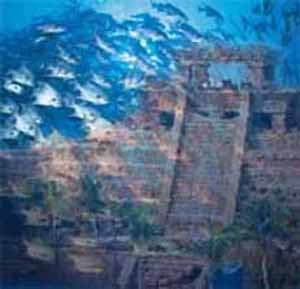
http://www.blog.dolorescannon.com/wp-content/uploads/2013/04/AtlantisTheMyth.jpg
 

In the children’s novel The Water-Babies (1863) by Charles Kingsley, Atlantis is merged with the legend of Tír na nÓg or ‘St Brandan’s fairy isle’, a ‘great land’ that sank beneath the waves to the west of Ireland. Kingsley’s story suggests that the surviving traces of Atlantis are not the sunken trees of ‘Noah’s woods’ but the ‘strange flowers, which linger still about this land’, such as ‘the Cornish heath, and Cornish moneywort’. He described the flowers as ‘fairy tokens left for wise men and good children’. Other writers have imagined the survival of more substantial remains of the sunken world.

In Twenty Thousand Leagues Under the Sea (1870), Jules Verne describes the occupants of the submarine Nautilus climbing through a sunken forest on the slopes of an erupting volcano on the bottom of the Atlantic until they find themselves looking down on a ruined town — ‘its roofs open to the sky, its temples fallen, its arches dislocated, its columns lying on the ground’. For the benefit of the submariners, Captain Nemo chalks a single word onto a rock of black basalt: ‘ATLANTIS’. Aronnax, the marine-biologist who narrates the book, is transfixed by the thought that he’s standing ‘on the very spot where the contemporaries of the first man had walked’.

Sir Arthur Conan Doyle offered another version of the legend, though his Atlantis was not, like Verne’s, a ‘perfect Pompeii escaped beneath the waters’ but a miraculously preserved and inhabited world. The underwater explorers of his short novel The Maracot Deep (1929) are assailed by a giant crustacean that snips the cable of their ‘bathysphere’, plunging it to the bottom of the sea. They are rescued by the surviving Atlantans and taken — as curiosities — to their submarine city.

The occultists were right in one respect: we live on the edge of drowned worlds and are descended from their inhabitants

Conan Doyle threaded his spiritualist beliefs throughout the tale in a way that illustrates how lost worlds might allow us to improve upon the real one, if only in imagination. But the Atlantis myth also allows us to rehearse our fears and fantasies of collapse and decay. In his novel After London (1885), the Victorian naturalist Richard Jefferies portrayed Britain as a kind of Atlantis, its capital reduced to a putrid swamp, its interior covered by an inland sea. Similarly, J G Ballard’s early novel, The Drowned World (1962), pictures futuristic London as a tropical lagoon. Ballard’s characters welcome the re-emergence of a primeval world: we fear the flood, his book implies — and yet embrace it too.

In 1954, the American science fiction writer L Sprague de Camp said that the number of novels and stories about lost continents was ‘beyond count’. Yet the treatment of the subject was not confined to books that advertised themselves as fiction.

The great champion of Atlantis as ‘veritable history’ was an American politician called Ignatius Donnelly, who served as a congressman and state senator for Minnesota at various times in the late 19th century. Donnelly was also a land speculator, farmer and fantasist, who proposed three equally striking and implausible theories — that Bacon had not only written Shakespeare’s plays but embedded a cipher within them; that great events in the Earth’s history, such as the Ice Age, were brought on by ‘extraterrestrial catastrophism’; and that Atlantis was a fragment of a once vast oceanic continent.

In Atlantis: The Antediluvian World (1882), Donnelly identified Plato’s Atlantis as source of all humanity’s lost paradises: ‘the Garden of Eden; the Gardens of the Hesperides; the Elysian Fields’. It represented ‘a universal memory of a great land, where early mankind dwelt for ages in peace and happiness’. Donnelly believed that a few lucky survivors of Atlantis’s drowning had escaped ‘in ships and on rafts’ to populate surrounding continents, citing, as proof, resemblances between European and American plants and animals, culture and language. Sprague de Camp notes that ‘most of Donnelly’s statements of fact… either were wrong when he made them, or have been disproved by subsequent discoveries’. And even if they hadn’t been wrong, he would still have drawn the wrong conclusions from them: the fact that people on both sides of the Atlantic used spears and sails, customarily married and divorced, and believed in ghosts and flood legends ‘proves nothing about sunken continents’.

 
http://www.crystalinks.com/atlantis705.jpg Of course, being wrong is rarely a bar to success, especially in the realms of fantasy and conspiracy. Donnelly’s book was reprinted 22 times in the eight years after publication, becoming ‘the New Testament of Atlantism’. And Donnelly attracted a curious following among 19th-century occultists such as Helena Petrovna Blavatsky, who founded the Theosophical Society. Blavatsky believed that Atlantis was one of several lost continents on which humanity had evolved. She claimed that her esoteric magnum opus The Secret Doctrine (1888) was originally dictated on Atlantis, and that part of humanity was descended from another ‘root-race’ who lived on the vanished continent of Lemuria.

Blavatsky did not invent the name ‘Lemuria’: it was proposed in 1864 by the English zoologist Philip Sclater as a way of explaining the presence of Lemur fossils in Madagascar and India, but not in Africa or the Middle-East. Lost land bridges were often invoked to explain how species had travelled across continents separated by water, and Sclater believed that India and Madagascar had been conjoined on a continent that broke apart into islands or sank beneath the waves.

For Blavatsky, Lemuria was ‘the cradle of mankind, of the physical sexual creature who materialised through long aeons out of the ethereal hermaphrodites’. In The Lost Lemuria (1904), her fellow theosophist William Scott-Elliott offered a vivid description of this ‘creature’:
His stature was gigantic, somewhere between 12 and 15 feet… His skin was very dark, being of a yellowish brown colour. He had a long lower jaw, a strangely flattened face, eyes small but piercing and set curiously far apart, so that he could see sideways as well as in front, while the eye at the back of the head… enabled him to see in that direction also.


The theory of continental drift, accepted in the early 20th century, obviated the need to conjure a Lemuria that explained the spread of fossils, but the idea has continued to fascinate occult writers. The American writer Frederick S Oliver pulled Lemuria into a orbit of spiritualist ideas, including spirit guides, astral travel and channelling. His 1905 novel A Dweller on Two Planets (1905), supposedly written under ‘spirit guidance’, tells the story of a community of sages who escaped from Lemuria and settled on Mount Shasta, near Oliver’s home in northern California.

Oliver’s book has been surprisingly influential. The idea of a Lemurian community living on Mount Shasta was frequently reported during the 1920s and ‘30s, and acquired a surprising degree of detail. There were said to be 1,000 magi, living in a ‘mystic village’ built around a Mayan-style temple. Occasionally, they appeared in neighbouring towns, clad in long white robes, ‘polite but taciturn’. They paid for supplies with gold nuggets and, every midnight, they rejoiced in their escape from Lemuria in ceremonies that bathed the mountains in red and green light. Various Californian luminaries, such as the actress Shirley MacLaine — who recalled a past life as an androgynous Lemurian in her memoir I’m Over All That (2012) — and Guy Warren Ballard, founder of the flamboyant religious movement I AM, were both inspired by Oliver’s novel. It still informs the philosophy of a New Age organisation called the Lemurian Fellowship, which maintains that ‘the continents of Atlantis and Mu [often synonymous with Lemuria] did exist, and still do, sunken beneath the waters of the Atlantic and Pacific Oceans’.


http://1.bp.blogspot.com/-aTnwAlKXcbs/TWesAJEbCcI/AAAAAAAAAJc/sSGZDN4SVzI/s760/Atlantis-deluge.jpg

The British occult writer James Churchward claimed to have learnt about Mu from ancient tablets discovered in temples in India. His book The Lost Continent of Mu: Motherland of Man (1926) was one of the last great manifestations of our preoccupation with lost worlds. It was published just five years before Pilgrim E Lockwood, skipper of the Colina, hauled up his handworked antler. The wild imaginings of the 19th-century cult of Atlantis were starting to be displaced by a picture of a lost world that was scarcely less astonishing, and which had the advantage of being true.

As early as 1936, only a handful of archaeologists went against the grain of thinking that Dogger Bank was a mere ‘land bridge’ to speculate that its ancient plains would have been ‘especially favourable for settlement’. Over the last decade, however, their ideas have gained credence. In 2001, researchers at the University of Birmingham decided to investigate further. Using seismic data collected by Norwegian oil companies, the archeologists Vincent Gaffney, Simon Fitch and David Smith constructed 3D rendering of ‘shallow deposits’ lying only metres beneath the seabed. They revealed the course of a river, large as the Rhine, that once ran across Dogger Bank. The scale of the lost territory has astonished the three researchers. They do not exaggerate when they write in Europe’s Lost World: The Rediscovery of Doggerland (2009) that they’re exploring ‘an entire, preserved, European hunter-gatherer country’ — a lost land that, at its most extensive, was as large as the UK. The team has now mapped the contours of Doggerland and identified 1,600km of river channels and 24 lakes or marshes. The emerging picture is that of ‘a massive plain dominated by water’. To the modern eye, this environment might appear featureless, even unattractive, yet to Mesolithic communities, it offered rich living.

Gaffney, Fitch and Smith understand that, with or without the science, Doggerland remains one of the most ‘enigmatic’ archaeological landscapes in the world, and that our lack of historic knowledge about the people who inhabited it will prove attractive to fantasists and conspiracy theorists alike. Besides, Doggerland is not the only lost continent to be rediscovered. There’s Sundaland, the coastal shelf in the south China Sea, and Beringia, the land bridge that joined Asia to Alaska. Although yet to be explored in any detail, their existence confirms that the occultists were right in one respect, at least: we live on the edge of drowned worlds and are descended from their inhabitants.

Yet one thing has changed: archaeologists now believe that Doggerland’s hunter-gatherers didn’t settle the British Isles until they were forced to abandon their traditional homes on the low-lying plain. Humanity, of course, has always lived with the threat of great floods; but as water levels begin rising once again, we should remind ourselves that our densely inhabited world contains no comparable havens to which we might retreat.


Edward Platt is a contributing writer for the New Statesman. His latest book is The City of Abraham: History, Myth and Memory, a Journey Through Hebron (2012).


From Aeon @ http://www.aeonmagazine.com/living-together/lost-civilisations-under-the-waves-still-fascinate-us/


For more information about Atlantis see http://nexusilluminati.blogspot.com/search/label/atlantis  
For more information about the antediluvian world see http://nexusilluminati.blogspot.com/search/label/antediluvian%20world  
- See ‘Older Posts’ at the end of each section


This is a ‘not for profit’ site -
But if you like what we do please buy us a meal if you can
Donate any amount and receive at least one New Illuminati eBook!
Please click in the jar -


Xtra Images – http://www.blog.dolorescannon.com/wp-content/uploads/2013/04/AtlantisTheMyth.jpg
http://www.crystalinks.com/atlantis705.jpg
http://1.bp.blogspot.com/-aTnwAlKXcbs/TWesAJEbCcI/AAAAAAAAAJc/sSGZDN4SVzI/s760/Atlantis-deluge.jpg


For further enlightening information enter a word or phrase into the random synchronistic search box @ http://nexusilluminati.blogspot.com


And see


 New Illuminati on Facebook - https://www.facebook.com/the.new.illuminati

New Illuminati Youtube Channel - http://www.youtube.com/user/newilluminati/feed


The Her(m)etic Hermit - http://hermetic.blog.com


The Prince of Centraxis - http://centraxis.blogspot.com (Be Aware! This link leads to implicate & xplicit concepts & images!)


DISGRUNTLED SITE ADMINS PLEASE NOTE –
We provide a live link to your original material on your site - which raises your ranking on search engines and helps spread your info further! This site is published under Creative Commons Fair Use Copyright (unless an individual article or other item is declared otherwise by copyright holder) – reproduction for non-profit use is permitted & encouraged, if you give attribution to the work & author - and please include a (preferably active) link to the original (along with this or a similar notice).
Feel free to make non-commercial hard (printed) or software copies or mirror sites - you never know how long something will stay glued to the web – but remember attribution! If you like what you see, please send a donation (no amount is too small or too large) or leave a comment – and thanks for reading this far…

Live long and prosper!


From the New Illuminati – http://nexusilluminati.blogspot.com