"All the World's a Stage We Pass Through" R. Ayana

Showing posts with label historic tsunamis. Show all posts

Wednesday, 12 October 2011

Mega-tsunami: Wave of Destruction

Mega-tsunami: Wave of Destruction

Image

Scattered across the world’s oceans are a handful of rare geological time-bombs. Once unleashed they create an extraordinary phenomenon, a gigantic tidal wave, far bigger than any normal tsunami, able to cross oceans and ravage countries on the other side of the world. Only recently have scientists realised the next episode is likely to begin at the Canary Islands, off North Africa, where a wall of water will one day be created which will race across the entire Atlantic Ocean at the speed of a jet airliner to devastate the east coast of the United States. America will have been struck by a mega-tsunami.

Back in 1953 two geologists travelled to a remote bay in Alaska looking for oil. They gradually realised that in the past the bay had been struck by huge waves, and wondered what could have possibly caused them. Five years later, they got their answer. In 1958 there was a landslide, in which a towering cliff collapsed into the bay, creating a wave half a kilometre high, higher than any skyscraper on Earth. The true destructive potential of landslide-generated tsunami, which scientists named "Mega-tsunami", suddenly began to be appreciated. If a modest-sized landslide in Alaska could create a wave of this size, what havoc could a really huge landslide cause?

Scientists now realise that the greatest danger comes from large volcanic islands, which are particularly prone to these massive landslides. Geologists began to look for evidence of past landslides on the sea bed, and what they saw astonished them. The sea floor around Hawaii, for instance, was covered with the remains of millions of years’ worth of ancient landslides, colossal in size.

But huge landslides and the mega-tsunami that they cause are extremely rare - the last one happened 4,000 years ago on the island of Réunion. The growing concern is that the ideal conditions for just such a landslide - and consequent mega-tsunami - now exist on the island of La Palma in the Canaries. In 1949 the southern volcano on the island erupted. During the eruption an enormous crack appeared across one side of the volcano, as the western half slipped a few metres towards the Atlantic before stopping in its tracks. Although the volcano presents no danger while it is quiescent, scientists believe the western flank will give way completely during some future eruption on the summit of the volcano. In other words, any time in the next few thousand years a huge section of southern La Palma, weighing 500 thousand million tonnes, will fall into the Atlantic ocean.

What will happen when the volcano on La Palma collapses? Scientists predict that it will generate a wave that will be almost inconceivably destructive, far bigger than anything ever witnessed in modern times. It will surge across the entire Atlantic in a matter of hours, engulfing the whole US east coast, sweeping away everything in its path up to 20km inland. Boston would be hit first, followed by New York, then all the way down the coast to Miami and the Caribbean.


For further enlightening information enter a word or phrase into the search box @  New Illuminati or click on any label/tag at the bottom of the pagehttp://nexusilluminati.blogspot.com


And see

The Her(m)etic Hermit - http://hermetic.blog.com


This material is published under Creative Commons Copyright (unless an individual item is declared otherwise by copyright holder) – reproduction for non-profit use is permitted & encouraged, if you give attribution to the work & author - and please include a (preferably active) link to the original along with this notice. Feel free to make non-commercial hard (printed) or software copies or mirror sites - you never know how long something will stay glued to the web – but remember attribution! If you like what you see, please send a tiny donation or leave a comment – and thanks for reading this far…

From the New Illuminati – http://nexusilluminati.blogspot.com

Tuesday, 17 November 2009

Coming One Day Near You: A Mega-Tsunami

Coming One Day Near You: A Mega-Tsunami

https://blogger.googleusercontent.com/img/b/R29vZ2xl/AVvXsEgo0EwF6EowcAArYwk_ayB5S_zqvzBBSrtphcTocRXgHcK1H0xG4O1q3VgZZG8xzsKpnkZbxB4CR-jT0wuozJzTrGutcQYOkJblG2tLx9mETr-bhBJjHrMQfXknvzjFsjeuFyjVc2LcRQAE/s400/atlantis2.jpg

One day, a giant wave travelling at 125 mph across open water could crash into Sydney harbour, wipe out the beaches of California or plough across the golf courses of northeast Scotland.
 
Mega-tsunamis have happened with greater frequency than modern science would like to believe, and no coastline in the world is safe, says Canadian geologist-geographer Edward Bryant.
 
He said he had found signs of giant waves sweeping over 425 feet high headlands in southeast Australia, roaring down the U.S. West Coast and carving into the bedrock of the Scottish coastline north of Edinburgh.
 
"I believe St. Andrews golf course is a tsunami deposit," Bryant, head of geosciences at Wollongong University south of Sydney, told Reuters.
 
Over the past 2,000 years, tsunamis have officially killed 462,597 people in the Pacific region alone [not including the massive number of deaths caused by the Indian Ocean tsunami a few years ago – Ed], with the largest toll recorded in the Japanese islands.
 
Of the top recorded events, the Lisbon earthquake of 1755 is said to have triggered a 15-meter high wave that destroyed the port of Lisbon and caused widespread destruction in southwest Spain, western Morocco and across the Atlantic in the Caribbean.
 
Modern science blames the killer waves on earthquakes and most countries believe they are immune.
 
But in his book, "Tsunamis -- The Underrated Hazard," Bryant argues that submarine landslides, underwater volcanoes and even the potentially catastrophic scenario of a meteorite impact must also be taken into account when evaluating tsunami risk.
 
That means a destructive tsunami moving at 250 meters per second in deep water, 85 meters per second across continental shelves and at 10 meters per second at shore could strike an unprotected coastal metropolis anywhere, killing thousands.
 
http://movingimages.files.wordpress.com/2008/12/asteroid-impact.jpg


Geological Dabbler to Catastrophist
 
In 1989, Bryant was dabbling into the coastal evolution of rock platforms and sand barriers along the New South Wales coastline of eastern Australia when he noticed something strange.
 
Giant boulders, some the size of boxcars and weighing almost 100 tons, were jammed 33 meters above sea level into a crevice at the top of a rock platform sheltered from storm waves.
 
Further field work found gravel dunes on a 130-meter-high headland and other massive boulders more than 100 meters inland. Bryant then examined bedrock that had been savagely eroded and found that headlands carved into inverted toothbrushes, where a gap had been roughly gouged in the middle, existed from Cairns in the far northeast to Victoria state in the south.
 
This could not be explained by normal wave action or storms.
 
"But a tsunami could do this," Bryant said.
 
"From being a trendy process geomorphologist wrapped in the ambience of the 1960s, I had descended into the abyss of catastrophism," Bryant writes in his book.
 
Similar toothbrush headlands exist in northeast Scotland and gravel has been dumped up to 30 km inland in Western Australia.
 
To the scorn of many modern scientists, Bryant says it is "naive" to base what we know about tsunamis simply on documented history.
 
In North America and Australia, official history only goes back as far as white colonization. We may be ignoring the legends of the Indians of North America, the Aborigines of Australia or the Maoris of New Zealand at our peril, he said.
 
Oral Legends
 
We ignore all oral record and it's probably a significant oversight," Bryant told Reuters. One Aboriginal tale tells how one of the four pillars holding up the sky collapsed in the east and the sea also fell in.
 
The Maoris of New Zealand have long spoken of a time of fire that burned the land to a crisp.
 
A legend told by the Kwenaitchechat people of the U.S. Pacific Northwest tells of a great shaking of the earth that led to the sea receding and then coming back in a great wall.
 
Using dating techniques, Bryant argues there is evidence that eastern Australia was struck by a mega-tsunami around 1500, which would coincide with the Aboriginal tale of a "great white wave."  The Aboriginal accounts of fire in the sky mean a comet crashing into the South Tasman Sea could have been responsible. Carbon dating indicates a great fire ravaged New Zealand at the same time, giving further weight to the theory of a comet. [This asteroid impact in the Tasman Sea between Australia and New Zealand has been dated to the 1520s by various other sources; the more recent huge wave in 1700, mentioned below, likely affected the entire Pacific and was caused by volcanic activity and underwater landslides emanating from Hawaii - Ed]
 
And Bryant said Japanese researchers probing past tsunamis had found evidence of a massive earthquake off Oregon in January 1700 that would coincide with the Indian tales, and with a Pacific seismic zone where the Juan de Fuca tectonic plate grinds under the North American plate in a process called subduction.
 
"We now know the Oregon subduction zone goes every 300 years. 1700 - 2002?" he wonders with raised eyebrows.
 
Bryant's suspicions of meteor and comet impacts a relatively short time ago rile many in the scientific community who believe the chances of Earth colliding with space debris are tiny.
 
But Bryant says computer modelling suggests a meteor would not have to be a "dinosaur killer" to cause a mega-tsunami. A chunk 100 meters in diameter moving at 20 meters per second could theoretically produce a tsunami that is 27 meters high at source.
 
SUBMARINE LANDSLIDES

Focusing on extreme scenarios such as meteorite impacts may also underestimate the risk of a mega-tsunami.
 
Contentiously, Bryant argues that underwater landslides, which can involve thousands of cubic kilometres of material, may have the power alone to generate the giant waves.
 
A 1998 earthquake off northwest Papua New Guinea has been blamed for a tsunami that killed around 2,000 people near Aitape.
 
But according to conventional scientific wisdom, the 7.1 magnitude was too small to be responsible for the 15-meter wave that at some points swept 500 meters inland.
 
Bryant says a submarine landslide was the likely villain.
 
Another landslide-induced tsunami may have been responsible for shaping the Scottish coastline, including the dunes of St. Andrews, 7,000 years ago.
 
Scientists have found indications of a large submarine landslide at Storegga off the east coast of Norway that Bryant says could have sent a wave originally measuring 8-12 meters roaring into the North Sea and across the Atlantic.
 
Worryingly, he says geologists at the University of Sydney have recently mapped around 170 submarine landslide zones off Sydney, Australia's largest city with four million inhabitants. What's more, he has found signs that tsunamis have struck the New South Wales coast with alarming regularity every 500 years.
 
If you take the risk seriously, it does not take much to save human life from tsunamis.
 
Chile, Japan and Hawaii already have warning systems and evacuation drills [at the time of writing; a few more exist now – Ed]. Seabed sensors can send tsunami warnings via satellite triggering bells, alarms and telephones within minutes.
 
"The only guarantee or prediction is that they will happen again, sometime soon, on a coastline near you," Bryant concludes.
 
"Tsunami are very much an underrated, widespread hazard. Any coast is at risk."

By Michael Christie
2-26-2
From Reuters via Rense.com

http://www.newprophecy.net/tidal_wave_third_of_a_mile.jpg

Big splash theory says meteors hit regularly

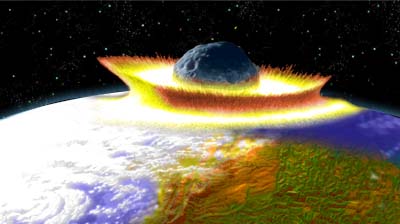
A LARGE asteroid or comet, the kind that could kill a quarter of the world's population, smashed into the Indian Ocean 4800 years ago, producing a tsunami more than 180 metres high - about 13 times as big as the one that hit Indonesia almost two years ago.
The startling claim is made by a group of researchers, including Australians, who cite as evidence a newly discovered crater, 29 kilometres in diameter, 3800 metres below the surface of 1600 kilometres south-east of Madagascar.

Most astronomers doubt that any large comets or asteroids have crashed into the Earth in the past 10,000 years. But the self-described "band of misfits" that make up the Holocene Impact Working Group say astronomers simply have not known how or where to look for evidence of such impacts along the world's shorelines and in the deep ocean.

Scientists in the working group say the evidence for such impacts during the past 10,000 years is strong enough to overturn estimates of how often the Earth suffers a violent impact on the order of a 10-megaton explosion. Instead of once in 500,000 to 1 million years, as astronomers now calculate, catastrophic impacts could happen every few thousand years.

The researchers, who formed the working group after finding one another through an international conference, are based in the US, Australia, Russia, France and Ireland. [In 2006] the group started using Google Earth, a free source of satellite images, to search the globe for chevrons - enormous wedge-shaped sediment deposits, that are composed of material from the ocean floor - which they interpret as evidence of past giant tsunamis.

Ted Bryant, a geomorphologist at the University of Wollongong, was the first person to recognise the palm prints of mega-tsunamis. Large tsunamis of 10 metres or more were caused by volcanoes, earthquakes and submarine landslides, Dr Bryant said, and their deposits have different features.

Deposits from mega-tsunamis contained unusual rocks with marine oyster shells, which could not be explained by wind erosion, storm waves, volcanoes or other natural processes, he said.

"We're not talking about any tsunami you've ever seen. Aceh was a dimple. No tsunami in the modern world could have made these features." Dr Bryant identified two chevrons found about six kilometres inland from the Gulf of Carpentaria. Both point north.
When Dallas Abbott, an adjunct research scientist at Lamont-Doherty Earth Observatory, in New York, visited a year ago, he asked her to find the craters.

To locate craters Dr Abbott uses sea surface altimetry data. Satellites scan the ocean surface and log the exact height of it. Underwater mountain ranges, trenches and holes in the ground disturb the Earth's gravitational field, causing sea surface heights to vary by fractions of a centimetre. Within 24 hours of searching the shallow water north of the two chevrons she found two craters.

She obtained samples from deep sea sediment cores taken in the area by the Australian Geological Survey.

"We think these two craters are 1200 years old," she said. The chevrons are well preserved and date to about the same time.

Copyright The New York Times
2006
New Illuminati comments: Sooner or later IT WILL HAPPEN AGAIN. In the best of times, anyone who lives on the coast cares little for their life, and anyone who BUILDS on or near a coastline condemns themselves, their family or whoever buys their 'property' to untimely death - and this is no longer the best of times...


Images - https://blogger.googleusercontent.com/img/b/R29vZ2xl/AVvXsEgo0EwF6EowcAArYwk_ayB5S_zqvzBBSrtphcTocRXgHcK1H0xG4O1q3VgZZG8xzsKpnkZbxB4CR-jT0wuozJzTrGutcQYOkJblG2tLx9mETr-bhBJjHrMQfXknvzjFsjeuFyjVc2LcRQAE/s400/atlantis2.jpg
http://movingimages.files.wordpress.com/2008/12/asteroid-impact.jpg
http://www.newprophecy.net/tidal_wave_third_of_a_mile.jpg 


For further enlightenment enter a word or phrase into the search box @  New Illuminati:

 http://nexusilluminati.blogspot.com (or click on any tag at the bottom of the page)
or http://newilluminati.blog-city.com  (this one only works with Firefox)

And see

The Her(m)etic Hermit - http://hermetic.blog.com


This material is published under Creative Commons Copyright (unless an individual item is declared otherwise by copyright holder) – reproduction for non-profit use is permitted & encouraged, if you give attribution to the work & author - and please include a (preferably active) link to the original along with this notice. Feel free to make non-commercial hard (printed) or software copies or mirror sites - you never know how long something will stay glued to the web – but remember attribution! If you like what you see, please send a tiny donation or leave a comment – and thanks for reading this far…

From the New Illuminati – http://nexusilluminati.blogspot.com


Wednesday, 22 November 2006

Researchers claim link between tsunamis and outer space

Researchers claim link between tsunamis and outer space


MARK COLVIN: After the devastation of the Aceh tsunami nearly two years ago, Australians have a clear idea of what a tidal wave can do. But imagine a mega tsunami, a tidal wave 10 times bigger than the Aceh event.

A group of scientists from the US, Australia, Russia, France and Ireland have been working on a theory that such mega tsunamis may happen, not every half a million years as astronomers had predicted, but every couple of millennia.

They say they're caused by meteor or asteroid impacts, which they believe have been much more frequent in earth's history than had been believed.

They call themselves Holocene Impact Research Group, and one of their members is Associate Professor Ted Bryant of
Wollongong University
.

He told me one factor behind the theory had been a better way of detecting where asteroids had fallen at sea.

TED BRYANT: It's a technology that's been around for about 10 years. Basically the sea surface reflects the bottom topography. So you get very small changes in the elevation of sea level across the ocean and it's a mirror image at the bottom topography. And you can pick up or measure the sea surface using altimeters on satellites.

MARK COLVIN: So the result of all this is that you think that a lot more comets and asteroids have hit Earth than had been previously thought, with devastating consequences?

TED BRYANT: Definitely and definitely. It's greater than the rate that American astronomers in Spaceguard believe is occurring.

There is a group of astronomers in
Britain
that don't really have objections to what we're looking at and have a higher rate of debris coming in, in the last 10,000 years.

MARK COLVIN: But what it comes down to is that instead of expecting a catastrophic impact every half a million years, you might expect one every few thousand years?

TED BRYANT: Exactly, and it might even be a shorter time frame.

MARK COLVIN: How often do you think there have been big comet impacts near
Australia
?

TED BRYANT: I guess now we're looking at maybe five events in the last 10,000 years.

MARK COLVIN: What kinds of effects did they have?

TED BRYANT: I mainly study tsunami and I think coming from here, we have comet impacts in the ocean, I was looking at shorelines and seeing on shorelines we have indicators of catastrophic erosion and deposition, which is beyond what storms can do and beyond what our historical record of what tsunamis can do.

Tsunamis are generated, 95 per cent of them, by earthquakes and these deposits are higher up than what an earthquake tsunami could do around the Australian coastline.

MARK COLVIN: Some people in
Australia
who have got 'water views' as they say, are already a bit worried about global warming. They're going to be even more worried when they hear you saying that tsunamis are much more likely, much more frequent than anyone ever expected.

TED BRYANT: Well, I have a water view and I'm not worried. There is a periodicity of about 2,500 years and there is... what the British astronomy group believe is a larger comet came into the inner solar system about 15,000 years ago and broke up and the Earth passes through the debris trail of this comet.

And it's quite common. The Earth passes through, annually, about 12 of these debris trails from different comets, broken up comets.

We tend to every 2,500 years pass through... close to the concentrated area of debris of this broken up comet and it's in a stream called the Taurids and the Taurids turn on in the end of June, you see a lot of meteorites there, small meteorites burning up in the sky.

Turns on about the third week of November, which is actually next week. The one 15,000 years ago was particularly big and its left a lot of debris and that is what we're passing through at regular periods giving rise, I think, to some of the comets... the impact craters that we're finding in the ocean.

MARK COLVIN: Your website says a tsunami will happen again sometime soon on a shoreline near you and you give people a lot of safety tips as to where to go if it happens. I mean, that sounds quite alarmist.

TED BRYANT: There I was sitting on Aceh, in
Indonesia, Boxing Day at eight o'clock
in the morning and if you told me a tsunami was going to come in, I would never have believed you.

And certainly if I was on Phuket in
Thailand
, I would have committed you to an insane asylum. If you wait long enough, a tsunami will come into any coastline of the ocean.

MARK COLVIN: Now, it's fair to say that the theories of the Holocene Impact working group are not universally accepted. How much work do you think you still have to do to get full scientific acceptance?

TED BRYANT: It'll be deadly. I'll be dead before the scientific community accepts what we believe. That's the nature of science, I mean, it's not stirring stuff out there, with people coming up with ideas and everybody gone... light bulb stuff.

I haven't been burnt at the stake, and they made Galileo recant and Copernicus, I don't know what they did to him, but no one believed him at the time and they were punished most severely.

I don't put ourselves in the same boat as Galileo or Copernicus, we're just average scientists in a range of fields who've come together and think that we're in agreement.

The scientific community, I wouldn't expect 99.9 per cent of it to agree with us.

MARK COLVIN: Associate Professor
Ted Bryant of Wollongong University.


http://i1-news.softpedia-static.com/images/news2/New-York-Hit-by-Asteroid-Triggered-Tsunami-Millennia-Ago-2.jpg


From PM - Tuesday, 14 November , 2006  18:30:00 Reporter: Mark Colvin

http://i1-news.softpedia-static.com/images/news2/New-York-Hit-by-Asteroid-Triggered-Tsunami-Millennia-Ago-2.jpg
For further enlightening information enter a word or phrase into the search box @  New Illuminati or click on any label/tag at the bottom of the page @  http://nexusilluminati.blogspot.com

And see

The Her(m)etic Hermit - http://hermetic.blog.com


This material is published under Creative Commons Copyright (unless an individual item is declared otherwise by copyright holder) – reproduction for non-profit use is permitted & encouraged, if you give attribution to the work & author - and please include a (preferably active) link to the original along with this notice. Feel free to make non-commercial hard (printed) or software copies or mirror sites - you never know how long something will stay glued to the web – but remember attribution! If you like what you see, please send a tiny donation or leave a comment – and thanks for reading this far…

From the New Illuminati – http://nexusilluminati.blogspot.com

Thursday, 26 October 2006

Prehistoric tsunami in Australia


Prehistoric tsunami in Australia

http://digitaljournal.com/img/8/7/3/i/8/8/9/o/Australian-continent.jpg

Identification of a range of features or signatures imprinted upon the landscape by large tsunami has allowed us to construct a record of palaeo- (prehistoric) tsunami. These signatures include sedimentary deposits and erosional bedrock features.

Depositional and erosional signatures of tsunami

For example, there are numerous piles of boulders aligned like fallen dominoes along the top of cliffs at Jervis Bay, New South Wales. The waves that overwashed these cliffs also deposited shelly sand that can be radiocarbon dated around AD 1500. This event produced one wave that overran the 130 m high headland flanking the south of Jervis Bay.

    The photographs in the linked windows show this evidence. At Gum Getters Bay, boulders as large as a boxcar were moved. They are stacked parallel with each other to the top of a 30 m high cliff. In this regard, cliff collapse did not produce the deposit. Rather the boulders were deposited from a wave that overwashed the cliff.

 http://www.uow.edu.au/content/groups/public/@web/@sci/@eesc/documents/mm/uow015608.jpg
           
Imbricated boulders stacked against a thirty-metre high cliff face on the south side of Gum Getters Inlet, New South Wales, Australia. Some of these boulders are the size of a boxcar. Note the person circled for scale.


 More dramatic are features carved into bedrock that render much of Australia's rocky coast so scenic. Multiple vortices in fast moving water can sculpture solid bedrock into many distinct features such as stacks, arches, and sea caves. Our web pages show many photographs of these features around the Australian coastline. Many of these features have been attributed, without substantiation, to long-term erosion by wind-generated waves.

However, some features lie beyond the reach of normal or high-energy wave attack and bear similarities to features carved by enormous floods that were last present on Earth during the Last Ice Age. Stacks such as Cathedral Rocks near Kiama on the New South Wales South Coast, and giant whirlpools on the sides of headlands were carved by vortices in tsunami flow within a few minutes.

http://www.printsasiaimages.com/632427467/110429060505HO343T38.jpg


A mega-tsunami approached the coastline from the southeast, overrode the headland, dropped into the sheltered embayment on the leeside, and then cut into the cliffs at Cathedral Rocks. Horizontal, eggbeater like vortices gouged out the stacks.. A sea cave was then bored into the cliffs by one of the vortices landward of the main stack.


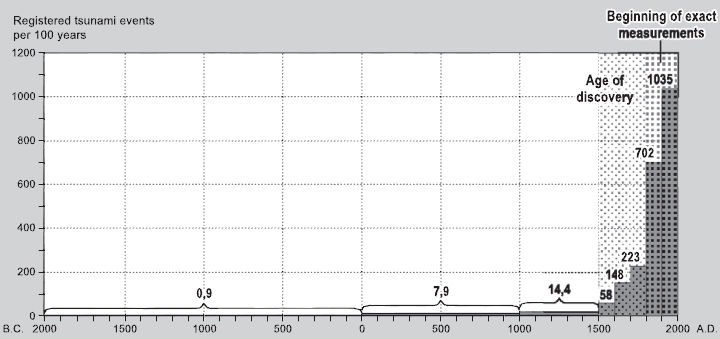
     Some of the above events would be devastating were they to recur today near inhabited coastline. Fortunately, only two large events have been identified along the New South Wales coast over the past 10000 years. The size of the evidence is beyond the capability of earthquake-generated tsunami and alludes to a meteorite or comet hit with the ocean. The figure below presents a record of comet and meteorites for the last 2000 years.


https://blogger.googleusercontent.com/img/b/R29vZ2xl/AVvXsEgrDrCgPwSWcW3LBCvwJYrcK_p-rkAH-1vvyFqXigyKDJXdBBN1QMMZ0Emvvog4jjtVS7qKr8KvWFgpubfjYDfJ60ukuIsyR6HPIiKJP2xrbZevpUgkMApHY69pzyqixBA-IbK8IHO0b9Nc/s1600/SCHEFFERetal_2003_Tsunami_historic_events.jpg

The calibrated radiocarbon dates under the Mystic Fires of Tamaatea are from wood and peats burnt on the South Island of New Zealand. The Mystic Fires of Tamaatea refers to a Maori legend where fire from the sky scorched the Earth killing many people.

The radiocarbon dates of prehistoric tsunami events in Australia are based on shell collected from tsunami deposits along the New South Wales coast and from Lord Howe Island.

    Also shown is the frequency of corrected radiocarbon ages from tsunami deposits along the New South Wales coast and Lord Howe Island. The panel entitled Fires of Tamaatea plots the frequency of corrected radiocarbon dates on burnt wood and peat from the South Island of New Zealand. This dates a Maori legend about the descent of fire from the sky that destroyed the landscape. The AD 1500 tsunami along the east coast of Australia corresponds to a peak in the comet and meteorite observations, and to the timing of Maori legends describing a comet hit.

Dates are now coming from tsunami deposits on the east coast of New Zealand confirming this age. Astronomers believe that a comet came into the inner solar system within the last 20,000 years and fragmented. The Earth periodically passes through the most concentrate part of the debris trail at 500-1500 year intervals. The evidence suggests that one such fragment might have struck the Australian-New Zealand region 500 years ago. Except for random meteorites, the Earth will not intercept this comet trail again until AD 3000.

    While our east coast is not threatened by another comet- or meteorite-induced tsunami, tsunami generated by submarine slides cannot be ruled out. Radiocarbon dating suggests that an important tsunami occurs along the New South Wales coast every 1000 years or less. The source of these events is not difficult to envisage. There are over 170 slide scars on the continental shelf edge along the New South Wales coast. They have not been dated, but they are geologically recent. Any of them could cause a localised tsunami. Some slides are large.

One off northern Wollongong measures 20 km in length and 10 km in width. It would have generated a tsunami that affected a considerable length of coast south of Sydney. There is no detection system in place in Australia to warn against tsunami generated by nearby submarine slides. Even if there were, people would have only 20- 30 minutes to evacuate to safety. They could do it though.


Transcript, links and further information for 'Tsunami'

Narration

    Forces of nature make great movie villains, big, powerful and very scary. But for the people of Papua New Guinea, Hollywood fiction became grim fact in July, when a tsunami slammed into the country's north coast

    Such monster waves have many causes and devastating consequences. In Papua New Guinea, over 2,200 people died and thousands more were left homeless. Scientists scrambled to pin down the source of the destructive wave.

    Associate Professor Ted Bryant

    It looks like it might be a submarine land slide triggered by an earthquake event and it was on catastrophic proportions

    Narration

    Tsunamis have been wreaking havoc around the Pacific Rim for millennia. Yet they remain a confusing phenomenon. For instance, "tsunami" is Japanese for "harbour wave", not "tidal wave". And the mighty waves are often depicted incorrectly in the media.

    Professor Joe Monaghan

    For example in this newspaper you will see an artist's representation of a wave....one or two decisive waves. You get thumped by something immense.

    Narration

    Ordinary storm waves have tremendous destructive power. But tsunamis can travel at speeds of nearly 1,000 kilometers per hour and carry billions of tonnes of water. The most common trigger is an undersea avalanche or earthquake. The sudden shift of a huge volume of water sends the tsunami on its way.

    As the front of a tsunami hits shallow water near shore, it slows. Faster moving water at the back catches up, and builds the wave to a height of 30 meters or more. Surprisingly, Australia has long been on the tsunami hit list, argues a leading Geomorphologist.

    Ted Bryant bases his startling claim on a suite of geological evidence scattered all around the vast coastline. Ted's discovered what he calls the "signatures" of a tsunami: Things like piles of shells where they shouldn't be, ocean sand on hilltops, and peculiar rock formations. For instance, at Little Bay, south of Sydney, there are giant 10-tonne boulders, tossed well beyond the reach of ordinary stormy seas.

    Associate Professor Ted Bryant

    This boulder has been lightly settled out of flowing water and its made contact with the blocks underneath and if it had been tossed up it would have fractured these contacts and you can see that there's no fracturing between the two ah three boulders where they made contact....

    This one has just settled out of the flow and so a tsunami's gone by and lost some of its energy so its dropped out of the flow gently onto the other blocks and the platform.

    Narration

    Ted claims that further south, near Wollongong, is another "signature" of that same tsunami, an enormous bowl-shaped structure.

    Associate Professor Ted Bryant

    Well we're standing on the side facing the wave's approach.. The wave's gone up over this head land and as the wave went over, you would have had about five minutes of water eight to ten meters deep but it slowly generated vortexes that sped up and when they reached the critical velocity they actually cut down through this bed rock and that's the circular depression the part which you see in the middle is the center of the vortex because the waves were moving and the water was moving slower than the vortex. It didn't erode as fast.

    Narration

    According to Ted, tsunamis the size of the vortex-carver were probably set rolling by asteroids. Impact, earthquake or undersea avalanche, he bets Australia will be struck again. It has already been hit by at least six tsunamis in the past 6,000 years.

    Associate Professor Ted Bryant

    The most recent big one we think occurred about fourteen hundred AD and that one was tossing material up sixty meters high ... and from other evidence around the Jarvis Bay region we think it may have been going up on top of eighty meter high cliffs.

    Narration

    Yet, the giant waves vary in size and shape, and haven't left their calling cards on every Australian beach. To find out why, mathematician Joe Monaghan puts tsunamis in a tank.

    Professor Joe Monaghan

    What you're going to see is a tsunami running onto shore . We're interested in how the tsunami breaks, what happens here when it meets beaches of different slope. We're interested in the way it runs ashore. We want to know how the sand has moved...

    Leigh Dayton

    Why is it important to know where the sand is after an experiment like this?

    Professor Joe Monaghan

    Well if you're like us and you want to find out about an ancient tsunami ... sediments ... material thrown up from the sea.

    Narration

    Based on experimental findings, Joe simulates real tsunamis, like the Papua New Guinea wave, which smashed into a lagoon.

    Professor Joe Monaghan

    The front of the tsunami...it will break..

    Narration

    Using similar scientific tools, Joe is tackling another complex problem: historical tsunamis, triggered by volcanic eruptions. He suspects the fall of the once mighty Minoan civilization of Crete, about thirty five hundred years ago, is linked to a known eruption on the Aegean island of Santorini.But how could a volcano be responsible?

    Professor Joe Monaghan

    They emit what are called pyroclastic flows, fast moving hot gas carrying a great deal of solid material that just pushes into the sea and in pushing into the sea it initiates these tsunamis.

    Narration

    To test his theory, Ted sets miniature pyroclastic flows off and monitors their waves. It's such a finicky process, he only manages one experiment a day. Still, a computer model based on the hard-won data shows Joe may be right. But with increasing insight into the secrets of tsunamis, why was Papua New Guinea caught off guard? After all, an international, Pacific-wide network of earthquake-sensitive seismographs, sea-level monitors and satellites produces tsunami alerts for member nations.

    Australia is a participant, unlike Papua New Guinea. But even a warning system can be too little too late. And sometimes there's no accounting for curiosity.

    Associate Professor Ted Bryant

    In San Francisco in 1964, after the Alaskan earthquake there was a warning put out for the Pacific and it gave San Francisco about 6 hours. And ten thousand people made it down to the coast line to stand there watching the wave come.

    Narration

    Fortunately the wave passed them by. If Ted Bryant is right, though, coast-loving Australians are in line for a front row view of a tsunami...anytime. There's even a chance Hollywood will have it right.

    Further Information
    Associate Professor Ted Bryant
    Geosciences
    University of Woollongong
    Professor Joe Monaghan
    Maths Department
    Monash University
    Melbourne


images - http://digitaljournal.com/img/8/7/3/i/8/8/9/o/Australian-continent.jpg 
http://www.uow.edu.au/content/groups/public/@web/@sci/@eesc/documents/mm/uow015608.jpg
http://www.printsasiaimages.com/632427467/110429060505HO343T38.jpg
https://blogger.googleusercontent.com/img/b/R29vZ2xl/AVvXsEgrDrCgPwSWcW3LBCvwJYrcK_p-rkAH-1vvyFqXigyKDJXdBBN1QMMZ0Emvvog4jjtVS7qKr8KvWFgpubfjYDfJ60ukuIsyR6HPIiKJP2xrbZevpUgkMApHY69pzyqixBA-IbK8IHO0b9Nc/s1600/SCHEFFERetal_2003_Tsunami_historic_events.jpg
http://www.greatdreams.com/weather/sri-lanka-wave.jpg


For further enlightenment see –

The Her(m)etic Hermit - http://hermetic.blog.com


This material is published under Creative Commons Copyright – reproduction for non-profit use is permitted & encouraged, if you give attribution to the work & author - and please include a (preferably active) link to the original along with this notice. Feel free to make non-commercial hard (printed) or software copies or mirror sites - you never know how long something will stay glued to the web – but remember attribution! If you like what you see, please send a tiny donation or leave a comment – and thanks for reading this far…

From the New Illuminati – http://newilluminati.blog-city.com