"All the World's a Stage We Pass Through" R. Ayana

Showing posts with label financial system. Show all posts

Friday, 14 March 2014

Banks Are Obsolete: The Entire Parasitic Sector Can Be Eliminated


Banks Are Obsolete:
The Entire Parasitic Sector Can Be Eliminated

 http://www.whatdoesitmean.com/bro3.jpg

by Charles Hugh Smith


What else can we do with the $1.25 trillion we'll save by eliminating these obsolete financial middleman parasites? A lot.


Technology has leapfrogged the banking sector, rendering it as obsolete as buggy whips. So why are we devoting 9% of our economy to an obsolete parasite? Financial sector profits now total a staggering 4.5% of GDP (gross domestic product), while the expenses generated by financial churning account for another 4.5% of the economy.


 chart courtesy of Market Daily Briefing


Software and existing non-Wall Street/too-big-to-fail institutions could replace the entire Wall Street/banking sector and drop costs to .5% of GDP, saving us 8+% of our GDP ($1.25 trillion) that is currently siphoned off by parasitic middlemen. The banking sector is Exhibit A in the Middleman-Skimming Economy (February 11, 2014).

The pull of habit and propaganda is so strong that most people haven't even recognized that software and the Web can replace the entire financial/banking sector for a fraction of the cost of the current parasitic system, a system that (as we all know) has captured the regulatory and governance machinery of the central state, making a mockery of democracy.

The benefits of eliminating the financial/banking sector are immense and far-reaching.

What exactly do banks do?
 Banks perform these basic functions:

1. They hold depositors' money.

2. They act as a clearing house for payments, transferring funds from payer to payee.

3. They issue loans on a fractional reserve basis, i.e. a few dollars in cash deposits supports $100 in loans.

4. They originate and trade derivatives, run high-speed trading desks, operate various money-laundering and embezzlement schemes, influence elected officials with lobbying and campaign contributions and subvert both free market capitalism and democracy at every turn.

This entire parasitic middleman sector could be replaced with automated digital clearing houses and crowdfunded or non-bank loans. Why do we need banks to pay bills online? We don't; any clearing house could charge a small fee for the transaction.

Why do we need banks when loans can be crowdfunded? If we can invest money in start-ups via Kickstarter, Indiegogo, RocketHub, AngelList, etc., why can't we own a piece of someone's auto loan or home mortgage?

The web and software now enable the elimination of the entire middleman skimming operation of banking. Those with capital can invest that capital directly in loans that the investors choose. Risk is distributed throughout the system, and the process of verifying credit scores, income, valuations, assets, and so on--the building blocks of risk assessment and a market for debt and cash--can also be automated.

The entire notion that 100 savers put their money in a bank which then buys a mortgage with their savings and sells it as a security that supports a pyramid of derivatives is obsolete. Each saver can directly own (and sell on a transparent market) a piece of a mortgage, auto loan, business loan, etc. There is no need for a middleman banking sector at all--no skim, no concentration of risk, no opportunities for selling derivatives to unwary investors. All that goes away with the banking sector.

But what about holding deposits? We already have two institutions that could serve this role: credit unions and the post office.
 If those holding depositors' cash do not issue loans, they have no source of income to defray operating expenses. The solution is obvious: charge fees for holding deposits and payer-payee transactions.

If the fee structures are transparent, those who charge too much will disappear as customers go elsewhere. That's the purpose of transparent competition in an open marketplace.

Many other advanced nations have long combined postal and simple banking services: France and Japan come to mind. Here we have a postal service that is struggling to fund its operations in the era of email, and here we have millions of people who prefer to (or have to) do simple banking in person. There is no technical or administrative reason that the post office could not operate as it does in Japan, as a place to deposit funds (including auto-deposit of Social Security checks), take out cash, etc.
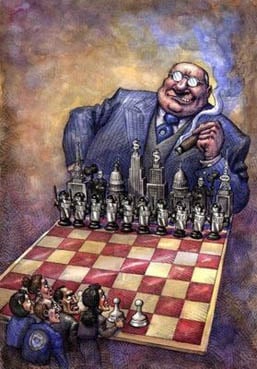


http://www.globalresearch.ca/wp-content/uploads/2013/03/bankster-chess.jpg
Please note that what I am suggesting is a transparent open market for these services provided by a range of enterprises and institutions.  Assemble a marketplace of local credit unions, the post office, enterprises that handle payor-payee transactions such as Dwolla and PayPal, and you have a wide spectrum of choices to suit every need.

As for business loans: you can get small-business loans on PayPal right now. It's called Working Capital, and the borrower is given the total amount due right up front.

As for the commercial paper market: there is no technical reason why a transparent exchange couldn't enable borrowers and owners of capital to set short-term loan rates via transparent bidding with automated software.

The obsolescence of banking includes the Federal Reserve--the ultimate middleman skimming operation. But what about providing liquidity in credit panics? Well, to start with, once the banking sector is gone then the concentrations of risk and the obscuring of risk that go hand in hand with banking also disappear-- the forces that generate panics will have been dispersed. Those forces will have vanished along with the middleman financial sector that created all the risks, speculative excesses and panics. If there were a liquidity crisis, the Treasury could create and lend whatever funds were needed.

But what about manipulating interest rates and other forms of financial repression? Interest rates would be set by millions of borrowers and owners of capital in transparent transactions.

What about all those great investing services offered by big banks and Wall Street? As many have observed, automated index funds outperform 99% of fund managers over 10 year time frames. So Wall Street is also obsolete.

Once we get rid of these obsolete middleman parasites--Wall Street, the banking sector and the Federal Reserve--we have a delightful question to answer:
 what else can we do with the $1.25 trillion we'll save every year by eliminating these obsolete financial middleman parasites? A lot.


http://www.realfarmacy.com/wp-content/uploads/2013/07/bankster.jpg


Why Banks Are Doomed: Technology and Risk


It's not just that banks are no longer needed--they pose a needless and potentially catastrophic risk to the nation. To understand why, we need to understand the key characteristics of risk.


The entire banking sector is based on two illusions:

1. Thanks to modern portfolio management, bank debt is now riskless.

2. Technology only enhances banks' tools to skim profits; it does not undermine the fundamental role of banks.

The global financial meltdown of 2008-09 definitively proved riskless bank debt is an illusion. If you want to understand why risk cannot eliminated, please read Benoit Mandelbrot's book The (Mis)Behavior of Markets.

Technology does not just enable high-frequency trading; it enables capital and borrowers to bypass banks entirely. I addressed this yesterday in Banks Are Obsolete: The Entire Parasitic Sector Can Be Eliminated.

Unfortunately for banks, higher education, buggy whip manufacturers, etc., monopoly and propaganda are no match for technology. Just because a system worked in the past in a specific set of technological constraints does not mean it continues to be a practical solution when those technological constraints dissolve.

The current banking system is essentially based on two 19th century legacies. In that bygone era, banks were a repository of accounting expertise (keeping track of multitudes of accounts, interest, etc.) and risk assessment/management expertise (choosing the lowest-risk borrowers).

Both of these functions are now automated. The funny thing about technology is that those threatened by fundamental improvements in technology attempt to harness it to save their industry from extinction. For example, overpriced colleges now charge thousands of dollars for nearly costless massively open online courses (MOOCs) because they retain a monopoly on accreditation (diplomas). Once students are accredited directly--an advancement enabled by technology--colleges' monopoly disappears and so does their raison d'etre.

The same is true of banks. Now that accounting and risk assessment are automated, and borrowers and owners of capital can exchange funds in transparent digital marketplaces, there is no need for banks. But according to banks, only they have the expertise to create riskless debt.

It's not just that banks are no longer needed--they pose a needless and potentially catastrophic risk to the nation. To understand why, we need to understand the key characteristics of risk.

Moral hazard is what happens when people who make bad decisions suffer no consequences. Once decision-makers offload consequence onto others, they are free to make increasingly risky bets, knowing that they will personally suffer no losses if the bets go bad.

The current banking system is defined by moral hazard. "Too big to fail" also means "too big to jail:" no matter how criminal or risky the bank managements' decisions, the decision-makers not only suffered no consequences, they walked away from the smouldering ruins with tens of millions of dollars in personal wealth.


Absent any consequence, the system created perverse incentives to pyramid risky bets and derivatives to increase profits--a substantial share of which flowed directly into the personal accounts of the managers.

The perfection of moral hazard in the current banking system can be illustrated by what happened to the last CEO of Lehman Brother, Richard Fuld: he walked away from the wreckage with $222 million. This is not an outlier; it is the direct result of a system based on moral hazard, too-big-to-jail and perverse incentives to increase systemic risk for personal gain.

And who picked up all the losses? The American taxpayer. Privatize profits, socialize losses: that's the heart of moral hazard.
 
 http://theflyingcameldotorg.files.wordpress.com/2012/07/bankers-dont-go-to-jail.jpg

Concentrating the ability to leverage stupendous systemic bets in a few hands leads to a concentration of risk. Just before America's financial sector imploded, banks had pyramided $2.5 trillion in dodgy mortgages into derivatives and exotic financial instruments with a face value of $35 trillion--14 times the underlying collateral and more than double the size of the U.S. economy.

In a web-enabled transparent exchange of borrowers bidding for capital, the risk is intrinsically dispersed over millions of participants. Not only is risk dispersed, but the consequences of bad decisions and bad bets fall solely to those who made the decision and the bet. This is the foundation of a sound, stable, fair financial system.

In a transparent marketplace of millions of participants, a handful of participants will be unable to acquire enough profit to capture the political process. The present banking system is not just a financial threat to the nation, it is a political threat because its outsized profits enable bankers to capture the regulatory and governance machinery.


The problem with concentrating leverage and moral hazard is that risk is also concentrated. And when risk is concentrated rather than dispersed, it inevitably breaks out of the "riskless" corral. This is the foundation of my aphorism: Central planning perfects the power of threats to bypass the system's defenses.

We can understand this dynamic with an analogy to bacteria and antibiotics. By attempting to eliminate the risk of infection by flooding the system with antibiotics, central planning actually perfects the search for bacteria that are immune to the antibiotics. These few bacteria will bypass the system's defenses and destroy the system from within.

The banking/financial sector claims to be eliminating risk, but what it's actually doing is perfecting the threats that will destroy the system from within. Another way to understand this is to look at what happened to home mortgages in the runup to the meltdown of 2008: the "safest" part of the financial sector ended up triggering the collapse of the entire pyramid of risk.

Once we concentrate risk and impose perverse incentives and moral hazard as the foundations of our financial/banking system, then we guarantee the risk will explode out of whatever sector is considered "safe."

Once you eliminate the "risk" of weak bacteria, you perfect the threat that will kill the host.

The banking sector cannot be reformed, for its very nature is to concentrate systemic risk and moral hazard into breeding grounds of systemic collapse. The only way to eliminate the threat posed by banks is to eliminate the banks and replace them with transparent exchanges where borrowers and owners of capital openly bid for yield (interest rates) and capital.

Bankers (and their fellow financial parasites) will claim they are essential and the nation will collapse without them. But this is precisely opposite of reality: the very existence of banks threatens the nation and democracy.

One last happy thought: technology cannot be put back in the bottle. The financial/banking sector wants to use technology to increase its middleman skim, but the technology that is already out of the bottle will dismantle the sector as a function of what technology enables: faster, better, cheaper, with greater transparency, fairness and the proper distribution of risk.

There may well be a place for credit unions and community banks in the spectrum of exchanges, but these localized, decentralized enterprises would be unable to amass dangerous concentrations of risk and political influence in a truly transparent and decentralized system of exchanges.


From Of Two Minds @ http://charleshughsmith.blogspot.ro/2014/02/banks-are-obsolete-entire-parasitic.html and http://charleshughsmith.blogspot.ro/2014/02/why-banks-are-doomed-technology-and-risk.html


For more information about the surrealist 'reality' of banking see http://nexusilluminati.blogspot.com/search/label/banksters
- See ‘Older Posts’ at the end of each section


Hope you like this not for profit site -
It takes hours of work every day to maintain, write, edit, research, illustrate and publish this website from a tiny cabin in a remote forest
Like what we do? Please give enough for a meal or drink if you can -  
Donate any amount and receive at least one New Illuminati eBook!
Please click below - 

Xtra Images – http://www.whatdoesitmean.com/bro3.jpg
 http://www.globalresearch.ca/wp-content/uploads/2013/03/bankster-chess.jpg
http://www.realfarmacy.com/wp-content/uploads/2013/07/bankster.jpg
http://theflyingcameldotorg.files.wordpress.com/2012/07/bankers-dont-go-to-jail.jpg


For further enlightening information enter a word or phrase into the random synchronistic search box @ http://nexusilluminati.blogspot.com


And see


 New Illuminati on Facebook - https://www.facebook.com/the.new.illuminati

New Illuminati Youtube Channel - http://www.youtube.com/user/newilluminati/feed


New Illuminati on Twitter @ www.twitter.com/new_illuminati


The Her(m)etic Hermit - http://hermetic.blog.com


The Prince of Centraxis - http://centraxis.blogspot.com (Be Aware! This link leads to implicate & xplicit concepts & images!)


DISGRUNTLED SITE ADMINS PLEASE NOTE –
We provide a live link to your original material on your site (and links via social networking services) - which raises your ranking on search engines and helps spread your info further! This site is published under Creative Commons Fair Use Copyright (unless an individual article or other item is declared otherwise by the copyright holder) – reproduction for non-profit use is permitted & encouraged, if you give attribution to the work & author - and please include a (preferably active) link to the original (along with this or a similar notice).

Feel free to make non-commercial hard (printed) or software copies or mirror sites - you never know how long something will stay glued to the web – but remember attribution! If you like what you see, please send a donation (no amount is too small or too large) or leave a comment – and thanks for reading this far…

Live long and prosper! Together we can create the best of all possible worlds…


From the New Illuminati – http://nexusilluminati.blogspot.com
 

Sunday, 27 June 2010

LESSONS FROM THE WIZARD OF OZ: The Web of Debt

LESSONS FROM THE WIZARD OF OZ

The Web of Debt

by Ellen Brown

http://polytricks.files.wordpress.com/2008/09/webofdebt.jpg

"The great Oz as spoken! Pay no attention to that man behind the curtain! I am the great and powerful Wizard of Oz!"
In refreshing contrast to the impenetrable writings of economists, the classic fairytale The Wizard of Oz has delighted young and old for over a century. It was first published by L. Frank Baum as The Wonderful Wizard of Oz in 1900. In 1939, it was made into a hit Hollywood movie starring Judy Garland, and later it was made into the popular stage play The Wiz.
Few of the millions who have enjoyed this charming tale have suspected that its imagery was drawn from that most obscure and tedious of subjects, banking and finance. Fewer still have suspected that the real-life folk heroes who inspired its plot may have had the answer to the financial crisis facing the country today!
The economic allusions in Baum's tale were first observed in 1964 by a schoolteacher named Henry Littlefield, who called the story "a parable on Populism," referring to the People's Party movement challenging the banking monopoly in the late nineteenth century.1 Other analysts later picked up the theme. Economist Hugh Rockoff, writing in the Journal of Political Economy in 1990, called the story a "monetary allegory."2 Professor Tim Ziaukas, writing in 1998, stated:
"The Wizard of Oz"... was written at a time when American society was consumed by the debate over the "financial question," that is, the creation and circulation of money... The characters of "The Wizard of Oz" represented those deeply involved in the debate: the Scarecrow as the farmers, the Tin Woodman as the industrial workers, the Lion as silver advocate William Jennings Bryan and Dorothy as the archetypal American girl.3

[T]here was once a time in history when people acted... [F]armers were trapped in debt. They were the most oppressed of Americans, they experimented with cooperative purchasing and marketing, they tried to find their own way out of the strangle hold of debt to merchants, but none of this could work if they couldn't get capital. So they had to turn to politics, and they had to organize themselves into a party... [T]he populists didn't just organize a political party, they made a movement. They had picnics and parties and newsletters and classes and courses, and they taught themselves, and they taught each other, and they became a group of people with a sense of purpose, a group of people with courage, a group of people with dignity.6
Like the Populists, Dorothy and her troop discovered that they had the power to solve their own problems and achieve their own dreams. The Scarecrow in search of a brain, the Tin Man in search of a heart, the Lion in search of courage actually had what they wanted all along. When the Wizard's false magic proved powerless, the Wicked Witch was vanquished by a defenseless young girl and her little dog. When the Wizard disappeared in his hot air balloon, the unlettered Scarecrow took over as leader of Oz.
The Wizard of Oz came to embody the American dream and the American national spirit. In the United States, the land of abundance, all you had to do was to realize your potential and manifest it. That was one of the tale's morals, but it also contained a darker one, a message for which its imagery has become a familiar metaphor: that there are invisible puppeteers pulling the strings of the puppets we see on the stage, in a show that is largely illusion.

Dorothys_Debt_web.jpg image by franciscoalf
Money in the Land of Oz
The 1890s were plagued by an economic depression that was nearly as severe as the Great Depression of the 1930s. The farmers lived like serfs to the bankers, having mortgaged their farms, their equipment, and sometimes even the seeds they needed for planting. They were charged so much by a railroad cartel for shipping their products to market that they could have more costs and debts than profits.
The farmers were as ignorant as the Scarecrow of banking policies; while in the cities, unemployed factory workers were as frozen as the Tin Woodman from the lack of a free-flowing supply of money to "oil" the wheels of industry. In the early 1890s, unemployment had reached 20 percent. The crime rate soared, families were torn apart, racial tensions boiled. The nation was in chaos. Radical party politics thrived.
In every presidential election between 1872 and 1896, there was a third national party running on a platform of financial reform. Typically organized under the auspices of labor or farmer organizations, these were parties of the people rather than the banks. They included the Populist Party, the Greenback and Greenback Labor Parties, the Labor Reform Party, the Antimonopolist Party, and the Union Labor Party. They advocated expanding the national currency to meet the needs of trade, reform of the banking system, and democratic control of the financial system.7
Money reform advocates today tend to argue that the solution to the country's financial woes is to return to the "gold standard," which required that paper money be backed by a certain weight of gold bullion. But to the farmers and laborers who were suffering under its yoke in the 1890s, the gold standard was the problem. They had been there and done it and knew it didn't work.
William Jennings Bryan called the bankers' private gold-based money a "cross of gold." There was simply not enough gold available to finance the needs of an expanding economy. The bankers made loans in notes backed by gold and required repayment in notes backed by gold; but the bankers controlled the gold, and its price was subject to manipulation by speculators. Gold's price had increased over the course of the century, while the prices laborers got for their wares had dropped. People short of gold had to borrow from the bankers, who periodically contracted the money supply by calling in loans and raising interest rates. The result was "tight" money – insufficient money to go around. Like in a game of musical chairs, the people who came up short wound up losing their homes to the banks.
The solution of Jacob Coxey and his Industrial Army of destitute unemployed men was to augment the money supply with government-issued United States Notes. Popularly called "Greenbacks," these federal dollars were first issued by President Lincoln when he was faced with usurious interest rates in the 1860s. Lincoln had foiled the bankers by funding the government with U.S. Notes that did not accrue interest and did not have to be paid back to the banks.
The same sort of debt-free paper money had financed a long period of colonial abundance in the eighteenth century, until King George forbade the colonies from issuing their own currency. The money supply had then shrunk, precipitating a depression that led to the American Revolution.
To remedy the tight-money problem that resulted when the Greenbacks were halted after Lincoln's assassination, Coxey proposed that Congress should increase the money supply with a further $500 million in Greenbacks. This new money would be used to redeem the federal debt and to stimulate the economy by putting the unemployed to work on public projects.8 The bankers countered that allowing the government to issue money would be dangerously inflationary.
What they failed to reveal was that their own paper banknotes were themselves highly inflationary, since the same gold was "lent" many times over, effectively counterfeiting it; and when the bankers lent their paper money to the government, the government wound up heavily in debt for something it could have created itself. But those facts were buried in confusing rhetoric, and the bankers' "gold standard" won the day.
 http://www.sott.net/image/image/s1/21717/full/Web_of_debt_hyperinflation.jpg

The Silver Slippers: The Populist Solution
to the Money Question

The Greenback Party was later absorbed into the Populist Party, which took up the cause against tight money in the 1890s. Like the Greenbackers, the Populists argued that money should be issued by the government rather than by private banks. William Jennings Bryan, the Populists' loquacious leader, gave such a stirring speech at the Democratic convention that he won the Democratic nomination for President in 1896. Outgoing President Grover Cleveland was also a Democrat, but he was an agent of J. P. Morgan and the Wall Street banking interests. Cleveland favored money that was issued by the banks, and he backed the bankers' gold standard. Bryan was opposed to both. He argued in his winning nomination speech:
We say in our platform that we believe that the right to coin money and issue money is a function of government. . . . Those who are opposed to this proposition tell us that the issue of paper money is a function of the bank and that the government ought to go out of the banking business. I stand with Jefferson . . . and tell them, as he did, that the issue of money is a function of the government and that the banks should go out of the governing business. . . . [W]hen we have restored the money of the Constitution, all other necessary reforms will be possible, and . . . until that is done there is no reform that can be accomplished.
He concluded with these famous lines:
You shall not press down upon the brow of labor this crown of thorns, you shall not crucify mankind upon a cross of gold.9
Since the Greenbackers' push for government-issued paper money had failed, Bryan and the "Silverites" proposed solving the liquidity problem in another way. The money supply could be supplemented with coins made of silver, a precious metal that was cheaper and more readily available than gold. Silver was considered to be "the money of the Constitution" although the Constitution only referred to the "dollar," because the dollar was understood to be a reference to the Spanish milled silver dollar coin then in common use. The slogan of the Silverites was "16 to 1": 16 ounces of silver would be the monetary equivalent of 1 ounce of gold. Ounces is abbreviated oz, hence "Oz." The Wizard of the Gold Ounce (Oz) in Washington was identified by later commentators as Marcus Hanna, the power behind the Republican Party, who controlled the mechanisms of finance in the administration of President William McKinley.10 (Hanna was reportedly admired by Karl Rove, who followed the model as political adviser to President George Bush Jr.11)
Frank Baum, the journalist who turned the politics of his day into The Wonderful Wizard of Oz, marched with the Populist Party in support of Bryan in 1896. He is said to have had a deep distrust of big-city financiers. But when his dry goods business failed, he bought a Republican newspaper, which had to have a Republican message to retain its readership.12 That may have been why the Populist message was so deeply buried in symbolism in his famous fairytale. Like Lewis Carroll, who began his career writing uninspiring tracts about mathematics and politics and wound up satirizing Victorian society in Alice's Adventures in Wonderland,
Baum was able to suggest in a children's story what he could not say in his editorials. His book contained many subtle allusions to the political and financial issues of the day. The story's inspirational message was evidently a product of the times as well. Commentators trace it to the theosophical movement, of which Baum was an active member.13 Newly-imported from India, it held that reality is a construct of the mind. What you want is already yours; you need only to believe it, to "realize" it or "make it real."
Looking at the plot of this familiar fairytale, then, through the lens of the contemporary movements that inspired it..

An Allegory of Money, Politics
and Believing in Yourself
The story began on a barren Kansas farm, where Dorothy lived with a very sober aunt and uncle who "never laughed" (the 1890s depression that hit the farmers particularly hard). A cyclone came up, carrying Dorothy and the house into the magical world of Oz (the American dream that might have been). The house landed on the Wicked Witch of the East (the Wall Street bankers and their man Grover Cleveland), who had kept the Munchkins (the farmers and factory workers) in bondage for many years.
For killing the Wicked Witch, Dorothy was awarded magic silver slippers (the Populist silver solution to the money crisis) by the Good Witch of the North (the North was then a Populist stronghold). In the 1939 film, the silver slippers would be transformed into ruby slippers to show off the cinema's new technicolor abilities; but the monetary imagery Baum suggested was lost. The silver shoes had the magic power to solve Dorothy's dilemma, just as the Silverites thought that expanding the money supply with silver coins would solve the problems facing the farmers.
Dorothy wanted to get back to Kansas but was unaware of the power of the slippers on her feet, so she set out to the Emerald City to seek help from the Wizard of Oz (the apparently all-powerful President, whose strings were actually pulled by financiers concealed behind a curtain).
"The road to the City of Emeralds is paved with yellow brick," she was told, "so you cannot miss it." Baum's contemporary audience, wrote Professor Ziaukas, could not miss it either, as an allusion to the gold standard that was then a hot topic of debate.14 Like the Emerald City and the Great and Powerful Oz himself, the yellow brick road would turn out to be an illusion. In the end, what would carry Dorothy home were silver slippers.
On her journey down the yellow brick road, Dorothy was first joined by the Scarecrow in search of a brain (the naive but intelligent farmer kept in the dark about the government's financial policies), then by the Tin Woodman in search of a heart (the factory worker frozen by unemployment and dehumanized by mechanization). Littlefield commented:
The Tin Woodman . . . had been put under a spell by the Witch of the East. Once an independent and hard working human being, the Woodman found that each time he swung his axe it chopped off a different part of his body. Knowing no other trade he "worked harder than ever," for luckily in Oz tinsmiths can repair such things. Soon the Woodman was all tin. In this way Eastern witchcraft dehumanized a simple laborer so that the faster and better he worked the more quickly he became a kind of machine. Here is a Populist view of evil Eastern influences on honest labor which could hardly be more pointed.
The Eastern witchcraft that had caused the Woodman to chop off parts of his own body reflected the dark magic of the Wall Street bankers, whose "gold standard" allowed less money into the system than was collectively owed to the banks, causing the assets of the laboring classes to be systematically devoured by debt.
The fourth petitioner to join the march on Oz was the Lion in search of courage. According to Littlefield, he represented the orator Bryan himself, whose roar was mighty like the king of the forest but who lacked political power. Bryan was branded a coward by his opponents because he was a pacifist and anti-imperialist at a time of American expansion in Asia. The Lion became entranced and fell asleep in the Witch's poppy field, suggesting Bryan's tendency to get side-tracked with issues of American imperialism stemming from the Opium Wars. Since Bryan led the "Populist" or "People's" Party, the Lion also represented the people, collectively powerful but entranced and unaware of their strength.
In the Emerald City, the people were required to wear green-colored glasses attached by a gold buckle, suggesting green paper money shackled to the gold standard. To get to her room in the Emerald Palace, Dorothy had to go through 7 passages and up 3 flights of stairs, an allusion to the "Crime of '73," the congressional Act that changed the money system from bimetallism (paper notes backed by both gold and silver) to an exclusive gold standard. The Crime of '73 proved to all Populists that Congress and the bankers were in collusion.15
Dorothy and her troop presented their requests to the Wizard, who demanded that they first vanquish the Wicked Witch of the West, representing the McKinley/Rockefeller faction in Ohio (then considered a Western state). The financial powers of the day were the Morgan/Wall Street/Cleveland faction in the East (the Wicked Witch of the East) and this Rockefeller-backed contingent from Ohio, the state of McKinley, Hanna, and Rockefeller's Standard Oil cartel. Hanna was an industrialist who was a high school friend of John D. Rockefeller and had the financial backing of the oil giant.16
Dorothy and her friends learned that the Witch of the West had enslaved the Yellow Winkies and the Winged Monkeys (an allusion to the Chinese immigrants working on the Union-Pacific railroad, the native Americans banished from the northern woods, and the Filipinos denied independence by McKinley). Dorothy destroyed the Witch by melting her with a bucket of water, suggesting the rain that would reverse the drought, and the financial liquidity that the Populist solution would bring to the land. As one nineteenth century commentator put it, "Money and debt are as opposite in nature as fire and water; money extinguishes debt as water extinguishes fire."17
When Dorothy and her troop got lost in the forest, she was told to call the Winged Monkeys by using a Golden Cap she had found in the Witch's cupboard. When the Winged Monkeys came, their leader explained that they were once a free and happy people; but they were now "three times the slaves of the owner of the Golden Cap, whosoever he may be" (the bankers and their gold standard). When the Golden Cap fell into the hands of the Wicked Witch of the West, the Witch had made them enslave the Winkies and drive Oz himself from the Land of the West.
Dorothy used the power of the Cap to have her band of pilgrims flown to the Emerald City, where they discovered that the "Wizard" was only a smoke and mirrors illusion operated by a little man behind a curtain. A dispossessed Nebraska man himself, he admitted to being a "humbug" without real power. "One of my greatest fears was the Witches," he said, "for while I had no magical powers at all I soon found out that the Witches were really able to do wonderful things."
If the Wizard and his puppet were Marcus Hanna and William McKinley, who were the Witches they feared? Behind the Wall Street bankers were powerful British financiers, who funded the Confederates in the Civil War and had been trying to divide and conquer America economically for over a century. Patriotic Americans had regarded the British as the enemy ever since the American Revolution. McKinley was a protectionist who favored high tariffs to keep these marauding British free-traders out. When he was assassinated in 1901, no conspiracy was proved; but some suspicious commentators saw the invisible hand of British high finance at work.18
The Wizard lacked magical powers but was a very good psychologist, who showed the petitioners that they had the power to solve their own problems and manifest their own dreams. The Scarecrow just needed a paper diploma to realize he had a brain. For the Tin Woodman, it was a silk heart; for the Lion, an elixir for courage. The Wizard offered to take Dorothy back to Kansas in his hot air balloon, but the balloon took off before she could get on board. Dorothy and her friends then set out to find Glinda the Good Witch of the South, who they were told could help Dorothy find her way home.
On the way they faced various challenges, including a great spider that ate everything in its path and kept everyone unsafe as long as it was alive. The Lion (the Populist leader Bryan) welcomed this chance to test his new-found courage and prove he was indeed the King of Beasts. He decapitated the mighty spider with his paw, just as Bryan would have toppled the banking cartel if he had won the Presidency.
The group finally reached Glinda, who revealed that Dorothy too had the magic tokens she needed all along: the Silver Shoes on her feet would take her home. But first, said Glinda, Dorothy must give up the Golden Cap (the bankers' restrictive gold standard that had enslaved the people).
The moral also worked for the nation itself. The economy was deep in depression, but the country's farmlands were still fertile and its factories were ready to roll. Its entranced people merely lacked the paper tokens called "money" that would facilitate production and trade. The people had been deluded into a belief in scarcity by defining their wealth in terms of a scarce commodity, gold. The country's true wealth consisted of its goods and services, its resources and the creativity of its people. Like the Tin Woodman in need of oil, all it needed was a monetary medium that would allow this wealth to flow freely, circulating from the government to the people and back again, without being perpetually drained into the private coffers of the bankers.
 https://blogger.googleusercontent.com/img/b/R29vZ2xl/AVvXsEhm5gR0ZZwZpLihZBPC8v4hrlk8ujvz8tZ4yWdJrR3Rl6LDFuFZ7bNUD9OX1xBsL12dmwmRrSzb-NqT81_TQp0e6DOjdi4cv4CHYcqwvsWJOB1ar0e4s28qmHNPUzoasOqsfTbZxeVfNEY/s400/debt-star.jpg

Sequel to Oz

The Populists did not achieve their goals, but they did prove that a third party could influence national politics and generate legislation. Although Bryan the Lion failed to stop the bankers, Dorothy's prototype Jacob Coxey was still on the march. In a plot twist that would be considered contrived if it were fiction, he reappeared on the scene in the 1930s to run against Franklin D. Roosevelt for President, at a time when the "money question" had again become a burning issue. In one five-year period, over 2,000 schemes for monetary reform were advanced.
Needless to say, Coxey lost the election; but he claimed that his Greenback proposal was the model for the "New Deal," Roosevelt's plan for putting the unemployed to work on government projects to pull the country out of the Depression. The difference was that Coxey's plan would have been funded with debt-free currency issued by the government, on Lincoln's Greenback model. Roosevelt funded the New Deal with borrowed money, indebting the country to a banking cartel that was surreptitiously creating the money out of thin air, just as the government itself would have been doing under Coxey's plan without accruing a crippling debt to the banks.
After World War II, the money question faded into obscurity. Today, writes British economist Michael Rowbotham, "The surest way to ruin a promising career in economics, whether professional or academic, is to venture into the 'cranks and crackpots' world of suggestions for reform of the financial system."19 Yet the claims of these cranks and crackpots have consistently proven to be correct. The U.S. debt burden has mushroomed out of control, until just the interest on the federal debt now threatens to be a greater tax burden than the taxpayers can afford. The gold standard precipitated the problem, but unbuckling the dollar from gold did not solve it. Rather, it caused worse financial ills.
Expanding the money supply with increasing amounts of "easy" bank credit just put increasing amounts of money in the bankers' pockets, while consumers sank further into debt. The problem proved to be something more fundamental: it was in who extended the nation's credit. As long as the money supply was created as a debt owed back to private banks with interest, the nation's wealth would continue to be drained off into private vaults, leaving scarcity in its wake.
Today's monetary allegory goes something like this: the dollar is a national resource that belongs to the people. It was an original invention of the early American colonists, a new form of paper currency backed by the "full faith and credit" of the people. But a private banking cartel has taken over its issuance, turning debt into money and demanding that it be paid back with interest. Taxes and a crushing federal debt have been imposed by a financial ruling class that keeps the people entranced and enslaved.
In the happy storybook ending to the tale, the power to create money is returned to the people, and abundance returns to the land. But before we get there, the Yellow Brick Road takes us through the twists and turns of history and the writings and insights of a wealth of key players. We're off to see the Wizard...

From Web of Debt - http://www.webofdebt.com/


Help This Unique Independent Site Survive
Donate any amount and receive at least one New Illuminati eBook!
Just click in the jar - 


Images -
  http://polytricks.files.wordpress.com/2008/09/webofdebt.jpg http://media.photobucket.com/image/web%20of%20debt/franciscoalf/Dorothys_Debt_web.jpg
http://www.sott.net/image/image/s1/21717/full/Web_of_debt_hyperinflation.jpg
https://blogger.googleusercontent.com/img/b/R29vZ2xl/AVvXsEhm5gR0ZZwZpLihZBPC8v4hrlk8ujvz8tZ4yWdJrR3Rl6LDFuFZ7bNUD9OX1xBsL12dmwmRrSzb-NqT81_TQp0e6DOjdi4cv4CHYcqwvsWJOB1ar0e4s28qmHNPUzoasOqsfTbZxeVfNEY/s400/debt-star.jpg

For further enlightenment see –

The Her(m)etic Hermit - http://hermetic.blog.com


This material is published under Creative Commons Copyright (unless an individual item is declared otherwise by copyright holder) – reproduction for non-profit use is permitted & encouraged, if you give attribution to the work & author - and please include a (preferably active) link to the original along with this notice. Feel free to make non-commercial hard (printed) or software copies or mirror sites - you never know how long something will stay glued to the web – but remember attribution! If you like what you see, please send a tiny donation or leave a comment – and thanks for reading this far…

From the New Illuminati – http://nexusilluminati.blogspot.com