"All the World's a Stage We Pass Through" – R. Ayana

Showing posts with label ether. Show all posts

Thursday, 21 January 2016

Did This Scientist Just Discover How the Universe Works?


Did This Scientist Just Discover How the Universe Works?
Source of Gravity Defined in Quantized Ether?

ether-gravity-universe-


Throughout the history of modern physics, scientists have theorized about the existence of “dark energy” or “ether,” a substance that, if it exists, envelops and fills everything – all space and all reality. Ether has often been theorized to be the substance which is the conduit for the life-giving force of the universe.

Yet physicists throughout the years have argued about this concept without ever reaching a consensus even regarding its existence, much less its makeup or nature. Those who argue in favor of the existence of this “ether” run into the problem of a lack of an ability to “quantize” it. Those who argue against it run into the problem of the conventional mainstream understanding of physics which is unable to account for many aspects of reality – both quantum and physical.

In an unpublished paper entitled “Man’s Greatest Achievement,” Nikola Tesla described the concept of ether by writing,

Long ago he (mankind) recognized that all perceptible matter comes from a primary substance, or tenuity beyond conception, filling all space, the Akasha or luminiferous ether, acted upon by the life giving Prana or creative force, calling into existence, in never ending cycles all things and phenomena. The primary substance, thrown into infinitesimal whirls of prodigious velocity, becomes gross matter; the force subsiding, the motion ceases and matter disappears, reverting to the primary substance.

If philosopher, chemist, and biophysicist Francis V. Fernandes’ equations are correct, however, we may be at the cusp of a scientific breakthrough that will change the face of the world of physics and the world in which we live. This is because Fernandes claims that he has in fact quantized the mass of ether.


2016-01-05_1557


If Fernandes’ calculations are correct, this changes the entire ball game. He himself states that, once the mass of ether is known, solving a number of “unknowns” in the world of physics becomes relatively simple. The question of gravity, relativity, magnetism, and, indeed, energy itself becomes answerable.

Thus, Fernandes says that he went on to solve tens of equations and was likewise able to solve tens of unresolved questions within the field of physics.

For instance, the question of gravity and relativity, according to Fernandes, once the mass of ether is known, can itself be solved. Fernandes suggests the equation below does just that,


mearth


But what are the questions surrounding gravity and general relativity?


The Question At Hand


Marianne Freiberger, in her article “Problems Of Gravity,” sums up the lack of consensus on these principles by writing the following:

“General relativity correctly describes what we observe at the scale of the solar system,” reassures Constantinos Skordis, of The Universities of Nottingham and Cyprus. “It all works beautifully at this scale and it has been tested.” The problems arise when you look at the Universe at very small or at very large scales.

At the turn of the twentieth century people realised that at very small scales, in the realm of atomic and sub-atomic particles, the world looked very different from what they had expected. The theory of quantum mechanics grew out of that realisation and posed a new challenge: the descriptions of the fundamental forces of nature now had to be adapted to the new quantum mechanical insights — they had to quantised (see Schrödinger’s equation — what is it? and Let me take you down cos we’re going to .. quantum fields).

The problem is that general relativity stubbornly refuses to comply in this undertaking. “Einstein’s theory cannot be easily quantised; we can’t find a quantum counterpart in the same way as we found one for electromagnetism,” explains Thomas Sotiriou of the University of Nottingham. In fact, the problem of finding a quantum theory of gravity is so challenging, and so important, many consider it the holy grail of modern physics.

Another mystery arises when you look at the Universe as a whole. Since 1929 physicists have known that the Universe is expanding, a fact that came as a shock even to Einstein: stars and galaxies are moving away from each other. Nearly 70 years later, in the 1990s, observations of far away objects also showed that this expansion is speeding up. General relativity cannot explain what causes this acceleration. If we believe the theory, then we must concede that there is something else out there, a mysterious form of energy which drives the acceleration. That something has been dubbed dark energy.

“Dark energy is bizarre,” says Skordis. “It’s not a particle, you can’t detect it in the lab. It’s just a missing form of energy which must have some peculiar properties. For example, it must exert negative pressure, which is what drives accelerated expansion. We just don’t know what causes it.” (See here for more on dark energy.)
Quantum physics offers one explanation for dark energy. According to this theory, the vacuum does not really exist in the sense we usually understand it, as empty space. Instead, particles constantly pop in and out of existence, resulting in avacuum energy, an energy of space itself, which might be driving the accelerated expansion. There’s a number which measures that vacuum energy, called the cosmological constant, whose value particle physicists can estimate. The trouble is that this estimated value is bigger than what observations suggest. And not just a bit: the two values, observed and theoretical, differ by at least 60 orders of magnitude (see this article for more). Although the estimate stemming from quantum physics is rough and perhaps naive, the difference is so big that something is clearly, very wrong.

These problems, dark energy and the need to quantize gravity, provide some of the motivations for meddling with general relativity. And perhaps they are even connected. “The very large and the very small [scale problems] are not necessarily distinct,” says Sotiriou. “It is technically very challenging, but not inconceivable that one could have an extension of general relativity that deals with the large scale problems, which would at the same time have a better behaviour when it comes to quantization. Maybe we can hit two birds with one stone.”

But how does one go about finding such an extension of general relativity?


The Answers?


Fernandes suggests his quantization of ether and his equation below helps answer these questions,
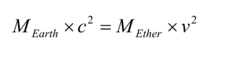

mearth2
fernandes


So how did Fernandes arrive at his conclusion? He provides the following information:


Gravity of Earth is Acceleration of Ether

Francis V Fernandes
Dec 2000

Leap of Imagination:


Gravitation energy or force is believed to be weak and nowhere in magnitude to the electric force. I assumed the energy of gravity to be equal to that of the electric energy.

Energy calculated by Newton’s gravitation equation is the same as energy calculated by Coulomb’s electric equation.
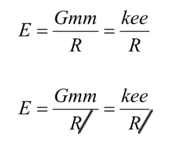
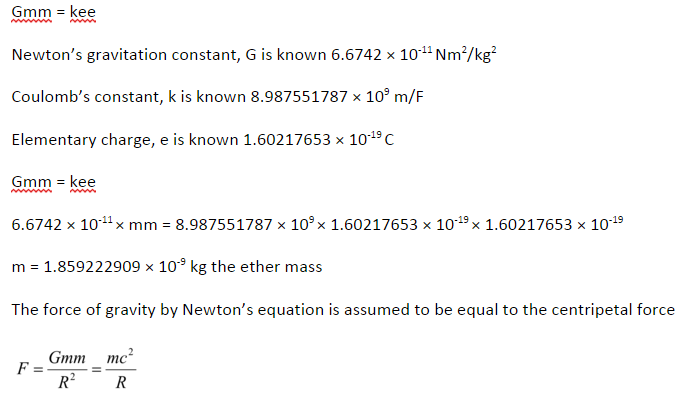
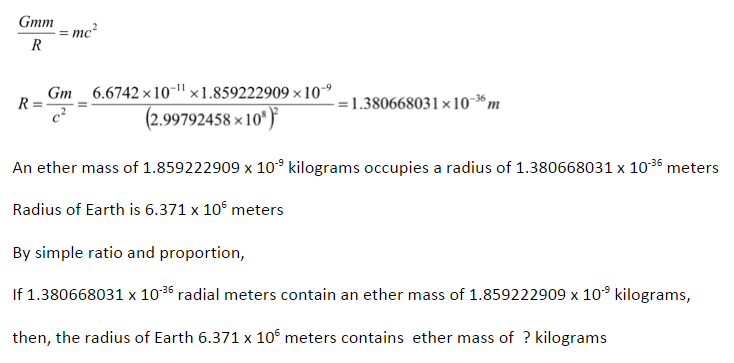
2016-01-05_1630

 
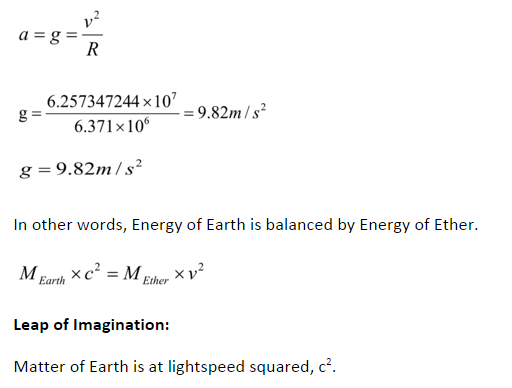
Acceleration due to Earth’s gravity,
2016-01-05_1632

 
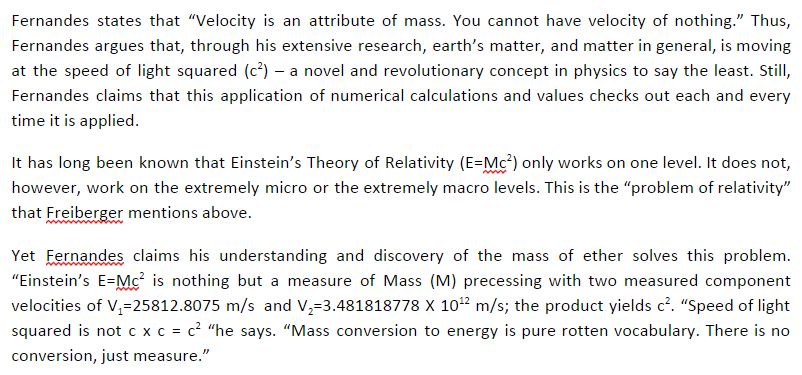
Back to the question of the speed at which we, the Earth, and matter in general is moving, Fernandes suggests that we/matter are all moving at the speed of light squared.

Fernandes states “I have shown that my discovery of 186-ether is the lower pulsate limit of the Planck mass. Planck actually derived an ether mass. The Planck length times the ether constant ratio K yields the Planck mass. Hence, the Planck mass is an ether mass.”

He continues, “Matter is at the speed of light squared as seen in the matter of earth below. And mass is ether mass on the right side of the equation.”

He continues:

Charge and Gravity unify at 186-ether

Elementary charge, e=186-ether


K


The ether distribution to the power of 27 zeros in kilograms per radial meter holds good at the atomic and galactic scales.

Fernandes concludes that “Acceleration due to ether is gravity.”


new

He writes,

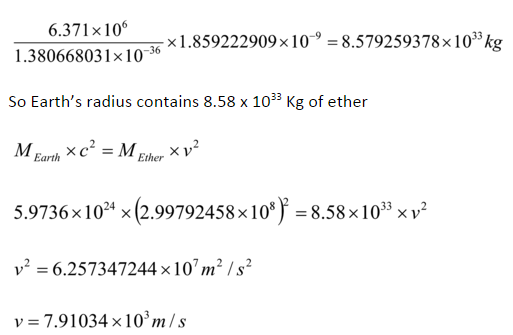
Mass of Earth, speed of light and tangential velocity squared are known quantities.

Mass of something is the missing entity. This missing hidden entity is the mass of ether.

Mass of Earth is at the speed of light squared whereas Mass of Ether is at slowed velocity squared.

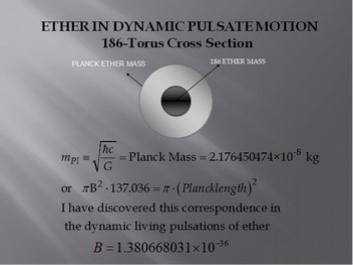
 

12483427_1083575961676137_1917244125_n


As depicted above the ether radius is the lower pulsate limit of the Planck length.

Yes, at the heart of the Universe is ether in dynamic pulsate motion by a factor of the Inverse Hand of God alpha number 137.036


Conclusion


The mainstream physics community will no doubt immediately scoff at Fernandes’ claims. However, mainstream communities often scoff at “fringe” declarations until those “fringe” claims eventually become mainstream themselves.

Regardless of how Fernandes’ claims will be received, it is important, for the sake of human civilization and the possibility of greater scientific development that his claims be seriously looked at and that his figures be put to the test.

Fernandes, for his part, is willing for his claims to be put to the test and for his figures to be challenged. He seems to welcome it, so sure he is of the outcome.

If he is right, his work will be some of the most groundbreaking physics related breakthroughs in modern times. We owe it to ourselves to look further into it.

What do you think? Do you have a physics background? Do Fernandes’ equations have merit?


Brandon Turbeville – article archive here – is the author of six books, Codex Alimentarius — The End of Health Freedom, 7 Real Conspiracies, Five Sense Solutions and Dispatches From a Dissident, volume 1 and volume 2, The Road to Damascus: The Anglo-American Assault on Syria, and The Difference it Makes: 36 Reasons Why Hillary Clinton Should Never Be President. Turbeville has published over 500 articles dealing on a wide variety of subjects including health, economics, government corruption, and civil liberties. Brandon Turbeville’s podcast Truth on The Tracks can be found every Monday night 9 pm EST at UCYTV. He is available for radio and TV interviews. Please contact activistpost (at) gmail.com.


- Scroll down through ‘Older Posts’ at the end of each section


Hope you like this not for profit site -
It takes hours of work every day by a genuinely incapacitated invalid to maintain, write, edit, research, illustrate and publish this website from a tiny cabin in a remote forest
Like what we do? Please give anything you can -  
Contribute any amount and receive at least one New Illuminati eBook!
(You can use a card securely if you don’t use Paypal)
Please click below -


Spare Bitcoin change?


For further enlightening information enter a word or phrase into the random synchronistic search box @ the top left of http://nexusilluminati.blogspot.com


And see


 New Illuminati on Facebook - https://www.facebook.com/the.new.illuminati

New Illuminati Youtube Channel -  https://www.youtube.com/user/newilluminati/playlists

New Illuminati’s OWN Youtube Videos -  
New Illuminati on Google+ @ For New Illuminati posts - https://plus.google.com/u/0/+RamAyana0/posts

New Illuminati on Twitter @ www.twitter.com/new_illuminati


New Illuminations –Art(icles) by R. Ayana @ http://newilluminations.blogspot.com

The Her(m)etic Hermit - http://hermetic.blog.com


DISGRUNTLED SITE ADMINS PLEASE NOTE –
We provide a live link to your original material on your site (and links via social networking services) - which raises your ranking on search engines and helps spread your info further!

This site is published under Creative Commons (Attribution) CopyRIGHT (unless an individual article or other item is declared otherwise by the copyright holder). Reproduction for non-profit use is permitted & encouraged - if you give attribution to the work & author and include all links in the original (along with this or a similar notice).

Feel free to make non-commercial hard (printed) or software copies or mirror sites - you never know how long something will stay glued to the web – but remember attribution!

If you like what you see, please send a donation (no amount is too small or too large) or leave a comment – and thanks for reading this far…

Live long and prosper! Together we can create the best of all possible worlds…


From the New Illuminati – http://nexusilluminati.blogspot.com

Tuesday, 29 March 2011

Alternative Models & the Ether: The Farce of Modern Physics

Alternative Models and the Ether
 The Farce of Modern Physics
by David Pratt


In modern physics subatomic particles are variously described as zero-dimensional points, one-dimensional strings, two-dimensional spacetime ribbon-tape, wave functions, or packets of probability waves. All of these are mathematical abstractions. Some of the equations associated with these concepts may be useful, but the theories concerned do not provide a realistic model of what particles are and why they have particular properties.

Clearly they must be finite, three-dimensional entities, and composed of something, i.e. energy-substance of some kind. They must have structure and be capable of deforming (i.e. changing size and shape) otherwise they would be unable to absorb, emit, or exchange energy with other particles. The standard model of particle physics is inadequate because it is no more than a mathematical model. A few examples of alternative models are outlined below.

Eric Lerner has suggested that particles may be vortices in a fluid medium. He points out that plasma – a magnetized fluid – forms particlelike structures (plasmoids) ranging in size from thousands of a millimetre to light-years. As mentioned in section 2, experiments with spin-aligned protons imply that protons are a kind of vortex. 

Plasmoid vortices interact far more strongly when they are spinning in the same direction, and because vortex behaviour would become evident only in near-collisions, the effects should be more pronounced at higher energies and in more head-on interactions. Experimental results confirm this, whereas the broken-symmetry approach favoured by mainstream physics predicts that the opposite should happen at higher energies. Lerner adds: ‘Particles act as if they have a “handedness,” and the simplest dynamic process or object that exhibits an inherent orientation is a vortex. Moreover, right- and left-handed vortices annihilate each other, just as particles and antiparticles do.’1

The idea of reality being formed out of vortices was put forward by Anaxagoras 2500 years ago, and was championed by Descartes in the 17th century. In the late 19th century, some scientists proposed that atoms might be vortices in an underlying etheric medium, which was also widely invoked to explain the transmission of forces and light waves. In the early 20th century, the ether went out of fashion among mainstream scientists, and was replaced with (curved) empty space containing a variety of ‘fields’. 

It should be noted that the famous Michelson-Morley experiment of 1887 did not disprove the existence of an ether. It failed to detect a variation in the speed of light caused by the earth’s motion through a hypothetical stationary ether. 

In 1905 Einstein dismissed the ether as ‘superfluous’, as light could be understood as consisting of particles (photons) rather than waves propagating through a medium. Later he introduced the notion of a ‘gravitational ether’, but he reduced it to an empty abstraction by denying it any energetic properties. Later still, he abandoned the term ‘ether’ altogether.2 However, numerous individual scientists have continued to develop ether-based models.
Such models are already ‘unified’ in the sense that physical matter and forces are derived from the activity of the underlying etheric medium.

As already mentioned [see link at end of article - Ed], some physicists speak of a ‘quantum ether’. This refers to two things: 1) the zero-point field (ZPF), i.e. fluctuating electromagnetic radiation fields produced by random quantum fluctuations that, according to quantum theory, persist even at a temperature of absolute zero (-273°C); 2) innumerable pairs of short-lived ‘virtual’ particles (such as electrons and positrons), sometimes called the ‘Dirac sea’. 

Formally, every point of space should contain an infinite amount of zero-point energy. By assuming a minimum wavelength of electromagnetic vibrations, the energy density of the ‘quantum vacuum’ has been reduced to the still astronomical figure of 10108 joules per cubic centimetre. 

Although various experimental results are widely interpreted as consistent with the existence of zero-point energy, further work is needed to test the theory and alternative explanations. Some scientists have theorized that mass, inertia, and gravity are all connected with the fluctuating electromagnetic energy of the ZPF. 

However, the ZPF itself is usually regarded as the product of matter-energy, which supposedly originated in the ‘big bang’, whereas modern ether theories generally hold that physical matter crystallizes out of or dissolves back into the preexisting ether. At present the only verified all-pervasive electromagnetic energy field is the cosmic microwave background radiation, which is commonly hailed as the afterglow of the big bang, but is also explicable as the temperature of space, or rather of the ether.3


Paul LaViolette has developed a theory known as ‘subquantum kinetics’, which replaces the 19th-century concept of a mechanical, inert ether with that of a continuously transmuting ether.4 Physical subatomic particles and energy quanta are pictured as wavelike or vortex-like concentration patterns in the ether. A particle’s gravitational and electromagnetic fields are said to result from the fluxes of different kinds of etheric particles, or etherons, across their boundaries, and the associated etheron concentration gradients.

LaViolette believes that an etheric subatomic particle might resemble the vorticular structures that theosophists Annie Besant and Charles Leadbeater observed during their clairvoyant examination of atoms from 1895 to 1933. They called these objects ‘ultimate physical atoms’ (UPAs), which they considered to be the basic unit of physical matter, existing on the seventh and highest (‘atomic’) subplane of our physical plane; they said that any effort to dissociate a UPA further caused it to disappear from our own plane of reality.5


Fig. 6.1 ‘Ultimate physical atoms’ as described by Besant and Leadbeater

The positive and negative forms of UPAs differ in the direction of their whorls and of the force pouring through them. In the positive UPA, the force is said to pour from the astral plane into the physical plane, while in the negative form it pours from the physical plane through the atom and into the astral plane. LaViolette believes that the ether streams flowing into and out of positive or negative etheric subatomic particles in his own model may look something like this. He writes:

Vortical structures similar to those drawn by Besant and Leadbeater have been observed at a more macroscopic level in plasma physics experiments. For example, the plasma focus device, a high-current spark discharge device used in fusion experiments, is observed to produce spherical plasma vortices measuring about a half-millimeter across. Each such plasmoid consists of eight or ten electric current plasma filaments twisted into a helical donut-shaped structure that closely resembles the whorl patterns [in fig. 6.1] ...6

19th-century scientists were confused about the properties of the ether, because to explain the transmission of light waves it had to behave like a vibrating solid, but to avoid retarding the motion of celestial bodies it had to be a perfect fluid. Harold Aspden’s very detailed ether model considers the ether to have the properties of a liquid crystal. It is composed of charged particles (quons), set in a cubic structured array, within a uniform charge continuum of opposite polarity, so that it is electrically neutral overall. 

His model can explain the value of the fine-structure constant (which links Planck’s constant, electron charge, and the speed of light), the proton-electron mass ratio (based on the proposal that protons are formed from virtual muons, which provide the main sea of energy in the ether), and the gravitational constant, among other things. His theory explains gravitation as an electrodynamic phenomenon, allows for the existence of antigravity, and proposes that the induction of ether spin permits the extraction of ‘free’ (i.e. etheric) energy.7

Aspden refers to the following simple experiment pointing to the existence of an ether. A rotor containing a magnet is brought up to a certain speed of rotation, then suddenly brought to a complete stop, and then promptly restarted. Aspden found that the energy required to bring it up to the same speed the second time was only a tenth of that required the first time, but this ceased to be the case if he waited half an hour before restarting the rotor. This suggests that the ether coextensive with the rotor spins with it, but whereas the motor can be stopped within a few seconds, the ether takes much longer to stop spinning.8

Paulo and Alexandra Correa, too, have developed a very detailed model of a dynamic ether, known as aetherometry. Their experiments with electroscopes, ‘orgone accumulators’ (specially designed metal enclosures or Faraday cages), and Tesla coils point to the existence of both electric and nonelectric forms of etheric energy.9 They rule out a purely electromagnetic ether, such as the zero-point field. They contend that ether units ‘superimpose’ to form physical particles, which take the shape of a torus. 

Pursuing an insight of Wilhelm Reich, they have found evidence that photons do not travel through space: the sun emits electric, etheric radiation which can travel much faster than the speed of light, and photons are transient, vortex-like structures generated from the energy shed by decelerating physical charges (such as electrons). They argue that gravity is essentially an electrodynamic force, and have found experimental evidence of antigravity.10 Aetherometry proposes that the rotational and translatory movements of planets, stars, and galaxies are the result of spinning, vortical motions of ether on multiple scales.

Demonstrations that energy can be tapped from sources not recognized by official physics will help to revive wider scientific interest in the ether, which is an infinite source of nonpolluting energy. Several scientists take the view that an energetic ether is needed to explain low-energy nuclear reactions (‘cold fusion’).11
 
Many mainstream scientists deny the possibility of room-temperature fusion with table-top reactors simply because conventional theories say fusion requires temperatures of tens of millions of degrees. Indeed, billions upon billions of dollars are being squandered in an effort to create a hot fusion reactor that supposedly imitates the processes powering stars. 

Aspden argues that the sun cannot possibly be a nuclear fusion reactor because it is ionized and electrostatic repulsion between protons would prevent it compacting sufficiently to produce at its core the extreme temperatures and pressures required for hot fusion.12

Fig. 6.2 Top: Dr Paulo and Alexandra Correa holding PAGD reactors in their laboratory.13

Below: PAGD diode in action (www.aetherometry.com).

The Correas have developed three power-generation technologies:

• the patented Pulsed Abnormal Glow Discharge (PAGD) plasma reactor, which produces excess energy by setting up a resonance between accelerated electron plasma and local etheric energy;
• the patented self-sustaining aether motor, which extracts etheric energy from Faraday cage-like enclosures or resonant cavities, living beings, the ground, vacua, and atmospheric antennas;
• the HYBORAC energy converter, which taps the latent heat of a Faraday cage and can supply heat, mechanical work, and electricity around the clock using solar and atmospheric etheric energy.14


Ether science is still in its infancy, and it is only natural that there should be a multitude of largely conflicting models. These theories at least show that more rational models are possible. At best, they may identify useful numerical relationships and equations, and propose concepts that approximate to realities in nature. But all models inevitably embody simplifications, idealizations, and abstractions to some extent. The future progress of physics will largely depend on a concerted scientific effort to explore the unseen ether.

A theosophical perspective

From a theosophical standpoint, there can be no ultimate, ‘bottom’ level of reality. The underlying ether cannot be perfectly continuous, i.e. absolutely structureless and homogenous, as this is an impossible abstraction; it must consist of particlelike discontinuities that can act together to form waves. Following the principle of analogy, such particles would be concentrations of a deeper, subtler ether, which can be thought of as relatively continuous, but actually consists of even finer particles, which are in turn concentrations of an even subtler ether, and so on, ad infinitum. 

The ‘empty’ space separating particles and objects on any particular plane, and through which they appear to move, is not so much filled with as composed of and generated by all the interpenetrating, invisible grades of energy-substances forming higher and lower spheres and planes beyond our range of perception. Space is therefore not absolutely empty, as this would be equivalent to pure nothingness. Rather it is the infinite totality of all the energy-substance, or consciousness-substance, in existence.

What to us are subatomic particles are no doubt, on their own level, just as complex as our own planet and star. For us, an electron can be regarded as an elementary particle, but it obviously has a shape and structure and is therefore divisible. Being a configuration of condensed ether energy, it can be broken apart and its energy can reform as less stable, very short-lived particlelike ‘resonances’. 

What we call an electron is probably not a single, continuously existing entity; it denotes the average behaviour of an entity that is continually reembodying with incredible rapidity. A year for us means a single orbit of the sun, and a ‘year’ for an electron would be a single orbit of the atomic nucleus; one second for us is therefore equivalent to about 4 million billion electron-years.15

Nature is infinite in all directions. There is no smallest finite size, and no largest finite size. Between the two abstract limits of the infinite and infinitesimal, there is an unimaginable diversity of concrete, finite entities and things, of infinitely varied sizes and composed of infinitely varied grades of energy-substance, all of them alive and conscious to some degree. Every entity or system – atoms, planets, stars, galaxies, etc. and the living entities that form them and inhabit them – is composed of smaller entities and forms part of ever larger entities. In addition, any particular entity or system is composed of a spectrum of energy-substances, from relatively physical to relatively spiritual. And every hierarchy of interacting worlds is merely one in an endless series, stretching ‘upwards’ to increasingly ethereal realms, and ‘downwards’ to increasingly denser realms.

Apart from the lowest etheric levels, which can be considered as the highest subplanes of our own physical plane, the inner, invisible worlds cannot be probed directly with physical instruments. However, the existence of subtler planes and bodies can be inferred from a wide range of ‘anomalous’ phenomena.16 Accurate first-hand knowledge of some of the higher planes forming part of our own system of worlds can only be gained by those who have sufficiently developed their inner occult faculties and powers.17

  The adepts say that they build their philosophy on ‘experiment and deduction’,18 but their field of investigation extends far beyond the outer physical shell of nature.


Notes and references
1. Eric J. Lerner, The Big Bang Never Happened, New York: Vintage, 1992, pp. 370-1.
2. ‘Space, time and relativity’, davidpratt.info.
3. Harold Aspden, Creation: The physical truth, Brighton: Book Guild, 2006, p. 82; Harold Aspden, ‘The heresy of the aether’, 1998, www.energyscience.org.uk.
4. Paul LaViolette, Genesis of the Cosmos: The ancient science of continuous creation, Rochester, VE: Bear and Company, 2004; Paul LaViolette, Subquantum Kinetics: A systems approach to physics and cosmology, Alexandria, VA: Starlane Publications, 2nd ed., 2003 (www.etheric.com).
5. Stephen Phillips argues that there is strong evidence that the results of Besant and Leadbeater’s clairvoyant research into atoms were not simply the product of hallucination, fabrication, or coincidence (e.g. their apparent discovery of isotopes five years before official science). But he shows that were certainly mistaken in thinking that they were observing the atoms and molecules known to science. The ‘atoms’ they saw were made up of a population of ‘ultimate physical atoms’ (UPAs) that was numerically equal to about 18 times the atomic weight of the chemical element in question.
    To reconcile their findings with modern physics, Phillips speculates that B&L’s clairvoyant observations brought about a disturbance that caused two atomic nuclei of the element being observed to collide and fuse, and that each UPA is one of the three hypothetical subquarks forming each of the three hypothetical quarks composing a proton or neutron, with quarks being joined together by hypothetical superstrings. (B&L did not apparently see any electrons.) A UPA is also supposed to be a magnetic monopole, and the ‘wall’ around the groups of UPAs seen by B&L is said to be the boundary between different domains of the hypothetical Higgs field. No doubt when quarks, superstrings, and Higgs go out of fashion someone will find a way of connecting B&L’s UPAs to whatever replaces them!
    (See ‘Occult chemistry’, Philip S. Harris (ed.), Theosophical Encyclopedia, Quezon City, Philippines: Theosophical Publishing House, 2006, pp. 456-61; E. Lester Smith, Occult Chemistry Re-evaluated, Wheaton, IL: Theosophical Publishing House, 1982.)
    B&L may well have observed something real, but there are few people nowadays who think there was no self-deception at all involved in their various clairvoyant observations – e.g. their descriptions of the past lives of themselves and their associates, their meetings with mahatmas and initiatory experiences on the astral plane, and their descriptions of the inhabitants of other planets in our solar system. (See ‘Leadbeater, Charles Webster’, Theosophical Encyclopedia, pp. 367-73; Gregory Tiller, The Elder Brother: A biography of Charles Webster Leadbeater, London: Routledge & Kegan Paul, 1982.)

6. Genesis of the Cosmos, pp. 237-8.
7. Aspden, Creation, www.aspden.org, www.energyscience.org.uk.
8. Harold Aspden, ‘The Aspden effect’, 2002, www.energyscience.org.uk; Creation, pp. 20-1.
9. Paulo N. Correa and Alexandra N. Correa, Experimental Aetherometry, vols. 1, 2A & 2B, Concord: Akronos Publishing, 2001, 2003, 2006 (www.aetherometry.com).
10. ‘Aetherometry and gravity: an introduction’, davidpratt.info.
11. Eugene F. Mallove, ‘LENR and “cold fusion” excess heat: their relation to other anomalous microphysical energy experiments and emerging new energy technologies’, 2003, www.infinite-energy.com; Paulo N. Correa and Alexandra N. Correa, The Correa solution to the ‘cold fusion’ enigma, 2004, www.aetherometry.com.
12. Creation, pp. 147-57; Harold Aspden, ‘A problem in plasma science’, 2005, www.aetherometry.com .
13. Michael Carrell, ‘The Correa invention: an overview and an investigation in progress’, Infinite Energy, v. 2, 1996, pp. 10-14.
14. Correa Technologies, www.aetherometry.com; Keith Tutt, The Search for Free Energy: A scientific tale of jealousy, genius and electricity, London: Simon & Schuster, 2001, pp. 218-22, 315-7.
15. ‘The infinite divisibility of matter’, davidpratt.info.
16. ‘Worlds within worlds’, davidpratt.info.
17. ‘The mahatmas’, ‘The theosophical mahatmas’, davidpratt.info.
18. The Mahatma Letters to A.P. Sinnett, TUP, 2nd ed., 1975, p. 144 / TPH, chron. ed., 1993, p. 285; ‘Physical vs. occult science’, davidpratt.info.


Extracted From ‘The Farce of Modern Physics @ http://www.davidpratt.info/farce.htm


For further enlightenment enter a word or phrase into the search box @  New Illuminati:

or http://newilluminati.blog-city.com  (this one only works with Firefox)

And see

The Her(m)etic Hermit - http://hermetic.blog.com
 http://newilluminati.blog-city.com (this one only works with Firefox)


This material is published under Creative Commons Copyright (unless an individual item is declared otherwise by copyright holder) – reproduction for non-profit use is permitted & encouraged, if you give attribution to the work & author - and please include a (preferably active) link to the original along with this notice. Feel free to make non-commercial hard (printed) or software copies or mirror sites - you never know how long something will stay glued to the web – but remember attribution! If you like what you see, please send a tiny donation or leave a comment – and thanks for reading this far…

From the New Illuminati – http://nexusilluminati.blogspot.com