"All the World's a Stage We Pass Through" R. Ayana

Showing posts with label em drive. Show all posts

Sunday, 6 November 2016

A Patent for the Controversial & ‘Impossible’ Quantum Space Engine (EM Drive) Was Just Made Public

A Patent for the Controversial & ‘Impossible’ Quantum Space Engine (EM Drive) Was Just Made Public


Drive


A month ago, we published an article about the Cannae-Drive, which was invented by Guido Fetta, and tested by NASA over an eight day testing campaign that took place in August of 2013. It’s also known as the EM drive. It showed that a small amount of thrust was achieved inside a container without the use of any fuel. The results were then presented at the 50th Joint Propulsion Conference in Cleveland, Ohio.

You can access the paper (titled “Numerical and Experimental Results for a Novel Propulsion Technology Requiring no On-Board Propellant”) that was presented at the conference here, and inventor Guido Fetta’s paper here.

2016 has been a huge year for the EM drive, primarily because it was recently announced that it’s about to be tested in space, and NASA researchers reported a successful 10-week trial of their EM drive prototype, which led to the approval of Fetta being granted permission to test his own version in space.

Now, even more recently, the latest patent application for the new kind of rocket engine that generates thrust without any kind of exhaust or propellant was just released by the U.K. Intellectual Property office by investor Roger Shawyer (source).

“The patent process is a very significant process, it’s not like an academic peer review where everyone hides behind an anonymous review, it’s all out in the open,” Shawer told Marry-Ann Russon at the International Business Times.

He went on to say that “this is a proper, professional way of establishing prior ownership done by professionals in the patent office, and in order to publish my patent application, they had to first carry out a thorough examination of the physics in order to establish that the invention does not contravene the laws of physics.” 

Utilizing electromagnetic waves as fuel, the EM drive creates thrust by bouncing microwave photons back and forth in a cone-shaped metal cavity.

Now, Newton’s Third Law states that without exhaust you can’t produce thrust, or if something needs an “equal and opposite reaction,” something needs to be coming out of the back of the propulsion system to push it forward, and the EM drive doesn’t have that.

It’s called the law of conservation of momentum, but this invention taps into the ‘zero-point‘ field of energy/electromagnetic waves.

By the way, the laws of physics need to be changed to account for the fact that space is not empty.

Experiments from a number of researchers from around the world and NASA have shown that it can indeed produce thrust with enough power to propel a spacecraft.

This has huge implications. Think about it—propulsion systems that require no fuel.

Apparently, Shawyer is now working with a U.K. aerospace agency that will produce even more thrust, greater than what NASA and other researchers have already observed (source).

This is exciting because it basically proves that we have a limitless resource of energy to tap into and utilize for space travel  This is currently the biggest barrier for modern day space travel and exploration.

Science needs to be careful and stray far from getting caught up in the grip of scientific dogma. History has constantly shown us, especially within the realms of science, that what we accept as real always changes at another point in time. Our understanding and knowledge regarding the nature of our reality is constantly changing.

There is nothing new to be discovered in physics now. All that remains is more and more precise measurement.” This statement (worldview statement) was made by Lord Kelvin in 1900, which was shattered five years later when Einstein published his paper on special relativity.

Today, engineers are inventing power generators that utilize these concepts, like Paramahamsa Tewari.

“These are not just fringe scientists with science fiction ideas. They are mainstream ideas being published in mainstream physics journals and being taken seriously by mainstream military and NASA type funders. I’ve been taken out on aircraft carriers by the Navy and shown what it is we have to replace if we have new energy sources to provide new fuel methods.” – Dr. Harold E. Puthoff, director of the Institute for Advanced Studies at Austin (source)


Invention Secrecy and the Problem With Patents


Did you know that invention secrecy is at an all time high? Did you know that the U.S. Government classifies over 500 million pages of documents each year? Justification for the mass classification of information is (apparently) done for the sake of “national security,” but as we know:

“The dangers of excessive and unwarranted concealment of pertinent facts far outweigh the dangers that are cited to justify them. There is a very grave danger that an announced need for an increased level of security will be seized upon by those anxious to expand its meaning to the very limits of censorship and concealment. That I do not tend to permit, so long as it’s in my control.” – JFK (source)

The U.S. Patent and Trademark Office is supposed to legally protect the inventions of entrepreneurs and companies, some of whom have developed groundbreaking technology. Unfortunately, it doesn’t work that way, as a number of documents obtained via the Freedom of Information Act (FOIA) reveal how the Patent Office has been using a secret system to withhold the approval of some applications.

A great example comes in the form of a 50-page document that was obtained by Kilpatrick Towsend & Stockton, LLP, who commonly represent major tech companies that include Apple, Google, and Twitter (to name a few). You can view that entire document HERE.

The program delaying patent applications is called the Sensitive Application Warning System (SWAS). Usually, when an application is submitted for a patent approval, it requires a couple of examiners who work with the Patent office to go through their process of approval. This process usually takes approximately 1 to 2 years, but  applications that are filed in SAWS must be approved by several people, and can be delayed for a number of years.

One great example (out of many) of delayed patent applications comes from Dr. Gerald F. Ross. He filed a patent application for a new invention he had devised to defeat the jamming of electromagnetic transmissions at specified frequencies. It was not until June 17, 2014 (almost 37 years later) that this patent was granted (source).

According to the Federation of American Scientists, a group of renowned scientists from various fields that was founded by many of the Manhattan Project scientists who wanted to prevent nuclear war, there were more than 5000 inventions that were under secrecy orders at the end of Fiscal Year 2014 (source).

This is all made possible by something called the “Invention Secrecy Act.” It was written up in 1951 and states that patent applications on new inventions can be subject to secrecy orders. These orders can restrict their publication if government agencies believe that their disclosure would be harmful to national security (source)(source).

As mentioned earlier, “national security” has become an excuse and justification for the classification of a large amount of information on a variety of topics that the public is deliberately kept in the dark about. Apparently, many of these projects and inventions go far above and beyond presidential knowledge.

“It is ironic that the U.S. should be fighting monstrously expensive wars allegedly to bring democracy to those countries, when it itself can no longer claim to be called a democracy when trillions, and I mean thousands of billions of dollars, have been spent on projects which both congress and the commander in chief know nothing about.”  – Paul Hellyer, Former Canadian Defence Minister  (source)

We don’t really know what other type of technologies are under restriction under the Invention Secrecy Act, but a previous list from 1971 was obtained by researcher Michael Ravnitzky. Most of the technology listed seems to be related to various military applications. You can view that list HERE (source).

As Steven Aftergood from the Federation of American Scientists reports:

“The 1971 list indicates that patents for solar photovoltaic generators were subject to review and possible restriction if the photovoltaics were more than 20% efficient. Energy conversion systems were likewise subject to review and possible restriction if they offered conversion efficiencies in excess of 70-80%” (source).


The Intellectual Property Office has published Shawyer's application featuring novel superconducting end plates.
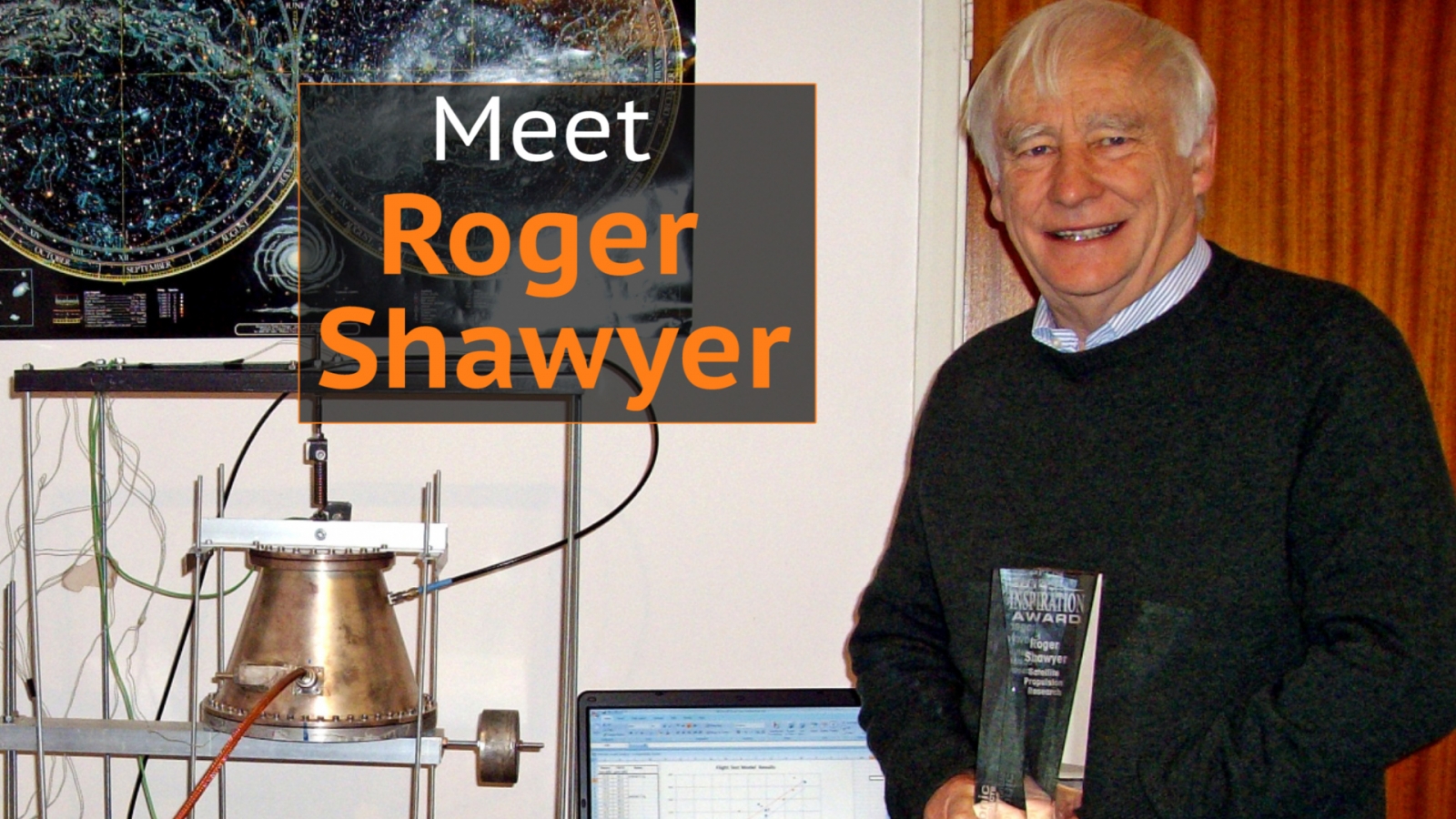
 

Meet Roger Shawyer
EmDrive Exclusive: Roger Shawyer confirms MoD and DoD are interested in controversial space propulsion tech IBTimes UK



British EmDrive inventor Roger Shawyer has had his latest patent application for a next-generation superconducting thruster published by the UK Intellectual Property Office (IPO), showing that his development of the controversial space propulsion technology is going ahead.

The patent, available here, describes a thruster that features a single flat superconducting plate on one end, while the other end is a unique shaped plate that is non-superconducting.

In order to minimise the internal Doppler shift (the change in frequency or wavelength of a wave for an observer moving relative to its source), circular polarisation and a phase-locked loop control the microwave input to the thruster, which maximises thrust as it accelerates.

Shawyer told IBTimes UK that he submitted the patent for the next-generation microwave thrusters 18 months ago, and that the patent is significant as it is currently very difficult – not to mention expensive – to produce a shaped non-superconducting end plate, since it has to be mounted on a sapphire substrate.

"This is pretty significant because it enables you to easily manufacture these things, and we want to produce thousands of them," he said. "The patent makes the construction of a viable superconducting thruster easier, and it will produce a lot of thrust."

See http://www.ibtimes.co.uk/videos/embed/21144

2016: A big year for EmDrive
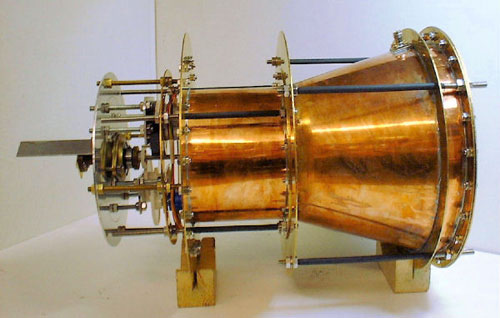
 

The EmDrive created by Shawyer's SPR Ltd
The EmDrive created by Shawyer's space company Satellite Propulsion Research LtdRoger Shawyer, Satellite Propulsion Research Ltd


How the EmDrive works

The EmDrive is the invention of British scientist Roger Shawyer, who proposed in 1999 that based on the theory of special relativity, electricity converted into microwaves and fired within a truncated cone-shaped closed metal cavity causes the microwave particles to exert more force on the flat surface at the large end of the cone (i.e. there is less combined particle momentum at the narrow end due to a reduction in group particle velocity), thereby generating thrust.

His critics say that according to the law of conservation of momentum, his theory cannot work as in order for a thruster to gain momentum in one direction, a propellant must be expelled in the opposite direction, and the EmDrive is a closed system.

However, Shawyer claims that following fundamental physics involving the theory of special relativity, the EmDrive does in fact preserve the law of conservation of momentum and energy.

Whether the technology actually works, there is no denying that 2016 has been a big year for the EmDrive. In mid-September, a respected space propulsion funding body in the US held a conference that included half a day dedicated to discussions about the EmDrive, led by a number of physicists, engineers and researchers.

Just before this, the American Institute of Aeronautics and Astronautics (AIAA) confirmed that it had peer-reviewed and accepted a paper on the EmDrive by Nasa Eagleworks researchers, which will be published in December 2016.

The researchers first posted on the Nasa Spaceflight forum in April 2015 and in November said they had succeeded in achieving thrust with the microwave thruster they built, although they didn't know how. In March, the researchers claimed that the paper was going through peer review, although they didn't know when it would be published.

There has been a great deal of debate over whether the EmDrive actually works. Many academics in the international space community continue to believe that it is complete nonsense, as the technology violates the law of conservation of momentum, and thus our understanding of physics.

In the meantime, Roger Shawyer, the British engineer/scientist who invented the EmDrive concept in 1999, is working with an unnamed UK aerospace company to develop the second generation of EmDrive, which will produce thrust many orders of magnitude greater than that observed by Eagleworks or any other laboratory.


Millions of pounds at stake on this patent
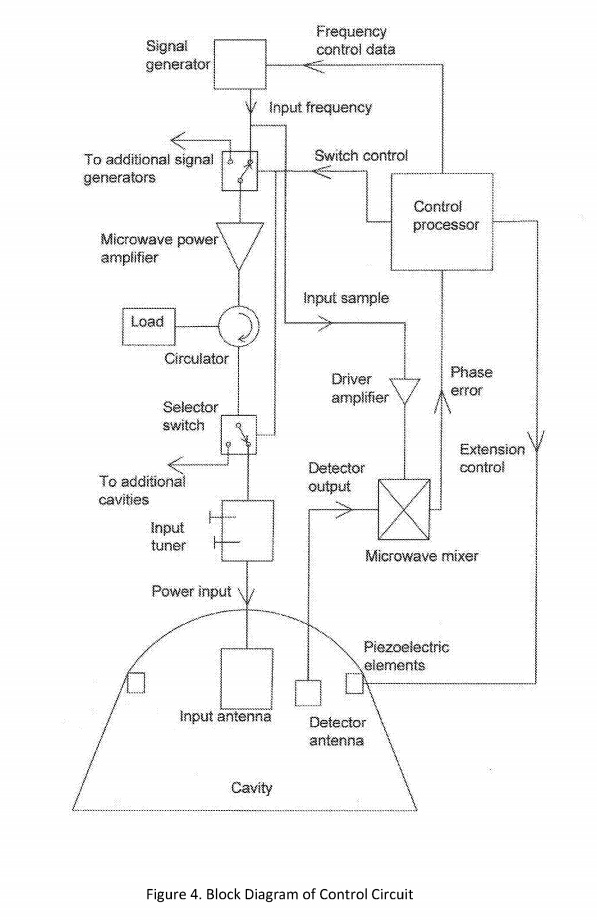
 

EmDrive patent diagram


A diagram explaining the control circuit within Roger Shawyer's second generation superconducting thrusterUK Intellectual Property Office


"The patent process is a very significant process, it's not like an academic peer review where everyone hides behind an anonymous review, it's all out in the open. This is a proper professional way of establishing prior ownership done by professionals in the patent office, and in order to publish my patent application, they had to first carry out a thorough examination of the physics in order to establish that the invention does not contravene the laws of physics," stressed Shawyer.

"There's millions of pounds at stake on this particular patent."

Shawyer has so far had four patents granted by the IPO – the first, GB2229865, was granted on 5 May 1993 and described the basic theory and construction of a cylindrical thruster with a shaped internal dielectric.

The second, GB2334761, granted on 21 March 2000, described the theory and construction of a tapered thruster with a cylindrical dielectric. This is essentially the same basic idea behind the NASA Eagleworks thruster that has been undergoing tests over the last two years.

The third patent, GB2399601, was granted on 13 March 2003, describing a second-generation EmDrive that uses no dielectric and employs superconducting technology to achieve high thrust.

Shawyer also has another patent still undergoing the patent review process – on 6 February 2013, the patent GB2493361 was published by the IPO, describing a thruster that uses shaped end plates and superconducting technology as a means of controlling the microwave input to maintain thrust under acceleration.


Nassikas Reactionless Lorentz Thruster Project - Dr. Paul LaViolette


For more information about the Cannae drive see http://nexusilluminati.blogspot.com/search/label/cannae%20drive  
For more information about electromagnetic propulsion see http://nexusilluminati.blogspot.com/search/label/electromagnetic%20propulsion
- Scroll down through ‘Older Posts’ at the end of each section


Do you LIKE this uniquely informative site?
A genuinely incapacitated invalid maintains, writes, edits, researches, illustrates, moderates and publishes this website from a tiny cabin in a remote forest.
Now that most people use ad blockers and view these posts on phones and other mobile devices, sites like this earn an ever shrinking pittance from advertising sponsorship.
This site needs your help.
Like what you see? Please give anything you can -  
Contribute any amount and receive at least one New Illuminati eBook!
(You can use a card securely if you don’t use Paypal)
Please click below -


And it costs nothing to share this post on Social Media!
Dare to care and share - YOU are our only advertisement!


For further enlightening information enter a word or phrase into the random synchronistic search box @ the top left of http://nexusilluminati.blogspot.com


And see


 New Illuminati on Facebook - https://www.facebook.com/the.new.illuminati

New Illuminati Youtube Channel -  https://www.youtube.com/user/newilluminati/playlists

New Illuminati’s OWN Youtube Videos -  
New Illuminati on Google+ @ For New Illuminati posts - https://plus.google.com/u/0/+RamAyana0/posts

New Illuminati on Twitter @ www.twitter.com/new_illuminati


New Illuminations –Art(icles) by R. Ayana @ http://newilluminations.blogspot.com

The Her(m)etic Hermit - http://hermetic.blog.com


DISGRUNTLED SITE ADMINS PLEASE NOTE –
We provide a live link to your original material on your site (and links via social networking services) - which raises your ranking on search engines and helps spread your info further!

This site is published under Creative Commons (Attribution) CopyRIGHT (unless an individual article or other item is declared otherwise by the copyright holder). Reproduction for non-profit use is permitted & encouraged - if you give attribution to the work & author and include all links in the original (along with this or a similar notice).

Feel free to make non-commercial hard (printed) or software copies or mirror sites - you never know how long something will stay glued to the web – but remember attribution!

If you like what you see, please send a donation (no amount is too small or too large) or leave a comment – and thanks for reading this far…

Live long and prosper! Together we can create the best of all possible worlds…


From the New Illuminati – http://nexusilluminati.blogspot.com

Saturday, 23 August 2014

Nasa Validates 'Impossible' Space Drive

NASA Validates 'Impossible' Space Drive


NASA is a major player in space science, so when a team from the agency this week presents evidence that "impossible" microwave thrusters seem to work, something strange is definitely going on. Either the results are completely wrong, or NASA has confirmed a major breakthrough in space propulsion.

British scientist Roger Shawyer has been trying to interest people in his EmDrive for some years through his company SPR Ltd. Shawyer claims the EmDrive converts electric power into thrust, without the need for any propellant by bouncing microwaves around in a closed container. He has built a number of demonstration systems, but critics reject his relativity-based theory and insist that, according to the law of conservation of momentum, it cannot work.

According to good scientific practice, an independent third party needed to replicate Shawyer's results. As Wired.co.uk reported, this happened last year when a Chinese team built its own EmDrive and confirmed that it produced 720 mN (about 72 grams) of thrust, enough for a practical satellite thruster. Such a thruster could be powered by solar electricity, eliminating the need for the supply of propellant that occupies up to half the launch mass of many satellites. The Chinese work attracted little attention; it seems that nobody in the West believed in it.

However, a US scientist, Guido Fetta, has built his own propellant-less microwave thruster, and managed to persuade NASA to test it out. The test results were presented on July 30 at the 50th Joint Propulsion Conference in Cleveland, Ohio. Astonishingly enough, they are positive.

The NASA team based at the Johnson Space Centre gave its paper the title "Anomalous Thrust Production from an RF [radio frequency] Test Device Measured on a Low-Thrust Torsion Pendulum". The five researchers spent six days setting up test equipment followed by two days of experiments with various configurations. These tests included using a "null drive" similar to the live version but modified so it would not work, and using a device which would produce the same load on the apparatus to establish whether the effect might be produced by some effect unrelated to the actual drive. They also turned the drive around the other way to check whether that had any effect.

Back in the 90s, NASA tested what was claimed to be an antigravity device based on spinning superconducting discs. That was reported to give good test results, until researchers realised that interference from the device was affecting their measuring instruments. They have probably learned a lot since then.

The torsion balance they used to test the thrust was sensitive enough to detect a thrust of less than ten micronewtons, but the drive actually produced 30 to 50 micronewtons -- less than a thousandth of the Chinese results, but emphatically a positive result, in spite of the law of conservation of momentum:

"Test results indicate that the RF resonant cavity thruster design, which is unique as an electric propulsion device, is producing a force that is not attributable to any classical electromagnetic phenomenon and therefore is potentially demonstrating an interaction with the quantum vacuum virtual plasma."

This last line implies that the drive may work by pushing against the ghostly cloud of particles and anti-particles that are constantly popping into being and disappearing again in empty space. But the NASA team has avoided trying to explain its results in favour of simply reporting what it found: "This paper will not address the physics of the quantum vacuum plasma thruster, but instead will describe the test integration, test operations, and the results obtained from the test campaign."

The drive's inventor, Guido Fetta calls it the "Cannae Drive", which he explains as a reference to the Battle of Cannae in which Hannibal decisively defeated a much stronger Roman army: you're at your best when you are in a tight corner. However, it's hard not to suspect that Star Trek's Engineer Scott -- "I cannae change the laws of physics" -- might also be an influence. (It was formerly known as the Q-Drive.)

Fetta also presented a paper at AIAA on his drive, "Numerical and Experimental Results for a Novel Propulsion Technology Requiring no On-Board Propellant". His underlying theory is very different to that of the EmDrive, but like Shawyer he has spent years trying to persuade sceptics simply to look at it. He seems to have succeeded at last.

Shawyer himself, who sent test examples of the EmDrive to the US in 2009, sees the similarity between the two.

"From what I understand of the Nasa and Cannae work -- their RF thruster actually operates along similar lines to EmDrive, except that the asymmetric force derives from a reduced reflection coefficient at one end plate," he says. He believes the design accounts for the Cannae Drive's comparatively low thrust: "Of course this degrades the Q and hence the specific thrust that can be obtained."

Fetta is working on a number of projects which he is not able to discuss at present, and Nasa's PR team was not able to get any comments from the research team. However, it's fair to assume that the results will be picked over very closely indeed, like CERN's anomalous faster-than-light neutrinos. The neutrino issue was cleared up fairly quickly, but given that this appears to be at least the third independent propellant-less thruster to work in tests, the anomalous thrust may prove much harder to explain away.

A working microwave thruster would radically cut the cost of satellites and space stations and extend their working life, drive deep-space missions, and take astronauts to Mars in weeks rather than months. In hindsight, it may turn out to be another great British invention that someone else turned into a success.


EmDrive: China's radical new space drive


Shutterstock


Scientists in China have built and tested a radical new space drive. Although the thrust it produces may not be enough to lift your mobile phone, it looks like it could radically change the satellite industry. Satellites are just the start: with superconducting components, this technology could generate the thrust to drive everything from deep space probes to flying cars. And it all started with a British engineer whose invention was ignored and ridiculed in his home country.

The latest research comes from a team headed by Yang Juan, Professor of Propulsion Theory and Engineering of Aeronautics and Astronautics at the Northwestern Polytechnic University in Xi'an. Titled "Net thrust measurement of propellantless microwave thruster," it was published last year in the academic journal Acta Physica Sinica, now translated into English.

The technology is controversial because of that key word "propellantless". Space drives rely on Newton's laws of motion: all are based on the principle of firing propellant out the back at high speed, pushing the spacecraft forward. Even with endless power from solar cells, thrust is still limited by the supply of propellant, even with high-velocity ion drives. Numerous attempts have been made to overcome this, from the infamous Dean Drive of the 1950's to Nasa's experiments with antigravity from spinning superconductors in the 1990's. All have failed, and the efforts of pseudoscientific cranks and scammers have left the field thoroughly discredited.

British engineer Roger Shaywer stepped into this dangerous field in 2001, after twenty years with European satellite firm EADS Astrium. He set up his own company, Satellite Propulsion Research (SPR) Ltd, with the aid of a modest grant from the UK's Department of Trade and Industry.

Shawyer aimed to develop an EmDrive: a closed, conical container which, when filled with resonating microwaves, experiences a net thrust towards the wide end. It seems to violate of the law of conservation of momentum, implied by Newton, which says that no closed system can have a net thrust. However, Shawyer says net thrust occurs because the microwaves have a group velocity which is greater in one direction than the other and Einstein's relativity comes into play. Group velocity, the speed of a collection of electromagnetic waves, is a tricky business -- a pulse of light can even have a group velocity which is greater than the speed of light -- but can it really cause net thrust?

Shawyer built a demonstration thruster to test the theory in 2003. The thrust was tiny -- 16 mN, equal to the weight of a couple of peanuts -- but enough to validate the concept. However, sceptics were quick to attack. None of them actually inspected the apparatus, but Shawyer was assailed from all sides online and in the science press. Criticism was unsophisticated: Newton said it was impossible, therefore he must be a fraud. Even the most advanced theoretical critique, produced by John Costella, a PhD in relativistic electrodynamics, amounted to arguing about the direction of an arrow on one of Shawyer's diagrams.

Shawyer continued to produce and test more advanced demonstrators, working out elaborate ways of ensuring that the test results are valid and not the result of air currents, friction, ionization, interference or electromagnetic effects.

Such effects can easily ruin experiments where small forces are involved. The Nasa investigation into supposed antigravity eventually found that the apparatus was actually causing electronic interference within the measuring system and producing false readings rather than negating the Earth's pull.

Boeing's Phantom Works, which works on various classified projects and has been involved in space research, went as far as acquiring and testing the EmDrive, but say they are no longer working with Shawyer.

In 2007 the Russian Research Institute of Space Systems launched an experimental micro-satellite called Yubileiny (Jubilee) with a "non-traditional" engine which, according to Director Valery Mesnshikov, functions without ejecting reaction mass. However, it was later stated that "further developments" were needed and nothing further appears to be been published on Russian reactionless drives.

Meanwhile, the EmDrive was picked up by Yang at Xi'an, who has a background in space propulsion systems.

The Chinese team took a cautious approach. They started with a new analysis in terms of quantum theory in 2008 which indicated that the theoretical basis was sound and net thrust is possible. The next paper in 2010 quantified the amount of thrust that could be produced, and stated that the team was getting positive experimental results. The latest paper describes their latest thruster and gives the test results in details, showing that with a couple of kilowatts of power they can produce 720 mN (about 72 grams) of thrust.

It may not sound very much, less than three ounces, but in space a little thrust goes a long way. Boeing's advanced XIPS thruster, which fires out Xenon ions at high speed, generates less than a quarter as much thrust from twice as much power. It's used to maintain satellites in position, or move them to a slightly different orbit. Crucially, Xips weights about twenty kilos, more than an equivalent EmDrive, and the propellant for prolonged operation can weigh much more.

Propellant can account for as much as half the launch weight of a geostationary satellite. This means that, in principle, fitting one with an EmDrive rather than a conventional drive, could halve launch costs. Shawyer notes that EmDrives no more powerful than the Chinese one could keep the International Space Station in position without the need for costly refueling.

Meanwhile, Shawyer is moving on to bigger plans. The amount of thrust produced by an EmDrive is determined by the Q value of the cavity, which measures how well it resonates. A tuning fork has a high Q value in air; put it in treacle and it is damped and does not resonate so well. By using superconducting apparatus, Shawyer says that the Q value, and hence thrust, can be boosted by a factor of several thousand -- producing perhaps a tonne of thrust per kilowatt of power. Suddenly it's not about giving a satellite a slight nudge, it's about launching spacecraft. 

Shawyer estimates that the prototype superconducting thruster could be ready in 2016. Even the most hardened sceptic would find it hard to ignore a thruster capable of levitating itself in the air. However, the EmDrive cannot violate the law of conservation of energy. It can exert force, but accelerating a vehicle over a distance still requires a huge amount of power, and ultimately it still needs a big power supply. Personal EmDrive jetpacks are unlikely, but Shawyer has plans for a deep space propulsion unit, an EmDrive-assisted spaceplane capable of taking off from a runway and travelling to Australia in three hours -- and a personal air vehicle the size of a car.

However, aerospace companies are not in a hurry to do business with Shawyer, and he will not be able to build the superconducting thruster without funding.

Yang's experimental work is continuing; she says she is not able to discuss her work until more results are published this year. There is also the tantalising prospect of a demonstration at an aerospace conference. This might make the EmDrive hard to ignore and force a showdown with skeptics. So far the reaction in the west to Yang's work has been muted -- perhaps polite disbelief would be the best description. 2013 may change all that.


From Wired @ http://www.wired.co.uk/news/archive/2014-07/31/nasa-validates-impossible-space-drive and http://www.wired.co.uk/news/archive/2013-02/06/emdrive-and-cold-fusion


For more information about antigravity see http://nexusilluminati.blogspot.com/search/label/antigravity
- Scroll down through ‘Older Posts’ at the end of each section


Hope you like this not for profit site -
It takes hours of work every day to maintain, write, edit, research, illustrate and publish this website from a tiny cabin in a remote forest
Like what we do? Please give enough for a meal or drink if you can -  
Donate any amount and receive at least one New Illuminati eBook!
Please click below -


For further enlightening information enter a word or phrase into the random synchronistic search box @ http://nexusilluminati.blogspot.com


And see


 New Illuminati on Facebook - https://www.facebook.com/the.new.illuminati

New Illuminati Youtube Channel - http://www.youtube.com/user/newilluminati/feed


New Illuminati on Twitter @ www.twitter.com/new_illuminati


New Illuminations –Art(icles) by R. Ayana @ http://newilluminations.blogspot.com

The Her(m)etic Hermit - http://hermetic.blog.com


The Prince of Centraxis - http://centraxis.blogspot.com (Be Aware! This link leads to implicate & xplicit concepts & images!)


DISGRUNTLED SITE ADMINS PLEASE NOTE –
We provide a live link to your original material on your site (and links via social networking services) - which raises your ranking on search engines and helps spread your info further! This site is published under Creative Commons Fair Use Copyright (unless an individual article or other item is declared otherwise by the copyright holder) – reproduction for non-profit use is permitted & encouraged, if you give attribution to the work & author - and please include a (preferably active) link to the original (along with this or a similar notice).

Feel free to make non-commercial hard (printed) or software copies or mirror sites - you never know how long something will stay glued to the web – but remember attribution! If you like what you see, please send a donation (no amount is too small or too large) or leave a comment – and thanks for reading this far…

Live long and prosper! Together we can create the best of all possible worlds…


From the New Illuminati – http://nexusilluminati.blogspot.com